R E S E A R C H
Open Access
Study on multi-channel mesh deterministic
access for wireless mesh LAN
Bih-Hwang Lee
1*, Hung-Chi Chien
1and Jhih-Ming Chen
2Abstract
IEEE802.11s draft proposes a new medium access control (MAC) function-mesh deterministic access (MDA), which is mainly used for single-channel wireless mesh local area network (LAN). In single-channel environment, collisions between control packets and data packets may occur very often. In order to provide higher performance and network capacity for wireless mesh LAN, this article develops an algorithm for MDA to work well on multi-channel wireless mesh LAN. To reduce the hardware requirements in design, a mesh point (MP) only equips single transceiver to support multi-channel environment. To completely avoid the collision between control packets and data packets, the interval of the meshed delivery traffic indication message is first divided into contention period and data transmission period. We newly define a neighbor MP status table for MPs to support multi-channel environment. The mechanism of reserving MDA opportunity (MDAOP) adopts the four-way-handshaking mode to reduce hidden node problem; we propose channel load first random fit and multi-channel best fit mechanisms to select MDAOP. We also propose a multi-channel MDA (MMDA) algorithm to improve the overall performance of wireless mesh LAN in multi-channel environment. The theoretical analysis gives the upper limit of the throughput for MMDA. The simulation experiments clearly show the results in multi-channel wireless mesh LAN environment that MMDA performs better than the enhanced distributed channel access in throughput, average waiting time, and packet drop ratio both in the saturated and non-saturated mode.
Keywords:IEEE802.11s, medium access control (MAC), mesh deterministic access (MDA), wireless mesh LAN
Introduction
With the popularity of wireless local area network (LAN) , it is inevitable to increase the network coverage. As outdoor wiring is not easy, the multi-hop technology of wireless mesh network becomes more important. IEEE802.11s working group aims to build the wireless mesh network standard. IEEE802.11s draft [1] provides a distributed network environment, so that each node can do self-configuration with the surrounding environment and does not need a service provider. In IEEE802.11s draft, the medium access control (MAC) protocol has great influence for wireless LAN performance [2] and it follows the enhanced distributed channel access (EDCA) of the original IEEE802.11e [3], containing congestion control [4], power saving [5], synchronization [6,7], and beacon collision avoidance [8]. In addition, IEEE802.11s
draft itself also defines a new MAC function-mesh deter-ministic access (MDA) to improve the performance of wireless mesh LAN.
In the recent IEEE802.11s researches, most literatures focus on the routing and gateway selection. In the rout-ing area, IEEE802.11s draft proposes a hybrid wireless mesh protocol to provide on-demand and proactive routing modes [9-11]. The VoIP performances of several different routing mechanisms in wireless mesh LAN’s are compared [12]. Some routing methods have also been proposed, like the multi-metric ad-hoc on-demand distance vector routing methods [13], the mechanism of supporting mobility path management [14], the com-bined routing and traffic shaping decisions to enhance the efficiency of the distributed coordination function (DCF) [15]. Neishaboori and Kesidis [16] use the link/ load-sensitive metric for routing, while Lee et al. [17] propose a new routing protocol to select high through-put paths based on channel diversity information and re-duce the broadcast overhead of control messages. In the * Correspondence:[email protected]
1
National Taiwan University of Science and Technology, 43, Keelung Rd., Section 4, Taipei 106, Taiwan
Full list of author information is available at the end of the article
gateway selection, a gateway selection mechanism is pro-posed to reduce the occurrence of broadcast loop by connecting the external network [18], while Ashraf et al. [19] combine the gateway load, route interference, and route quality as the basis for selecting the gateway.
According to the studies [20,21], using multi-channel architecture is more effective than single-channel archi-tecture to enhance performance and reduce collision probability in IEEE802.11 network, but the researches for the IEEE802.11s MAC enhancement are relatively fewer and mainly discuss on the single-channel MAC protocol design. For example, in order to improve the utilization of transmission media, Nandiraju et. al. [22] propose a queue management scheme for multi-hop net-works to increase the fairness of multi-hop flows using available buffer. Ranjitkar and Ko [23] propose an ag-gressive block acknowledge (ACK) scheme to improve the performance of 802.11s mesh network. Vishnevsky et al. [24] make beacons responsible to support MDA for delay-sensitive multimedia applications. Based on MDA, Chen and Emeott [25] develop a scheduled mesh access (SMA) mechanism, which has better anti-interference ability than EDCA. Finally, this article pro-poses a multi-channel single-transceiver MAC protocol called multi-channel MDA (MMDA) algorithm to fur-ther enhance the overall performance of wireless mesh LAN.
This article is organized as follows. The next section is to describe the proposed MMDA algorithm. “MMDA analysis in throughput” section describes the MMDA throughput analysis and “Simulation experiments” sec-tion shows the simulasec-tion results. Finally, the article ends with some conclusions.
Description of the proposed MMDA algorithm
In the original MDA, a mesh delivery traffic indication message (DTIM) interval is defined between two con-secutive beacon frames. According to IEEE802.11s draft, the slot size of mesh DTIM interval is set to 32 μs, in which a mesh point (MP) can reserve MDA opportunity (MDAOP) to transmit data. An MDAOP can be used by MP periodically until an MP finishes transmission and releases it. MDA is established by using two control packets: MDA Setup Request and MDA Setup Reply.
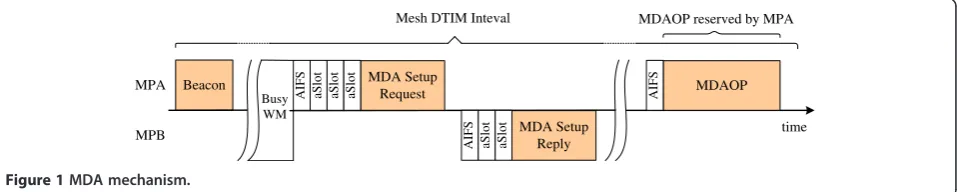
Figure 1 shows the operation of MDA mechanism. Be-fore the source MP transmits data, it sends an MDA Setup Requestpacket to the destination MP for request-ing MDAOP setup. The destination MP will reply an MDA Setup Reply packet to the source MP if it can sat-isfy the request of MDAOP setup, i.e., MDA mechanism is completed and the source MP can periodically use MDAOP to transmit data. However, in IEEE802.11s draft, not every MP in wireless mesh LAN supports MDA mechanism.
Mesh DTIM interval architecture
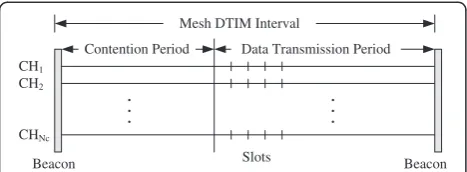
In MMDA algorithm, we further split mesh DTIM inter-val into contention period (CP) and data transmission period (DTP) as shown in Figure 2. In CP, MPs use con-tention mechanism for reserving MDAOP, and DTP lets the successful MP to establish MDAOP at the selected channel to transmit data, which is to make sure that control packets and data packets can be transmitted in different intervals and avoid the collisions between them. Because MMDA algorithm allows an MP only equips a single transceiver in wireless mesh LAN, only a channel (i.e., CH1) is listened by all MPs in CP; then MPs know the channel information in DTP, but CH1can be used to transmit data in DTP. The maximum size of an MDAOP to be reserved in DTP is 4096 μs (or 128 slots), which can be used by MP periodically at the same location of each DTP in the following mesh DTIM interval.
In order to make MPs achieve timing synchronization in wireless mesh LAN, we use the IEEE802.11 ad-hoc timing synchronization mechanism, because MMDA al-gorithm uses the new defined mesh DTIM interval architecture. An MP sends beacon in accordance with the principles of DCF at the beginning of each beacon interval; the other MPs will cease sending beacon if any MP sends beacon successfully; then the MPs will take the timestamp value in beacon. This article also requires that each MP must build a neighbor MP status table (NMST) to make sure that MPs know their neigh-bor MPs’ status and the channel state information, in-cluding MP ID (identification), the channel ID currently used by MP, offset from MDAOP’s starting position to the beginning of subinterval, duration of MDAOP, peri-odicity (i.e., the number of MDAOPs in DTP). For
Beacon
MDA Setup Reply
Busy WM
aSlot
AIFS aSlo
t
MPA
MPB
Mesh DTIM Inteval MDAOP reserved by MPA
time MDA Setup
Request
aSlot
AIFS aSlot aSlot AIFS MDAOP
example, if periodicity is equal to 4, it means that DTP are divided into four subintervals, while the four MDAOPs are located in the same distance from the be-ginning of these four subintervals. We also need to modify MDAOP reservation element, because the MDAOP reservation element of the original MDA con-trol packet is designed for single-channel environment. Therefore, it is necessary to add a newChannel IDfield into MDAOP reservation element to support the oper-ation of multi-channel environment.
Four-way-handshaking mechanism for MMDA algorithm Similarly as the original IEEE802.11 ad-hoc networks, wireless mesh LAN also has hidden node problem [26]. In order to effectively solve this problem, MMDA algo-rithm uses four-way-handshaking mechanism instead of two-way-handshaking mechanism in the original MDA. In other words, MMDA uses four control packets, in-cluding MDA Setup Request, MDA Setup Reply, MDA ACK(acknowledge), and MDA ADV (advertisement), to reserve MDAOP, where MDA ACK and MDA ADVare newly defined in this article. When an MP has data to transmit, it needs to decide the size of MDAOP used in DTP to obtain the required bandwidth shown as Equa-tion (1), where Trans_Data_Size and Channel_Trans_ Rateare the transmitted data size and channel transmis-sion rate, respectively.
Slot NumbersMDAOP¼
Trans Data Size32μs Channel Trans Rate
ð1Þ When an MP establishes MDAOP, it uses two extra slots for guard slots, one in front and another one in back of its own MDAOP, to avoid being affected by the delay or incomplete synchronization of the other MDAOPs; the MDAOP duration can be obtained by Equation (2). Because the source MP can know which duration in every channel currently being used, accord-ing to channel ID, offset, duration, and periodicity of each MP in NMST. After the source MP determines MDAOP duration, it can find the suitable location and duration for its own MDAOP and determine its own MDAOP’s channel ID, offset, duration, and periodicity
to be capsulated into the MDA Setup Request packet which will be sent to its target MP. Before MP sends the MDA Setup Request packet in CP, it uses backoff algo-rithm according to CSMA/CA mechanism defined by IEEE802.11 standard [27]. After waiting for a random time, the source MP sends the MDA Setup Request packet to its target MP successfully.
DurationMDAOP ¼Slot NumbersMDAOPþ2 ð2Þ After the target MP receives the MDA Setup Request packet, it copies the same information (channel ID, off-set, duration, and periodicity) to an MDA Setup Reply packet and sends back to its source MP if it can satisfy the requirements of the source MP. When the source MP receives the MDA Setup Reply packet, it waits an additional short inter-frame space (SIFS) time and sends back an MDA ACK packet to the target MP to confirm the MDAOP setup. The neighbor MPs of the source MP update the content of NMST after overhearing theMDA ACKpacket. The target MP needs to reply anMDA Adv packet to inform the source MP that the MDAOP setup is successful, when the target MP receives the MDA ACK packet; then the neighbor MPs of the target MP update the content of NMST by overhearing the MDA Adv packet. After finishing the four-way-handshaking mechanism, MDAOP is completely established; then MDAOP can be used to transmit data periodically in DTP. The details of the MMDA four-way-handshaking mechanism can be found in Figure 3. Conversely, the target MP may select another MDAOP (including chan-nel ID, offset, duration, and periodicity) according to its own NMST if it cannot satisfy the requirements of the source MP. The information of new MDAOP will be put into an MDA Setup Reply packet and sends back to its source MP. The source MP sends an MDA ACKpacket back to the target MP if it agrees the new MDAOP. Otherwise, the source MP does not send theMDA ACK packet back to the target MP if it disagrees. The target MP knows the setup of the new MDAOP fails if it does not receive the MDA ACK packet within a period of time.
After completing the MMDA four-way-handshaking mechanism, the MDAOP owner just needs to wait an SIFS time to access its own MDAOP, i.e., the MDAOP owner has higher priority to access the MDAOP and avoids the interference from the other MPs. The MDAOP setup may fail if any one of four control packets is collided, damaged, or lost in transmission, i.e., MP needs to restart the MMDA four-way-handshaking mechanism. In addition, the MMDA four-way-handshaking mechan-ism should be completed before the end of CP, otherwise it fails. An MP may restart to reserve MDAOP until the next CP of the mesh DTIM interval. This article allows an Beacon
CH1 CH2
CHNc
Slots
.
.
.
Beacon
.
.
.
Mesh DTIM Interval
Contention Period Data Transmission Period
MP to reserve different MDAOPs to transmit data on the same channel or different channels in DTP, if MP needs more than one MDAOP to meet the transmission request. However, the MDAOPs on different channels cannot be overlapped in time, and the MP should complete the cor-responding MMDA four-way-handshaking mechanisms for these MDAOPs. Figure 4 shows an example of mul-tiple MDAOPs used by MPA on different channels in DTP and Table 1 shows the NMST content corresponding to Figure 4.
If an MP wants to send data to a destination MP, the steps of MMDA algorithm can be summarized as follows:
Step1: To check NMST to find available durations to satisfy the required size of MDAOP in every channel. Step2: To select the position of these durations to establish MDAOP.
Step3: To start four-way-handshaking mechanism in CP.
Step4: To start transmission in the MDAOP on the selected channel in DTP after the completion of four-way-handshaking mechanism.
Step5: To use the established MDAOP to periodically send data to the destination MP.
MDAOP selection mechanism for MMDA algorithm An MP is called non-MDA-MP (NMP) if it does not support MDA mechanism; conversely an MP is called MMP if it supports MDA mechanism. An NMP may oc-cupy other MP’s MDAOP, because it arbitrarily selects duration on the channel and does not know the distribu-tion of MDAOPs on the channel. An MMP must wait
until NMP finishing transmission; therefore, an MP can only transmit data in the remaining MDAOP duration, which degrades the throughput of MP. Furthermore, the MP’s MDAOP may fully be occupied by NMP in the worst case and make the MP be unable to transmit any data in its own MDAOP. In order to avoid the afore-mentioned situation, NMP also needs NMST and listens the control packets on CH1 in CP, so NMP knows the distribution of MDAOPs and obtains the channel state information. However, NMP still has to use the pro-posed four-way-handshaking mechanism to obtain the time slots on CH1 in CP, and then NMP can use the time slots to transmit data in DTP.
By using NMST, NMP can avoid selecting other MMP’s MDAOP, but MMP still records the information of the received NMP’s control packets into its NMST, including NMP’s channel ID, offset, and duration, but the MDA-support field is marked as 0, where duration here means the slot number used for NMP to transmit data. The information will be removed from NMST after the end of mesh DTIM interval, which means NMP has released the time slots.
When a source MMP wants to create MDAOP to send data to its target MMP, it first gets the channel state in-formation according to its own NMST and avoids select-ing the MDAOPs used by other MPs. Different MDAOP selection mechanism may affect the performance of wireless mesh LAN. Cicconetti et al. [28] propose two MDAOP selection mechanism: random fit and best fit, while these two mechanisms only apply to single-channel network structure but not multi-single-channel net-work structure. We want to improve these two mechan-isms to work on multi-channel wireless mesh LAN; therefore, MMDA algorithm also have two MDAOP se-lection mechanisms: channel load first random fit (CLFRF) and multi-channel best fit (MCBF).
MDA Setup Request
MDA Setup Reply
MDA ACK
MDA Adv
MDAOP
Contention Period (at CH1)
Data Transmission Period (at selected CH)
MDA control packet sent by source MP MDA control packet sent by destination MP
Figure 3MMDA four-way-handshaking mechanism.
CH 4
CH 5
MDAOPs used by MPA
10 20 30 40 50 60 70 80 90 100 110 120 10 20 30 40 50 60 70 80 90 100 110 120
Figure 4MDAOPs used by MPA on different channels in DTP.
Table 1 NMST records the corresponding information of MDAOPs in Figure 4
MP ID Channel ID Offset Duration Periodicity MDA-support
MPA 4 10 20 1 1
MPA 5 40 20 1 1
CLFRF mechanism
The CLFRF mechanism is to randomly select duration from the lightest loading channel for MDAOP reserva-tion, which has the advantage of simple and no more complex operation. The main purpose of CLFRF is to balance the channel load among all channels and avoid some channels always at overload situation to degrade throughput. First MP can obtain a channel having the lightest loading (e.g., channel r) according to its own NMST in multi-channel wireless mesh LAN. Let x be the size of MDAOP and Ar│x be the subset of free locations large enough to contain an MDAOP of dur-ation x on channel r, as shown in Equation (3), where
〈di,oi〉 means the ith free location that di is the dur-ation of contiguous slots and oi is the offset from this location’s starting position to the beginning of sub-interval. Then MP randomly selects the location 〈drnd, ornd〉 among this subset to establish MDAOP, shown in Equation (4).
Arjx¼fdi;oi∈Arjdi≥xg ð3Þ
〈drnd;ornd〉¼randomf〈di;oi〉∈Arjxg ð4Þ
MCBF mechanism
The goal of the MCBF mechanism is to find the best fit location from all channels to build the requested MDAOP, i.e., MCBF is to select the minimum duration from these durations, hence the advantage of MCBF is to minimize the remaining space after building MDAOP and to avoid causing a large fragmentation. First MMP finds out the subset Ac|x having free locations large enough to contain an MDAOP of durationxon channel c, shown in Equation (5), then it finds the minimum free location of each channel to meet the requested MDAOP. Let us denote〈dbestc;obestc〉be the minimum free location
on channelcto contain an MDAOP of durationx. Then we can get the minimum free locations for all channels, respectively, from CH1to CHNc. Finally, MP selects the smallest duration among these minimum free locations, where 〈dbest,obest〉 is the best fit location for MDAOP, shown in Equation (6).
〈dbestc;obestc〉¼ arg min
〈di;oi〉∈Acjx
dix
f g ð5Þ
〈dbest;obest〉¼minfhdbest1;obest1i;hdbest2;obest2i;. . .; dbestN c;obestN c
ð6Þ
MDAOP teardown and relocation mechanisms for MMDA algorithm
The source MMP must release the occupied MDAOP when it completes transmitting data. Before sending teardown packet, the source MMP will enter the backoff
mechanism at the beginning of CP. After backoff mech-anism finished, the source MMP sends a teardown packet to the destination MMP for releasing the occu-pied MDAOP. The neighbor MMPs of the source MMP will update NMST and release the occupied time slots of the MDAOP. After receiving the tear-down packet, the destination MP needs to forward it to its neighbor MMPs to release the occupied time slots of the MDAOP as well. Because the original tear-down packet is designed for single-channel environ-ment, it is not applied to our MMDA algorithm. Therefore, we add the new Channel ID field into the format of the teardown packet to support the oper-ation of multi-channel environment.
When an MMP wants to establish MDAOP, it may find according to NMST that all of the remaining dura-tions on each channel cannot meet the MDAOP size. However, after checking NMST, we will find that some channels’ total remaining time slots can meet the MDAOP, which is caused by serious fragmentation on every channel. To avoid the waste of channel space, we use MDAOP relocation mechanism to deal with. How-ever, to avoid too complex relocation action, resulting in too many MDAOPs to be moved, we hope to move only one MDAOP to solve this problem instead.
First MP will choose the lightest load channel accord-ing to NMST; MP knows the distribution of MDAOPs on the channel, and further finds out the MDAOP hav-ing enough front and back time slots to meet the MP’s own MDAOP size. MP will send an MDAOP relocation request packet to the owner of the MDAOP in the next CP of mesh DTIM interval, if the MDAOP meet the requirements. The requested MP will reply an MDAOP relocation reply packet if it can perform the MDAOP re-location; otherwise it will reply an MDAOP relocation reject packet if it cannot perform the MDAOP reloca-tion. After finishing the MDAOP relocation, MP may have the sufficient number of time slots to establish MDAOP.
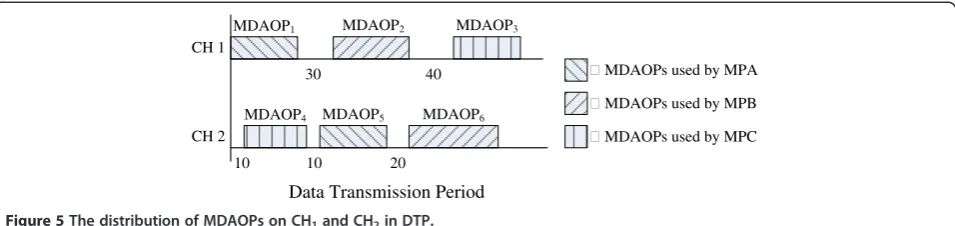
to MPB in the next CP of mesh DTIM interval. MPB will first check whether it can do this relocation or not (including the forward shift and backward shift) according to its own NMST. If MPB agrees on this re-location, it asks its partner MP (e.g., MPE) which is using the same MDAOP with MPB. If MPE also agreed, MPB will send MDAOP relocation reply packet back to MPD, then MPD can use the space to estab-lish MDAOP after relocation. If MPB or MPE cannot
perform MDAOP relocation, MPB will reply an
MDAOP relocation reject packet to MPD, which means that MPD’s MDAOP relocation request is rejected.
MMDA analysis in throughput
In this section, we analyze the proposed MMDA algo-rithm based on the saturated contention in CP. To sim-plify the analysis, we only consider the two-hop wireless mesh LAN environment. We assume that there are to-tally n MPs operated in CP with the saturation mode binary exponential backoff; W0 is the initial contention window; andpcis collision probability caused by two or more MPs transmissions at the same time. The trans-mission probability ptof MP can be obtained by Equa-tion (7) [29], where MP contends with each other until successful transmission in CP without limiting the max-imum backoff stage. Similarly,ptcan also be obtained by Equation (8).
pt ¼
2 1ð 2pcÞ W0ð1pcÞ þ12pc
ð7Þ
pt ¼1ð1pcÞ 1=
ðn1Þ ð8Þ
We can easily obtain the unique solutions ofptandpc, respectively, by solving Equations (7) and (8), if n and W0are given. In addition, pt(n) andpc(n) can be consid-ered as the functions ofn for ptand pc, respectively, by assumingW0is a fixed system parameter. Therefore, the probabilities of successful transmission and idle channel can also be considered as a function ofnand expressed by Equations (9) and (10), respectively. Similarly,pc(n) is shown in Equation (11). In addition, we will consider the
other parameters as the functions of n later in this article.
psuccð Þ ¼n nptð Þn ð1ptð ÞnÞn1 ð9Þ pið Þ ¼n ð1ptð ÞnÞn ð10Þ pcð Þ ¼n 1pið Þ n psuccð Þn ð11Þ According to the content of NMST, MP knows that the durations will be used in DTP and avoid selecting these durations; then MP can reserve MDAOP by com-pleting MMDA four-way-handshaking mechanism. Let us denoteTcpto be the duration of CP, which obviously affects the number of successful contentions in CP. Let us also denote Tcp_c to be the critical duration of CP, which is the minimum duration of CP for MPs to suc-cessfully reserve all available MDAOPs. Let us assume that an MP will experience i times of collision and j empty slot times before successfully reserving an MDAOP in CP with n MPs to contend, whose joint probability mass function,Pss(i, j, n), can be obtained by Equation (12), where I and J are the random variables that an MP will experience i times of collision and j empty slots before successfully reserving an MDAOP in CP, respectively. Furthermore, the means of Iand J can be expressed as the functions of n and obtained by Equations (13) and (14), respectively.
pssði;j;nÞ ¼p I½ ¼i;J¼j
¼ iþj
j
picð Þnpjið Þnpsuccð Þn ; for i
¼0;1;2. . .and j¼0;1;2 ð12Þ
I nð Þ ¼X
1
i¼0
iX
1
j¼0
pssði;j;nÞ ð13Þ
J nð Þ ¼X
1
j¼0
jX
1
i¼0
pssði;j;nÞ ð14Þ
Let us denote Ts and Tc to be the durations of each successful MMDA four-way-handshaking contention and collision shown as Equations (15) and (16), respect-ively, where TMDASRQ, TMDASRP, TMDAACK, TMDAADV,
MDAOP1 MDAOP2 MDAOP3
MDAOP4 MDAOP5 MDAOP6
MDAOPs used by MPA
MDAOPs used by MPB
MDAOPs used by MPC CH 1
CH 2
10 10 20
30 40
Data Transmission Period
TDIFS, and TSIFS are the durations of MDA Setup Re-quest, MDA Setup Reply, MDA Acknowledge, MDA Ad-vertisement, DIFS, and SIFS, respectively. Let us define Tr(n) as the average time to reserve an MDAOP for an MP in CP, which can be obtained by Equation (17), whereTiis a slot time that should be long enough to ac-cess the channel state information. Let us denoteTDTIM and TDTP to be the durations of mesh DTIM interval and DTP, respectively, where TDTP can be obtained by Equation (18).
Ts¼TMDASRQþTMDASRPþTMDAACK
þTMDAADVþTDIFSþ3TSIFS ð15Þ
Tc¼TMDASRQþTDIFS ð16Þ
Trð Þ ¼n I nð Þ TcþJ nð Þ TiþTs ð17Þ
TDTP¼TDTIMTcp ð18Þ
Let us denote Na to be the available MDAOPs pro-vided for MPs to reserve in DTP shown in Equation (19), where Nc, B, D, and L are the number of chan-nels in wireless mesh LAN, Each channel’s bandwidth, MDAOP duration, and the average interval between two MDAOPs, respectively. Let us define Nmin as the minimum value of n and Na; then, the critical dur-ation of CP Tcp_c(n) can be obtained by Equation (20). Hence, the available MDAOPs will be completely reserved by MPs within CP, if Tcp is longer than Tcp_c. Let us define Tm as the mth sub-critical duration of CP that m MPs can successfully reserve MDAOPs, which can be obtained by Equation (21). We define G (n) as the number of MPs that can successfully reserve MDAOPs in a CP, which can be obtained by Equation (22). Let us denote S(n) to be the throughput of MPs, which can be obtained by Equation (23). Finally, the average throughput of each MP, s(n), can be obtained by Equation (24).
Na ¼
TDTPB DþL
Nc ð19Þ
Tcp cð Þ ¼n
X Nmin
x¼0
TrðnxÞ ð20Þ
Tmð Þ ¼n X m1
x¼0
TrðnxÞ for1≤m≤Nmin ð21Þ
G nð Þ ¼ minðn;mÞTcp∈½Tm;Tmþ1Þfor m
¼0;1. . .;Nmin1 ð22Þ
S nð Þ ¼G nð Þ D TDTIM
ð23Þ
s nð Þ ¼S nð Þ
n ð24Þ
Simulation experiments
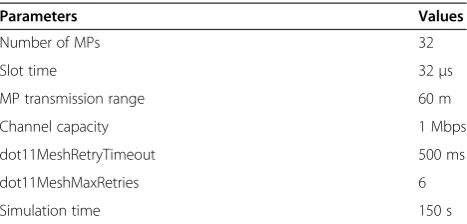
This section performs the simulation experiments. We use C# to design simulation program, and consider wire-less mesh LAN topology with 32 MPs in a random style. We also assume that all MPs are fixed and do not con-sider propagation delay and background noise. The other simulation parameters are shown in Table 2. We consider both saturated and non-saturated modes, and the packet arrival distribution of non-saturated mode is Poisson distribution. In the constant bit rate (CBR) traf-fic class, the packet size is assumed to be 512 bytes. The variable bit rate (VBR) traffic class is exponentially dis-tributed, we assume the average packet size is 256 bytes, the maximum and minimum packet sizes are 512 and 64 bytes, respectively. We will compare the perfor-mances of MMDA using CLFRF mechanism, known as MMDA (CLFRF); MMDA using MCBF mechanism, known as MMDA (MCBF) and EDCA.
Two-hop scenario
First, we consider that the number of hops is limited to two in wireless mesh LAN for CBR traffic at the satu-rated mode. We assume that the mesh DTIM interval length, the length of CP, and MDAOP duration are 30 ms, 6 ms, and 128 slots, respectively. In Figure 6, the MMDA (analysis) curve shows the upper limit of the Table 2 Simulation parameters
Parameters Values
Number of MPs 32
Slot time 32μs
MP transmission range 60 m
Channel capacity 1 Mbps
dot11MeshRetryTimeout 500 ms
dot11MeshMaxRetries 6
Simulation time 150 s
0 20 40 60 80 100
2 3 4
Number of Channels
Average
T
hroughput
(kbps) MMDA(CLFRF)MMDA(MCBF)
EDCA
MMDA(Analysis)
theoretical analysis; we can find the curves of MMDA (MCBF) and MMDA (analysis) are very close. MMDA (MCBF) can approach the theoretical upper limit, be-cause it has smaller fragmentation; conversely due to the larger fragmentation, MMDA (CLFRF) performs worse than MMDA (MCBF). When using EDCA, the source MP and the destination MP have to coordinate which channel to use, so the source MP must contend with the other MPs in CP. In addition, the source MP needs to reserve TXOP (transmission opportunity) by contention mechanism in DTP, which increases network overhead and more collisions. Furthermore, TXOP cannot period-ically be used in every mesh DTIM interval, so it also increases the number of contentions and causes EDCA having poor performance.
Multi-hop scenario
In this section, we consider the multi-hop wireless mesh LAN in both saturated and non-saturated modes. We randomly place 32 MPs in the square of 300 m × 300 m. We assume that the mesh DTIM interval length and CP are 100 and 10 ms, respectively. We allow each MP to
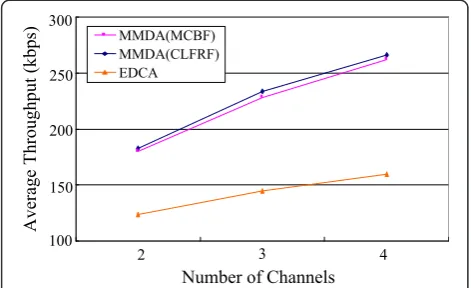
get more than one MDAOP to transmit data in DTP. Performance evaluation includes the average throughput, average waiting time (the time from packet entering the queue to leaving the queue), and packet drop ratio will be investigated. Figures 7 and 8 show the average throughput for CBR and VBR traffics, respectively, in the saturated mode. It is obvious that MMDA (CLFRF) and MMDA (MCBF) perform better than EDCA, be-cause the situation is very similar to the two-hop scenario.
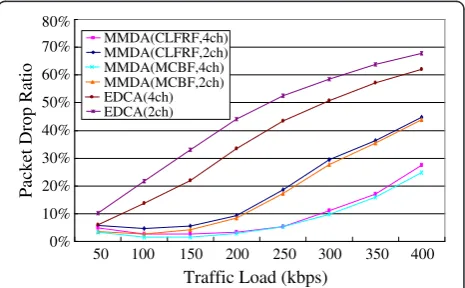
Figures 9, 10, 11, 12, 13, and 14 show the results for the CBR and VBR traffics in the non-saturated mode, and it is obvious that both MMDA (CLFRF) and MMDA (MCBF) perform better than EDCA in average through-put, average waiting time, and packet drop ratio. The poor performance of EDCA is because EDCA needs to contend in both CP and DTP, and then it just can re-serve TXOP, which causes more collisions and increases network overhead. Whatever the saturated or non-saturated mode is used, the simulation results show that in CBR traffic mode, the average throughput of MMDA (CLFRF) and MMDA (MCBF) is close, but in VBR traffic
100 150 200 250 300
2 3 4
Number of Channels
Average
T
hroughput
(kbps) MMDA(CLFRF)
MMDA(MCBF)
EDCA
Figure 7Average throughput for CBR traffic in the saturated mode.
100 150 200 250 300
2 3 4
Number of Channels
Average
T
hroughput
(kbps)
MMDA(CLFRF) MMDA(MCBF)
EDCA
Figure 8Average throughput for VBR traffic in the saturated mode.
100 150 200 250 300
Traffic Load (kbps)
Average
T
hroughput
(kbps)
50 100 150 200 250 300 350 400 0
50
MMDA(CLFRF,2ch) MMDA(CLFRF,4ch)
MMDA(MCBF,2ch) MMDA(MCBF,4ch)
EDCA(2ch) EDCA(4ch)
Figure 9Average throughput for CBR traffic in the non-saturated mode.
100 150 200 250 300
Traffic Load (kbps)
Av
erage
Throughput
(kbps)
50 100 150 200 250 300 350 400 0
50
MMDA(CLFRF,2ch) MMDA(CLFRF,4ch)
MMDA(MCBF,2ch) MMDA(MCBF,4ch)
EDCA(2ch) EDCA(4ch)
mode the average throughput of MMDA (MCBF) is bet-ter than MMDA (CLFRF). This is because the data packet size in VBR traffic mode is variable and MMDA (CLFRF) uses random mechanism to select the location of MDAOP, it will causes that the smaller MDAOP oc-cupies the larger free location and results in the waste problem of channel resource.
In Figures 11 and 12, the average waiting times of MMDA (CLFRF), MMDA (MCBF), and EDCA increase when traffic load increases, because MP suffers more contentions to transmit data when packet arrival rate increases. For MMDA (CLFRF) and MMDA (MCBF), MP needs to wait until the next mesh DTIM interval, if it cannot complete MMDA four-way-handshaking be-fore the end of CP. Therebe-fore, MMDA (CLFRF) and MMDA (MCBF) need to wait for several mesh DTIM intervals to transmit data packets when traffic load increases, which significantly make the average waiting time increase. Figures 13 and 14 show the packet drop ratio also increases, because packets will be dropped for time out or reached the retransmission limit when traffic load increases.
Conclusions
This research makes the MDA of IEEE802.11s draft to work well on multi-channel wireless mesh LAN to pro-vide higher performance and network capacity. MMDA algorithm uses four-way-handshaking mechanism to re-duce hidden node problems, and mesh DTIM interval is divided into CP and DTP to completely avoid the colli-sion between control packets and data packets. MMDA algorithm is designed with only single transceiver, so it can reduce the hardware resource requirements and de-sign complexity. NMST helps MP to know the distribu-tion of MDAOPs on each channel and makes MP easily to select an available MDAOP. These two MDAOP lection mechanisms, CLFRF and MCBF, make MP to se-lect the location of MDAOP more effectively. Because of these designs, MMDA algorithm works well on multi-channel wireless mesh LAN. The theoretical analysis gives the upper limit of the throughput for MMDA. The simulation experiments clearly show the results in multi-channel wireless mesh LAN environment that the throughput of MMDA is better than EDCA both in saturated and non-saturated modes. In addition, MMDA
Traffic Load (kbps)
Average Waiting Time (ms)
50 100 150 200 250 300 350 400
Figure 11Average waiting time for CBR traffic in the non-saturated mode.
Traffic Load (kbps)
Average Waiting Time (ms)
50 100 150 200 250 300 350 400
Figure 12Average waiting time for VBR traffic in the non-saturated mode.
Traffic Load (kbps)
Figure 13Packet drop ratio for CBR traffic in the non-saturated mode.
also has the lower average waiting time and packet drop ratio than EDCA. Obviously, the proposed MMDA algo-rithm can effectively improve overall performance of multi-channel wireless mesh LAN.
Competing interests
‘The authors declare that they have no competing interests’.
Acknowledgments
This study was supported in part by the National Science Council (NSC) of Taiwan under Grant no. NSC 99-2221-E-011-119.
Author details
1National Taiwan University of Science and Technology, 43, Keelung Rd.,
Section 4, Taipei 106, Taiwan.2Ling Tung University, 1, Ling Tung Rd,
Taichung 408, Taiwan.
Received: 12 June 2012 Accepted: 25 September 2012 Published: 16 October 2012
References
1. IEEE std,802.11s/d2.02 Part 11, Wireless LAN Medium Access Control (MAC) and Physical Layer (PHY) Specifications Amendment 10: mesh networking
(2008)
2. G.R. Hiertz, S. Max, Y. Zang, T. Junge, D. Denteneer, IEEE 802.11s MAC fundamentals, inProceedings of IEEE International Conference on Mobile Ad-hoc and Sensor Systems (MASS 2007), ed. by, 2007, pp. 1–8 3. IEEE std. 802.11e-2005,Wireless LAN Medium Access Control (MAC) and
Physical Layer (PHY) Specifications Amendment 8: Medium Access Control (MAC) Quality of Service Enhancements(2005)
4. H. Aoki, S. Takeda, K. Yagyu, A. Yamada, IEEE 802.11s wireless LAN mesh network technology. NTT DoCoMo Tech. J.8(2), 13–21 (2006) 5. G.R. Hiertz, S. Max, Z. Rui, D. Denteneer, L. Berlemann, Principles of IEEE
802.11s, inProceedings of 16th International Conference on Computer Communications and Networks (ICCCN 2007), ed. by (2007), pp. 1002–1007 6. J. Camp, E. Knightly, The IEEE 802.11s extended service set mesh
networking standard. IEEE Commun. Mag.46(8), 120–126 (2008) 7. J.H. Chiang, T. Chiueh, Accurate clock synchronization for IEEE 802.11-based
multi-hop wireless networks, inProceedings of 17th IEEE International Conference on Network Protocols (ICNP 2009), ed. by (2009), pp. 11–20 8. M.J. Lee, J. Zheng, Y.B. Ko, D.M. Shrestha, Emerging standards for wireless
mesh technology. IEEE Wireless Commun.13(2), 56–63 (2006) 9. K. Yang, J.F. Ma, Z.H. Miao, Hybrid routing protocol for wireless mesh
network, inProceedings of International Conference on Computational Intelligence and Security (CIS '09), ed. by (2009), pp. 547–551
10. A.O. Lim, X. Wang, Y. Kado, B. Zhan, A hybrid centralized routing protocol for 802.11s WMNs. Mob. Netw. Appl. J13(1–2), 117–131 (2008) 11. W.J. Yoon, S.H. Chung, S.J. Lee, Y.S. Lee, An efficient cooperation of
on-demand and proactive modes in hybrid wireless mesh protocol, in
Proceedings of 33rd IEEE Conference on Local Computer Networks (LCN 2008), ed. by (2008), pp. 52–57
12. A. Ksentini, O. Abassi, A comparison of VoIP performance over three routing protocols for IEEE 802.11s-based wireless mesh networks (WLAN Mesh), in
Proceedings of 6th ACM International Symposium on Mobility Management and Wireless Access (MOBIWAC’08), ed. by (2008), pp. 147–150
13. Q. Shen, X. Fang, A multi-metric AODV routing in IEEE 802.11s, in
Proceedings of IEEE International Conference on Communication Technology (ICCT‘06), ed. by (2006), pp. 1–4
14. J. Li, J. Yun, K. Cho, K. Han, Path management scheme to support mobile station in wireless mesh networks for U-healthcare applications, in
Proceedings of Wireless Telecommunications Symposium (WTS 2009), 2009, pp. 1–4
15. C. Pepin, U.C. Kozat, S.A. Ramprashad, A joint traffic shaping and routing approach to improve the performance of 802.11 mesh networks, in
Proceedings of 4th IEEE International Symposium on Modeling and Optimization in Mobile, Ad-hoc and Wireless Networks, ed. by (2006), pp. 1–10
16. A. Neishaboori, G. Kesidis, SINR-sensitive routing in wireless 802.11 mesh networks, inProceedings of 5th IEEE International Conference on Mobile Ad-hoc and Sensor Systems (MASS 2008), ed. by (2008), pp. 623–628 17. S.H. Lee, Y.B. Ko, Y.G. Hong, H.J. Kim, A new MIMC routing protocol
compatible with IEEE 802.11s based WLAN mesh networks, inProceedings of IEEE International Conference on Information Networking (ICOIN2011), ed. by (2011), pp. 126–131
18. G. Isabwe, K.S. Kim, A novel approach to WLAN mesh interworking with multiple mesh portals, inProceedings of 5th IEEE International Conference on Mobile Ad-hoc and Sensor Systems (MASS 2008), ed. by (2008), pp. 641–646 19. U. Ashraf, S. Abdellatif, G. Juanole, Gateway selection in backbone wireless mesh networks, inProceedings of Wireless Communications and Networking Conference (WCNC), ed. by (2009), pp. 1–9
20. M.A. Marsan, D. Roffinella, Multichannel local area network protocols. IEEE J. on Selected Areas in Commun.1(5), 885–897 (1983)
21. A. Baiocchi, A. Todini, A. Valletta, Why a multichannel protocol can boost IEEE 802.11 performance, inProceedings of the 7th ACM International Symposium on Modeling, Analysis and Simulation of Wireless and Mobile Systems, ed. by (2004), pp. 143–148
22. N.S. Nandiraju, D.S. Nandiraju, D. Cavalcanti, D.P. Agrawal, A novel queue management mechanism for improving performance of multihop flows in IEEE 802.11s based mesh networks, inProceedings of Performance, Computing, and Communications Conference (IPCCC 2006), ed. by (2006), pp. 162–168
23. A. Ranjitkar, Y.B. Ko, Performance enhancement of IEEE 802.11s mesh networks using aggressive block Ack. scheme, inProceedings of International conference on Information Networking (ICOIN 2008), ed. by (2008), pp. 1–5 24. V. Vishnevsky, A. Lyakhov, A. Safonov, S. Shpilev, Beaconing for MDA
support in IEEE 802.11s mesh networks, inProceedings of IEEE 18th Symposium on Personal, Indoor and Mobile Radio Communications (PIMRC 2007), ed. by (2007), pp. 1–5
25. Y. Chen, S. Emeott, Impact of scheduled mesh access on the capacity of wireless mesh links, inProceedings of Radio and Wireless Symposium (RWS 2009), ed. by (2009), pp. 107–110
26. H. Jasani, N. Alaraje, Evaluating the performance of IEEE 802.11 network using RTS/CTS mechanism, inProceedings of IEEE International Conference on Electro/Information Technology, ed. by (2007), pp. 616–621
27. IEEE 802.11 Working Group, Wireless LAN Medium Access Contro1 (MAC) and Physical Layer (PHY) specifications. (1997)
28. C. Cicconetti, L. Lenzini, E. Mingozzi, Scheduling and dynamic relocation for IEEE 802.11s mesh deterministic access, inProceedings of 5th Annual IEEE Communications Society Conference on Sensor, Mesh and Ad Hoc Communications and Networks (SECON '08), ed. by ( 2008), pp. 19–27 29. B.J. Kwak, N.O. Song, L.E. Miller, Performance analysis of exponential backoff.
IEEE/ACM Trans. Netw.13(2), 343–355 (2005)
doi:10.1186/1687-1499-2012-313
Cite this article as:Leeet al.:Study on multi-channel mesh
deterministic access for wireless mesh LAN.EURASIP Journal on Wireless Communications and Networking20122012:313.
Submit your manuscript to a
journal and benefi t from:
7 Convenient online submission
7 Rigorous peer review
7 Immediate publication on acceptance
7 Open access: articles freely available online
7 High visibility within the fi eld
7 Retaining the copyright to your article