R E S E A R C H
Open Access
Proficient routing by adroit algorithm in
5G-Cloud-VMesh network
P. Dharanyadevi
1*and K. Venkatalakshmi
2Abstract
5G-Cloud-VMesh network (5CVN) is nascent as an economical alternative for building federated and community networks. In 5G milieu, the Aggregator Node B (ANB) is the base station with enhanced computing capabilities and storage space. In this paper, an integration of 5G-cloud-VMesh network is initiated. In this paper, we also propose a new routing algorithm for 5CVN, dubbed as 5CVN-adroit algorithm. The proposed 5CVN-adroit algorithm chooses an optimal gateway and ANB in the network layer to route the request/response from and to the service requesters and the cloud using 5G technologies. This paper endows with the network architecture and main technical features such as interconnection, integration, and intelligence of 5CVN-adroit algorithm. The simulation study shows that the 5CVN-adroit algorithm augments the routing issues such as delay, congestion, and deployment cost and it is justified based on the packet delivery ratio, average response time, routing overhead ratio, and packet collision ratio.
Keyword:5G, Vehicular network, Mesh network, Cloud, Routing, Performance
1 Introduction
Vehicular Ad hoc Networks (VANET) are pervasive, ubi-quitous, and infrastructure-free without any centralized authority. VANET is a decentralized network where each node is proficient to forward data packets between the nodes dynamically [1–4]. In VANET, a node can be bus, tram, subway, train, or taxi. Vehicles get a broadband wireless access by using heterogeneous wireless technolo-gies, namely IEEE 802.11, IEEE 802.16 (WMAN, WiMax), 3GPP Universal Mobile Telecommunications System (UMTS), and Long-Term Evolution. A wireless mesh net-work (WMN) is a multi-hop communication netnet-work in which the nodes are self-organized (i.e., without a central coordinator) [5]. VMesh is a hybrid network, which com-bines the features of VANET and WMN. VMesh network is the communication environment between the vehicles made up of radio nodes organized in a mesh topology. VMesh generates a loop among the moving vehicle. In the loop, we can add, update, or remove the nodes [6]. Vehi-cles are becoming more sophisticated with powerful on-board computing capabilities such as tons of on-on-board storage and short- or medium-range wireless transceiver
with no power limitations. Advancement in wireless net-works crafts the access to the Internet from vehicles. The high-flying industries and governments such as Audi, BMW, Daimler-Chrysler, and Toyota have commenced important research for vehicle to vehicle communications. California Partners for Advanced Transit and Highways, Crash Avoidance Metrics Partnership, FleetNet, Advanced Driver Assistance Systems, Chauffeur in EU, CarTALK 2000, and DEMO 2000 are petty distinguished research, which are moving towards the realization of intellectual transport services.
With surging vehicle Internet services, VMesh network is facing unique opportunities and challenges. To coup the rapid development and demands due to the multimedia services, social networks, and entertainments, it is far from enough to only expand and upgrade current networks, which results in a substantial increase in CAPital EXpend-iture (CAPEX) and OPerating EXpendEXpend-iture (OPEX) with-out reasonable investment returns. Therefore, in order to offer a High-Quality of Experience (HQoE) for vehicle users with affordable costs, new network architecture is de-signed to enable sustainable network evolution to the 5G. Till now, much attention has been paid to emerging 5G technologies ranging from information processing to net-working techniques. Most of the focus has been on further improving radio access efficiency through advanced signal * Correspondence:[email protected]
1Information and Communication Engineering, Anna University, Chennai,
India
Full list of author information is available at the end of the article
processing, e.g., cooperative relaying, massive MIMO, and millimeter-wave communications [7–13]. On the other hand, the existing shaft-like network structure with cen-tralized data processing is not suitable for flexible and diverse VANET Internet services, which undoubtedly re-stricts the service provisioning ability of the VMesh net-work. Hence, designing new network architecture becomes imperative. This motivates us to propose a new architec-ture for VMesh network with the integration of cloud and 5G technologies. However, there is still much work that needs to be done to improve the 5CVN architecture with good backward compatibility. This paper emphasizes how to maximize the utilization of resource without delay and congestion and to smoothly evolve towards converged 5CVN.
The motivations of the paper are as follows, nowadays, users of all ages want to share and get the information at anytime and anywhere via vehicle Internet service. Also, the growth of the Internet-of-Things (IoTs) has had ser-ious effects in the VANET performance. It is expected that by the year 2020, average user data rates will increase from around 20 MB/s to 1 GB/s, and connection density will also increase from 140,000 connections per square kilome-ters to 6 million connections per square kilomekilome-ters. More-over, new applications such as the Internet-of-Vehicles are envisioned for 5G, which will demand much shorter la-tency from the underlying network. Considering the exist-ing network infrastructure, telecommunication operators need to invest heavily on both network maintenance and upgrade to support ever increasing capacity requirements. However, revenues from increased data traffic cannot keep up with the investment. How to reduce CAPEX/OPEX and create new revenue flows are crucial issues facing tele-communications operators. The proposed 5CVN-adroit al-gorithm may perhaps solve the above issues.
In this paper, an integration of 5G-cloud-VMesh net-work is introduced. The envisioned architecture shall en-able data access from the vehicles, anytime and anywhere. In particular, the integration of IEEE 802.11-based multi-hop VANETs with 5G shall contribute to the evolution of beyond 4G wireless communication systems. The pro-posed 5CVN-adroit algorithm addresses the choosing of an optimal gateway and Aggregator Node B (ANB) in the network layer from and to the service requesters and the cloud using 5G technologies. 5CVN-adroit algorithm con-sists of two key processes such as metric-based gateway se-lection and metric-based ANB sese-lection. In the majority of the existing research, gateways are considered static and deployed on the road at fixed distances from each other, depending on their wireless transmission range, which makes the deployment costlier. Moreover, the multi-hop and dynamic nature of VANET communication impacts the stability of the links to these gateways. Furthermore, as these gateways are fixed, the discovery and routing
processes are mainly pro-active. Although the pro-active routing mechanisms reduce delay, they increase the fre-quent changes in the predefined routing tables of vehicles and routing overhead. To deal with these limitations, this paper defines the concept of vehicle gateways. Any vehicle in the VMesh network can act as a gateway. A gateway re-fers to the dual-interfaced vehicle that relays the packet from sources to the 5G backhaul network. It is enabled with dual interfaces of IEEE 802.11p and the 5G backhaul networks. The major challenge is to amalgamate these two network interfaces on a gateway, as they lie in two dif-ferent spectrum regions. The next challenge is to choose a minimum number of optimal gateways using relevant metrics. There could be several nodes in the VMesh net-work, which possess the important criterion and required metric information, and hence, the qualification to serve as gateways. The focus of this paper is on defining a mechanism that chooses a minimum number of optimal gateways, at an instance, so as to avoid the bottleneck at the 5G backhaul network. With this regard, as pro-active gateway discovery reduces delay and reactive discovery re-duces routing overhead, this paper envisages a hybrid gateway discovery mechanism for VMesh network, com-bining the pros of both pro-active and reactive concepts.
For example, network statistics show that 70 % of data traffic is carried by 30 % of base stations. To solve the above issue, we introduced ANB pool; a large number of ANBs can form an“ANB pool”with aggregated process-ing capabilities to serve the traffic requirements of the coverage area. For instance, there are certain regions with heavy traffic loads and certain ANB are overloaded. In such cases, ANB selection has been introduced to se-lect the optimal ANB among the ANB pool. In the ma-jority of the existing research, conventional centralized cloud is considered. However, the conventional central-ized cloud may result in a high delay of offloading data delivery and in congestion of backhaul due to the trans-mission of the offloaded data. The perceived delay caused by the centralized cloud can be minimized by adopting a distributed cloud deployed over ANB of cel-lular network.
Our paper deals with the above-identified issues by the following key contributions such as:
huge scale urban area using a real vehicle mobil-ity model.
Our second goal is to develop a new routing algorithm (adroit algorithm). The 5CVN-adroit algorithm discovers an optimal gateway and ANB in order to route the service request from the service requester to the cloud. The main purpose of gateway selection in the 5CVN is to permit only a minimum number of vehicles to communicate with the ANB. Certainly, if all vehicles in a 5G VMesh network directly communicate with the ANB, it results in a bottleneck at the ANB. The rationale of ANB selection is to avoid the data traffic at the ANB. Our third goal is to analyze the performance of the
proposed 5CVN-adroit algorithm over various per-formance metrics, including packet delivery ratio, average response time, routing overhead ratio, and packet collision ratio.
The rest of this article is organized as follows. In Section 2, we discuss the proposed 5CVN architecture and its main features. In Section 3, we describe the 5CVN-adroit algorithm. In Section 4, we discuss and analysis the performance of the 5CVN-adroit algorithm. Finally, in
Section 5, we present our conclusions and a description of future work that needs to be done.
2 Network architecture of 5CVN
To facilitate the flexible network control and reduce the network capital and operational expenditures, the complimentary concepts, 5G software-defined networking (SDN) components, and cloud have been integrated with VMesh networks. Through the proper cooperation be-tween newly developed 5CVN and radio access network, vehicle user can enjoy a much better quality of experience with lower access delay and congestion. 5G SDN is fast evolving and becoming the focal point and a growth area in networking. 5G SDN is a new paradigm in net-working, e.g., data and control plane separation, glo-bally optimized network management, and centralized network controller [14–16].
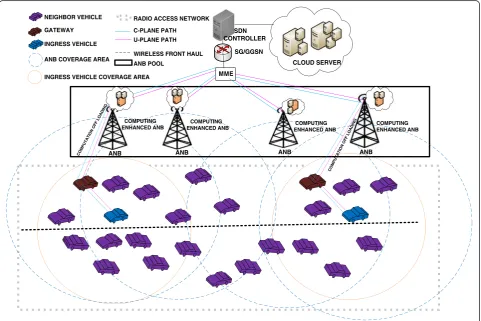
Figure 1 illustrates the 5CVN network architecture. The 5CVN is heterogeneous and IP-based model with relays. The architecture includes a number of independent vehi-cles with the autonomous radio access technologies, ANB, MME, Serving Gateway (SG)/Gateway GPRS Support Node (GGSN), SDN controller, and cloud server. VMesh network user’s vehicle may have any technology provisions.
INGRESS VEHICLE NEIGHBOR VEHICLE
ANB COVERAGE AREA
ANB ANB
CLOUD SERVER SG/GGSN
SDN CONTROLLER
WIRELESS FRONT HAUL
MME
ANB ANB
GATEWAY
RADIO ACCESS NETWORK
COMPUTING ENHANCED ANB
COMPUTING
ENHANCED ANB ENHANCED ANBCOMPUTING COMPUTINGENHANCED ANB
COMPUTATION OFF LOADING
COMPUTATION OFF LOADING U-PLANE PATH
C-PLANE PATH
INGRESS VEHICLE COVERAGE AREA ANB POOL
ANB has local cloud and it also has a computing capability for offloading a computation from the vehicle. The local cloud consists of the service which the user opts often. ANB provides the air interface between the control plane protocol terminations and the user plane towards the au-tonomous Human Machine Interface (HMI). The inter-faces of network are built on IP protocols. ANB is equipped with different MAC protocols to deliver different types of data information. The SG/GGSN act as a limited anchor for the mobility service for transmitting and receiv-ing packet rates from and to the requester and cloud to serve the HMI request. Mobility Management Entity (MME) is an entity to afford signaling only, and later, the user packets of the IP do not pass over the MME. SDN controller allows administrators to manage network ser-vices through abstraction of lower-level functionality. A cloud server is a logical server that is built, hosted, and delivered through a cloud computing platform over the Internet. Cloud servers exhibit and possess similar cap-abilities and functionality to a usual server but are accessed remotely on-demand from a cloud service provider. The cloud server provides computation, data access, software, services, and storage that do not re-quire service requester’s knowledge about the physical location and configuration of the system that deliver services.
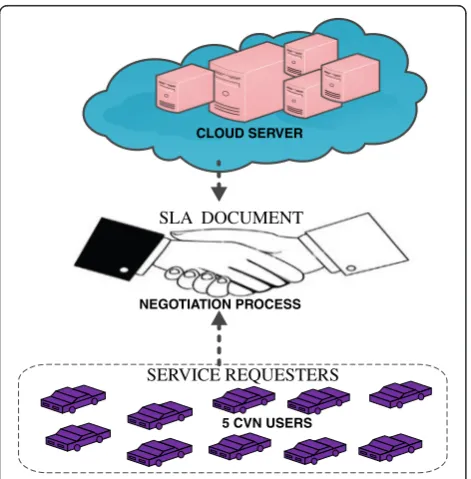
As shown in Fig. 2. Service-level agreement (SLA) is the negotiation between the cloud server and service re-questers for maintaining the QoS. Some metrics that SLAs may specify in the 5CVN are as follows:
The number of 5CVN users that can be served simultaneously by the cloud.
The particular performance benchmark to which actual performance to be compared periodically. Advance notification about the network changes. Help desk response time for different classes of
problems and dial-in access accessibility.
3 5CVN-adroit algorithm
The 5CVN-adroit algorithm discovers an optimal gate-way and ANB in the network layer to route the request/ response from/to the requesters and the cloud using 5G technologies. An ingress vehicle (service requester ve-hicle) coverage area is IEEE 802.11p wireless transmis-sion range. As expressed in Eq. 1, the coverage area of an ingress vehicle is determined as follows:
Carea¼TRmaxð1−αÞ ð1Þ
where TRmax denotes the maximum IEEE 802.11p
trans-mission range and α reflects the wireless channel fading conditions of the ingress vehicle location. For instance,α can be set to small values in environments when there are no major obstacles and takes high values in urban areas with tall buildings. A mapping function between the geo-graphical locations and the values ofαcan be provided by using position system such as GPS and Galileo. As illus-trated in Algorithm 1, the 5CVN-adroit algorithm consists of two key processes such as metric-based gateway selec-tion and metric-based ANB selecselec-tion.
3.1 Metric-based gateway selection
The ingress vehicle dynamically scans for the neighbor vehicle in the coverage area. Then, the ingress vehicle will send the beacon message to each neighbor vehicle and get the updated information periodically about the signal strength, number of packets in the buffer of the neighbor vehicle, and distance between ingress vehicle and neighbor vehicle. Based on the above periodic mes-sages, the ingress vehicle calculates the fitness value for each neighbor vehicle, as given in Eq. 2. If an ingress ve-hicle does not receive reply beacon messages from the specific neighbor vehicle during a certain time period, then the link is considered down. The neighbor vehicle is discarded. The fitness value (fv) for gateway selection (GS) is computed as follows:
fv GSð Þ ¼ Sstr
NPDt;i ∀n;n
¼1;2;3; ::::::;r ð2Þ
where“fv(GS)”is the fitness value for gateway selection, “Sstr” is the signal strength of the neighbor vehicle in
terms of dBm,“Np”is the number of packets in the buf-fer of the neighbor vehicle,“Dt,i”is the distance between
CLOUD SERVER
SERVICE REQUESTERS NEGOTIATION PROCESS
SLA DOCUMENT
5 CVN USERS
the ingress vehicle and the neighbor vehicle in terms of meter, and“r”is the maximum number of the neighbor vehicles. Among all possible neighbor vehicles (NV) NV∈F⊂Carea, we want to determine a gateway (Gw)
that optimizes (maximum) the function fv:
Gw¼ arg max
NV∈F⊂Carea
fv GSð Þ ð3Þ
where F is the feasible solution. As expressed in Eq. 3, among the neighbor vehicles, the vehicle which has the maximum fitness value is chosen as the gateway. The gateway activates its interface in order to communicate with the ANB. Then, the request from the ingress vehicle is transmitted to the gateway. The chosen gateway broad-casts periodic gateway advertisement (GWADV) messages within its coverage area up to time-to-live (TTL) value.
3.1.1 Selecting on-hand gateway
The new ingress vehicle checks for an on-hand (existing) gateway in its coverage area. If there is a gateway in its coverage area, then the new ingress vehicle will transmit the service request to an on-hand gateway and then go to the metric-based gateway selection.
3.2 Metric-based ANB selection
The range is distinct as the coverage area of the ANB. The ANB broadcasts periodic ANB advertisement (ANBADV) messages within its range (R). The gateway dynamically checks for the ANB to transmit the service request.
3.2.1 Case 1
If there is only one ANB, from the gateway, the service request is stanchly transmitted to the ANB.
3.2.2 Case 2
If there are no ANBs, the gateway dynamically scans for the neighbor vehicle towards its moving direction within its coverage area. Then, the gateway will send the beacon mes-sage to the each neighbor vehicle in the list. It gets the up-dated information periodically about the signal strength of the neighbor vehicle, number of packets in the buffer of the neighbor vehicle, and distance between the gateway and neighbor vehicle. Based on the above periodic messages, the gateway calculates the fitness value for each neighbor vehicle, as given in Eq. 4. If a gateway does not receive reply beacon messages from the specific neighbor vehicle during a certain time period, then the link is considered down. The neighbor vehicle is discarded. The fitness value (fv) for subsequent gateway selection (SGS) is computed as follows:
fv SGSð Þ ¼ Sstr
NPDq;e ∀n;n
¼1;2;3; ::::::;s ð4Þ
where“fv(SGS)” is the fitness value for subsequent gate-way selection,“Sstr”is the signal strength of the neighbor
vehicle in terms of dBm, “Np” is the number of packets in the buffer of the neighbor vehicle, “Dq,e” is the
dis-tance between the gateway and the neighbor vehicle in terms of meter, and “s” is the maximum number of the neighbor vehicles. Among all possible neighbor vehicles (NV) NV∈F⊂Carea, we want to determine a subsequent
gateway (SGw) that optimizes (maximum) the function fv:
SGw¼ arg max NV∈F⊂Carea
fv SGSð Þ ð5Þ
where F is the feasible solution. As expressed in Eq. 5, among the neighbor vehicles, the vehicle which has the maximum fitness value is chosen as the subsequent gate-way. From the gateway, the service request is transmitted to the subsequent gateway and then goes to the metric-based ANB selection. Case 1 and case 2 are the worst cases.
3.2.3 Case 3
If there are two or more ANBs, the gateway will send the beacon message to each neighbor ANB, gets the up-to-the-minute information about the number of packets in the buffer of the ANB and the distance between the gateway and ANB, and calculates a fitness value for each ANB, as given in Eq. 6. If the gateway does not receive beacon messages from the specific neighbor ANB during a certain time period, then the link is considered down. The ANB is discarded. The fitness value (fv) for ANB se-lection (ANBS) is calculated as follows:
fv ANBSð Þ ¼NPBþDg;a ∀n;n
¼1;2;3; ::::::;w ð6Þ
where “fv(ANBS)” is the fitness value for ANB selection, “NPB”is the number of packets in the buffer of the ANB, “Dg,a” is the distance between the gateway and ANB, and
“w”is the maximum number of ANBs. Among all possible ANBs, ANB∈F⊂R, we want to determine an ANB that optimizes (minimum) the function fv:
OANB¼ arg min
ANB∈FS⊂Rfv ANBSð Þ ð7Þ
4 Simulation results and analysis
We implemented the 5CVN-adroit algorithm and the existing techniques on network simulator (NS2) and used the topology of the network generated by Simula-tion of Urban Mobility (SUMO). SUMO is the micro-scopic, open source, and multimodal traffic simulator. The simulation allows to address a large set of traffic management topics. Each vehicle is modeled explicitly and has an own route and travel independently through the network. Here, SUMO is coupled to a communica-tion network simulator using a middleware (VSimRTI). The V2X Simulation Runtime Infrastructure (VSimRTI) is a framework which enables the groundwork and execution
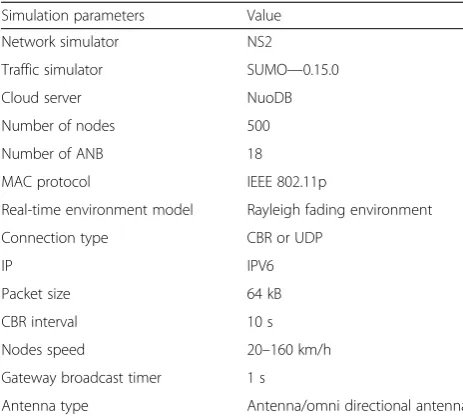
of V2X simulations. The easier integration and exchange of simulators enables the replacement of the most relevant simulators for a realistic presentation of traffic, communi-cation, and the execution of V2X applications. The NuoDB is a cloud database and offers a well-off SQL implementa-tion and factual ACID transacimplementa-tions. Table 1 illustrates the characteristics of the environment in which the simulation is experimented. In the simulation, the request generation speeds remnants at five packets per second when the ve-hicle density changes.
fitness function, in order to reduce the packet loss, re-transmission, gridlock, protocol overhead, and delay in VMesh milieu [5]. In this work, we do not consider the base station selection which results in data traffic at the base station. The data traffic results in delay, packet loss, and packet collisions. Abderrahim et al. proposed a mech-anism and named as Clustering-based Multi-metric adap-tive mobile Gateway Management (CMGM) in which vehicles are dynamically clustered according to different related metrics such as UMTS received signal strength, direction of vehicles, and vehicle to vehicle distance [17]. However, the cluster mechanism leads to confusion in electing the cluster head. And as well in CMGM fixing, the gateway candidate progression is complex which re-sults in a delay in gateway discovery mechanism. Kaouther et al. have proposed efficient and scalable LocVSDPs for VNs. The proposed protocols have vehicles provided with an efficient mechanism to locate service providers and how to reach them (routing) simultaneously [18]. How-ever, in LocVSDPs for VNs, clustering leads to confusion in electing the cluster head and it will increase the routing overhead and delay. The performance of the proposed 5CVN-adroit algorithm and existing OHBR, 3G-CMGM, and LocVSDPs are assessed in terms of the packet delivery ratio, average response time, routing overhead ratio, and packet collision ratio. The intricate descriptions of these indexes are as follows:
Packet Delivery Ratio (PDR): PDR is defined as the ratio between the number of responses received by the source to the number of requests sent.
Average Response Time (ART): ART is the average difference between the time a request packet is
originated by an application and the time the response packet is received.
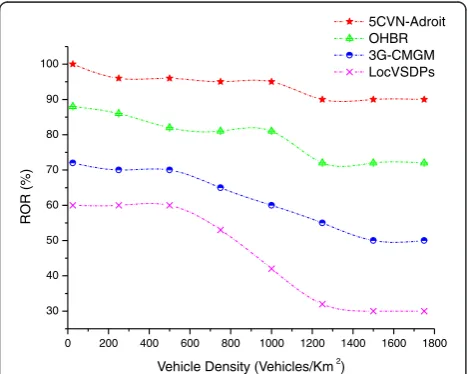
Routing Overhead Ratio (ROR): ROR is defined as the ratio between the total number of bytes of control packets and the cumulative size of data packets which are delivered to the destinations to the total number of control packets and the cumulative size of data packets sent.
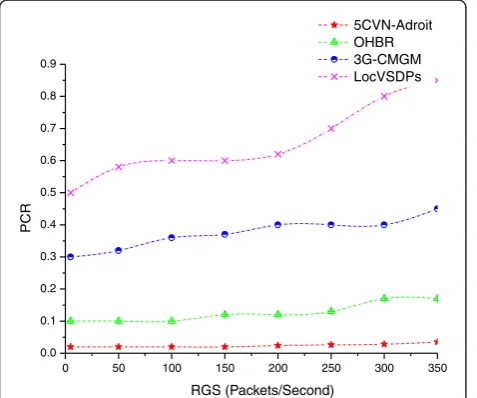
Packet Collision Ratio (PCR): The packet collision ratio is defined as the number of packets collided to the number of packets transmitted. This gives an indication of the loading of the network.
Table 2 depicts the simulation results obtained by the proposed 5CVN-adroit algorithm (A), existing OHBR (O), 3G-CMGM (C), and LocVSDPs (L) for different request generation speed (RGS) and vehicle density (VD). Based on the obtained results, we calculate the PDR, ART, RO, and PCR. In our existing work Optimized Heuristic Buffer-based Routing (OHBR), we do not consider the base sta-tion pool and the base stasta-tion selecsta-tion which results in data traffic at the base station when the RGS and VD rises. This results in delay, packet loss, and packet collisions. Consequently, PDR and RO decrease, and ART and PCR increase. In existing 3G-CMGM, the cluster mechanism leads to confusion in electing the cluster head. It results in a decrease in the PDR and RO and increase in the ART and PCR. In addition, in CMGM fixing, the gateway candi-date progression is complex which results in a delay in gateway discovery mechanism. The existing LocVSDPs re-lies on roadside routers. The roadside router has to be planned and deployed on the road side. Consequently, the deployment cost is high. LocVSDPs is also the cluster-based approach. The cluster creates confusion in the rout-ing process, results in the diminishrout-ing of the PDR and RO, and rises in the ART and PCR. However, in the pro-posed mechanism by using the 5G technology compo-nents, adroit algorithm, and local cloud at ANB, the VMesh user can enjoy with the minimum delay and maximum delivery ratio.
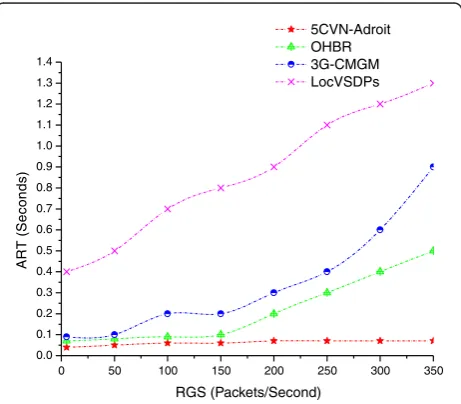
The impact of various RGS on PDR is illustrated in Fig. 3. It can be deduced from this figure that PDR de-creases as the RGS rises. Higher RGS causes more net-work topology changes and more link failures and thereby PDR decreases accordingly. Owing to the introduction of gateway and ANB selection based on the relevant metrics, the probability of disconnections between platoons shows an improvement in the 5CVN-adroit algorithm over to the OHBR, 3G-CMGM, and LocVSDPs. Hence, the PDR of the 5CVN-adroit algorithm outperforms the existing techniques. As depicted in Fig. 4, the ART of OHBR, 3G-CMGM, LocVSDPs, and 5CVN-adroit algorithm increases when the number of request increases. Higher RGS gener-ates more network topology changes and more delay. In
Table 1Simulation parameters
Simulation parameters Value
Network simulator NS2
Traffic simulator SUMO—0.15.0
Cloud server NuoDB
Number of nodes 500
Number of ANB 18
MAC protocol IEEE 802.11p
Real-time environment model Rayleigh fading environment
Connection type CBR or UDP
IP IPV6
Packet size 64 kB
CBR interval 10 s
Nodes speed 20–160 km/h
Gateway broadcast timer 1 s
existing techniques, the selected gateways and the base station will be overloaded with packets, some of which will be left over, finally impacting the packet loss and retrans-mission, which will increase the response time. In the 5CVN-adroit algorithm, as the gateway and the ANB are chosen based on the minimum number of packets in the buffer, it will decrease the processing delay. In addition, in the 5CVN-adroit algorithm, the next-hop gateway and the
ANB are picked based on the fitness value and reserved ahead before ingress vehicle transmitting the request. As a consequence, the ART of the 5CVN-adroit algorithm out-performs the ART of OHBR, 3G-CMGM and LocVSDPs. Accordingly, we have compared the ROR performance of the 5CVN-adroit algorithm, OHBR, 3G-CMGM, and LocVSDPs with RGS varying in Fig. 5. It can be figured out from this figure that ROR decreases as the RGS rises.
0 50 100 150 200 250 300 350
0.4 0.5 0.6 0.7 0.8 0.9 1.0
R
D
P
RGS (Packets/Second)
5CVN-Adroit OHBR 3G-CMGM LocVSDPs
Fig. 3PDR for different RGS
0 50 100 150 200 250 300 350
0.0 0.1 0.2 0.3 0.4 0.5 0.6 0.7 0.8 0.9 1.0 1.1 1.2 1.3 1.4
5CVN-Adroit OHBR 3G-CMGM LocVSDPs
)
s
d
n
o
c
e
S(
T
R
A
RGS (Packets/Second)
Fig. 4ART for different RGS
Table 2Simulation results
RGS PDR ART RO PCR
A O C L A O C L A O C L A O C L
5 0.96 0.88 0.76 0.5 0.04 0.07 0.09 0.4 100 92 80 50 0.02 0.1 0.3 0.5
50 0.94 0.8 0.76 0.5 0.05 0.08 0.1 0.5 94 80 76 50 0.02 0.1 0.32 0.58
100 0.92 0.77 0.69 0.46 0.06 0.09 0.2 0.7 92 77 69 46 0.02 0.1 0.36 0.6
150 0.9 0.77 0.67 0.46 0.06 0.1 0.2 0.8 90 77 67 46 0.02 0.12 0.37 0.6
200 0.89 0.67 0.61 0.45 0.07 0.2 0.3 0.9 89 67 65 45 0.024 0.12 0.4 0.62
250 0.88 0.66 0.6 0.44 0.07 0.3 0.4 1.1 88 66 60 44 0.026 0.13 0.4 0.7
300 0.85 0.62 0.57 0.42 0.07 0.4 0.6 1.2 85 62 57 42 0.028 0.17 0.4 0.8
350 0.85 0.6 0.5 0.42 0.07 0.5 0.9 1.3 80 55 45 42 0.035 0.17 0.45 0.85
VD PDR ART RO PCR
A O C L A O C L A O C L A O C L
25 0.96 0.88 0.72 0.6 0.02 0.05 0.06 0.1 100 88 72 60 0.01 0.03 0.04 0.1
250 0.92 0.86 0.7 0.6 0.03 0.06 0.07 0.15 96 86 70 60 0.01 0.034 0.062 0.1
500 0.92 0.82 0.7 0.6 0.05 0.07 0.08 0.2 96 82 70 60 0.01 0.035 0.07 0.1
750 0.92 0.81 0.56 0.53 0.06 0.08 0.1 0.25 95 81 65 53 0.02 0.036 0.075 0.12
1000 0.91 0.81 0.45 0.42 0.06 0.08 0.2 0.3 95 81 60 42 0.02 0.038 0.08 0.13
1250 0.8 0.72 0.44 0.32 0.068 0.09 0.3 0.35 90 72 55 32 0.02 0.039 0.088 0.13
1500 0.8 0.6 0.4 0.3 0.08 0.1 0.4 0.45 90 72 50 30 0.02 0.04 0.093 0.14
By virtue of gateway selection, the 5CVN-adroit algorithm is more likely to find a route from source to destination without any confusion in the routing process. Thus, the 5CVN-adroit algorithm outperforms the ROR of OHBR, 3G-CMGM, and LocVSDPs in terms of higher routing overhead ratio. It can be deduced from Fig. 6 that PCR of OHBR, 3G-CMGM, LocVSDPs, and 5CVN-adroit algo-rithm increases as the RGS increases. This result is rational and illustrates that high data rate may easily inundate the service channel of IEEE 802.11p since no differentiated ser-vice is being used. Compared to OHBR, 3G-CMGM, and LocVSDPs, the 5CVN-adroit algorithm shows the superla-tive PCR owing to its routing selection concern which com-bines the delay estimation and path connectivity together.
The influence of vehicle density on PDR of the 5CVN-adroit algorithm, OHBR, 3G-CMGM, and LocVSDPs is
plotted in Fig. 7. It is worth stressing that the impact of ve-hicle density on PDR is more apparent than that of RGS. The PDR of OHBR, 3G-CMGM, LocVSDPs, and 5CVN-adroit algorithm generally shows a diminishing trend in the growth of vehicle density. However, a large vehicle density will introduce more collisions and retransmissions on the IEEE 802.11p MAC layer. Thus, the OHBR, 3G-CMGM, LocVSDPs, and 5CVN-adroit algorithm experi-ence a dropping PDR when vehicle density increases. Due to the usage of real connected paths in 5CVN-adroit algo-rithm between source and destination, it can easily tolerate MAC collisions, thus still providing better PDR when ve-hicle density is more. From Fig. 8, it can be deduced that with the continuous increase of vehicle density, the ART of OHBR, 3G-CMGM, LocVSDPs, and 5CVN-adroit algo-rithm also increases. Higher density generates more net-work topology changes and more delay. By selecting the qualified gateway and ANB based on relevant metrics, ART of adroit algorithm outperforms the ART of existing techniques. In addition, by using the local cloud in com-puting enhanced ANB, the ART of 5CVN-adroit algorithm outperforms the existing techniques. As shown in Fig. 9, the ROR of the 5CVN-adroit algorithm, OHBR, 3G-CMGM, and LocVSDPs decreases when the vehicle density increases. The existing techniques create con-fusions in the routing process; hence, it will decrease the routing overhead ratio. To avoid the confusion in adroit algorithm, quantified gateway and ANB has been selected. In addition, the next-hop gateway and ANB is picked and reserved ahead; that causes less routing overhead. Therefore, the ROR of the proposed scheme is high compared to the existing techniques. The 5CVN-adroit algorithm has some advantage in the aspects of ROR by considering important path selec-tion factors such as link availability and link quality,
0 200 400 600 800 1000 1200 1400 1600 1800
0.30
Vehicle Density (Vehicles/Km2)
Fig. 7PDR for different VD
0 50 100 150 200 250 300 350
Fig. 6PCR for different RGS
0 50 100 150 200 250 300 350
which is of great importance to select a better route. Thus, the 5CVN-adroit algorithm shows better reli-ability and scalreli-ability. PCR is affected by different pa-rameters such as vehicle density and traffic load. The results presented in Fig. 10 suggest that the proposed 5CVN-adroit algorithm is not affected as much as existing techniques. The increase in vehicle density brings more collisions on MAC. The reason behind is that more retransmission and collision causes the rout-ing layer to use more beacons. The 5CVN-adroit algo-rithm reduces the retransmission and collision by introducing an ANB selection mechanism among an ANB pool. Thus, the PCR of adroit algorithm outper-forms the existing techniques.
5 Conclusions
The proposed 5CVN-adroit algorithm affords high per-formance, globally optimized load balancing and network usage increased from 30 % to over 90 %. In this paper, we initiate an architecture that amalgamates 5G SDN, cloud, and VMesh networks, which offers advanced network ser-vices and apps at software speed for the users. The simula-tion results show that our 5CVN-adroit algorithm is very suitable for real-time applications and outperforms the existing techniques on packet delivery ratio, average re-sponse time, routing overhead ratio, and packet collision ratio. However, there is still much research needed to fully exploit the potential of 5CVN. This paper may be giving a good platform to motivate the researchers for a better out-come of different types of problems in next generation networks.
Competing interests
The authors declare that they have no competing interests.
About the authors
P. Dharanyadevi is a research scholar in the Department of Information and Communication Engineering, Anna University, Chennai, India. She finished her master degree at Pondicherry University. Her research areas include web services, service oriented architecture, ad hoc milieus, pervasive computing, context aware computing, and cloud computing. She has published many research papers in International Journals and Conferences.
Dr. Venkatalakshmi Krishnan is working as Assistant Professor and Head of the Department in the Department of Electronics and Communication Engineering, Anna University Tindivanam Campus, Tindivanam, India. Her research areas include networks, pattern recognition, evolutionary protocols, and multispectral data fusion. She has published many research papers in International Journals and Conferences. She is an eminent reviewer in most of the reputed journals.
Author details
1Information and Communication Engineering, Anna University, Chennai,
India.2Electronics and Communication Engineering, Anna University Tindivanam Campus, Tindivanam, India.
0 200 400 600 800 1000 1200 1400 1600 1800
0.00
Vehicle Density (Vehicles/Km2)
Fig. 10PCR for different VD
0 200 400 600 800 1000 1200 1400 1600 1800
30
Vehicle Density (Vehicles/Km2)
Fig. 9ROR for different VD
0 200 400 600 800 1000 1200 1400 1600 1800
0.0
Vehicle Density (Vehicles/Km2
)
Received: 26 January 2016 Accepted: 13 March 2016
References
1. P Dharanyadevi, K Venkatalakshmi, Potent gateway selection algorithm for integrated 3G-VMesh milieu. World Appl. Sci. J.33, 1228–1233 (2015). doi:10.5829/idosi.wasj.2015.33.07.243
2. Y-S Chen, C-S Hsu, C-H Cheng, Network mobility protocol for vehicular ad hoc networks. Int. J. Commun. Syst.27, 3042–3063 (2014)
3. W Xiaonan, Q Huanyan, Constructing a VANET based on cluster chain. Int. J. Commun. Syst.27, 2497–2517 (2014)
4. H. Moustafa, Y. Zhang. Vehicular networks—techniques, standards, and applications. CRC Press. 2009.
5. P Dharanyadevi, K Venkatalakshmi, Optimized heuristic buffer-based routing for VMesh milieu. Aust. J. Basic Appl. Sci.9, 386–390 (2015)
6. P Dharanyadevi, K Venkatalakshmi, Reliable and scalable routing protocol (RSRP) for multimedia data transmission in vehicular mesh milieu. Int. J. Appl. Eng. Res.9, 19935–19946 (2015)
7. PK Agyapong, M Iwamura, D Staehle, W Kiess, A Benjebbour, Design considerations for a 5G network architecture. IEEE Commun. Mag.52, 65–75 (2014). doi:10.1109/MCOM.2014.6957145
8. C-X Wang, Cellular architecture and key technologies for 5G wireless communication networks. IEEE Commun. Mag.52, 122–130 (2014). doi:10.1109/MCOM.2014.6736752
9. E Hans-Joachim, S Patrick, T Riccardo,System design for 5G converged networks, 2015, pp. 391–396. doi:10.1109/EuCNC.2015.7194105. European Conference on Networks and Communications (EuCNC)
10. Z Zhang, Full duplex techniques for 5G networks: self-interference cancellation, protocol design, and relay selection. IEEE Commun. Mag.53, 128–137 (2015). doi:10.1109/MCOM.2015.7105651
11. Z Zhang, Large-scale MIMO based wireless backhaul in 5G networks. IEEE Commun. Mag.22, 58–66 (2015). doi:10.1109/MWC.2015.7306538 12. Y Mao, Software-defined and virtualized future mobile and wireless
networks: a survey. MONET20, 4–18 (2015). doi:10.1007/s11036-014-0533-8 13. Y Niu, A survey of millimeter wave communications (mmWave) for 5G:
opportunities and challenges. Wirel. Netw.21, 2657–2676 (2015). doi:10.1007/s11036-014-0533-8
14. R Guerzoni, R Trivisonno, D Soldani,SDN-based architecture and procedures for 5G networks, 2014. doi:10.1007/s11036-014-0533-8. 1st International Conference on 5G for UbiquitousConnectivity (5GU)
15. H Nam,Intelligent content delivery over wireless via SDN, 2015, pp. 2185–2190. IEEE Wireless Communications and Networking Conference (WCNC): Track 4 - Services, Applications, and Business
16. P Ameigeiras, JJ Ramos-Munoz, L Schumacher, J Prados-Garzon, J Navarro-Ortiz, JM Lopez-Soler, Link-level access cloud architecture design based on SDN for 5G networks. IEEE Netw.29, 24–31 (2015). doi:10.1109/MNET.2015.7064899 17. B Abderrahim, A Benslimane, T Taleb, R Sivaraj, Dynamic clustering-based
adaptive mobile gateway management in integrated VANET—3G heterogeneous wireless networks. IEEE J. Sel. Areas Commun.29(3), 559–570 (2011)
18. K Abrougui, A Boukerche, RWN Pazzi, Design and evaluation of context-aware and location-based service discovery protocols for vehicular networks. IEEE Trans. Intell. Transp. Syst.12(3), 717–735 (2011)
Submit your manuscript to a
journal and benefi t from:
7Convenient online submission
7Rigorous peer review
7Immediate publication on acceptance
7Open access: articles freely available online
7High visibility within the fi eld
7Retaining the copyright to your article