R E S E A R C H
Open Access
Dynamics and behavior of a higher order rational
recursive sequence
Elsayed M Elsayed
1,2*and Mohammed M El-Dessoky
1,2* Correspondence: [email protected] 1Mathematics Department, Faculty of Science, King Abdulaziz University, P. O. Box 80203, Jeddah 21589, Saudi Arabia
Full list of author information is available at the end of the article
Abstract
In this article we study the global convergence result, boundedness, and periodicity of solutions of the difference equation
xn+1 =axn−s+
bxn−l+cxn−k dxn−l+exn−k
n= 0, 1, . . .,
where the parametersa,b,c, dandeare positive real numbers and the initial conditionsx-t,x-t+1, . . . ,x-1andx0 are positive real numbers wheret= max{s, l,k}. Mathematics Subject Classification:39A10.
Keywords:stability, periodic solutions, boundedness, difference equations
1 Introduction
Difference equations appear as natural descriptions of observed evolution phenomena because most measurements of time evolving variables are discrete and as such these equations are in their own right important mathematical models. More importantly, difference equations also appear in the study of discretization methods for differential equations. Several results in the theory of difference equations have been obtained as more or less natural discrete analogues of corresponding results of differential equations.
The study of rational difference equations of order greater than one is quite challen-ging and rewarding because some prototypes for the development of the basic theory of the global behavior of nonlinear difference equations of order greater than one come from the results for rational difference equations. However, there have not been any effective general methods to deal with the global behavior of rational difference equations of order greater than one so far. Therefore, the study of rational difference equations of order greater than one is worth further consideration.
Recently there has been a lot of interest in studying the global attractivity, bounded-ness character, periodicity and the solution form of nonlinear difference equations. For some results in this area, for example: Agarwal and Elsayed [1] studied the global stabi-lity, periodicity character and gave the solution form of some special cases of the recursive sequence
xn+1=axn+
bxnxn−3 cxn−2+dxn−3
.
Aloqeili [2] obtained the form of the solutions of the difference equation
xn+1=
xn−1 a−xnxn−1
.
Elabbasy et al. [3] investigated the global stability character, boundedness and the periodicity of solutions of the difference equation
xn+1= α
xn+βxn−1+γxn−2 Axn+Bxn−1+Cxn−2
.
Elabbasy et al. [4] get the dynamics such that the global stability, periodicity charac-ter and gave the solution of special case of the following recursive sequence
xn+1=axn− bxn cxn−dxn−1
.
Elabbasy et al. [5] investigated the behavior of the difference equation especially glo-bal stability, boundedness, periodicity character and gave the solution of some special cases of the difference equation
xn+1= α
xn−k
β+γki=0xn−i .
El-Metwally et al. [6] dealed with the following difference equation
yn+1=
yn−(2k+1)+p yn−(2k+1)+qyn−2l
.
Saleh and Aloqeili [7] investigated the difference equation
yn+1=A+ yn yn−k
.
Simsek et al. [8] obtained the solution of the difference equation
xn+1= xn−3
1 +xn−1
.
Yalçınkaya [9,10] considered the dynamics of the difference equations
xn+1=
Zayed and El-Moneam [11,12] studied the behavior of the following rational recur-sive sequences
Other related results on rational difference equations can be found in [1-45].
Our goal in this article is to investigate the global stability character and the periodi-city of solutions of the recursive sequence
xn+1=axn−s+
bxn−l+cxn−k dxn−l+exn−k
where the parametersa,b,c,dandeare positive real numbers and the initial condi-tionsx-t,x-t+1, . . . ,x-1and x0are positive real numbers wheret= max{s,l, k}.
2 Some basic properties and definitions
Here, we recall some basic definitions and some theorems that we need in the sequel. Let Ibe some interval of real numbers and let
F:Ik+1→I,
be a continuously differentiable function. Then for every set of initial conditions x-k,
x-k+1, . . . ,x0Î I, the difference equation
xn+1=F(xn, xn−1, . . ., xn−k), n= 0, 1,. . ., (2)
has a unique solution {xn}∞n=−k. Definition 1(Equilibrium point)
A point x¯ ∈ I is called an equilibrium point of Equation (2) if
¯
x=F(¯x, x¯, . . ., ¯x).
That is, xn = x¯ forn≥0, is a solution of Equation (2), or equivalently, x¯ is a fixed point ofF.
Definition 2(Periodicity)
A sequence {xn}∞n=−k is said to be periodic with periodpifxn+p=xnfor all n≥-k.
Definition 3(Stability)
(i) The equilibrium point x¯ of Equation (2) is locally stable if for everyε>0, there existsδ>0 such that for all x-k,x-k+1, . . . ,x-1,x0ÎIwith
|x−k− ¯x|+|x−k+1− ¯x|+ · · · +|x0− ¯x| < δ,
we have
|xn− ¯x| < for all n≥ −k.
(ii) The equilibrium point x¯ of Equation (2) is locally asymptotically stable if x¯ is locally stable solution of Equation (2) and there existsg>0, such that for allx-k,x-k+1, .
. . , x-1,x0 ÎIwith
|x−k− ¯x|+|x−k+1− ¯x|+· · ·+|x0− ¯x| < γ,
we have
lim n→∞xn=x¯.
(iii) The equilibrium point x¯ of Equation (2) is global attractor if for allx-k,x-k+1, . . .
, x-1,x0 ÎI, we have
lim n→∞xn=x¯.
(iv) The equilibrium point x¯ of Equation (2) is globally asymptotically stable if x¯ is locally stable, and x¯ is also a global attractor of Equation (2).
The linearized equation of Equation (2) about the equilibrium x¯ is the linear differ-ence equation
yn+1= k
i=0
∂F(x¯,x¯,. . .,x¯) ∂xn−i
yn−i. (3)
Theorem A:[34]Assume that piÎR,i= 1, 2, . . .and kÎ{0, 1, 2, . . . }. Then
k
i=1
|pi| < 1, (4)
is a sufficient condition for the asymptotic stability of the difference equation
yn+k+p1yn+k−1+· · ·+pkyn= 0, n= 0, 1, . . .
Consider the following equation
xn+ 1=g(xn,xn−1, xn−2). (5)
The following two theorems will be useful for the proof of our results in this article. Theorem B:[35] Let [a,b] be an interval of real numbers and assume that
g: [α, β]3→[α, β],
is a continuous function satisfying the following properties:
(a) g(x,y, z) is non-decreasing inx andy in [a,b] for eachz Î [a, b], and is non-increasing in zÎ[a,b] for eachxandy in [a,b];
(b) If (m,M)Î[a,b]×[a,b] is a solution of the system
M=g(M,M,m) and m=g(m,m,M),
then
m=M.
Then Equation (5) has a unique equilibrium x¯∈[α,β] and every solution of Equa-tion (5) converges to x¯.
Theorem C:[35] Let [a,b] be an interval of real numbers and assume that
g: [α, β]3→[α, β],
is a continuous function satisfying the following properties:
(a) g(x,y, z) is non-decreasing inx andzin [a, b] for eachy Î [a, b], and is non-increasing in yÎ[a,b] for each xand zin [a,b];
(b) If (m,M)Î[a,b]×[a,b] is a solution of the system
M=g(M,m,M) and m=g(m,M,m),
then
m=M.
The article proceeds as follows. In Section 3 we show that the equilibrium point of Equation (1) is locally asymptotically stable when 2 |(be - dc)| <(d+e)(b +c). In Sec-tion 4 we prove that the soluSec-tion is bounded when a <1 and the solution of Equation (1) is unbounded ifa >1. In Section 5 we prove that the there exists a period two solu-tion of Equasolu-tion (1). In Secsolu-tion 6 we prove that the equilibrium point of Equasolu-tion (1) is global attractor. Finally, we give numerical examples of some special cases of Equa-tion (1) and draw it by using Matlab.
3 Local Stability of the equilibrium point of Equation (1)
This section deals with study the local stability character of the equilibrium point of Equation (1).
Theorem 1 Assume that
2|(be−dc)| < (d+e) (b+c).
Then the positive equilibrium point of Equation (1)is locally asymptotically stable. Proof. Equation (1) has equilibrium point and is given by
¯
x=ax¯+ b+c
d+e.
Ifa <1, then the only positive equilibrium point of Equation (1) is given by
¯
x= b+c
(1−a)(d+e).
Let f: (0,∞)3 ®(0,∞) be a continuous function defined by
f(u, v, w) =au+ bv+cw
dv+ew. (6)
Therefore it follows that
∂f(u,v,w) ∂u = a,
∂f(u,v,w)
∂v =
(be −dc)w (dv +ew)2, ∂f(u,v,w)
∂w =
(dc− be)u (dv +ew)2.
Then we see that
∂f(¯x,¯x,x¯)
∂u = a=−a2, ∂f(¯x,¯x,x¯)
∂v =
(be−dc) (d+e)2x¯ =
(be−dc)(1−a) (d+e)(b+c) =−a1,
∂f(¯x,¯x,x¯)
∂w =
(dc−be) (d+e)2x¯ =
(dc−be)(1−a) (d+e)(b+c) =−a0.
Then the linearized equation of Equation (1) about x¯ is
yn+ 1 + a2yn−s + a1yn-l + a0yn-k = 0, (7)
whose characteristic equation is
λk+1+a
It follows by Theorem A that, Equation (7) is asymptotically stable if all roots of
4 Existence of bounded and unbounded solutions of Equations (1)
Here we study the boundedness nature of solutions of Equation (1). Theorem 2 Every solution of Equation(1)is bounded if a <1.
Proof. Let {xn}∞n=−t be a solution of Equation (1). It follows from Equation (1) that
By using a comparison, we can write the right hand side as follows
yn+1=ayn−s+
and this equation is locally asymptotically stable becausea <1, and converges to the
equilibrium point ¯y= be+cd
Thus the solution is bounded.
Theorem 3 Every solution of Equation(1)is unbounded if a >1.
Proof. Let{xn}∞n=−t be a solution of Equation (1). Then from Equation (1) we see that
xn+1=axn−s+
bxn−l+cxn−k dxn−l+exn−k >
We see that the right hand side can write as follows
yn+1=ayn−s ⇒ ysn+i=anys+i, i= 0, 1, . . ., s,
and this equation is unstable becausea> 1, and nlim→∞yn = ∞. Then by using ratio
test {xn}∞n=−t is unbounded from above.
5 Existence of periodic solutions
In this section we study the existence of periodic solutions of Equation (1). The follow-ing theorem states the necessary and sufficient conditions that this equation has peri-odic solutions of prime period two.
Theorem 4 Equation(1)has positive prime period two solutions if and only if
(i) (b−c)(d−e)(1 +a) + 4(bae+cd) > 0,d>e,b>c and l−odd,k,s−even.
(ii) (c−b) (e−d) (1 +a) + 4(acd+be)>0, e>d,c>b and k−odd, l,s−even.
(iii) (c−b)(d−e)−4be > 0, d>e, c>b, a<1, and k, s−odd, l−even.
(iv) (b−c)(e−d)−4cd > 0, e>d, b>c, a<1, and l, s−odd, k−even.
Proof. We prove that whenl- odd,k,s- even (the other cases are similar and will be omitted.)
First suppose that there exists a prime period two solution
. . . ,p, q,p, q, . . .,
of Equation (1). We will prove that Condition (i) holds. We see from Equation (1) when l- odd,k- even that
p=aq+bp+cq
dp+eq,
and
q=ap+bq+cp
dq+ep.
Then
dp2+epq=adpq+aeq2+bp+cq, (9)
and
dq2+epq=adpq+aep2+bq+cp. (10)
Subtracting (9) from (10) gives
d(p2−q2) =−ae(p2−q2) + (b−c)(p−q).
Since p≠q, it follows that
p+q= (b−c)
Again, adding (9) and (10) yields
d(p2+q2) + 2epq= 2adpq+ae(p2+q2) + (b+c)(p+q),
(d−ae) (p2+q2) + 2(e−ad)pq= (b+c) (p+q). (12)
It follows by (11), (12) and the relation
p2+q2= (p+q)2−2pqfor allp,q∈R,
that
2(e−d) (1 +a)pq= 2(bae+cd)(b−c) (d+ae)2 .
Thus
pq= (bae+cd)(b−c)
(d+ae)2(e−d)(1 +a). (13)
Now it is clear from Equations (11) and (13) that pandqare the two distinct roots of the quadratic equation
t2−
(b−c) (d+ae)
t+
(bae+cd)(b−c) (d+ae)2(e−d)(1 +a)
= 0,
(d+ae)t2−(b−c)t+
(bae+cd)(b−c) (d+ae)(e−d)(1 +a)
= 0,
(14)
and so
[b−c]2−4(bae+cd)(b−c) (e−d)(1 +a) >0,
or
[b−c]2+4(bae+cd)(b−c) (d−e)(1 +a) >0. (b−c)(d−e)(1 +a) + 4(bae+cd)>0.
Therefore inequalities (i) holds.
Second suppose that inequalities (i) is true. We will show that Equation (1) has a prime period two solution.
Assume that
p= b−c+ζ 2(d+ae),
and
q=b−c−ζ 2(d+ae),
where ζ =
We see from inequalities (i) that
(b−c)(d−e)(1 +a) + 4(bae+cd)>0, b>c, d>e,
which equivalents to
(b−c)2> 4(bae+cd)(b−c) (e−d)(1 +a) .
Therefore pandq are distinct real numbers. Set
x−s =q, x−l=p, x−k=q,. . .,x−2=q, x−1=pandx0=q.
We wish to show that
x1=x–1=pandx2=x0=q.
It follows from Equation (1) that
x1=aq+
Dividing the denominator and numerator by 2(d+ae) gives
Multiplying the denominator and numerator of the right side by (1 + a) we obtain
x1=ab−ac−aζ
2(d+ae) +
(b−c)[(dc+eb)(1 +a)−2(bae+cd)] +ζ(1 +a)(eb−cd) 2[ed(b−c)(1 +a) + (e−d)(bae+cd)]
= ab−ac−aζ 2(d+ae) +
(b−c)(eb−dc)(1−a) +ζ(1 +a)(eb−cd) 2[ed(b−c)(1 +a) + (e−d)(bae+cd)]
= ab−ac−aζ 2(d+ae) +
(eb−dc){(b−c)(1−a) +ζ(1 +a)} 2(eb−cd)(d+ae)
= ab−ac−aζ 2(d+ae) +
(b−c)(1−a) +ζ(1 +a) 2(d+ae)
= ab−ac−aζ+ (b−c)(1−a) +ζ(1 +a)
2(d+ae) =
b−c+ζ 2(d+ae)=p.
Similarly as before one can easily show that
x2=q.
Then it follows by induction that
x2n=qandx2n+1=pfor alln≥ −1.
Thus Equation (1) has the prime period two solution
. . .,p,q,p,q, . . .,
where pandqare the distinct roots of the quadratic equation (14) and the proof is complete.
Lemma 5If l,k,s- even. Then there exists a prime period two solutions if and only if a= -1.
Proof. First suppose that there exists a prime period two solution . . . ,p, q,p, q, . . .,
then we see from Equation (1) that whenl,k,s- even
p=aq+b+c
d+e, (15)
and
q=ap+b+c
d+e. (16)
Subtracting (15) from (16) gives
p−q=−a(p−q).
Since p≠q, it follows that
a=−1.
Again, adding (15) and (16) yields
p+q= b+c
If we take
p= b
d+e, q= c
d+e, if b=c.
Set
x−s =q,x−l=p, x−k=q,. . .,x−2=q, x−1=pandx0=q.
We wish to show that
x1=x−1=pandx2=x0=q.
It follows from Equation (1) that
x1=aq+ bq+cq dq+eq =a
c d+e
+ b+c
d+e = −c d+e+
b+c d+e =
b d+e =p.
Similarly as before one can easily show that
x2=q.
Then it follows by induction that
x2n=qandx2n+1=pfor alln≥ −1.
Thus Equation (1) has the prime period two solution
. . . ,p,q,p,q, . . .,
and the proof is complete.
Lemma 6 If l, k- odd,s-even. Then there exists a positive prime period two solutions if and only if a= -1.
Proof. The proof as the previous Lemma and it will be omitted.
6 Global attractivity of the equilibrium point of Equation (1)
In this section we investigate the global asymptotic stability of Equation (1).
Lemma 7 For any values of the quotient b
dand
c
e, the function f(u, v, w)defined by
Equation(6)has the monotonicity behavior in its two arguments.
Proof. The proof follows by some computations and it will be omitted.
Theorem 8The equilibrium point x¯is a global attractor of Equation(1)if one of the following statements holds
(1)be≥dc and c≥b. (17)
(2)be≤dc and c≤b. (18)
Proof. Letaand bbe a real numbers and assume thatg: [a,b]3® [a, b] be a func-tion defined by
g(u, v, w) =au+ bv+cw
Then
∂g(u,v,w) ∂u =a,
∂g(u,v,w) ∂v =
(be−dc)w
(dv+ew)2, ∂g(u,v,w)
∂w =
(dc−be)u
(dv+ew)2.
We consider the two
cases:-Case (1) Assume that (17) is true, then we can easily see that the functiong(u, v, w) increasing in u,vand decreasing inw.
Suppose that (m,M) is a solution of the systemM =g(M,M,m)and m=g(m,m, M). Then from Equation (1), we see that
M=aM+bM+cm
dM+em, m=am+
bm+cM
dm+eM,
or
M(1−a) = bM+cm
dM+em, m(1−a) =
bm+cM
dm+eM,
then
d(1−a)M2+e(1−a)Mm=bM+cm, d(1−a)m2+e(1−a)Mm=bm+cM.
Subtracting this two equations we obtain
(M−m){d(1−a)(M+m) + (c−b)}= 0,
under the conditions c≥b,a< 1, we see that
M=m.
It follows by Theorem B that x¯ is a global attractor of Equation (1) and then the proof is complete.
Case (2) Assume that (18) is true, letaandbbe a real numbers and assume that g:
[a,b]3 ®[a,b] be a function defined by g(u, v, w) =au+bv+cw
dv+ew, then we can easily
see that the functiong(u,v,w) increasing inu,wand decreasing inv.
Suppose that (m, M) is a solution of the systemM =g(M,m, M)and m =g(m, M, m). Then from Equation (1), we see that
M=aM+ bm+cM
dm+eM, m=am+
bM+cm
dM+em,
or
M(1−a) = bm+cM
dm+eM, m(1−a) =
bM+cm
dM+em,
then
Subtracting we obtain
(M−m){e(1−a)(M+m) + (b−c)}= 0,
under the conditions b≥c,a <1, we see that
M=m.
It follows by Theorem C that x¯ is a global attractor of Equation (1) and then the proof is complete.
7 Numerical examples
For confirming the results of this article, we consider numerical examples which repre-sent different types of solutions to Equation (1).
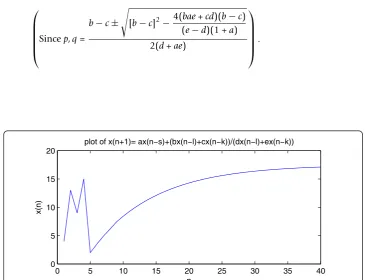
Example 1. We assumel= 3,k= 4,s = 0,x-4= 4,x-3 = 13,x-2= 9,x-1 = 15,x0= 2,
a= 0.9, b= 5,c= 2,d= 3,e= 1. See Figure 1.
Example 2. See Figure 2, sincel = 3,k= 4,s = 2,x-4= 3, x-3= 11,x-2 = 9,x-1= 5,
x0= 7,a= 0.8, b= 5,c= 4,d= 3,e= 2.
Example 3. We considerl= 2,k= 3,s = 4,x-3= 7,x-3 = 1,x-2= 4,x-1 = 11,x0= 3,
a= 1.5, b= 2,c= 3,d= 3,e= 2. See Figure 3.
Example 4. See Figure 4, sincel= 1, k= 3,s = 2,x-3=b/(d+e),x-2=c/(d+e),x-1 =
b/(d+e),x0 =c/(d+e),a=-1, b= 5,c= 6,d= 3,e= 4.
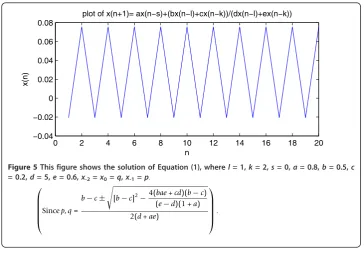
Example 5. Figure 5 shows the solutions when l= 1,k= 2,s= 0,a= 0.8,b = 0.5,c = 0.2, d= 5,e= 0.6, x-2=q,x-1=p,x0=q.
⎛ ⎜ ⎜ ⎜ ⎜
⎝Sincep,q= b−c±
[b−c]2− 4(bae+cd)(b−c) (e−d)(1 +a) 2(d+ae)
⎞ ⎟ ⎟ ⎟ ⎟ ⎠.
0 5 10 15 20 25 30 35 40
0 5 10 15 20
n
x(n)
plot of x(n+1)= ax(n−s)+(bx(n−l)+cx(n−k))/(dx(n−l)+ex(n−k))
Figure 1This figure shows the solution of Equation (1) withl= 3,k= 4,s= 0,x-4= 4,x-3= 13,x-2
0 5 10 15 20 25 30 35 40 45 50 2
4 6 8 10 12
n
x(n)
plot of x(n+1)= ax(n−s)+(bx(n−l)+cx(n−k))/(dx(n−l)+ex(n−k))
Figure 2This figure shows the solution ofxn+1= 0.8xn−2+
5xn−3+ 4xn−4
3xn−3+ 2xn−4
, with the initial conditions x-4= 3,x-3= 11,x-2= 9,x-1= 5,x0= 7.
0 5 10 15 20 25 30 35 40 45 50 0
100 200 300 400 500
n
x(n)
plot of x(n+1)= ax(n−s)+(bx(n−l)+cx(n−k))/(dx(n−l)+ex(n−k))
Figure 3This figure shows the behavior of the solution of Equation (1) when we takel= 2,k= 3, s= 4,x-3= 7,x-3= 1,x-2= 4,x-1= 11,x0= 3,a= 1.5,b= 2,c= 3,d= 3,e= 2.
0 2 4 6 8 10 12 14 16 18 20
0.7 0.75 0.8 0.85 0.9 0.95
n
x(n)
plot of x(n+1)= ax(n−s)+(bx(n−l)+cx(n−k))/(dx(n−l)+ex(n−k))
Figure 4This figure shows the periodicity of the solution of xn+1=−xn−2+
5xn−1+ 6xn−3
3xn−1+ 4xn−3
Acknowledgements
This article was funded by the Deanship of Scientific Research (DSR), the King Abdulaziz University, Jeddah. The authors, therefore, acknowledge with thanks DSR technical and financial support.
Author details 1
Mathematics Department, Faculty of Science, King Abdulaziz University, P. O. Box 80203, Jeddah 21589, Saudi Arabia 2Department of Mathematics, Faculty of Science, Mansoura University, Mansoura 35516, Egypt
Authors’contributions
The authors declare that the study was realized in collaboration with the same responsibility. All authors read and approved the final manuscript.
Competing interests
The authors declare that they have no competing interests.
Received: 4 March 2012 Accepted: 28 May 2012 Published: 28 May 2012
References
1. Agarwal, RP, Elsayed, EM: On the solution of fourth-order rational recursive sequence. Adv Stud Contemp Math.20(4), 525–545 (2010)
2. Aloqeili, M: Dynamics of a rational difference equation. Appl Math Comp.176(2), 768–774 (2006). doi:10.1016/j. amc.2005.10.024
3. Elabbasy, EM, El-Metwally, H, Elsayed, EM: Global attractivity and periodic character of a fractional difference equation of order three. Yokohama Math J.53, 89–100 (2007)
4. Elabbasy, EM, El-Metwally, H, Elsayed, EM: On the difference equationxn+1=axn−cxn−bxdxnn−1. Adv Differ Equ. the 6th ICDE. Taylor and Francis, London (2004)
7. Saleh, M, Aloqeili, M: On the difference equationxn+1=A+
n. Fasciculi Mathematici.42, 133–139
(2009)
11. Zayed, EME, El-Moneam, MA: On the rational recursive sequencexn+1= Aα++Bxβxn+n+γCxxnn−−11. Commun Appl Nonlinear
Anal.12(4), 15–28 (2005)
12. Zayed, EME, El-Moneam, MA: On the rational recursive sequencexn+1=axn− bxn
13. Agarwal, RP: Difference Equations and Inequalities, 1st edn. Marcel Dekker, New York (1992), 2 (2000)
14. Cinar, C: On the positive solutions of the difference equationxn+1= 1+axbxnn−x1n−1. Appl Math Comp.156, 587–590 (2004). doi:10.1016/j.amc.2003.08.010
15. Cinar, C: On the positive solutions of the difference equationxn+1= −1+xaxn−n1xn−1. Appl Math Comp.158(3), 793–797 (2004). doi:10.1016/j.amc.2003.08.139
16. Elabbasy, EM, El-Metwally, H, Elsayed, EM: On the periodic nature of some max-type difference equations. Int J Math Math Sci.2005(14), 2227–2239 (2005). doi:10.1155/IJMMS.2005.2227
17. Elabbasy, EM, El-Metwally, H, Elsayed, EM: Global behavior of the solutions of difference equation. Adv Diff Equ.2011, 28 (2011). doi:10.1186/1687-1847-2011-28
18. Elabbasy, EM, El-Metwally, H, Elsayed, EM: Some properties and expressions of solutions for a class of nonlinear difference equation. Utilitas Math.87, 93–110 (2012)
19. Elabbasy, EM, Elsayed, EM: Dynamics of a rational difference equation. Chinese Ann Math Ser B.30(2), 187–198 (2009). doi:10.1007/s11401-007-0456-9
20. Elabbasy, EM, Elsayed, EM: Global attractivity and periodic nature of a difference equation. World Appl Sci J.12(1), 39–47 (2011)
21. El-Metwally, H: Global behavior of an economic model. Chaos Solitons Fract.33, 994–1005 (2007). doi:10.1016/j. chaos.2006.01.060
22. El-Metwally, H, El-Afifi, MM: On the behavior of some extension forms of some population models. Chaos Solitons Fract.
36, 104–114 (2008). doi:10.1016/j.chaos.2006.06.043
23. Elsayed, EM: A solution form of a class of rational difference equations. Int J Nonlinear Sci.8(4), 402–411 (2009) 24. Elsayed, EM: Behavior of a rational recursive sequences. Studia Univ“Babes-Bolyai”Mathematica.LVI(1), 27–42 (2011) 25. Elsayed, EM: On the difference equationxn+1= −1+xxnn−−52xn−5. Int J Contemp Math Sci.3(33), 1657–1664 (2008) 26. Elsayed, EM: On the Global attractivity and the solution of recursive sequence. Studia Scientiarum Mathematicarum
Hungarica.47(3), 401–418 (2010). doi:10.1556/SScMath.2009.1139
27. Elsayed, EM: Solution and attractivity for a rational recursive sequence. Discr Dyn Nat Soc.2011, 17 (Article ID 982309) (2011)
28. Elsayed, EM: Qualitative behavior of difference equation of order three. Acta Scientiarum Mathematicarum (Szeged).
75(1-2), 113–129 (2009)
29. Elsayed, EM: Qualitative behavior of difference equation of order two. Math Comput Model.50, 1130–1141 (2009). doi:10.1016/j.mcm.2009.06.003
30. Elsayed, EM: Solutions of rational difference system of order two. Math Comput Model.55, 378–384 (2012). doi:10.1016/ j.mcm.2011.08.012
31. Elsayed, EM: On the solution of some difference equations. Eur J Pure Appl Math.4(3), 287–303 (2011)
32. Elsayed, EM: On the dynamics of a higher order rational recursive sequence. Commun Math Anal.12(1), 117–133 (2012) 33. Elsayed, EM, El-Dessoky, MM, Alotaibi, A: On the solutions of a general system of difference equations. Discr Dyn Nat
Soc2012, 12 (2012). (Article ID 892571)
34. Kocic, VL, Ladas, G: Global Behavior of Nonlinear Difference Equations of Higher Order with Applications. Kluwer Academic Publishers Dordrecht (1993)
35. Kulenovic, MRS, Ladas, G: Dynamics of Second Order Rational Difference Equations with Open Problems and Conjectures. Chapman & Hall/CRC Press, Boca Raton (2001)
36. Rafiq, A: Convergence of an iterative scheme due to Agarwal et al. Rostock Math Kolloq.61, 95–105 (2006)
37. Saleh, M, Abu-Baha, S: Dynamics of a higher order rational difference equation. Appl Math Comput.181, 84–102 (2006). doi:10.1016/j.amc.2006.01.012
39. Touafek, N, Elsayed, EM: On the solutions of systems of rational difference equations. Math Comput Model.55, 1987–1997 (2012). doi:10.1016/j.mcm.2011.11.058
40. Wang, C, Wang, S, Li, L, Shi, Q: Asymptotic behavior of equilibrium point for a class of nonlinear difference equation. Adv Diff Equ.2009, 8 (2009)
41. Wang, C, Shi, Q, Wang, S: Asymptotic behavior of equilibrium point for a family of rational difference equation. Adv Diff Equ.2010, 10 (2010)
42. Wang, C, Wang, S, Wang, Z, Gong, H, Wang, R: Asymptotic stability for a class of nonlinear difference equation. Discr Dyn Nat Soc.2010, 10 (2010)
43. Wang, C, Wang, S, Wang, W: Global asymptotic stability of equilibrium point for a family of rational difference equations. Appl Math Lett.24(5), 714–718 (2011). doi:10.1016/j.aml.2010.12.013
44. Yalçınkaya, I: On the global asymptotic stability of a second-order system of difference equations. Discr Dyn Nat Soc.
2008, 12 (2008)
45. Yalçınkaya, I, Cinar, C, Atalay, M: On the solutions of systems of difference equations. Adv Diff Equ.2008, 9 (2008)
doi:10.1186/1687-1847-2012-69