R E S E A R C H
Open Access
Mobility management in HetNets:
a learning-based perspective
Meryem Simsek
1*†, Mehdi Bennis
2†and Ismail Guvenc
3Abstract
Heterogeneous networks (HetNets) are expected to be a key feature of long-term evolution (LTE)-advanced networks and beyond and are essential for providing ubiquitous broadband user throughput. However, due to different coverage ranges of base stations (BSs) in HetNets, the handover performance of a user equipment (UE) may be significantly degraded, especially in scenarios where high-velocity UE traverse through small cells. In this article, we propose a context-aware mobility management (MM) procedure for small cell networks, which uses reinforcement learning techniques and inter-cell coordination for improving the handover and throughput performance of UE. In particular, the BSs jointly learn their long-term traffic loads and optimal cell range expansion and schedule their UE based on their velocities and historical data rates that are exchanged among the tiers. The proposed approach is shown not only to outperform the classical MM in terms of throughput but also to enable better fairness. Using the proposed learning-based MM approaches, the UE throughput is shown to improve by 80% on the average, while the handover failure probability is shown to reduce up to a factor of three.
Keywords: Cell range expansion; HetNets; Load balancing; Mobility management; Reinforcement learning; Context-aware scheduling
1 Introduction
To cope with the wireless traffic demand within the next decade, operators are underlaying their macro-cellular networks with low-power base stations (BSs) [1]. Such networks are typically referred as heterogeneous net-works (HetNets), and their deployment entails a num-ber of challenges in terms of capacity, coverage, mobility management (MM), and mobility load balancing across multiple network tiers [2]. Mobility management, in par-ticular, is essential to ensure a continuous connectivity to mobile user equipment (UE) while maintaining satis-factory quality of service (QoS). Therefore, poor mobility management may lead to handover failures (HOFs), radio link failures, as well as unnecessary handovers, typically referred as ping-pong (PP) events. Such deficiencies result in low resource utilization efficiency and poor user experi-ence. In order to solve such problems, mobility parameters in each cell need to be dynamically optimized according
*Correspondence: [email protected] †Equal contributors
1Vodafone Chair Mobile Communications Systems Technische Universität Dresden, Dresden, Germany
Full list of author information is available at the end of the article
to cell traffic loads, coverage areas of different cells, and velocities of the UE.
In the advent of HetNets, recent studies have demon-strated that HOFs and PPs can be serious problems due small cell sizes [2,3]. MM mechanisms, which have been included in the first release of the long-term evolution (LTE) standard (Rel-8), were originally developed for net-works that only involve macrocells [4]. The defined MM procedures for the macrocell-only scenarios have been widely discussed in the literature, e.g., in [5-19]. It has been shown that MM for macrocell-only scenarios yield highly reliable handover execution, where HOFs and PPs can be typically avoided due to large cell sizes [20]. How-ever, the deployment of a large number of small cells (e.g., femtocells, picocells, etc.) increases the complexity of MM in HetNets, since mobile UE may trigger fre-quent handovers when they traverse the coverage area of a small cell. This leads to less reliable handover execution in HetNets.
While MM carries critical importance for HetNets to minimize HOFs and PPs, mobility load balancing is also crucial to achieve load balancing among different network tiers. In HetNets, the load among tiers is unbalanced due
to significant differences in transmit power levels. UE tend to connect to the macrocell even when the path loss condi-tions between the small cell and the UE are better, because the handover decision is based on the highest reference signal received power (RSRP) measured at a UE [21]. As a remedy to this, the 3rd Generation Partnership Project (3GPP) standardized the concept ofcell range expansion tovirtuallyincrease a small cell’s coverage area by adding a bias value to its RSRP, which leads to traffic offload-ing from the macrocell. To enhance the overall system performance, not only cell-specific handover parameter optimization, such as the range expansion bias (REB) value adaptation, but also scheduling and resource alloca-tion must be performed in a coordinated manner across different tiers. A survey of these and various other exist-ing mobility management and load balancexist-ing approaches considering such aspects for small cells in LTE-advanced networks is provided in [22].
In this article, a joint MM and UE scheduling approach is proposed using tools from reinforcement learning. The proposed MM approach utilizes parameter adaptation both in the long term and the short term. Hereby, macro-and picocells learn how to optimize their long-term traffic load, whereas in the short-term, the UE association pro-cess is carried out based on history and velocity-based scheduling. We propose multi-armed bandit (MAB) and satisfaction-based MM learning techniques as a long-term load balancing approach aiming at improving the over-all system throughput while at the same time reducing the HOF and PP probabilities. A context-aware sched-uler is proposed as a short-term UE scheduling approach considering fairness.
The rest of the article is organized as follows. Section 2 provides a brief review about recent mobility manage-ment works in the literature and summarizes our con-tribution in this paper. Section 3 describes our system model. In Section 4, the problem formulation for MM is presented. In Section 5, the context-aware scheduler is described. In Section 6, we introduce our learning based MM approaches. Section 7 presents system level simula-tion results, and finally, Secsimula-tion 8 concludes the article.
2 Related work and contribution
In this section, we first summarize some of the recent studies on mobility management in LTE-advanced Het-Nets and use these to highlight the challenges and open problems that should be further addressed in the research community. Subsequently, a typical HetNet scenario with macro- and picocells deployed in the same frequency band is considered to describe our contribution in this paper.
2.1 Literature review
The handover process requires a smooth transfer of a UE’s active connection when moving from one cell to another,
while still maintaining the guaranteed QoS. The objective is to have mobility procedures resulting in low probability of experiencing radio link failures, HOFs, and PP events. Mobility solutions meeting those objectives are often said to be robust. The enhancement for handover robustness in HetNet LTE networks have been subject to recent inter-est. In LTE Rel-11,mobility enhancements in HetNetshave been investigated through a dedicated study item [2]. In this study item and cited work items therein, mobility performance enhancement solutions for co-channel Het-Nets are analyzed taking into account mobility robustness improvement. Proposed solutions are related to optimiz-ing the handover procedure by dynamically adaptoptimiz-ing han-dover parameters for different cell sizes and UE velocities. Mobility management techniques for HetNets have been recently investigated in the literature, e.g., [23-28]. In [23], the authors evaluate the effect of different com-binations of various MM parameter settings for HetNets. The conclusions are aligned with the HetNet mobility per-formance evaluations in 3GPP [2], i.e., HetNet mobility performance strongly depends on the cell size and the UE speed. The simulation results in [23] consider that all UE have the same velocity in each simulation setup. Further results on the effects of MM parameters are presented in [24], where the authors propose a fuzzy-logic-based controller. This controller adaptively modifies handover parameters for handover optimization by considering the system load and UE speed in a macrocell-only network.
In [28], the authors propose a MAB-based intercell interference coordination approach that aims at max-imizing the throughput and handover performance by subband selection for transmission for a small-cell-only network. The proposed approach deals with the trade-off of increasing the subband size for throughput and han-dover success rate maximization and decreasing the sub-band size as far as possible to minimize interference. The only parameter which is optimized is the number of sub-bands based on some signal-to-interference-plus-noise-ratio (SINR) thresholds. While the HOF rate is decreased by the proposed approach, the PP probability is not ana-lyzed. To the best of our knowledge, there is no previous work related to learning-based HetNet MM in the litera-ture, which jointly considers handover performance, load balancing, and fairness.
2.2 Contribution
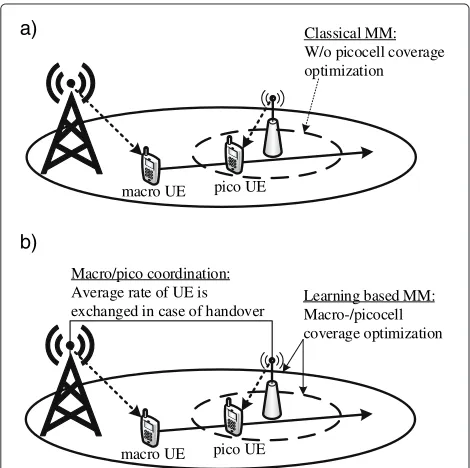
In this paper, we propose MM approaches for network capacity maximization and HOF reduction, which also maintain user fairness across the network. In Figures 1a,b, we depict the basic idea of the classical MM and the proposed MM approaches, respectively. In the classical MM approach, there is no information exchange among tiers in case of UE handover and traffic offloading might be achieved by picocell range expansion. In the pro-posed MM approaches, instead, each cell individually optimizes its own MM strategy based on limited coor-dination among tiers. Hereby, macro and pico BSs learn how to optimize their REB on the long term. On the other
Classical MM: W/o picocell coverage optimization
macro UE pico UE
Macro/pico coordination: Average rate of UE is exchanged in case of handover
Learning based MM: Macro-/picocell coverage optimization
macro UE pico UE a)
b)
Figure 1Learning-based MM framework with velocity and history (average rate)-based resource allocation (a, b).
hand, on the short term, they carry out user schedul-ing based on each UE’s velocity and average rate via coordination among the macrocell and picocell tiers. We propose two learning-based MM approaches: MAB and satisfaction-based MM. The major difference between MAB and satisfaction-based learning is that MAB aims at maximizing the overall capacity, while satisfaction-based learning aims at satisfying the network in terms of capac-ity. The contributions of this article can be summarized as follows:
• In the proposed MM approaches, we focus on both short-term and long-term solutions. In the long term, a traffic load balancing procedure in a HetNet scenario is proposed, while in the short term, the UE association process is solved.
• To implement the long-term load balancing method, we propose two learning-based MM approaches by using reinforcement learning techniques: a
MAB-based and a satisfaction-based MM approach.
• The short-term UE association process is based on a proposed context-aware scheduler considering a UE’s throughput history and velocity to enable fair scheduling and enhanced cell association.
3 System model
We focus on the downlink transmission of a two-layer HetNet, where layer 1 is modeled as macrocells and layer 2 as picocells. The HetNet consists of a set of BSsK = {1,. . .,K}with a setM= {1,. . .,M}of macrocells under-laid by a set P = {1,. . .,P} of picocells, where K = M∪P. Macro BSs are dropped following a hexagonal lay-out including three sectors. Within each macro sectorm, p ∈ P picocells are randomly positioned, and a setU = {1,. . .,U}of UE which are randomly dropped within a cir-cle around each picocellp(referred as a hotspot region). UE associated to macrocells are referred as macro UE U(m) = {1(m),. . .,U(m)} ∈ U and UE served by pico-cells are referred as pico UEU(p)= {1(p),. . .,U(p)} ∈U, whereU(p) = U(m). Each UEi(k)withk ∈ {m,p}has a randomly selected velocityvi(k) ∈ Vkm/h and a random
direction of movement within an angle of [0; 2π]. This is a slightly modified version of the mobility model described in Section 5.3.1 case 2 in [2]. The only difference with the 3GPP mobility model is that we do not consider any bouncing circle in our simulations. Hereby, considering a random direction of movement and no bouncing circle enables different types of handover (macro-to-macro and pico(macro)-to-macro(pico). A co-channel deployment is considered, in which picocells and macrocells operate in a system with a bandwidthBconsisting ofr = {1,. . .,R} resource blocks (RBs). At every time instanttn=nTswith
n= [1,. . .,N] andTs = 1 ms, each BSkdecides how to
with βm = {0; 3; 6}dB and βp = {0; 3; 6; 9; 12; 15} dBa.
Both macro and pico BSs select their REB to decide which UEi(k)to schedule on which RB based on the UE’s con-text parameters. These concon-text parameters are defined as the UE’s velocityvi(k), its instantaneous rateφi(k)(tn)when
associated to BSk, and its average rateφi(k)(tn)defined as
φi(k)(tn)=
1 T
N
n=1
φi(k)(tn), (1)
wherebyT = NTsis a time window. The instantaneous
rateφi(k)(tn)is given by
φi(k)(tn)=Bi(k)log1+γi(k)(tn)
, (2)
withγi(k)(tn)being the SINR of UEi(k)at timetn, which
is defined as
γi(k)(tn)=
pkgi(k),k(tn)
j∈K j=k
pjgi(k),j(tn)+σ2
, (3)
wherepkis the transmit power of BSk,σ2is the noise vari-ance, andgi(k),k(tn)is the channel gain from cellkto UE
i(k)associated to BSk. The bandwidthBi(k)in Equation 2
is the bandwidth which is allocated to UEi(k)by BSkat timetn.
3.1 Handover procedure
According to the 3GPP standard, the handover mecha-nism involves the use of RSRP measurements, the filtering of measured RSRP samples, a handover hysteresis margin, and a time-to-trigger (TTT) parameter. Hereby, TTT is a time window which starts after the handover condition is fulfilled; a UE does not transmit its measurement report to its serving cell before the TTT timer expires. This helps to ensure that ping-pongs are minimized due to fluctua-tions in the link qualities from different cells. The main steps of a typical handover process in a HetNet scenario are illustrated in Figure 2. First, a UE performs RSRP mea-surements and waits until the biased RSRP from a target cell (e.g., a picocell) is larger than the biased RSRP from its serving cell (e.g., a macrocell) plus a hysteresis margin (step 1). Hence, a handover is executed if the target cell’s (biased) RSRP (plus hysteresis margin) is larger than the source cell’s (biased) RSRP, i.e., the handover condition for a UEi(k)to BSkis defined as
Pl(i(l))+βl<Pk(i(k))+βk+mhist, (4)
with {l,k} ∈ K, mhist [dB] the UE- or cell-specific hys-teresis margin, βk(βl) [dB] is the REB of BS k(l), and
Pk(i(k)) (orPl(i(l))) [dBm] is the i(k)-th (i(l)-th) UE’s
RSRP from BSk(l). Even when the condition in (4) is sat-isfied, the UE waits for a duration of TTT, before sending a measurement report to its serving cell (step 2). If the condition in step 1 is still satisfied after TTT, the UE sends
Location of UE DL
RSRP
1
2 3
4
HOF macrocell
picocell
1. Hysteresis threshold 2. TTT running
3. Measurement report (Uplink) 4. Handover command (Downlink)
Figure 2Illustration of the HOF problem in HetNets due to small cell size.
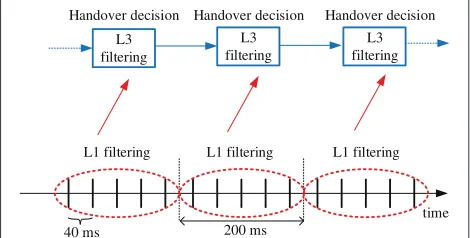
the measurement reports to its serving cell in its uplink (step 3), which finalizes the handover by sending a han-dover command to the UE in the downlink (step 4). In order to filter out the effects of fast fading and shadowing, a UE obtains each RSRP sample as the linear average over the power contribution of all resource elements that carry the common reference signal within one subframe (i.e., 1 ms) and in a pre-defined measurement bandwidth (e.g., 6 RBs) [2]. This linear averaging is done in layer 1 filter. As illustrated in Figure 3, layer 1 filtering is performed every 40 ms and averaged over five samples. The layer 1 fil-tered measurement is then updated through a first-order infinite impulse response filter in layer 3 every 200 ms [2].
4 Problem formulation for throughput maximization
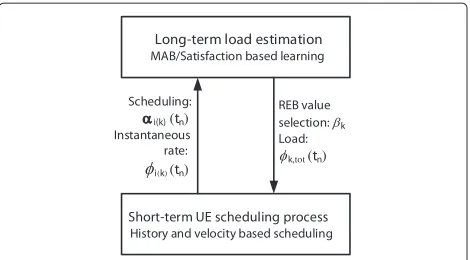
In this section, we describe our optimization approach for maximizing the total rate of each cell k as a long-term load balancing process. To provide a better overview, we first present the interaction of the proposed term and short-term processes in Figure 4. The long-term load balancing optimization approach is solved by the proposed learning-based MM approaches presented in Section 6.1 and Section 6.2. As illustrated in Figure 4, both, MAB and satisfaction-based MM, result in REB
time Handover decision
L3 filtering
L1 filtering
L3 filtering
L3 filtering
40 ms 200 ms
L1 filtering L1 filtering
Handover decision Handover decision
Long-term load estimation MAB/Satisfaction based learning
Short-term UE scheduling process
History and velocity based scheduling REB value
Figure 4Flow chart of the proposed learning-based MM approaches.
βk value optimization and in load balancing φk,tot(tn).
Based on the estimated instantaneous load, the context-aware scheduler selects, in the short term, for each RB a UE by considering its history and velocity as described in Section 5. This results in each UE’s instan-taneous rate φi(k)(tn) and the RB allocation vector
cated at RB r or not. The inter-relation between the selected context parameters (UE’s history and velocity), the scheduling function, the described optimization for-mulation, and the rationale behind the short-term and long-term MM approaches can be summarized as follows. Within the proposed MM approach, we carry out load balancing in the long term by optimizing the REB values and carry out history-based UE scheduling in the short term by means of the proposed context-aware scheduler. The combination of both procedures yields the HOF and PP probability reduction via the optimal REB value selec-tion and the proposed context-aware scheduler. Here, the load balancing procedure yielding the optimal REB value incurs wideband SINR enhancement and HOF reduction. The context-aware scheduler on the other hand schedules UE based on the highest estimated achievable rate of each UE according to its instantaneous channel condition and its history, which leads to long-term fairness among UE. Both approaches, i.e., load balancing and history-based scheduling, yield throughput enhancement. Additionally, the velocity-based ranking property of the context-aware scheduler reduces the PP probability since low velocity UE are prioritized over high-velocity UE.
The optimization approach aims at maximizing the total rate φk,tot(tn) of each cell k in long-term, i.e., for
each time instant tn, each BS k performs the following
optimization:
The condition in (12) implies that the total transmitted power over all RBs does not exceed the maximum trans-mission power of BSk. Since our optimization approach in (6) aims at maximizing the total rate, the last condition (13) dictates that the instantaneous rate is larger than a minimum rate for BSk. Due to the distributed nature of this optimization problem in (6), we will investigate two reinforcement learning techniques in this paper, as will be discussed in Sections 6.1 and 6.2.
5 Short-term solution: a context-aware scheduler The proposed MM approach considers a fairness-based context-aware scheduling mechanism in the short term. At each RBr, a UEi(k)∗is selected to be served by BSk according to the following scheduling criterion:
i(k)∗r = sort
The scheduler defined in (14) will allocate many (or even all) resources to a newly handed over UE since its aver-age rate in the target cell is zero. To avoid this and enable a fair resource allocation among all UE in a cell, we pro-pose a history-based scheduling approached as follows. Via the X2-interface, macro- and picocells coordinate, so that once a macro UE i(m) is handed over to a pico-cellp, the UE’s target cellpand source cellmexchange information. In particular, UEi(m)’s rate history at time instanttnis provided to picocellpin terms of average rate φi(m)(tn), such that the UE’s (which is named asi(p)after
the handover) average rate at picocellpbecomes
φi(p)(tn+Ts)=
Tφi(m)(tn)+φi(p)(tn+Ts)
T+1 . (15)
In (15), a moving average rate is considered from macro-cell to picomacro-cell, whereas in the classical MM approach, a UE’s rate history is not considered and is equal to zero. In other words, in the classical proportional fair scheduler, the average rateφi(tn)in (14) isφi(tn) = φi(k)(tn) = 0
when a UE is handed over to cell k, whereas we rede-fine it according to (15), i.e.,φi(tn) = φi(p)(tn+Ts). The
proposed MM approach, instead, considers the histori-cal rate when UEi(m)was associated to the macrocellm in the past. The incorporation of a UE’s history enables the scheduler to perform fair resource allocation even in the presence of a sequence of handovers. Since handovers occur more frequently in HetNets due to small cell sizes, such a history-based scheduler leads to fair frequency resource allocation among the UE of a cell. More specifi-cally, UE recently joining a cell will not be preferred over other UE of the cell since their historical average rate will be taken into account.
6 Long-term solution: learning-based mobility management techniques
To solve the optimization approach defined in Section 4, we rely on the self organizing capabilities of HetNets and propose an autonomous solution for load balancing by using tools from reinforcement learning [29]. Hereby, each cell develops its own MM strategy to perform optimal load balancing based on the proposed learning approaches pre-sented in Sections 6.1 and 6.2 and schedules its UE accord-ing to the context-aware scheduler presented in Section 5. An overview of the inter-relation of the short-term and long-term MM approaches is provided in Algorithm 2 (see Appendix). To realize this, we consider the gameG= {K,{Ak}k∈K,{uk}k∈K}, in which each cell autonomously learns its optimal MM strategy. Hereby, the set K = {M∪P}represents the set of players (i.e., BSs), and for allk∈K, the setAk = {βk}represents the set of actions
playerkcan adopt. For allk∈K,ukis the utility function
of playerk. The action definition implies that the BSs learn at each time instanttnto optimize their traffic load in the
long term using the cell range expansion process. Each BS learns its action selection strategy based on the MAB orsatisfaction-based learning approaches as presented in Sections 6.1 and 6.2, respectively.
6.1 Multi-armed bandit-based learning approach
The first learning-based MM approach is based on the MAB procedure, which aims to maximize the overall sys-tem performance. MAB is a machine learning technique based on an analogy with the traditional slot machine (one-armed bandit) [30]. When pulled at time tn, each
machine/player provides a reward. The objective is to maximize the collected reward through iterative pulls, i.e., learning iterations. The crucial trade-off the player faces at each trial is between exploitation of the action that has the highest expected utility and exploration of new actions to get more information about the expected util-ity performance of the other actions. The player selects its actions based on a decision function reflecting this exploration-exploitation trade-off.
The set of actions, the learning strategy, and the utility function for our MAB-based MM approach are defined as follows:
• Actions:Ak = {βk}withβm=[0, 3, 6]dB and βp=[0, 3, 6, 9, 12, 15, 18]dB is the CRE bias. We consider higher bias values for picocells due to their low transmit power. The considered bias values are selected considering the results in [31] and also based on our extensive simulation studies.
• Strategy:
1. Every BSklearns its optimum CRE bias value on a long-term basis considering its load as defined in (5). This is interrelated with the handover triggering by defining the cell border of each cell. The problem formulation defined in Section 4 optimizes this load in the long term, i.e., over timetn.
2. A UE is handed over to BSkif it fulfills the condition (4).
3. RB-based scheduling is performed based on the context-aware scheduler defined in Section 5.
• Utility Function:The utility function is a decision function in MAB learning and is composed by an exploitation term represented by playerk’s mean reward for selecting an action until timetnand an exploration term that considers the number of times an action has been selected so far. Playerkselects its actionaj(k)(tn)∈Akat timetnthrough maximizing a decision functiondk,aj(k)(tn), which is defined as
dk,aj(k)(tn)=uk,aj(k)(tn)+
2 log|iA=1k|nk,ai(k)(tn)
whereuk,aj(k)(tn)is the mean reward of playerkat timetnfor actionaj(k),nk,aj(k)(tn)is the number of times actionaj(k)has been selected by playerkuntil timetn, and| · |represents the cardinality operation.
The decision function in the form as in (16) has been proposed by Auer et al. in [30]. The main advantage of Auer’s solution is that the decision function does not rely on the regret which is the loss due to the fact that the globally optimal policy (which is usually not known in practical wireless networks) is not followed in each learn-ing iteration. It is clear that the regret will increase with time, because the globally optimal policy is usually not known and hence cannot be followed by the player. Thus, the MAB-based strategies need to bound the increase of the regret, at least asymptotically. Auer et al. defined an upper confidence bound (UCB) within which the regret will be present. The UCB considers the player’s aver-age reward and the number of times an action has been selected untiltn. Relying on these assumptions, we define
our decision function in Equation 16.
During the firsttn = |Ak| iterations, playerk selects
each action once in a random order to initialize the learn-ing process by receivlearn-ing a reward for each action. For the following iterations tn > |Ak|, action selection is
performed according to Algorithm 1. In each learning iteration, the action a∗j(k) that maximizes the decision function in (16) is selected by playerk. Then, the param-eters sk,aj(k)(tn), nk,aj(k)(tn), and uk,aj(k)(tn) are updated,
wheresk,aj(k)(tn)is the cumulated reward of playerkafter
playing actionaj(k)and1i=jis equal to 1 ifi=jand zero
otherwise.
Algorithm 1MAB-based mobility management algorithm. 1: fortn>|Ak|do
2: fori=1 :|Ak|do
3: Select actiona∗j(k)according:
4: a∗j(k)=arg maxa j(k)∈|Ak|
dk,aj(k)(tn)
5: Update parameters according to:
6: Update the cumulated reward when player k selects actionaj(k)
7: sk,aj(k)(tn+Ts)=sk,aj(k)(tn)+1i=jφk,tot(tn)
8: Update the number of times actionaj(k)has been
selected by playerk
9: nk,aj(k)(tn+Ts)=nk,aj(k)(tn)+1i=j
10: Update the mean reward for selecting actionaj(k)
11: uk,aj(k)(tn+Ts)=
sk,aj(k)(tn+Ts)
nk,aj(k)(tn+Ts) 12: end for
13: tn=tn+Ts
14: end for
6.2 Satisfaction-based learning approach
The idea of satisfaction equilibrium was introduced in [32], where players having partial or no knowledge about their environment and other players are solely interested in the satisfaction of some individual per-formance constraints instead of individual perper-formance optimization. Here, we consider the player to be satisfied if its cell reaches a certain minimum level of total rate and if at least 90% of the UE in the cell obtain a certain average rate. The rationale behind considering these satisfaction conditions is to guarantee a minimum rate for each indi-vidual UE, while at the same time improving the total rate of the cell.
To enable a fair comparison, the set of players and the corresponding set of actions in the proposed satisfaction-based MM approach are considered to be the same as those in the MAB-based MM approach. The utility func-tion of playerkat timetnis defined as the load according
to (5). In the satisfaction-based learning approach, the actions are selected according to a probability distribu-tionπk(tn)=
πk,1(tn),. . .,πk,|Ak|(tn)
. Hereby,πk,j(tn)is
the probability with which BSkchooses its actionaj(k)(tn)
at timetn. The following learning steps are performed in
each learning iteration:
1. In the first learning iterationtn=1, the probability of each action is equal and an action is selected randomly.
2. In the following learning iterationstn>1, the player changes its action selection strategyonly if the received utility does not satisfy the cell, i.e., if the satisfaction condition is not fulfilled.
3. If the satisfaction condition is not fulfilled, the player
kselects its actionaj(k)(tn)according to the probability distributionπk(tn).
4. Each playerkreceives a rewardφk,tot(tn)based on the selected actions.
5. The probabilityπk,j(tn)of actionaj(k)(tn)is updated according to the linear reward-inaction scheme:
πk,j(tn)=πk,j(tn−Ts)+λbk(tn)
[−4pt]×
1aj(k)(tn)=ai(k)(tn)−πk,j(tn−Ts)
,
(17)
whereby1aj(k)(tn)=ai(k)(tn)=1for the selected action
and zero for the non-selected actions. Moreover,
bk(tn)is defined as follows:
bk(tn)=
uk,max+φk,tot(tn)−uk,min 2uk,max
, (18)
whereuk,maxis the maximum rate in case of
single-UE anduk,min= 12uk,max. Hereby,
λ= 1
7 Simulation results
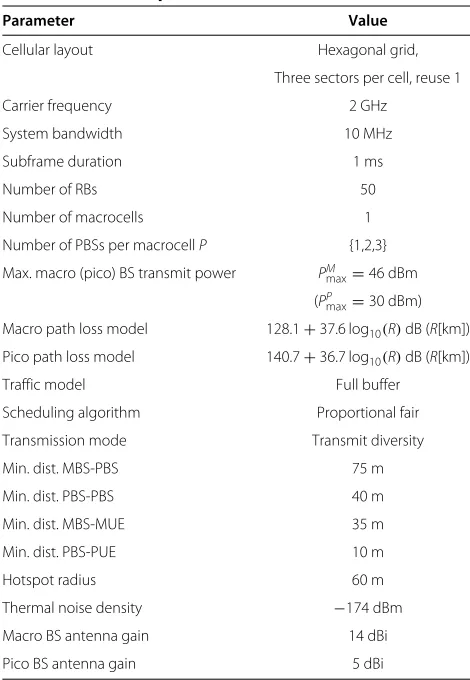
The scenario used in the system-level simulations is based on configuration #4b HetNet scenario in [21]. We consider a macrocell consisting of three sectors and P= {1, 2, 3} pico BSs per macro sector, randomly dis-tributed within the macrocellular environment as illus-trated in Figure 5. It has to be pointed out that the proposed MM approaches can be applied to any number of macrocells. We are presenting in this section the results for one macrocell (three macro sectors) due to large com-putation times. In each macro sector,U = 30 mobile UE are randomly dropped within a 60-m radius of each pico BS. The rationale behind dropping all UE around pico BSs is to obtain a large number of handover within a short time in order to avoid large computation times due to the com-plexity of our system level simulations. Each UEi(k)has a randomly selected velocity vi(k) of V = {3; 30; 60; 120}
km/h and a random direction of movement within [0; 2π]. We consider fast-fading and shadowing effects in our sim-ulations that are based on 3GPP assumptions [21]. Further simulation parameters are summarized in Table 1.
To compare our results with other approaches, we con-sider a baseline MM approach as defined in [2]. In the baseline MM approach, handover is performed based on layer 1 and layer 3 filtering as described in Section 3.1. For the baseline MM approach, we consider proportional fair-based scheduling, with no information exchange between macro and pico BSs. This baseline approach is referred to asclassicalHO approach. In the following, we will com-pare our proposed MM approaches with this baseline MM approach which is aligned with the handover procedure defined in 3GPP [2].
7.1 UE throughput and sum-rate
Figure 6 depicts the cumulative distribution function (CDF) of the UE throughput for the classical, MAB -andsatisfaction-based MM approaches. For the classical
macro BS pico BS
hotspot
picocell coverage MUE
PUE
Figure 5Illustration of the simulated HetNet scenario.
Table 1 Simulation parameters
Parameter Value
Cellular layout Hexagonal grid,
Three sectors per cell, reuse 1
Carrier frequency 2 GHz
System bandwidth 10 MHz
Subframe duration 1 ms
Number of RBs 50
Number of macrocells 1
Number of PBSs per macrocellP {1,2,3} Max. macro (pico) BS transmit power PM
max=46 dBm (PP
max=30 dBm) Macro path loss model 128.1+37.6 log10(R)dB (R[km]) Pico path loss model 140.7+36.7 log10(R)dB (R[km])
Traffic model Full buffer
Scheduling algorithm Proportional fair
Transmission mode Transmit diversity
Min. dist. MBS-PBS 75 m
Min. dist. PBS-PBS 40 m
Min. dist. MBS-MUE 35 m
Min. dist. PBS-PUE 10 m
Hotspot radius 60 m
Thermal noise density −174 dBm
Macro BS antenna gain 14 dBi
Pico BS antenna gain 5 dBi
approach, we present results for different picocell REB values βp. For the MAB- and satisfaction- based MM
0 0.5 1 1.5 2 2.5 3 3.5 4
Throughput per UE [Mbps]
CDF
Figure 6CDF of the UE throughput for 30 UE and 1 pico BS per macrocell and TTT = 480 ms.
In the case of the long-term only MM approaches, the improvement in average UE throughput is 12% and 37% for the MAB- and satisfaction-based MM approaches, respectively. Hence, the satisfaction-based approach out-performs the other MM approaches in terms of average and cell-edge UE throughput. In case of the cell-center UE throughput, which is defined as the 95th% through-put, the opposite behavior is obtained. In this case, an improvement of 124% and 80% is achieved for the MAB- and satisfaction-based approaches, respectively. The reason is that the satisfaction-based MM approach only aims at satisfying the network in terms of rate and does not update its learning strategy once satis-faction is achieved in the network, i.e., no actions that may lead to improvements are explored. The MAB-based approach on the other hand aims at maximizing the
10 15 20 25 30 35 40 45 50
Number of UEs per macrocell Cell−edge UE throughput [kbps] βp={0,3,6,9} dB
Classical MAB Satisfaction
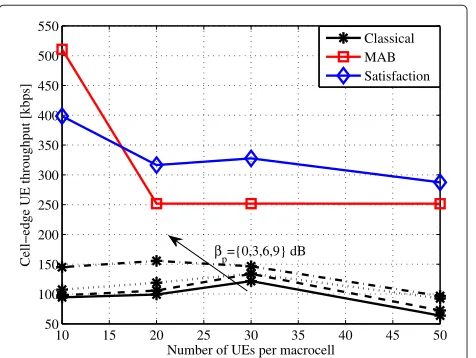
Figure 7Cell-edge (/5th%) UE throughput for 30 UE and 1 pico BS per macrocell and TTT = 480 ms.
network performance, which is reflected in the improved cell-center UE throughput.
To show the effect of different REB values in case of classical MM, we depict in Figure 7 the cell-edge UE throughput for different number of UE per macrocell. With increasing REB bias value for picocells, the cell-edge UE throughput is enhanced. However, the proposed learning-based MM approaches outperform the classi-cal approach up to five times for 10 UE per macrocell and up to 4.5 times for 50 UE per macrocell. Interest-ingly, the MAB-based MM yields higher cell-edge UE throughput than the satisfaction-based MM approach for smaller number of UE. This can be interpreted as fol-lows: In a scenario with 10 UE and a bandwidth of 10 MHz, the probability of having unsatisfied UE is very low. Since most of the UE (or even all UE) are satisfied, the satisfaction-based learning approach does not change its strategy to further enhance each UE’s performance, whereas the MAB-based learning procedure adapts its strategy disregarding the satisfaction condition to maxi-mize the UE’s performance. This leads to the fact that the cell-edge UE performance is enhanced, too. With increas-ing number of UE, the probability of unsatisfied UE’s in the cell increases and the satisfaction-based learning approach adapts its strategy to enhance especially the cell-edge UE performance, i.e., to satisfy all UE in the cell. That is why the cell-edge UE performance is larger for the satisfaction-based MM approach for increasing the number of UE. In addition to the results for different REB values, we present in Figure 8 the sum-rate versus UE density per macrocell for TTT = {40, 480}ms values. For both TTT values, the classical approach yields very low sum-rates, while the proposed approaches lead to sig-nificant improvement of up to 81% and 85% for TTT values 40 ms and 480 ms, respectively. The proposed MM
10 15 20 25 30 35 40 45 50
Number of UEs per macrocell
Sum−rate [Mpbs]
Classical (TTT = 480 ms) MAB (TTT = 480 ms) Satisfaction (TTT = 480 ms) Classical (TTT = 40 ms) MAB (TTT = 40 ms) Satisfaction (TTT = 40 ms)
Table 2 Confidence intervals of the sum-rates for a confidence level of 95%
MM approach Number of UE per macrocell
10 20 30 50
Classical MM [45.74, 56.33] [58.77, 67.15] [62.61, 71.94] [67.51, 76.81]
MAB MM [92.04, 113.92] [116.79, 132.7] [124.4, 142.33] [124.4, 142.33]
Satisfaction MM [92.37, 114.11] [116.07, 132.84] [124.04, 142.2] [128.64, 145.77]
Confidence interval of simulation results for sum-rate [Mbps] for 1 pico BS per macrocell, different number of UE, and TTT = 480 ms.
approaches converge to significantly larger sum-rates than the classical MM approach. Interestingly, the sum-rate performance of the proposed MM approaches depends on the TTT. The reason for this lies in the convergence behavior of the learning algorithms. For smaller TTT val-ues, handover is executed faster and the BS has to adapt its REB strategy to the new cell load before convergence. To demonstrate the statistical properties of the presented results in Figure 8, we present confidence intervals of the sum-rates for a confidence level of 95% in Table 2. It can be seen that the presented sum-rate results lie within the confidence intervals.
Figure 9 depicts the effect of the long-term strategy on the derived REB values. Since the long term is related to the load estimation which impacts the average UE throughput, we depict it over the REB values. In case of the learning-based MM approaches, we would like to emphasize that each BS selects its own REB value according to the selected learning approach. This leads in the simulations to the fact that in the REB optimization process some REB values are favored against other REB values and that a mix of REB value selection for all BSs is achieved, so that the average UE throughput is depicted over mixed REB values. This is due to the fact that based on the self-organizing capability of our proposed learning approaches, the REB values are selected autonomously by
0 3 6 mixed mixed 0
0.2 0.4 0.6 0.8 1 1.2 1.4
REB [dB]
Average UE throughput [Mbps]
Classical MAB Satisfaction
Figure 9Average UE throughput over REB values for 30 UE and 1 pico BS per macrocell and TTT = 480 ms.
each BS according to their learning strategy. Hence, the selection of each REB value is controlled by the learning approach and not by our simulation settings, so that it is not possible to separately present results for each REB value. It can be seen that a fix REB value selection leads to lower average UE throughput than an autonomous REB value selection by each BS, which is the case for the proposed learning-based MM approaches.
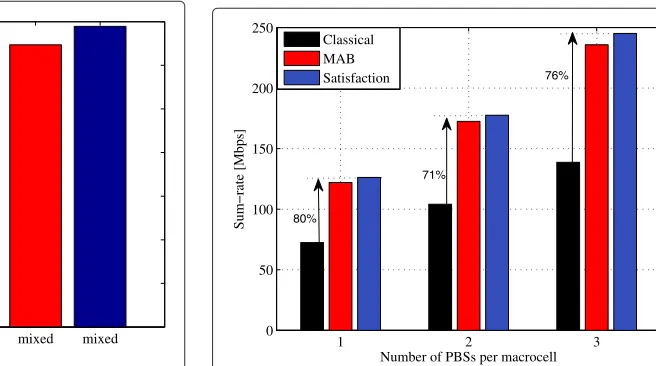
To compare the performance of the proposed approaches for different number of picocells per macro-cell, Figure 10 plots the sum-rate versus number of pico BSs per macrocell. For the different number of pico BSs, the proposed MM approaches yield gains of around 70% to 80% for TTT=480 ms.
7.2 HOF and PP probabilities
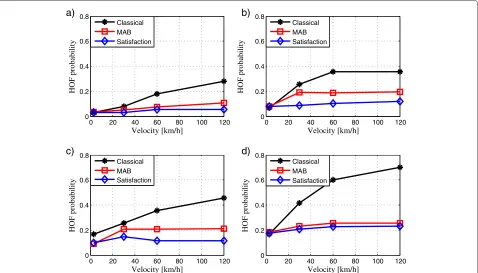
Mobility management approaches must not only enhance the networks performance in terms of UE throughput and sum-rate but also reduce handover failure rates and PP probabilities. Here, we present results for the HOF proba-bility and PP event probaproba-bility. We modify our simulation settings by using the same velocity for each UE per simu-lation, so that we can present results for each velocity sep-arately. Figure 11 depicts the HOF probability for different TTT values. As it can be seen, our proposed learning-based approaches yield, besides the gains in terms of rate,
1 2 3
0 50 100 150 200 250
Number of PBSs per macrocell
Sum−rate [Mbps]
Classical MAB
Satisfaction 76%
71%
80%
0 20 40 60 80 100 120 0
0.2 0.4 0.6 0.8
Velocity [km/h]
HOF probability
0 20 40 60 80 100 120
0 0.2 0.4 0.6 0.8
Velocity [km/h]
HOF probability
0 20 40 60 80 100 120
0 0.2 0.4 0.6 0.8
Velocity [km/h]
HOF probability
0 20 40 60 80 100 120
0 0.2 0.4 0.6 0.8
Velocity [km/h]
HOF probability
Classical MAB Satisfaction Classical
MAB Satisfaction
Classical MAB Satisfaction
Classical MAB Satisfaction
a) b)
d) c)
Figure 11HOF probability for different TTT values.HOF probability for 30 UE and 1 pico BS per macrocell and(a)TTT=40 ms,(b)TTT=80 ms, (c)TTT=160 ms, and(d)TTT=480 ms.
improvements in terms of HOF probability. Compared to the classical MM approach, the proposed methods yield to the same HOF probability for UE at 3 km/h speed. For higher velocities in which more HOFs are expected, the HOF probability obtained by the proposed approaches is significantly lower than in the case of classical MM. Inter-estingly, the proposed methods lead to almost constant HOF probabilities for velocities larger than 30 km/h. For UE at 120 km/h, the HOF probability of the MAB-based approach is twice the HOF probability of satisfaction-based learning but only one third of the classical approach for TTT=40 ms. For increasing TTT values, the trend between the proposed MM approaches and the classical MM approach remains similar. This is because the picocell coverage in the classical approach without range expan-sion is small, and thus the macrocell UE quickly run deep inside the picocell coverage area before the TTT expires, significantly degrading the signal quality of the macrocell UE before the handover is completed. In this case, HOFs are alleviated with smaller TTT values.
Reducing TTT values may decrease the HOF probabil-ity but increase PP probabilprobabil-ity. Hence, HOFs and PPs must be studied jointly. We depict in Figure 12 the PP prob-ability for the same simulation settings as in Figure 11. It can be observed that the number of PPs are reduced with larger TTT values. In addition, for lower velocities, all MM approaches yield similar PP probabilities for all
TTT values. For higher velocities, the PP probability is decreased by the proposed MM approaches by up to a factor of two (TTT=40 ms).
7.3 Convergence behavior of MAB- and satisfaction-based MM
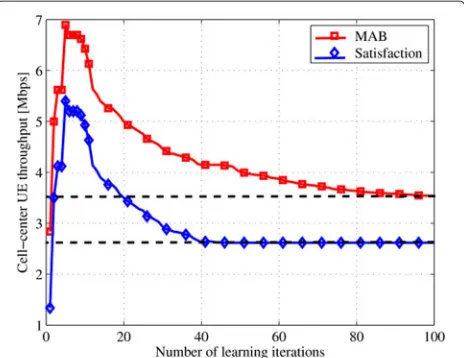
One of the major concerns of learning-based approaches is their convergence behavior in dynamic systems. In Figure 13, we depict the convergence of the proposed
Figure 13Convergence of cell-center (95-th%) UE throughput for 30 UE and 1 pico BS per macrocell and TTT= {480}ms.
learning-based MM approaches in terms of cell-center UE throughput. It can be seen that the MAB-based MM approach converges slower than the satisfaction-based MM approach, but it converges to a larger cell-center UE throughput since it aims at system performance maxi-mization. Hence, depending on the system requirements, either the MAB-based approach can be applied if a large cell-center UE throughput is aimed or the satisfaction-based approach can be preferred if a better cell-edge UE throughput (see Figure 7) and fast convergence is expected.
8 Conclusions
We propose two learning-based MM approaches and a history-based context-aware scheduling method for HetNets. The first approach is based on MAB-based learning and aims at system performance maximization. The second method aims at satisfying each cell and each UE of a cell and is based on satisfaction-based learning. System level simulations demonstrate the performance enhancement of the proposed approaches compared to classical MM method. While up to 80% gains are achieved in average for UE throughput, the HOF probability is reduced significantly by the proposed learning-based MM approaches.
Endnote
aWe consider lower REB values for macro BSs to avoid
overloaded macrocells due to their large transmission power.
Appendix
Algorithm 2 presents the interrelation between the short-term and long-short-term MM approaches.
Algorithm 2 Simulation flow for long- and short-term mobility management algorithm.
1: whiletn<Tsimdo
2: Update UE positions based on each UE’s velocity vi(k)and direction of movement
3: Update channel conditions 4: Begin short-term MM approach: 5: for each UEi(k),k∈Kdo
6: Check handover condition in (4):
7: ifpl(i(l))+βl>pk(i(k))+βk+mhistthen
8: Handover UEi(k)to BSl
9: Forward average rateφi(¯tn)of UEito BSl
10: else
11: No handover
12: end if
13: Perform context-aware scheduling according to (14)
14: end for
15: Begin long-term MM approach: 16: foreach BSk,k∈Kdo
17: Select βk according to MAB/satisfaction based MM approach.
18: end for
n=n+1 19: end while
Competing interests
The authors declare that they have no competing interests.
Authors’ contributions
The general ideas presented in this article have been developed by all the authors at high level. MS developed the algorithms presented, implemented them into the system level simulator, and ran simulations. The paper has been revised collaboratively by all authors. All authors read and approved the final manuscript.
Acknowledgements
This research was supported in part by the SHARING project under the Finland grant 128010 and by the U.S. National Science Foundation under the grants CNS-1406968 and AST-1443999.
Author details
1Vodafone Chair Mobile Communications Systems Technische Universität Dresden, Dresden, Germany.2Centre for Wireless Communications, University of Oulu, Oulu, Finland.3Department of Electrical & Computer Engineering, Florida International University, Miami, FL, USA.
Received: 11 August 2014 Accepted: 5 January 2015
References
1. Cisco Visual Networking Index: Global Mobile Data Traffic Forecast Update, 2013-2018. Cisco Public Information (2014)
2. 3GPP, Evolved Universal Terrestrial Radio Access (E-UTRA); Mobility Enhancements in Heterogeneous Networks. Technical Report 3GPP TR 36.839 V11.1.0 (Oct. 2012)
3. Y Peng, YZW Yang, Y Zhu, inProc. IEEE Symposium on Personal Indoor and Mobile Radio Communications (PIMRC). Mobility Performance
4. H Holma, A Toskala,LTE-Advanced: 3GPP Solution for IMT-Advanced. (John Wiley & Sons, Ltd, UK, 2012)
5. J Aonso-Rubio, inProc. IEEE Network Operations and Management Symp. Self-optimization for handover oscillation control in LTE, (2010), pp. 950–953
6. G Hui, P Legg, inProc. IEEE Vehic. Technol. Conf. (VTC). LTE handover optimisation using uplink ICIC, (2011), pp. 1–5
7. K Kitagawa, T Komine, inProc. IEEE Int. Symp. Personal Indoor Mobile Radio Commun. (PIMRC). A handover optimization algorithm with mobility robustness for LTE systems, (2011), pp. 1647–1651
8. K Ghanem, H Alradwan, inProc. IEEE Int. Symp. Commun. Syst., Networks and Digital Signal Proc. Reducing ping-pong handover effects in intra EUTRA networks, (2012), pp. 1–5
9. H Zhang, X Wen, B Wang, W Zheng, Z Lu, inProc. IEEE Int. Conf. on Research Challenges in Computer Science. A novel self-optimizing handover mechanism for multi-service provisioning in LTE-Advanced, vol. 1, (2009), pp. 221–224
10. T Jansen, I Balan, J Turk, I Moerman, T Kurner, inProc. IEEE Vehic. Technol. Conf. (VTC). Handover parameter optimization in LTE self-organizing networks, (2010), pp. 1–5
11. K Dimou, M Wang, Y Yang, M Kazmi, A Larmo, J Pettersson, W Muller, Y Timner, inProc. IEEE Vehic. Technol. Conf. (VTC). Handover within 3GPP LTE: design principles and performance, (2009), pp. 1–5
12. W Li, X Duan, S Jia, L Zhang, Y Liu, J Lin, inProc. IEEE Vehic. Technol. Conf. (VTC). A dynamic hysteresis-adjusting algorithm in LTE self-organization networks, (2012), pp. 1–5
13. T-H Kim, Q Yang, J-H Lee, S-G Park, Y-S Shin, inProc. IEEE Vehic. Technol. Conf. (VTC). A mobility management technique with simple handover prediction for 3G LTE systems, (2007), pp. 259–263
14. M Carvalho, P Vieira, inProc. Int. Symp. on Wireless Personal Multimedia Commun.An enhanced handover oscillation control algorithm in LTE Self-Optimizing networks, (2011)
15. W Luo, X Fang, M Cheng, X Zhou. Proc. IEEE Int. Workshop on Signal Design and Its Applications in Commun, (2011), pp. 193–196 16. I Balan, T Jansen, B Sas, inProc. Future Network and Mobile Summit.
Enhanced weighted performance based handover optimization in LTE, (2011), pp. 1–8
17. T Jansen, I Balan, S Stefanski, I Moerman, T Kurner, inProc. IEEE Vehic. Technol. Conf. (VTC). Weighted performance based handover parameter optimization in LTE, (2011), pp. 1–5
18. H-D Bae, B Ryu, N-H Park, inAustralasian Telecommunication Networks and Applications Conference (ATNAC). Analysis of handover failures in LTE femtocell systems, (2011), pp. 1–5
19. Y Lei, Y Zhang, inProc. IEEE Int. Conf. Computer Theory and Applications. Enhanced mobility state detection based mobility optimization for femto cells in LTE and LTE-Advanced networks, (2011), pp. 341–345
20. M. P Wiley-Green, T Svensson, inProc. IEEE GLOBECOM. Throughput, Capacity, Handover and Latency Performance in a 3GPP LTE FDD Field Trial (FL, USA, Dec. 2010)
21. 3GPP,Evolved Universal Terrestrial Radio Access (EUTRA); Further
advancements for E-UTRA Physical Layer Aspects, Technical Report 3GPP TR 36.814 V9.0.0, (Oct. 2010)
22. D Xenakis, LMN Passas, C Verikoukis, Mobility Management for Femtocells in LTE-Advanced: Key Aspects and Survey of Handover Decision Algorithms. IEEE Comm. Surveys Tutorials.16(1) (2014)
23. S Barbera, SPH MMichaelsen, K Pedersen, inProc. IEEE Wireless Comm. and Networking Conf. (WCNC). Mobility Performance of LTE Co-Channel Deployment of Macro and Pico Cells (France, Apr. 2012)
24. RBP Munoz, I de la Bandera, On the potential of handover parameter optimization for self-organizing networks. IEEE Trans. Vehicular Technol. 62(5), 1895–1905 (2013)
25. D Lopez-Perez, I Guvenc, X Chu, Mobility management challenges in 3GPP heterogeneous networks. IEEE Comm. Mag.50(12) (2012) 26. KI Pedersen, RPH CMichaelsen, S Barbera, Mobility enhancements for
LTE-advanced multilayer networks with inter-site carrier aggregation. IEEE Comm. Mag.51(5) (2013)
27. J Wang, JPJ DWLiu, G Shen, inProc. IEEE Vehic. Technol. Conf. (VTC). Optimized Fairness Cell Selection for 3GPP LTE-A Macro-Pico HetNets (CA, Sept. 2011)
28. A Feki, V Capdevielle, L Roullet, AG Sanchez, in11th Int. Symp. on Modeling & Optimization in Mobile, Ad Hoc & Wireless Networks (WiOpt). Handover Aware Interference Management in LTE Small Cells Networks, (2013) 29. ME Harmon, SS Harmon, Reinforcement Learning: A Tutorial. http://
citeseerx.ist.psu.edu/viewdoc/download?doi=10.1.1.33.2480&rep=rep1& type=pdf
30. NC-BP Auer, P Fischer, Finite time analysis for the multiarmed bandit problem. Mach. Learn.17, 235–256 (2012)
31. 3GPP,Performance Study on ABS with Reduced Macro Power, Technical Report 3GPP R1-113806, (Nov. 2011)
32. S Ross, B Chaib-draa, inProc. 19th Canadian Conf. on Artificial Intelligence. Satisfaction equilibrium: achieving cooperation in incomplete information games, (2006)
Submit your manuscript to a
journal and benefi t from:
7Convenient online submission
7Rigorous peer review
7Immediate publication on acceptance
7Open access: articles freely available online
7High visibility within the fi eld
7Retaining the copyright to your article