R E S E A R C H
Open Access
Low-complexity multiuser MIMO downlink system
based on a small-sized CQI quantizer
Jiho Song
1, Jong-Ho Lee
2, Seong-Cheol Kim
1and Younglok Kim
3*Abstract
It is known that the conventional semi-orthogonal user selection based on a greedy algorithm cannot provide a globally optimal solution due to its semi-orthogonal property. To find a more optimal user set and prevent the waste of the feedback resource at the base station, we present a multiuser multiple-input multiple-output system using a random beamforming (RBF) scheme, in which one unitary matrix is used. To reduce feedback overhead for channel quality information (CQI), we propose an efficient CQI quantizer based on a closed-form expression of expected SINR for selected users. Numerical results show that the RBF with the proposed CQI quantizer provides better throughput than conventional systems under minor levels of feedback.
1 Introduction
The study of multiuser multiple-input multiple-output (MU-MIMO) has focused on broadcast downlink chan-nels as a promising solution to support high data rates in wireless communications. It is known that the MU-MIMO system can serve multiple users simultaneously with reliable communications and that it can provide higher data rates than the point-to-point MIMO system owing to multiuser diversity [1-3]. In particular, dirty paper coding (DPC) has been shown to achieve high data rates that are close to the capacity upper bound [4,5]. However, this technique is based mainly on impractical assumption such as perfect knowledge of the wireless channel at the transmitter. To send the channel state information (CSI) back to the transmitter perfectly, considerable wireless resources are required to assist the feedback link between the base station (BS) and the mobile station (MS). This adds a high level of complex-ity to the communication system, which is not feasible in practice.
Numerous studies have investigated and designed MU-MIMO systems that operate reliably under limited knowledge of the channel at the transmitter [6-9]. The semi-orthogonal user selection (SUS) algorithm in [6] shows a simple MU-MIMO system with zero-forcing beamforming (ZFBF) [10] and limited feedback [11,12]. Although this system achieves a sum-rate close to the
DPC in the regime of large number of users, the overall performance is restricted seriously by a quantization error due to the mismatch between the predefined code and the normalized channel. For this reason, antenna combining techniques have been developed that decrease this quantization error using multiple antennas at the MS [7,8]. However, the SUS algorithm based on the conventional greedy algorithm does not guarantee a globally optimized user set. Furthermore, in earlier research, quantizing the channel quality information (CQI) is not considered.
In this article, we consider a MU-MIMO downlink sys-tem with minor levels of feedback in which each user sends channel direction information (CDI) quantized by a log2M-sized codebook instead of by the large prede-fined CDI codebook used in SUS. Furthermore, to reduce the feedback overhead for CQI, we propose a small-sized CQI quantizer based on the closed-form expression of the CQI of selected users. It is shown that the proposed quantizer provides a point of reference for the quantizing boundaries of CQI feedback and reflects the sum-rate growth resulting from multiuser diversity with only 1 or 2 bits. The proposed CQI quantizer operates well with minor levels of feedback.
The remainder of this article is organized as follows. In Section 2, we introduce the system model and pro-pose a low-complexity and small-sized feedback multi-antenna downlink system which is based on the random beamforming (RBF) scheme in [13]. In Section 3, we present the user selection algorithm in the RBF scheme
* Correspondence: [email protected]
3Department of Electronic Engineering, Sogang University, Seoul, Korea
Full list of author information is available at the end of the article
and we review the SUS algorithm and improve upon its weaknesses. In Section 4, the closed form expression for CQI is proposed whenN=M orN≠M respectively in order to set up the criteria of quantizing CQI. In Sec-tion 5, the numerical results are presented and SecSec-tion 6 details our conclusions.
2 System model and the proposed system
We consider a single-cell MIMO downlink channel in which the BS hasMantennas and each ofKusers hasN
antennas located within the BS coverage area. The channel between the BS and the MS is assumed to be a homoge-neous and Rayleigh flat fading channel that has circularly symmetric complex Gaussian entries with zero-mean and unit variance. In this system, we assume that the channel is frequency-dependent and the MS experiences slow fad-ing. Therefore, the channel coherence time is sufficient for sending the channel feedback information within the sig-naling interval. In addition, we assume that the feedback information is reported through an error-free and non-delayed feedback channel.
The received signal for thekth user is represented as ¯
vector with zero-mean and unit variance for the nth antenna of thekth user.W= [w¯1, . . .,w¯M]∈CM×Mis a
ZFBF matrix for the set of selected usersS,n¯k∈CN×1is
an additive white Gaussian noise vector with the covar-iance of IN, whereIN denotes aN×Nidentity matrix.
ykis the received signal vector at userk.
2.1 Proposed MU-MIMO system
In this section, we present a low-complexity and small-sized feedback multiple-antenna downlink system. The proposed system is based on the RBF scheme in [13] using only one unitary matrix - identity matrixIM. (This
is identical to the per user unitary and rate control (PU2RC) scheme in [14] which uses only one pre-coding matrixIM.) For this reason, it is not necessary for each
user to send preferred matrix index (PMI) feedback to the BS. In the proposed system, each MS has multiple antennas and an antenna combiner such as the quanti-zation-based combining (QBC) in [7] or the maximum expected SINR combiner (MESC) in [8] is used. The received signalyeff
k,aafter post-coding with an antenna
combinerη˜Hk,a∈C1×N is given by
We assume that perfect channel information is avail-able at each MS and that this channel information is fed back to the BS using a feedback link. After computing all M CQIs, the MS feeds back one maximum CQIs to the BS. In this work, CQIs are quantized by the pro-posed quantizer with 1 or 2 bits.
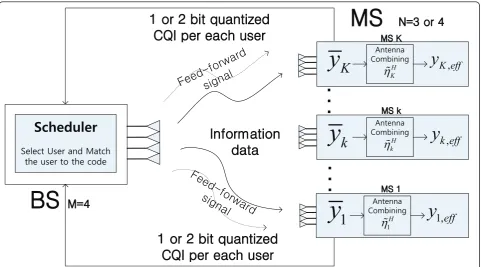
With the CQIs from Kusers, the BS constructs the selected user set and sends the feed-forward signal through the forward channels. The feed-forward signal contains information about which users will be served and which codebook vector is allocated to each selected user. With the feed-forward signal, selected users are able to construct proper combining vectors. The proposed RBF system illustrated in Figure 1 is described as follows.
(1) Each user computes the direction of the effective channel for QBC in [7] using all code vectorsc¯a(ath
row of the identity matrix IM, 1 ≤ a ≤ M) and
nor-malizes the effective channel.
¯
(2) The combining vectors for QBC and MESC in [7,8] are computed and then normalized to unit vector.
whereθk,a= arccos
|˜heff
k,a¯cHa|
, (1≤a≤M, 1≤k≤K)
¯
heffk,a=η˜kH,aHk, h˜effk,a=
¯ heff
k,a
||heffk,a||
(4) Each user feeds back CDI and its related CQI to the BS according to the feedback scheme.
3 User selection algorithm
3.1 User selection algorithm in RBF system
In this section, we present the user selection algorithm with the CQI feedback matrix Fi ÎRK ×M (1≤ i≤M),
which is made up of CQIs from each user. In the initial feedback matrixF1, the (k,a)th entry CQIk,a represents
the CQI feedback of thekth user with theath effective channel. The CQIk,a that is used for user selection is
described in (6).
(1) BS selects the first user π(1) and the first effective channel code (1) simultaneously with the maximum entry from the entries of the initial feedback matrixF1.
π(1) = arg max
1≤k≤KCQIk,σk, code (1) =¯cσπ(1) (7)
where σk= arg max
1≤a≤MCQIk,a for 1≤k≤K, CQIk,a∈F1
(2) The (i+ 1)th feedback matrixFi+1is constructed by removing the entries of theith usersπ(i) and the entries of theith effective channelscode(i) from theith feedback matrix. After doing this, the BS selects the (i+ 1)th user and the effective channel with the maximum entry from the feedback matrixFi+1in (8). This user selection pro-cess is repeated until the BS constructs a selected set of usersS= {π(1), . . . ,π(M)} up toM.
let (CQIk,a∈Fi+1) = 0 (8)
whenk=π(j)or a=sπ(j), 1≤j≤i
π(i+ 1) = arg max
1≤k≤KCQIk,σk, code (i+ 1) =¯cσπ(i+1)(9)
whereσk= arg max
1≤a≤MCQIk,a for 1≤k≤K, CQIk,a∈Fi+1
3.2 Modified SUS
In this section, we review the SUS algorithm [6] and modify it to overcome its vulnerable aspects. In the SUS-based MU-MIMO system, the codebook design is based on the random vector quantization (RVQ) scheme in [15,16]. The predefined codebook,C={¯c1,. . .,c¯2BCDI}of sizeL= 2BCDI,
is composed ofLisotropically distributed unit-norm code-words inC1×M, whereBCDIdenotes the number of feed-back bits for a single CDI. In the SUS algorithm, the BS tries to select users up toMout ofKusers. The BS selects the first user π(1) = arg maxk∈A1CQIk,σkwhich has the
%6
͟͟͟
5EJGFWNGT
6HOHFW8VHUDQG0DWFK WKHXVHUWRWKHFRGH
͑͢ΠΣ͑ͣ͑ΓΚΥ͑ΦΒΟΥΚΫΖΕ
ʹͺ͑ΡΖΣ͑ΖΒΔΙ͑ΦΤΖΣ
ͳ΄͑
;ͮͥ
͑͢ΠΣ͑ͣ͑ΓΚΥ͑ΦΒΟΥΚΫΖΕ
ʹͺ͑ΡΖΣ͑ΖΒΔΙ͑ΦΤΖΣ
ͺΟΗΠΣΞΒΥΚΠΟ
ΕΒΥΒ
$QWHQQD &RPELQLQJ
͟͟͟
,
K eff
y
H K
K
$QWHQQD &RPELQLQJ
,
k eff
y
Hk
K
$QWHQQD &RPELQLQJ
1,
eff
y
1H
K
ͷΖΖΕ͞ΗΠΣΨΒΣΕ͑
ΤΚΘΟΒΝ
ͷΖΖΕ͞ΗΠΣΨΒΣΕ͑
ΤΚΘΟΒΝ
;΄͑ͼ
;΄͑Μ
;΄͑͢
K
y
k
y
1
y
;΄͑͑
Ϳͮͤ͑ΠΣ͑ͥ
largest CQI out of the initial user setA1= {1, . . . ,K}. The value of CQIk,σk(σk= arg max1≤a≤2BCDICQIk,a for 1≤k≤K)
is described in (6) according to the antenna combiner. The BS constructs the user set,
Ai+1={1≤k≤K : |ˆhkhˆHπ{j}| ≤ε, 1≤j≤i} (10)
wherehˆk=h˜effk,σkis a quantized effective channel vector of
userk, and selects the (i+ 1)th user π(i+ 1) out of the user setAi+1. In this formulation, the system design para-meterε, which determines the upper bound of the spatial correlation between quantized channels, is the critical parameter for the user selection. When the design para-meter is set to a small value or when few users are located within the BS coverage area, user setAi+1can potentially be an empty set for some cases in whichi≤M, resulting no selection of the (i+ 1)th user by the BS.
For this reason, we develop a modified SUS algorithm denoted as SUS-epsilon expansion (SUS-ee). In SUS-ee, the system increases the design parameter gradually until user setAi+1is not an empty set so as to guarantee the achievement of the multiplexing gainM.
With the modified user set denoted as,
Aeei+1={1≤k≤K : |ˆhkhˆHπ{j}| ≤ε tion, εeeis an expanded design parameter. With the pro-posed algorithm, the BS can construct a selected set of usersS= {π(1), . . . ,π(M)} with cardinality up toM.
4 Proposed CQI quantizer
In the MU-MIMO downlink system, the CQI quantizer is also a critical factor determining the size of overall feed-back. In this section, we derive the closed form expres-sion of the CQI of selected users in order to quantize CQI with small bits. Then, we propose a CQI quantizer to better reflect the multiuser diversity. The proposed quantizer is derived for QBC because the distribution of the CQI resulting from QBC can be obtained analytically and is more amenable to analysis than MESC.
4.1N=M: Closed form expression for CQI and the proposed quantizer
4.1.1 CQI quantizer under QBC
In the RBF system, identity matrix IM is considered as a
codebook of log2M bit size. WhenN=M, the combin-ing vector is given in the shape of the row vector of the pseudo inverse channel matrix.
¯
With the combining vector, the CQI can be repre-sented as the product of an equally allocated power r and a norm of effective channel||¯heffk,a||2since there is no CDI quantization error whenN=M. The CQI feedback of the kth user with the ath effective channel is described as given by
CQIk,a=ρ|| ˜ηkH,aHk||2=ρ||¯heffk,a||2
As shown in (14), the CQI is related to the distribu-tion of entries of the inverse channel matrix. According to [7,17],||¯heffk,a||2follows Chi-square distribution with variance σ2 (iii) distribution in [[18], Theorem 4].
FY(y) = 1−e−y, y≥0. (16)
In that case, the approximated y can be obtained through the study of extreme value theory from order statistics. According to [18,19], the distribution of Y
satisfies following inequality
antennas in theath user selection process.
When Qa is large enough, y satisfies the following
approximated formulation,
xa:Qa∼= 2σ
theath user selection process. Qaused under RBF and
SUS-ee system will be presented in the Section 4.3.
4.1.2 CQI quantizer under MESC
While the distribution of the||¯heff
k,a||2under QBC can be
obtained analytically, it is hard to analyze the distribu-tion of the||¯heff
k,a||2under MESC. For this reason, we
describe the distribution of the||¯heff
k,a||2under MESC
using numerical results. According to the numerical results of Monte-Carlo simulation, we assume that ||¯heffk,a||2has a Chi-square distribution with variance s2
In this section, we develop the closed form expression of the CQI of selected users whenN≠M. In the case ofN ≠M, removing the quantization error between the code-word and the effective channel completely is not possi-ble. To develop the closed form expression of the CQI of selected users, we need to derive the cdf of the CQI. For this reason, we must know the distribution of both the norm of the effective channel||¯heffk,a||2and the
quan-tization error term sin2 θk,a. As explained in Section 4.1,
the norm of the effective channel||¯heffk,a||2has a
Chi-according to [7], quantization error sin2θk,afollows the
approximated formulation as given by
Fsin2θ
With the distribution of ||¯heff
k,a||2 and sin 2 θ
k,a, we
derive the cdf of CQI in the same way as in [[6], Section 5: N = 1]. At first, we derive the distribution of the interference term in Lemma 1 and it is proved in Appendix 1.
Lemma 1:(Interference term)
||¯heffk,a||2sin2θk,a∼Gamma(M−N, 2σ2δ)∼2σ2δY =I
As can be seen in Appendix 1, the interference term has a Gamma distribution, Gamma(M- N, 2s2δ).
Lemma 2:(Information signal term)
||¯heff
In Appendix 2, to derive the distribution of ||¯heffk,a||2cos2θk,a, we verify that the joint distribution of
||¯heffk,a||2cos2θk,a and ||¯heffk,a||2sin2θk,a is comparable with
the joint distribution ofIandS. Therefore, the informa-tion signal term can be described as the sum of the two Gamma variables X and Y. Furthermore, it is shown that the distribution ofγk,a= ρ||¯
Lemma 3:(CQI: Expected SINR) Define
Since it is proved that the distribution of gk,ais equal
to the distribution ofg, in Lemma 2, the cdf ofgk,acan
be derived using the distribution ofg. In Lemma 3, we define gwith two independent Gamma variablesX and
Y. For this reason, the cdf ofg can be derived usingX
andY.
Theorem 1: (Largest order statistic among CQIs for
For largeQa changed to follow the type (iii) distribution in [[18], Theorem 4], the closed form expression of CQIk,acan
be analyzed using the studies of extreme value theory whenN≠M. Qaused under the RBF and SUS-ee
sys-tem will be presented in the next section.
4.3 The number of antennas in theath user selection process
In this section, the number of user candidates in each user selection process are described. At first,Qaused in
RBF is shown as
Qa= (Qa)RBF= (. K−a+ 1)(M−a+ 1) 1≤a≤M.(23)
In contrast to the RBF, the number of user candidates used in the user selection stage under the SUS-ee algo-rithm is described as follows:
Qa= (Qa)SUS−ee= [. K−(a−1) max(1, K/2BCDI)]αa
Here,Iz(x,y) is the regularized incomplete beta
func-tion which determines the size of the user pool, which varies according to the user selection order [10]. The constantaarepresents the probability that channel
vec-tors of the user pool are in the set of vecvec-tors that are semi-orthogonal (referred to as ε-orthogonal in [6]) to all of the CDIs of the formerly selected users. As explained in the Section 3.2, the design parameter εis expanded in the modified SUS-ee algorithm and is
assumed to beεee=ε+ 0.05 in the fourth user selection stage according to the numerical results.
4.4 CQI quantization boundary
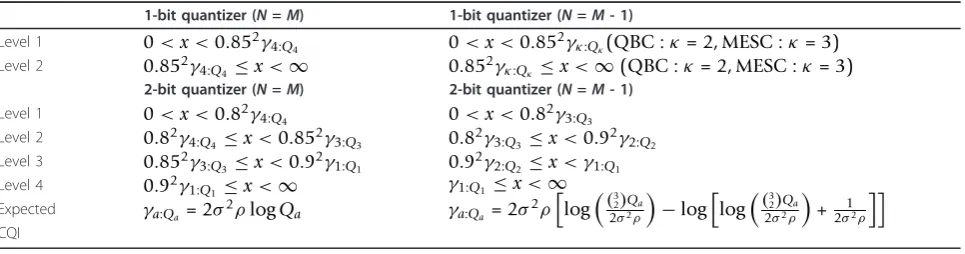
With the closed form expression of CQI, the quantiza-tion boundary of the CQI feedback is determined. In this work, we use 1 or 2 bit size CQI (2 or 4 level) quantizers. In the case of RBF based system, the CQI quantization boundaries are represented in Table 1. The CQI quantization boundaries in SUS-ee based system are represented in Table 2.
4.5 Complexity analysis
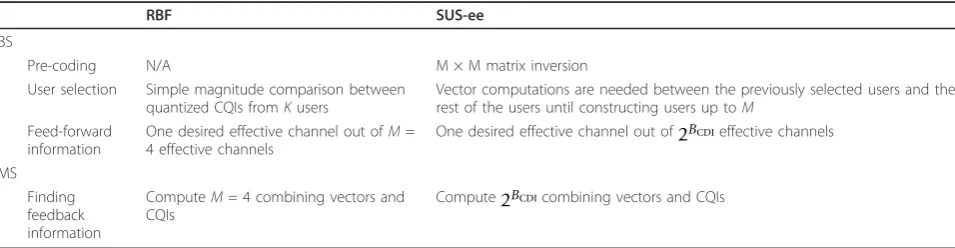
In this section, the complexity of the proposed RBF sys-tem is compared to that of a SUS-ee-based syssys-tem. The complexity comparison is described in Table 3.
The RBF system is operated under low computational complexity at the BS stage because there is no need for vector computation in the user selection procedure and pre-coding operation at the beamformer, unlike in SUS-ee. In SUS-ee, BS has to let the selected users know their effective channel out of 2BCDI effective channels,
whereas the BS selects the feed-forward information for each selected user out of only M effective channels in RBF. Furthermore, at the MS stage, each user has to compute only M CQIs in RBF, whereas 2BCDI CQIs
should be computed in SUS-ee. By decreasing the com-putational complexity at the BS, selecting users and allo-cating the desired information to each antenna can be performed more reliably within the signaling interval.
5 Numerical results
The numerical performances of the proposed system are discussed. We compared the numerical results of RBF to the results of three different MU-MIMO downlink systems (SUS-ee with antenna selection (AS) [6,7], QBC [7] and MESC [8]). The total size of the feedback used by each user is given in Table 4.
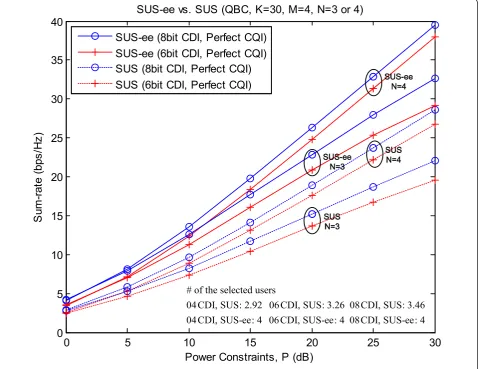
First, Figure 2 compares the results between the SUS and the SUS-ee algorithm under QBC when the system design parameter ε is 0.3. As shown in Figure 2, by
Table 1 The proposed CQI quantizer (RBF)
adaptively increasingεin the SUS-ee algorithm, M users are serviced simultaneously and the sum-rate is increased by about 40% when BCDI = 8, K = 30 and
P= 15 dB.
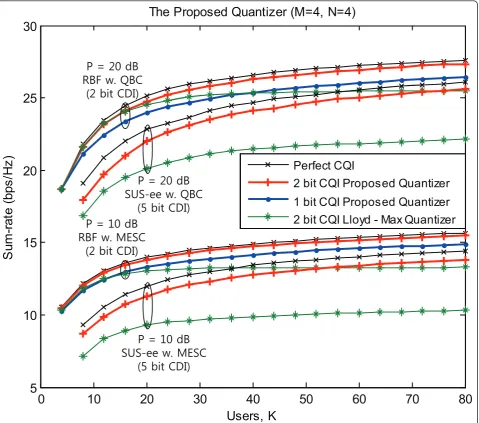
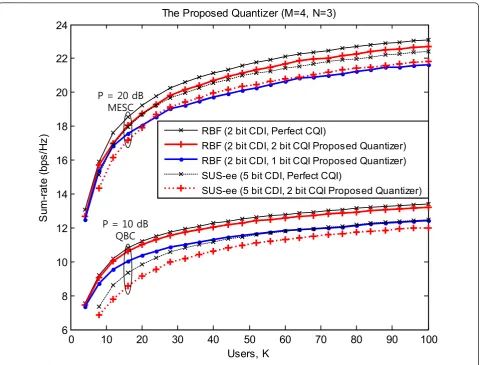
Figures 3 and 4 plot the performance of the proposed CQI quantizer. The CQI quantizer shows better perfor-mance than the Lloyd-Max quantizer [20,21] as the number of user increases. Both the proposed quantizer for RBF and the SUS-ee algorithm can quantize CQI effectively and minimize performance degradation with both 1 and 2 bit CQI feedback. This is attributable to the fact that the proposed CQI quantizers is a function of the number of users and the distribution of the CQI, whereas the conventional quantizer is a function of only the distribution of the CQI. The proposed quantizer for RBF shows better performance than that for SUS-ee because the exact number of user candidates for SUS-ee cannot be determined.
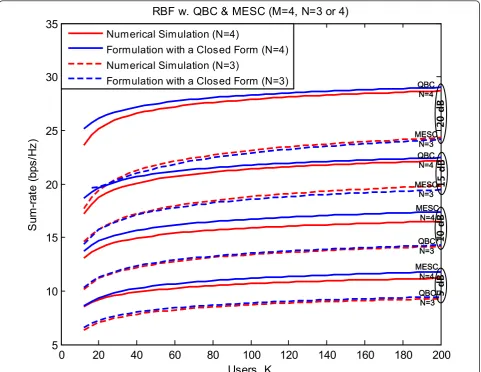
In Figure 5, the sum-rate results from the numerical simulation and from formulation with a closed form for QBC or MESC are compared. With the closed form expression for CQI in Section 4, the sum-rate formula-tion can be represented as follows:
R=
M
a=1
log2(1 +γa:Qa) (25)
where γa:Qa is the expected SINR in (20) and (41, Appendix 4), forN=M andN=M - 1 case. As shown in (25),Ris the sum-rate which grows likeMlog2 logQ due to multiplexing and multiuser diversity gains.
According to the assumption of a large user regime in the formulation with a closed form, when the number of users in the system is not large enough, a substantial difference between the numerical results and the expec-tation based on the closed form can be seen. However, as K increases, the difference decreases to verify the accuracy of the formulation with a closed form.
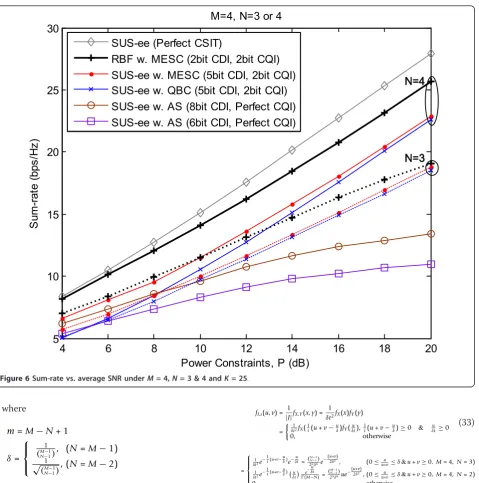
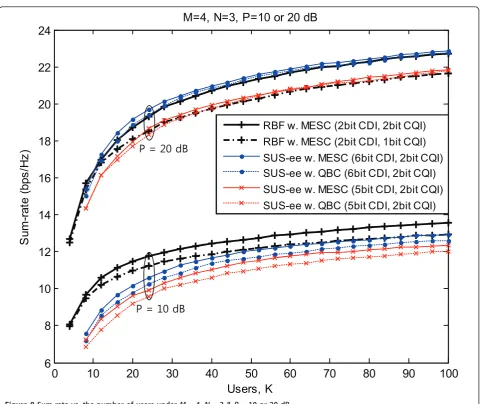
In Figure 6, RBF shows better performance than SUS-ee-based systems under minor feedback conditions when
N=M orN=M - 1. In these numerical simulations, with the QBC or MESC technique, SUS-ee system uses a 5-bit size codebook and with the AS technique, it uses a 6- and 8-bit size codebook. Although systems based on the SUS-ee have 23times more effective channel vectors for CQI than RBF, the user pool employed in the SUS-ee algorithm is determined entirely by the formerly selected users. If the previously selected users are not semi-ortho-gonal to the rest of the users, the number of user candi-dates in the next user selection stage will be highly restricted. Furthermore, if the effective channel vectors of the remaining users in the user selection stage are equal to the effective channel vectors of the previously selected users, these users will not have the opportunity to be ser-viced because each user feeds back only one CQI. Regardless of the fact that each user can fully remove the interference when N = M, the semi-orthogonality between the effective channel of users is a still critical issue of the system. By increasing the system design para-meterε, the effective channel gains for a set of selected users will be increased due to the multiuser diversity. However, the loss resulting from the normalization
Table 2 The proposed CQI quantizer (SUS-ee)
2-bit quantizer (N = M) 2-bit quantizer (N=M- 1)
Level 1 0<x<0.72γ
3:Q3 0<x<0.9
2γ 3:Q3
Level 2 0.72γ
3:Q3 ≤x<0.8
2γ
2:Q2 0.9
2γ
3:Q3 ≤x<0.95
2γ 2:Q2
Level 3 0.82γ
2:Q2 ≤x<0.85
2γ
1:Q1 0.95
2γ
2:Q2 ≤x< γ1:Q1
Level 4 0.852γ
1:Q1 ≤x<∞ γ1:Q1 ≤x<∞
Expected γa:Qa= 2σ2ρlogQ
a γa:Qa = 2σ
2ρlog(32)Qa 2σ2ρ
−log
log
(3 2)Qa 2σ2ρ
+2σ12ρ
CQI
Table 3 Complexity comparison between the RBF and the SUS-ee
RBF SUS-ee
BS
Pre-coding N/A M × M matrix inversion
User selection Simple magnitude comparison between quantized CQIs fromKusers
Vector computations are needed between the previously selected users and the rest of the users until constructing users up toM
Feed-forward information
One desired effective channel out ofM= 4 effective channels
One desired effective channel out of2BCDIeffective channels MS
Finding feedback information
ComputeM= 4 combining vectors and CQIs
process in ZFBF matrix W(Moore-Penrose pseudo-inverse matrix of set of selected users S in [6]) also grows. For these reasons, SUS-ee does not guarantee that a globally optimized user set solution will be found. In RBF, the selected user set approaches a globally opti-mized solution because the effective channel vectors are completely orthogonal to each other. Additionally, RBF can guarantee the construction of a user set composed of up toMusers, even in a small user regime.
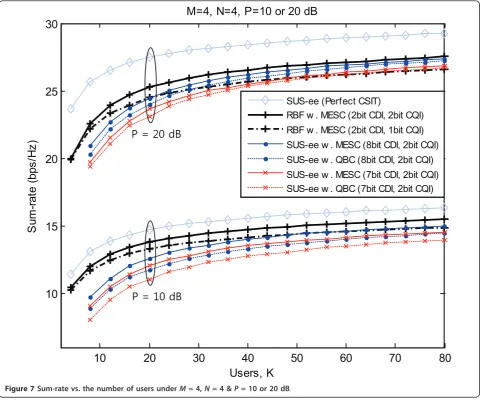
Figures 7 and 8 display the sum-rate vs.Kcurves with power constraint P as 10 or 20 dB. In the figures, the RBF system is operated under 3 or 4 bit feedback
conditions, whereas the SUS-ee system is operated under 9 or 10 bit feedback conditions in Figure 7 and under 7 or 8 bit feedback conditions in Figure 8, respec-tively. Despite the fact that the numerical results of the RBF performance are about 2.5 bps/Hz below that of SUS-ee with perfect CSIT in Figure 7, they still show better performance than SUS-ee-based systems, espe-cially with a small number of users. For the best-case example, the sum-rate results of RBF are 4.5 bps/Hz higher than those of two different MU-MIMO systems when K= 8 and P = 20 dB employing 4bit feedback overall. As shown in Figures 7 and 8, while the size of all feedback for RBF with MESC (2 bit CQI) is 6 and 4 bits smaller than that of SUS-ee with MESC, respec-tively, the proposed system shows better throughput performance. With RBF (1 bit CQI), the system can achieve a reduction in the feedback overhead of up to 7 bits out of total 10 bits when P = 10 dB in Figure 7. WhenNis equal or similar toM(N= 4 or 3), the nega-tive effect of a small candidate pool of effecnega-tive channels
Table 4 The size of feedback used in each MU-MIMO system
System Feedback organization Total
feedback
RBF w. QBC or MESC CDI: 2 bits, CQI: 1 or 2 bits 3 or 4 bits SUS-ee w. QBC or
MESC
CDI: 5,6,7 or 8 bits, CQI: 2 bits
7,8,9 or 10 bits
0
5
10
15
20
25
30
0
5
10
15
20
25
30
35
40
Power Constraints, P (dB)
S
um
-r
ate
(
bp
s/H
z)
SUS-ee vs. SUS (QBC, K=30, M=4, N=3 or 4)
SUS-ee (8bit CDI, Perfect CQI)
SUS-ee (6bit CDI, Perfect CQI)
SUS (8bit CDI, Perfect CQI)
SUS (6bit CDI, Perfect CQI)
686HH1686 1
686 1 686HH
1
# of the selected users
04 CDI, SUS: 2.92 06 CDI, SUS: 3.26 08CDI, SUS: 3.46 04CDI, SUS-ee: 4 06CDI, SUS-ee: 4 08CDI, SUS-ee: 4
for CQI can be offset by the positive effect from full-orthogonality between the effective channel of each user in the proposed user selection scheme.
On the other hand, whenN is much smaller thanM
(N= 1 or 2), removing quantization error entirely is not possible. Therefore, RBF system does not guarantee higher throughput than SUS-ee. SUS-ee with QBC or MESC has more codes for antenna combinations than RBF. For this reason, these two systems have additional opportunities to reduce quantization error compared to RBF. In consequence, employing a system which uses large codebook for antenna combinations undoubtedly provides the advantage of increasing the sum-rate of the system.
6 Conclusion
In this article, we propose a low-complexity multi-antenna downlink system based on a small-sized CQI quantizer. First, in the proposed system, each user feeds back a CDI and its related CQI collected fromMCQIs that are com-puted according to the every codeword from a codebook of log2Mbit size instead of using a large codebook. In addition, using the extreme value theory, the closed form expression of the expected SINR of selected users is derived. With this formulation, a CQI quantizer is pro-posed in order to maintain the small-sized feedback sys-tem and reflect the sum-rate growth resulting from multiuser diversity. In this work, the sum-rate throughput of the RBF system is obtained by Monte-Carlo simulation
0
10
20
30
40
50
60
70
80
5
10
15
20
25
30
Users, K
Su
m
-r
a
te
(
b
p
s
/H
z
)
The Proposed Quantizer (M=4, N=4)
Perfect CQI
2 bit CQI Proposed Quantizer
1 bit CQI Proposed Quantizer
2 bit CQI Lloyd - Max Quantizer
3 G%
5%)Z4%&
ELW&',
3 G%
686HHZ4%&
ELW&',
3 G%
5%)Z0(6&
ELW&',
3 G%
686HHZ0(6&
ELW&',
and is compared to that of a conventional MU-MIMO sys-tem based on SUS. Numerical results show that, in the proposed system, the sum-rate can approach the result of SUS-ee with perfect CSIT, outperforming all other systems which are based on SUS-ee under minor amounts of feed-back. Furthermore, the results show that performance degradation due to CQI quantization is negligible under the proposed low-bit quantizer. Considering the fairness level of the system, the data rates are distributed quite uni-formly amongMselected users for RBF, whereas the data rates are weighted too much on the first and second selected users in the SUS-ee algorithm. Finally, the com-plexity at the BS is reduced as there is no need for pre-coding multiplication and vector computation in the user selection procedure.
Appendix 1 Proof of Lemma 1
Using the distribution of||¯heffk,a||2and sin2 θk,a, the
distri-bution of the interference term is derived. The cdf of ||¯heffk,a||2sin2θk,ais described as follows.
FX(x) =P(||¯heffk,a||2sin2θk,a≤x)
= ∞
0
P
sin2θk,a≤
x y
f||¯heff k,a||2(y)dy
∼=
x
δ
0
f||¯heff k,a||2(y)dy+
∞
x
δ
M−1 N−1
x y
(M−N)
f||¯heff k,a||2(y)dy
(26)
= 1−e−2σx2δ
m−1
k=0 1
k!
x
2σ2δ
k
+
M−1
N−1
xm−1 1 σ2m2m(m)
∞
x δ
e−
y
2σ2dy
= 1−e−2σx2δ
m−1
k=0 1
k!
x
2σ2δ
k
−
M−1 N−1 xm−1 σ2(m−1)2m−1(m)
(wherem=M−N+ 1)
(27)
0
10
20
30
40
50
60
70
80
90
100
6
8
10
12
14
16
18
20
22
24
Users, K
S
um
-ra
te
(
bps
/Hz
)
The Proposed Quantizer (M=4, N=3)
RBF (2 bit CDI, Perfect CQI)
RBF (2 bit CDI, 2 bit CQI Proposed Quantizer) RBF (2 bit CDI, 1 bit CQI Proposed Quantizer) SUS-ee (5 bit CDI, Perfect CQI)
SUS-ee (5 bit CDI, 2 bit CQI Proposed Quantizer) 3 G%
0(6&
3 G% 4%&
= Proof of Lemma 2
In Lemma 2, we define both the interference term and the information signal term such asIk= ||¯heffk,a||2sin2θk,a
andSk= ||¯heffk,a||2cos2θk,a.
At first, we develop the relation between the joint dis-tribution of (Ik, Sk) and that of (||¯heffk,a||2, sin
2θ
k,a). The
relation between the joint distribution of (Ik, Sk) and
that of(||¯heffk,a||2, sin2θk,a)are as given by
Formulation with a Closed Form (N=4) Numerical Simulation (N=3)
Formulation with a Closed Form (N=3)
F$
where
m=M−N+ 1
δ=
⎧ ⎨ ⎩
1 (M−1
N−1)
, (N=M−1) 1
√ (M−1
N−1)
, (N=M−2)
Then, after defining I= δtYand S = t(X + (1 - δ)Y) wheret = 2s2, the relation between the joint distribu-tions of (I, S) and that of (X, Y ) are derived as follows.
fX,Y(x,y) = |J|fI,s(u,v) (32)
where
u=δty, v=t(x+ (1−δ)y)
J= det
∂u ∂x ∂
u ∂y ∂v ∂x ∂
v ∂y
=−δt2
fI,s(u,v) = 1
|J|fX,Y(x,y) = 1
δt2fX(x)fY(y) =
1
δt2fX(1t(u+v− u
δ)fY(δut),
1
t(u+v− u
δ)≥0 & δut≥0
0, otherwise
(33)
=
⎧ ⎪ ⎪ ⎨ ⎪ ⎪ ⎩
1
δt2e−
1 t(u+v−uδ)e−u
δt=(MN−−11)
22δ4e−
(u+v)
2δ2, (0≤ u
u+v≤δ&u+v≥0,M= 4,N= 3) 1
δt2e−
1 t(u+v−
u
δ)u
δt e
−δut
(M−N)=(
M−1
N−1)
23δ6ue−
(u+v) 2δ2, (0≤ u
u+v≤δ&u+v≥0,M= 4,N= 2)
0, otherwise
(34)
By comparing the equations (31) and (34), we can verify that the joint distributionfIk,Sk(u,v)is the same as the joint distribution fI,S(u,v). Therefore, the information signal
termSkfollows the distribution ofS=t(X+(1 -δ)Y) which
is described as the sum of two Gamma variablesXandY.
Appendix 3 Proof of Lemma 3
To derive the cdf ofgk,a, we define thegusingSand Iin
Lemma 2γ = 1+ρSρI = ρtX1++ρρδt(1tY−δ)Y. The distribution of g is described as follows.
4
6
8
10
12
14
16
18
20
5
10
15
20
25
30
Power Constraints, P (dB)
S
um
-ra
te
(
bps
/Hz
)
M=4, N=3 or 4
SUS-ee (Perfect CSIT)
RBF w. MESC (2bit CDI, 2bit CQI)
SUS-ee w. MESC (5bit CDI, 2bit CQI)
SUS-ee w. QBC (5bit CDI, 2bit CQI)
SUS-ee w. AS (8bit CDI, Perfect CQI)
SUS-ee w. AS (6bit CDI, Perfect CQI)
1
1
Fγ(x) =P(γ ≤x) =P Proof of Theorem 1
In this section, we define the relation γ= γt+1ρ .(γ =tργ −1)By substituting g’ with γt+1ρ the cdf is changed to follow type (iii) distribution in [[18], Theorem 4]. SUS-ee w . MESC (8bit CDI, 2bit CQI) SUS-ee w . QBC (8bit CDI, 2bit CQI) SUS-ee w . MESC (7bit CDI, 2bit CQI) SUS-ee w . QBC (7bit CDI, 2bit CQI)
3 G%
3 G%
where
α=M−N, 1
β = e
1
tρ
(δtρ)M−N
Therefore, g’ can be analyzed using the studies of extreme value theory in order statistics. According to [18,19], the distribution of g’ satisfies the following inequality
Pr|γa:Qa−bQa| ≤log log
Qa
≥1−O
1 logQa
. (39)
where
aQa= 1,bQa = log Qa
β −αlog log Qa
β
= log e
1
tρQa
(δtρ)M−N −(M−N) log log
e
1
tρQa
(δtρ)M−N
When Qa is large enough, g’ satisfies the following
approximated formulation,
γa:Qa+ 1 tρ =γ
a:Qa ∼= bQa= log
Qa
(δtρ)M−N
+1
tρ −(M−N) log
log
Qa
(δtρ)M−N
+ 1
tρ
.
(40)
γa:Qa∼= tρlog
Qa
(δtρ)M−N
−tρ(M−N) log
log
Qa
(δtρ)M−N
+ 1
tρ
∼= 2σ2ρ
log
Qa
(2σ2δρ)M−N
−(M−N) log
log
Qa
(2σ2δρ)M−N
+ 1
2σ2ρ
.
(41)
0
10
20
30
40
50
60
70
80
90
100
6
8
10
12
14
16
18
20
22
24
Users, K
Su
m
-r
a
te
(
b
p
s
/H
z
)
M=4, N=3, P=10 or 20 dB
RBF w. MESC (2bit CDI, 2bit CQI)
RBF w. MESC (2bit CDI, 1bit CQI)
SUS-ee w. MESC (6bit CDI, 2bit CQI)
SUS-ee w. QBC (6bit CDI, 2bit CQI)
SUS-ee w. MESC (5bit CDI, 2bit CQI)
SUS-ee w. QBC (5bit CDI, 2bit CQI)
3 G%
3 G%
Abbreviations
SINR: signal to interference plus noise ratio; SUS: semi-orthogonal user selection; SUS-ee: semi-orthogonal user selection epsilon expansion; RBF: random beamforming; CQI: channel quality information; CDI: channel direction information; CSI: channel state information; MU-MIMO: multiuser multiple-input multiple-output; DPC: dirty paper coding; BS: base station; MS: mobile station; ZFBF: zero-forcing beamforming; PU2RC: per user unitary and
rate control; PMI: preferred matrix index; RVQ: random vector quantization; QBC: quantization-based combining; MESC: maximum expected SINR combiner.
Acknowledgements
This study was supported by the National Research Foundation of Korea (NRF) grant funded by the Korea government (MEST) (2011-000316) and the Korea Communications Commission (KCC) under the R&D program supervised by the Korea Communications Agency (KCA) (KCA-2011-08913-04003).
Author details
1Department of Electrical Engineering and INMC, Seoul National University,
Seoul, Korea2Department of Electronic Engineering, Gachon University, Seongnam, Gyeonggi, Korea3Department of Electronic Engineering, Sogang
University, Seoul, Korea
Competing interests
The authors declare that they have no competing interests.
Received: 25 July 2011 Accepted: 8 February 2012 Published: 8 February 2012
References
1. P Viswanath, DNC Tse, R Laroia, Opportunistic beamforming using dumb antennas. IEEE Trans Inf Theory.48(6), 1277–1294 (2002). doi:10.1109/ TIT.2002.1003822
2. M Sharif, B Hassibi, A comparison of time-sharing, DPC, and beamforming for MIMO broadcast channels with many users. IEEE Trans Commun.55(1), 11–15 (2007)
3. D Gesbert, M Kountouris, RW Heath Jr, CB Chae, T Sälzer, Shifting the MIMO paradigm. IEEE Signal Process Mag.24(5), 36–46 (2007)
4. M Costa, Writing on dirty paper. IEEE Trans Inf Theory.29(3), 439–441 (1983). doi:10.1109/TIT.1983.1056659
5. A Goldsmith, SA Jafar, N Jindal, S Vishwanath, Capacity limits of MIMO channels. IEEE J Sel Areas Commun.21(5), 684–702 (2003). doi:10.1109/ JSAC.2003.810294
6. T Yoo, N Jindal, A Goldsmith, Multi-antenna downlink channels with limited feedback and user selection. IEEE J Sel Areas Commun.25(7), 1478–1491 (2007)
7. N Jindal, Antenna combining for the MIMO downlink channel. IEEE Trans Wirel Commun.7(10), 3834–3844 (2008)
8. M Trivellato, F Boccardi, H Huang, On transceiver design and channel quantization for downlink multiuser MIMO systems with limited feedback. IEEE J Sel Areas Commun.26(8), 1494–1504 (2008)
9. CB Chae, D Mazzarese, N Jindal, RW Heath Jr, Coordinated beamforming with limited feedback in the MIMO broadcast channel. IEEE J Sel Areas Commun.26(8), 1505–1515 (2008)
10. T Yoo, Sum-capacity, scheduling and multi-user diversity in MIMO broadcast systems. PHD Dissertation, Stanford University (2007)
11. DJ Love, RW Heath Jr, T Strohmer, Grassmannian beamforming for multiple-input multiple-output wireless systems. IEEE Trans Inf Theory.49(10), 2735–2747 (2003). doi:10.1109/TIT.2003.817466
12. DJ Love, RW Heath Jr, W Santipath, ML Honig, What is the value of limited feedback for MIMO channels?. IEEE Commun Mag.42(10), 54–59 (2004). doi:10.1109/MCOM.2004.1341261
13. M Sharif, B Hassibi, On the capacity of MIMO broadcast channels with partial side information. IEEE Trans Inf Theory.51(2), 506–522 (2005). doi:10.1109/TIT.2004.840897
14. Samsung Electronics. Downlink MIMO for EUTRA, 3GPP TSG RAN WG1#44/ R1-060335
15. W Santipach, ML Honig, Asymptotic performance of MIMO wireless channels with limited feedback, inIEEE Military Communications Conference, Boston, USA,1, 141–146 (Oct. 2003)
16. CK Au-Yeung, DJ Love, On the performance of random vector quantization limited feedback beamforming in a MISO system. IEEE Trans Wirel Commun.6(2), 458–462 (2007)
17. JH Winters, J Salz, RD Gitlin, The impact of antenna diversity on the capacity of wireless communication systems. IEEE Trans Commun.42(234), 1740–1751 (1994)
18. MA Maddah-Ali, MA Sadrabadi, AK Khandani, Broadcast in MIMO systems based on a generalized QR decomposition: Signaling and performance analysis. IEEE Trans Inf Theory.54(3), 1124–1138 (2008)
19. HA David,Order Statistics(Wiley, New Work, 1980)
20. JG Proakis, Digital Communications, 4th edn. (McGrawHill, New Work, 2001) 21. SP Lloyd, Least squares quantization in PCM. IEEE Trans Inf Theory.28(2),
129–137 (1982). doi:10.1109/TIT.1982.1056489 doi:10.1186/1687-1499-2012-36
Cite this article as:Songet al.:Low-complexity multiuser MIMO downlink system based on a small-sized CQI quantizer.EURASIP Journal on Wireless Communications and Networking20122012:36.
Submit your manuscript to a
journal and benefi t from:
7Convenient online submission
7Rigorous peer review
7Immediate publication on acceptance
7Open access: articles freely available online
7High visibility within the fi eld
7Retaining the copyright to your article