R E S E A R C H
Open Access
Polar codes for non-identically distributed
channels
Jangseob Kim and Jungwoo Lee
*Abstract
We introduce new polar coding schemes for independent non-identically distributed parallel binary discrete memoryless channels. The first scheme is developed for the case where underlying channels are time invariant (the case of a deterministic channel parameters), while the other schemes deal with a scenario where underlying channels change based on a distribution (the case of random channel parameters). For the former case, we also discuss the importance of the usage of an interleaverQto enhance system reliability, and for the latter case, we model the channel behavior of binary erasure channels. It is shown that the proposed polar coding schemes achieve a symmetric capacity.
Keywords: Polar codes, Non-identically distributed channels, Channel parameters, An interleaver scheme
1 Introduction
The polar codes previously introduced in [1] are a coding scheme that achieves the symmetric capacity of any dis-crete memoryless channel (DMC) by exploiting channel polarization phenomena. The block error rate converges to zero as the code lengthNgoes to infinity.
One disadvantage of polar codes is their dependency on the underlying channel. If a channel is unknown to a transceiver, communication becomes unreliable and erro-neous decoding can result, since the code design is based on a different channel. The performance gap due to imper-fect channel knowledge was analyzed in [2], and a robust approximation technique has been proposed for this mis-match. In [3], it was demonstrated that polarization is possible even under a non-stationary channel.
In this paper, we propose an approach to the design of polar codes in the parallel channel model based on a mar-tingale process and extend the model to the case in which the channel parameters are no longer fixed but exhibit some random behaviors. In addition, we briefly discuss the importance of the usage of the proper interleaverQ.
The communication scenario in which the transmit-ter and the receiver do not know the channel parametransmit-ter but know the domain (set) to which it belongs is known as the compound channel scenario [4]. The authors of [4] defined the compound channel capacity as the rate
*Correspondence: [email protected]
Department of Electrical and Computer Engineering, Seoul National University, Seoul, Korea
at which one can reliably transmit data without knowing the underlying channel parameter. In [5] and [6], polar codes that achieve the compound channel capacity were proposed. In [5], the unknown channel is deterministic during a codeword transmission, and in [6], the authors dealt with a deterministic compound parallel channels model.
Parallel channels are used to model statistical behaviors of communications in conveying multiple data simulta-neously between nodes, connected with multiple links. The internal structure of storage systems or singu-lar value decomposed multiple-input multiple-output (MIMO) channels are an example of parallel channel models. In these channels, the links do not need to be the same, and their statistical behaviors can differ. The question then arises about whether the parallel chan-nel capacity is achievable via polar codes. In [7, 8], it is demonstrated, under a non-identically distributed chan-nel assumption, that when all chanchan-nel parameters (CP) are given to the transceiver, polar codes can achieve the capac-ity in both degraded and non-degraded channel settings.
In this paper, we show that the polarization phe-nomenon occurs in the parallel channel model and pro-vide proof of achievability of polar codes for general binary discrete memoryless channels (B-DMC), under a non-identically distributed assumption, where determin-istic CPs are given. Second, in contrast to previous liter-ature, we also consider a case where CPs that describe binary erasure channels (BECs) are realizations of some
random variables, and only their probability distributions, and not their exact values, are known to the transmitter and the receiver.
This is similar to the compound channel scenario, since the transmitter does not know the CPs but differs since the CPs, which are a realization of random variables, might differ. The system model is depicted in Fig. 1. The role of the interleaver in this figure is discussed in the last part of the second section.
Developing polar codes for the randomly varying chan-nel scenario is one of the noticeable issues. For the ith transmit BEC at time instant η, assume that an erasure probability i(η)is a realization of a random variable ε
that follows a distribution fε. In this case, conventional polar coding schemes fail to achieve the capacity since the encoder and the decoder do not know the exact value, i(η), of the underlying channel. For example, in flash
memories, the statistical responses of the voltage thresh-old may change asymmetrically with time and with the number of accesses to the cells. As the storage capacity increases, it is inefficient for a storage controller to trace and probe the exact states of every block or cell.
The remainder of this paper is organized as follows. In the second section, we analyze the polarization pro-cess on a time-invariant non-identical parallel channel. This corresponds to a parallel channel with determin-istic CPs which could differ to each other. In the third and fourth sections, an independently non-identically dis-tributed channel model with random CPs is discussed. In these sections, we assume that only the distributions of the CPs of each channel,W(i), (∀i∈[1,N]), are known to an encoder and decoder. In the third section, the CPs may change in a block-by-block manner; however, their states are maintained within a block. In the fourth section, in contrast to the third section, CPs may change even within a block. In the fifth section, we discuss a special case of partially dependent channels and show that polar codes
Fig. 1System model. Non-identically distributed parallel channels. InterleaverQis inserted to make a set of virtually ordered transmit channels from{W(j)}to{W(j)},j∈[1,N]. By applying the interleaver,
{W(j)}is sorted in a way that maximize the reliability and the achievable rate
based on theq-ary input can achieve the capacity. In the final section, concluding remarks are provided.
2 Non-identical channels with deterministic CP LetW :X →Ydenote a general symmetric binary input memoryless channel (B-DMC) and WN : XN → YN
denote a vector channel. If channels are independent but not identical, thenWN(yN1|xN1) =
N
i=1W(i)(yi|xi)where
W(i) : Xi → Yi, such that their transition probabilities
p(i)(y|x)andp(j)(y|x)may differ ifi= j. In parallel
chan-nels, a non-identical channel may correspond to a trans-mission scenario through links with different qualities. In terms of the channel model, this can be interpreted as a fast-fading channel in a time or frequency domain. This corresponds to the case when the time duration or the fre-quency gap between adjacent channels is larger than the coherence time or coherence frequency, respectively.
As in [1], given any B-DMCW(i), the same definitions of
the symmetric capacity and the Bhattacharyya parameter are adopted as performance measures
• Symmetric capacity
IW(i)
y∈Y
x∈X
1
2W(i)(y|x)log
W(i)(y|x)
1
2W(i)(y|0)+12W(i)(y|1)
(1)
• Bhattacharyya parameter
ZW(i)
yi∈Y
W(i)(yi|0)W(i)(yi|1). (2)
According to Proposition 1 in [1], the two parameters satisfy
log 2
1+ZW(i)
≤I(W(i))≤
1−ZW(i)
2
. (3)
For later use, we denote the bit channelWN(i)by
WN(i)yN1,ui1−1|ui
uN i+1∈XN−i
1 2N−1WN
yN1|uN1,
whereN=2nis the code length.
In this section, channels are assumed to be independent and not identically distributed, and the CPs are known to the transmitter and the receiver. For BEC withN
1, these
erasure probabilities may differ and are known in advance to the encoder and the decoder. Let us denote the sum symmetric capacity byIs = N1Ii, whereIi = I(Xi;Yi),
and the sample mean by E[Ii]= INs. Then, the following
theorem holds.
sum capacity Is, in the sense that as N, which is the power of
2, goes to infinity, the fraction of indices i∈[1,N]satisfies
|{i|I converge to {0, 1} as the code length N increases. For the second proof, the martingale convergence theorem and (3) will be used. These statements are proved via Lemma 1, Lemma 2, and Proposition 1. After proving Lemma 2, we summarize the proof of the theorem.
For a kernel F = recursive equation in [1], except for the last recursions for the length 2.
Lemma 1Suppose WN(i),WN(i) → W2(2Ni−1),W2(2Ni) for some set of binary input channels. Then,
W2(2Ni−1)
where the last recursive channel relations is a mapping such thatW(j),W(j+1) →
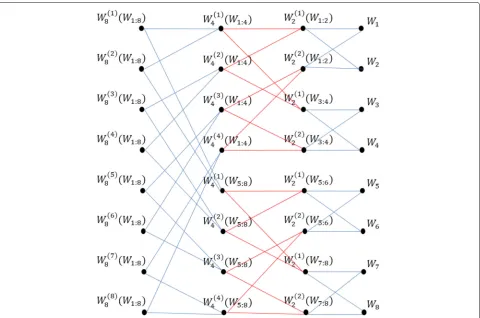
The evolution of the parallel channel transition proba-bilities is depicted in Fig. 2. Observe that the structure is
still recursive, but the number of inputs and the outputs of each evolution is identical.
The proof of the Lemma 1 directly follows from [1]. The last recursion derives from the independently and non-identically distributed parallel channel environment. We now extend Propositions 4–7 in [1], which were proved under the i.i.d. condition, into the non-identically distributed DMC case. This extension was performed in previous literatures, in the names of “parallel channels” [7, 8] and “non-stationary channels” [3] with the measure of the symmetric capacity.
2.1 Evolution of symmetric capacities
In this subsection, we consider the symmetric capacities of the recursively achieved bit channels. By inserting (6) and (7) into the definition of the symmetric capacities (1), the following proposition holds.
Proposition 1Suppose W(1),W(2) → (W2(1),W2(2)) for any binary input discrete channels. Then,
I
Proof of (8)Equation (8) can be proved as follows:
I
Since the mapping from a message vector U12 to an encoded codeword is deterministic through a genera-tor matrix G2, no information loss occurs between the
Fig. 2Recursive parallel channel transitionsN=8. Note that the number of inputs and the outputs of each evolution is identical
Since the value of mutual information is always non-negative, I(·) ≥ 0. By inserting (11) into (8), we obtain I
W2(1) ≤IW(1)
However, ambiguity remains about whether (9) and (10) are true based on this relation and (11), since there are no additional conditions on the qualities of transmit channels W(i),i∈[1,N] that make them order with measures of the
symmetric capacity I(·) or the Bhattacharyya parameter Z(·).
Now, we can consider three necessary conditions for (9) and (10) to be true: (1)IW(1)
≤I
W2(2) , (2)IW(2)
≥
I
W2(1) , and (3)IW(1)≤IW(2).
Conditions 1 and 2 can be easily verified and hold for any set of BECs, binary symmetric channels (BSCs), and binary-input additive white Gaussian noise (BI-AWGN), and thus satisfy (9) and (10). However, the first and the second inequalities do not hold in general B-DMCs. Then, the third condition, IW(1) ≤ IW(2), should be sat-isfied to achieve (9) and (10). For channels of N = 2, where I(W(1)) ≥ I(W(2)), the third condition can be achieved simply by swappingW(1),W(2)
→W(2),W(1)
without degrading the achievable rate. This operation is available since the channel parameters are exposed to the
transceiver in advance. Therefore, we can conclude that (9), (10), and Proposition 1 are true for any B-DMCs.
In general, we can extend these relations to the case of N =2n(n≥ 1). The following relations are thus true for all given channel parameters.
I2(2Ni)≤min
IN(i)W[1:N]
,IN(i)W[N+1:2N]
(12)
I2(2Ni−1)≥max
IN(i)W[1:N]
,IN(i)W[N+1:2N]
(13)
I2(2Ni−1)+I2(2Ni)=I(Ni)W[1:N]
+IN(i)W[N+1:2N]
. (14)
The equality holds betweenI2(2Ni)andI2(2Ni−1)if and only if the underlying channels are either perfect or completely noisy.
be formed suggesting that the evolvedI2(2Ni−1)andI2(2Ni) con-verge to one of the extremal values, 0 or 1, as the process is repeated. We can now prove this conjecture with the aid of the concept of the martingale process and bounded martingale convergence theorem in the following subsection.
2.1.1 Martingale processIn
Following the notation of the random tree process in [1], we first define the random sequence{In}such thatIN(i) →
In
bn1, whereIn
bn1 ∈ {In}is represented asIbn1. Let us
introduce an average sequenceEnto replaceIbn
1 such that En
bn1 = E[Ibn1]. Based on the channel transitions in
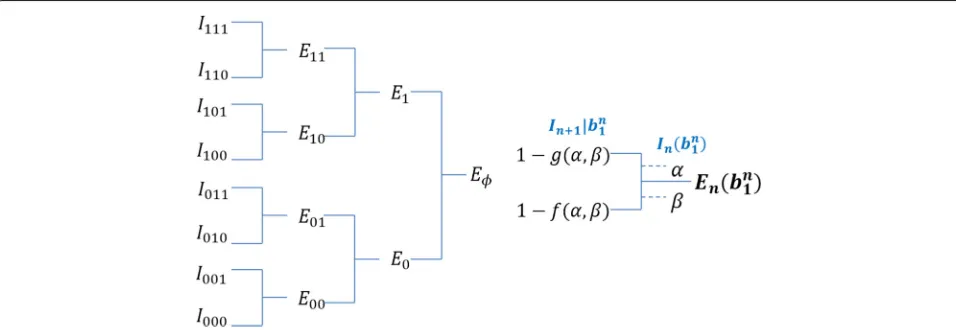
Fig. 2 and the definition of the average sequence, we can draw the alternative graphical transitions for each stagen as depicted in Fig. 3. The following lemma then shows that {In}is a martingale process.
Lemma 2{In} is a martingale under average sequence
{En}in the sense thatE[In+1|En]= En, where Ibn 1 ∈ {In} and En
bn1=E[Ibn 1]
ProofLemma 2 can be proved from the chain rule of
mutual information that preserves rate.
I2(2Ni−1)+I2(2Ni−1)=IN(i)W[1:N]
+IN(i)W[N+1:2N]
. (15)
By taking an average on both sides, one can get
EIn|bn1
= 1
2((In(b
n
1,W[1:N])+In(bn1,W[N+1:2N]))
(16)
which is equivalent toEn(bn1).
We can now exploit the ergodicity in B-DMCs. Let us denote the sum symmetric capacity asIs = N1Ii, where
Ii = I(Xi;Yi), and the sample mean asE[Ii]. Then, from
the ergodicity,E[Ii]= NIs. Next, we borrow the tree
pro-cess representation and the corresponding notations from Section 4 in [1].
A bit-channelWN(i)=2n can be uniquely represented via a binary sequencebn1:Wbn
1. For example,W (3)
8 → W011.
Using this, we abbreviate I(Wbn 1) = I
W2(in) into Ibn 1, where Ibn
1 is an element of a set In. We use the same notation in the definition of the average sequence En;
En
bn1=E[Ibn
1]=E[In] which is the average over all the elements of the setIn. By exploitingEn, we can draw a new
tree process as depicted in Fig. 3, and we have shown that this process satisfies the property of a martingale process via (16).
Recalling the following properties, we can conclude that En converges to 0 or 1: (i) the symmetric capacity
is bounded by 0 and 1, such that 0 ≤ Ibn
1 ≤ 1, and (ii) a bounded martingale process converges to extremal values, which is the same technique as that used in the proof of [1].
OnceEn converges to one of the extremal values, we
can also conclude thatInconverges to the same extremal,
sinceEnis defined as the average ofIn. From (16), the two
newly evolving terms are equidistant fromEn(bn1), so we
denote them using distancesα:En(bn1)+αandEn(bn1)−α.
When the martingaleEn(bn1) goes to 1, we haveα → 0
since it is bounded above by 1. Similarly, when the martin-galeEn(bn1)goes to 0, we haveα → 0 since it is bounded
below by 0. Therefore, we conclude thatInalso converges
to 0 or 1.
Consequently, it is concluded that sequence {In} is a
martingale sequence.
Since {In} is a bounded martingale sequence, it
con-verges to a random variableI∞ with probability 1. Fur-thermore, from the martingale property,E[I∞]= E[I0],
which is equivalent to Is
N. By combining this relation with
the martingale property of the random sequence{In}, we
have
P(I∞=0)=1− Is
N (17)
P(I∞=1)= Is
N (18)
which concludes the proof of Theorem 1.
In summary, to prove Theorem 1, we showed that first, polarization takes place by using the martingale process, and second, the ratio of noiseless bit channels converges to the symmetric capacity as N → ∞. This is because this equivalently indicates that the block error converges to zero as the code length goes to infinity as in [1].
2.1.2 Example on BECs
Consider BECs with 1N, where i can differ and N =
210, and we assume that they are chosen in the range of [ 0.4, 0.5]. As is known, the BEC has a convenient prop-erty such thatIN can be described in a recursive form as
follows:
I2(2Ni−1)=1−Z22Ni−1 (19)
I2(2Ni)=1−Z22iN,
where
Z(22Ni−1)=f(ZN(i)(W[1:N]),ZN(i)(W[N+1:2N])) (20)
Z(22Ni)=g(ZN(i)(W[1:N]),Z(Ni)(W[N+1:2N])).
Here,f(α,β)=α+β−αβ,g(α,β)=αβ, andW[1:N]=
{W(j)}Nj=1.
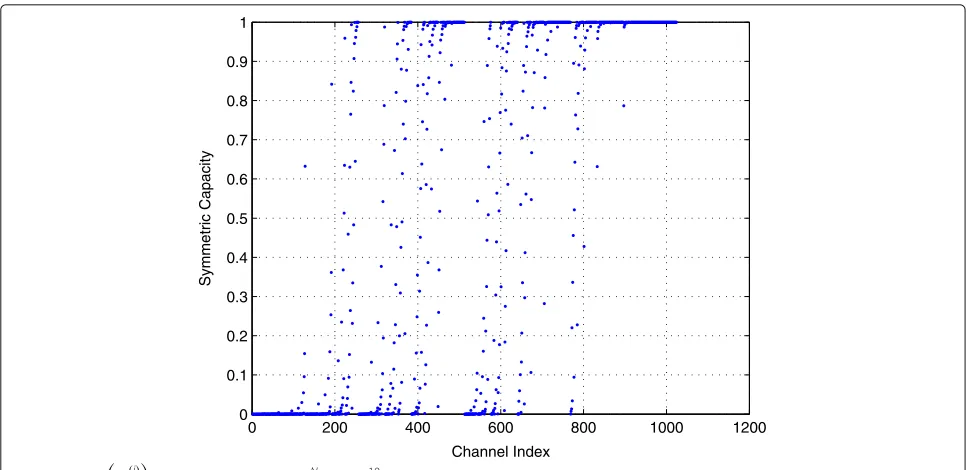
Figure 4 depicts the polarization phenomenon in IN(i). Observe that even under the non-identically distributed channel condition, symmetric capacities are polarized into {0, 1}. It should be verified that it approaches the channel capacity as it is in the i.i.d. scenario. In Table 1, the differences between the symmetric capacity and the rate according to the exponent ofnare shown. Here, the difference is defined as Is−NR
Is . As can be seen, the size of the differences decreases asnincreases, which means that the rateRapproaches to the average symmetric capacity
Is
N. Equivalently, it can be said thatIsis achievable in terms
of the sum rate.
2.2 Achievable scheme based on the symmetric capacity
2.2.1 Encoder
Given a set of B-DMCs {WN(i)}, the encoder calculates {IN(i)}according to its definition. Only for BECs,IN(i) cal-culation follows (19) with equality. In general B-DMCs, the error performance of bit channels should be tracked
with appropriate measures such asZ(Ni)by using the den-sity evolution method [9]. Then, define an information index setA=i|IN(i)≥IN(j),i∈A,j∈/Afor alli,j∈[ 1,N] such that|A| = Is. We apply the interleaverQto map
the indices of the codeword to the ordered set of trans-mit channels:Q : XN → WN, wherexN1 ∈ XN, and W[1:N] ∈ WN. This is deployed to help the
polariza-tion processes. The problem with finding the properQfor given channels is discussed at the end of this section.GN
is aN×Ngenerator matrix, and its kernel isG2=
1 0 1 1
.
The encoder outputs a codewordxN1 =uN1 ·GN·Q.
2.2.2 Decoder
First, the receiver maps an output sequence by a de-interleaverQ−1, which producesyN
1. Next,yN1 is processed
by a successive cancellation (SC) decoder in order to obtain an estimated message sequenceuˆN1. One can eas-ily check that the same recursive relations exist under the non-identical condition as those under the i.i.d channel condition, by considering the evolutions of bit channels. The only change is the last recursion of a likelihood ratio (LR) equation:L(yi)changes toLi(yi)= WW((ii))((yyii||01)).
L(Ni)yN1,ui1−1 = WN(i)
yN1,ui1−1|0
WN(i)
yN1,ui1−1|1
. (21)
Thus, the decoding complexity is still maintained as O(NlogN), and it has vanishing probability of error rate Pe asN → ∞. The encoding and decoding process is
summarized in Algorithm 1.
Algorithm 1Encoding and decoding process
Encoding Process
1: Given{W(i)|1≤i≤N}, calculate{IN(i)|1≤i≤N}
2: DefineAof size k = Is s.t.A = {i|IN(i) ≥ I (j) N,∀i ∈
A,∀j∈/A}
3: FixuFand insert data into{uA|i∈A} 4: EncodexN1 =uN1 ·GN
5: InterleaverQ:xN1 →sN1 6: TransmitsN1
Decoding Process:
1: De-interleaver :Q−1:t1N →yN1
2: Given(A,uF), for∀i∈[ 1,N], calculateL(yN1,ui1−1)for uiin the SC decoder based on modifiedLRin ( 21 ).
2.3 Evolution of Bhattacharyya parameters
Fig. 4Plot ofIWN(i) for a non-identical BEC(N
1),N=210
Proposition 2Suppose W(1),W(2)
→ W2(1),W2(2) for some binary input non-identically distributed discrete channels. Then, the following relations hold
Z
W2(1) ≤ZW(1)
+ZW(2)
−ZW(1)
ZW(2)
(22)
Z
W2(2) =ZW(1)ZW(2) (23)
ZW2(2) ≤ZW2(1) . (24)
The proofs of (22)-(24) is presented in the Appendix.
Corollary 1ZN can be described in a recursive form as
follows:
Z(22Ni−1)≤fZ(Ni)W[1:N]
,ZN(i)W[N+1:2N]
Z2(2Ni)=g
ZN(i)W[1:N],ZN(i)W[N+1:2N] , (25)
where f(α,β)=α+β−αβ,g(α,β)=αβ, and W[1:N]=
W(j)
N
j=1. The equality holds for BEC.
Table 1Difference between capacities and achievable rates of polar codes under non-identical parallel channels
Number 8 10 12 14 16
Diff. [ %] 0.6 0.044 0.038 0.003 0.002
By applying the recursive channel structure of Lemma 1 to the definition of the Bhattacharyya parameter, the above corollary can be derived. With the aid of Lemma 1 and (22)–(24), we can derive Properties 1, 2, and 3 as follows:
1.
Z2(2Ni−1)+Z2(2Ni)≤Z(Ni)W[1:N]
+ZN(i)W[N+1:2N]
. (26)
2. (for some B-DMCW )
Z(22Ni−1)≥maxZN(i)W[1:N]
,ZiNW[N+1:2N]
. (27)
To prove the above propositions, let us start from the first property. Property 1 can be derived from the definition of theZ-parameter and we can use the same proof process of (24) that exploits the inequality relation between the arith-metic mean and the geometric mean. By using thef(α,β) andg(α,β)notations as in Corollary 1, Property 2 holds if and only if the joint event of{αβ ≤α} ∩ {αβ ≤β}holds, which is true because of the non-negativity ofα,β ∈[0, 1]. Property 3 is true for BEC, BSC, and BI-AWGN which can be transformed to an equivalent BSC model.
2.3.1 BEC case
As previously mentioned, BEC has received attention for its special property of maximizing theZ-parameter value of thef(·)operation. For the BECW(i)with erasure prob-abilityi,Z(W(i))= i. ForN = 2 with1and2,Z2(1) =
without loss of generality, the following relation holds by repeating recursions:
Z(22Ni−1)=ZN(i)W[1:N]
+Z(Ni)W[N+1:2N])
−ZN(i)W[1:N]
·ZN(i)W[N+1:2N]
.
Hence, Z(22Ni−1) ≥ Z(Ni)(W[1:N]) and Z2(2Ni−1) ≥
ZNi (W[N+1:2N]); thus, Property 3 holds.
2.3.2 BSC case
For N = 2 BSC with crossover probability 1 and 2, ZW(i) = 2√i(1−i). Then,Z2(1) = 2√(1−s)·s,
wheres = 1+2−212. Without loss of generality,
assume that1 ≥ 2, if not, we swap these two channels.
The numerical results in Fig. 5 show that differences of Z2(1)−ZW(1)for all CPs are always non-negative.
Hence, we can conclude that Property 3 holds for the BSC case.
2.3.3 BI-AWGN case
Note that a binary-input AWGN channel can be trans-formed to the equivalent BSC by applying a line coding that maps the set of binary alphabets{0, 1} → {−1,+1}. Therefore, Property 3 holds.
2.4 SupermartingaleZn
Let us define the random sequence {Zn} such that
ZN(i) → Zn(bn1), where Zn(bn1) ∈ {Zn} is
repre-sented as Zbn
1. Then, for some B-DMCs that satisfy four properties, we can draw a graphical evolving recur-sive structure of ZN(i) ( or Zn) similar to Fig. 3. The
graphical structure of Zn has a common feature to
that of the identically distributed channel case; however,
elements in the rightmost column are under a non-identically distributed scenario, where CPs may not be the same.
{Zn}can be considered as a supermartingale if this
ran-dom tree process satisfies the relationZn ≥E
Zn+1|bn1
. Under the i.i.d. channel assumption, it is easily verified, since the one step transition from Zn(bn1)to {Zn+1} is a
single variable to single variable mapping:K : Z → Z such thatZ = {Z|Z ∈ ,Z ∈[ 0, 1]}. In contrast, with the non-identically distributed assumption, the transition becomes a two to one mapping:K:Z2→Z. EachZbn1is
not a scalar but a 2×1 vector. In this case, the format of the condition is not appropriate due to dimension mismatch.
Using a similar process as that forInin proving the
mar-tingale property, we apply the average sequence {En} to
replaceZbn
1 such thatEn
bn1=EZbn 1
. Then, from (25),
we can verify thatEZn+1|En(bn1)≤Enwhich meansZn
is a supermartingale underEn.
2.5 Convergence of{Zn}
Since{Zn}is bounded within [0, 1] and the
supermartin-gale, from the martingale convergence theorem, there exists a random variableZ∞where the sequence{Zn}
con-verges with probability 1 asn→ ∞. It is equivalent to the statement that inL1, limn→∞E[|Zn+1−En|]= 0 which
impliesE[|Z∞−E∞|]=0. Given thatEn(bn1)= α+2β and
Zn+1(bn1)=
f(α,β) w.p. 12
g(α,β)w.p.12 , (28)
whereαZN(i)(W1:N)andβ ZN(i)(WN+1:2N), it becomes
an indeterminate equation with the condition of α,β ∈
[0, 1]. Solution pairs (α∞,β∞) = {(0, 0),(1, 1)} can be obtained. Therefore, sinceZ∞, which corresponds toα∞, converges to either 0 or 1 almost everywhere, we can con-clude that allZN(i)are polarized in either a near perfect or totally random manner asn→ ∞.
2.6 Channel mapping via the interleaverQ
In this subsection, we discuss the role of an interleaverQ in polar coding systems under non-identically distributed B-DMCs and propose an algorithm that explains how to construct such an operation. The transceiver structure including an interleaver Q and a de-interleaver Q−1 is depicted in Fig. 1. To understand the importance ofQ, let us consider the following example.
Example 1For N = 4, let the set of erasure probabili-ties of parallel BECs be{1N} = {0.1, 0.4, 0.6, 0.9}, of which the average is m = 0.5. Then, the evolved bit channel
capacities areIWN(i) = {0.02, 0.56, 0.44, 0.98}and the encoder selects the information set A= {2, 4}. The result-ing sum of the capacities of the selected bit channels is 1.54 [bits] for four channel uses.
We now apply the interleaver Q over the same set, which results in1N= {0.6, 0.4, 0.9, 0.1}. The evolved set of
sym-metric capacities is
I
WN(i) = {0.02, 0.31, 0.69, 0.97}. The encoder chooses two indices with the highest IWN(i) values: A = {3, 4}, and the achievable sum is 1.66 [bits], which is a7.8%enhancement compared to the previous index.
Note that as i∈AI
WN(i) increases, the system becomes more reliable. The result of this example indi-cates that for a given set of channels {W(i)|i ∈[1,N]},
the optimal mappingQ : xN1 → sN1 exists in the sense that the reliability (or the rate) is maximized by boost-ing polarizations among the symmetric capacities of bit channels. Finding the appropriateQcan be viewed as an optimization problem:
FindQ:xN1 → sN1
Maximize
i∈A
IW(i)
.
Equivalently, the mapping can be interpreted as a chan-nel permutation such that Q : {W(i)} → {W(i)}. We discuss two methods that search for such a mappingQ.
2.6.1 Exhaustive search method with grouping
The simplest and most naive approach involves testing every possible combination overN channels and select-ing the best combination. Obviously,N! number of cases need to be checked. However, we can categorize every combination into equivalent groups since in each group,
all combinations output the same qualities of bit chan-nels. The size of each group is 2N−1. Hence, owing to the recursive channel evolving structure, the required num-ber of tests is 2NN−1! . The detailed proof is shown in the Appendix. This grouping technique considerably reduces the computational burdens: forN = 8, we need to test 315 representative combinations instead ofN!= 40, 320. However, the enhanced test set size would go beyond the computational capability for practicalNlengths.
2.6.2 Heuristic method
The purpose of the channel combining and the splitting operation is to build virtual channels that are as close to the extremal channels as possible as the recursions are repeated. We already know that for any non-identical parallel B-DMCs, there exist polar codes that achieve the symmetric capacity as N goes to infinity. However, in a practical system that exploits finite code lengths, as we observed via Example 1, differences exist in the convergence speed for different mappings through the interleaverQ. A well-designedQwill polarize bit channel qualities fast. Therefore, theQshould sort the given set of transmit channels in order to create as many enhanced and degraded transmit channels as possible that are close to the extremals simultaneously. In this section, we pro-pose an algorithm ofQthat achieves such an object.
1. Sort transmit channelsW(i),i∈[1,N]in an
ascending order of the capacityIW(i)
.
2. MakeN2 pairs: theithpair includes theithsmallest transmit channel and theithlargest transmit channel. 3. Using the indices ofN2 pairs,1 : N2, repeat the
second procedure until the size of the index set becomes 4.
As can be seen, this algorithm has a recursive structure, and we can represent it in a matrix form. LetPnrepresent
the interleaver operationQfor lengthN =2nandSn
indi-cate the second operation of the above algorithm. Then,
Pn=Sn·P⊗n−I12, (29)
where I2is the 2×2 identity matrix and⊗means the Kronecker product.
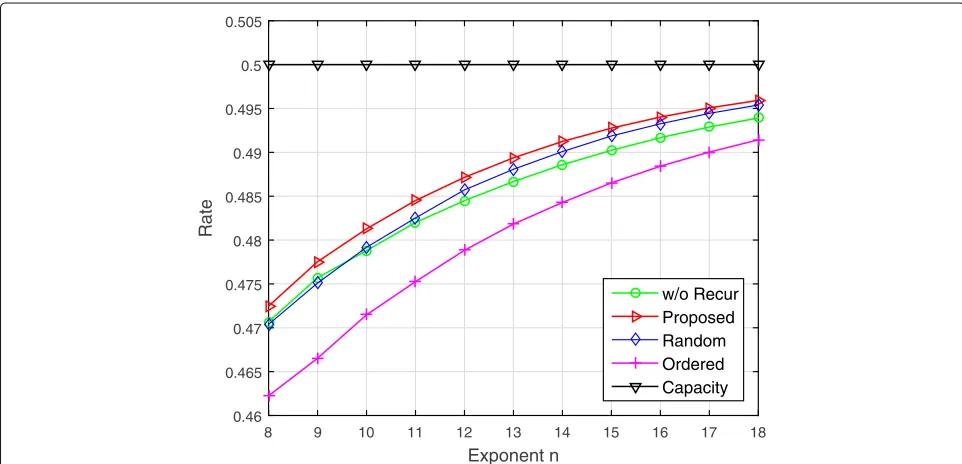
In Fig. 6, we depict achievable rates N1i∈AIWN(i) of polar codes by exploiting different interleaving meth-ods under parallel BECs of which the erasure probabilities are uniformly chosen within the range of(0, 1)(hence, the average of 0.5). The black curve refers to the capacity, the red curve refers to the result of the proposed algorithm, and the blue curve refers the performance when using ran-dom shuffling. We can obtain the green curve when we apply the proposed algorithm only once without recur-sion: that is,Pn = Sn. Finally, the dark red curve refers to
Fig. 6Observation on the different usage of the interleaverQ. Shuffling the coded alphabetsxN
1as randomly as possible exhibits higher achievable rates compared to the ordered interleaver
capacities; whether the order is ascending or descending, the result is not affected.
From the figure, the proposed interleaving algorithm shows better performance in the rate than the other algo-rithms. It is also observed that when W(i)s forms an
ordered set, it converges to the capacity slower than the other algorithms. Hence, if the symmetric capacities of the exposed channels are ordered in either way, they should be rearranged throughQ.
3 Non-identical binary erasure channels with random erasure probabilities with single distribution
In previous studies, [8] and [3], it is assumed that the char-acteristics of underlying discrete memoryless channels are fully exposed to the transceiver; thus, the encoder and the decoder exploit this information. Under this condition, it is proved that polar codes can achieve the symmetric capacity.
In this section, we assume that channel parameters are not deterministic, but are realizations of a random vari-able. For BEC, the channel transition probability of a transmit channelW(i) :Xi →Yiis fully described by the
erasure probabilityi. Hence, the channel features of the
non-identically distributed parallel channels model are perfectly represented via the set of erasure probabilities
N
1
.
The existence of random erasure probabilities means that each i is the realization of the random variable θ
such thati ∼ fθ(i),∀i ∈[1,N], wherefθ is a stationary
probability distribution function.
We now assume that the realized set of erasure prob-ability 1N is exposed to neither the encoder nor the decoder. In this case, the only available information that can be extracted to the encoder and the decoder is the set of moments from the given distributionfθ . We prove that under this scenario, polar codes can achieve the symmetric capacity.
Theorem 2For a set of BECs{W(i)}with the unknown
set of erasure probabilities{i},i∈[1,N], but the
distribu-tion fθis given to the transceiver, there exist polar codes, for arbitrary smallδ ≤ 0, that achieve the symmetric capac-ity Is, in the sense that as N → ∞, the fraction of indices i
satisfies
lim
N→∞
|{i|I
WN(i) ∈(1−δ, 1]}|
N =Is
lim
N→∞
|{i|I(WN(i))∈[0,δ)}|
N =1−Is,
where the symmetric capacity Isis defined as an average
of the individual transmit channel’s capacities: Is(WN) =
1
N
N
i=1I
W(i)
, where WN :X1N →Y1N.
3.1 Proof of Theorem 2
m of the distributionfθ. Also, as previously mentioned, since the transceiver is oblivious to the exact set of erasure probabilities of the underlying parallel channels, it has no choice but to exploitmfor consideration of constructing
codewords.
Now, let us consider the meaning ofIs
Is(WN)=
1 N
N
i=1
I(W(i)) (30)
= 1
N
N
ı=1
(1−i) (31)
=1− 1
N
N
ı=1
i (32)
=(1−), (33)
where = N1 Nı=1i. Hence, we can conclude that
the non-identically distributedN parallel BECs model is equivalent to the N identically distributed BECs model of which the erasure probability is for a largeN and we can achieve the symmetric capacity. Next, we need to verify whether (33) is reliably achievable based on infor-mation given by the transceiver. To that end, we need to demonstrate that the following two issues are true:
• The existence of polar codes over BEC with erasure probabilitym
• ≥
mfor all distributionsfθ
The first statement is proved to be true in Theorem 2 of [1] in that for any B-DMCW, there exists a sequence of information bit sets AN such that |AN| ≥ NRwith
arbitrary small error probability. In this scenario,|AN| =
N(1 − ). The second statement is proved through the linearity ofIs to the erasure probability. In Fig. 7,Is
Fig. 7The symmetric capacityIsof BEC
is depicted. Note that the Is is an affine function of the
erasure probability. Therefore, = m for any
distri-butionfθsince limN→∞N1 Nı=1i=m. Note that under
erasure channels, the equality in the Jensen’s inequality holds
IEW(i)
≤EIW(i)
. (34)
This completes the proof of Theorem 2.
3.2 Achievable polar coding scheme
According to Theorem 2, the construction of the capac-ity achieving polar coding scheme is straightforward. First, given the distributionfθ, the encoder calculates the first moment E[]= m. It then constructs the
mes-sage vectoruN1 by determining the information index set AN with the pre-defined frozen bits uF. This message
sequence is encoded through the generator matrix GN
and is transmitted through the non-identically distributed parallel BECs of 1N. The procedure is summarized in Algorithm 2.
Algorithm 2Polar coding scheme
Encoding process
1: Givenfθ, calculatem
2: Figure out the information setsANaccording to BEC(
m)
3: Encoding:xN1 =uN1 ·GN
Decoding process
1: Given (A,uF,m) Perform SC decoding:yN1 → ˆuA.
It should be noted that to achieve the symmetric capacity under non-identically distributed parallel BECs, with unknown channel parameters, the only constraint required is the code lengthN→ ∞.
4 Random erasure probabilities with non-identical distributions
In this subsection, we consider the case of N non-identically distributed BECsW(i): for∀i∈[1,N] that each distributionfθiof the erasure probabilityifor each trans-mit channel W(i) could differ for different bit channel
indices. Thus, this scenario includes previous scenarios as a special case.
Fig. 8Example: the multi-hop transmission
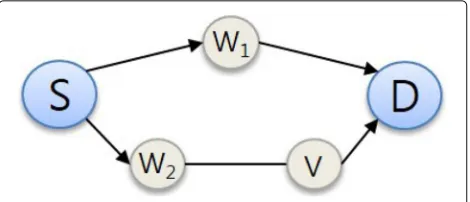
media or interference from different noise sources such as the nodeV in the figure. In these cases, the proposed scenario is logical.
A simple coding scheme that is able to achieve the sym-metric capacity is the conveyance of multiple codewords as a group for each decoding stage. In each stage, we exploit the set of parallel non-identical channelsL = 2l times. The reason for this power of 2 format is to match with the length of polar codewords.
LetW(i)(j)mean thejth access to the channelW(i),i(j)
as the instantaneous erasure probability of the channel W(i)(j)that follows the distributionfθi, andIs,i(W(i))is the symmetric capacity ofW(i)by accessing itLtimes.
The instantaneous capacity for L blocks are depicted in Table 2. The distributions of erasure probabilities can differ, and each transmit channel (row) shows ergodic behavior as shown in the last column of the table. Here, ¯
I(W(N))= L1
L
j=1I(W(i)(j)).
The symmetric capacity in this case becomes
Is
Table 2Ergodic behaviors of instantaneous capacities
1 2 · · · L Average to the affinity of the symmetric capacity over the domain of erasure probability. We now consider two cases. In the first case, we assume that the encoder is able to be adapt-edto various code lengths. This means that the encoder can construct generator matricesGN for any exponentn
(N = 2n). In the second case, the coding structure is
fixed, thus parameterN(and the followingGN) cannot be
changed. In the first case, let the encoder exploit any expo-nentl, and constructL×L generator matrixGL where
L=2l. The following proposition is then satisfied:
Proposition 3For a set of non-identically distributed
BECs {W(i)}, with a set of random erasure parameter
{i},i ∈[ 1,N] that each i follows non-identical fθi, the symmetric capacity Is
W[LN] is achievable by exploiting multiple streams of polar codewords.
The proof of Proposition 3 is the same as that of the existence of polar codes that achieve the set of indi-vidual capacities {¯I(W(i))}, since the symmetric capacity
Is
W[LN] is their sum. Also, in Theorem 2, we proved that there exist polar codes that achieve each capacity ¯
for an arbitrary smallδ ≥ 0, and for all channel index i ∈[1,N]. Therefore, Proposition 3 is true for any set of distributionsfθi
.
4.0.1 Achievable coding scheme
In Fig. 9, the encoding and the decoding procedures are depicted for all transmit channel indexes. Given
all distributions {fθi|∀i ∈[1,N]}, the encoder calculates the set of first moments {mi} and evolved bit
chan-nel capacities
I
WN(i) with {mi} according to these
recursive equations, (19) and (20). With these moments and symmetric capacities, the encoder then constructs N streams polar codewords {xL1(i)} of length L = 2l. To achieve this, the encoder first defines an information setAL(i)= which is then encoded with theL×Lgenerator matrixGL
and output codewords matrixX. Each column ofX propa-gates sequentially through the non-identically distributed parallel BECs.
The receiver savesLoutput vectors in matrixYand pro-duces estimates by applying the SC decoder row by row. This procedure is summarized in Algorithm 3. Note that there are no constraints on N. Actually, since the pro-posed coding scheme is not affected by N, it is robust to the deletion of some transmit channels. Assume that a set of channelsWJ whereJ is a subset of [ 1,N] is lost
since the corresponding set of symmetric capacities are all zeros. The encoder and the decoder will then simply decrease N to N − |J|; the data is transmitted through
Algorithm 3Encoding and decoding process
Encoding process: Repeat∀i∈[1,N] 6: Transmit each column ofX Decoding Process:
1: StackNblocks into matrixYrow by row.
2: Given (Ai,L,uF), perform SC decoder:Y(i) → ˆuAi ∀i∈[ 1,N]
4.0.2 Proof of achievability
From the set of BECs {W(i)} for∀i ∈[1,N], the size of each information set|AL(i)| = L(1 − mi), the unit of which is in bits perL channel uses. It is known that the SC decoder recovers each message uAi with van-ishing probability of error as L → ∞ for ∀i. Now,
For the symmetric capacity, Is
that it is achievable from the proposed scheme. The complexity of this polar coding scheme is O(NLlogL), since it is a concatenation of N SC decoders of lengthL.
In addition, consider a transmitter in which the encod-ing structure cannot be changed. Then, the only choice is to utilize the fixed size of the N × N generator matrixGN, whereN = 2nand the produced codewords
are of the same length, N. We can treat this problem by setting L to be identical to N. The encoder defines the collection of information index sets{Ai} from{mi},
where |Ai| = N · I(mi). Using a common genera-tor matrixGN, the encoder sequentially produces N of
polar codewords xN1(i) = uN1(i) · GN for i ∈[1,N].
These codewords xN1(k) are stacked in rows of the matrix X. The complexity of this polar coding scheme is O(N2logN), since it is a concatenation of N SC decoders.
5 Polarizations on non-independent channels In the previous sections, it was assumed that all transmit channels are independent from each other from
WN
these channels are correlated; thus, the equality in (39) does not hold. Then, the previous polar coding scheme for independent B-DMCs might not achieve the capacity. For example, we can check the polarization phenomenon in a measure of the symmetric capacity forN = 2, where the transition probability of the channelW2:X1×X2→Y1×
The elementedenotes the erasure symbol. Without los-ing information,W2can be modeled as a single quaternary
capacities of split bit channels IW2(1) and IW2(2)
via (1). We can then obtain IW2(1) = IW2(2) = 1 − , which means that no polarization occurs with the coding strategy for independent channels. By relabel-ing, the set of binary input vectorsX12 = {00, 01, 10, 11} is mapped to a quaternary symbol set S = {0, 1, 2, 3}, as depicted in Fig. 10, where r = 2 with the chan-nel notation change from the correlated vector chanchan-nel W2to the single independentq-ary DMCW. The
prob-lem of non-polarization is proved to occur in someq-ary DMCs when the cardinality of the set S is a compos-ite number [10]. However, in [11], the authors proved the existence of polar codes for the composite cardinality ofq=2r.
Under the parallel channel model, whenN = 2n, the
transmit channels are pairwise correlated from
WN
yN1|xN1=
N/2
i=1 W2(i)
y22ii−1|x22ii−1. (41)
The transmit channels can be represented asNlength of independent quaternary input DMCs
WN
tN1|sN1 =
N
i=1
W(i)(ti|si), (42)
whereN= N2.
For generalization, assume thatrtransmit channels are correlated in similarly to (41). If we assumer = 2α (1 ≤ α n − 1) for simplicity, then the new code length becomesN=2n−α, and we have
WN
yN1|xN1=
N
i=1 Wr(i)
yrir(i−1)+1|xrir(i−1)+1 . (43)
In a q-ary representation, (42) still holds, where the input alphabet cardinality is q = 2r. If these relabeled independentq-ary DMCs are identically distributed, such thatW(i)=W(j)for∀i,j∈[1,N], it is proved in [11] that polar codes forq-ary input DMCs achieves the symmet-ric channel capacity whenq = 2rby exploiting the same kernel as in [1]. Therefore, the following proposition holds for a generalq-ary DMCW.
Proposition 4 There exist polar codes for
non-independent DMCs W, which achieve the symmetric
I(W), by relabeling r-bits binary sequence to a q-ary (q=2r) symbol as N→ ∞through the power of 2.
Proof The proof follows the proof of the existence of polar codes in [11]. The authors proved the existence of polar codes that achieve the symmetric capacity for anyq -ary input alphabet discrete memoryless channel whenqis the power of 2. In our model, by grouping and relabeling alphabets in the same length, the model can be mapped to an equivalentq-ary alphabet model, without any informa-tion loss because these operainforma-tions are deterministic. We can then exploit the same proof as that in [11]; hence, the achievability still holds in this partially non-independent channels model.
6 Conclusions
In Section 2, we proved that for deterministic CPs in non-identical channel models, polar codes can achieve the sample mean of bit channel capacities. In addition, we provided an example that demonstrates the importance of the use of the proper channel interleaverQfor achievable rate enhancement and proposed the heuristic mapping algorithm.
In Sections 3 and 4, the key contribution is a new system model where the transmitter and the receiver know only the channel parameter distribution and not the channel parameter itself. If the underlying channel type is BEC, the coding scheme can become simpler. Note that for a BEC with erasure probability, its symmetric capacityIis the affine function of. Then, we have the relationE[I(ε)]= I(), whereis the expectation of the random variableε∼ fε().
By applying multiple streams of polar codewords, we prove that the average capacity of BECs under our sce-narios is achievable. However, this is obtained by sacrific-ing the latency and complexity, since they stack multiple blocks during the encoding and decoding process. Hence, these schemes might not be suitable in systems where low latency or low complexity is required. Rather, it is more practical in storage systems such as flash memory devices where throughput is more important than latency. Espe-cially, for flash memories, statistical responses such as a voltage threshold would change with time and with the number of accesses to a cell block. Hence, as the storage
capacity increases, it is inefficient for a storage controller to determine the exact states of every block or cell. If statistics on their changes are given instead, we can man-age cells more efficiently using the proposed polar coding scheme.
In addition, in the case of parallel channels, where sta-tistically different random disturbances exist across chan-nels, it is difficult to track all the channel parameters. However, if their statistics are known to the transmitter and the receiver, we can deliver data up to the aver-age capacity through polar codes by sacrificing latency. In such cases, polar codes are a promising option that maximizes the throughput.
Under the non-independent channel scenario, we assume that the N transmit channels are grouped into channels with size r which is a power of 2, so that we can treat the scenario as a non-binary system. If N is not divisible by r (N modr = 0), punctur-ing may be used to fit the system into a q-ary system [12]. The proposed polar codes appear to be promis-ing for applications where only the knowledge of the channel parameter distribution is available and can be practical for storage applications such as flash memory devices.
The fourth equation comes from the fact that the sum-mation overu1is a sum of two similar terms. In addition,
the following relation holds with the aid of (23):
Z
W2(2) ≤minZ(W(1),ZW(2)).
The relation can be verified simply by subtracting either the right had terms from the left hand term.
Proof of (24)
ProofWe can prove (24) simply by applying the
ZW2(1)
rewrite the above equation as follows:
Z
which the inequality is from the arithmetic and geometric mean relation.
Proof of the number of equivalent channel combinations
According to the basic theory of polar codes, chan-nels are recursively evolved such that (WN(i),WN(i)) → (W2(N2i−1),W2(2Ni)) for some set of binary input discrete memoryless channels. We denote each mapping as fol-lows:
and it was proved that polarizations occur in non-identically distributed channels.
Recall that functionalFnandGn share the same set of
functions as an input. Furthermore, these input functions
are also results of functionals Fn−1 or Gn−1 due to the
recursive structure of channel evolution. Let us define a swapping operationS:(α,β) →(β,α). We can then eas-ily check thatFnandGnare invariant toS. We also define
a functionalHn which includes bothFn andGn.Hncan
represent its members sinceFnandGn are equivalent in
the number of cases; hence, it is also invariant toS. In a similar way, we defineWn+1which includesW2(2Ni−1)and
W2(2Ni−1). We now rewrite (44) and (45) usingHandW, respectively.
Wn+1=Hn+1(Wn,Wn).
Due to the recursive structure in channel evolutions, each WN(i)is calculated again throughHn. It is then generally in
the form of
Wn+1=Hn+1(Hn(Wn−1,Wn−1),Hn(Wn−1,Wn−1)).
Defining the number of operations ofHthat are required to recursively reachHnasχnthen
χn+1=2χn+1.
By solving this recurrence formula, we can obtainχn =
N−1. Recalling thatHis invariant toSwhich indicates there are two cases for eachH, the number of combina-tions of the B-DMCs that result in the same information set of polar codes is 2N−1. Hence, the number of represen-tative combinations that may have different information sets for lengthNparallel polar coding systems is2NN−1! .
Acknowledgements
This research was supported in part by the Basic Science Research Programs (NRF-2013R1A1A2008956 and NRF-2015R1A2A1A15052493) through NRF funded by MOE and MSIP, the ICT R&D Program of MSIP/IITP (B0717-16-0023), the Technology Innovation Program (10051928) funded by MOTIE, the Bio-Mimetic Robot Research Center funded by DAPA (UD130070ID), INMC, and BK21-plus.
Authors’ contributions
JK and JL prove the achievability of polar codes in non-identically distributed channels and propose the channel interleaver algorithm to enhance the system reliability. Both authors read and approved the final manuscript.
Competing interests
The authors declare that they have no competing interests.
Received: 27 July 2015 Accepted: 27 November 2016
References
1. E Arikan, Channel polarization: a method for constructing capacity-achieving codes for symmetric binary-input memoryless channels. IEEE Trans. Inform. Theory.55(7), 3051–3073 (2009) 2. M Alsan, Conditions for robustness of polar codes in the presence of
channel mismatch (2013). e-print ArXiv:1303.2379v2
3. M Alsan, E Telatar, inIEEE International Symposium on Information Theory (ISIT) 2014. A simple proof of polarization and polarization for non-stationary channels, (Honolulu, 2014), pp. 301–305
4. D Blackwell, L Breiman, AJ Thomasian, The capacity of a class of channels. Ann. Math. Stat.3(4), 1229–1241 (1959)
6. E Sasoglu, L Wang, inIEEE International Symposium on Information Theory (ISIT) 2014. Universal polarization, (Honolulu, 2014), pp. 1456–1460 7. E Hof, I Sason, S Shamai, inIEEE 26th Convention of Electrical and Electronics
Engineers in Israel (IEEEI). Polar coding for degraded and non-degraded parallel channels, (Eilat, 2010), pp. 550–554
8. E Hof, I Sason, S Shamai, C Tian, Capacity-achieving codes for arbitrarily permuted parallel channels. IEEE Trans. Inform. Theory.59(3), 1505–1516 (2013)
9. R Mori, T Tanaka, Performance of Polar codes with the construction using density evolution. IEEE Commun. Lett.13(7), 519–521 (2009)
10. E Sasoglu, inIEEE International Symposium on Information Theory Proceedings (ISIT) 2012. Polar codes for discrete alphabets, (Cambridge, 2012), pp. 2137–2141
11. W Park, A Barg, Polar codes forq-ary channels,q=2r. IEEE Trans. Inform. Theory.59(2), 955–969 (2013)
12. A Eslami, H Pishro-Nik, inIEEE International Symposium on Information Theory Proceedings (ISIT) 2011. A practical approach to polar codes, (St. Petersburg, 2011), pp. 16–20
Submit your manuscript to a
journal and benefi t from:
7Convenient online submission 7Rigorous peer review
7Immediate publication on acceptance 7Open access: articles freely available online 7High visibility within the fi eld
7Retaining the copyright to your article
![Fig. 1 System model. Non-identically distributed parallel channels.Interleaver Q is inserted to make a set of virtually ordered transmitchannels from {W(j)} to {W′(j)}, j ∈ [1, N]](https://thumb-us.123doks.com/thumbv2/123dok_us/933323.1113451/2.595.56.292.551.677/identically-distributed-parallel-channels-interleaver-inserted-virtually-transmitchannels.webp)
![Fig. 5 General differences in Z-parameters for BSC (N = 2) for all ϵ1 ∈ [0, 1] and ϵ2 ∈ [0, 1 − ϵ1]](https://thumb-us.123doks.com/thumbv2/123dok_us/933323.1113451/8.595.57.540.497.713/fig-general-differences-z-parameters-bsc-n.webp)