Volume 2009, Article ID 801613,10pages doi:10.1155/2009/801613
Research Article
Optimal and Fair Resource Allocation for Multiuser Wireless
Multimedia Transmissions
Zhangyu Guan, Dongfeng Yuan, and Haixia Zhang
Wireless Mobile Communications and Transmission Laboratory. (WMCT), Shandong University, Jinan, 250100, China
Correspondence should be addressed to Dongfeng Yuan,[email protected] Received 30 June 2008; Revised 18 December 2008; Accepted 20 February 2009 Recommended by Kwang-Cheng Chen
This paper presents an optimal and fair strategy for multiuser multimedia radio resource allocation (RRA) based on coopetition, which suggests a judicious mixture of competition and cooperation. We formulate the co-opetition strategy as sum utility maximization at constraints from both Physical (PHY) and Application (APP) layers. We show that the maximization can be solved efficiently employing the well-defined Layering as Optimization Decomposition (LOD) method. Moreover, the coopetition strategy is applied to power allocation among multiple video users, and evaluated through comparing with existing- competition based strategy. Numerical results indicate that, the co-opetition strategy adapts the best to the changes of network conditions, participating users, and so forth. It is also shown that the coopetition can lead to an improved number of satisfied users, and in the meanwhile provide more flexible tradeoffbetween system efficiency and fairness among users.
Copyright © 2009 Zhangyu Guan et al. This is an open access article distributed under the Creative Commons Attribution License, which permits unrestricted use, distribution, and reproduction in any medium, provided the original work is properly cited.
1. Introduction
Radio resource allocation (RRA) for multimedia services has drawn a lot of attention because of its capability of offering an efficient way to handle the resources. In previous research, much attention has been paid to system efficiency improvement, that is, maximizing system utility [1–8]. It is shown that the Nash Bargaining Solution (NBS), a well-defined notion in game theory, can be used to maximize the sum of Peak Signal-to-Noise Ratios (PSNRs) in rate allocation for collaborative video transmissions [1]. Optimal resource allocation for multiuser wireless transmissions is studied in [2] from an information theoretic perspective, and it is shown that sum rate maximization (SRM) is suboptimal when taking video quality into account. This work has been extended to joint power and subcarrier allocation for mutiuser video transmission in multi-carrier systems [3]. In [4], Application (APP), MAC, and Physical (PHY) layers are jointly optimized using Cross-Layer Design (CLD) for streaming video delivery in a multiuser wireless environ-ments, and two objective functions are introduced, that is, minimizing the sum of mean square error (MSE) of all video users, maximizing the sum of PSNRs. As a continuous work
of [4, 5] proposed an application-driven cross-layer opti-mization strategy and discussed the challenges in CLD for multiuser multimedia services. Two Layering, as Optimiza-tion DecomposiOptimiza-tion (LOD) methods, dual decomposiOptimiza-tion and gradient projection-based decomposition, are used in [6,7] for downlink utility maximization (DUM) assuming utility functions at APP layer are concave, increasing, and differentiable. The maximization of weighted sum of data rates in cross-layer resource allocation is addressed in [8], and an improved conjugate gradient method under given power constraint is presented as well.
Solution (KSBS) was used to allocate rates amongst multiple video users such that the utility achieved by each user is proportional to the maximum utility achievable.
Both maximization based and distributive policies work in a competitive way as explained by the following two examples. Utility maximization can actually be viewed as a process in which all users compete for resources according to the criteria that the Highest Quality Improvement the Highest Possibility Resources (HQIHPR) [2]. Using KSBS, users compete for resources to make efficient use of the resource and achieve higher utility. The disadvantage of these competitive policies is that they do not consider user’s quality of service (QoS) satisfication degree, meaning that they are not suitable for multimedia services. To address this disadvantage, we propose an optimal and fair policy for multimedia resource allocation, which introduces a judicious mixture of competition and cooperation, such that user’s QoS satisfication degree is taken into account. The idea behind this judicious mixture is Co-opetition, a concept from economic [13]. Co-opetition has been employed in decentralized resource management [14] and collaborative multimedia resource allocation in our preliminary work [15]. It is shown that co-opetition can provide better tradeoff between system efficiency and fairness.
Main contribution of this paper relies on the proposal of a novel co-opetition strategy for RRA in multimedia services, which is both optimal and fair. In this paper, optimal represents sum utility maximization (SUM) subject to the constraints on individual utility. It is worth to mention that the value of optimal sum utility might be smaller than that achieved by the unconstrained SUM, due to the constraints. Fair is defined to describe that, compared to unconstrained SUM, our strategy can result in fairer resource allocation. The additional fairness from our strategy comes from the individual utility constraint. Recall that the uncon-strained SUM allocates resources in a competitive way, which has no constraint on individual utility. Our co-opetition strategy suggests a judicious mixture of competition and cooperation in resource allocation. We formulate the co-opetition strategy mathematically and solve it efficiently using LOD method. This mathematical formulation would help to get a better insight into the essential of competition and cooperation behaviors of users in RRA. We apply our strategy to wireless resource allocation for multiuser video transmissions and evaluate its performance by comparing with existing competition based mechanisms.
The rest of this paper is organized as follows. InSection 2, we formulate the co-opetition strategy, and inSection 3we implement it by employing LOD method. In Section 4, we apply the co-opetition strategy to power allocation amongst multiple video users together with numerical results for performance evaluation. Conclusion is drawn inSection 5.
2. Problem Setup
We consider RRA over a downlink transmission with N users. We assume that the resource available at PHY layer is denoted by X. Denote R ⊂ RN
0,+ as the rate region
achievable at PHY layers, and assume thatRis convex and compact. Convexity assumption means that time-sharing mode is enabled at PHY layer. LetUn(rn),rn ∈R0,+denote the usern’s utility function, which is assumed to be concave, increasing, and differentiable. An example of utility is PSNR for video services [16]. Each user has a minimum desired rate, denoted by r0n, which should be at least guaranteed. That means
rn≥r0n, (1)
otherwise, usernwould not be served. A competition strat-egy should be employed to develop our co-opetition stratstrat-egy. In this paper, we focus on optimization-based strategy, that is, sum utility maximization (SUM). Investigation based on distributive and competition-based strategies will be accommodated in our future work. For SUM, system utility functionU:RN0,+ →R0,+is defined as
Ur=
N
n=1
Un(rn), (2)
wherer =(r1,. . .,rN). Hence, SUM can be written as
max r∈RU
r, s.t. rn≥r0n. (3)
To allow co-opetition, we first define the notion of satisfied user. A user is called satisfied user if its achieved QoS is above or equal to predefined QoS threshold,Uth. Then the basic idea of co-opetition can be described as follows. During the process of RRA, in which all users compete for resources to achieve SUM, users who have achievedUthstop competing temporarily, until all resources have been allocated or all users have been satisfied. Denote rate required by usernto achieveUthwithrn,th, and denoterthas (r1,th,. . .,rN,th). We distinguish the following two cases.
(1) Ifrth∈R, co-opetition allocates resources such that the minimum utility of all users isUth, that is,Un ≥
Uth,∀n.
(2) Ifrth∈/R, co-opetition allocates resources such that the maximum utility of all users isUth, that is,Un≤
Uth,∀n.
Thus, our co-opetition strategy reads
max r∈R U
r,
s.t. rn≥r0n,
Un≥Uth,∀n, ifrth∈R, Un≤Uth,∀n, ifrth∈/R.
(4)
case, rate, which can translate to resources at PHY layer, is more important to unsatisfied users. In the following, we investigate how the LOD method is used to solve (4) efficiently.
3. LOD Method
LOD is a well-defined technique for network utility maxi-mization (NUM) by decomposing the NUM into a set of subproblems coupled with each other. Each subproblem is associated with a protocol layer, in which it can be solved separately [17].
3.1. Rewrite Co-opetition Strategy. We assume it is known whetherrthcan be achieved or not. In the case ofrth ∈R, Un≥Uthtranslates intorn≥rn,th, andUn ≤Uthtranslates intorn≤rn,thotherwise. We also assume that
rn,th> r0n (5)
always satisfies. Then constraints in (4) can be rewritten as
rth≤r ≤ ∞, ifrth∈R,
r0≤r≤rth, ifrth∈/R,
(6)
where r = (r1,. . .,rN),r0 = (r01,. . .,r0N)( In the case of
r0∈/R, total resource available cannot guarantee all users the minimum resource required, and some users will deny to be served. In this paper, we assume the minimum resource of all users can be always guaranteed, that is,r0∈R.) . We observe that, no matterrth ∈Ror not, the constraint has the same form of
rlow≤r ≤rupp, (7)
withrlow=(rl1,. . .,rlN),rupp=(ru1,. . .,ruN). Hence, (4) can be rewritten as
max r∈RU
r, s.t.rlow≤r≤rupp. (8)
3.2. Dual Decomposition. To solve (8) with LOD, (8) is firstly modified by introducing an additional variables, then the primal function (8) reads
max s U
s,
s.t.rlow≤s≤r,
r≤rupp, r∈R.
(9)
After introducing the Lagrangian factors
λ=(λ1,. . .,λN)T,
λ =(λ1,. . .,λN)T ,
(10)
the Lagrangian function of (9) is written as
Ls,r,λ,λ=Us+λT,λT ⎛ ⎝ r−s
s−rlow ⎞
⎠ (11)
withλ≥0,λ ≥0. Thus, the dual function is
gλ,λ=sup s
Ls,r,λ,λ, (12)
The maximization in (9) can be solved by searching the optimumλandλ such that the dual function is minimized, that is,
min λ,λ
gλ,λ. (13)
Based on the analysis afore, (12) can be decomposed into two subproblems as
gλ,λ=gAλ,λ +gPλ, (14)
where
gAλ,λ =max s
Us+λT−λTs−λTrlow, (15)
gPλ=max r∈R, r≤rupp
λTr. (16)
For given λ and λ , the above two-maximization can be solved independently at APP layer for (15) and at PHY layer for (16). So far, we have transformed the original maximization, (8), into its dual problem.
3.3. Solving (13), (15)and (16). As mentioned above, for each fixedλandλ , (15) and (16) have to be solved. Denote G(s) as the item to be maximized in (15), that is,
Gs=Us+λ T−λTs−λ Trlow. (17)
Then G(s) is continuous and differentiable, and further denoteS0as set ofs=(s1,. . .,sN) such that
S0=
s∂G
s
∂sn =0, n=1,. . .,N
. (18)
Then (15) can be solved via efficiently selecting the optimum s∗, such that
s∗=arg max s∈S0 G
s. (19)
1.Original optimization
2.Determine whether all users can be satisfied or not Dual decomposition 3.LOD method
Outer iteration: subgradient method gA λn,λn gP
APP layer optimization
PHY layer optimization Inner iteration
Figure1: Illustration of the implement of co-opetition strategy.
assumed to be convex and compact, thus the domain of (16), denoted withR,
R =R∩rr≤rupp, (20)
is also convex and compact. WSRMax over R is a well-researched problem and there are many efficient solutions for a wide range of PHY layer setups [3,8,18].
Hereafter, we assume that for eachλ andλ, (15) and (16) can be solved efficiently. Then the optimumλ andλ can be determined, for example, using either sub-gradient method, cutting plane method or ellipsoid method [19]. In
Section 5, we would show how to solve (13), (15) and (16)
more concretely through power allocation.
3.4. Determining Whetherrth ∈ R or Not. Note that isrth
not necessarily achievable. Whetherrth ∈R or not can be determined by userwisely computing the minimum resource required to achieverth. Fortunately again there are several solutions available for different scenarios. For example, in [20] a generic procedure, CLARA, was presented for cross-layer resource minimization subject to a set of constraints on the overall QoS. [21] proposed an iterative algorithm which monotonically converges to the unique allocation with optimal sum power efficiency. This is actually another hot topic as opposed to utility maximization in this paper, namely, cost minimization to achieve certain QoS.
3.5. Summery of LOD Method. In this Section, we have mapped our co-opetition strategy, (4), to a standard con-strained optimization over convex domain, that is, (8). Moreover, importantly, through applying the LOD, many well-researched solutions are available which make our co-opetition strategy more applicable. Finally, since the resource allocation in this paper can be formulated as a convex optimization, the LOD method has worst-case polynomialtime complexity [17]. It will be shown that the LOD method converges within limited iterations. Figure 1
is a brief description to apply the co-opetition strategy. We investigate how co-opetition can be applied to power allocation in detail.
4. RRA Using Co-Opetition
In this Section, we first describe the system scenario, and then illustrate the co-opetition strategy in detail. Finally, numerical results are presented for performance evaluation through comparing with competition-based strategy.
4.1. System Setup. We consider downlink N-user video transmission in a cell with a base-station (BS) which acts as the central spectrum manager (CSM). At APP layer, users transmit same or different video sequences. We choose PSNR as user’s utility as it is the only widely accepted video QoS metric and choose the rate-distortion (RD) model proposed in [16] to describe user’s average RD behavior as this model applies well to the state-of-the-art video encoder [22]. Then user’s utility can be defined as
Un(rn)=10 log 255
2(rn−R0n)
D0n(rn−R0n) +μn, (21)
whereR0n,D0n andμn are sequence parameters, which are dependent on video sequence characteristics, such as spatial and temporal resolution, delay constraints as well as the percentage of INTRA coded macro-blocks [1,16].D0nis the minimum rate that should be at least guaranteed for usern, therefore in this work we assume thatrn> R0n.
At PHY layer, the BS has limited transmit power, Ptot. LetP=(P1,. . .,PN) represent the power allocated to all the users, thus we have Nn=1Pn ≤ Ptot. Each user is assumed
to experience an AWGN channel, whose capacity,Cn(Pn), is given by
Cn(Pn)=B·log2
1 + Pn σ2
n,n
, (22)
where Band σ2
n,n denote bandwidth available and receiver noise power, respectively.
It is assumed that private information of each user, including R0n,D0n,μn,σ2
n,n, are sent to CSM, where power allocation is made. Then CSM sends back the decision of power allocated to each user. Note that, more complicated PHY layer setups can also be taken into account, such as multicarrier and multiple antennas systems over Rayleigh fading channels. However, employing simple PHY layer setup would help to highlight the focus of this paper, investigating optimal and fair criteria for RRA. It is worth mentioning that the co-opetition strategy can be easily extended to other scenarios.
4.2. Co-Opetition Strategy.
35 dB, or 32 dB, representing perfect, good and acceptable video quality, respectively. The PSNR threshold can also be set dynamically according to the total resources available, the number of users, and so forth. As an illustration, we choose QoS threshold as PSNR = 35 dB corresponding to good video quality, that is, Uth = 35 dB in (4). Denote
Pthas (P1,th,. . .,PN,th) representing power required by users to achieve PSNR of 35 dB. Using co-opetition strategy, if sum(Pth) ≤ Ptot( sum(Pth) means calculating the sum of all members in Pth, i.e., Nn=1Pn,th.) , the lower and upper bounds of achievable PSNR are set at Ulow = 35dB and Uupp = ∞, respectively, andUlow = −∞andUupp =35 dB otherwise. Correspondingly, when we have sum(Pth) ≤Ptot, lower and upper bounds of rates arerlow = (r1,th,. . .,rN,th) andrupp = ∞, respectively, andrlow = (R01,. . .,R0N) and
rupp = (r1,th,. . .,rN,th) otherwise. In this paper, it is easy to calculatePn,th,rn,thcorresponding to PSNR threshold, for both (21) and (22) are invertible and monotonic increasing functions. Thus, given PSNR threshold, sum(Pth) ≤ Ptotor not can be easily determined, and consequently, bothrlowand
ruppare known.
Given each user’s utility definition in (21) and (22), system utility writes
where Cn(Pn) refers to as rn. We assume that capacity approaching channel codes is employed at PHY layer. Then our co-opetition strategy writes
max UsP, same form as (8). The first constraint on the sum of the power (24) corresponds tor∈Rin (8).
4.2.2. The Implement of Co-opetition. Using LOD, maximiza-tion of (24) can be decomposed into
max
wherePn,uppis defined as the upper bound of transmit power of userncorresponding torn,upp.
The optimum variable of (25),c∗ =(c1∗,. . .,c∗N), can be obtained by simply making the partial derivative ofgAand let it equal to 0, layer by the weighted sum rate maximization with thecon-straints of total and individual power. Note thatCn(Pn) in (22) is concave and increasing with respect toPn, thus the item to be maximized in (26) is also concave increasing. The domain of (26) is formed by two linear inequalities, each of which forms a convex domain together withPn≥0,∀n. Thus the domain of (26) is also convex, and (26) is accessible to conventional convex optimization techniques, such as feasible direction method and projected gradient method. In this paper the feasible increasing direction method is employed (see the Appendix for details).
So far, given fixedλ,λ , two subproblems, (25) and (26), have been solved. We denote the optimal values of them withgA∗(λ,λ ) andgP∗(λ), respectively. In the following, the
Table1: test video sequences (videoID, video type, temporal level (TL), frame rate).
ID Video sequence μ D0 R0
1 Foreman (CIF, TL=4, 30 Hz) 5232400 0 0
2 Coastguard (CIF, TL=4, 30 Hz) 6329700 4.3 0
3 Mobile (CIF, TL=4, 30 Hz) 38230000 1 44040
4 Foreman (QCIF, TL=4, 30 Hz) 2653300 0 19614
5 Foreman (CIF, TL=4, 15 Hz) 2760000 1 20720
6 Foreman (CIF, TL=2, 30 Hz) 4610000 3 55080
100 200 300 400 500 600 700 800 Total transmit power,Ptot
32 33 34 35 36 37 38 39 40 41
PSNR
(dB)
Co-opetition (Foreman) Co-opetition (Mobile)
NBS SP (Foreman) NBS SP (Mobile)
Figure2: Plot of individual PSNRs achieved by the co-opetition, NBS SP. User 1: Foreman (CIF, TL=4, 30 Hz), user 2: Mobile (CIF, TL=4, 30 Hz).
whereαk is the step-size which can be set as constant, and
gk denotes the sub-gradient at (λk,λ k). Note that, P = (P1,. . .,PN)Tat (λk,λ k) rightly forms a sub-gradient, so the sub-gradient can be obtained almost without any cost.
4.3. Numerical Results. In this subsection, the proposed co-opetition strategy (co-co-opetition) is evaluated by comparing with the strategy proposed in [1], which allocates resources using the Nash bargaining Solution of Same bargaining Power (NBS SP). For the sake of comparison, we use the same test sequences as those in [1], and we list the parameters in Table I for reader’s convenience.
4.3.1. Comparison in Terms of Individual PSNR. In this experiment we focus on individual PSNRs in the case of two users. At APP layer, user 1 transmits Foreman sequence of CIF resolution at 30 Hz, and user 2 transmits Mobile sequence of CIF resolution at 30 Hz. At PHY layer, we set the bandwidth toB=250 kHz, and let the receiver noise power to beσ2
n,1=50 andσn,22 =1 for user 1 and user 2, respectively.
1: Setk=1 andPk
n=0, ∀n, Precisionε=10−4 Repeat:
2: Determine∇gk
Pusing(A.1)
3: Determinedkaccording (A.4) and(A.5) 4: Determineαkusing(A.6)
5: ComputePk+1using(A.8)
Until:|(∇gk
P)Tdk| ≤ε.
Algorithm1: Feasible increasing direction method.
Total transmit power Ptot varies from 50 to 800. Figure 2 shows the individual PSNRs achieved by these two schemes. If NBS SP is employed, user 1 can achieve higher PSNR that user 2 or, in other words, it is very hard for user 2 to achieve satisfying video quality (PSNR≥35). In the case ofPtot ≥
200, user 1 can always be satisfied. Note in this case, user 1’s video satisfaction degree increases very slowly as the PSNR increases, but significantly for user 2. Taking this observation into account, co-opetition imposes individual constraint on each user (see (4)). For example, with Ptot = 200, which can not satisfy two users simultaneously, co-opetition decreases user 1’s PSNR to 35 dB, and consequently, user 2’s PSNR achieves an improvement about 1 dB. If have 350 ≤ Ptot ≤ 650, user 2’s PSNR is improved such that user 2 is just satisfied. Note, in these two cases, co-opetiton keeps user 1 satisfied, while user 2 either be satisfied or achieve much QoS improvement. It is worth to mention that, under a given total transmit power constraint, NBS SP can achieve higher total PSNR of two users than that in co-opetition. This is because the NBS SP maximizes the sum of PSNRs without taking the individual PSNR constraints into account. The co-opetition works in quite a different way. It maximizes the sum of PSNRs under the constraints of individual PSNR. Therefore, the co-opetition is not only optimal ( As stated inSection 1, in this paper the optimal means sum utility maximization under certain constraints, differing from unconstrained optimization.) , but also fairer than NBS SP. This argument is further verified with other experiments
200 400 600 800 1000 1200 Total transmit power,Ptot
1 2 3 4 5 6 7 8 9
N
u
mber
of
satisfied
users
Co-opetition NBS SP
(a)
200 400 600 800 1000 1200
Total transmit power,Ptot
22 24 26 28 30 32 34 36
M
inim
um
PSNR
(dB)
Co-opetition NBS SP
(b)
Figure3: Plot of the number of satisfied users (a) and minimum PSNRs (b) achieved by co-opetition and NBS SP in the case of nine users. Id of sequences transmitted are 3, 6, 1, 3, 5, 1, 3, 2, 2, respectively. These sequences are randomly selected fromTable 1. BandwidthBis set to 400 KHz for all users, and the receiver noise power are set to 16, 7, 5, 1, 19, 12, 24, 12, 11, respectively, again by random generation.
500 1000 1500 2000 2500 3000 Total transmit power,Ptot
3 4 5 6 7 8 9
N
u
mber
of
satisfied
users
Co-opetition NBS SP
32 dB 34 dB 36 dB
(a)
500 1000 1500 2000 2500 3000 Total transmit power,Ptot
22 24 26 28 30 32 34 36
M
inim
um
PSNR
(dB)
Co-opetition NBS SP
32 dB 34 dB 36 dB
(b)
Figure4: Plot of the number of satisfied users (a) and minimum PSNRs (b) achieved by NBS SP and adaptive co-opetition. System setup is the same as that ofFigure 3. 32 dB, 34 dB, and 36 dB refer to PSNR thresholds corresponding to differentPtot.
receiver noises randomly generated from 0 to 25. Figure 3 shows the number of satisfied users and the minimum PSNRs achieved by NBS SP and co-opetition. We observe that, the co-opetition always outperforms the NBS SP. For example, in the case ofPtot =1250, co-opetition can make all users satisfied, but only 6 users satisfied by NBS SP. With respect to the minimum PSNR, which is an important criteria evaluating system in the worst case, improvement of around 6 dB can be achieved when Ptot ≥ 200. Note that, NBS SP can only make minimum PSNRs from about 25 dB
0 5 10 15 20 Number of iterations 32
32.5 33 33.5 34 34.5 35
PSNR
(dB)
Foreman Mobile
Optimal average PSNR Average PSNR (a)
0 5 10 15
Number of iterations 35
35.5 36 36.5 37 37.5 38 38.5 39
PSNR
(dB)
Foreman Mobile
Optimal average PSNR Average PSNR (b)
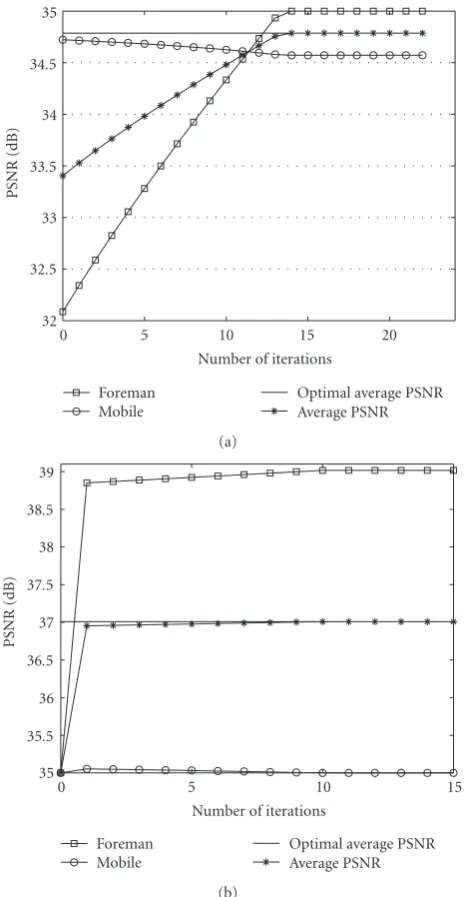
Figure 5: Plot of individual PSNRs and average PSNR. User 1: Foreman (CIF, TL=4, 30 Hz), user 2: Mobile (CIF, TL=4, 30 Hz). (a):Ptot=200 and (b):Ptot=500.
Again, this experiment indicates that co-opetition provides a good tradeoffbetween system efficiency and fairness.
4.3.3. Adaptive Co-opetiton Strategy. In previous experi-ments, the threshold PSNR is fixed to be 35 dB. In order to consider more fairness in resource allocation, adaptive threshold can be employed. As an illustration, we present a simple method to set the threshold PSNR. More optimal and fair scheme for determining the threshold PSNR will be investigated in our future work. We employ PSNR=32 dB, 34 dB and 36 dB to represent acceptable, good and very good quality, respectively. Denote resources required by the three
levels withRa,Rg,Rv, then threshold PSNR, PSNRth, can be determined as follows
PSNRth=32 dB, ifRtot< Rg,
PSNRth=34 dB, ifRg≤Rtot≤Rv,
PSNRth=36 dB, ifRg≤Rtot≤Rv,
(31)
whereRtotis denote as total resources available.
Same system setup as that in previous experiment is used. We observe from Figure 4(a) that, co-opetition employing adaptive PSNRth still outperforms the NBS SP. Moreover, adaptive PSNRthis more concerned with fairness than that using fixed threshold. For example, in the case of low resource, for example,Ptot≤500, PSNRth=32 dB is selected. Consequently, an improvement of about 3 dB and 2 dB can be achieved for the minimum PSNRs compared to NBS SP and co-opetition using fixed threshold (see Figure 3(b)), respectively. Note, these improvements are significantly important for users having low PSNRs. Although these improvements come from further decreasing the maximum achievable PSNR, it can provide fairer resource allocation. For instance, in Figure 4(a), it is very easy for all users to achieve similar quality level using co-opetition. Moreover, PSNRthcan also be set to a very high level, for example, 36 dB in the case ofPtot > 2500. An important advantage of this is that all users can be guaranteed high video quality, but cannot by fixed PSNR threshold and NBS SP.
4.3.4. Optimality Verification. Our co-opetition is also opti-mal. As stated in Section 1, optimal means sum utility maximization (SUM) under individual constraints. The optimality is verified by experimental analysis in the case of two users. Results of two examples of them are shown
inFigure 5(a)andFigure 5(b). System setup is the same as
that in Figure 2. The optimal average PSNRs are achieved by exhaustive search. Recall that the LOD method consists of inner and outer iterations. In each inner iteration, the power allocation is initiated corresponding to (R01,R02) for
Figure 5(a) and (r1,th,r2,th) for Figure 5(b). In the outer
iteration, the values of λ and λ are initialized randomly. Figures5(a)and5(b)show the results of outer iterations.
From these two figures, we can see that our strategy is optimal under individual constraints. InFigure 2,Ptot=200 cannot satisfy two users simultaneously. Therefore the PSNR of user 1 is pegged at the threshold PSNR = 35 dB. The optimal average PSNR can be achieved after 14 iterations. In
Figure 5(b),Ptot = 500 can make satisfying PSNR for both
the two users. We observe that, user 2’s PSNR has only little fluctuation, and converges to the threshold. At the optimal power allocation, both the two users’ PSNRs are above or equal to the threshold. All these coincide with the results in
Figure 2.
5. Conclusion
In this paper, we have presented an optimal and fair co-opetition strategy for multiuser multimedia RRA. Following contributions and conclusions have been made and drawn
(1) We formulate the co-opetition strategy as sum utility maximization under constraints from both APP and PHY layers. APP layer constraints imply that co-opetition takes the QoS satisfaction degree into account in RRA.
(2) We show that the co-opetition strategy can be implemented efficiently through applying the LOD method. Therefore the co-opetition strategy can easily apply to real time multimedia services.
(3) We apply the co-opetition strategy to power alloca-tion among multiple video users. Numerical results indicate that co-opetition can result in an improved number of satisfied users and significant improve-ment in minimum PSNRs as well. A simple method for adaptively determining threshold PSNR is also presented, such that fairer resource allocation can be achieved.
(4) We conclude that co-opetition, that is, mixture of cooperation and competition, is more applicable to multiuser multimedia RRA than pure competition based strategy. Co-opetition strategy is not only optimal, but also fair.
Our future work is to design more feasible co-opetition strategy for different system setups, including multicarrier and multiple antennas systems. We also wish to extend our preliminary work to future heterogenous network, in which users not necessarily run in a collaborative way.
Appendix
Feasible Increasing Direction Method
Feasible Increasing direction method iteratively searches the optimum variable,P∗ = (P1∗,. . .,PN∗), by in each iteration selecting a feasible increasing direction and update step size. Denote Pk = (Pk
1,. . .,PkN) as power allocation in the kth iteration, then Pk satisfies the constraints in (26). Denote
IfPkis strictly feasible, that is,
N
can be obtained by solving following maximization through linear programming, αkby solving following one-dimension maximization,
maxφαk=gPPk+αkdk
Then the feasible increasing direction method can be sum-marized inAlgorithm 1.
Acknowledgment
References
[1] H. Park and M. van der Schaar, “Bargaining strategies for net-worked multimedia resource management,”IEEE Transactions on Signal Processing, vol. 55, no. 7, part 1, pp. 3496–3511, 2007. [2] C. Shen and M. van der Schaar, “Optimal resource allocation in wireless multiaccess video transmissions,” inProceedings of the IEEE International Conference on Communications (ICC ’07), pp. 4581–4586, Glasgow, UK, June 2007.
[3] Y. Su and M. van der Schaar, “Multiuser multimedia resource allocation over multicarrier wireless networks,”IEEE Transac-tions on Signal Processing, vol. 56, no. 5, pp. 2102–2116, 2008. [4] L.-U. Choi, W. Kellerer, and E. Steinbach, “On cross-layer
design for streaming video delivery in multiuser wireless environments,”EURASIP Journal on Wireless Communications and Networking, vol. 2006, Article ID 60349, 10 pages, 2006. [5] S. Khan, Y. Peng, E. Steinbach, M. Sgroi, and W. Kellerer,
“Application-driven cross-layer optimization for video streaming over wireless networks,” IEEE Communications Magazine, vol. 44, no. 1, pp. 122–130, 2006.
[6] J. Brehmer and W. Utschick, “A decomposition of the downlink utility maximization problem,” inProceedings of the 41st Annual Conference on Information Sciences and Systems (CISS ’07), pp. 437–441, Baltimore, Md, USA, March 2007. [7] J. Brehmer and W. Utschick, “Utility maximization strategies
in the multi-user MIMO downlink,” inProceedings of the 1st International Workshop on Cross Layer Design (IWCLD ’07), pp. 86–90, Jinan, China, September 2007.
[8] R. B¨ohnke and K.-D. Kammeyer, “Weighted sum rate maxi-mization for the MIMO-downlink using a projected conjugate gradient algorithm,” in Proceedings of the 1st International Workshop on Cross Layer Design (IWCLD ’07), pp. 82–85, Jinan, China, September 2007.
[9] L. Zhang, S. Deering, D. Estrin, S. Shenker, and D. Zappala, “RSVP: a new resource reservation protocal,”IEEE Network, vol. 7, no. 5, pp. 8–18, 1993.
[10] M. van der Schaar and S. Shankar N, “Cross-layer wireless multimedia transmission: challenges, principles, and new paradigms,”IEEE Wireless Communications, vol. 12, no. 4, pp. 50–58, 2005.
[11] F. Kelly, “Charging and rate control for elastic traffic,”
European Transactions on Telecommunications, vol. 8, no. 1, pp. 33–37, 1997.
[12] F. P. Kelly, A. K. Maulloo, and D. Tan, “Rate control for communication networks: shadow prices, proportional fairness and stability,” Journal of the Operational Research Society, vol. 49, no. 3, pp. 237–252, 1998.
[13] A. M. Brandenburger and B. J. Nalebuff, Co-Opetition: A Revolution Mindset That Combines Competition and Cooper-ation: The Game Theory Strategy That’s Changing the Game of Business, Currency Doubleday, New York, NY, USA, 1997. [14] A. Larcher, H. Sun, M. van der Shaar, Z. Ding, et al.,
“Decen-tralized transmission strategy for delay-sensitive applications over spectrum agile network,” inProceedings of International Packet Video Workshop, Irvine, Calif, USA, December 2004. [15] Z. Guan, D. Yuan, and H. Zhang, “Novel coopetition paradigm
based on bargaining theory or collaborative multimedia resource management,” in Proceedings of the 9th Annual IEEE International Symposium on Personal, Indoor and Mobile Radio Communications (PIMRC ’08), pp. 1–5, Cannes, France, September 2008.
[16] K. Stuhlm¨uller, N. F¨urber, M. Link, and B. Girod, “Analysis of video transmission over lossy channels,”IEEE Journal on Selected Areas in Communications, vol. 18, no. 6, pp. 1012– 1032, 2000.
[17] M. Chiang, S. H. Low, A. R. Calderbank, and J. C. Doyle, “Layering as optimization decomposition: a mathermatical theory of netowrk architectures,”Proceedings of the IEEE, vol. 95, no. 1, pp. 255–312, 2007.
[18] S. Shi, M. Schubert, and H. Boche, “Weighted sum-rate optimization for multiuser MIMO systems,” inProceedings of the 41st Annual Conference on Information Sciences and Systems (CISS ’07), pp. 425–430, Baltimore, Md, USA, March 2007. [19] J.-L. Goffin and J.-P. Vial, “Convex nondifferentiable
opti-mization: a survey focussed on the analytic center cutting plane method,” Tech. Rep. 99.02, Logilab, University of Geneva, Geneva, Switzerland, 1999.
[20] J. A. Nossek, “CLARA: cross layer assisted resource allocation—theory and applications,” in Proceedings of the 1st IEEE International Workshop on Cross Layer Design (IWCLD ’07), Jinan, China, September 2007.
[21] R. D. Yates, “A framework for uplink power control in cellular radio systems,” IEEE Journal on Selected Areas in Communications, vol. 13, no. 7, pp. 1341–1347, 1995. [22] Y. Andreopoulos, A. Munteanu, J. Barbarien, M. van der