R E S E A R C H
Open Access
A chaotic simulated annealing and particle
swarm improved artificial immune
algorithm for flexible job shop scheduling
problem
Rui Zeng
1,2*and Yingyan Wang
1Abstract
Reasonable scheduling of flexible job shop is key to improve production efficiency and economic benefits; in order to solve the problem in flexible job shop scheduling problem, a novel flexible job shop scheduling method based on improved artificial immune algorithm is proposed. Firstly, a mathematical model of the flexible job shop scheduling is established, and the total shortest processing time is taken as the objective function. Secondly, artificial immune algorithm is used to solve the problem, and particle swarm optimization algorithm is taken as the operator to embed into manual immune algorithm for maintaining the diversity of population and prevent obtaining local optimal solution. Finally, the performance of the algorithm is tested by simulation experiments on standard set. The results show that the proposed algorithm can obtain better flexible job shop scheduling scheme and especially has more significant advantages in solving large-scale problems in comparison with other algorithms.
Keywords: Flexible job shop scheduling, Artificial immune algorithm, Mutation operator, Particle swarm
optimization algorithm
1 Introduction
Job shop scheduling problem (JSP) refers to the ordering of available shared resource allocation and production tasks within a certain period of time, so that certain performance indicators can be optimized. The typical JSP model is more ideal. It is difficult to fully reflect the actual application. With the intensification of the marketization of manufacturing, the production resources are not infinitely usable, and the processing time of each process alone is not always the same. This results in the flexibility of the production process. The flexible job shop scheduling problem (FJSP) came into being; it is more in line with the actual production situation, but it also increases the complexity of the problem [1]. FJSP is a typical combinatorial optimization
problem, which belongs to the NP problem and has al-ways been a key and difficult point in the research of the manufacturing industry [2].
For FJSP problems, a large number of scholars and researchers have invested a lot of time and energy in in-depth research, made some research progress, and pro-posed many FJSP problem solving algorithms [3]. The current FJSP problem solving algorithms can be roughly divided into three categories: exact solution algorithms, heuristic algorithms, and artificial intelligence algo-rithms. The branch-and-bound method is the most clas-sic and accurate solution algorithm. It is simple and easy to implement. For small-scale FJSP problems, the solu-tion efficiency is high; however, as the scale of the manu-facturing industry continues to grow, the scale of processing products is getting larger and larger. The boundary method is difficult to meet the FJSP problem solving requirements of modern production and manufacturing [4]. The most representative heuristic algorithm is the Lagrangian relaxation method. Others * Correspondence:[email protected]
1School of Electro-Mechanical and Information Technology, Yiwu Industrial and Commercial College, Yiwu, China
2College of Computer Science and Technology, Zhejiang University of Technology, Hangzhou, China
have high efficiency in solving small-scale FJSP prob-lems, but they have the same flaws as the exact solution algorithms, and their application scope is limited [5]. Artificial intelligence algorithm is mainly used to simulate the behavior of biological groups in nature. It has the advantages of parallelism, fast search speed, etc. It is the most widely used in FJSP problem solving and has become the main research direction [6]. Some scholars proposed the use of genetic algorithm, simulated annealing, particle swarm optimization algorithm, ant colony algorithm, and firefly algorithm to solve the FJSP problem and obtained better results [7–9]. However, in practical applications, these artificial intelligence algorithms all have their own deficiencies, such as the late con-vergence speed is slow, easy to obtain local optimal solution [10]. Artificial immune algorithm (AIA) is a kind of evolutionary algorithm that simulates the biological immune system. It is a multi-point ran-dom search algorithm. It has learning, self-organization, and memory under the premise of maintaining the excellent characteristics of the gen-etic algorithm. Such characteristics, so compared with other evolutionary algorithms, have better glo-bal search capabilities; have been successfully applied in cloud computing resource scheduling, robot path planning, and other fields; and provide a new re-search tool for solving FJSP problems [11].
In order to obtain a more optimal FJSP problem optimization program and reduce the production cost of the manufacturing industry, an improved FJSP problem solving method based on the modified artifi-cial immune algorithm (MAIA) was proposed, and some standard examples were used to test the per-formance of the algorithm.
2 The mobile agent-based data fusion algorithm
2.1 Mathematical model of FJSP
The FJSP can be expressed as follows: n workpieces are processed on m machines, the processing time and production cost of each operation are known, and the processing order of each workpiece on each machine is constrained. The requirements are deter-mined and the process constraints are required. The processing start time, completion time, and process-ing sequence of all the parts on the compatible machines make the production cycle, production cost, and equipment utilization process performance index optimal or suboptimal. The objective function of FJSP is
The corresponding constraint condition is
Xm
In the function,Ciis the completion time of the work
piece Ji; Fp is the total processing cost; Fijk is the
pro-cessing cost of the jth process of workpiece i on the k
machine tool; Tsijk is the first processing time on the k
machine tool for the jth process of workpiece i; TEiðj−1Þk
is the workpiece i in (j−1)th process on the kmachine end time; t1k andt2k are the start and end points of the
idle time period of machine k, respectively; FSij is the
unit time storage cost between the (j−1)th and jth processes of the workpiecei;Pijkis the time required for
the jth machining operation of the workpiece i on the
kth machine; and Xijk indicates whether the jth
proced-ure of the workpieceiis selected to be machined on the
kmachine [12].
2.2 Improved artificial immune algorithm
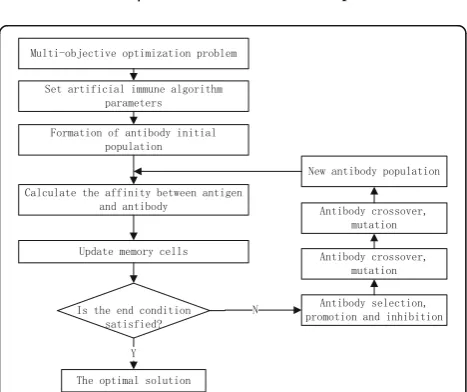
1. Set the objective function and corresponding constraints of the multi-objective optimization problem.
2. Generate the initial antibody group of the artificial immune algorithm, that is, the candidate solution or feasible solution of the multi-objective optimization problem. 3. Calculate the affinity of the antibody and the
antigen; the affinity can describe the degree of matching between the solution and the objective function.
4. Save the antibody with higher affinity and enter the next-generation antibody group to generate immune memory cells.
5. Selecting, promoting, and inhibiting antibodies to ensure the diversity of individuals in the antibody population.
6. Crossing and mutating individuals to create new antibody populations.
7. For individuals with low antibody-adaptive fitness values, individuals with high fitness values in memory cells are replaced to produce next-generation antibody populations.
8. If the algorithm satisfies the end condition, the algorithm is terminated; otherwise, the process jumps to step 3.
From the above, we can see that the workflow of the standard artificial immune algorithm is shown in Fig.1.
2.3 Correlation operator of artificial immune algorithm
Artificial immune algorithm requires some operator dur-ing the work process, as follows:
1. Affinity evaluation operator between antibodies. Set the antibody as a viable solution to optimization
problems. The affinity of theith andjth antibodies isaff(abi)andaff(abj), respectively. The affinity evaluation operator is mainly used to describe the similarity of i andj; the affinity evaluation formula is
2. Antibody concentration evaluation operator. Set the individual of the antibody group asN. The
calculation formula for the antibody concentration evaluation operator is
3. Mutation operator. The mutation operator is used for nascent antibodies to ensure multiple samples of individuals in the antibody group. The calculation formula is
In the formula,Gis genes of antibody;G′is genes of antigen;fis an affinity function;ηis a control parameter; andN(0,1)is a Gaussian variable.
2.4 chaotic simulated annealing particle swarm parallel artificial immune optimization algorithm
Similar to other group intelligent algorithms, the stand-ard artificial immune algorithm has the disadvantages of being easy to fall into local optimality and premature-ness. For this reason, the chaotic simulated annealing particle swarm optimization algorithm is introduced into the artificial immune algorithm. The chaos theory is used to dynamically adjust the parameters of the particle swarm optimization algorithm. At the same time, the dy-namic inertia weight method is used to accelerate the convergence of the algorithm. The simulated annealing process based on the automatic attenuation coefficient is used to improve the probability and speed of searching for the optimal solution. The optimized artificial im-mune algorithm solves the problem of slow convergence in the late search period to ensure the diversity of the population and improves the search speed and efficiency of the algorithm, resulting in an improved artificial im-mune algorithm.
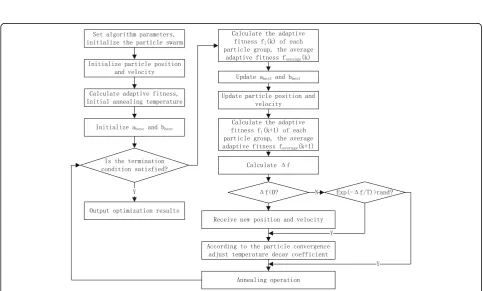
The execution process of chaotic simulated annealing particle swarm optimization algorithm consists of the following three parts.
1. Using the chaos theory to dynamically adjust parametersr1,r2of the particle swarm optimization algorithm, resulting in an excellent population; 2. Using the formulae (1) and (2) to search for the
optimal solution in evolution;
3. Simulate the annealing algorithm to locally optimize the position of each particle in the particle swarm optimization algorithm and repeatedly run the iteration process until the termination condition is satisfied. The improved algorithm is shown in Fig.2.
The steps of the chaotic simulated annealing particle swarm optimization algorithm are as follows:
1. Randomly generate initial populations ofm
particles, initialize each particle’s velocity, and position, and give inertia weightω, learning factors
c1andc2, and initial acceptance probabilityPr. 2. Calculate the fitness of each particleiand initialize
the annealing temperatureT0¼ðf
0
min−f0maxÞ lnPr ¼−
jΔfj
lnPr.
3. The fitness of each particle is taken as the particle extremumpbest, and the individual extremum is selected as the population extremumgbest.
4. If the algorithm reaches the termination condition, the result is output; otherwise, the cycle ofkfrom 1 toMis performed, whereMis the maximum number of iterations.
5. Calculate the fitnessfi(k) and the average fitness
favgi(k) for each particle.
6. If the particle’s fitness is better than the original individual’s extreme valuepbest, then the current fitness is set topbestand the optimal individual extreme value is chosen as the population extreme valuegbest.
7. Update the flying position and velocity of each particle according to Eqs. (1) and (2).
8. Calculate the fitness of each new particlefi(k+ 1) and the average fitnessfavgi(k+ 1).
9. Calculate the amount of change in fitness caused by the two positionsΔf=fi(k+ 1)−fi(k). IfΔf < 0or
exp.(−Δf/T) > rand, accept the new position; otherwise, keep the old position.
10. According to the individual fitness and average fitness, calculate the temperature automatic attenuation coefficientζ.
11.Tk+ 1 =ζTk,Tk+ 1 =ζTk,k = k + 1, whereζ∈(0, 1), turn to (4).
2.4.1 Fitness parameter strategy
Using chaos to adjust the parameters related to particle velocity updates [13], when generating chaotic se-quences, a logistic model is used:
λtþ1
i ¼uλ t i 1−λ
t i
;i¼1;2…;n ð9Þ
In the formula,λti is the value of the chaotic evolution of λi in step t,λi∈[0, 1], 1≤u≤4. When u= 4 andλiis
not equal to 0.25, 0.5, or 0.75, the system exhibits full chaos. The chaotic sequence exhibits excellent random-ness, and the trajectory of chaotic variable may not re-peatedly traverse the entire search space. Perform chaos optimization onr1andr2as follows:
riðtþ1Þ ¼4rið Þt ð1−rið Þt Þ
rið Þt ∈ð0;1Þ;i¼1;2
ð10Þ
The inertia weight value ωcan be used to balance the current velocity of the particle by controlling the histor-ical velocity to balance the global and local search of the particle swarm optimization algorithm; at the same time, the appropriate ω can reduce the time to find the opti-mal solution. The dynamic adjustment mechanism of in-ertia weight is used to take a largerω in the early stage of search. When the particle is searched in a large space, the algorithm has a good global search capability; as the number of iterations increases,ωgradually decreases, in the local area The speed of particles gradually slows down to improve the search accuracy of the algorithm, so that the optimal solution can be found quickly and accurately. The inertia weight setting formula for each particle is as follows:
ωð Þ ¼t ωmax−tðωmax−ωminÞ tmax
ð11Þ
In the formula, ωmaxand ωmin are the maximum and minimum inertia weights, respectively; t is the current algebra; andtmaxis the maximum number of iterations.
2.4.2 Simulated annealing algorithm parameter control
2.4.2.1 Initial temperature setting The temperature initial value is an important influence parameter of the global search performance of the simulated annealing al-gorithm. The higher the initial temperature is, the stron-ger the global search ability is; and the greater the possibility of searching for the global optimal solution, the longer the search time. Conversely, although the search time is reduced, the global optimal solution may not be searched. Using a temperature initialization method based on fitness and acceptance probability, the initial temperature T0 is determined by the following equation: and minimum target function fitness values and their differences calculated according to the initial particle
group, respectively, andpris the initial acceptance
prob-ability, and the general value is [0.7, 0.9].
2.4.2.2 Annealing velocity The global search ability of the simulated annealing algorithm depends on the an-nealing speed. In general, first set the initial temperature and then follow the temperature decay function to im-plement the cooling process. However, the fixed temperature decay function cannot perceive the current convergence condition and cannot dynamically adjust the local search depth according to the convergence condition. The dynamic temperature decay coefficient is introduced to enable the algorithm to perceive the local convergence according to the current fitness of the indi-vidual particles and the average fitness of the population. The temperature decay rate and the local search depth are dynamically adjusted according to the current condi-tions to ensure the diversity of the population in the search process. The formula for the adaptive temperature decay coefficient is:
ξ¼μþNð0;1Þ 1−exp fpi−favg
h i
2Tk
ð13Þ
In the formula, favg is the average fitness value of the
population; fpi is the current particle’s fitness; μ is the
initial temperature attenuation coefficient; N(0,1) is a random number with a variance of 1 and a mean value of 0 Gaussian distribution; andTk is the temperature of
the particle in the previous iteration.
2.4.3 Design of artificial immune optimization algorithm based on chaotic simulated annealing particle swarm parallel algorithm
2.4.3.1 Cross-antibody acceptability of the algorithm Set the antibodiesai= {φ0,⋯,φn−1} andaj= {r0,⋯,rn−1};
n represents the number of genes in an antibody. The cross-knot between them is k, and the resulting new antibodies are: the Metropolis guideline of the simulated annealing al-gorithm. min{1, exp(1−aff(S)−aff(F)/Tk)} >rc, where rc is a random number, F= {ai,aj} is the parent antibody,
andTkis thekth annealing temperature.
2.4.3.2 Variant antibody acceptability of the algorithm Set the variant junction of antibodyai= {φ0,⋯,φn−1} to
Tmð Þ ¼ai a0i¼ φ0;⋯;φk;φkþ1;⋯;φn−1
;φ0
k⊕φk−1 ð15Þ
The sub-antibody a0i is accepted according to the Me-tropolis guideline of the simulated annealing algorithm. minf1; expð1−affðaiÞ−affða0iÞ=TkÞg>rm, wherermis a random number and Tk is the kth annealing temperature.
2.4.3.3 Improvement in selecting factor calculation method Set the annealing selection probability of anti-body ai= {φ0,⋯,φn−1} to P(αi), and its selection factor
δ(αi) is calculated as:
δð Þ ¼ai p að Þ ji A tð Þ j ð16Þ
In the formula, |A(t)| is the scale of the population
A(t); Str(αi) represents the enhancement degree. Its cal-culation formula is
The sub-antibody a0i is accepted according to the Me-tropolis guideline of the simulated annealing algorithm, minf1; expð1−affðaiÞ−affða0iÞ=TkÞg>rm whererm is a random number and Tk is the kth annealing temperature.
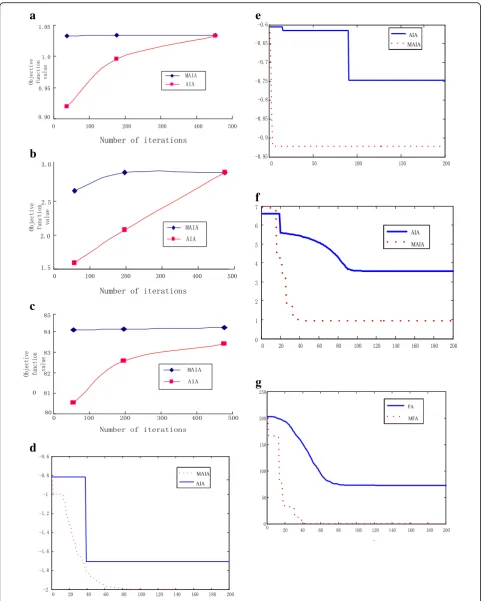
In order to test the performance of the improved arti-ficial immune algorithm (MAIA) and the standard artifi-cial immune algorithm (AIA), a typical nonlinear function is selected to analyze its performance. These function tests are defined as follows:
f1ð Þ ¼x exp −ðx1−3Þ2−ðx2−5Þ2
The above seven standard test functions have different shapes and can test the performance of the algorithm in an all-round way. f1~f3 are continuous unimodal
func-tions and are usually used to measure the convergence speed of the algorithm. From the convergence perform-ance of the f1~f3 functions, it can be concluded that
compared to the AIA, the MAIA avoids the difficulty of the AIA being trapped in the local optimum, and the global search capability is stronger, which proves the feasibility of improving the AIA.
The functions f4~f7 are complex nonlinear multi-peak
functions, and there are a large number of local extrema, which are usually used to measure the population diver-sity and global search performance of the algorithm. From the performance tests off4~f7 functions, it can be
concluded that compared with AIA, MAIA has fewer evolution iterations, better overcomes the disadvantages of AIA (such as easy to fall into local optimum and pre-mature), and has higher convergence accuracy and speeds up convergence (Fig.3).
3 Improved application of artificial immune algorithm in FJSP
3.1 Simulation parameters
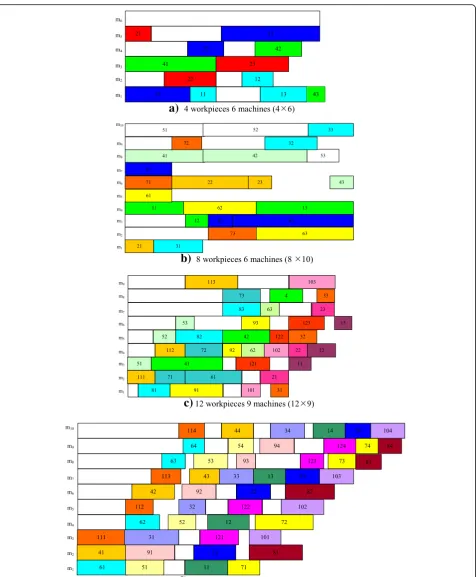
In order to test and improve the performance of the arti-ficial immune algorithm in the FJSP application, select four instances of FJSP:
(1) 4 workpieces are processed on 6 machines. (2) 8 workpieces are processed on 10 machines. (3) 12 workpieces are processed on 9 machines. (4) 12 workpieces are processed on 10 machines
The application example adopts C++ and MATLAB mixed programming. The author uses Matlab to call the MEX program files written in the C programming lan-guage and complete the simulation experiment.
3.2 Results and analysis
3.2.1 Improve the effectiveness of artificial immune algorithm analysis
a
b
c
d
e
f
g
Fig. 3Comparison of performance before and after improvement of artificial immune algorithm.aComparison of the convergence curves off1.
d)
c)
b)
a)
3.2.2 Analysis of advantages of improved artificial immune algorithm
In order to test the superiority of the improved artificial immune algorithm, the FJSP classical algorithm of the literature [14–16] was selected for comparison experi-ments. All the experiments were performed 100 times. The improved artificial immune algorithm and the clas-sical algorithm searched for flexibility. The number of optimal solutions for the job shop scheduling problem and the number of iterations are shown in Table1. Ana-lysis of the Table 1 shows that for a smaller flexible job shop scheduling problem. The success rate of all algo-rithms is relatively high and the number of iterations is also relatively small. For the smaller flexible job shop scheduling problems, such as 12 workpieces 10 ma-chines, the success rate of the improved artificial im-mune algorithm is much higher than that of the current classical solution algorithm, and the number of itera-tions is relatively small. This algorithm improves the efficiency of solving the flexible job shop scheduling problem and proves that is superior of solving in FJSP.
4 Conclusions
FJSP is a major topic in the current production practice. There are many constraints, and the traditional intelli-gent algorithm has its own defects. This study proposes an chaotic simulated annealing and particle swarm improved artificial immune algorithm and applied to flexible job shop scheduling problem solving process. The experimental results show that the improved artifi-cial immune algorithm’s optimization ability and optimization efficiency are better than that of the stand-ard artificial immune algorithm, and a better solution to the flexible job shop scheduling problem is obtained. Compared with the current typical flexible job shop scheduling problem, the algorithm is solved. Improving artificial immune algorithms has obvious advantages. How to introduce a better intelligent algorithm to obtain a better flexible job shop scheduling solution is the con-tent that will be studied in the next step.
Abbreviations
AIA:Artificial immune algorithm; FJSP: Flexible job shop scheduling problem; JSP: Job shop scheduling problem; MAIA: Modified artificial immune algorithm
Acknowledgements
The research presented in this paper was supported by the Science Technology Department of Zhejiang Province, China.
Funding
The authors acknowledge the National Natural Science Foundation Project (Grant: 60972036), the National Education Information Technology Research
“12th Five-Year”Program (Grant: 136241559), and the Science and Technology Program of Zhejiang Province (Grant: 2015C31171).
Authors’contributions
RZ is the main writer of this paper. He has proposed the main idea of the modified artificial immune algorithm for the flexible job shop scheduling problem algorithm and completed the simulation. YW had designed the fitness parameter stability and simulated annealing algorithm parameter. Both authors read and approved the final manuscript.
Competing interests
The authors declare that they have no competing interests.
Publisher’s Note
Springer Nature remains neutral with regard to jurisdictional claims in published maps and institutional affiliations.
Received: 13 March 2018 Accepted: 18 April 2018
References
1. D Pan, M Wang, Y Zhu, K Han, An optimization algorithm for locomotive secondary spring load adjustment based on artificial immune. J. Cent. South Univ.20(12), 3497–3503 (2013).
2. C Wang, X Lei, Protein-protein interaction network clustering based on artificial immune system. J. Comp. App.33(12), 3567–3570 (2013). 3. A Rezaee Jordehi, A chaotic artificial immune system optimisation algorithm
for solving global continuous optimisation problems. Neural Comput. & Applic.26(4), 827–833 (2014).
4. A Karimi-Majd, M Fathian, B Amiri, A hybrid artificial immune network for detecting communities in complex networks. Computing97(5), 483–507 (2014).
5. B Naderi, M Mousakhani, M Khalili, Scheduling multi-objective open shop scheduling using a hybrid immune algorithm. Int. J. Adv. Manuf. Technol.
66(5–8), 895–905 (2012).
6. R Liu, L Zhang, B Li, Y Ma, L Jiao, Synergy of two mutations based immune multi-objective automatic fuzzy clustering algorithm. Knowl. Inf. Syst.45(1), 133–157 (2014).
7. Y Xu, L Wang, S Wang, M Liu, An effective immune algorithm based on novel dispatching rules for the flexible flow-shop scheduling problem with multiprocessor tasks. Int. J. Adv. Manuf. Technol.67(1–4), 121–135 (2013). 8. G Qu, Z Lou, Application of particle swarm algorithm in the optimal allocation of regional water resources based on immune evolutionary algorithm. Journal of Shanghai Jiaotong University (Science).18(5), 634–640 (2013).
9. C Kahraman, O Engin, I Kaya, RE Ozturk, Multiprocessor task scheduling in multistage hybrid flow-shops: a parallel greedy algorithm approach. Appl. Soft Comput.10(4), 1293–1130 (2010).
Table 1Performance comparison with current classical algorithms
The scale of FJSP problem
Number of iterations Number of successes
Improved artificial immune algorithm
Literature [14] Literature [15] Literature [16] Improved artificial immune algorithm
Literature [14] Literature [15] Literature [16]
4 × 6 100 160 163 164 100 98 95 94
8 × 10 250 376 365 393 100 91 90 91
12 × 9 300 539 560 534 90 73 76 75
10. T Nichi, Y Hiranaka, M Inuiguchi, Lagrangian relaxation with cut generation for hybrid flow shop scheduling problems to minimize the total weighted tardiness. Comput. Oper. Res.37(1), 189–198 (2010).
11. CT Tseng, CJ Liao, A particle swarm optimization algorithm for hybrid flow-shop scheduling with multiprocessor tasks. Int. J. Prod. Res.46(17), 4655–4670 (2008).
12. C Ziyu, Y Chunming, Y Mingshun, Application of new quantum particle swarm optimization algorithm to solve PFSP problem. Technol. Innov. Manag.33(2), 162–165 (2012).
13. J Zheng, P Yang, S Chen, G Shen, W Wang, Iterative re-constrained group sparse face recognition with adaptive weights learning. IEEE Trans. Image Process.26(5), 2408–2423 (2017).
14. SQ Liu, K Erhan, Scheduling trains with priorities: a no-wait blocking parallel-machine job-shop scheduling model. Transp. Sci.45(2), 175–198 (2011). 15. R Rubén, S Thomas, A simple and effective iterated greedy algorithm for
the permutation flow shop scheduling problem. Eur. J. Oper. Res.177(3), 2033–2049 (2007).