R E S E A R C H
Open Access
A Lycaon pictus impulsive state feedback
control model with Allee effect and
continuous time delay
Yaning Li
1, Huidong Cheng
1*and Yanhui Wang
1,2*Correspondence:
1College of Mathematics and
Systems Science, Shandong University of Science and Technology, Qingdao, China Full list of author information is available at the end of the article
Abstract
Allee effect (i.e. sparse effect) is active when the population density is small. Our purpose is to study such an effect of this phenomenon on population dynamics. We investigate an impulsive state feedback control single-population model with Allee effect and continuous delay. We first qualitatively analyze the singularity of this model. Then we obtain sufficient conditions for the existence of an order-one periodic orbit by the geometric theory of impulsive differential equations for the survival of
endangered populations and obtain the uniqueness of an order-one periodic orbit by the monotonicity of the subsequent function. Furthermore, we prove the orbital asymptotic stability of an order-one periodic orbit using the geometric properties of successor functions to confirm the robustness of this control. Finally, we verify the correctness of our theoretical results by using some numerical simulations. Our results show that the release of artificial captive African wild dog (Lycaon pictus) can
effectively protect the African wild dog population with Allee effect.
MSC: 34C25; 34D23; 92B05; 34A37
Keywords: Qualitatively analysis; Order-one periodic orbit; Impulsive differential equation; Allee effect
1 Introduction
The African wild dog is one of the endangered carnivorous species in South Africa. They are mainly distributed in parts of eastern and southern Africa. In the past few decades the habitat of African wild dog has been drastically reduced, and the population quan-tity has declined significantly [1]. Research suggests that there are many reasons for the sharp decline in the distribution and number of African wild dogs, which may include conflicts with humans, habitat loss, persecution and competition with other predators, genetic diversity of infectious diseases, and inbreeding depression [2]. The scholars ana-lyzed the demographic data of endangered Lycaon pictus in Hluhluwe–Imfolozi Park in South Africa from 1980 to 2004. They found that the African wild dog population has an obvious Allee effect [3]. In 1931, W.C. Allee paid attention to the possibility of a posi-tive relationship between individual aspects of fitness and population density [4]. In other words, when the species has a small population density, the death rate increases, and the birth rate decreases, then the risk of species extinction increases. There are many reasons
for this phenomenon. For example, for an individual, it is difficult to seek spouses and dif-ficult to resist enemies and inbreeding depression [5]. Therefore many researches focus on the Allee effect (sparse effect) and have done a lot of work in this direction [6–9].
The Allee effect has been observed in many species, such as plants, marine inverte-brates, and mammals [8]. For these species, there exists a minimum survival threshold, which implies that it is not necessary to adopt any measure to intervene when the popula-tion density is above this threshold [10]. But once the population density is lower than the survival threshold, some corresponding control measures should be performed according
to the state of the target species. So the threshold strategy is also called the state feed-back control strategy. This strategy can be precisely described by an impulsive differential equation in mathematics [11].
In recent years, impulsive differential equations have been used in various fields [12–20], such as disease control and pharmacology [21–29], integrated pest management [30–38], microbial culture [38–43], and protection of endangered animals and plants [44–51]. For example, Zhang et al. [10] focused on a predator–prey model with impulsive state feed-back control and assuming that the spraying pesticide and releasing the natural enemies are taken at different thresholds. Liang et al. [5] investigated a state-dependent impulsive control model for computer virus propagation under media coverage, and the results show that the media coverage can delay the spread of computer virus. Nie et al. [52] studied dif-ferent types of chemostat ecosystems of microbial cultures. However, there are few studies
on the use of impulsive control strategies to protect the endangered species. Assume that the model with Allee effect of African wild dog species is as follows:
dx
whereKis the maximum capacity of the environment,ris the intrinsic growth rate, and
a
cax+1 represents the Allee effect caused by mating restrictions. Ifa>
r
ck, then for
Allee effect and continuous time delay as follows:
The paper is organized is as follows. In Sect.2, we first analyze qualitatively the singular-ity of system (3) without impulse effect by the Bendixson–Dulac theory. Then we use the geometric theory of impulsive differential equations to prove the existence of a periodic orbit. The uniqueness of the periodic orbit of model (3) is proved by the monotonicity of subsequent functions. Meanwhile, the geometric properties of subsequent functions are used to prove the stability of the periodic orbit of system (3) in Sect.3. In Sect.4, we il-lustrate the correctness of the results obtained by some numerical simulations. Finally, we conclude our work.
2 Dynamic analysis of system (3)
2.1 Qualitative analysis of system (3)
In this subsection, we first discuss system (3) without impulse. Thus we consider the fol-lowing system:
Obviously, system (3) has the equilibrium pointO(0, 0) and a positive equilibrium point
and
Obviously, if (H2) holds, then the function
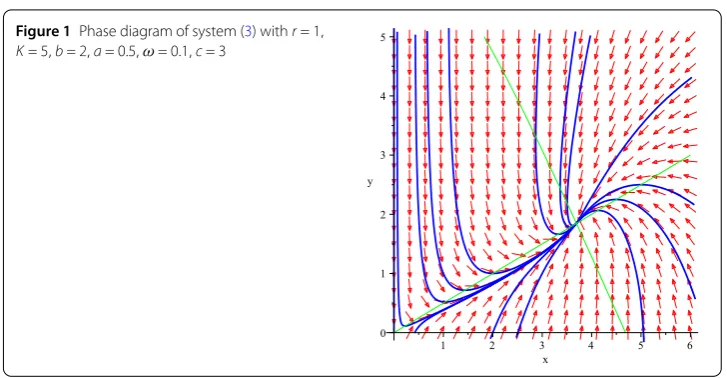
Figure 1Phase diagram of system (3) withr= 1,
K= 5,b= 2,a= 0.5,ω= 0.1,c= 3
2.2 Dynamic analysis of an order-one periodic orbit of system (3)
2.2.1 System(3)has a unique periodic orbit
In this subsection, we study the existence and uniqueness of an order-one periodic orbit. We assume that the impulsive setM={(x,y)∈R+
2|x=h,y≥0}and phase setN={(x,y)∈
R+2|x=h+p,y≥0}are straight lines. The trajectory that starts from any pointAis denoted byf(A,t). A positive equilibriumE∗(x∗,y∗) is globally asymptotically stable if conditions (H1) and (H2) hold.
Theorem 2.3
(1) If0 <h<h+p≤x∗,then system(3)has no order-one periodic orbit. (2) If0 <h<x∗<h+p<K,then system(3)has no order-one periodic orbit.
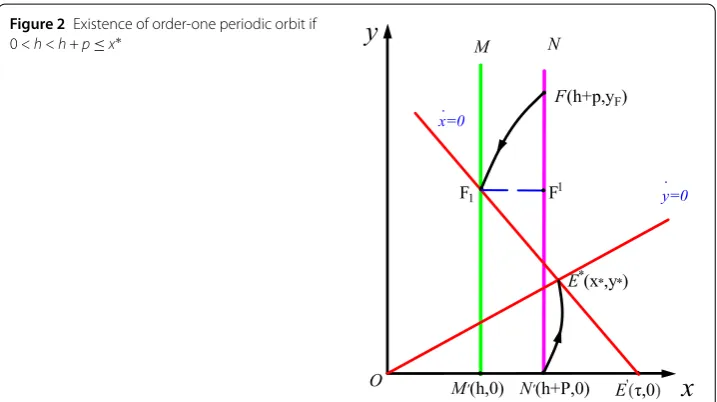
Proof Case 1. 0 <h<h+p≤x∗.
If 0 <h<h+p≤x∗, then the impulsive setMand the phase setNare on the left of the pointE∗(x∗,y∗). The impulsive setMand the phase setNintersect thex-axis at the points
M(h, 0) andN(h+p, 0), respectively. The isoclinic linex˙= 0 intersects with thex-axis at the pointE(τ, 0), where
τ=(rKca–r) + √
2rca
and
= (rKca–r)2+ 4rca(rK–aK).
The intersection point of the isoclinic linex˙= 0 and the impulsive setMisF1(h,yF1),
where
yF1=
(ahc+ 1)(rK–rh) –aK
ωK(ahc+ 1) .
Let
χ:Kx+y–bM= 0.
Then we have
dχ
dt
χ=0=
Kdx dt +
dy dt
=x–bMy+K
x
r–rx
K
– a
cax+ 1–ωy
=x+rKx–rx2– aK
cax+ 1–ωKy–bMy
= (1 +rK)x–rx2– aK
cax+ 1– (ωK+bM)y< 0.
This implies that there must exist an intersection point of the trajectoryf(F1,t) and the phase setNdenoted byF(h+p,yF). The pointF1jumps to the pointF1due to the impulse effect. According to the definition of the subsequent function in [5] and the trajectory tend of system (3), the subsequent function of the pointFis
g(F) =yF1–yF< 0.
The trajectoryf(N,t) will have no intersection point with the impulsive setM. Thus, the trajectory starting from any point located on the segmentFN⊂Nis attractive to the positive equilibrium pointE∗by impulse effect. The orbit starting from any point that is above the pointFis also attractive to the pointE∗by several impulsive effects at most.
In summary, system (3) has no order-one periodic orbit when 0 <h<h+p≤x∗ (see Fig.2).
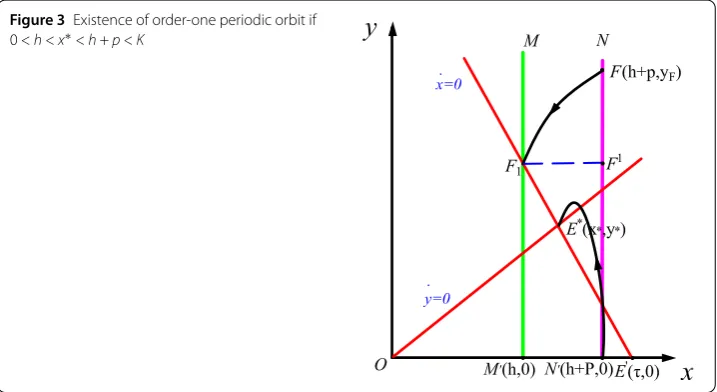
Case 2. 0 <h<x∗<h+p<K
If 0 <h<x∗<h+p<Kholds, then the pointE∗(x∗,y∗) is between the impulsive setM
and the phase setN. The isoclinic linex˙= 0 intersects the impulsive setMat the point
F1(h,yF1). The impulsive setMintersects thex-axis at the pointM(h, 0), and the
intersec-tion point of the phase setNand thex-axis is the pointN(h+p, 0).
Thus the orbitf(N,t) tends to the pointE∗(x∗,y∗), and the trajectoryf(F1,t) surely has an intersection point with the phase setN, denoted byF(h+p,yF), where
yF>y∗=(rcabK–rb–ωK) + √
2b(rcab+ωcaK) .
Thus the pointF1will jump to the pointF1∈Nby the impulse effect. So the subsequent function of the pointFis
g(F) =yF1–yF< 0.
Similarly, the orbit that starts from any point on the segmentFN⊂Nwill tend to the positive equilibrium pointE∗(x∗,y∗), and the trajectory starting from any point above the pointFon the phase setNwill also be attractive to the pointE∗by several impulse effects at most.
Thus, system (3) has no order-one periodic orbit if 0 <h<x∗<h+p<K(see Fig.3).
Theorem 2.4 If0 <x∗≤h<h+p<K,then system(3)has an order-one periodic orbit,
and when h+p>
√
+(brkca–ωr–br)
2(brca+ωKca) ,the order-one periodic orbit is unique.
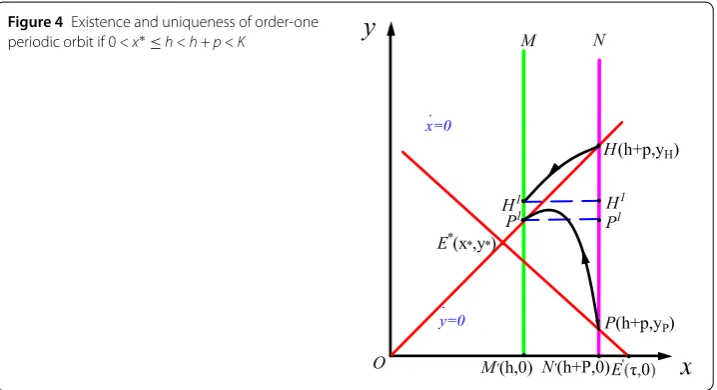
Proof Let 0 <x∗≤h<h+p<K. Then the positive equilibrium pointE∗is on the left of the impulsive setM. The phase setN intersects the isoclinic linex˙= 0 andy˙= 0 at the pointsP(h+p,yP) andH(h+p,h+bp), respectively, where
yP=–rca(h+p)
2+ (rKca–r)(h+p) +K(r–a)
ωKca(h+p) +ωK .
By the asymptotic stability of the pointE∗the trajectoryf(H,t) intersects the impulsive setMat the pointH1, then it hits the impulsive setMat the pointH1(h+p,yH1) on the
phase setN. The successor pointH1of the pointHis surely under the pointH, soy
H1<yH.
Then the subsequent function of the pointHis
g(H) =yH1–yH< 0.
The trajectoryf(P,t) hits the impulsive setMat the pointP1, then jumps to the point
P1(h+p,y
P1) by the impulsive effect. The successor pointP1of the pointPmust be above
the pointPby the trajectory tend of system (3). Thus the subsequent function of the point
Pis
g(P) =yP1–yP> 0.
By [10] there must be a pointSbetween the pointsHandFsuch that
g(S) = 0,
and thus the orbitf(S,t) is an order-one periodic orbit of system (3) when 0 <x∗<h<
h+p<K(see Fig.4).
Now, we prove the uniqueness of the order-one periodic orbit of system (3). We choose any two pointsG(h+p,yG) andI(h+p,yI) such that
yG>yI.
The intersection point of the trajectoryf(G,t) and the impulsive setMis the pointG1. Then the pointG1jumps to the pointG1by impulse effects. The subsequent function of the pointGis
g(G) =yG1–yG.
The intersection point of the orbitf(I,t) and the impulsive setMis the pointI1,.Then the pointI1jumps to the pointI1by impulse effects. The subsequent function of the point
Iis
g(I) =yI1–yI.
Let the functiony(x,Q0)be denoted by the coordinates of an arbitrary point on the
tra-jectoryf(Q0,t), whereQ0is the starting point. According to
yG>yI,
we define
yG(x)y(x,G), yI(x)y(x,I)
and
dGI=yG(x) –yI(x), x∈[h,h+p].
Hence we have
dGI (x) =yG(x) –yI(x)
=K(cax+ 1)
x
x–byG
(rK–rx–ωyGK)(cax+ 1) –aK
– x–byI
(rK–rx–ωyIK)(cax+ 1) –aK
=K(cax+ 1)
x φ
(ς)(yG–yI),
where
φ(y) = x–by
(rK–rx–ωyK)(cax+ 1) –aK
and
φ(y) = –b[(cax+ 1)(rK–rx–ωKy)] +ωK(cax+ 1)(x–by) [(cax+ 1)(rK–rx–ωKy) –aK]2
=–brcaKx+brcax
2–brK+brx+ωKcax2+ωKx
[(cax+ 1)(rK–rx–ωKy) –aK]2
=(brca+ωKca)x
2+ (ωK+br–brkca)x–brk
[(cax+ 1)(rK–rx–ωKy) –aK]2
when
h+p> √
+ (brkca–ωr–br) 2(brca+ωKca) ,
where
Then
φ(y) > 0,
and thus
dGI > 0
forx∈[h,h+p]. In summary, the functiondGI(x) is an increasing function, and
dGI(h+p) >dGI(h).
Let
d1=dGI(h+p) =yG–yI,
d2=dGI(h) =yG1–yI1.
Obviously,
d1>d2.
Hence the subsequent function of the pointsGandIsatisfies
g(G) –g(I) = (yG1–yG) –yI1=yI
= –(yG–yI) + (yG1–yI1)
=d2–d1< 0.
Thus, the successor function is decreasing monotonously on the phase setN. So there must exist a unique pointS such thatg(S) = 0. This means that the order-one periodic
orbit of system (3) is unique.
3 Stability of the order-one periodic solution
Theorem 3.1 The periodic orbit of system(3)is orbitally asymptotically stable.
Proof By Theorems2.3and2.4system (3) has a unique order-one periodic orbit between the pointsHandF, andyF<yS<yH. Thusg(F) > 0 for anyF∈N withyS>yF,g(H) < 0
for anyH∈NwithyH>yS, andg(F) =g(H) = 0 if and only ifH=F=S.
Then we choose an arbitrary pointF0on the phase setN. IfF0∈N/FS, then after several impulse effects, the orbit jumps to the segmentFS. Hence we assume thatF0∈FS⊂N. The orbitf(F0,t) hits the impulsive setMat the pointF
1, then the pointF1jumps to the pointF1∈Nafter an impulse effect, and
The orbitf(F1,t) intersects the impulsive setMat the pointF
2, then jumps to the point
F2∈N, and
yF<yF0<yF1<yF2<yS.
The orbitf(F2,t) hits the impulsive setMat the pointF3, then jumps to the pointF3∈N, and
yF<yF0<yF1<yF2<yF3<yS.
Repeating this process, we get a point sequence{Fk}, wherek= 0, 1, 2, . . . , such that
yF<yF0<yF1<· · ·<yFk<· · · ≤yS.
Then the sequenceFk
k=0,1,2,...is an increasing sequence with upper boundyS.
Accord-ing to the monotone bounded theorem, there exists the limitlimk→∞yFk =yS, which
im-plies that
gS=glim
k→∞yFk
= lim
k→∞g(yFk) =klim→∞(yFk+1–yFk) = 0.
Sinceg(F) = 0 if and only ifF=S, we getS=S, that is,
lim
k→∞g(yFK) =yS
=yS.
Similarly, by the same method we obtain a point sequencesIk
k=0,1,2,...such that
yS≤ · · ·<yIk<· · ·<yI2<yI1<yI0<yI.
Since{Ik}is an decreasing sequence with lower boundy
S, by the monotone bounded
theorem it has the limitlimk→∞yIk=yS, which means that
gS=g
lim
k→∞yIk
= lim
k→∞g(yI
K) = lim
k→∞(yIk+1–yIk) = 0.
Sinceg(I) = 0 if and only ifI=S, we getS=S, that is,yIk =yS. Then we have
yF<yF0<yF1<· · ·<yFk<· · · ≤yS≤ · · ·<yIk<· · ·<yI2<yI1<yI0<yJ.
By the arbitrariness of the pointsI0andF0we have
lim
k→∞yIk=klim→∞yFk=yS.
In summary, all orbits of system (3) tend to the order-one periodic orbit (see [5]). So the order-one periodic orbit of system (3) is orbitally asymptotically stable and globally
Figure 5Orbital asymptotically stability of the order-one periodic orbit of system (1)
Thus our theoretical results show that releasing the African wild dogs in captivity to the wild is effective for protecting African wild dog population with Allee effect and contin-uous delay. Therefore, when protecting African wild dogs, we can determine the survival threshold, have African wild dogs in captivity, and monitor the wild populations (the ini-tial value). Then, according to the state feedback of wild white-headed langurs, a certain amount of white-headed langurs in captivity will be released to the wild to increase the number of white-headed langurs in the wild, making the population have a normal repro-duction to survive. According to the survival threshold and initial value, we can choose different grazing plans.
4 Numerical simulations and conclusion
4.1 Numerical simulations
In this section, we verify the correctness of the results by two examples.
Example4.1 Letr= 1,K= 5,ω= 0.1,b= 2,c= 3, anda= 0.5. By calculations we obtain the pointE∗(3.694254177, 10847127088). Thus system (3) becomes
⎧
Then we get the following cases.
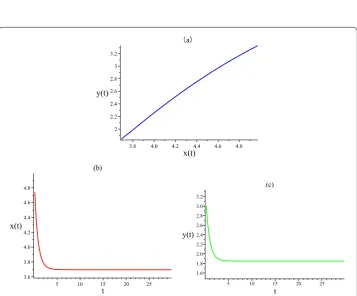
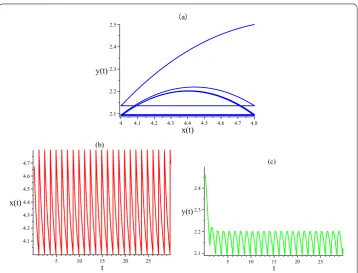
Case I: Leth= 2.2,p= 0.8. Then 0 <h<h+p<x∗. See Fig.6. Case II: Leth= 3.39,p= 0.8. Then 0 <h<x∗<h+p<K. See Fig.7. Case III: Leth= 4,p= 0.8. Then 0 <x∗<h<h+p<K. See Fig.8.
Figure 6(a) Phase portrait of system (3) withh= 2.2,p= 0.8, and the initial point is(3, 1.4611). (b) (c) Time series of model (3)
Figure 8(a) Phase portrait of system (3) withh= 4,p= 0.8, and the initial point is(0.45, 2.5). (b) (c) Time series of model (3)
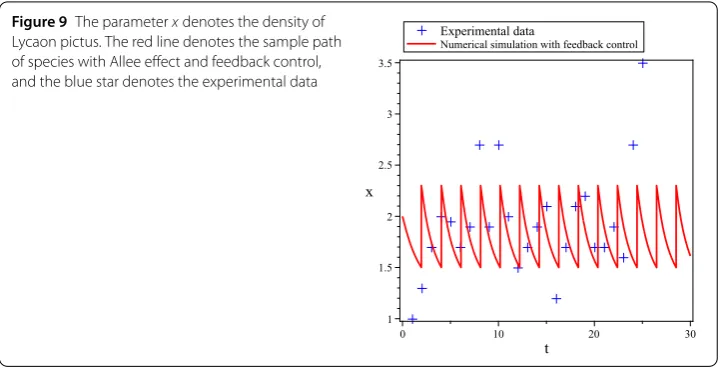
In [8], the authors studied the data from 1980–2004 on a small region population of Lycaon pictus in Hluhluwe–Imfolozi Park (HIP) to analyze the pack and population den-sity dynamics. According to these data in [8], the authors take the annual growth rate of Lycaon pictus is 0–1.47, the carrying capacityKis 2.2–13.3, the parameterais 0.6–1.3, andcis 0.5–1.2. Thus, we assume that the initial value of the pack is 2. We determine the minimum survival threshold by monitoring the population of Lycaon pictus in the wild; when the population of Lycaon pictus decreases to 1.5, a certain amount of Lycaon pictus in captivity is released to the wild. Let the parametersr= 1,K= 2.5,a= 0.7,c= 1,ω= 0.1, andb= 1 (see Fig.9). Numerical simulation shows that the feedback control strategy can effectively protect the Lycaon pictus population.
4.2 Conclusion
In this paper, we studied the African wild dogs impulsive state feedback control model with Allee effect and continuous time delay. By the feedback information of the density of African wild dog population from the monitor we can protect the African wild dog population.
First, we carried on the quantitative and qualitative analysis and obtained two condi-tions (H1) and (H2). We proved the global asymptotic stability of the positive equilibrium
E∗(x∗,y∗) by the Bendixson–Dulac theory.
Figure 9The parameterxdenotes the density of Lycaon pictus. The red line denotes the sample path of species with Allee effect and feedback control, and the blue star denotes the experimental data
Finally, we studied the orbital asymptotic stability of the order-one periodic orbit by the geometric properties of successor functions. Then we proved that the limit exists by the uniqueness of the order-one periodic orbit and the limit existence theorem.
All the results suggest that the release of artificial captive of African wild dogs can effec-tively protect the African wild dog population with Allee effect. The determination of the value of the survival thresholdhinvolves analyzing the viability of the African wild dog population, which will be our future work.
Funding
The paper was supported by the National Natural Science Foundation of China (No. 11371230, 11501331), Shandong Provincial Natural Science Foundation, China (No. S2015SF002), SDUST Research Fund (2014TDJH102), and Joint Innovative Center for Safe and Effective Mining Technology and Equipment of Coal Resources, Shandong Province of China.
Competing interests
The authors declare that they have no competing interests.
Authors’ contributions
All authors read and approved the final manuscript.
Author details
1College of Mathematics and Systems Science, Shandong University of Science and Technology, Qingdao, China.2State
Key Laboratory of Mining Disaster Prevention and Control Co-founded by Shandong Province and the Ministry of Science and Technology, Shandong University of Science and Technology, Qingdao, China.
Publisher’s Note
Springer Nature remains neutral with regard to jurisdictional claims in published maps and institutional affiliations.
Received: 9 May 2018 Accepted: 27 September 2018
References
1. Lindsey, P.A., Alexander, R.R., Toit, J.T.D., Mills, M.G.L.: The potential contribution of ecotourism to African wild dog Lycaon pictus conservation in South Africa. Biol. Conserv.123(3), 339–348 (2005)
2. Courchamp, F., Brock, T.C., Grenfell, B.: Multipack dynamics and the Allee effect in the African wild dog,lycaon pictus. Anim. Conserv.3(4), 277–285 (2000)
3. Somers, M.J., Graf, J.A., Szykman, M., Slotow, R., Gusset, M.: Dynamics of a small re-introduced population of wild dogs over 25 years: Allee effects and the implications of sociality for endangered species’ recovery. Oecologia158(2), 239 (2008)
4. Stephens, P.A., Sutherland, W.J., Freckleton, R.P.: What is the Allee effect? Oikos87(1), 185–190 (1999)
5. Chen, S., Xu, W., Chen, L., Huang, Z.: A white-headed langurs impulsive state feedback control model with sparse effect and continuous delay. Commun. Nonlinear Sci. Numer. Simul.50, 88–102 (2017)
7. Liu, Q., Huang, L., Chen, L.: A pest management model with state feedback control. Adv. Differ. Equ.2016(1), 292 (2016)
8. Yu, X., Yuan, S., Zhang, T.: Persistence and ergodicity of a stochastic single species model with Allee effect under regime switching. Commun. Nonlinear Sci. Numer. Simul.59, 359–374 (2018)
9. Bian, F., Zhao, W., Song, Y., Yue, R.: Dynamical analysis of a class of prey–predator model with Beddington–DeAngelis functional response, stochastic perturbation, and impulsive toxicant input. Complexity2017, Article ID 3742197 (2017).https://doi.org/10.1155/2017/3742197
10. Zhang, T., Ma, W., Meng, X., Zhang, T.: Periodic solution of a prey–predator model with nonlinear state feedback control. Appl. Math. Comput.266, 95–107 (2015)
11. Liang, Z., Zeng, X., Pang, G., Liang, Y.: Periodic solution of a Leslie predator-prey system with ratio-dependent and state impulsive feedback control. Nonlinear Dyn.89(4), 2941–2955 (2017).https://doi.org/10.1007/s11071-017-3637-4 12. Li, Y., Cheng, H., Wang, J., Wang, Y.: Dynamic analysis of unilateral diffusion Gompertz model with impulsive control
strategy. Adv. Differ. Equ.2018(1), 32 (2018)
13. Wang, J., Cheng, H., Li, Y., Zhang, X.: The geometrical analysis of a predator–prey model with multi-state dependent impulsive. J. Appl. Anal. Comput.8(2), 427–442 (2018)
14. Cheng, H., Zhang, T., Wang, F.: Existence and attractiveness of order one periodic solution of a Holling I predator–prey model. Abstr. Appl. Anal.2012, Article ID 126018 (2012).https://doi.org/10.1155/2012/126018
15. Liu, F.: Continuity and approximate differentiability of multisublinear fractional maximal functions. Math. Inequal. Appl.21(1), 25–40 (2018)
16. Liu, B., Tian, Y., Kang, B.: Existence and attractiveness of order one periodic solution of a Holling II predator–prey model with state-dependent impulsive control. Int. J. Biomath.5(03), 675 (2012)
17. Huang, M., Song, X., Li, J.: Modelling and analysis of impulsive releases of sterile mosquitoes. J. Biol. Dyn.11(1), 147 (2017)
18. Zhang, S., Meng, X., Wang, X.: Application of stochastic inequalities to global analysis of a nonlinear stochastic SIRS epidemic model with saturated treatment function. Adv. Differ. Equ.2018(1), 50 (2018)
19. Liu, F., Xue, Q., Yabuta, K.: Rough maximal singular integral and maximal operators supported by subvarieties on Triebel–Lizorkin spaces. Nonlinear Anal.171, 41–72 (2018)
20. Braverman, E., Liz, E.: Global stabilization of periodic orbits using a proportional feedback control with pulses. Nonlinear Dyn.67(4), 2467–2475 (2012)
21. Zhang, M., Song, G., Chen, L.: A state feedback impulse model for computer worm control. Nonlinear Dyn.85(3), 1561–1569 (2016)
22. Zhang, T., Meng, X., Song, Y., Zhang, T.: A stage-structured predator–prey SI model with disease in the prey and impulsive effects. Math. Model. Anal.18(4), 505–528 (2013)
23. Meng, X., Zhao, S., Feng, T., Zhang, T.: Dynamics of a novel nonlinear stochastic SIS epidemic model with double epidemic hypothesis. J. Math. Anal. Appl.433(1), 227–242 (2016)
24. Miao, A., Wang, X., Zhang, T., Wang, W., Sampath Aruna Pradeep, B.: Dynamical analysis of a stochastic SIS epidemic model with nonlinear incidence rate and double epidemic hypothesis. Adv. Differ. Equ.2017(1), 226 (2017) 25. Guo, H., Chen, L., Song, X.: Dynamical properties of a kind of SIR model with constant vaccination rate and impulsive
state feedback control. Int. J. Biomath.10(7), 1750093 (2017).https://doi.org/10.1142/S1793524517500930 26. Wang, W., Zhang, T.: Caspase-1-mediated pyroptosis of the predominance for driving CD4+T cells death: a nonlocal
spatial mathematical model. Bull. Math. Biol.80(3), 540–582 (2018)
27. Leng, X., Feng, T., Meng, X.: Stochastic inequalities and applications to dynamics analysis of a novel SIVS epidemic model with jumps. J. Inequal. Appl.2017(1), 138 (2017)
28. Miao, A., Jian, Z., Zhang, T., Pradeep, B.G.S.A.: Threshold dynamics of a stochastic SIR model with vertical transmission and vaccination. Comput. Math. Methods Med.2017, Article ID 4820183 (2017).
https://doi.org/10.1155/2017/4820183
29. Li, F., Meng, X., Wang, X.: Analysis and numerical simulations of a stochastic SEIQR epidemic system with quarantine-adjusted incidence and imperfect vaccination. Comput. Math. Methods Med.2018(2), 1–14 (2018) 30. Cheng, H., Zhang, T.: A new predator–prey model with a profitless delay of digestion and impulsive perturbation on
the prey. Appl. Math. Comput.217(22), 9198–9208 (2011)
31. Wang, J., Cheng, H., Meng, X., Pradeep, B.S.A.: Geometrical analysis and control optimization of a predator–prey model with multi state-dependent impulse. Adv. Differ. Equ.2017(1), 252 (2017)
32. Wang, J., Cheng, H., Liu, H., Wang, Y.: Periodic solution and control optimization of a prey–predator model with two types of harvesting. Adv. Differ. Equ.2018(1), 41 (2018)
33. Liu, H., Cheng, H.: Dynamic analysis of a prey-predator model with state-dependent control strategy and square root response function. Adv. Differ. Equ.2018(1), 63 (2018).https://doi.org/10.1186/s13662-018-1507-0
34. Zhang, H., Chen, L., Georgescu, P.: Impulsive control strategies for pest management. J. Biol. Syst.15(02), 235–260 (2007)
35. Zhang, H., Jiao, J., Chen, L.: Pest management through continuous and impulsive control strategies. Biosystems90(2), 350–361 (2007)
36. Jiang, G., Lu, Q.: Impulsive state feedback control of a predator-prey model. J. Comput. Appl. Math.200(1), 193–207 (2007)
37. Liu, X., Zhang, T., Meng, X., Zhang, T.: Turing-Hopf bifurcations in a predator-prey model with herd behavior, quadratic mortality and prey-taxis. Phys. A, Stat. Mech. Appl.496, 446–460 (2018)
38. Lv, X., Wang, L., Meng, X.: Global analysis of a new nonlinear stochastic differential competition system with impulsive effect. Adv. Differ. Equ.2017(1), 296 (2017)
39. Zhang, T., Ma, W., Meng, X.: Global dynamics of a delayed chemostat model with harvest by impulsive flocculant input. Adv. Differ. Equ.2017, 115 (2017)
40. Meng, X., Wang, L., Zhang, T.: Global dynamics analysis of a nonlinear impulsive stochastic chemostat system in a polluted environment. J. Appl. Anal. Comput.6(3), 865–875 (2016)
42. Chi, M., Zhao, W.: Dynamical analysis of multi-nutrient and single microorganism chemostat model in a polluted environment. Adv. Differ. Equ.2018(1), 120 (2018)
43. Jiao, J., Cai, S., Liu, W., Li, L.: Dynamics of a competitive population system with impulsive reduction of the invasive population. Electron. J. Differ. Equ.2017, Article ID 281 (2017)
44. Zhang, T., Liu, X., Meng, X., Zhang, T.: Spatio-temporal dynamics near the steady state of a planktonic system. Comput. Math. Appl.75(12), 4490–4504 (2018)
45. Pang, G., Chen, L.: Periodic solution of the system with impulsive state feedback control. Nonlinear Dyn.78(1), 743–753 (2014)
46. Lv, W., Wang, F., Li, Y.: Adaptive finite-time tracking control for nonlinear systems with unmodeled dynamics using neural networks. Adv. Differ. Equ.2018(1), 159 (2018)
47. Tang, S., Chen, L.: Global attractivity in a food-limited population model with impulsive effects. J. Math. Anal. Appl.
292(1), 211–221 (2004)
48. Zhuo, X.: Global attractability and permanence for a new stage-structured delay impulsive ecosystem. J. Appl. Anal. Comput.8(2), 457–470 (2018)
49. Tian, Y., Zhang, T., Sun, K.: Dynamics analysis of a pest management prey–predator model by means of interval state monitoring and control. Nonlinear Anal. Hybrid Syst.23, 122–141 (2017)
50. Ling, Z., Zhang, L., Zhu, M., Malay, B.: Dynamical behaviour of a generalist predator–prey model with free boundary. Bound. Value Probl.2017(1), 139 (2017)
51. Zeng, G.Z., Chen, L.S., Chen, J.F.: Persistence and periodic orbits for two-species nonautonomous diffusion Lotka–Volterra models. Math. Comput. Model.20(12), 69–80 (1994)