R E S E A R C H
Open Access
Throughput enhancement using synchronization
and three-dimensional resource allocation
Hyuk-Chin Chang
*and Saewoong Bahk
Abstract
Emerging multimedia applications require more bandwidth and strict QoS requirements. To meet these in wireless personal area networks, WiMedia multiband-orthogonal frequency division multiplexing (MB-OFDM) has been designed while consuming low-transmission power. In this article, we increase the wireless bandwidth of the standard MB-OFDM scheme three times using device synchronization, and consider resource allocation policies to deal with the increased bandwidth. Then, we apply the proposed allocation policies with some operation rules to support prioritized QoS traffic. Extensive simulations verify that the synchronized MB-OFDM triples the throughput of the standard MB-OFDM, and the considered allocation policies with the considered operation rules run effectively as desired.
1 Introduction
Wireless technologies have been evolved to support data
rates of up to a few hundreds of Mbps for high data
rate and QoS services such as voice over internet proto-col, internet protocol television, and wireless universal serial bus. Typically, the communication range for such high data rates is within a few tens of meters that covers home or office environments, where wireless personal area network (WPAN) technology provides the commu-nication with high data rate, low-transmission power consumption, and low cost [1]. WiMedia alliance has standardized the PHY and medium access control (MAC) layers for multiband-orthogonal frequency divi-sion multiplexing (MB-OFDM) of high data rate WPAN based on ultra wide band (UWB), called ECMA (Eur-opean Computer Manufacturers Association)-368 [2].
Supporting multimedia traffic with QoS requirements over wireless environments is still an important issue in the resource management. Besides, emerging high-qual-ity video applications such as full high-definition multi-media contents require more bandwidth. The MAC is a key layer to meet tight QoS requirements and achieve high throughput [3-7].
WiMedia MAC has two wireless channel access poli-cies: contention-free distributed reservation protocol (DRP) like time division multiple access (TDMA) and
contention-based prioritized contention access (PCA) with priorities like IEEE 802.11-2007 [8]. DRP is designed to support QoS for isochronous streams such as multimedia contents [9-11], and PCA to support a random channel access for asynchronous services [12,13]. In [3], DRP and PCA are used together to assign I, B, and P frames in H.264/AVC (MPEG-4 Part 10) to the wireless resource. In this article, we only consider contention-free DRP to support QoS traffic.
In [14], two analytical models for resource assignment in WiMedia MAC are proposed: subframe-fit and iso-zone-fit reservations. The subframe-fit scheme only uses request sizes and delay requirements, whereas the iso-zone-fit scheme does block sizes and locations recom-mended in [15]. They also suggest improvements to the isozone-fit algorithm by introducing cross-isozone allo-cation and on-demand compaction.
Adaptive multiuser (MU) spectrum allocation methods have been investigated in [16,17]. They allow users to share available resources by exploiting the effective sig-nal-to-interference plus noise ratio and priority level, depending on throughput, delay, and packet error rate. They apply cross-layer approaches for the PHY and MAC layer designs that use the channel state informa-tion and service differentiainforma-tion.
The WiMedia standard adopts MB-OFDM where sig-nal transmission uses only one of the three bands at a symbol time. This means that the standard scheme does not exploit the bandwidth fully. In this article, we * Correspondence: [email protected]
School of Electrical Engineering and Computer Science, Seoul National University, Seoul 151-742, Korea
increase the wireless bandwidth three times using the three bands together, which is enabled by synchronizing devices in a piconet. This provides the benefit of increasing the number of multimedia flows to be ser-viced at a time. To deal with the enlarged bandwidth in supporting various QoS traffic types, we consider appro-priate resource allocation policies too.
The remainder of the article is organized as follows. In Section 2, we briefly overview WiMedia PHY and MAC, and propose the synchronized MB-OFDM in Section 3. We consider the resource allocation algorithms to deal with the enlarged bandwidth in Section 4. Then, we apply the proposed allocation policies with some opera-tion rules for prioritized QoS traffic support in Secopera-tion 5, and present simulation results in Section 6, followed by concluding remarks in Section 7.
2 Background
We overview the WiMedia specification with regard to PHY and MAC layers, MB-OFDM, and time-frequency code (TFC).
2.1 WiMedia PHY and MAC
ECMA specified WiMedia PHY and MAC, called ISO (International Organization for Standardization)-based ECMA-368 [2]. The standard uses the spectrum between 3.1 and 10.6 GHz and supports the data rates of 53.3, 80, 106.7, 160, 200, 320, 400, and 480 Mbps. The spectrum is divided into 14 bands with each band-width of 528 MHz. The consecutive three bands form one band group except the last two bands that form the last fifth group. And frequency-domain and time-domain spreading, forward error correction with convo-lutional codes are used.
WiMedia MAC uses a superframe that contains 256 medium access slots (MASs), and coordinates frame transmission in a distributed manner. The superframe structure consists of two periods: beacon period (BP) and data transfer period (DTP) as shown in Figure 1. The BP starts with the beacon period start time (BPST)
which is the start time of the first MAS in the BP, fol-lowed by the superframe. All the devices resynchronize their interval timers obtained from received beacons with each other at the beginning of every superframe. Then, each device sends a beacon frame at its desig-nated time slot and listens to all the beacon frames from other devices. In the DTP, MASs are accessible by PCA or DRP. PCA uses carrier sense multiple access with collision avoidance and priority for the channel access of asynchronous services. Whereas, DRP uses reservation-based TDMA for isochronous i.e. strict QoS services.
2.2 MB-OFDM
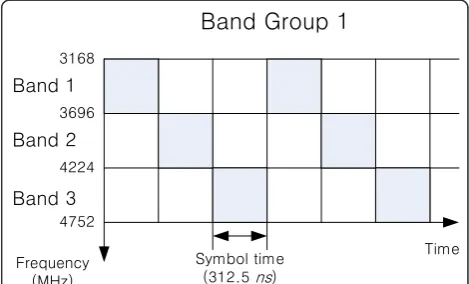
MB-OFDM is a combination of frequency hopping and OFDM. The frequency hopping allows only one of the three bands to be used at each symbol time as shown in Figure 2.aThere are a total of 128 subcarriers in each band. The numbers of data, pilot, null, and guard sub-carriers are 100, 12, 6, and 10, respectively. The fre-quency hopping provides the frefre-quency diversity and mitigates the co-channel interference between neighbor-ing piconets which operate independently, and exploits the maximum transmit power per device following the regulation of Federal Communications Commission (FCC).
2.3 TFC
The coded information is spread with TFCs that are classified into three types: time-frequency interleaving (TFI), TFI2, and fixed frequency interleaving (FFI) as shown in Table 1. The coded data are interleaved over one, two, and three band(s) in FFI, TFI2, and TFI, respectively. The TFCs are designed to allow the average collision probability of 1/3 at maximum between two TFCs, since they are not always orthogonal. Table 2 shows the collision probabilities between two TFCs in band group 1.
ͳΖΒΔΠΟ͑ΖΣΚΠΕ͑
͙ͳ͚ ͵ΒΥΒ͑΅ΣΒΟΤΗΖΣ͑ΖΣΚΠΕ͙͑͵΅͚ Ͳ͑΄ΦΡΖΣ͑ͷΣΒΞΖ͑
͙ͣͦͧ͑;Ͳ΄Τ͑ͮ͑ͧͦͦͤͧ͟ΞΤ͚
;ΖΕΚΦΞ͑ͲΔΔΖΤΤ͑΄ΝΠΥ͙͑;Ͳ΄͚͑ͮ͑ͣͦͧΦΤ
͟͟͟
ͳ΄΅
Figure 1WiMedia superframe structure. A superframe consists of 256 MASs that are divided into two periods: BP and DTP.
ͤͧͩ͢
ͤͧͪͧ
ͥͣͣͥ
ͥͨͦͣ
ͷΣΖΦΖΟΔΪ͑ ͙;Ϋ͚ ͳΒΟΕ͑͢ ͳΒΟΕ͑ͣ ͳΒΟΕ͑ͤ
ͳΒΟΕ͑ΣΠΦΡ͑͢
΅ΚΞΖ ΄ΪΞΓΠΝ͑ΥΚΞΖ͑
͙ͤͣͦ͑͢͟ΟΤ͚
3 System model
We model MU MB-OFDM to exploit three bands at each symbol time. To realize this model in a piconet, we propose to synchronize three concurrent transmissions at each MAS boundary time to overcome the clock drift. Moreover, we consider imperfect synchronization and some issues in applying the model for multi-piconet environments.
3.1 MU MB-OFDM
The conventional MB-OFDM uses only one band among the three in a band group at each symbol time. However, the synchronization of devices in a piconet can make it possible to use three bands concurrently, thereby tripling the wireless bandwidth compared to the standard scheme. The synchronization helps to avoid interference from other devices in a piconet. The MU MB-OFDM selects a TFC in TFI or TFI2, and shifts it by some OFDM symbol times to create two or three orthogonal TFCs that can be used together.
Specifically, the numbers of the shift are 0, 1, 2 at TFC1 and TFC2, 0, 2, 4 at TFC3 and TFC4, and 0, 1 at
TFC8, TFC9, and TFC10. bThe use of three shifted
TFCs brings the gain of the frequency diversity.
Each device in the MU MB-OFDM uses the same transmit power as in the conventional MB-OFDM because each device should conform the regulation of
FCC. Figure 3 shows an example of TFC patterns in the MU MB-OFDM with three devices transmitting together at a given time.
3.2 Synchronization
In the BP, every node in a piconet is awake and broad-casts its own beacon at its predetermined slot. Each node maintains a table of timing differences between the actual arrival times of each neighbor’s beacon by simply synchronizing with the slowest device in the BP. The expected arrival time is calculated based on the BPST.
In the DTP, concurrent transmissions should be syn-chronized to avoid inter symbol interference between consecutive adjacent transmissions. One OFDM symbol time is 312.5 ns with the fast Fourier transform time of 242.42 ns and the zero-padded suffix duration of 70.08 ns, of which function is to overcome the multi-path effect and give time for frequency hopping [2].
We assume that the crystal oscillator has a clock of 4224 MHz. Then, the maximum clock drift is given by
MaxDrift= 2×mClockAccuracy×SyncInterval, (1)
where mClockAccuracy is the clock drift set to 20
PPM (parts per million) andSyncIntervalthe synchroni-zation time of a device in the DTP. MaxDrift is about 2.62μs for each transmission pair in a superframe if all the nodes are synchronized in the BP.
There is a guard interval, i.e.mGuardTime = 12 μs, between two adjacent MAS boundary times to overcome the clock drift in the conventional MAC policy. Conse-quently, RX nodes are ready to listen to signals prior to mGuardTimeat their reserved MAS boundary times.
However, concurrent transmissions scheduled at the same MAS with differently shifted TFCs can arrive prior
to the MAS boundary time withinmGuardTime
simul-taneously, when all the devices are synchronized in the Table 1 Time-frequency codes for band group 1 in
ECMA-368 [2]
TFC number Types Band ID for TFC
1 TFI 1 2 3 1 2 3
2 TFI 1 3 2 1 3 2
3 TFI 1 1 2 2 3 3
4 TFI 1 1 3 3 2 2
5 FFI 1 1 1 1 1 1
6 FFI 2 2 2 2 2 2
7 FFI 3 3 3 3 3 3
8 TFI2 1 2 1 2 1 2
9 TFI2 1 3 1 3 1 3
10 TFI2 2 3 2 3 2 3
Table 2 Collision probabilities between TFCs in band group 1
TFC # 1-4 5 6 7 8 9 10 Avg. prob.
1-4 1/3 1/3 1/3 1/3 1/3 1/3 1/3 1/3
5 1/3 1 0 0 1/2 1/2 0 1/3
6 1/3 0 1 0 1/2 0 1/2 1/3
7 1/3 0 0 1 0 1/2 1/2 1/3
8 1/3 1/2 1/2 0 1/2 1/4 1/4 1/3
9 1/3 1/2 0 1/2 1/4 1/2 1/4 1/3
10 1/3 0 1/2 1/2 1/4 1/4 1/2 1/3
ͤͧͩ͢
ͤͧͪͧ
ͥͣͣͥ
ͥͨͦͣ
ͷΣΖΦΖΟΔΪ͑ ͙;Ϋ͚
ͳΒΟΕ͑͢ ͳΒΟΕ͑ͣ
ͳΒΟΕ͑ͤ
ͳΒΟΕ͑ΣΠΦΡ͑͢
΅ΚΞΖ
͡
͡
͡
͡
͡
͡
ͣ
͢ ͣ
ͣ
ͣ
ͣ
ͣ
͢
͢
͢
͢
͢
BP. To solve this problem, TX-RX pairs have to listen first to the hopping pattern for the duration of OFDM symbol time, and then transmit their signals according to their scheduled hopping patterns. Each TX-RX pair already knows the hopping patterns of other TX nodes from hearing beacons in the BP.
3.3 Implementation
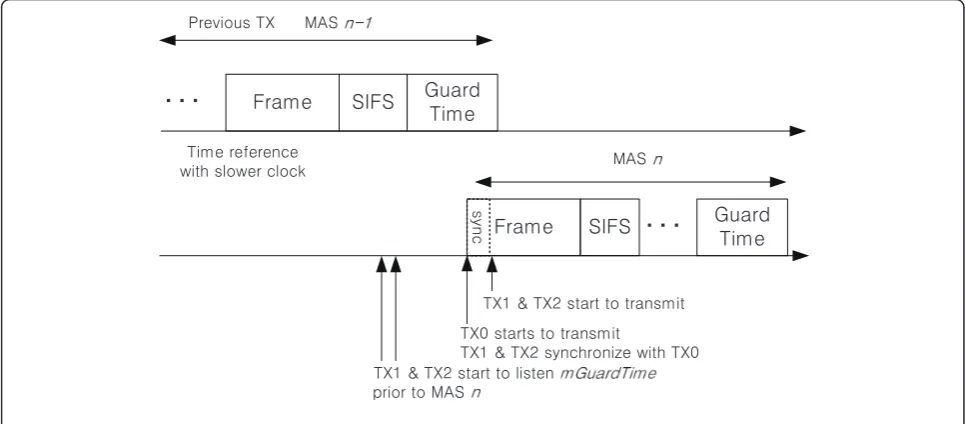
For a practical implementation, we propose to use an MU synchronization at the MAS boundary as shown in Figure 4.
The frame structure has the PLCP protocol data unit (PPDU) that consists of physical layer convergence proto-col (PLCP) preamble, PLCP header, and PHY service data unit. The PLCP preamble has two distinct parts: a unique synchronization sequence and a channel estimation sequence. It helps the receiver in timing synchronization, carrier-offset recovery, and channel estimation. In our proposed MU-synchronization, TX0 with 0 shift starts to transmit a PPDU first based on its local timer and the other nodes, i.e. TX1, TX2, RX0, RX1, and RX2, start to listen to the synchronization sequence of TX0 for the synchronization with their local timers. The transmitters, TX1 and TX2, start to transmit their PPDUs with their shifted TFCs after the synchronization. Then, the TX-RX pairs can communicate synchronously.
3.4 Imperfect synchronization
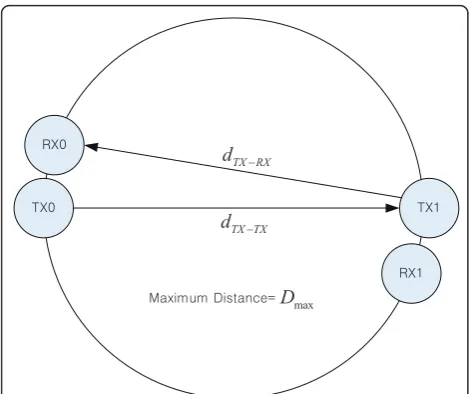
There is still a timing offset because of the unavoidable propagation delay between two nodes. The maximum
timing offset between two transmitters at a receiver is shown in Figure 5 and expressed as
dprop,max= 2Dmax
c , (2)
where Dmax is the maximum distance between two
nodes in a piconet, andcis the speed of light. The tim-ing offset between a TX and the other TX, measured at an RX, isdprop Î[0,dprop,max].
WiMedia UWB can support the ranging capability that calculates the distance between two nodes with an accuracy of ± 60 cm or better. The ranging is performed by calculating the round trip delay using the two-way time transfer technique. We assume that each device maintains a table for distances to other nodes using this ranging. Then, all the TX nodes can removedTX-TX in
Figure 5 by adjusting their local timers using this table. Therefore, the maximum timing offset with ranging is given by
drng,max=
Dmax
c . (3)
3.5 Effects of imperfect synchronization
Though the timing offset can be mitigated by the ranging capability of WiMedia UWB, it cannot be removed per-fectly. We consider using the zero-padded prefix in an OFDM symbol time to absorb such timing offset. The zero-padded suffix duration of 70.08 ns in a OFDM sym-bol serves to mitigate the effects of multi-path and give a
ͷΣΒΞΖ ΄ͺͷ΄ ΦΒΣΕ͑ ΅ΚΞΖ
͟͟͟
ͷΣΒΞΖ ΄ͺͷ΄ ΦΒΣΕ͑ ΅ΚΞΖ
͟͟͟
;Ͳ΄͑;Ͳ΄͑ ΅ΚΞΖ͑ΣΖΗΖΣΖΟΔΖ
ΨΚΥΙ͑ΤΝΠΨΖΣ͑ΔΝΠΔΜ
΅Ή͑͡ΤΥΒΣΥΤ͑ΥΠ͑ΥΣΒΟΤΞΚΥ
΅Ή͑͗͑͢΅Ήͣ͑ΤΪΟΔΙΣΠΟΚΫΖ͑ΨΚΥΙ͑΅Ή͡
ΤΪΟΔ
ΣΖΧΚΠΦΤ͑΅Ή
΅Ή͑͗͑͢΅Ήͣ͑ΤΥΒΣΥ͑ΥΠ͑ΝΚΤΥΖΟ͑ ΡΣΚΠΣ͑ΥΠ͑;Ͳ΄͑
΅Ή͑͗͑͢΅Ήͣ͑ΤΥΒΣΥ͑ΥΠ͑ΥΣΒΟΤΞΚΥ
guard time for the band switch,pBandSwitchTime(= 9.47 ns). And the indoor communication range for multimedia traffics is generally within a few meters, resulting indrng, maxto be below a few ns delay, e.g. 10 ns at 3 m.
However, the received signal will be degraded if the effects of multi-path and the propagation delay are not mitigated sufficiently by the zero-padded suffix duration. In this case, the TX-RX pair lowers their transmission rate based on packet error rate in practice to overcome the effects of imperfect synchronization, requiring more wireless resources. Therefore, this imperfect synchroni-zation degrades the network throughput.
3.6 Multi-piconet environments
In normal operation, there is no interference in a pic-onet if all the nodes are synchronized and scheduled in the MU MB-OFDM. But the interference is not avoid-able if the network is heavily loaded in a multi-piconet environment. It happens when some bands are occupied again by neighboring piconets at a given time.
In the conventional MB-OFDM, several methods such as transmit power control, band group change, TFC change, and exclusive time reservation have been proposed to miti-gate the interferences from neighboring networks [18-21]. In this context, we use the band group change to avoid the interferences from other piconets. Our scheme can support 14 concurrent users at a time in the UWB spectrum, i.e. a user per band, without creating interference.c
Different from ours, the standard scheme can support five users at a time, i.e. a user per band group. This means our scheme can accommodate about three times more users than the standard scheme. To apply our
scheme to a multi-piconet environment, we need to adopt a solution to a distributed vertex coloring problem with five colors, i.e. a different color for each band group. Several solutions to this problem have been proposed and analyzed [22-24]. The detailed discussion about the coloring problem is beyond the scope of this article.
4 Resource allocation
In this section, we review the conventional 2-dimen-sional (2D) resource allocation scheme to assign 256 MASs in MB-OFDM, and consider 3-dimensional (3D) allocation schemes to deal with the increased 3 × 256 MASs in MU MB-OFDM.
4.1 Conventional 2D resource allocation
The 2D structure of 16 × 16 MASs in a superframe has been proposed for MAS allocation [15]. The contiguous 16 MASs are grouped into an allocation zone, called zone. There are 16 zones in column. We denote the zones byZ0. toZ15.Z0is reserved for BP, and the other 15 zones are grouped into four subsets, called isozones. We denote the set of zones with isozonejbyIjthat has
2j zones. That is, I0={Z8},
I2={Z2,Z6,Z10,Z14}I2={Z2,Z6,Z10,Z14}, and
I3={Z1,Z3,Z5,Z7,Z9,Z11,Z13,Z15}.
Since an MAS has the duration of 256μs, each zone is separated by 4.096 ms from each neighboring one. Higher-indexed isozones are used to support services with smaller service intervals, i.e. tight QoS require-ments. For instance, the service intervals of I0and I3 are 16 × 4.096 and 2 × 4.096 ms, respectively. When a flow with QoS requirements enters the network, it indi-cates its service requirements by an isozone number and the number of required MASs in a superframe.
The number of available MASs with isozone j,
denoted bymj, is expressed as
mj= 2jyj, yj∈ {0,. . ., 16}, (4)
where yj is the number of available MASs in each
zone with Ij. The MAS allocation follows the symmetric assignment property [15]. We shown an example of 2D MAC resource allocation in Figure 6.
4.1.1 2D MAC policy
This policy tries to find available resources in a higher-indexed isozone, which meets the requested maximum delay bound, when there is an insufficient number of MASs in the requested isozone. The 2D MAC policy is expressed as follows:
P2D(ri) = min{2j∗x|ri≤2j∗x≤mj∗},
s.t.j∗= min{j|ri≤mj,i≤j≤3}, x∈ {0,. . ., 16},
(5)
΅Ή͡ Ή͡
΅Ή͢
Ή͢
;ΒΩΚΞΦΞ͑͵ΚΤΥΒΟΔΖͮDmax
TX TX
d
TX RX
d
Figure 5 The effect of the worst-case propagation delay in synchronization.dTX-TXanddTX-RXare the propagation delays
whereP2Dis the number of assigned MASs in the 2D
MAC policy, ri the number of requested MASs in Ii
specified by a QoS flow, and x the number of selected MASs in each zone with Ij∗. Note that the assigned MASs can be more than the requested MASs because of the symmetric assignment property. The MASs to be allocated are evenly distributed over the zones with the same requested isozone for the convenience of future reservation.
4.2 3D resource allocation
Against the standard 2D allocation of 16×16 MASs, our proposed allocation schemes handle the 3D structure of 3 × 16 × 16 MASs. This structure comes from the MU MB-OFDM that uses the three bands. We denote the three superframes with 0, 1, and 2 shift(s) of OFDM symbol time by SF0, SF1, and SF2, respectively.d This
implies that the standard MB-OFDM usesSF0 only.
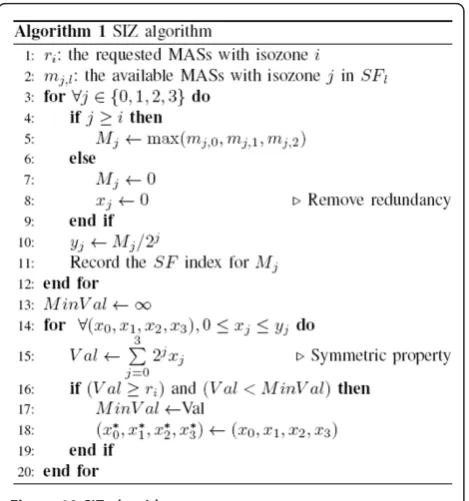
In the 2D MAC policy, if there are not enough MASs in the requested isozone of a superframe, each TX node searches for MASs from other higher-indexed isozones. In our MU MB-OFDM scheme, as we have the 3D resource structure, we can consider three types of resource assignment policies:SF (SuperFrame)-first pol-icytries available resources sequentially from equal and next higher-indexed isozones in SF0 first, IZ
(IsoZone)-first policy tries the requested isozone first over the three SFs, and SIZ (Shared-IZ) policytries resources
from all the isozones and SFs exhaustively. When a
resource request is given,SIZ policy can partially assign MASs from an isozone and then additional MASs from
other isozones over the three SFs. We explain these
three policies in detail.
4.2.1 SF-first policy
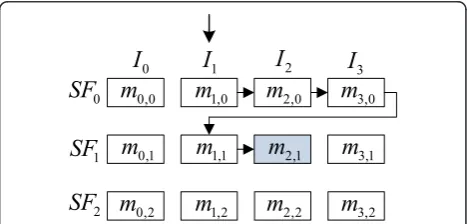
To find available MASs, this policy tries equal and then higher-indexed isozones inSF0 first. If not found, it tries
SF1 and SF2 sequentially until it finds the requested
resources, as shown in Figure 7. This policy is expressed as
where PSFis the number of assigned resources, ASF the set of available isozonesjwith eachSF, and mj,lthe available MASs with Ijand SFl.
4.2.2 IZ-first policy
This policy assigns resources to the requested isozone first and searches through the three SFs. If there exist insufficient MASs at the requested isozone over the threeSFs, this policy tries next higher-indexed isozones until found. The searching sequences are depicted in Figure 8 and expressed as
PIZ(ri) = min{2j
where PIZis the number of assigned resources and
AIZthe set of available isozones with eachSF.
4.2.3 SIZ policy
This policy tries cross isozones for MAS allocation if the requested MASs cannot be allocated to one isozone of an SF. This is a simply extended version of the 2D cross-IZ allocation scheme for 3D allocation [14]. Given the resource requestri, it will be allocated to isozonej(≥ i) that uses the minimum sum of MASs, while meeting the QoS requirements.
When this policy is applied to the case of r1 = 6 in
Figure 6 it selects two isozones that have two MASs in
͟͟͟
Figure 6The 2D structure of MASs in the conventional MB-OFDM. The number of assigned MASs whenr1= 6 is 8 with
I2(m2= 16). In this example, the available MASs inI1are insufficient (m1= 4). Hence, the assignment forI2is needed, and two MASs are excessively allocated.
0
Figure 7 SF-first policy. A flow requires I1in this case. This policy triesI1toI3inSF0to find available resources, and then in SF1andSF2, sequentially. In this example,I2inSF1has available
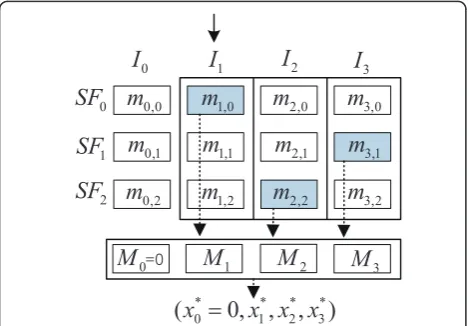
I2and four MASs in I2, respectively. The isozones are not necessarily from the same SF. SIZ policy is illu-strated in Figure 9 and expressed as
PSIZ(ri) =
wherePSIZis the number of assigned resources, ASIZ the set of feasible combinations of xj,Mjthe maximum of available MASs in Ijover the three SFs, and xj the number of selected MASs with Ijin the selectedSF.
The search space in this policy is larger than those in SF-firstandIZ-first policies, leading to a best combina-tion. For simplicity, we omitted the SF index forMj in (8). To find x∗j and itsSFindex exhaustively, we present an algorithm in Figure 10 as an example.
5 Resource allocation for prioritized QoS traffic
In this article, we consider video with low quality (VL), video with high quality (VH), and best effort (BE), and assume that VL has priority over VH.eBE has no prior-ity and requirements, and simply tries to take all the available MASs that are unassigned to VL and VH.
5.1 Priority support
The resource allocation policy for QoS flows can be pre-emptive or non-preemptive: a policy is preemptiveif a QoS flow can be interrupted by another QoS flow, and non-preemptiveotherwise.
5.1.1 Preemptive policy
Each QoS flow of VL or VH is assigned to at least one SF with available isozones. We simply dedicate one SF to VL and two SFs to VH, and use the following rules forpreemptive QoS operation with ownership.
•VL owns SF0, VH owns SF1 and SF2, but BE has
no dedicatedSF.
•VL and VH occupy any availableSF and preempt
BE.
•VL can preempt VH in SF0, but VH cannot
pre-empt VL inSF1andSF2.
•An existing owner of eachSFcannot be preempted by other traffic types.
We also consider preemptiveQoS operation without
ownership.
•VL and VH occupy any availableSFwithout dedi-catedSFand preempt BE.
•VL can preempt VH over threeSFs.
5.1.2 Non-preemptive policy
All the QoS flows of VL and VH can use three SFs
without being preempted by next incoming QoS flows. However, BE flows still can be preempted by QoS flows.
5.2 BE service support
All the unassigned MASs can be allocated for BE ser-vices. Incoming BE flows share available MASs with other existing BE flows in a fair manner, and do not fol-low the symmetric assignment property.
We propose a Cross-SF allocation policyfor BE traffic with an example in Figure 11. We denote the number of available MASs for BE traffic in SF0, SF1, and SF2 on
Figure 8IZ-first policy. A flow requiresI1in this example. This policy tries the same isozone first over the threeSFs to assign resources, and finally finds enough resources atI3inSF0.
0
each MAS indexq Î {1,....,M} by Nq Î{0, 1, 2, 3} and classify the MASs on an SF into as a set of
SNq⊂ {1,. . .,M}, where M is the maximum number of MASs in an SF. In Figure 11a, there are no remaining MASs for BE flows at MAS 5 and 7, i.e.S0={5,7}. And other sets areS1={1,3},S2={2,4,8}, andS3={6}.
Let us considerNBE flows. As a BE flow can transmit through only one MAS at a time, the number of assigned MASs to each BE flownis given by
PCSF(N,n) = ⎧ ⎪ ⎨ ⎪ ⎩
3
i=1|Si|, N= 1, 3
i=2|Si|+
|S1|/2
+bn, N= 2,
3
i=1i× |Si|
/N+bn, N≥3, (9)
where PCSF (N, n) is the number of MASs to be
assigned over the three SFs for BE flow n,|Si|is the number of elements in the setSi,⌊x⌋is a floor function which mapsxto the largest integer not greater thanx.
And bn is a binary variable having 0 or 1 when the
inputx of ⌊x⌋is not an integer, and 0 otherwise. One MAS will be assigned to BE flownstarting with 1, i.e. bn= 1, till the remaining MASs are empty if the input x is not an integer.
After calculating PCSF(N, n), each BE flownoccupies resources in a descending order ofNq inSNq, i.e. S3,S2,
and S1. When two or three MASs are available at a
given time, a low-indexedSFis selected.
The first arriving flow 1 in Figure 11a transmits through six MASs sequentially, i.e.SF2,SF0,SF0,SF0,X,
SF0,X,SF0, whereXindicates‘not available’MAS at the
given time. The number of assigned MAS for flow 1 is 6.
The second arriving flow 2 in Figure 11b has the same number of assigned MASs with flow 1 according to (9):
PCSF (2, 1) = 5 and PCSF (2, 2) = 5. At MAS 6 the
resource on SF2cannot be assigned to any flow because
a BE flow can transmit through only one MAS at a time. Finally, flow 3 in Figure 11c requests resources and then we get PCSF(3, 1) = 4, PCSF(3, 2) = 4 andPCSF(3, 3) = 3 from (9). Therefore, theCross-SF allocation policy guarantees the fairness of each BE flow.
6 Simulation results
In simulations, QoS flows are generated with uniformly distributed delay requirements in [10] ms. Each QoS flow comes with a requested isozone corresponding to the delay requirement. VL and VH flows have a uni-formly distributed MAS requirement in [2,10] and in [10], respectively. The maximum number of MASs in an SF, i.e.M, is set to 240. We ran the simulations 1,000 times with MATLAB [25] and averaged out the results.
6.1 Case of VL traffic only
If we only consider the requested MASs without the symmetric assignment, about 40 flows are supportable at maximum in the standard MB-OFDM. We compare the throughput of the proposed MU MB-OFDM with that of the standard MB-OFDM. Then, we measure the ratio of redundant MASs and the number of blocked flows for each assignment policy.
6.1.1 Throughput
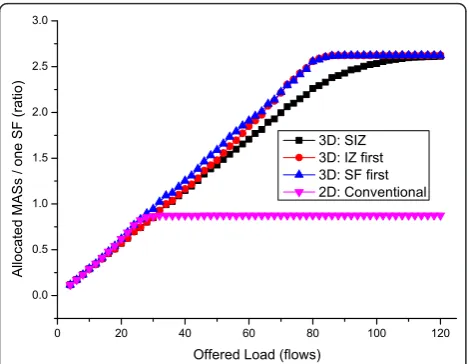
Figure 12 shows that the throughput in the MU MB-OFDM is saturated at three times as high load as that in the standard MB-OFDM. At the load of 26 flows, the throughput of the standard MB-OFDM is saturated. The throughputs usingSF-first, IZ-first, andSIZ policies in the MU MB-OFDM are saturated at 80, 80, and 110 flows, respectively. These policies have not reached the maximum capacity yet because of the property of sym-metric MAS assignment.
6.1.2 Redundant MASs
Owing to the symmetric assignment property, some allocated MASs are actually unused and wasted. Figure 13 shows that the standard 2D policy has the highest ratio of redundant MASs. This is because it has only one superframe, thereby having a small number of pos-sible MAS allocation combinations for the requested isozone.
has the least ratio of redundant MASs. The use of mul-tiple isozones over the threeSFs in this policy reduces redundant MAS allocation compared to that of single isozone over theSF-firstand IZ-first policies.
The ratio of redundant MASs in theSIZ policystarts to decrease at about 80 flows. We can explain this as follows. First, higher-indexed resources, i.e. having shorter service intervals, become candidates for the resource assignment more frequently. Therefore, higher-indexed resources tend to be consumed earlier than lower-indexed resources. This tendency causes higher-indexed flows to be blocked more often compared to lower-indexed flows. Second, lower-indexed resources have a lower number of symmetric zones according to (4). This leads this policy to have the lowest ratio of redundant MASs at above 80 flows.
6.1.3 Blocked flows
A flow will be blocked if the requested resources are not available. The number of blocked flows in the 3D MAC
policies is smaller than that in the conventional 2D pol-icy as shown in Figure 14. The ratio of blocked flows in the proposed 3D policies starts to smoothly increase at above 80 flows, whereas that in the conventional 2D policy rapidly increases at above 26 flows. TheSIZ pol-icyshows the lowest ratio of blocked flows.
6.2 Case of VL, VH, and BE traffics
Flows of VL, VH, and BE are generated with the equal probability. We apply theSIZ policywith thepreemptive policyfor VL and VH flows, and theCross-SF allocation policy for BE flows. Then, we measure throughput and numbers of serviced, blocked, and dropped flows.
6.2.1 Throughput
Figure 15 shows the number of allocated MASs for each traffic type. BE flows occupy most MASs in the begin-ning owing to their tendency of unlimited resource use. As the numbers of VL and VH flows increase, BE flows achieve lower throughput, and VL and VH flows higher
͢
0
SF
1
SF
2
SF
͢ ͢
͢ ͢ ͢ ͢ ͢ ͢
͢ ͢ ͢ ͢
;Ͳ΄͑ ͢ ͣ ͤ ͥ ͦ ͧ ͨ ͩ
ͳͶ͢
ͳͶ͢
ͳͶ͢ ͳͶ͢ ͳͶ͢ ͳͶ͢
͢
0
SF
1
SF
2
SF
͢ ͢
͢ ͢ ͢ ͢ ͢ ͢
͢ ͢ ͢ ͢
͢ ͣ ͤ ͥ ͦ ͧ ͨ ͩ
ͳͶ͢
ͳͶ͢
ͳͶͣ ͳͶ͢ ͳͶ͢
ͳͶͣ ͳͶͣ
ͳͶͣ
ͳͶͣ
ͳͶ͢
;Ͳ΄͑
͢
0
SF
1
SF
2
SF
͢ ͢
͢ ͢ ͢ ͢ ͢ ͢
͢ ͢ ͢ ͢
͢ ͣ ͤ ͥ ͦ ͧ ͨ ͩ
ͳͶ͢
ͳͶͤ
ͳͶͤ ͳͶ͢ ͳͶ͢ ͳͶ͢
ͳͶͣ
ͳͶͣ
ͳͶͣ
ͳͶͤ ͳͶͣ
;Ͳ΄͑
͙Β͚͑Ϳͮ͢
͙Γ͚͑Ϳͮͣ
͙Δ͚͑Ϳͮͤ
throughput. As VL flows have high priority in the pre-emptive policywith ownership, they are allowed to pre-empt on-going VH flows that are being serviced inSF0.
For this reason, the number of assigned MASs for VH flows starts to be lowered from the load of 60 flows, and then saturated. However, the number of assigned
MASs for VH flows in the preemptive policy without
ownership decreases continuously while VL flows achieve higher throughput.
Even when the network is heavily crowded by all the traffic types, BE flows still have a chance to use frag-mented MASs that are left over from the allocation for VL and VH flows.
6.2.2 Serviced flows
Figure 16 shows the number of serviced flows for priori-tized QoS data. A BE flow is counted as serviced if at least one MAS is assigned, whereas VL and VH flows are not allowed for the allocation of fragmented MASs. When VL flows preempt VH flows over threeSFs in the preemptive policywithout ownership, the number of VL flows that can be admitted is higher than that in the preemptive policy with ownership where VL flows can preempt on onlySF0. When the number of VH flows in
thepreemptive policywithout ownership decreases, the number with ownership is saturated as the offered load increases.
Figure 12 Throughput in the case of VL traffic only. The throughputs of the standard MB-OFDM with the 2D MAC policy and the proposed MU MB-OFDM withSF-firstandIZ-first policiesare saturated at the loads of 26 and 80 flows, respectively.
0 20 40 60 80 100 120
Figure 13Ratio of redundant MASs in the case of VL traffic only. TheSIZ policyhas the least ratio of redundant MASs while the 2D MAC policy shows the highest.
0 20 40 60 80 100 120
Figure 14Ratio of blocked flows in the case of VL traffic only. TheSIZ policyshows the least ratio of blocked flows.
0 50 100 150 200
VL(non-own) BE(non-own) VH(own)
VH(non-own)
6.2.3 Blocked flows
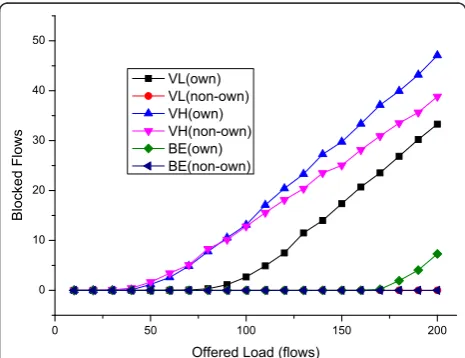
As shown in Figure 17 the number of blocked VH flows starts to increase first while that of BE flows last. Again fragmented resources, even one MAS, can be allocated for BE flows. VL flows in thepreemptive policywithout ownership can still find available resources after pre-empting VH flows at the high load.
6.2.4 Dropped flows
In thepreemptive policy, a flow is dropped if it is pre-empted by a flow with high priority. VL flows are not dropped because they have the highest priority. The number of dropped VH and BE flows starts to rise from the load of 50 flows as shown in Figure 18. The BE and
VH flows in thepreemptive policy without ownership
are preempted by the VH flows over threeSFs. In this
regard, the numbers of dropped flows for these flows are higher than those with ownership.
7 Conclusion
In this article, we have modeled the MU MB-OFDM using synchronization that provides the merit of three concurrent transmissions for a band group in a piconet. As a result, the proposed MU MB-OFDM triples net-work throughput compared to the conventional MB-OFDM. Then, we considered three 3D resource alloca-tion policies to handle the expanded MAS resources: SF-first, IZ-first, and SIZ policies. The simulations showed that the SIZ policyperforms the best in terms of throughput, redundant MASs, and blocked flows.
We also investigated some operation rules with resource allocation policies to support prioritized QoS traffic in the MU MB-OFDM. Extensive simulations presented that the proposed QoS support rules operate well in terms of throughput and numbers of serviced, blocked, and dropped flows.
Acknowledgment
This study was supported by the“Samsung Electronics Semiconductor Business”.
Endnotes
a
In the fifth band group, two bands are available for frequency hopping.
bIn band group 5, the numbers of the shift are 0, 1 only at TFC8. cThis does not mean that 14 users are the maximum that can be admitted.
For instance, the maximum length of BP is 96 beacon slots which support 94 users (two beacon slots are reserved for signaling) in a piconet at maximum.
d
In this case, we consider TFC1 and TFC2 in band groups 1, 2, 3, and 4.
eWe have not considered resource allocation for voice traffic because its
bandwidth requirement is too small. The allocation of even an MAS is too much for a voice traffic. Note that theSIZ policycannot allocate one MAS in pieces over three SFs.
Competing interests
The authors declare that they have no competing interests.
0 50 100 150 200
Figure 16Serviced flows in the case of VL, VH, and BE traffics. VL and VH flows in thepreemptive policywithout ownership show the highest and lowest number of serviced flows, respectively.
0 50 100 150 200
Figure 17Blocked flows in the case of VL, VH, and BE traffics.
0 50 100 150 200
Received: 1 February 2011 Accepted: 31 October 2011 Published: 31 October 2011
References
1. J Lee, Y Su, C Shen, Comparative study of wireless protocols: Bluetooth, UWB, ZigBee, and Wi-Fi. in33rd Annual Conference of the IEEE Industrial Electronics Society (IECON), 46–51 (5-8 November 2007)
2. ECMA-368, High Rate Wideband PHY and MAC Standard. inEuropean Computer Manufacturers Association (ECMA), 3rd edn. New York, 53–76 (3 December 2008)
3. R Zhang, R Ruby, J Pan, L Cai, X Shen, A hybrid reservation/contention-based MAC for video streaming over wireless networks. IEEE J. Sel. Areas Commun.28(3), 389–398 (2010)
4. Z Zhang, Y He, E Chong, Opportunistic scheduling for OFDM systems with fairness constraints. EURASIP J. Wireless Commun. Networking.2008, 1–12 (2008). doi:10.1155/2008/215939
5. O Falowo, H Chan, Adaptive bandwidth management and joint call admission control to enhance system utilization and QoS in heterogeneous wireless networks. EURASIP J. Wireless Commun. Networking.2007, 1–11 (2007). doi:10.1155/2007/34378
6. F Sun, M You, V Li, Dynamic subcarrier allocation for real-time traffic over multiuser OFDM systems. EURASIP J. Wireless Commun. Networking.2009, 1–9 (2009). doi:10.1155/2009/298451
7. Y Choi, S Oh, S Choi, S-ARQ: a new truncated ARQ for IP-based wireless network. J. Commun. Networks.12(2), 174–180 (2010)
8. Part 11, Wireless LAN medium access control (MAC) and physical layer (PHY) specifications. inIEEE 802.11-2007(12 June 2007)
9. S Kim, K Hur, J Park, D Eom, K Hwang, A fair distributed resource allocation method in UWB wireless PANs with WiMedia MAC. J. Commun. Networks.
11(4), 375–383 (2009)
10. W Kuo, H Wu, Supporting real-time VBR video transport on WiMedia-based wireless personal area networks. IEEE Trans. Vehicular Technol.58(4), 1965–1971 (2009)
11. Z Fan, Bandwidth allocation in UWB WPANs with ECMA-368 MAC. Elsevier Comput. Commun.32(5), 954–960 (2009)
12. D Wong, F Chin, M Shajan, Y Chew, inSaturated Throughput of Burst Mode PCA with Hard DRPs in WiMedia MAC(March 2008)
13. R Ruby, J Pan, inPerformance Analysis of WiMedia UWB MAC(June 2009) 14. M Daneshi, J Pan, S Ganti, inTowards an Efficient Reservation Algorithm for
Distributed Reservation Protocols1–9 (March 2010)
15. W Alliance, WiMedia Logical Link Control Protocol, draft., 1.0 (13 August 2007) 16. A Khalil, M Crussiere, J Helard, Adaptive self-learning resource allocation
scheme for unlicensed users in highrate UWB systems. Springer Wireless Personal Commun 1–13 (2010). doi:10.1007/s11277-010-9993-8
17. A Khalil, M Crussiere, J Helard, inCross-Layer Resource Allocation Scheme for Multi-Band High Rate UWB Systems(June 2009)
18. S Ko, H Kwon, B Lee, Distributed uplink resource allocation in multi-cell wireless data networks. J. Commun. Networks.12(5), 449–458 (2010) 19. P Xue, P Gong, D Kim, Enhanced IEEE 802.15.3 MAC protocol for efficient
support of multiple simultaneously operating piconets. IEEE Trans. Vehicular Technol.57(4), 2548–2559 (2008)
20. R Al-Zubi, M Krunz, Interference management and rate adaptation in OFDM-based UWB networks. IEEE Trans. Mobile Comput.9(9), 1267–1279 (2010) 21. D Lowe, X Huang, inAdaptive Time-Frequency Codes for Ultra-wideband(2007) 22. D Leith, P Clifford, inA Self-Managed Distributed Channel Selection Algorithm
for WLANs(April 2006)
23. K Duffy, N O’Connell, A Sapozhnikov, Complexity analysis of a decentralised graph colouring algorithm. Inf. Process. Lett.107(2), 60–63 (2008). doi:10.1016/j.ipl.2008.01.002
24. M Al-Ayyoub, M Buddhikot, H Gupta, inSelf-regulating Spectrum Management: a Case of Fractional Frequency Reuse Patterns in LTE Networks(April 2010) 25. MATLAB http://www.mathworks.com
doi:10.1186/1687-1499-2011-150
Cite this article as:Chang and Bahk:Throughput enhancement using
synchronization and three-dimensional resource allocation.EURASIP
Journal on Wireless Communications and Networking20112011:150.
Submit your manuscript to a
journal and benefi t from:
7Convenient online submission 7Rigorous peer review
7Immediate publication on acceptance 7Open access: articles freely available online 7High visibility within the fi eld
7Retaining the copyright to your article
![Table 1 Time-frequency codes for band group 1 in ECMA-368 [2]](https://thumb-us.123doks.com/thumbv2/123dok_us/953255.1116551/3.595.305.540.558.700/table-time-frequency-codes-band-group-ecma.webp)