CSEIT161111 | Received: 23 July 2016 | Accepted: 01 August 2016 | July-August 2016 [(1)1: 54-59]
International Journal of Scientific Research in Computer Science, Engineering and Information Technology © 2016 IJSRCSEIT | Volume 1 | Issue 1 | ISSN : 2456-3307
54
Address Allocation Algorithm with Cooperative
Communication in MANET
Parameswaran T
1, Dr.Palanisamy C
2, Logeshwari N
31Teaching Fellow, Department of CSE, Anna University Regional Campus, Coimbatore. India 2Professor and HOD, Department of IT, Bannari Amman Institute of Technology, Sathyamangalam. India
3
PG Scholar, Department of CSE, Anna University Regional Campus, Coimbatore. India
ABSTRACT
Wireless sensor network (WSN) has devices with radio transceivers that cooperate to form and continue a fully connected network of sensor nodes. In existing systems, topology control algorithms allow each node in a wireless multi-hop network to adjust the power. It generates the transmission and decides neighbors where it communicates while preserving goals like connectivity or coverage. When a node drains its inadequate energy, it does not reach neighboring nodes resulting in a disjointed network and stopping important communications. With the limited energy, the node does not able to continue the environmental monitoring performance that is important to the efficient operation of the system. In proposed system, MANETs controlled the provision of pre-registered or approved nodes and it has the opportunity for pre-deployed exchange of security parameters like public keys, session keys. Each node in a MANET moves in any direction and changes its links frequently. A low-overhead identity based distributed dynamic address configuration scheme for secure allocation of IP addresses is used to allow the nodes of a managed mobile ad hoc network. MANET reduces the power usage for each packet transmission and mobile node movement. MANET also improves the security of transmission in mobile networks. Finally, this process conduct the performance metrics are: network overhead, delay time and security level.
Keywords: MANET, low-overhead identity, Wireless Sensor Network (WSN), Topology Control algorithm, IP Address.
I.
INTRODUCTION
Wireless sensor network (WSN) has devices with radio transceivers that cooperate to form and continue a fully connected network of sensor nodes.A wireless sensor network (WSN) comprises spatially distributed autonomous sensors to examine physical or environmental conditions to pass data through the network to main location.
Neighbor discovery protocols (NDPs) survey is made in [2]. Generally, protocol is divided using four principles. They are: randomness, over half Occupation, rotation resistant intersection, and co prime cycles. The birthday protocols functions as Agents of NDPs by change where the node listen NDP used to find the future information.
The growth of wireless sensor networks was encouraged by military applications. Wireless Sensor Networks (WSNs) is a class of wireless ad hoc networks where sensor nodes gather, process and communicate data attained from the physical environment to Base-Station (BS).
II.
METHODS AND MATERIAL
2. LITERATURE SURVEY
In [1], a distributed algorithm is presented for creating minimum weight directed spanning trees with root node in connected directed graph. A processor presents at each node. With weights and origins of edges incoming to nodes, the processors follow the algorithm and exchange messages with their neighbors
algorithm is designed in [3]. The algorithm fails to consider the nodes with GPS information and it depends on directional information. Roughly speaking is important design of the algorithm where the node sends with minimum power to guarantee in all cone of quantity around.
R3E increases the packet delivery ratio when preserving the high energy efficiency and low delivery latency. In [4], two localized topology control algorithms are designed for heterogeneous networks. They are: Directed Relative Neighborhood Graph (DRNG) and Directed Local Spanning Sub graph. Each node builds its neighbor set by changing the transmission power and describes the network topology with local information.
A protocol optimized in [5] for less energy usage in mobile wireless networks which support peer-to-peer communications. An easy local optimization scheme is used at all nodes to guarantee link of network and attains the global less energy solution for stationary networks. In [6], distributed channel access protocol joins the channel reservation and the iterative/global transmission power control techniques in ad hoc networks. The designed protocol solves the convergence problem of global power control in ad hoc networks. The designed access criteria use the local admission control depending on the adequate criteria for admissibility and global power control for balancing the SIR of the links. In [7], a minimum spanning tree (MST)-based algorithm termed as local minimum spanning tree (LMST) is designed for topology control in wireless multi hop networks. In algorithm, each node creates LMST separately and preserves on-tree nodes that are one-hop away in final topology.
2.1 Related Works
In [8] to develop the benefits of user cooperation in cooperative WANETs, distributed energy-efficient selective diversity (EESD) topology control is planned to enhance the energy efficiency. It equally considers the network capacity and energy consumption using bits per Joule. EESD creates the transmission coalitions via cooperative manner selection by considering the cost of channel information exchange. Game theory is briefed in [9] to solve the power control issue in a CDMA-based distributed sensor
network. A non-cooperative game with incomplete information is designed by Nash equilibrium. With this equilibrium, a distributed algorithm is planned for optimal power control and verified the system is power stable when the nodes observe with the transmit power thresholds.
The energy efficiency problem is addressed and designed a comprehensive study of topology control techniques in [10] for increasing the lifetime of battery powered WSNs. Initially, a topology control algorithms are designed to present insights into how energy efficiency is attained using the design. In addition, algorithms are derived from the energy preservation approach that implemented and computed using the trade-offs they provide to help the designers in choosing a method that suits the applications.
3. ADDRESS ALLOCATION ALGORITHM IN MANET
Nodes are within the each other’s radio range that communicate where the nodes are not in each other’s radio range communicate via intermediate nodes where the packets are transmitted from source to destination. Number of nodes is increased in the network and the time taken to attain an IP address, number of packet replaces in less address allocation. The existing node in the network creates distinctive IP addresses from its own IP address for new authorized nodes. Mobile ad hoc networks are divided into stateless allocation and state full allocation methods. It is evident in many existing dynamic address allocation methods for MANET based on DAD.
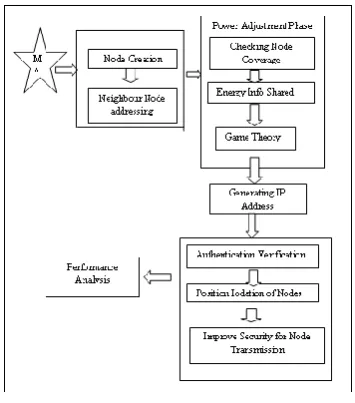
From figure 1, in initialization phase creates the node and address the neighbor node. From the initialization phase, it is send to the power adjustment phase. In power adjustment phase, it checks for the network coverage. The energy is shared through the node using the game theory. Then, it sends for generating IP address. After generating the address, communication takes place through mobile. In mobile communication, authentication verification takes place. After authentication, nodes update the position and increase the security of the node transmission. After that, the performance is analysed.
3.1 MODULES
1. Nodes deployed and create source and destination nodes
2. Node searching neighbor node for cooperative communication
3. Game theory for minimize the energy consumption
4. Generate IP address for each mobile node in network
5. Updated position of mobile nodes provide secured communication
6. Performance Analysis
3.1.1 Nodes Deployed and Create Source and Destination Nodes
The nodes are deployed in the network with the help of NS2. It also creates the source and destination node with higher efficient.
3.1.2 Node Searching Neighbor Node for Cooperative Communication
Based on the location of a node with respect to others, some nodes end up with a larger communication radius. By taking that all nodes initiates with the same energy supply and make transmissions at the same rate. Node A has the largest energy cost and the shortest lifetime. For the cooperative communication, Cooperative topology control algorithm is designed. Initially, it is separated into two types. They are: topology construction and topology maintenance. Topology construction is the charge of initial reduction and the topology maintenance is the charge of maintenance of the reduced topology where the features such as connectivity and coverage are protected. The initial topology is employed when the
location of nodes is chance where the administrator without the control over the design of the network.
Simultaneously, the topology is reduced and the network starts allocation in the selected nodes by spending the energy. Topology control is executed in following steps to protect the desired properties like connectivity, coverage, density.
Step 1: Change the transmission range of the nodes Step 2: Turn off nodes from the network
Step 3: Create a communication backbone Step 4: Clustering
Step 5: Add new nodes to the network to preserve connectivity (Federated Wireless sensor networks)
3.1.3 Game Theory for Minimize the Energy Consumption
Each node updates its transmission power periodically, the algorithm functions in rounds. At staring of each round, each node broadcasts its remaining energy. If it not broadcasted before, the Energy Info Shared Flag denotes it. Game theory is an ordinal potential game looking for the optimal global potential function yield Nash equilibrium.
3.1.4 Generate IP Address for Each Mobile Node in Network
The network initiates from a single node and develops as more nodes by adding one by one. These nodes are free to move around and it joins or leaves the network at any point of time. A node has to inform its parent before departing the network. In case of graceless departure, a node moves away from the network inadvertently or even deliberately. As IPv6 provides a large address space, it is also not that necessary for an address to be reused.
3.1.5 Updated Position of Mobile Nodes Provide Secured Communication
III.
RESULTS AND DISCUSSION
PERFORMANCE ANALYSIS
The performance quality is analysed for cooperative communication using the cooperative topology control algorithm. The metrics of parameters is given below:
Network overhead. Security
Delay time.
4.1 Number of nodes vs. Network overhead
Network overhead is the metadata and network routing information sent by anapplication that uses a portion of the availablebandwidthof acommunications protocol. The additional data creating the protocol headers and application-specific information is denoted as overhead. Network overhead is the ratio of non-applicationbytesdivided to the total number of bytes in the message. Network overhead is measured in terms of percentage (%).
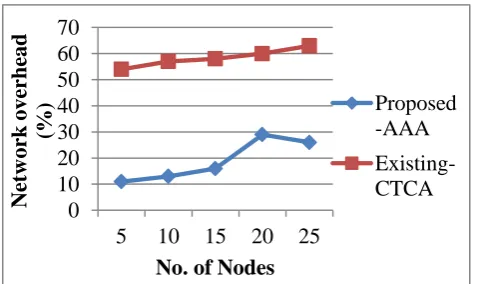
Figure 4.1. Number of nodes vs. Network overhead
Figure 4.1 demonstrates the network overhead of cooperative communication and dynamic address allocation algorithm. X axis represents the no. of nodes whereas Y axis denotes network overhead of the cooperative topology control and dynamic address allocation algorithm. When the no. of nodes is increased, the performance of network overhead gets automatically increases accordingly.
4.2 Number of nodes vs. Security
Network security involves the approval of access to data in a network that are controlled by the network administrator. Network security includes the large number of computer networks both public and private information in businesses, government agencies and individuals. It secures the network and also protects the operations carried out. Network securitycomprises thepoliciesimplemented to avoid and examineauthorizedaccess, misuse, alteration or denial of a computer networkand network-accessible resources. The simple way of protecting a network resource is by assigning a unique name and a password. It is also measured in terms of percentage (%).
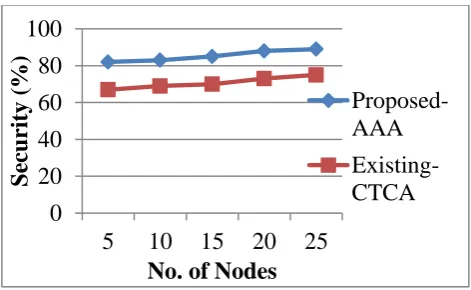
Figure 4.2 Number of nodes vs. Security
Figure 4.2 illustrates the security of cooperative communication and dynamic address allocation algorithm. X axis represents the no. of nodes whereas Y axis denotes security of the cooperative topology control and dynamic address allocation algorithm. When the no. of nodes is increased, the performance of network security gets automatically increases accordingly. In the proposed algorithm, the network security is high.
4.3 Number of nodes vs. Delay time
delay is defined as time taken to push the packet's bits onto the link. Propagation delay is defined as time taken for a signal to reach its destination.
Figure 4.3. Number of nodes vs. Delay Time
Figure 4.3 demonstrates the delay time of cooperative communication and dynamic address allocation algorithm. X axis represents the no. of nodes whereas Y axis denotes delay time of the cooperative topology control and dynamic address allocation algorithm. When the no. of nodes is increased, the performance of delay time gets automatically increases accordingly. For an effective cooperative communication, the delay time should be as low as possible.
IV.CONCLUSION
Cooperative communication provides the communication directly or indirectly using neighbor nodes, the Neighbor searching technique is used for neighbor selection. Quality of topology by CTCA algorithm to optimal solution attained with centralized algorithm. A distributed algorithm called Cooperative Topology Control with Adaptation (CTCA) executes more information or options presented at each node. The Cooperative Topology Control with Adaptation (CTCA) algorithm executes better than other distributed algorithms. Game theory is implemented to minimize the energy consumption.
V.
FUTURE ENHANCEMENT
Planned to improve the security and reduce the Network overhead, delay time in MANET, it updates the position and provide efficient communication between nodes in the network depending on network coverage. Use secure address allocation algorithm for packet transmission to reduce the energy consumption of nodes.
VI.REFERENCES
[1] Pierre A. Humblet, "A Distributed Algorithm for Minimum Weight Directed Spanning Trees", IEEE Transactions on Communications, Volume 31, Issue 6, June 2003.
[2] Wei Sun, Zheng Yang, Xinglin Zhang, and Yunhao Liu, "ENERGY-Efficient Neighbor Discovery in Mobile Ad Hoc and Wireless Sensor Networks: A Survey", IEEE Communications Surveys and Tutorials, Volume 16, Issue 3, Third Quarter 2014.
[3] Li (Erran) Li, Joseph Y. Halpern, Paramvir Bahl, Yi-Min Wang, and Roger Wattenhofer, "A Cone-Based Distributed Topology-Control Algorithm for Wireless Multi-Hop Networks", IEEE/ACM Transactions on Networking, Volume 13, Issue 1, February 2005.
[4] Ning Li, and Jennifer C. Hou, "Localized Topology Control Algorithms for Heterogeneous Wireless Networks", IEEE/ACM Transactions on Networking, Volume 13, Issue 6, December 2005.
[5] VolkanRodoplu, and Teresa H. Meng, "Minimum Energy Mobile Wireless Networks" IEEE Journal on Selected Areas in Communications, Volume 17, Issue 8, August 1999.
[6] AzrinaAbd Aziz, Y. Ahmet S. Ekercioglu, Paul Fitzpatrick, and MiloshIvanovich, "A Distributed Channel Access Protocol for Ad Hoc Networks with Feedback Power Control" IEEE Communications Surveys and Tutorials, Volume 15, Issue 1, First Quarter 2013.
[7] Ning Li, Jennifer C. Hou, and LuiSha,"Design and Analysis of an MST-Based Topology Control Algorithm" IEEE Transactions on Wireless Communications, Volume 4, Issue 3, MAY 2005.
[8] BingyiGuo, Quansheng Guan, F. Richard Yu., Shengming Jiang and Victor C. M. Leung, "Energy-Efficient Topology Control with Selective Diversity in Cooperative Wireless Ad Hoc Networks: A Game-Theoretic Approach" IEEE Transactions on Wireless Communications, Volume 13, Issue 11, November 2014.
IEEE Transactions on Computers, Volume 59, Issue 2, February 2010.
[10] AzrinaAbd i hmet e ercioglu Paul Fitzpatrick, and MiloshIvanovich., "A Survey on Distributed Topology Control Techniques for Extending the Lifetime of Battery Powered Wireless Sensor Networks", IEEE Communications Surveys and Tutorials, Volume 15, Issue 1, First Quarter 2013.
[11] C.EPerkins, E.M.Royer, and S.R.Das:"IP Address Auto Configuration for Ad Hoc Networks", Technical Report draft-ietf-manet-autoconfig-00.txt, Internet Engineering Task Force, MANET Working Group, July 2000. [12] S.Thomson, and T.Narten:"Ipv6 Stateless Auto
Configuration", RFC 2462, December 1998. [13] A.Misra, S.Das, A.McAulley, and
S.K.Das:"Auto configuration, Registration, and Mobility Management for Pervasive Computing,"IEEE Personal Communications, Volume8, Issue 4, Auguest 2001.Pages 24-31. [14] R.Droms,"Dynamic Host Configuration
Protocol," Network Working Group, RFC 2131, Mar 1997.
[15] N.Vaidhya,"Weak Duplicate Address Detection in Mobile Ad Hoc Networks," ACM International Symposium on Mobile Ad Hoc Networking and Computing (MobiHoc02), June 2002, pp.201-216.
[16] Jeff.Bleng,"Efficient Network Layer Addressing for MANET s," in Proc.of International Conference on Wireless Networks (ICWN'020Las Vegas, USA.
[17] C.Perkins et al.,"IP Address Auto configuration for Ad Hoc Networks,"IETF draft, 2001.
[18] J.Broch, D.Maltz, D.Johnson, Y.Hu, and J.Jetcheva."A Performance Comparison of Multi-Hop Wireless Ad Hoc Routing Protocols," Proceedings of the Fourth Annual ACM/IEEE Inter-national Conference on Mobile Computing and Networking, pp.85-97, October 1998. [19] M.Mohsin and R.Prakash,"IP Address
Assignment in a Mobile Ad Hoc Network,"Proc MILCOM, Vol.2, Oct 2002, pp.856-61.
[20] P.Patchipulusu,"Dynamic Address Allocation Protocols for Mobile Ah Hoc Networks," M.Sc thesis, Comp.Sci.Texas A&M Univ., 2001.
Parameswaran.T has received his B.E degree in Electronics and Communication Engineering from Velalar College of Engineering and Technology, Erode, and M.E degree in Software Engineering from College of Engineering Guindy, Anna University Chennai in 2005 and 2008 respectively. He is currently pursuing his Ph.D Anna University Chennai. He is currently working as Teaching Fellow in the Department of Computer Science and Engineering, Anna University Regional Campus, Coimbatore, Tamilnadu, India.
Palanisamy.C has received his B.E degree in Electronics and Communication Engineering from University of Madras, Chennai and M.E degree (Gold Medalist) in Communication Systems from Thiagarajar College of Engineering, Madurai, and Madurai Kamaraj University in 1998 and 2000 respectively. He has received his Ph.D from the faculty of Information and Communication Engineering, Anna University, Chennai in 2009. He has more than 15 years of academic and research experience and currently he holds the post of Professor and Head of the Department of Information Technology, Bannari Amman Institute of Technology, Sathyamangalam, and Tamilnadu, India. He has published more than 40 research papers in various journals and conferences. He has organized more than 15 workshops and holds 2 funded projects. He is a lifetime member of ISTE. He Won Best M.E Thesis Award at Thiagarajar College of Engineering, Madurai and best paper award titled, "A Neural Network Based Classification Model Using Fourier and Wavelet Features ” Proceedings of the 2nd Int. Conf. on Cognition and Recognition 2008, (ICCR 2008), Organised by P. E. S. College of Engineering, Mandaya, Karnataka, India, pp. 664-670, 2008.His research interests include Data mining, image processing, and mobile networks.