R E S E A R C H
Open Access
Global dynamics of some systems of
higher-order rational difference equations
Abdul Qadeer Khan, Muhammad Naeem Qureshi and Qamar Din
**Correspondence:
[email protected] Department of Mathematics, University of Azad Jammu and Kashmir, Muzaffarabad, Pakistan
Abstract
In the present work, we study the qualitative behavior of two systems of higher-order rational difference equations. More precisely, we study the local asymptotic stability, instability, global asymptotic stability of equilibrium points and rate of convergence of positive solutions of these systems. Our results considerably extend and improve some recent results in the literature. Some numerical examples are given to verify our theoretical results.
MSC: 39A10; 40A05
Keywords: system of difference equations; stability; global character; rate of convergence
1 Introduction
Recently, studying the qualitative behavior of difference equations and systems is a topic of great interest. Applications of discrete dynamical systems and difference equations have appeared recently in many areas such as ecology, population dynamics, queuing problems, statistical problems, stochastic time series, combinatorial analysis, number theory, geom-etry, electrical networks, neural networks, quanta in radiation, genetics in biology, eco-nomics, psychology, sociology, physics, engineering, ecoeco-nomics, probability theory and resource management. Unfortunately, these are only considered as the discrete analogs of differential equations. It is a well-known fact that difference equations appeared much earlier than differential equations and were instrumental in paving the way for the devel-opment of the latter. It is only recently that difference equations have started receiving the attention they deserve. Perhaps this is largely due to the advent of computers where differ-ential equations are solved by using their approximate difference equation formulations. The theory of discrete dynamical systems and difference equations developed greatly dur-ing the last twenty-five years of the twentieth century. The theory of difference equations occupies a central position in applicable analysis. There is no doubt that the theory of difference equations will continue to play an important role in mathematics as a whole. Nonlinear difference equations of order greater than one are of paramount importance in applications. It is very interesting to investigate the behavior of solutions of a system of higher-order rational difference equations and to discuss the local asymptotic stability of their equilibrium points. Systems of rational difference equations have been studied by several authors. Especially there has been a great interest in the study of the attractivity of the solutions of such systems. For more results on the qualitative behavior of nonlinear difference equations, we refer the interested reader to [–].
Zhang et al.[] studied the dynamics of a system of rational third-order difference equations
xn+=
xn–
B+ynyn–yn–
, yn+=
yn–
A+xnxn–xn– .
Dinet al.[] investigated the dynamics of a system of fourth-order rational difference equations
xn+=
αxn–
β+γynyn–yn–yn–
, yn+=
αyn–
β+γxnxn–xn–xn– .
To be motivated by the above studies, our aim in this paper is to investigate the qualitative
behavior of the following (k+ )th-order systems of rational difference equations:
xn+=
αxn–k
β+γki=yn–i
, yn+=
αyn–k β+γ
k
i=xn–i
, n= , , . . . , ()
where the parametersα,β,γ,α,β,γand initial conditionsx,x–, . . . ,x–k,y,y–, . . . ,y–k are positive real numbers, and
xn+=
ayn–k b+cki=xn–i
, yn+=
axn–k b+c
k
i=yn–i
, n= , , . . . , ()
where the parametersa,b,c,a,b,cand initial conditionsx,x–, . . . ,x–k,y,y–, . . . ,y–k are positive real numbers. This paper is a natural extension of [, , ].
Let us consider (k+ )-dimensional discrete dynamical system of the form
xn+=f(xn,xn–, . . . ,xn–k,yn,yn–, . . . ,yn–k),
yn+=g(xn,xn–, . . . ,xn–k,yn,yn–, . . . ,yn–k), n= , , . . . ,
()
where f :Ik+ ×Jk+→I and g:Ik+ ×Jk+→J are continuously differentiable
func-tions andI,Jare some intervals of real numbers. Furthermore, a solution{(xn,yn)}∞n=–k
of system () is uniquely determined by initial conditions (xi,yi)∈I×Jfori∈ {–k, –k+
, . . . , –, }. Along with system (), we consider the corresponding vector map F =
(f,xn,xn–, . . . ,xn–k,g,yn,yn–, . . . ,yn–k). An equilibrium point of () is a point (x¯,¯y) that satisfies
¯
x=f(x¯,x¯, . . . ,x¯,y¯,y¯, . . . ,¯y),
¯
y=g(x¯,x¯, . . . ,x¯,y¯,y¯, . . . ,y¯).
The point (x¯,y¯) is also called a fixed point of the vector mapF.
Definition Let (x¯,y¯) be an equilibrium point of system ().
(i) An equilibrium point(x¯,y¯)is said to be stable if for everyε> there existsδ>
such that for every initial condition(xi,yi),i∈ {–k, –k+ , . . . , –, },
i=–k(xi,yi) – (x¯,¯y)<δimplies(xn,yn) – (x¯,y¯)<εfor alln> , where · is
(ii) An equilibrium point(x¯,¯y)is said to be unstable if it is not stable.
(iii) An equilibrium point(x¯,¯y)is said to be asymptotically stable if there existsη>
such thati=–k(xi,yi) – (x¯,y¯)<ηand(xn,yn)→(x¯,y¯)asn→ ∞.
(iv) An equilibrium point(x¯,¯y)is called a global attractor if(xn,yn)→(x¯,y¯)asn→ ∞. (v) An equilibrium point(x¯,¯y)is called an asymptotic global attractor if it is a global
attractor and stable.
Definition Let (x¯,y¯) be an equilibrium point of the map
F= (f,xn,xn–, . . . ,xn–k,g,yn,yn–, . . . ,yn–k),
wheref andgare continuously differentiable functions at (x¯,y¯). The linearized system of
() about the equilibrium point (x¯,y¯) is
andX is the fixed point of F¯ .If all eigenvalues of the Jacobian matrix JFaboutX lie inside¯ an open unit disk|λ|< ,thenX is locally asymptotically stable¯ .If one of them has norm greater than one,thenX is unstable¯ .
Lemma [] Assume that Xn+=F(Xn),n= , , . . . ,is a system of difference equations
co-Let us consider a system of difference equations
Xn+=
A+B(n)Xn, ()
whereXnis anm-dimensional vector,A∈Cm×mis a constant matrix, andB:Z+→Cm×m
is a matrix function satisfying
B(n)→ ()
asn→ ∞, where · denotes any matrix norm which is associated with the vector norm
(x,y)=x+y.
Proposition (Perron’s theorem)[] Suppose that condition()holds.If Xnis a solution of(),then either Xn= for all large n or
ρ= lim n→∞
Xn/n ()
exists and is equal to the modulus of one of the eigenvalues of matrix A.
Proposition [] Suppose that condition()holds.If Xnis a solution of(),then either Xn= for all large n or
ρ= lim n→∞
Xn+
Xn ()
exists and is equal to the modulus of one of the eigenvalues of matrix A.
2 On the systemxn+1= αxn–k β+γki=0yn–i
,yn+1= α1yn–k β1+γ1ki=0xn–i
In this section, we shall investigate the qualitative behavior of system (). Let (x¯,y¯) be an
equilibrium point of system (), then for α>β andα>β, system () has two positive
equilibrium pointsP= (, ),P= (A,B), whereA= (αγ–β)
k+ andB= (α–β
γ )
k+.
To construct the corresponding linearized form of system (), we consider the following transformation:
(xn,xn–,xn–, . . . ,xn–k,yn,yn–, . . . ,yn–k)→(f,f, . . . ,fn–k,g,g, . . . ,gn–k), ()
where f = αxn–k
β+γki=yn–i, f=xn,f=xn–, . . . ,fn–k=xn–(k–) andg=
αyn–k
β+γki=xn–i,g =yn,
transformation () is given by
Proof It is easy to verify that
≤xn≤
Proof The linearized system of () about the equilibrium point (, ) is given by
Clearly,Dis invertible. ComputingDED–, we obtain
DED–=
We obtain the following two inequalities:
which implies that
It is a well-known fact thatEhas the same eigenvalues asDED–. Hence, we obtain
max
Hence, the equilibrium pointPof system () is locally asymptotically stable.
Theorem The positive equilibrium point Pof system()is unstable.
Proof The linearized system of () about the equilibrium pointPis given by
and
α . The characteristic
polynomial ofFJ(P) is given by
Proof It follows from induction.
Theorem Letα<β andα<β,then the equilibrium point Pof system()is globally
asymptotically stable.
Proof Forα<β andα<β, from Theorem ,Pis locally asymptotically stable. From
alln= , , , . . . , whereμ=max{x–k,x–k+, . . . ,x–,x}andν=max{y–k,y–k+, . . . ,y–,y}.
So, it is sufficient to prove that{(xn,yn)}is decreasing. From system (), one has
xn+=
αxn–k
β+γki=yn–i
≤αxn–k β <xn–k.
This implies thatx(k+)n+<x(k+)n–kandx(k+)n+(k+)<x(k+)n+. Hence, the subsequences
{x(k+)n+}, {x(k+)n+}, . . . , {x(k+)n+k}, {x(k+)n+(k+)}
are decreasing,i.e., the sequence{xn}is decreasing. Also,
yn+=
αyn–k β+γki=xn–i
≤αyn–k β <yn–k.
This implies thaty(k+)n+<y(k+)n–kandy(k+)n+(k+)<y(k+)n+. Hence, the subsequences
{y(k+)n+}, {y(k+)n+}, . . . , {y(k+)n+k}, {y(k+)n+(k+)}
are decreasing,i.e., the sequence{yn}is decreasing. Hence,limn→∞xn=limn→∞yn= .
Theorem Letα>βandα>β.Then,for a solution{(xn,yn)}of system(),the following
statements are true:
(i) Ifxn→,thenyn→ ∞. (ii) Ifyn→,thenxn→ ∞.
2.1 Rate of convergence
We investigate the rate of convergence of a solution that converges to the equilibrium
pointPof system ().
Assume thatlimn→∞xn=x¯ andlimn→∞xn=y¯. First we will find a system of limiting
equations for the mapF. The error terms are given as
xn+–x¯=
k
i=
Ai(xn–i–x¯) + k
i=
Bi(yn–i–y¯),
yn+–y¯=
k
i=
Ci(xn–i–x¯) + k
i=
Di(yn–i–y¯).
Seten=xn–x¯anden=yn–y¯, one has
en+= k
i=
Aien–i+ k
i=
Bien–i, en+= k
i=
Cien–i+ k
i=
Dien–i,
whereAi= fori∈ {, , . . . ,k– },
Ak=
α
β+γki=yn–i
, B= –
αγxyn¯ –yn–· · ·yn–k (β+γki=yn–i)(β+γ¯yk+)
,
B= –
αγx¯¯yyn–yn–· · ·yn–k (β+γki=yn–i)(β+γy¯k+)
, B= –
αγx¯y¯yn
–· · ·yn–k (β+γki=yn–i)(β+γy¯k+)
Bk–= –
Using proposition (), one has the following result.
Theorem Assume that{(xn,yn)}is a positive solution of system()such thatlimn→∞xn= ¯
satisfies both of the following asymptotic relations:
In this section, we shall investigate the qualitative behavior of system (). Let (x¯,y¯) be an equilibrium point of system (), then system () has a unique equilibrium point (, ). To construct the corresponding linearized form of system (), we consider the following transformation: following results hold.
(ii) ≤yn≤
Proof Assume that
λ=max
Theorem The equilibrium point(, )of equation()is locally asymptotically stable.
Proof The linearized system of () about the equilibrium point (, ) is given by
and
Clearly,Dis invertible. ComputingDHD–, we obtain
DHD–=
Next, we have the following two inequalities:
<dk+<dk<· · ·<d, <dk+<dk+<· · ·<dk+,
which implies that
NowHhas the same eigenvalues asDHD–, we obtain that
max ≤m≤k+|λm|
=DHD–
=max
dd– , . . . ,dk+d–k ,dk+d–k+, . . . ,dk+d–k+,
a bdd
– k+,
a
b
dk+d–k+
< .
Hence, the equilibrium point (, ) of system () is locally asymptotically stable.
Theorem Let a<b and a<b,then the equilibrium point(, )of system()is globally
asymptotically stable.
Proof Assume thata<banda<b. Then from Theorem the equilibrium point (, ) of system () is locally asymptotically stable. Moreover, from Lemma every positive
solution (xn,yn) is bounded,i.e., ≤xn≤μand ≤yn≤ν for alln= , , , . . . , where
μ=max{x–k,x–k+, . . . ,x}andν=max{y–k,y–k+, . . . ,y}. Now, it is sufficient to prove that
(xn,yn) is decreasing. From system () one has
xn+ =
ayn–k b+cki=xn–i
≤ayn–k b <yn–k.
This implies thatx(k+)n+<y(k+)n–kandx(k+)n+(k+)<y(k+)n+(k+).
yn+ =
axn–k b+c
k
i=yn–i
≤ axn–
b <xn–k.
This implies that
y(k+)n+<x(k+)n–k and y(k+)n+(k+)<x(k+)n+(k+).
Hence,x(k+)n+(k+)<y(k+)n+(k+)<x(k+)n+ andy(k+)n+(k+)<x(k+)n+(k+)<y(k+)n+. Hence, the subsequences
{x(k+)n+}, {x(k+)n+}, . . . , {x(k+)n+(k+)}
and
{y(k+)n+}, {y(k+)n+}, . . . , {y(k+)n+(k+)}
are decreasing. Therefore the sequences{xn}and{yn}are decreasing. Hence,limn→∞xn=
3.1 Rate of convergence
Assume thatlimn→∞xn=x¯andlimn→∞yn=y¯. First we will find a system of limiting
equa-tions for system (). The error terms are given as
xn+–x¯= So, the limiting system of error terms can be written as
where
Using proposition (), one has the following result.
Theorem Assume that{(xn,yn)}is a positive solution of system()such thatlimn→∞xn=
¯
x,andlimn→∞yn=y¯,where(x¯,¯y) = (, ).Then the error vector Enof every solution of() satisfies both of the following asymptotic relations:
lim
In order to verify our theoretical results, we consider some interesting numerical examples in this section. These examples show that the equilibrium point (, ) of both systems () and () is globally asymptotically stable.
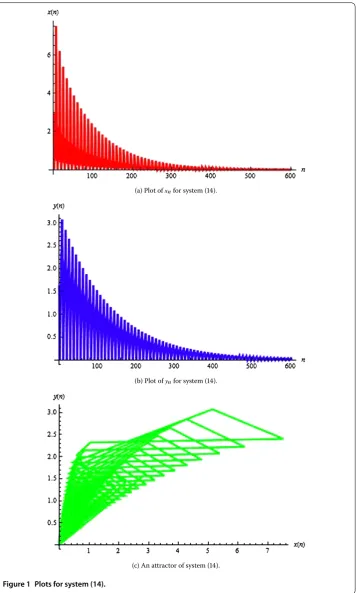
with initial conditionsx–= .,x–= .,x–= .,x–= .,x–= .,x–= .,x–= .,x–= .,x= .,y–= .,y–= .,y–= .,y–= .,y–= .,y–= .,y–=
.,y–= .,y= .. Moreover, in Figure , the plot ofxnis shown in Figure a, the plot
ofynis shown in Figure b, and an attractor of system () is shown in Figure c.
Example Consider system () with initial conditionsx–= .,x–= ., x–= .,
x–= .,x–= .,x–= .,x–= .,x–= .,x–= .,x–= .,x–= .,x–= .,x–= .,x–= .,x–= .,x= .,y–= .,y–= .,y–= .,y–= .,
y–= .,y–= .,y–= .,y–= .,y–= .,y–= .,y–= .,y–= .,y–= .,
y–= .,y–= .,y= .. Moreover, choose the parametersα= ,β= ,γ= .,
α= ,β= ,γ= .. Then system () can be written as
xn+=
xn– + .i=yn–i
, yn+=
yn– + .i=xn–i
, n= , , . . . , ()
with initial conditionsx–= .,x–= .,x–= .,x–= .,x–= .,x–= .,
x–= .,x–= .,x–= .,x–= .,x–= .,x–= .,x–= .,x–= .,x–= .,
x= .,y–= .,y–= .,y–= .,y–= .,y–= .,y–= .,y–= .,y–= .,
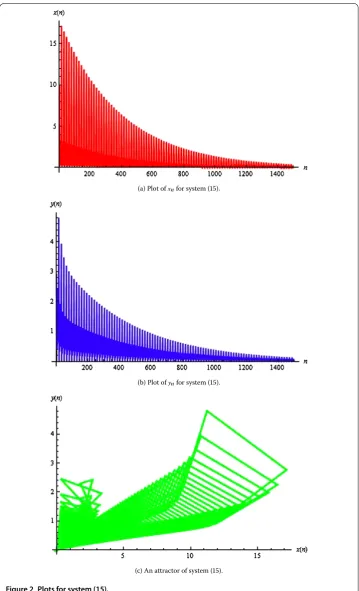
y–= .,y–= .,y–= .,y–= .,y–= .,y–= .,y–= .,y= .. Moreover, in
Figure , the plot ofxnis shown in Figure a, the plot ofynis shown in Figure b, and an
attractor of system () is shown in Figure c.
Example Consider system () with initial conditionsx–= .,x–= .,x–= .,x–= .,x–= .,x–= .,x= .,y–= .,y–= .,y–= .,y–= .,y–= .,y–=
.,y= .. Moreover, choose the parametersa= ,b= ,c= ,a= ,b= ,
c= . Then system () can be written as
xn+=
yn– + i=xn–i
, yn+=
xn– + i=yn–i
, n= , , . . . , ()
with initial conditionsx–= .,x–= .,x–= .,x–= .,x–= .,x–= .,x= .,
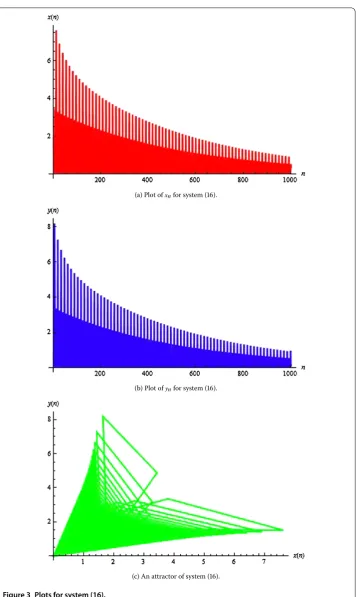
y–= .,y–= .,y–= .,y–= .,y–= .,y–= .,y= .. Moreover, in Figure ,
the plot ofxnis shown in Figure a, the plot ofynis shown in Figure b, and an attractor
of system () is shown in Figure c.
Example Consider system () with initial conditionsx–= .,x–= .,x–= .,
x–= .,x–= .,x–= .,x–= .,x–= .,x–= .,x–= .,x–= .,x–= .,x= .,y–= .,y–= .,y–= .,y–= .,y–= .,y–= .,y–= .,y–=
.,y–= .,y–= .,y–= .,y–= .,y= .. Moreover, choose the parameters
a= ,b= ,c= ,a= ,b= ,c= . Then system () can be written as
xn+=
yn– + i=xn–i
, yn+=
xn– + i=yn–i
, n= , , . . . , ()
with initial conditionsx–= .,x–= .,x–= .,x–= .,x–= .,x–= .,
x–= .,x–= .,x–= .,x–= .,x–= .,x–= .,x= .,y–= .,y–= .,y–= .,y–= .,y–= .,y–= .,y–= .,y–= .,y–= .,y–= .,y–=
.,y–= .,y= .. Moreover, in Figure , the plot ofxnis shown in Figure a, the
(a) Plot ofxnfor system ().
(b) Plot ofynfor system ().
(c) An attractor of system ().
(a) Plot ofxnfor system ().
(b) Plot ofynfor system ().
(c) An attractor of system ().
(a) Plot ofxnfor system ().
(b) Plot ofynfor system ().
(c) An attractor of system ().
(a) Plot ofxnfor system ().
(b) Plot ofynfor system ().
(c) An attractor of system ().
Conclusion
This work is a natural extension of [, , ]. In the paper, we have investigated the
qual-itative behavior of (k+ )-dimensional discrete dynamical systems. Each system has only
one equilibrium point which is stable under some restriction to parameters. The lineariza-tion method is used to show that equilibrium point (, ) is locally asymptotically stable. The main objective of dynamical systems theory is to predict the global behavior of a sys-tem based on the knowledge of its present state. An approach to this problem consists of determining the possible global behaviors of the system and determining which initial conditions lead to these long-term behaviors. In case of higher-order dynamical systems, it is crucial to discuss global behavior of the system. Some powerful tools such as semi-conjugacy and weak contraction cannot be used to analyze global behavior of systems () and (). In the paper, we prove the global asymptotic stability of equilibrium point (, ) by using simple techniques. We have carried out a systematical local and global stability analysis of both systems. The most important finding here is that the unique equilibrium point (, ) can be a global asymptotic attractor for systems () and (). Moreover, we have determined the rate of convergence of a solution that converges to the equilibrium point (, ) of systems () and (). Some numerical examples are provided to support our theo-retical results. These examples are experimental verifications of theotheo-retical discussions.
Competing interests
The authors have no competing interests. Authors’ contributions
All authors contributed equally in drafting this manuscript and giving the main proofs. Acknowledgements
This work was supported by the Higher Education Commission of Pakistan. Received: 3 October 2013 Accepted: 7 November 2013 Published:03 Dec 2013
References
1. Cinar, C: On the positive solutions of the difference equation systemxn+1=yn1;yn+1=xnyn
–1yn–1. Appl. Math. Comput.
158, 303-305 (2004)
2. Stevi´c, S: On some solvable systems of difference equations. Appl. Math. Comput.218, 5010-5018 (2012) 3. Kurbanli, AS: On the behavior of positive solutions of the system of rational difference equationsxn+1=ynxnxn–1–1 –1,
yn+1=xnynyn–1–1 –1,zn+1=ynzn1 . J. Differ. Equ.2011, 40 (2011)
4. Stevi´c, S: On a third-order system of difference equations. Appl. Math. Comput.218, 7649-7654 (2012)
5. Bajo, I, Liz, E: Global behaviour of a second-order nonlinear difference equation. J. Differ. Equ. Appl.17(10), 1471-1486 (2011)
6. Kalabuˆsi´c, S, Kulenovi´c, MRS, Pilav, E: Dynamics of a two-dimensional system of rational difference equations of Leslie-Gower type. Adv. Differ. Equ. (2011). doi:10.1186/1687-1847-2011-29
7. Kalabuˆsi´c, S, Kulenovi´c, MRS, Pilav, E: Global dynamics of a competitive system of rational difference equations in the plane. Adv. Differ. Equ.2009, Article ID 132802 (2009)
8. Kurbanli, AS, Çinar, C, Yalçinkaya, I: On the behavior of positive solutions of the system of rational difference equationsxn+1=ynxnxn–1–1 +1.yn+1=xnynyn–1 +1–1 . Math. Comput. Model.53, 1261-1267 (2011)
9. Din, Q: Dynamics of a discrete Lotka-Volterra model. Adv. Differ. Equ.1, 1-13 (2013)
10. Din, Q, Donchev, T: Global character of a host-parasite model. Chaos Solitons Fractals54, 1-7 (2013)
11. Din, Q, Qureshi, MN, Khan, AQ: Dynamics of a fourth-order system of rational difference equations. Adv. Differ. Equ.1, 1-15 (2012)
12. Din, Q, Khan, AQ, Qureshi, MN: Qualitative behavior of a host-pathogen model. Adv. Differ. Equ. (2013). doi:10.1186/1687-1847-2013-263
13. Din, Q: Global behavior of a rational difference equation. Acta Univ. Apulensis34, 35-49 (2013)
14. Din, Q, Ibrahim, TF: Global behavior of a neural networks system. Indian J. Comput. Appl. Math.1(1), 79-92 (2013) 15. Qureshi, MN, Khan, AQ, Din, Q: Global behavior of third order system of rational difference equations. Int. J. Eng. Res.
Technol.2(5), 2182-2191 (2013)
16. El-Metwally, H, Elsayed, EM: Form of solutions and periodicity for systems of difference equations. J. Comput. Anal. Appl.15(5), 852-857 (2013)
18. Elsayed, EM, El-Metwally, HA: On the solutions of some nonlinear systems of difference equations. Adv. Differ. Equ. (2013). doi:10.1186/1687-1847-2013-161
19. Elsayed, EM: Solution and attractivity for a rational recursive sequence. Discrete Dyn. Nat. Soc.2011, Article ID 982309 (2011)
20. Zhang, Q, Yang, L, Liu, J: Dynamics of a system of rational third order difference equation. J. Differ. Equ. (2012). doi:10.1186/1687-1847-2012-136
21. Shojaei, M, Saadati, R, Adibi, H: Stability and periodic character of a rational third order difference equation. Chaos Solitons Fractals39, 1203-1209 (2009)
22. Sedaghat, H: Nonlinear Difference Equations: Theory with Applications to Social Science Models. Kluwer Academic, Dordrecht (2003)
23. Kocic, VL, Ladas, G: Global Behavior of Nonlinear Difference Equations of Higher Order with Applications. Kluwer Academic, Dordrecht (1993)
24. Pituk, M: More on Poincare’s and Perron’s theorems for difference equations. J. Differ. Equ. Appl.8, 201-216 (2002)
10.1186/1687-1847-2013-354