R E S E A R C H
Open Access
Control plane delay minimization-based
capacitated controller placement algorithm
for SDN
Rong Chai
*, Qiongfang Yuan, Lei Zhu and Qianbin Chen
Abstract
Software-defined networking (SDN) is proposed as a new network paradigm which decouples control plane from data plane and provides flexible network management. In this paper, we consider the capacitated controller placement problem in SDN, which jointly determines the number, location, and the capacity matching strategy of SDN controllers. redTo stress the importance of control plane delay which is composed of both the transmission and processing delay between controllers and switches, and the inter-controller delay; we formulate control plane delay minimization problem subject to controller-switch association constraints, controller capacity constraints, etc. Since the formulated optimization problem is a complicated nonlinear integer programming problem which cannot be solved easily, we transform it into controller-switch association subproblem and controller capacity matching subproblem. To solve the controller-switch association subproblem, we propose a heuristic algorithm based on Dijkstra algorithm and K-means algorithm. Given the controller-switch association strategy, we then apply the Kuhn-Munkres (K-M) algorithm to solve the controller capacity matching subproblem and obtain the capacitated controller placement strategy. Simulation results are shown to demonstrate the effectiveness of the proposed algorithm.
Keywords: Software defined networking, Control plane delay, Controller placement, Capacity matching
1 Introduction
The rapid development of broadband services and the quick growth of user data traffic pose challenges to tra-ditional network architectures and management tech-nologies. It is highly difficult for traditional networks to meet the increasing user service requirements due to inflexible network architectures, complicated network management mechanisms, poor scalability, and low uti-lization of network resources [1,2]. To tackle this problem, researchers proposed software-defined networking (SDN) technology [3].
As a promising novel network paradigm, SDN is capable of separating data plane from control plane. The con-trollers in the control plane are responsible for centrally controlling and managing the forwarding devices in the data plane, e.g., routers or switches [4]. On the other hand, the data forwarding devices only need to conduct
*Correspondence:[email protected]
School of Communications and Information Engineering Chongqing University of Posts and Telecommunications, Key Lab of Mobile Communication Technology, Chongqing, China
the flow forwarding policies received from the controllers and and no longer participate in network control [5]. Through applying logically centralized control and effi-cient management, SDN is expected to greatly simplify the forwarding function of the underlying devices and the control process of the entire network, and promote the rapid deployment of complex network functions by offer-ing application programmoffer-ing interface (API) for network administrators [6].
For an SDN scenario consisting of multiple switches, a certain number of controllers should be deployed [7]. The controller placement problem should be studied which typically refers to how to place controllers in the net-work and how to allocate the associated switches to those controllers, i.e., determining the number of controllers, their optimal location, and the association relationship between controllers and switches [8]. As the controllers are required to conduct signaling interaction with their associated switches as well as with other controllers, the problem of controller placement is of particular impor-tance as the location and capability of the controllers may
highly affect the signaling transmission performance in control plane, i.e., the signaling interaction performance between switches and controllers, and that between controllers.
Some previous research works addressed the energy consumption or the transmission cost required for trans-mitting signaling messages between switches and con-trollers and proposed controller placement strategies which aim to achieve the lowest energy consumption or the minimum transmission cost [9–18]. However, as a major performance metric characterizing service transmission performance, the signaling transmission delay should be considered when designing optimal con-troller placement strategies. While the signaling prop-agation delay between controllers and switches was mainly considered in [19–24], the inter-controller sig-naling transmission, which is mandatorily required for achieving controller synchronization over network states, failed to be considered extensively.
A general assumption in previous research works was that the controllers to be deployed are of exactly the same characteristics which can be arbitrarily defined; however, in a practical deployment scenario, the characteristics of the controllers which can be deployed may be subject to certain constraints. For instance, it is highly possible that the controllers can only be selected from a given candi-date controller set, and the parameters of the controllers are also pre-defined in a certain parameter set. In this case, the capacitated controller placement problem, i.e., determining the number, location, and capacity of con-trollers based on a candidate controller set, should be considered [25–31].
In this paper, we assume that the controllers can only be selected from a given candidate controller set and study the capacitated controller placement problem of SDN. In particular, it is assumed that the capacity of the candidate controllers which characterizes the processing capability of the controllers is chosen from a certain set containing various pre-determined capacity values. To achieve effi-cient placement of the controllers, we propose an SDN hierarchical management architecture. Then, stressing the importance of control plane delay which is composed of both the transmission and processing delay between controllers and switches, and the synchronization delay between controllers, we formulate control plane delay minimization problem subject to controller-switch asso-ciation constraints and controller capacity constraints, etc. Since the formulated optimization problem is a com-plicated nonlinear integer programming problem which cannot be solved easily, we transform it into controller-switch association subproblem and controller capacity matching subproblem. To solve the controller-switch association subproblem, we propose a heuristic algorithm based on Dijkstra algorithm and K-means algorithm.
Given the controller-switch association strategy, we then apply the Kuhn-Munkres (K-M) algorithm to solve the controller capacity matching subproblem and obtain the corresponding capacitated controller placement strategy.
We summarize the major contributions of this work as follows:
• In this paper, we study the capacitated controller placement problem of SDN. To achieve the efficient placement of the controllers, we design an SDN hierarchical management architecture based on which the proposed capacitated controller deployment scheme can be conducted.
• While previous research work [19–24] aimed to achieve the minimum propagation delay between controllers and switches when designing controller placement strategy for SDN, they failed to examine extensively the inter-controller delay, the signaling transmission delay between controllers and switches, and the signaling processing delay at the controllers which may jointly affect the transmission
performance of the user services severely. In this paper, we examine the control plane delay of SDN comprehensively; formulate it as a sum of the transmission delay and propagation delay between controllers and switches, the processing delay at the controllers, and the inter-controller delay; and design an effective capacitated controller placement strategy which minimizes control plane delay.
• While most of the previous research works made a general assumption that the controllers to be
deployed are of exactly the same characteristics which can be arbitrarily chosen, in practical deployment scenarios, the characteristics of the controllers which can be deployed may be subject to certain constraints and the parameters of the controllers might be pre-defined. In this paper, we assume that the controllers can only be selected from a given parameter set; in particular, the processing capability of each candidate controller is chosen from a certain set containing various pre-determined capacity values, and design the capacitated controller placement strategy which jointly determines the number and location of the controllers and the matching strategy between the controllers and the capacity values.
association subproblem, we propose a heuristic algorithm based on Dijkstra algorithm and K-means algorithm. Given the controller-switch association strategy, we then apply the K-M algorithm to solve the controller capacity matching subproblem and obtain the capacitated controller placement strategy.
The remainder of this paper is structured as follows. Section2reviews some related works. Section3describes the system model and the proposed SDN hierarchical management architecture. In Section 4, the capacitated controller placement problem is formulated. The solution to the formulated optimization problem is described in Section5. Simulation results are presented in Section6. Finally, Section7concludes this paper.
2 Related work
In this section, we present an overview of the related work.
2.1 Energy consumption minimization-based controller placement algorithms
As an important metric, energy consumption is often stressed when designing the optimal controller placement strategy for SDN. In [9], the authors proposed to switch off as many control links as possible in order to reduce the energy consumption of the network while ensuring all the switches are capable of connecting to one controller under maximum delay constraint. Jointly considering the propagation delay between controllers and switches, the load status of the controllers, and link utilization, the authors further proposed a controller-switch association algorithm to reduce network energy consumption. In [10], the authors considered the controller placement problem of SDN from the perspective of energy consumption of the control link between controllers and switches. Consider-ing the energy consumption of the network that serves for the control traffic, the propagation delay, and the load of controllers, the authors formulated the controller place-ment problem as an energy consumption minimization-based binary integer programming problem and obtained the optimal strategy by solving the optimization problem.
2.2 Cost effective controller placement algorithms While energy consumption minimization was addressed when designing controller placement strategy in SDN [9, 10], network signaling cost may also have a signif-icant impact on the traffic transmission performance through the network; hence, some research works con-sidered the cost for deploying SDN controllers and proposed cost-effective controller placement strategies [11–18].
The authors in [11] considered the signaling cost of transmitting flow setup requests from switches to their associated controllers in SDN. By defining the signaling
cost as the product of the number of flow setup requests and the signaling transmission delay between controllers and switches, the controller placement problem was for-mulated to minimize the signaling cost, and the opti-mal placement strategy of the controller was obtained by solving the optimization problem. In [12], a cost func-tion was defined as a weighted sum of the state col-lection cost of switches, inter-controller synchronization cost, and switch reassignment cost. Aiming to mini-mize the cost function, the authors proposed a heuristic algorithm to determine the optimal number and place-ment strategy of the controllers. The authors in [13] jointly considered the communication cost between con-trollers, and that between controllers and switches. In order to reduce the two types of communication costs, a Pareto optimal solution for controller placement was proposed.
Dynamic controller placement problem of SDN was addressed in [14–16]. Under the assumption that con-trollers were statically deployed in the network and switches were statically associated to the controllers, the authors in [14] studied dynamic controller associa-tion problem. By formulating the problem as an online optimization problem which minimizes the overall cost caused by transmitting flow setup requests and the main-tenance cost of the controllers, a hierarchical two-phase algorithm was proposed to obtain the suboptimal con-troller placement strategy. In [15], the authors proposed a two-level hierarchy (master and slave) control frame-work and designed a slave controller placement strat-egy to optimize control cost and control plane delay. In [16], dynamic controller placement and flow management problems were jointly considered for SDN and a joint opti-mal strategy was proposed to minimize maintenance cost and maximize controller utilization as well.
The financial cost for deploying controllers in SDN was considered in [17, 18]. In [17], the authors jointly con-sidered the financial cost for installing controllers and setting up association relationship between switches and controllers and formulated the controller placement prob-lem as an overall financial cost minimization probprob-lem. The optimal placement strategy of the controllers was obtained by solving the optimization problem. The prob-lem of re-organizing an existing SDN was addressed in [18]. The financial cost for re-organizing the network was defined as the total cost for deploying or removing con-trollers, and setting up or removing network links, and an optimal re-organizing strategy was proposed which minimizes the financial cost.
2.3 Delay minimization-based controller placement algorithms
placement strategies for SDN; however, it can be observed that the transmission delay or propagation delay between switches and controls may affect network performance significantly; thus, it is highly desired to design delay minimization-based controller placement strategy.
The control plane delay between switches and con-trollers was considered in designing the optimal SDN controller placement strategy [19–24]. The authors in [19] studied the problem of placing controllers in SDN with wireless southbound interface. To achieve low signaling transmission latency and link failure probability, a heuris-tic solution was proposed based on simulated annealing genetic algorithm. In [20], the propagation delay from switches to controllers was examined and the propagation delay bound was set as a criterion to obtain the location and the number of controllers being deployed in the SDN scenario. In [21], the authors considered an SDN scenario consisting of a certain number of subnetworks and char-acterized the controller placement problem as a network partition problem. By employing K-means algorithm-based scheme, the maximum propagation delay between controllers and switches in each subnetwork was min-imized. In [22], a controller placement approach based on community detection was proposed. The authors regarded the SDN topology as a network composed of multiple communities and designed controller placement strategy for each community. To further constrain the number of nodes in each community and achieve the bal-ance of the controllers in different communities, a scale constraint factor was introduced. In [23], the authors for-mulated the flow setup time of various switches and opti-mally designed the controller placement strategy so as to minimize the average flow setup time. In [24], the authors divided the entire network into several sub-networks and proposed a modified density peaks clustering (MDPC) algorithm to design the controller placement strategy, so as to minimize the average propagation latency between switches and controllers.
In the case that network failures may occur, for instance, controllers, switches, or the links between switches may become unavailable, robust controller placement strate-gies are highly desired. To enhance the resilience of the controllers, the authors in [25] proposed to deploy redundant controllers at various resilience levels. By min-imizing the propagation delay between the redundant controllers and switches, the optimal resilient controller placement strategy can be obtained. The research work in [26] considered the trade-off among various perfor-mance requirements, such as load balancing, failure tol-erance, and transmission latency, and in order to achieve the trade-off, an optimal controller placement framework based on the Pareto game model is proposed. The authors in [27] considered the delay between controller and the associated switches in link failure state and proposed
a particle swarm optimization-based heuristic controller placement method to guarantee the delay and reliability in control plane.
While the authors in [20–27] stressed control plane delay optimization, they mainly considered a relatively simple delay formulation and ignored some important delay components, such as the signaling transmission delay, signaling processing delay, and the inter-controller delay. Furthermore, most of the previous research works assumed that the controllers to be deployed are of exactly the same characteristics which can be arbitrarily set; how-ever, in practical deployment scenarios, the characteristics of the controllers may be subject to certain constraints and the parameters of the controllers might be pre-defined in a certain parameter set, in which case, the problem of capacitated controller placement or joint controller placement and capacity matching should be studied.
In [28], the authors explored and investigated more pos-sible delay contributors, including the end-to-end latency and the queuing latency of controllers. The concept of network partitioning was introduced to decrease end-to-end delay. To further reduce the queuing latency of controllers, it is proposed to place appropriate multi-ple controllers in the sub-networks. The authors in [29] jointly took into account the propagation delay from switches to controllers and the load balancing among controllers and characterize the capacitated controller placement problem as a propagation delay minimiza-tion problem under controller load constraints. In [30], the authors designed a capacitated controller place-ment strategy which minimizes the worst case latency. Reference [31] considered the latency requirement of the links between switches and controllers, and those between controllers, and proposed a heuristic clique-based approach to determine the suboptimal controller placement strategy. In this paper, we extended our pre-vious work on controller placement in SDN [32]. Under the assumption that the capacity of the controllers can only be chosen from a certain set containing various pre-determined capacity values, we study the capacitated controller placement problem based on control plane delay minimization and the optimal placement strategy of the controllers is obtained by solving the optimization problem.
3 System model and proposed SDN hierarchical
management architecture
In this section, we first present the system model of this paper, then proposed an SDN hierarchical management architecture.
3.1 System model
area. Assuming that switches may have different traf-fic transmission requirements and are allowed to choose controllers from a given specific set, we study the capacitated controller placement problem of the net-work. We assume that the co-location of switches and controllers is allowed, i.e., each controller can be deployed co-located with one switch. Without loss of generality, we assume that the transmission delay between one controller and its co-located switch can be ignored.
We denote the number of switches in the network as N. Let V= {V1,V2, ...,VN} denote the set of switches,
whereVidenotes theith switch, 1 ≤ i ≤ N. To
charac-terize the connection status between switches, we define binary identifierαij, i.e., we set αij = 1, ifVi is directly
connected withVj in the network; otherwise,αij = 0.
In this paper, we assume that the network topology is known; thus,αij is a known constant. LetCi denote the
ith controller, for convenience, we assume thatCiis
co-located with Vi, 1 ≤ i ≤ N. We assume that the
maximum number of controllers that can be deployed is M, and the capacity of the controllers is specified. Let
= {φ1,φ2, ...,φM} denote the set of controller
capac-ity, where φm represents the mth capacity value which
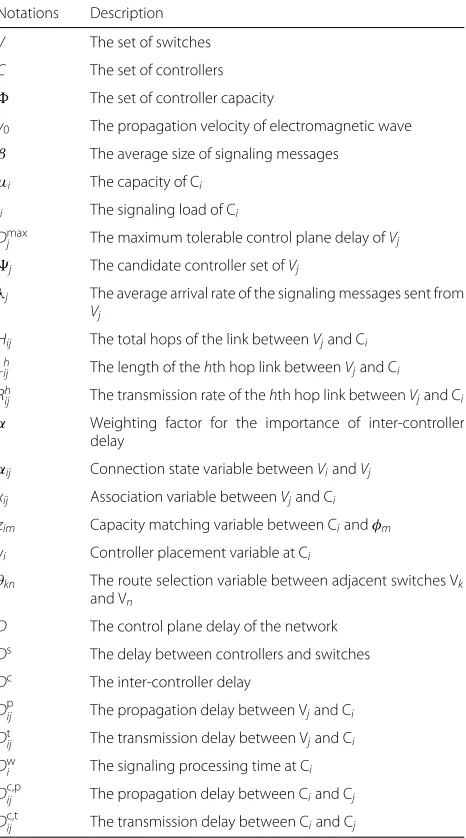
can be assigned to one controller. Without loss of gen-erality, the capacity of one controller is defined as the average rate of processing signaling message [33]. All sym-bols and variables used in this paper are summarized in Table1.
Figure 1 shows the system model considered in this paper. As an example, in Fig.1, we assume that the con-troller C1 is deployed co-located with switch V1; thus,
the signaling interaction between C1 andV4 requires a
multi-hop path fromV1toV4viaV2andV3. In the case
that V4 tends to transmit user flows to other switches
and no flow forwarding rules have been pre-cached,V4
should send packet-in message to C1 and then forward
user flows according to the received flow forwarding strat-egy from C1. As the signaling message interaction
pro-cess between V4 and C1 results in control plane delay,
it is obvious that shorter control plane delay is highly desired. From this example, we can also observe that given the topology of SDN switches, various controller place-ment strategies may result in different control plane delay. Hence, in this paper, we stress the importance of control plane delay and design capacitated controller placement strategy.
3.2 Proposed SDN hierarchical management architecture In SDN, the available controller resources need to be managed in a coordinated manner to guarantee the latency requirements of switches and meet the capac-ity limitation of controllers. In order to achievethe effi-cient placement of the controllers and achieve centralized
Table 1List of notations
Notations Description
V The set of switches
C The set of controllers The set of controller capacity
v0 The propagation velocity of electromagnetic wave
β The average size of signaling messages μi The capacity of Ci
li The signaling load of Ci
Dmax
j The maximum tolerable control plane delay ofVj
j The candidate controller set ofVj
λj The average arrival rate of the signaling messages sent from
Vj
Hij The total hops of the link betweenVjand Ci
Lh
ij The length of thehth hop link betweenVjand Ci
Rh
ij The transmission rate of thehth hop link betweenVjand Ci
α Weighting factor for the importance of inter-controller delay
αij Connection state variable betweenViandVj
xij Association variable betweenVjand Ci
zim Capacity matching variable between Ciandφm
yi Controller placement variable at Ci
θkn The route selection variable between adjacent switches Vk
and Vn
D The control plane delay of the network
Ds The delay between controllers and switches
Dc The inter-controller delay
Dpij The propagation delay between Vjand Ci
Dtij The transmission delay between Vjand Ci
Dw
i The signaling processing time at Ci
Dc,pij The propagation delay between Ciand Cj
Dc,tij The transmission delay between Ciand Cj
network management, we propose an SDN hierarchi-cal management architecture and design the capacitated controller deployment scheme based on the proposed architecture.
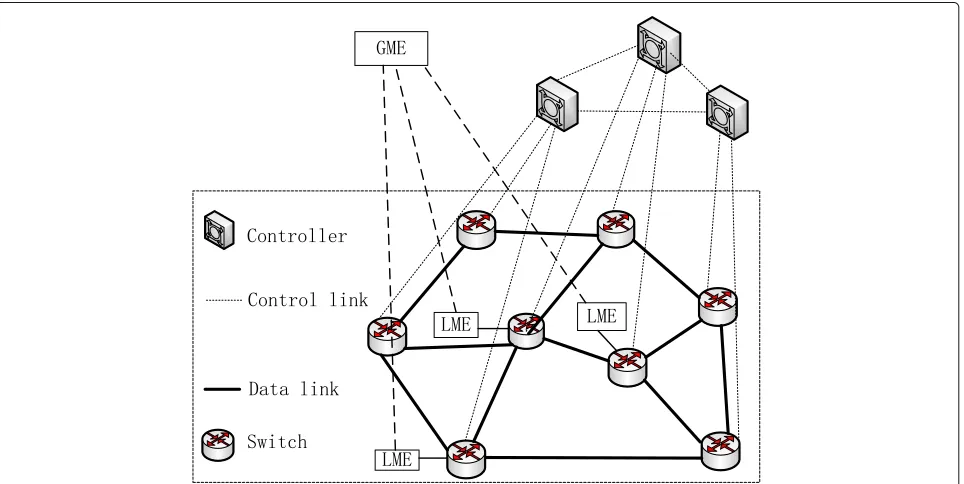
Figure 2 shows the proposed SDN hierarchical man-agement architecture, which is composed of two types of functional entities, i.e., local management entity (LME) and global management entity (GME). The major func-tions of LME and GME can be summarized as follows.
3.2.1 LME
maxi-Fig. 1System model. The system model considered in this paper
mum tolerable control plane delay of the switch. Through interacting with the GME, the LME sends the collected information to the GME. In addition, the LME also receives the obtained controller placement strategy from the GME.
3.2.2 GME
Being deployed over the switches and the controllers, GME acts as a centralized manager of the network. Through interacting with the associated LMEs, GME receives the state information of the switches. Based on
the obtained information, GME is capable of conducting the proposed capacitated controller placement algorithm and obtaining the controller placement strategy.
4 Capacitated controller placement problem
formulation
In this section, we first take into account the flow trans-mission requirement of the switches and determine the candidate controllers set for individual switches; then, we formulate the capacitated controller placement problem as a control plane delay minimization-based optimization problem.
4.1 Candidate controller set
The switches transmitting different user flows may have various requirement on signaling transmission perfor-mance. For instance, in the case of transmitting delay-sensitive user flows, the shorter end-to-end delay and control plane delay are highly desired. On the other hand, some delay-tolerant services may not have high require-ment on flow transmission delay and control plane delay. In this paper, we assume that the switches in the SDN might be of different sensitivity on control plane delay, thus place constraints on their associated controllers. Let Dsij denote the control plane delay when Vj associates
withCi(we will give the mathematical expression ofDsij
in the next subsection) and Dmaxj denote the maximum tolerable control plane delay ofVj; we define the
candi-date controller set for individual switch to characterize the requirements of different switches, i.e., only the con-trollers belonging to the candidate controller set of one switch can be selected as the associated controller of the switch. Letjdenote the candidate controller set ofVj;
we can expressjas
4.2 Control plane delay formulation
The control plane delayDof the SDN can be expressed as
D=Ds+αDc (2)
where Ds denotes the delay between controllers and switches,Dcdenotes the inter-controller delay,α∈[ 0,α0]
is a weighting factor characterizing the importance of inter-controller delay, andα0≥1 is a given constant. 4.2.1 Delay between controllers and switches
The delay between controllers and switches, i.e.,Dsin (2),
can be calculated as
Ds=
wherexijdenotes the binary association variable between
Vj andCi, i.e., we set xij = 1, if Vj associates with Ci;
otherwise, xij = 0, 1 ≤ i,j ≤ N. Dsij in (3) can be
expressed as
Dsij=Dpij+Dtij+Dwi (4)
whereDpijdenotes the propagation delay betweenVjand
Ci,Dtijdenotes the transmission delay betweenVjandCi,
andDwi denotes the signaling processing time atCi.
Dpijin (4) can be calculated as
whereLhijdenotes the length of thehth hop link between VjandCi,Hijdenotes the total hops of the path between
Vj and Ci, and v0 denotes the propagation velocity of
electromagnetic wave.
whereλjdenotes the average arrival rate of the signaling
messages sent fromVjover time durationT0,β denotes
the average size of the signaling messages, andRhijdenotes the transmission rate of the hth hop link between Vj
andCi.
In this paper, we assume that the signaling messages arrived at the controllers are processed in a first-come-first-serve (FCFS) manner; thus,Dwi in (4) can be
calcu-where zim is the binary capacity matching variable, i.e.,
we setzim = 1, if the capacity of Ci is set asφm;
other-wise,zim =0,lidenotes the signaling load of Ci, which is
4.2.2 Inter-controller delay
The inter-controller delay denoted by Dc in (2) can be expressed as
whereyidenotes the binary controller placement variable
ofCi, i.e., we setyi = 1, ifCiis placed atVi; otherwise,
yi=0.
In order to create a global view of the network, con-trol signaling interaction between concon-trollers is required. In this subsection, we characterize inter-controller delay as the sum of the propagation delay and the transmission delay of the communication signaling messages transmit-ted between controllers, i.e.,
Dcij=Dc,pij +Dc,tij (11)
where Dcij,p andDcij,t denote respectively the propagation delay and the transmission delay of the communication signaling transmitted betweenCiandCj.Dc,pij can be
cal-culated as the product of the normalized signaling load of the controllers and the propagation delay between Ciand
Cj, i.e.,
Dc,pij = 1
2(li+lj)D
p
ij. (12)
Dc,tij can be expressed as
Dc,tij =
The optimal capacitated controller placement strategy should be designed under a number of constraints including association constraints between controllers and switches, controller capacity constraints, and capacity matching constraints.
4.3.1 Controller-switch association constraints
In this paper, we assume that each switch can only asso-ciate with a unique controller, i.e.,
C1 :
N
i=1
xij=1.
As switches can only associate with their candidate controllers, we obtain:
C2 : xij=0, if Ci∈/j.
The association variable and controller placement vari-able should meet the following constraint:
C3 : xij≤yi.
The signaling load arriving at one controller cannot exceed the capacity of the controller, i.e.,
C4 :
N
j=1
xijλjβ ≤μi.
4.3.2 Controller placement constraints
As the total number of the controllers being placed should be less thanM, we obtain
C5 :
N
i=1
yi≤M.
We assume that the capacity of each controller should match one given value in the set, and one given capacity value is assigned to one controller, we obtain
C6 :
4.4 Optimization problem formulation
In this paper, we consider the capacitated controller place-ment problem in SDN. To stress the importance of control plane delay which is composed of both the transmission and processing delay between controllers and switches, and the inter-controller delay, we formulate controller placement problem as control plane delay minimization problem, which can be expressed as follows:
min
xij,yi,zim D (14)
s.t. C1−C7.
5 Solution to the optimization problem
The formulated optimization problem in (14) is a com-plicated nonlinear integer programming problem which cannot be easily solved. In this section, we transform it into controller-switch association subproblem and con-troller capacity matching subproblem and solve the two subproblems successively [14].
5.1 Controller-switch association subproblem
In this subsection, we first assume that the capacity of the controllers is large enough; thus, the signaling process-ing time at Ci, denoted byDwij, is negligible in comparison
min
To solve the above controller-switch association sub-problem, we propose a heuristic algorithm based on Dijkstra and K-means algorithms [34,35].
5.1.1 Dijkstra-based optimal route selection strategy Examining the objective function in (15), we can see that for any two nonadjacent switches,Vi andVj, the delay
termsDpijandDtijmay involve multi-hop links, hence may not be calculated easily. In this paper, we apply the Dijk-stra algorithm, which is widely used to solve the shortest path problem in a weighted directed graph, to compute the optimal route between Vi and Vj, and to obtain the
minimalDpijand the minimalDtijaccordingly.
Considering the multi-hop transmission between Vi
andVj, we can expressDpijas
if Vk and Vn are adjacent switches and the data
pack-ets pass through the link betweenVkandVnwhen being
transmitted fromVitoVj. To guarantee the end-to-end
transmission fromVitoVj,θknshould meet the following
constraints:
The optimization problem of determining the optimal route betweenViandVjwhich achieves the minimalDpij
can then be formulated as
min
Applying the Dijkstra algorithm to solve the optimiza-tion problem formulated in (20), we create a weighted
directed graphG=(V,E,W), whereE= {Ekn}is the link
By solving the shortest path problem for G, we can obtain the optimal route betweenViandVjoffering the
minimum end-to-end propagation delay. Letθkn∗ denote the optimal route selection strategy; the optimal propa-gation delay betweenVi to Vj, denoted by Dp,ij∗, can be
calculated accordingly.
Following the similar manner, we are capable of cal-culating the optimal transmission delay between Vi and
Vj, denoted byDt,ij∗. In addition, substitutingDp,ij∗in (12),
and re-calculating (11), we can also obtain the updated propagation delay between controllersCiandCj, denoted
byDc,ij∗.
5.1.2 K-means-based controller placement strategy GivenDp,ij∗,Dt,ij∗, andDc,ij∗, the controller-switch associa-tion subproblem formulated in (15) can be rewritten as
min
Since one controller in the network may associate with a number of switches, we may form a cluster with the controller being the cluster head while its associated switches being the cluster members. Hence, the SDN net-work topology can be regarded as a cluster-based form. By applying clustering methods, the reasonable controller placement and controller-switch association strategy can be obtained.
In this paper, we apply K-means algorithm [21], which is an efficient clustering method to determine the num-ber and location of the controllers and propose a K-means algorithm-based optimal controller placement strategy. The steps of the proposed algorithm can be described as follows:
1. Determine the first controller: for each switch, calculate the sum of the transmission delay and propagation delay when connecting with all other switches, i.e., for∀Vj, computeNi=1(Dt,ij∗+D
p,∗
ij ),
and select the switch which offers the minimum sum of the transmission delay and propagation delay to place the first controller, i.e.,
Ci1 =argmin
between each switch and deployed controllers, select the switch which offers the minimum propagation delay and transmission delay to deploy themth controller, i.e.,Cim =argmin
im−1 whereCimrepresents themth controller which is deployed atVim,y∗im =1;
4. Determine controller-switch association strategy, i.e., {x∗i The proposed controller-switch association algorithm is described in Algorithm 1.
5.2 Controller capacity matching subproblem
In this subsection, we assume that M controllers have been placed and all the switches have been associated with one controller, then solve the controller capacity matching subproblem. AssumingCiis placed atVi, i.e.,y∗i =1, and
Algorithm 1Proposed controller-switch association algo-rithm
11: then Applying Dijkstra algorithm to obtainDpij, Dtij
12: end if
13: end for 14: end for
15: Applying K-means algorithm to select the Ci1th switch to deploy the first controller, i.e.,
Ci1 =argmin
17: Deploy the kth controller: Cik = argmin im−1
18: Determine controller-switch association strategy:
{x∗i
the optimal controller capacity matching subproblem can be formulated as
whereDc,0ij denotes the inter-controller delay correspond-ing to the obtained controller placement strategyy∗i and switch-controller association strategyx∗ij. SinceDp,ij∗,Dt,ij∗, andDc,0ij are all constants, the controller capacity matching optimization problem formulated in (23) can be converted into the following optimization problem:
min
Under the given constraints, the objective function of the above optimization problem can be rewritten as
N formulated in (25) is equivalent to the following problem:
min problem can be considered as an optimal matching prob-lem in a weighted bipartite graph, it can be solved by the K-M algorithm [36].
Applying the K-M algorithm to solve the optimization problem in (26), we create a weighted network bipar-tite graph G0 = (V1,,E), where the set of vertices
V1 denotes the collection of the controllers, i.e.,V1 =
{Ci1,Ci2, ...,CiM}andE= {Eim,φm}denotes the set of edge weight, andEim,φm = φm−1l
im.
The steps for solving the optimal controller capacity matching subproblem based on the K-M algorithm can be described as follows.
1. Find an initial feasible vertex labeling and determine Gl0fromG0;
3. IfH is perfect, then the optimization problem is solved. Otherwise, the label having not being allocated by the distributionH is selected inGl0. Set S=V1, andT =ψ, which denotes the empty set;
4. LetNGl
0(S)denote the collection of points which connect withS inGl0. IfNGl
0(S)=T, go to step 2. Otherwise,NGl
0(S)=T. Find
=min{l(u)+l(v)≥w(u,v)|u∈S,v∈V2−T}
(27)
and replace the existing labelingl withl∗by
l(u)=
This process is conducted iteratively until an opti-mal match is obtained. The proposed controller capacity matching algorithm is described in Algorithm 2.
Algorithm 2Proposed controller capacity matching algo-rithm
1: Create the weighted network bipartite graphG0 =
(V1,,E)
2: V1 = {Ci1,Ci2, ...,CiM}, = {φ1,φ2, ...,φM}, E = {Eim,φm}, whereEim,φm =
1 φm−lim
3: Find an initial feasible vertex labeling and determine G0l fromG0
4: A distributionHis selected inGl0 5: ifHis perfectthen
6: Obtain the optimal controller capacity matching
strategy
7: elsethe label having not being allocated by the
distri-butionHis selected inGl0
8: SetS=V1, andT =ψ 9: Let NGl
0(S) denote the collection of points which connect withSinGl0
14: Replace the existing labelinglwithl∗by
l(u)=
15: untilan optimal match strategy is obtained
16: end if 17: end if
It should be mentioned that the proposed Dijkstra-based optimal route selection strategy, K-means-Dijkstra-based
optimal controller placement strategy, and the controller capacity matching algorithm should be executed based on the proposed SDN hierarchical management architecture. More specifically, the LMEs collect the status information of their associated switches, such as the maximum toler-able control plane delay of the switchDmaxj , the average size of signaling messagesβ, and the average arrival rate of signaling messagesλj. Through interacting with the
asso-ciated LMEs, GME receives the state information of the switches. Based on the information obtained, the GME may conduct the proposed capacitated controller place-ment algorithm, obtain the controller deployplace-ment and matching strategy, characterized byxi,j,yi,zi,m, and send
the strategy to the LMEs.
6 Complexity analysis
In this section, we analyze the computational complex-ity of the proposed algorithm. As two subproblems, i.e., controller-switch association subproblem and controller capacity matching subproblem, are successively solved, we examine the complexity for solving the two subproblems, respectively.
6.1 Controller-switch association subproblem
For controller-switch associated subproblem, the Dijk-stra algorithm is applied to calculate the optimal route between Vi and Vj, 1 ≤ i,j ≤ N. As the number of
switches in the network is denoted byN, then computa-tional complexity can be calculated asO(NlogN). Apply-ing K-means algorithm to solve the controller-switch association strategy, the computational complexity can be computed asO(NMT), whereMdenotes the number of cluster heads (controllers) andT denotes the number of iterations.
6.2 Controller capacity matching subproblem
Based on the controller placement strategy obtained from previous controller-switch association subproblem, we formulate the controller capacity matching subproblem and obtained the matching strategy through applying the K-M algorithm. Given the number of controllersM, it can be shown that the complexity of the algorithm isO(M4).
7 Performance evaluation
of values. To examine the characteristics of transmission links on the control plane delay, we consider three link characteristics cases, as summarized in Table2.
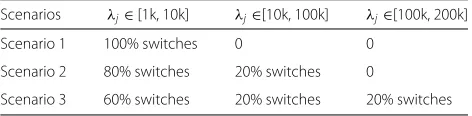
In the simulation, the size of the packet-in message β is set as 160 bytes [29], and the arrival rate of the packet-in message requests of the switches is represented by
λj, which are distributed in different ranges. In order to
examine the difference ofλj, we set three message request
scenarios in the simulation. More specifically, different scenarios contain various percentage of the switches with
λj being chosen from certain range; the specific
simula-tion parameters are shown in Table3. Simulation results are averaged over 400 independent processes involving independent instances.
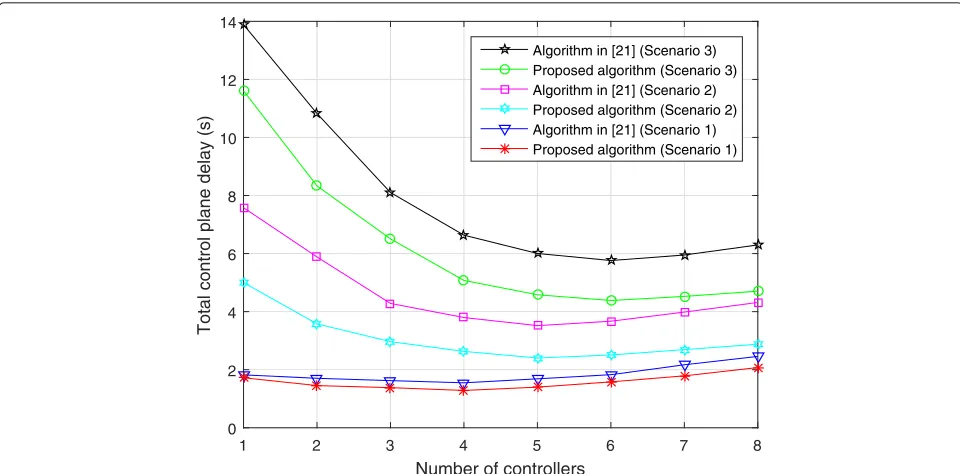
Figure 3 shows the relationship between the control plane delay and the number of controllers obtained from different message request scenarios for link status case 1. We also compare the results obtained from the pro-posed scheme and the scheme propro-posed in [21]. We can see that for case 1, the control plane delay initially decreases as the number of controllers increases for three message request scenarios. However, when the number of controllers deployed in the network reaches a certain value, the control plane delay begins to increase as the number of controllers increases. This is because when the number of controllers increases, the inter-controller delay increases rapidly. Comparing the three curves in the figure, we can see that the proposed scheme outper-forms the scheme proposed in [21]. The reason is that the algorithm proposed in [21] mainly aims to minimize the propagation delay between controllers and switches and ignores the transmission delay between controllers and switches, the processing delay at the controllers, and the inter-controller delay. In addition, the simulation results obtained for the three message request scenarios show that scenario 1 provides the best latency performance, while scenario 3 provides the worst latency performance. The reason is that the service request of the switches in scenario 1 is relatively low compared to the other two scenarios; hence, a minimum control plane delay can be obtained.
In Fig. 4, we examine the relationship between the control plane delay and the number of controllers for different link cases, i.e., case 2 and case 3 under sce-nario 3 of message requests. Similar to Fig. 3, we can see that for scenario 3, the control plane delay initially decreases as the number of controllers increases for two
Table 2Transmission rate of links
Link cases Transmission rate of links (Mbps)
Case 1 Rh
ij∈ {50, 100, 150, 200, 300, 500}
Case 2 Rhij∈ {50, 75, 100}
Case 3 Rhij∈ {150, 200, 300}
Table 3Message request scenarios
Scenarios λj∈[1k, 10k] λj∈[10k, 100k] λj∈[100k, 200k]
Scenario 1 100% switches 0 0
Scenario 2 80% switches 20% switches 0
Scenario 3 60% switches 20% switches 20% switches
transmission rate cases. However, when the number of controllers deployed in the network reaches a certain value, the control plane delay begins to increase with the increase of controller number. This is because the inter-controller delay increases as the number of inter-controllers increases. Comparing the results obtained from our pro-posed algorithm and the algorithm propro-posed in [21], we can see that the proposed scheme offers lower control plane delay than the scheme proposed in [21]. Simula-tion results obtained for different link cases indicate that case 3 provides a lower control plane delay and case 2 provides a higher control plane delay; this is benefited from the better transmission performance of the switches in case 3.
Figure 5 shows the relationship between the control plane delay and the number of controllers for different average size of the signaling messages (denoted byβ). The link status and message request scenario are chosen as case 1 and scenario 2, respectively, in plotting the figure. We also compare the results obtained from the proposed scheme and the scheme proposed in [22] and [31]. We can see that the proposed algorithm offers a smaller con-troller plane delay than the scheme proposed in [22] and [31]. The reason is that the algorithm proposed in [22] failed to consider the processing delay at the controllers and the inter-controller delay, and the algorithm proposed in [31] assumed that the controllers are of the same capac-ity and failed to consider the capaccapac-ity matching problem of the controllers, thus resulting in undesired controller plane delay. In addition, comparing the results obtained from differentβ, we can see that smallerβ offers better delay performance, which is benefited from a lower load of message requests.
Fig. 3Control plane delay versus the number of controllers (different scenarios). The control plane delay versus the number of controllers for different scenarios
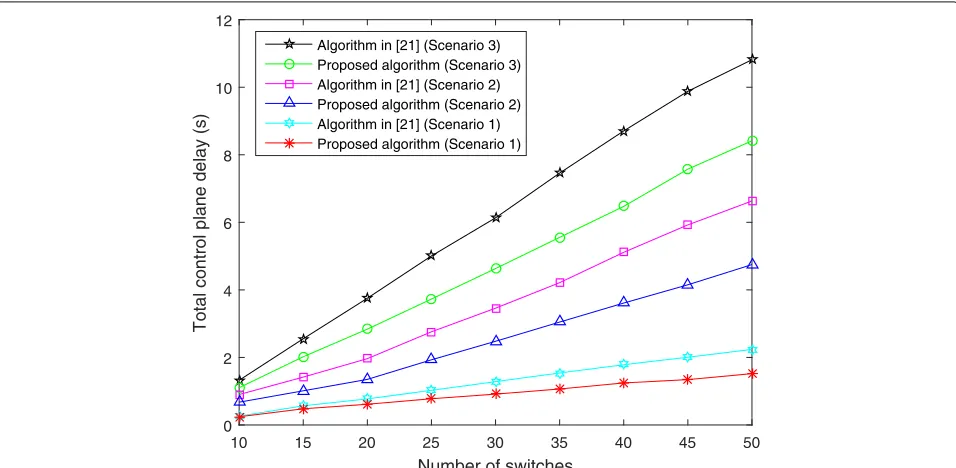
Figure 7 examines the relationship between control plane delay and the number of switches by varying the transmission rate of the switches, i.e., case 2 and case 3 under scenario 3 of message requests. As can be seen from the figure, the increase in the num-ber of switches leads to an increase in control plane
delay, and the delay performance obtained from case 3 is better than the delay performance obtained from case 2.
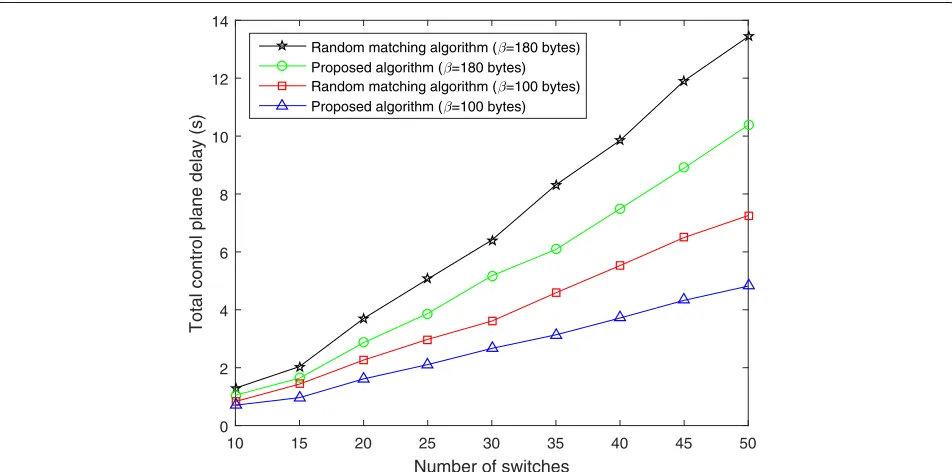
In Fig. 8, we examine the control plane delay ver-sus the number of switches obtained from proposed scheme and random matching scheme which matches
Fig. 5Control plane delay versus the number of controllers (differentβ). The control plane delay versus the number of controllers for differentβ
the capacity of the controller to the values in the given capacity set randomly. For comparison, we also plot the control plane delay obtained for different average size of the signaling messages denoted by β. The link sta-tus and message request scenario are chosen as case 1 and scenario 3, respectively, in plotting the figure.
We can see that the proposed algorithm provides a smaller controller plane delay than the random matching algorithm. The reason is that the proposed controller matching scheme aims at minimizing the controller plane delay, thus resulting in desired delay performance. Comparing the results obtained from different β, we
Fig. 7Control plane delay versus the number of switches (different cases). The control plane delay versus the number of switches for different cases
can see that smallerβ offers better delay performance, which is benefited from a lower load of message requests.
8 Conclusion
In this paper, we consider the capacitated controller place-ment problem in SDN. To achieve the efficient placeplace-ment
of the controllers, we first propose an SDN hierarchical management architecture. Stressing the importance of control plane delay of the network, we formulate a control plane delay minimization problem subject to controller-switch association, controller capacity constraints, etc. To solve the formulated optimization problem, we trans-form it into controller-switch association subproblem and
controller capacity matching subproblem. To solve the controller-switch association subproblem, we propose a heuristic algorithm based on Dijkstra algorithm and K-means algorithm. Given the controller-switch association strategy, we then apply the Kuhn-Munkres (K-M) algo-rithm to solve the controller capacity matching subprob-lem and obtain the corresponding capacitated controller placement strategy. Simulation results validate the effec-tiveness of the proposed algorithm.
Abbreviations
API: Application programming interface; GME: global management entity; K-M: Kuhn-Munkres; LME: local management entity; QoS: quality of service; SDN: software-defined networking
Acknowledgements
We gratefully acknowledge the anonymous reviewers for taking time reviewing our manuscript.
Authors’ contributions
RC proposed the idea and revised this paper. QY and LZ wrote the manuscript and participated in the simulation. QC gave some suggestions and
participated in the paper revision. All authors have contributed to this research work. All authors have read and approved the final manuscript.
Funding
This work was supported in part by the National Science and Technology Specific Project of China (2016ZX03001010-004), in part by the National Natural Science Foundation of China (No.61571073) and in part by the Joint Scientific Research Fund of Ministry of Education and China Mobile (MCM20160105).
Availability of data and materials
Data sharing not applicable to this article as no datasets were generated or analyzed during the current study.
Competing interests
The authors declare that they have no competing interests.
Received: 6 May 2019 Revised: 3 November 2019 Accepted: 28 November 2019
References
1. P. Mell, T. Grance, The NIST definition of cloud computing. Commun. ACM.53(6), 50 (2011)
2. J. Zhao, Y. Liu, Y. Gong, C. Wang, L. Fan, A dual-link soft handover scheme for C/U plane split network in high-speed railway. IEEE Access.6, 12473–12482 (2018).https://doi.org/10.1109/ACCESS.2018.2794770 3. W. Xia, Y. Wen, C. H. Foh, D. Niyato, A survey on software-defined
networking. Communications Surveys Tutorials IEEE.17(1), 27–51 (2015) 4. D. Kreutz, F. M. V. Ramos, P. E. Ver´issimo, C. E. Rothenberg, S. Azodolmolky,
S. Uhlig, Software-defined networking: a comprehensive survey. Proc IEEE.103(1), 14–76 (2015).https://doi.org/10.1109/JPROC.2014.2371999 5. T. Das, V. Sridharan, M. Gurusamy, A survey on controller placement in
SDN. Commun. Surv. Tutor. IEEE, 1–1 (2019).https://doi.org/10.1109/ COMST.2019.2935453
6. J. Lu, Z. Zhang, T. Hu, P. Yi, J. Lan, A survey of controller placement problem in software-defined networking. IEEE Access.7, 24290–24307 (2019).https://doi.org/10.1109/ACCESS.2019.2893283
7. A. Ksentini, M. Bagaa, T. Taleb, in2016 IEEE Global Communications Conference (GLOBECOM). On using SDN in 5G: the controller placement problem, (2016), pp. 1–6.https://doi.org/10.1109/GLOCOM.2016.7842066 8. G. Wang, Y. Zhao, J. Huang, W. Wang, The controller placement problem
in software defined networking: a survey. IEEE Netw.31(5), 21–27 (2017). https://doi.org/10.1109/MNET.2017.1600182
9. A. Ruiz-Rivera, K. W. Chin, S. Soh, Greco: an energy aware controller association algorithm for software defined networks. IEEE Commun. Lett.
19(4), 541–544 (2015).https://doi.org/10.1109/LCOMM.2015.2394457
10. Y. Hu, T. Luo, N.C. Beaulieu, C. Deng, The energy-aware controller placement problem in software defined networks. IEEE Commun. Lett.
21(4), 741–744 (2017).https://doi.org/10.1109/LCOMM.2016.2645558 11. L. Yao, P. Hong, W. Zhang, J. Li, D. Ni, in2015 IEEE International Conference
on Communication Workshop (ICCW). Controller placement and flow based dynamic management problem towards SDN, (2015), pp. 363–368. https://doi.org/10.1109/ICCW.2015.7247206
12. M. F. Bari, A. R. Roy, S. R. Chowdhury, Z. Qi, inProceedings of the 9th International Conference on Network and Service Management (CNSM 2013). Dynamic controller provisioning in software defined networks, (2013). https://doi.org/10.1109/cnsm.2013.6727805
13. A. Ksentini, M. Bagaa, T. Taleb, I. Balasingham, inIEEE International Conference on Communications (ICC). On using bargaining game for optimal placement of SDN controllers, (2016), pp. 1–6.https://doi.org/10. 1109/ICC.2016.7511136
14. T. Wang, F. Liu, H. Xu, An efficient online algorithm for dynamic SDN controller assignment in data center networks. IEEE/ACM Trans. Netw.
25(5), 2788–2801 (2017).https://doi.org/10.1109/TNET.2017.2711641 15. W. Ren, Y. Sun, H. Luo, M. Guizani, A novel control plane optimization
strategy for important nodes in SDN-IoT networks. IEEE Internet Things J.
6(2), 3558–3571 (2019).https://doi.org/10.1109/JIOT.2018.2888504 16. M. T. I. Huque, W. Si, G. Jourjon, V. Gramoli, Large-scale dynamic controller
placement. IEEE Trans. Netw. Serv. Manag.14(1), 63–76 (2017).https://doi. org/10.1109/TNSM.2017.2651107
17. A. Sallahi, M. St-Hilaire, Optimal model for the controller placement problem in software defined networks. IEEE Commun. Lett.19(1), 30–33 (2015).https://doi.org/10.1109/LCOMM.2014.2371014
18. A. Sallahi, M. St-Hilaire, Expansion model for the controller placement problem in software defined networks. IEEE Commun. Lett.21(2), 274–277 (2017).https://doi.org/10.1109/LCOMM.2016.2621746 19. A. Dvir, Y. Haddad, A. Zilberman, The controller placement problem for
wireless SDN. Wirel. Netw. (2019). https://doi.org/10.1007/s11276-019-02077-5
20. T. Y. Cheng, M. Wang, X. Jia, in2015 IEEE Global Communications Conference (GLOBECOM). QoS-guaranteed controller placement in SDN, (2015), pp. 1–6.https://doi.org/10.1109/GLOCOM.2015.7416960 21. G. Wang, Y. Zhao, J. Huang, Q. Duan, J. Li, in2016 IEEE International
Conference on Communications (ICC). A k-means-based network partition algorithm for controller placement in software defined network, (2016), pp. 1–6.https://doi.org/10.1109/ICC.2016.7511441
22. W. Chen, C. Chen, X. Jiang, L. Liu, Multi-controller placement towards SDN based on Louvain heuristic algorithm. IEEE Access.6, 49486–49497 (2018).https://doi.org/10.1109/ACCESS.2018.2867931
23. M. He, A. Basta, A. Blenk, W. Kellerer, in2017 IEEE International Conference on Communications (ICC). Modeling flow setup time for controller placement in SDN: evaluation for dynamic flows, (2017), pp. 1–7.https:// doi.org/10.1109/ICC.2017.7996654
24. Y. Qi, D. Wang, W. Yao, H. Li, Y. Cao, inICC 2019 - 2019 IEEE International Conference on Communications (ICC). Towards multi-controller placement for SDN based on density peaks clustering, (2019), pp. 1–6.https://doi. org/10.1109/ICC.2019.8761814
25. M. Tanha, D. Sajjadi, J. Pan, in2016 IEEE Global Communications Conference (GLOBECOM). Enduring node failures through resilient controller placement for software defined networks, (2016), pp. 1–7.https://doi.org/ 10.1109/GLOCOM.2016.7841786
26. S. Lange, S. Gebert, T. Zinner, P. Tran-Gia, D. Hock, M. Jarschel, M. Hoffmann, Heuristic approaches to the controller placement problem in large scale SDN networks. IEEE Trans. Netw. Serv. Manag.12(1), 4–17 (2015).https://doi.org/10.1109/TNSM.2015.2402432
27. Z. Fan, J. Yao, X. Yang, Z. Wang, X. Wan, in2019 28th Wireless and Optical Communications Conference (WOCC). A multi-controller placement strategy based on delay and reliability optimization in SDN, (2019), pp. 1–5.https://doi.org/10.1109/WOCC.2019.8770551
28. G. Wang, Y. Zhao, J. Huang, Y. Wu, An effective approach to controller placement in software defined wide area networks. IEEE Trans. Netw. Serv. Manag.15(1), 344–355 (2018).https://doi.org/10.1109/TNSM.2017. 2785660
30. B. P. R. Killi, S. V. Rao, Capacitated next controller placement in software defined networks. IEEE Trans. Netw. Serv. Manag.14(3), 514–527 (2017). https://doi.org/10.1109/TNSM.2017.2720699
31. M. Tanha, D. Sajjadi, R. Ruby, J. Pan, Capacity-aware and delay-guaranteed resilient controller placement for software-defined WANs. IEEE Trans. Netw. Serv. Manag.15(3), 991–1005 (2018).https://doi.org/10.1109/ TNSM.2018.2829661
32. L. Zhu, R. Chai, Q. Chen, inWCSP. Control plane delay minimization based SDN controller placement scheme, (2017), pp. 1–6.https://doi.org/10. 1109/ICC.2017.7996654
33. Y. Zhao, L. Iannone, M. Riguidel, in2015 IEEE Conference on Network Function Virtualization and Software Defined Network (NFV-SDN). On the performance of SDN controllers: a reality check, (2016).https://doi.org/10. 1109/nfv-sdn.2015.7387410
34. P. Bogdan, inInternational Carpathian Control Conference (ICCC). Dijkstra algorithm in parallel-case study, (2015), pp. 50–53.https://doi.org/10. 1109/ICCW.2015.7247206
35. Z. Junhui, Y. Tao, G. Yi, W. Jiao, F. Lei, Power control algorithm of cognitive radio based on non-cooperative game theory. China Commun.10(11), 143–154 (2013).https://doi.org/10.1109/CC.2013.6674218
36. X. Zhou, L. Yang, D. Yuan, Bipartite matching based user grouping for grouped OFDM-IDMA. IEEE Trans. Wirel. Commun.12(10), 5248–5257 (2013).https://doi.org/10.1109/TWC.2013.090413.130097
Publisher’s Note