R E S E A R C H
Open Access
Performance analysis of wireless-powered
cognitive radio networks with ambient
backscatter
Daniyal Munir
1, Syed Tariq Shah
1,2, Kae Won Choi
1, Tae-Jin Lee
1and Min Young Chung
1*Abstract
Ambient backscatter is a promising wireless communication technique where low-power users communicate with each other without any dedicated power source. These communicating users transmit their information by reflecting ambient radio-frequency (RF) signals. In this paper, we propose an ambient backscatter communications-assisted wireless-powered underlay cognitive radio network (CRN). The proposed CRN consists of a single primary transmitter (PT) and multiple primary receivers (PRs), secondary transmitters (STs), and secondary receivers (SRs). For efficient utilization of radio resources, the STs in the proposed scheme dynamically adopt either harvest-then-transmit mode or backscatter mode. Furthermore, PRs cooperate with STs to select an appropriate mode for their communication with SRs. To evaluate the performance of our proposed scheme, we conduct system-level simulations. Numerical results show that the performance of the secondary system can be improved in terms of throughput with minimum effect on the communication of primary users.
Keywords: Ambient backscatter, Underlay cognitive radio, Harvest-then-transmit
1 Introduction
For the realization ofInternet of things (IoT), low-power wireless sensor networks (WSNs) have been adopted in numerous applications, such as health care, traffic con-trol, surveillance, and so on. In general, WSNs operate in the unlicensed industrial, scientific, and medical (ISM) spectrum [1]. However, with the extensive use of Wi-Fi, ZigBee, and Bluetooth in modern day applications, the mutual interference problem has become more chal-lenging [2]. To alleviate this problem for a large num-ber of sensors, cognitive radio technology was incorpo-rated inWSNs, which yields cognitive radio sensor net-works (CRSNs) [3]. Sensors, in a CRSN, can exploit more channel access opportunities in an underutilized licensed spectrum.
In CRSNs, secondary users can share the spectrum with primary users by adopting one of the two known modes: overlay and underlay modes. In overlay mode, secondary
*Correspondence:[email protected]
1Department of Electrical and Computer Engineering, Sungkyunkwan
University, 2066 Seobu-Ro, Jangan-Gu, 16419 Suwon, Gyeonggi-Do, South Korea
Full list of author information is available at the end of the article
users can access radio resources (i.e., channels) owned by the primary network only if the primary channels are idle. However, for some wireless broadcast services such as TV and FM radio, the primary channels may be busy most of the time and secondary users may be unable to access these channels opportunistically. On the other hand, in underlay mode, secondary users can concur-rently access the channels owned by the primary network, provided that the resulted interference at primary users remains below a predefined threshold value [4]. Operat-ing on this mode may become challengOperat-ing for secondary users in densely deployed area since these users will cause more interference to closely located primary users. There-fore, we need to find substitute techniques to solve this problem and enhance the performance of the secondary system.
In order to enable opportunistic communication between secondary transmitters (STs) and secondary receivers (SRs), ambient backscatter communication was proposed recently [5]. Ambient backscatter users oper-ate on the principle of reflecting received radio frequency (RF) signals from an ambient source such as TV tower, WiFi access point (AP), and cellular base station [6].
Note that instantaneous excitation signals provide enough power to a backscatter user to carry out its operations [7]. Hence, a dedicated time for energy harvesting is not required.
From the perspective of primary network, the backscat-tered (reflected) signals received at the primary receiver (PR) are treated as multipath signals from the primary transmitter (PT). This is because of the fact that the mod-ulation rate of backscatter is very low as compared to the modulation rate of the PT’s transmission. Hence, the backscattered signals are treated as constant signals from the viewpoint of a PR. Moreover, PR can prevent the effect of multipath distortion from backscattering users by implementing existing techniques used in modern wire-less networks, such as cyclic prefix in OFDMA networks [5]. Therefore, ambient backscatter communications with its ultra low-power and low-complexity characteristics can be conveniently employed in a CRSN.
Recently, RF energy harvesting has been introduced and implemented in CRSNs [8]. This leads to a new type of networks, called wireless-powered CRSNs. In this net-work, the STs are able to harvest energy from primary sig-nals, and use the harvested energy to transfer data to their SRs through a primary channel. Therefore, the transmis-sion used in wireless-powered CRSN is known as harvest-then-transmit mode [9]. A wireless-powered CRSN can be integrated with ambient backscatter communication to improve the performance of the secondary system. Two possible communication modes can be adopted in such networks: (i) harvest-then-transmit mode and (ii) ambi-ent backscatter mode [10]. However, integrating ambiambi-ent backscatter communications with underlay CRSN may raise different issues as compared to overlay CRSN model considered in [10]. Some of the major challenges faced in underlay CRSN are as follows: (a) how can a secondary user choose between backscatter mode or harvest-then-transmit mode; (b) while using harvest-then-harvest-then-transmit mode, how much time is used for harvesting energy and information transmission; and (c) how to estimate the interference at the PRs.
In order to address the above mentioned issues, we use ambient backscatter-assisted wireless-powered network proposed by [10] in an underlay environment. The pro-posed CRN consists of a PT and multiple PRs, STs, and SRs. All PRs, STs, and SRs have the capability of per-forming RF communication and/or ambient backscatter communication. STs considered in our proposed network are energy-constraint devices and harvest energy from ambient RF signals. Thus, STs transmit their information using either harvest-then-transmit mode or backscatter mode. STs select one of the two modes based on the estimated interference they may cause to nearby PRs. STs estimate this interference with the help of channel state information (CSI) between PT and PRs, which is
reported by PRs using backscatter communication. The main contributions of this paper are as follows:
• We propose a transmission mode selection
mechanism for secondary users, where STs can select either harvest-then-transmit mode or ambient backscatter mode based on the estimated interference at PRs.
• In order to estimate the interference at the PR, we propose an ambient backscattering-based CSI reporting mechanism. PRs report their CSI to nearby STs using backscatter communication.
• To evaluate the performance of the proposed scheme, we conduct system-level simulations. The numerical analysis shows that the proposed scheme improves the performance of the secondary system in terms of average data rates with a minimal effect on the primary communications average data rates.
A preliminary version of this work has been presented at a conference, which briefly describes the integration of ambient backscatter with underlay CRSN [11].
The rest of this paper is organized as follows. In the next section, we present related works. System model
and problem formulation are introduced in Section 3.
Section4explains the proposed scheme in details. Perfor-mance of the proposed solution is evaluated in Section5 and finally, we conclude this paper in the last section.
2 Related work
In CRSN, the battery life of a sensor user is very impor-tant, because it highly affects the network topology once the battery runs out. To improve the network lifetime and energy efficiency, a lot of effort has been put together by the research society [12–16]. Nonetheless, battery replacement is still required to keep the CRSN active. However, changing the batteries usually costs a lot and can even be dangerous where the sensors are used for moni-toring radioactive and toxic materials. Instead of replacing the batteries, wireless power transfer with simultane-ous information transfer (SWIPT) was first proposed by Varshney [17]. RF energy transfer was further studied for WSNs in [18–20].
to access the primary channels, backscatter communica-tions can be used to improve the low overall transmission rate for secondary networks [10].
Recently, backscatter communications powered by RF energy harvesting has received a lot of attention. Parks et al. in [23] proposed a coding mechanism for backscat-ter users that enables long range communication between them as well as improves the transmission rate as high as 1 Mbps. To provide Internet connectivity for these low power devices, authors in [24] reuse existing Wi-Fi infrastructure to demonstrate its feasibility. Authors in [6] have proposed a network architecture where two users can communicate with each other by integrating energy harvesting and backscatter communications. They con-sider a scenario where power beacons are deployed for wirelessly powering these users. The users transmit data to their potential receiver by modulating and reflecting a portion of received signals from the power beacons. How-ever, deploying power beacons to recharge an enormous amount of low power users may prove to be costly.
Backscatter communications was also addressed in some recent works [7,25, 26]. To enhance the through-put of backscatter communications, authors in [25] pro-posed a reader design with multi-antenna wireless energy beamforming for multiple backscatter users. Lyu et al. [7] have proposed resource allocation policies for multi-user backscatter communication systems. They have considered a dedicated reader antenna, which excites the backscatter user for their concurrent communica-tion with the reader. Authors in [26] have proposed a wireless powered communications network assisted by backscatter communications. Their model consists of a
power station, an information receiver and multiple users that can work in either backscatter mode or harvest-then-transmit mode. These works provide useful insight into the backscatter communications and, however, require special infrastructure to generate the excitation RF sig-nals that backscatter users can reflect. Therefore, ambient backscatter communications should be given more atten-tion to exploring cost-effective possibilities for low-power devices.
Recent research works such as [10] have reduced the need for specialized infrastructure. In [10], an ambi-ent backscatter-assisted CRSN was proposed, where two types of users are present in the network, which can oper-ate in backscatter and harvest-then-transmit modes. For flexible network deployment, the authors assumed that a user could operate in one of the two modes. A single-user CRSN was considered, and a tradeoff between the backscatter and harvest-then-transmit modes was ana-lyzed. Based on [10], the authors in [27] extended the work for a multi-user case and studied the optimal time allocation policy. In [10] and [27], authors have stud-ied an overlay CRSN to maximize the secondary system throughput. However, in practical systems, the possibil-ity of finding idle channels is very low for overlay-based CRSN, which motivates us to study this scenario in an underlay CRSN.
3 System model
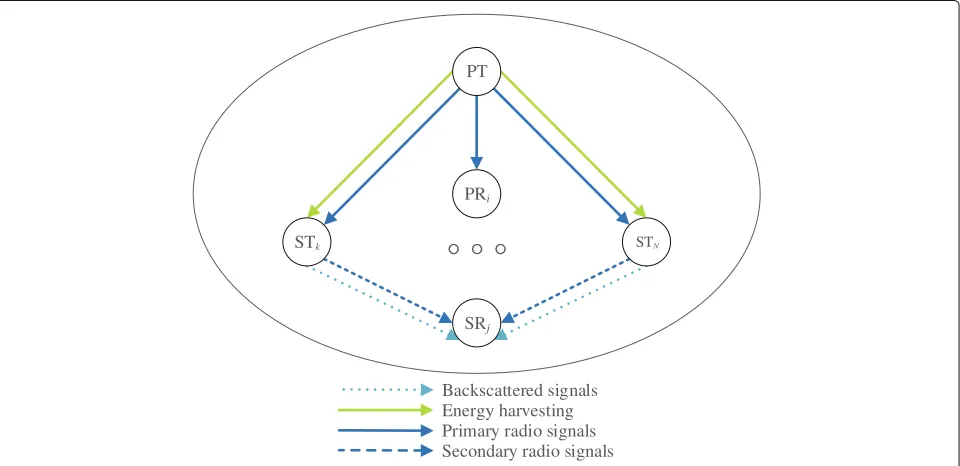
As shown in Fig.1, we consider an underlay CRSN
sce-nario, where energy-constrained secondary users simul-taneously access the licensed spectrum to transmit their own data. The network consists of primary users, primary
° ° °
STNSTk
PT
Backscattered signals Energy harvesting Secondary radio signals Primary radio signals
PRi
SRj
transmitter (PT) and primary receiver (PR), and sec-ondary users, secsec-ondary transmitter (ST) and secsec-ondary receiver (SR). We denote set of PRs, set of SRs, and set of STs asI,JandK, respectively, whereI= {1, 2, 3,· · ·,L}, J = {1, 2, 3,· · ·,M}andK = {1, 2, 3,· · ·,N}. The PRs and SRs are randomly deployed within the disc radius of PT using Poisson point process (PPP) with densitiesλpr and λsr, respectively. Then, STs are deployed randomly using PPP within the radius of each SR with densityλst.
The PT continuously broadcasts radio signals within its coverage area to transfer information to PRs. PRs receive these broadcast signals using their RF commu-nication interface. Furthermore, PRs concurrently report CSI between PT and PR to STs located nearby, using their backscatter interface. Those STs that will receive the CSI from a PR are considered as its nearby STs. Based on the information received from the PR, nearby STs esti-mate the interference that may be induced to the PR. This estimated interference is then used by the STs to select either harvest-then-transmit mode or backscatter mode. It should be noted that STs cannot operate on harvest-then-transmit mode and backscatter mode simul-taneously [5]. Therefore, STs switch between one of the two modes to transfer their information to SRs. To receive useful information from STs, SRs may tune to either RF communication or backscatter communication, depend-ing upon the communication mode used by STs.
For the harvest-then-transmit mode, STs rely only on harvested energy from RF signals transmitted by PT and store the harvested energy in their energy storage units for further data transmission. On the other hand, when the backscatter mode is activated, the STs can backscatter the modulated PT signals to the SRs instantaneously. It is assumed that SRs have the perfect knowledge of each ST’s operating mode and are able to select the corresponding demodulators for effective communication [10]. More-over, the channel gains between the users are modeled by the quasi-static block-fading process. In other words, the channel remains constant over the block timeT, but may vary independently from one block to another follow-ing an identical distribution. In addition, the small-scale fading experienced by these channels is represented by Rayleigh fading model.
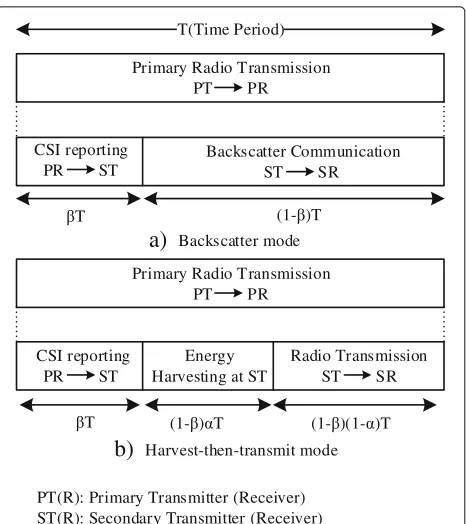
The transmission block structure of the proposed scheme is shown in Fig.2. A time block in which PT trans-mits signals to PRs can be utilized by STs in two main phases: CSI reporting phase and communication phase. ForβTduration, i.e., CSI reporting phase, PRs report their CSI to nearby STs by using backscatter communication. Based on the received CSI, each ST estimates the inter-ference it may cause to its nearby PRs. Depending on the estimated interference in the first phase, ST decides to
select one of the two modes for (1 −β)T duration in
communication phase.
T(Time Period)
PT(R): Primary Transmitter (Receiver) ST(R): Secondary Transmitter (Receiver)
Primary Radio Transmission PT PR
Harvest-then-transmit mode
T (1- ) (1- )(1- )T
Energy Harvesting at ST
Radio Transmission ST SR CSI reporting
PR ST
T (1- )T
Backscatter Communication ST SR Primary Radio Transmission
PT PR
CSI reporting PR ST
Backscatter mode
a)
b)
Fig. 2Transmission block structure for the proposed scheme
In backscatter mode, since STs do not use conventional radio components such as oscillator, mixer, and power amplifiers, they activate their backscatter module from received RF signal power. In addition, STs use the same signals to modulate their data and reflect these signals to communicate with SRs. The SRs may use either passive or active components to demodulate the backscattered signals received from STs. Figure2a illustrates the opera-tion for backscatter mode. STs communicate with SRs by using backscatter communications for the whole(1−β)T duration.
4 Proposed scheme
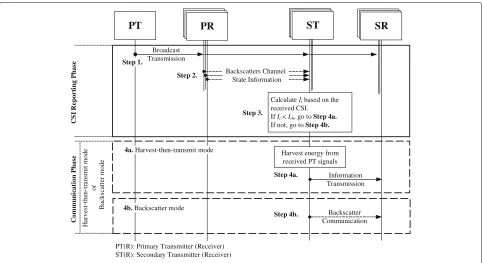
In this section, we explain the proposed scheme for underlay CRSN assisted by backscatter communications. Figure3 presents a graphical overview of the proposed scheme. In step 1, PT broadcasts signals to all the users located within its coverage area. PRs backscatter the received signals to report their CSI to nearby STs in step 2. Based on the received CSI, an ST estimates interference it may cause to the nearby PRs in step 3. ST takes a decision to choose one of the two communication modes based on the estimated interference. If the interference is less than a certain threshold, in step 4a, ST chooses to harvest energy from PT signal power and transmits its information to SR using the harvested energy. On the other hand, if the esti-mated interference is greater than a threshold, ST chooses to communicate with the SR using backscatter communi-cations in step 4b. The detailed procedure is explained in the following subsections.
4.1 CSI reporting phase
In conventional underlay CRSNs, PRs do not assist STs to estimate the channel conditions. This problem is more intractable for broadcast networks, where receivers do not send any acknowledgment of the reception of their data. However, authors in [29] have considered that primary users cooperate with secondary users to enhance mutual performance. In order to maintain high-performance gains for STs and minimize interference at PRs, STs should
continuously monitor channel gains between PT and PRs [30]. If an ST can determine the information about the received signal strength at a PR, it will be able to estimate the interference it may cause to that PR. These channel gains can be estimated by using pilot-aided approaches or by employing sensors near all the PRs [30]. There-fore, for reliable estimation of interference at PRs, we assume that each PR is equipped with a backscatter inter-face, instead of a separate sensor, which is only used for reporting the channel conditions between PR and PT to its nearby STs. This channel condition information can then be used by the nearby STs to estimate interference which may be induced to the PR. Due to low power consumption and simple communications mechanism of backscatter communications, it is rational to assume that PRs use backscatter communications for reporting channel condi-tion to nearby STs.
In broadcast networks such as TV transmissions, the transmissions periodically encode specific symbols for synchronization [31]. These special symbols are used by the receivers to synchronize the timing and compute dif-ferent channel characteristics such as multipath. Once a PR is synchronized, it reports CSI between PR and PT to its nearby STs using its backscatter interface forβT time. In case more than one PRs are located near a ST, there will be collision if both the PRs report CSI simultaneous. To avoid this collision, βT time slot is further divided into X sub-slots. In each slot, independent of others, a
Calculate Iibased on the
received CSI. Harvest energy from
received PT signals
PT(R): Primary Transmitter (Receiver) ST(R): Secondary Transmitter (Receiver)
C
4a. Harvest-then-transmit mode
4b. Backscatter mode
SR
backscattering PR randomly selects a single sub-slot to transmit its signal. This divides each slot into a
backscat-ter phase and a waiting phase of durations 1/X and
(1 - 1/X), respectively. If two or more PRs select the same sub-slot, then there will be collision, which will be reported back by the receiving ST. Those users will then back-off for a random time and then try to send their information again by randomly selecting another sub-slot in the next time frame. We adopt this simple anti-collision method for our system, however, one can further reduce the number of collisions by adopting more complex anti-collision mechanisms reported in [32].
4.2 Communication phase
Based on the interference estimated after the CSI phase, an ST will be allowed to operate on either harvest-then-transmit mode or backscatter mode to communicate with
the associated SR. Since there are N number of STs
present in the network, some may cause more interference to the nearby PRs and select backscatter mode. On the other hand, some STs may select harvest-then-transmit mode if the interference caused by this mode is less then a specific threshold. The average capacity of SR is computed by averaging the individual capacity of each ST. The main objective of the proposed scheme is to improve the overall data rates of the secondary system in the communication phase, which can be mathematically represented as:
Csr=
Cb , Backscatter mode
Crt , Harvest-then-transmit mode (1)
where Cb and Crt are the data rates of backscattering and harvest-then-transmit, respectively. The procedure for calculating the data rates of ST using two different modes is explained in the following.
4.2.1 Backscatter mode
The transmission rate of backscatter communication depends on the RC circuit of the backscatter module [5]. The rate may vary according to the different settings of the circuit elements (such as resistance and capacitance of the modulator). In addition, reported data rates of ambi-ent backscatter can range from 1 Kbps [5] to 1 Mbps [24]. Therefore, data rates of the backscatter communications with a fixed transmission rate can be calculated as:
Cb=(1−β)TBb, (2)
whereBbis the transmission rate of the backscatter mode considered for a unit time block. Note that instantaneous excitation signals received from PT provide enough power to the ST for carrying out backscatter operations [10]. Therefore, in Eq. (2), there is no need to consider the circuit energy consumption for the backscatter mode.
4.2.2 Harvest-then-transmit mode
The signals transmitted by PT with transmission powerPp are received at PRiand can be given by:
yi,p=
wherehp,i is thechannel coefficientbetween PT and PR, dp,i is the distance between the two users, andni is the additive white Gaussian noise (AWGN) at PR. Similarly, the signals received from PT at STkcan be written as:
yk,p=
where hp,k anddp,k are the channel coefficient and
dis-tance between PT and ST, respectively, and nk is the
AWGN at ST. For energy harvesting duration(1−β)αT, the STkharvests energy from the received signal power (P0), which can be given as:
EH,k=(1−β)αTP0=(1−β)αTη
Pp|hp,k|2
dp,km , (5)
whereηis the energy harvesting efficiency.
For radio transmission, STk utilizes harvested energy EH,k as a source of transmission power. Thus, for a suc-cessful transmission,EH,k should be greater than circuit energy consumption Ec, i.e.,EH,k > Ec. Substituting the value ofEH,kfrom (5), the value of energy harvesting time
αcan be obtained as:
α > Ecd
m p,k
η(1−β)TPp|hp,k|2
. (6)
The minimum energy harvesting time
is required such that sufficient energy is acquired to acti-vate the circuit of the ST for radio transmission. After accumulating enough energy for radio transmission, the ST transmits the signalxs for(1−β)(1−α)T duration and the transmitted powerPkcan be given as:
Pk=
γi= ference to PRi, as indicated in (8). STkshould limit this interference to a certain level such that the SINR (γi) at PR idoes not drop below a certain threshold (γth). Ifγiat PR iis greater thanγth(i.e.γi> γth) after experiencing inter-ference from ST k, ST k will use harvest-then-transmit mode. Otherwise, ifγi< γth, then STkwill use backscat-ter mode for its data transfer. The data rates of PRican be calculated as:
The main focus of the proposed scheme is to improve the performance of the secondary system without com-promising a certain level of quality of service for the primary system. In the communication process of primary system, when PT transmits signals to PR, SR also receives those signals, which can be given as:
yj,p=
wherehp,janddp,jare the channel coefficient and distance between PT and SRj, respectively, andnjis the AWGN at the SRj. These signals serve as interference for SRj. The signals received at SRjfrom STkcan be given as:
yj,k =
wherehk,jrepresents the channel coefficient between ST kand SRj,dk,jis the distance between them, andnjis the AWGN at SR. Substituting the value ofPk from (7) into (11), the received signalyj,kcan be rewritten as:
yj,k =
SR j receives useful information from ST k and
inter-ference from PT. The subsequent SINR at SR j can be
written as:
γj=
ηαPp|hp,k|2|hk,j|2dmp,j
(1−α)Pp|hp,j|2dp,kmdmk,j+(1−α)dmp,jdp,kmdmk,jσj2
, (13)
As mentioned before, ST k can successfully use radio
transmission only if the harvested energy is greater than
the circuit energy consumption. Only then the ergodic capacity of the SR can be non-negative and can be given as:
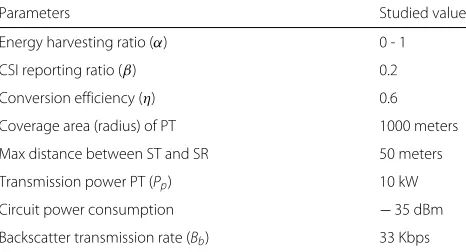
We consider a CRSN where PT is a TV broadcast tower operating on 539 MHz frequency and a bandwidth of 6 MHz [5]. We consider that the PT is a source with
unlim-ited power supply and a transmission powerPp= 10 kW
[10]. All STs within the coverage area of PT, which is set as a disc of radius 1000 m, harvest energy from the signal power of PT. We set energy harvesting efficiency,η=0.6 and path loss exponentm = 2.7 (for urban wireless net-work environment). The system parameters are listed in Table1. The mean values of randomly generated channel gains|hx,y|2,x∈ {p,k},y∈ {k,i,j}, are set to 1.
For simplicity, the noise variance at PR, SR, and ST are assumed to be the same, i.e.,σi2 = σj2 = σk2 = 0.01. To ensure minimum effect on the communication of primary system, SINR threshold (γ) at PR is set as −5 dB. The circuit power consumption is set to -35 dBm [10]. Unless otherwise stated, PRs and SRs are deployed in the network using PPP with densitiesλpr andλsr set to 0.2/km2and 0.1/km2, respectively. STs are also distributed using PPP with a densityλst= 0.002/m2within a radius of 50 m cen-tered at each SRj. Therefore, in terms of distance, nearby PRs are those which are located within 50m radius of STs. An example of our considered network deployment is shown in Fig.4.
Each ST present in the simulation environment oper-ates using the proposed scheme presented in Section4. The capacity for both the modes is obtained from the
Table 1Simulation parameters
Parameters Studied value
Energy harvesting ratio (α) 0 - 1
CSI reporting ratio (β) 0.2
Conversion efficiency (η) 0.6
Coverage area (radius) of PT 1000 meters
Max distance between ST and SR 50 meters
Transmission power PT (Pp) 10 kW
Circuit power consumption −35 dBm
Fig. 4The spatial distribution of an underlay CRSN modeled using PPP
equations derived in Subsection 4.2. We obtain the
average capacity of the secondary system by averaging the individual capacity of each ST, operating on either backscatter mode or harvest-then-transmit mode. Other results in our simulations are also obtained from the mathematical equations presented in Section4. All sim-ulation results are achieved by averaging 10,000 Monte Carlo runs.
5.2 Simulation results
The performance of the proposed scheme is evaluated through results shown in this subsection. Different per-formance metrics are shown in this subsection to provide
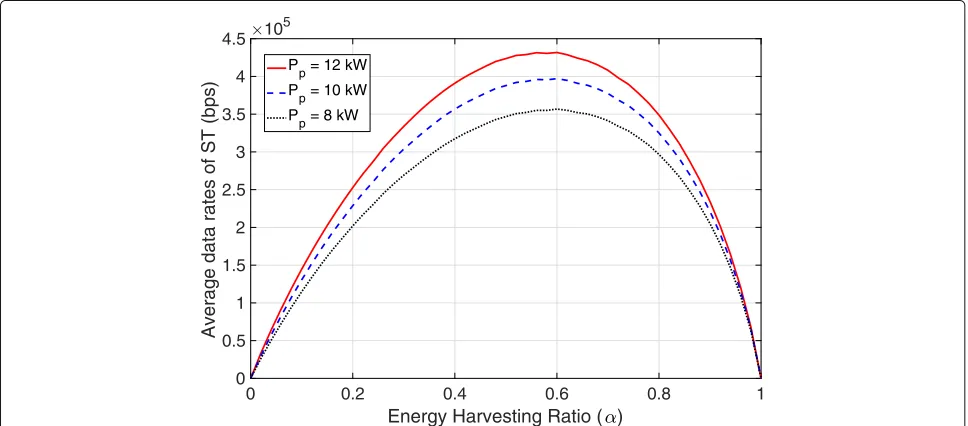
an insight to the wireless-powered underlay CRSN with backscatter communications. In the proposed scheme, when the harvest-then-transmit mode is selected, we observe that there is a tradeoff between time ratio for energy harvesting and average data rates of ST. Figure5 shows the variation of the average data rates of ST for dif-ferent values ofα. The figure plots average data rates of ST for different transmit powers of PT. As shown in the figure, the average data rate of the secondary system is low for lower values of α and increases as the value of α increases. Whenα > α, the average data rateCrt is concave, and it exhibits the highest value atα= 0.56. We use this value ofα to evaluate the affect of other system
0 0.2 0.4 0.6 0.8 1
Energy Harvesting Ratio ( ) 0
0.5 1 1.5 2 2.5 3 3.5 4 4.5
Average data rates of ST (bps)
105
Pp = 12 kW
Pp = 10 kW
Pp = 8 kW
0 2 4 6 8 10 Transmission Power of PT (P
p) (KW) 0
0.5 1 1.5 2 2.5 3 3.5 4 4.5
Average data rate of ST (bps)
105
Proposed scheme Harvest-then-transmit mode Backscatter mode
Fig. 6Performance of the secondary system under the variation of the transmission power of PT (Pp). Other parameters:α=0.56,η=0.6 and
β=0.2
parameters on the system performance.αrepresents the time spent for harvesting energy from the received signals of PT; if more energy is harvested, more power will be available for the transmission of data through radio trans-mission; as a result, the data rates will be improved. On the other hand, a higher value ofαmeans there will be less time for radio transmission and ST will not be able to send more data which results in lower data rates.
To provide insight of the effect of the transmission power of PT (Pp) on the proposed scheme, Fig.6shows the average data rate of ST for different values ofPp. For the value ofα= 0.56, the figure shows that as the values
ofPpincreases, the average data rate of ST increases. This is because of the fact that more energy can be harvested for higher values ofPp. The harvested energy is then used as the transmission power of ST, which results in higher data rates. It can be seen from the figure that the proposed scheme has the best performance in terms of the aver-age data rate of ST as compared to backscatter mode and harvest-then-transmit mode.
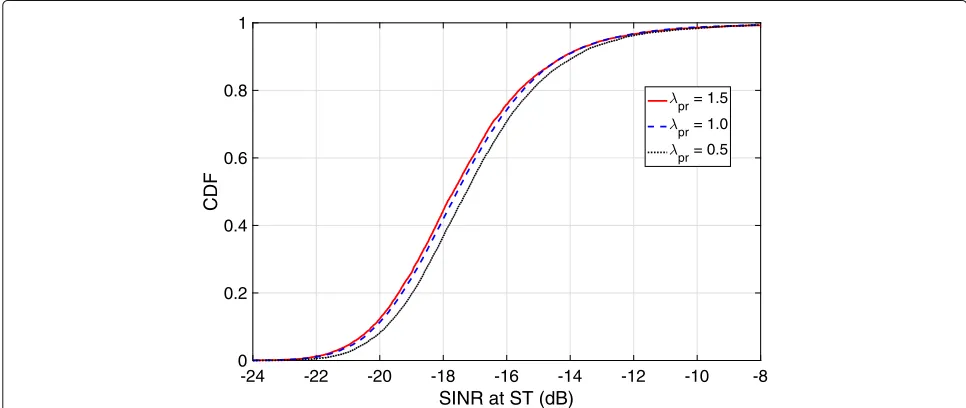
The effect of PR density (λpr) on the SINR of STs is
shown in Fig. 7 for the proposed scheme. The figure
plots the CDF of average SINR at STs for different val-ues ofλpr. Increase in the density of the PR degrades the
-24 -22 -20 -18 -16 -14 -12 -10 -8
SINR at ST (dB) 0
0.2 0.4 0.6 0.8 1
CDF
pr = 1.5
pr = 1.0
pr = 0.5
0.5 1 1.5 2 2.5 3 3.5 4 4.5 5
Backscatter transmission rate (B b) 10
4 (bps) 0
0.5 1 1.5 2 2.5 3 3.5 4 4.5
Average data rates of ST (bps)
105
Proposed scheme Harvest-then-transmit mode Backscatter mode
Fig. 8Performance of the secondary system under the variation of backscatter transmission rate (Bb). Other parameters:α=0.56,η=0.6 and
β=0.2
performance of STs. This is aligned with the basic concept of the underlay CRSN model because less number of STs will be able to use harvest-then-transmit mode as the den-sity of PRs increases. Note that backscatter mode will be still used for the transmission of information from ST to SR. However, the transmission rate of backscatter mode is much less than that of the harvest-then-transmit mode, which results in the degradation of average SINR at STs.
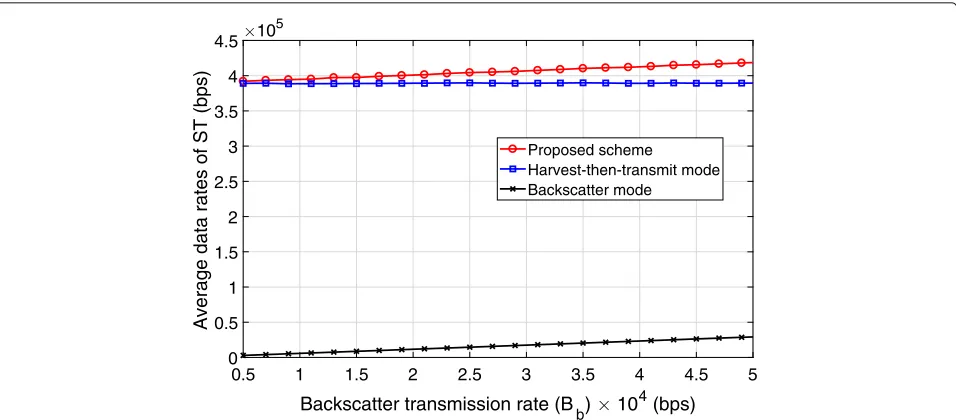
Furthermore, we present the results to provide insight on the performance of the proposed scheme by varying different system parameters. To evaluate the performance of the secondary system, Fig. 8shows the effect on the
Fig. 9Performance of the secondary system under the variation of energy harvesting efficiency (η). Other parameters:α=0.56, and β=0.2
average data rate of ST with the variation of backscatter transmission rate. For this performance metric, we use the value ofα= 0.56 because it achieves the highest data rates for the harvest-then-transmit mode. It can be seen from the figure that the average data rate of ST achieves the best performance for the proposed scheme as compared to backscatter mode and harvest-then-transmit mode sepa-rately. This is because when the ST is unable to operate at harvest-then-transmit mode due to interference at the PR, it can use backscatter mode to transfer its information to the SR.
We then vary the energy harvesting efficiencyηshown in Fig.9, for different values of the transmission power of PT. Average data rates of ST increases as the value ofη increases. Energy harvesting efficiency is the capability of energy harvesting circuit to convert the RF signal power into DC current. This harvested energy is then used by the ST to transmit information towards SR using active radio component. As the value ofηincreases average data rate of ST also increases because ST can more efficiently harvest energy and use that energy as its transmission power. Furthermore, for higher values ofPpthe data rates increase which can be confirmed by previous figures.
Fig. 10Performance of the secondary system under the variation of CSI reporting ratio (β). Other parameters:α=0.56, andη=0.6
β with both data rates of backscatter mode and
harvest-then-transmit mode. Increasing values of β imply that
more time will be used for CSI reporting and less time will be available for communication phase.
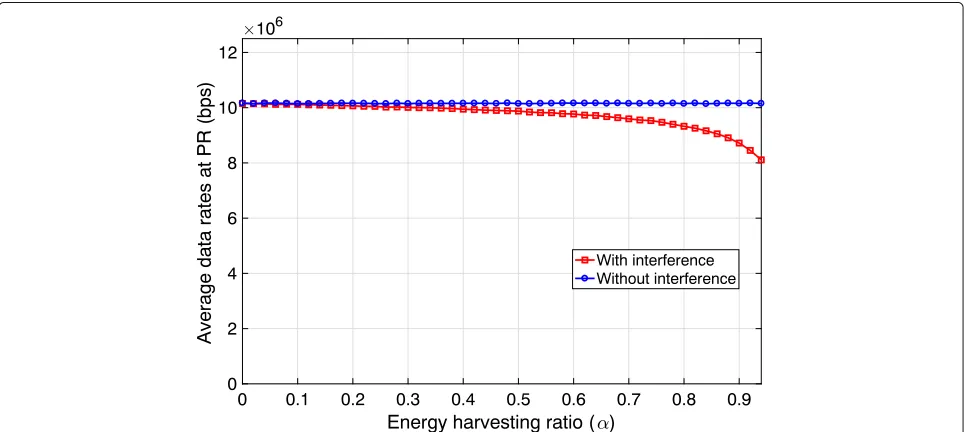
To see the effect of energy harvesting ratio (α), Fig.11 plots the average data rate of PR in the presence of STs. Since for smaller values of α, the amount of harvested energy is less, consequently, the transmission power of
STs is also less and the interference ST may cause will be lower. On the other hand, although less time is available for transmission, STs may cause a significant interference to the nearby PRs. This is because of the fact that large number of STs are located near the PRs and the transmission power of STs is higher for higher
values of α. As a result, we choose an optimal value
of α, which maximizes average data rate of secondary
0 10 20 30 40 50
SINR at PR (dB)
0 0.2 0.4 0.6 0.8 1
CDF
With interfernece Without interference
Fig. 12Performance of primary receivers with and without secondary interference. Other parameters:γ= −5dBm,α=0.56,η=0.6 andβ=0.2
system and minimizes the effect on the communication of primary system.
Communication of the primary system is of prime con-cern in CRSN and should be guaranteed a certain level
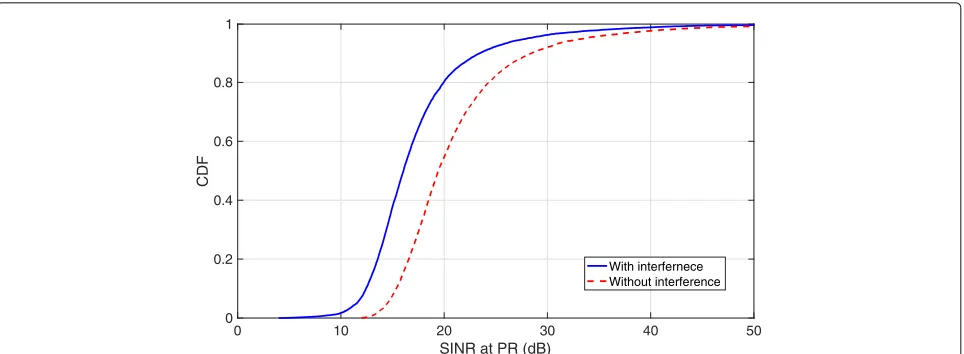
of quality of service. Figure 12 plots the CDF of the
average SINR at PR. The figure also shows the effect of the proposed scheme on the SINR of PR. It can be observed from the figure that the performance of PR experience a slight degradation due to the presence of STs operating in underlay model. This minor degrada-tion to the performance of the primary system is a limited cost to pay for providing communication opportunity to a large number of users in a CRSN. However, SINR of all the PRs is above a certain threshold level which shows that the proposed scheme minimally affect primary communications.
6 Conclusion
In this paper, we proposed a new concept of integrating ambient backscatter communications with the cognitive radio network, where STs are wirelessly powered by radio signals transmitted by the PT. Considering an underlay model for the secondary system, we proposed a scheme where STs choose between backscatter mode or harvest-then-transmit mode, based on the estimated interference that will be induced to PRs. The secondary system mini-mally affects the primary users’ performance while coex-isting with the primary network. Under the constraints of interference on PRs, the proposed scheme improves the average data rate of the secondary system in under-lay CRSN. Furthermore, we evaluate the performance of the proposed scheme through system level simulations. Finally, the results are presented for the proposed scheme to show the improvement in the performance of the sec-ondary system. We also highlight the slight degradation of the primary system which is a tradeoff for providing
communication services to a large number of low power secondary users.
Acknowledgements
This work was supported by the National Research Foundation of Korea (NRF) grant funded by the Korean government (MSIP) (2014R1A5A1011478).
Authors’ contributions
DM and MYC conceived the idea and designed the algorithm. STS helped in the evaluation of the proposed scheme. DM wrote the manuscript. KWC and T-JL helped in improving the algorithm and reviewing the manuscript. All authors read and approved the final manuscript.
Competing interests
The authors declare that they have no competing interests.
Publisher’s Note
Springer Nature remains neutral with regard to jurisdictional claims in published maps and institutional affiliations.
Author details
1Department of Electrical and Computer Engineering, Sungkyunkwan
University, 2066 Seobu-Ro, Jangan-Gu, 16419 Suwon, Gyeonggi-Do, South Korea.2Department of Telecommunication Engineering, FICT, Balochistan University of Information Technology, Engineering and Management Sciences, Airport Road, Baleli, 87300 Quetta, Pakistan.
Received: 23 October 2017 Accepted: 6 February 2019
References
1. A. Ahmad, S. Ahmad, M.H. Rehmani, N.U. Hassan, A survey on radio resource allocation in cognitive radio sensor networks. IEEE Commun. Surv. Tutor.17(2), 888–917 (2015)
2. G.I. Tsiropoulos, O.A. Dobre, M.H. Ahmed, K.E. Baddour, Radio resource allocation techniques for efficient spectrum access in cognitive radio networks. IEEE Commun. Surv. Tutor.18(1), 824–847 (2016)
3. O.B. Akan, O.B. Karli, O. Ergul, Cognitive radio sensor networks. IEEE Netw. (23)4, 34–40 (2009)
4. M.E. Tanab, W. Hamouda, Resource allocation for underlay cognitive radio networks: a survey. IEEE Commun. Surv. Tutor.19(2), 1249–1276 (2017) 5. V. Liu, A.N. Parks, V. Talla, S. Gollakota, D. Wetherall, J.R. Smith,Ambient
Backscatter: Wireless Communication out of Thin Air. (Association for Computing Machinery (ACM), Hong Kong, 2013)
6. K. Han, K. Huang, Wirelessly powered backscatter communication networks: modeling, coverage and capacity. IEEE Trans. Wirel. Commun.
7. B. Lyu, Z. Yang, G. Gui, Y. Feng, Optimal resource allocation policies for multi-user backscatter communication systems. Sensors.16(12), 2016 (2016)
8. D.T. Hoang, D. Niyato, P. Wang, D.I. Kim, Opportunistic channel access and RF energy harvesting in cognitive radio networks. IEEE J. Sel. Areas Commun.32(11), 2039–2052 (2014)
9. S. Bi, Y. Zeng, R. Zhang, Wireless powered communication networks: an overview. IEEE Wirel. Commun.23(2), 10–18 (2016)
10. D.T. Hoang, D. Niyato, P. Wang, D.I. Kim, Z. Han,The Tradeoff Analysis in RF-Powered Backscatter Cognitive Radio Networks. Global Communications Conference (GLOBECOM). (Institute of Electrical and Electronics Engineers (IEEE), Washington, 2016)
11. K.H. Park, D. Munir, J.S. Kim, M.Y. Chung,Integrating RF-Powered Backscatter with Underlay Cognitive Radio Networks. (Institute of Electrical and Electronics Engineers (IEEE), Da Nang, 2017)
12. K. Hareesh, P. Singh,An Energy Efficient Hybrid Co-operative Spectrum Sensing Technique for CRSN. (Institute of Electrical and Electronics Engineers (IEEE), Kottayam, 2013)
13. Y. Lin, C. Wang, J. Wang, Z. Dou, A novel dynamic spectrum access framework based on reinforcement learning for cognitive radio sensor networks. Sensors.16(10), 1675 (2016)
14. Y. Zhang, S. He, J. Chen, Y. Sun, X. Shen, Distributed sampling rate control for rechargeable sensor users with limited battery capacity. IEEE Trans. Wirel. Commun.12(6), 3096–3106 (2013)
15. S. Gao, L. Qian, D.R. Vaman, Distributed energy efficient spectrum access in cognitive radio wireless ad hoc networks. IEEE Trans. Wirel. Commun.
8(10), 5202–5213 (2009)
16. J.A. Han, W.S. Jeon, D.G. Jeong, Energy-efficient channel management scheme for cognitive radio sensor networks. IEEE Trans. Veh. Techol.
60(4), 1905–1910 (2011)
17. L.R. Varshney,Transporting Information and Energy Simultaneously. (Institute of Electrical and Electronics Engineers (IEEE), Toronto, 2008) 18. S. He, J. Chen, F. Jiang, D.KY. Yau, G. Xing, Y. Sun, Energy provisioning in
wireless rechargeable sensor networks. IEEE Trans. Mob. Comput.12(10), 1931–1942 (2013)
19. Y. Zhang, S. He, J. Chen, Y. Sun, X.S. Shen, Distributed sampling rate control for rechargeable sensor users with limited battery capacity. IEEE Trans. Commun.12(6), 3096–3106 (2013)
20. I. Yoon, M.Y. Jun, J. Semi, K.N. Dong, Adaptive sensing and compression rate selection scheme for energy harvesting wireless sensor networks. Int. J. Distrib. Sens. Netw.13(6), 1–10 (2017)
21. Y. Wang, W. Lin, R. Sun, Y. Huo, Optimization of relay selection and ergodic capacity in cognitive radio sensor networks with wireless energy harvesting. Pervasive Mob. Comput.22, 33–45 (2015)
22. S. Kalamkar, J. Jeyaraj, A. Banerjee, K. Rajawat, Resource allocation and fairness in wireless powered cooperative cognitive radio networks. IEEE Trans. Commun.64(8), 3246–3261 (2016)
23. A.N. Parks, A. Liu, S. Gollakota, J.R. Smith,Turbocharging Ambient Backscatter Communication. (ACM SIGCOMM, Chicago, 2014)
24. B. Kellogg, V. Talla, S. Gollakota, J.R. Smith,Passive Wi-Fi: Bringing Low Power to Wi-Fi Transmissions. (The Advanced Computing Systems Association (USENIX), Santa Clara, 2016)
25. C. Boyer, S. Roy, Backscatter communication and RFID: coding, energy, and MIMO analysis. IEEE Trans. Commun.62(3), 770–785 (2014) 26. B. Lyu, Z. Yang, G. Gui, H. Sari, Optimal time allocation in backscatter
assisted wireless powered communication networks. Sensors.17(6), 1258 (2017)
27. D.T. Hoang, D. Niyato, P. Wang, D.I. Kim,Optimal Time Sharing in RF-Powered Backscatter Cognitive Radio Networks. (Institute of Electrical and Electronics Engineers (IEEE), Paris, 2017)
28. R. Zhang, C.K. Ho, MIMO broadcasting for simultaneous wireless information and power transfer. IEEE Trans. Wirel. Commun.12(5), 1989–2001 (2013)
29. W. Su, J.D. Matyjas, N.B. Stella, Active cooperation between primary users and cognitive radio users in heterogeneous ad-hoc networks. IEEE Trans. Signal Process.60(4), 1796–1805 (2012)
30. L.B. Le, E. Hossain, Resource allocation for spectrum underlay in cognitive radio networks. IEEE Trans. Wirel. Commun.7(12), 5306–5315 (2008) 31. ATSC digital television standard (1995). Advance Television System
Committee (ATSC) Digital Television System Standards, ATSC Standard A/53, Online available at: https://www.atsc.org/standard/a53-atsc-digital-television-standard/