R E S E A R C H
Open Access
Sparse representation utilizing tight frame
for phase retrieval
Baoshun Shi, Qiusheng Lian
*and Shuzhen Chen
Abstract
We treat the phase retrieval (PR) problem of reconstructing the interest signal from its Fourier magnitude. Since the Fourier phase information is lost, the problem is ill-posed. Several techniques have been used to address this problem by utilizing various priors such as non-negative, support, and Fourier magnitude constraints. Recent methods exploiting sparsity are developed to improve the reconstruction quality. However, the previous algorithms of utilizing sparsity prior suffer from either the low reconstruction quality at low oversampled factors or being sensitive to noise. To address these issues, we propose a framework that exploits sparsity of the signal in the translation invariant Haar pyramid (TIHP) tight frame. Based on this sparsity prior, we formulate the sparse representation regularization term and incorporate it into the PR optimization problem. We propose the alternating iterative algorithm for solving the corresponding non-convex problem by dividing the problem into several subproblems. We give the optimal solution to each subproblem, and experimental simulations under the noise-free and noisy scenario indicate that our proposed algorithm can obtain a better reconstruction quality compared to the conventional alternative projection methods, even outperform the recent sparsity-based algorithms in terms of reconstruction quality.
Keywords:Phase retrieval, Tight frame, Sparse representation, Signal processing
1 Introduction
In science and engineering fields, such as crystallography, neutron radiography, astronomy, signal processing, and optical imaging [1, 2], it is difficult to design sophisticated measuring setups to allow direct recording of the phase, which carries the critical structural information of the test object or signal [1]. Interestingly, an alternative mean called algorithmic phase retrieval is arising in these fields. The goal of phase retrieval (PR) algorithms is to retrieve the signal only through its Fourier spectrum magnitude that can be obtained by the sensors. However, since the global phase shift, conjugate inversion, spatial shift on the interest signal can lead to the same Fourier magnitude, the PR problem is ill-posed. Therefore, prior information on the underlying signal is incorporated into the recovery process to enable its recovery.
In the past decades, alternative projection strategy pioneered by Gerchberg and Saxton [3] for PR is popu-lar. The object magnitude constraint and Fourier mag-nitude constraint are utilized in the Gerchberg-Saxton
(GS) algorithm, which addresses the problem of recov-ering a complex object from its Fourier magnitude via projecting onto the constrained sets alternatively. Instead of the magnitude constraint of the GS algorithm in object domain, Fienup [4] in 1978 suggested a PR algorithm called hybrid-input output (HIO) algorithm, which incorporates the non-negativity and support constraint into the PR process. Further study of
alterna-tive projection strategy [5–7] can be regarded as the
modification or extension of the HIO algorithm and the GS algorithm.
Recently, the sparsity prior for PR is focused by researchers [8–12]. Theoretically, the sparsity prior can be incorporated into the object constraint of any alter-native projection algorithm to improve the perform-ance. Mukherjee et. al. proposed the so-called Max-K algorithm [8], which incorporates sparsity into the object constraint of alternative projection strategy via solving the sparse coding subproblem; Loock et. al. [9] incorporated the sparsity constraint into relaxed averaged alternating reflectors (RAAR) algorithm and proposed a shearlet soft thresholding procedure for PR from near-field sampled data, namely Fresnel magnitude. Another
* Correspondence:[email protected]
School of Information Science and Engineering, Yanshan University, 438, Hebei Avenue, Qinhuang Dao 066004, People’s Republic of China
sparsity-based strategy for PR is based on greedy strategy, including greedy sparse phase retrieval (GESPAR) [10] and nonlinear basis pursuit [11]. It has been shown that GESPAR could achieve lower computational complexity compared to the alternative projection algorithm with sparsity constraints [10].
In the image PR field, the image regularization, such asl1
regularization [13, 14], is focused by researchers. They
often formulate the non-convex l1minimization problem
and solve the problem by alternating directions method of multipliers (ADMM) [15], which can obtain a suboptimal solution to the non-convex problem. Inspired by this idea, in this paper, we extend the spatial sparsity prior to trans-form sparsity prior based on translation invariant Haar pyramid (TIHP) [16] for PR. The proposed regularization is based on the assumption that the underlying image can be represented sparsely in TIHP tight frame. The assump-tion is natural for a wide class of natural images. Indeed, TIHP tight frame have been shown to provide suitable results for image restoration [16, 17]. We formulate the sparse representation regularization term and incorporate it into the PR optimization problem combining with the support and Fourier magnitude constraint. Due to the non-convexity of the objective function, the optimal solution to the corresponding problem is difficult to obtain. Neverthe-less, ADMM technique, which can obtain a satisfied solu-tion to the PR problem [13, 14], is utilized in this paper.
Our contributions can be summarized as follows:
1. We propose a sparse representation regularization term based on the TIHP tight frame for phase retrieval. We combine the sparse representation regularization term with the data consistency term and object constraint term of utilizing the indicator function to formulate a new phase retrieval problem. The sparse representation regularization term of utilizing TIHP tight frame is helpful to retrieve the missing phase as well as recover the image at low oversampled factors. Moreover, additional spatial priors of the image can be incorporated into the object constraint via enforcing the spatial priors in the constraint set, specially support prior and the intensity constraint of the underlying image are utilized in this paper;
2. The alternative iterative algorithm of utilizing ADMM technique for solving the formulated optimization problem is proposed via dividing the formulated problem into several subproblems. We give the optimal solution to each subproblem theoretically, and experimental results demonstrated the better convergence behavior of this approach; 3. We demonstrate the sparsity measure of utilizingl1
norm can obtain better reconstruction thanl0norm
for our framework heuristically. Experimental results
indicate that our proposed algorithm can obtain better reconstruction quality compared with the alternative projection algorithms of utilizing the same sparsity prior. Additionally, our algorithm is robust to noise, which is demonstrated empirically.
The structure of this paper is as follows. To begin with, the PR prior work is reviewed in Section 2. Then, in Section 3, we formulate our new PR problem and introduce our alternative iterative algorithm in detail. Section 4 presents our experimental simulations. Finally, concluding remarks and directions for future research are presented in Section 5.
2 Related work
2.1 The alternative projection strategy
Let Μ= {x∈ℝN| |Fx| =b} (here, F∈ℂN×N accounts for
the discrete Fourier transform matrix, b∈ℝN is the
observed Fourier magnitude, and x represents the
underlying signal) be the Fourier magnitude constraint, which is a set of the signals whose Fourier magnitude spectrum matches with the measured Fourier magni-tude of the underlying signal, and S= {x(r)| x(r)≠ 0 for some r∈Dand x(r) = 0 for r∉D} be the support constraint set that indicates the set of signals have the
non-zero support inD. The PR problem can be
formu-lated as the following feasible problem
findx∈M∩S: ð1Þ
The alternative projection algorithms are utilized for solving the above problem, and the popular algorithm
among them is the Fienup’s HIO algorithm [4], which
starts with an initial guess and bounces between the above constraint sets until the terminated condition is
reached. Given a parameter β, the HIO algorithm for
updatingxcan be described as
xðtþ1ÞðrÞ ¼ ½PMðxðtÞÞðrÞ;ifr∈D;
verse Fourier transform and ⊙ denotes element-wise
product, t is the iteration number. Mathematically, the
above formulation is equivalent to
xðtþ1Þð Þ ¼r ð1þβÞP
Here,PSis the projection ontoS. To solve the problem
xðtþ1Þð Þ ¼r 2βP
r∉D} represents the support and non-negative
con-straint set. Indeed, under the same concon-straint, the
RAAR algorithm equals to the HIO algorithm whenβ=
1. To further improve the performance of RAAR, Loock et. al. [9] utilized shearlet sparsity prior to recover the phase from the Fresnel magnitude data, namely near-field data. Instead of the projection operator PSþð Þ• in (4), they utilizePð ÞSεþð Þ• defined as represents the shearlet transform matrix, and F−1s represents the inverse shearlet transform matrix. The experimental simulations in [9] show that the RAAR algorithm with shearlet sparsity constraint outper-forms the support constraint and similarly as the support plus non-negative constraint under the near-field scenario.
2.2 ADMM for the PR optimization problem
Differ from the PR feasible problem, the PR problem can also be formulated as a minimum problem that can be solved by the optimization theory. Additional constraints can be incorporated into the correspond-ing PR minimum problem by way of indicator func-tions. Theoretically, the feasible problem (1) can be regarded as the following minimum problem approximately
The first term of problem (6) is the data consistency, which enforces the Fourier magnitude constraint. The second term represents the real-space or object con-straint, such as support or positive, onto the underlying signal; here,ISis an indicator function
ISðxÞ ¼
0x∈S; þ∞otherwise:
(
ð7Þ
Yang et. al. incorporated the l1 regularization for PR
[14]
The above problem is a non-convex problem, Yang et. al. [14] suggested ADMM technique to solve the problem and obtained a better reconstruction. Yang’s algorithm suffers
from the limit of recovering the image that is sparse in spatial domain; when it comes to recover the images that are non-sparse in spatial domain, it fails to reconstruct. However, most of the natural images are non-sparse in spatial domain; Yang’s algorithm cannot enable to retrieve the phase of these images. Moreover, the previous alterna-tive projection algorithms of utilizing sparsity prior suffer from either the relatively low reconstruction quality at low oversampled factors or being sensitive to noise. To address these issues, we propose a framework of utilizing TIHP tight frame, and experimental results indicate its efficiency for natural images.
3 The proposed approach
3.1 Problem formulation
We study the PR optimization problem of recovering the image from its Fourier magnitude also known as the far-field data. Few decades have witnessed a great inter-est in image regularization, especially the sparse repre-sentation regularization for solving inverse problems. As a special inverse problem, it is essential to exploit a fine sparse representation for PR problem. The fine ana-lytical transform or sparsifying basis for sparse repre-sentation regularization is critical for recovering the signal. In this paper, we propose utilizing TIHP tight frame for PR. The sparse representation regularization term of utilizing the TIHP tight frame is incorporated into the PR minimum problem and yields the following optimization problem
Where x∈ℝN is the interest signal, W represents the
TIHP tight frame admits WTW=I (here I is an identify
matrix), and λis the regular parameter. The first term of problem (9) is the data consistency, and the second term represents sparse representation regularization term in the TIHP tight frame. For the sparse representation regularization term, both thel1norm andl0norm can be
considered to promote sparsity. In the simulations section (Subsection 4.1), we demonstrate that the reconstruction obtained by l1 norm is better than utilizing l0 norm in
terms of reconstruction quality. The third term is an indi-cator function that can combine some additional con-straints, such as support or non-negative constraint, into PR process.
3.2 The proposed phase retrieval method
^
The above problem can be rewritten as the following Lagrangian form that can be solved by ADMM
^
Here, u1, u2 represent the scaled dual variables. We
solve the above problem by attacking the followingx,y,z subproblems and following the updating of scale dual vari-ables finally. The optimal solution to each subproblem is derived, to thetth iteration:
1. xsubproblem
With y,z, u1, u2fixed, problem (11) is corresponding
to thexsubproblem
The above problem can be recast as
xð Þt ¼argmin
,Cis a constant independent ofx. The objective function of problem (13) is a convex function with the unique solution
Here, Tε(·) is a soft thresholding operator with ε
=λ/(2 × (ρ1+ρ2))..The hard thresholding operator T wð Þ
thresholding operator is utilized in (14) under the
scenario that the l0 norm is exploited for promoting
sparsity.
The first term is the Fourier magnitude constraint, and the second term indicates that the underlying vector is close to the known vector. To obtain the optimal
solu-tion of problem (16), the phase of z and w(t) must be
guaranteed to equal
phað Þ ¼z phawð Þt : ð17Þ
Here, pha(•) represents the operator that extracts the phase. To solve problem (16), we can only consider the following optimization problem with respect to |z|
zð Þt ¼argmin
Consider the cost function of problem (18) is a differen-tiable function with respect to |z|, and the least squares solution to problem (18) is
zð Þt ¼ bþρ
Therefore, the optimal solution to problem (16) is given by
yð Þt ¼Ρ
S xð Þt−uð2t−1Þ
: ð22Þ
Where ΡS(•) represents the projection operator onto
the constraint set S.
Finally, update the scaled dual variables of ADMM
uð Þ1t ¼u gence for the convex problem [18]. There is no theoretical guarantee that ADMM can obtain the optimal solution to the non-convex problem. Nevertheless, ADMM method can obtain a satisfied solution for the non-convex PR problem [14, 19]. To give a better convergence for our
al-gorithm, we incorporate the parameter γ, which can be
adjusted heuristically, into ADMM. So far, all issues in the process of handing problem (11) have been solved. We update the variable x, z,y at the tth iteration by solving
subproblems (12), (15), and (21), and update u1, u2
by (23) iteratively. To monitor the convergence of our algorithm, we utilize the relative residual norm de-fined by [19]
res¼ jjjFxð Þt j−bjj
2=jjbjj 2: ð24Þ
The iteration is terminated until the relative residual normres≤τfor some small τ> 0, or the maximum iter-ation number is reached under the noise-free case, and only the latter terminated condition is utilized for the noisy case. To illustrate our algorithm with sparse repre-sentation regularization utilized tight frame in detail, Table 1 provides the proposed algorithm.
4 Experimental simulations
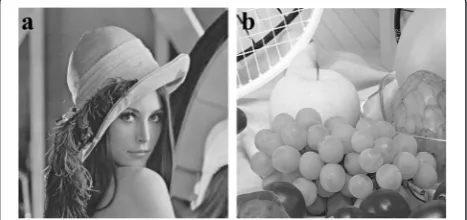
In our experiments, we use two standard gray scale images with size 512 × 512, including “Lena” and “Fruits.” The Fourier transform of the testing image is oversampled by various factors for comparison, and we call the factor as oversampled factor [19]. For example, the image is cropped
with size 314 × 314, namely, the 314 × 314 pixels of the ori-ginal image in Fig. 1 are retained, and the other part of it is excluded. The cropped testing images are padded with zeros to create the 512 × 512 image; under this scenario, the oversampled factor is 1.63 (512/314). Theoretically, the lower the oversampled factor is, the more difficult to
reconstruct the image. We compare the l0 norm and l1
norm for promoting sparsity in our approach firstly. Then, the algorithm is compared with other existing algorithms and is evaluated of reconstruction quality and robustness to noise. All simulations were performed in MATLAB R2012a on the computer with AMD Athlon (tm) II X2 255 processor (3.11 GHz), 1.75 G memory, and Windows XP operator system.
4.1 Parameter setup
To demonstrate the effectiveness of the sparsity in our al-gorithm, we compared our algorithm with the alternative projection algorithm without sparsity constraint, and the HIO algorithm is chosen as the benchmark algorithm under the noise-free case. The non-negative constraintS+
is utilized in the HIO algorithm, and the HIO MATLAB codes can be downloaded from https://github.com/leeneil/ ghio-matlab. We also incorporated the state-of-the-art sparsity-based algorithms such as the Max-K algorithm [8] and RAAR framework with shearlet sparsity method [9] for comparison. The Max-K algorithm can be regarded as a parameterized relaxation with respect to RAAR [8] of utilizing K sparse constraint; therefore, we chose the RAAR method with sparsity constraint in the TIHP tight frame for comparison. Due to thel0norm that is incorporated to
promote sparsity, we termed this algorithm as RAAR-l0
algorithm, which is also introduced in [8]. For RAAR-l0
algorithm, the sparsity level K is set to 0.4 N, where N is
the total number of the measurements, and β= 0.99.
Moreover, the proposed RAAR-based algorithm in [9] is selected for comparison. We utilize the sparsity in TIHP tight frame instead of shearlet sparsity for reconstruction from the far-field data. The l1 norm is utilized in [9] to
promote sparsity; thus, the corresponding algorithm is
called RAAR-l1 algorithm. It is difficult to give the
Table 1Complete description of our proposed algorithm Input: the Fourier magnitudeb;
Initialization:t= 1, initial estimated imagex(0), error tolerance
τ> 0, parameters
Until maximum iteration number is reached orres≤τ
Output: final estimated image
Fig. 1Images with 512 × 512 pixels for our experiments.aLena.
theoretical guarantee for the choice of the parameters for PR algorithms. In general, these parameters are tuned heuristically. To give a better performance for the RAAR-l1
algorithm, we suggest a rule of updating thresholding ε
empirically: ε=C1+C2/t (here C1 and C2 are some
con-stants that need to be tuned empirically). The thresholding εof the RAAR-l1algorithm is decreasing in dependence of
the iteration numbert, which gives a promising result that has been demonstrated in [9]. Each parameter in the
RAAR-l1 algorithm was evaluated by varying one
param-eter at a time while keeping the rest fixed based on the principle of obtaining the higher peak signal to noise ratio (PSNR). We tried several choices ofβ,C1, andC2for this
algorithm at oversampled factor 1.58, and experimental re-sults show thatβ= 0.99,ε= 1.5 + 8/tare suitable parameter choices.
The projection operator PM utilized in RAAR-l0 and
RAAR-l1algorithms is defined as [7]
PΜð Þ ¼x I−F−1 j jFx
rithms utilize the RAAR framework with TIHP sparsity constraint; the difference between the two algorithms is the object domain constraint, which yields the different projection operatorPSþð Þ• in (4). Concretely, the RAAR-l0algorithm utilizes the following projection operator
PK
Here,TK(•) represents the operator that retains the K
largest coefficients, and B(•) = max(min(•, 255), 0) de-notes as the pixel intensities constraint. The projection PS(•) represents projection onto the support constraint.
Differing from the RAAR-l0 algorithm, the RAAR-l1
-algorithm incorporates PεSð Þ ¼• B PS WTTε Wð Þ•
into (4). The maximums of iterations for all algorithms in the experiments are set to 3000.
For TIHP tight frame, the transform and its inverse transform can be downloaded from http://www.io.csic.es/ PagsPers/JPortilla/software/file/4-l0-abs-deblur-pack. The l0norm andl1norm are all considered to promote
spars-ity, and the corresponding algorithm utilizing TIHP tight frame is termed PR-TIHP-l0and PR-TIHP-l1. ThePS
uti-lized in our algorithm is defined as
PSðxÞ ¼
BðxÞifx∈S; 0 otherwise:
(
ð27Þ
Note that an initial guess is important for PR, we utilize x(0)
=PSPΜ(v) as the initial guess for all algorithms; here,v is a random image. We tune the parameters of the
proposed two algorithms finely, heuristically, we set the dyadic scales 7, and ρ1=ρ2= 0.01,γ= 0.5,τ= 0.01 for the
two algorithms. For the parameter λ, we set PR-TIHP-l0
and PR-TIHP-l1to 0.1 and 0.05, respectively.
We compare the proposed PR-TIHP-l0and
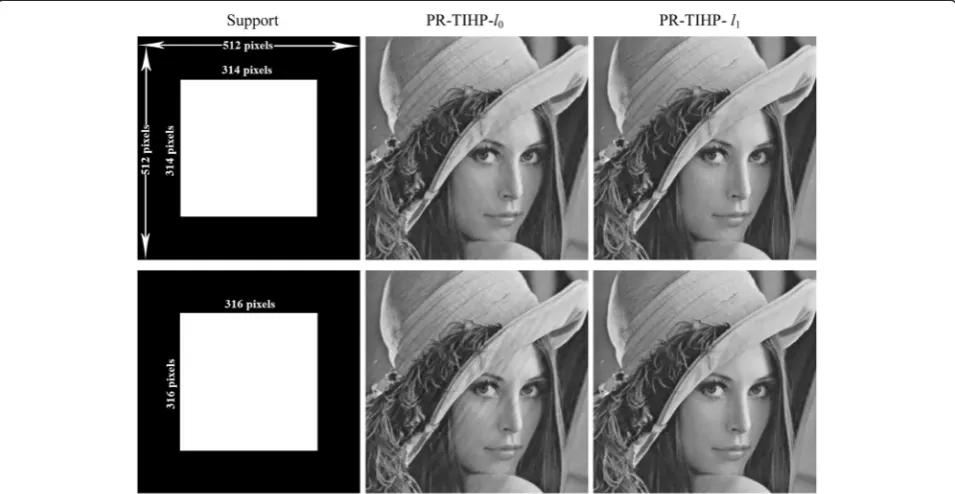
PR-TIHP-l1at various oversampled factors. In Fig. 2, we give the
reconstructed image“Lena” at oversampled factor 1.63
and 1.62, namely, containing 314 × 314 pixels (the first row) and 316 × 316 pixels (the second row), respect-ively. Moreover, the corresponding non-negative sup-port regions in the center of the 512 × 512 padded image are shown in Fig. 2. Since the global phase factor exists in the reconstructed images, the reconstructions can be flipped or shifted. In this case, we aligned the reconstruction with the original image to give a clear comparison. Moreover, the part of the reconstructed image that padding zeros to create the oversampled dif-fraction pattern is excluded. One can see that the nearly perfect reconstructions in first row are achieved
by the two algorithms; however, the PR-TIHP-l0
algorithm fails to reconstruct as the decreasing of the
oversampled factor. One can see our PR-TIHP-l1
algorithm can provide the perfect reconstruction at these oversampled factors. Indeed, for image “Lena”, the mini-mum oversampled factor for perfect reconstitution of our PR-TIHP-l1 algorithm is 1.58 (contains 324 × 324 pixels),
but the reconstruction of our PR-TIHP-l0 algorithm is
extremely worse than PR-TIHP-l1algorithm at this
over-sampled factor. Therefore, we utilizel1norm to promote
sparsity for comparison in next subsection.
4.2 Phase retrieval from noise-free oversampled diffraction pattern
We performed the proposed algorithm and the three benchmark algorithms for various images at oversampled factor 1.58. In this simulation, the non-negative support region is simply the window with size 324 × 324 in the center of the 512 × 512 padded image.
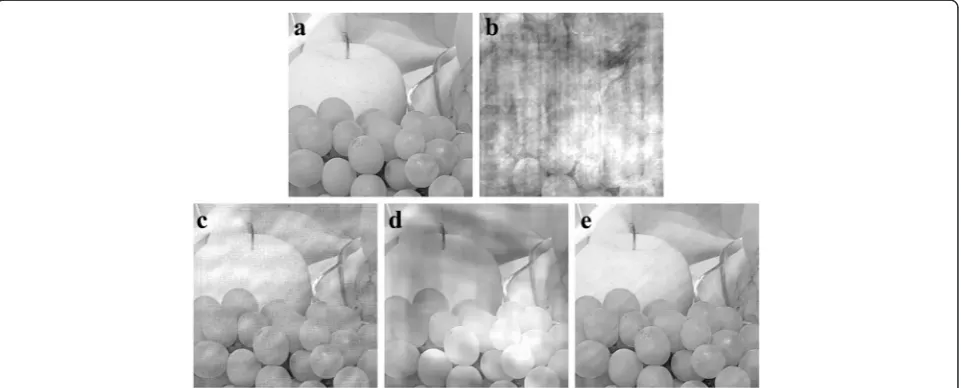
We used the same initial guess for all algorithms for fairness. Figures 3 and 4 show the comparisons of the re-construction performance for the two testing images. Note that the reconstructed image may be flipped for the global phase factor in its Fourier transform; the translation has been removed for clear comparison. The original images are shown in Figs. 3a and 4a. From the reconstructions of the four algorithms presented in Figs. 3 and 4, it is easy to
see that our PR-TIHP-l1 produced high-quality
recon-structions regardless of the images (see Figs. 3e and 4e). From the reconstructions in Figs. 3b and 4b, one can see that the HIO algorithm cannot give a visible reconstruc-tion at this oversampled factor. The RAAR-l0algorithm
spots of the apple in image“Fruits” (see Fig. 4c) are also lost. The RAAR-l1 reconstruction is not visibly good for
image“Lena”(see Fig. 3d), and most details are also lost in image“Fruits”(see Fig. 4d). Interestingly, a nearly perfect reconstruction for image “Lena” is achieved by our PR-TIHP-l1 algorithm. As for the “Fruits” reconstruction,
the spots of the apple in our reconstruction is preserved (see Fig. 4e), which shows our reconstruction is better than the reconstructed images obtained by the bench-mark algorithms. The utilization of TIHP tight frame and ADMM technique should account for the consider-able results obtained by our algorithm.
Although our proposed PR-TIHP-l1 algorithm could
obtain a suboptimal solution to the non-convex prob-lem (11) as well as a better reconstruction, the global convergence is difficult to be proved rigorously, which is the results of the non-convexity of the objective
func-tion. Empirically, our PR-TIHP-l1algorithm converges
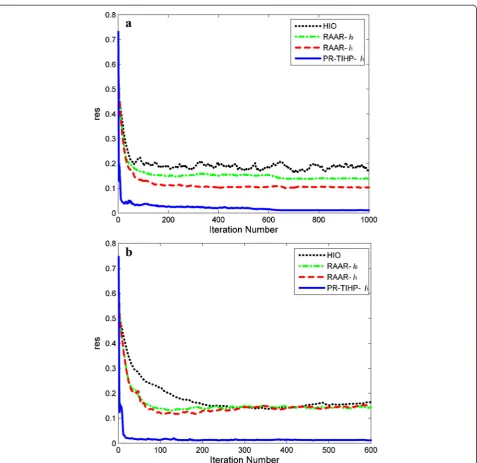
to a stable point as the iteration increases. Figure 5 gives the plot of res, namely the relative residual norm defined in (24), versus iterations for the image“Lena”and “Fruits” at the oversampled factor 1.58. It is observed in Fig. 5 that the three benchmark algorithms are easy to strap into stagnation at this oversampled factor. One can
see our PR-TIHP-l1 algorithm can circumvent this issue
and become flat and stable ultimately, indicating good con-vergence property. As the non-convex optimization prob-lem may yield some perturbations in the convergent
curves, one can see some perturbations in our stable curves.
To show the computational cost, we present the running
time of our PR-TIHP-l1 algorithm and the benchmark
algorithms in Table 2. In the table, the“average”means the average running time of processing the two testing images. From Table 2, one can see our proposed algorithm results in faster imaging speed compared to the sparsity-based benchmark algorithms. The high computational cost of the
projection operator PM and PS should account for the
slower imaging speed of the RAAR-l0 algorithm and the
RAAR-l1 algorithm. However, from Table 2, one can see
our algorithm is slower than the HIO algorithm in terms of the average running time. The TIHP transform and its inverse transform should account for the higher average running time of our algorithm compared to the HIO algo-rithm. Interestingly, for image “Fruits,” our algorithm is faster than the HIO algorithm. Since different image con-tains different component, the running time for the two testing images is different. Indeed, for image “Fruits,” our algorithm only needs 605 iterations, which results in a fas-ter imaging speed. From the results and the analysis of the running time, one can see our algorithm outperforms the RAAR-l0algorithm and the RAAR-l1algorithm in terms of
both reconstruction quality and imaging speed. Although the average time of the HIO algorithm is less, the recon-struction quality of the HIO algorithm is extremely worse than our algorithm at low oversampled factors.
Fig. 2The reconstructed“Lena”images by PR-TIHP-l0and PR-TIHP-l1with various oversampled factors and their corresponding non-negative support
4.3 Phase retrieval from noisy oversampled diffraction pattern
We simulated a noisy diffraction pattern from the image “Lena” at oversampled factor 1.74. Under the noisy data case, we incorporate the oversampling smoothness (OSS) algorithm [20], which produces consistently better recon-struction than the HIO algorithm under the noisy scenario, instead of the HIO algorithm for comparison. The OSS
code can be downloaded from the author’s homepage and
the maximum iterations for OSS we set is also 3000. Note that the random phase without support constraint is suit-able for OSS, we utilized its initial method for initial guess of OSS; moreover, the same initialization is as described in
Section 4.1 for the other algorithms. We added the random noisenon the true oversampled diffraction pattern to gen-erate the noisy measurement databnoise=b+n.. The noise
n is scaled so that the Rnoise defined by Rnoise= ||b−
bnoise||1/||b||1is ranging from 5–20 %. For each noise level,
we performed 20 independent runs and calculated theRreal
[20]:Rreal= ||x(t)−x||1/||x||1to evaluate the reconstruction
quality.
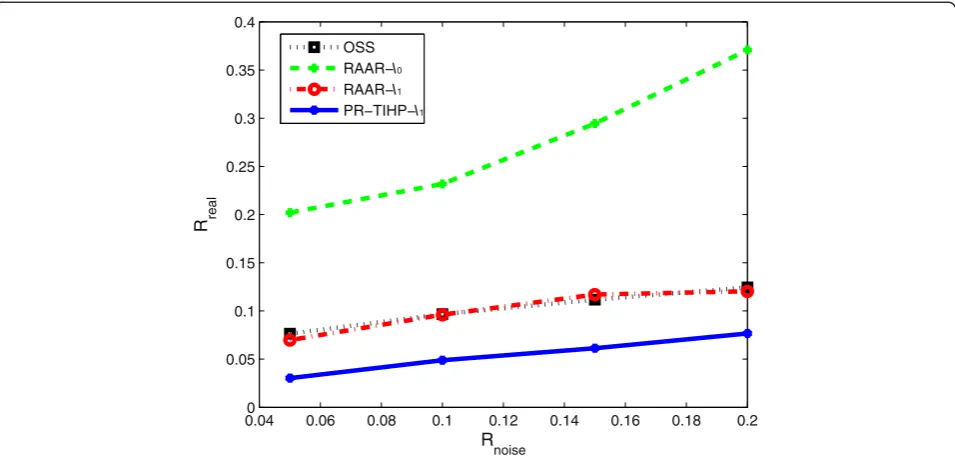
The Gaussian noise is added on the true oversampled diffraction pattern to characterize the effects of different noise levels on the reconstructions. The averageRrealof the
three benchmark algorithms and our algorithm as a func-tion of the noise levels are presented in Fig. 6. From Fig. 6,
Fig. 3The reconstructed“Lena”images with 324 × 324 pixels.Top-row(left to right):aThe original image.bThe reconstructed image by HIO;
Bottom row(left to right), the reconstructed images by:cRAAR-l0.dRAAR-l1.ePR-TIHP-l1
Fig. 4The reconstructed“Fruits”images with 324 × 324 pixels.Top-row(left to right):aThe original image.bThe reconstructed image by HIO;
one can see our algorithm always shows a smaller Rreal,
which indicates that the best reconstructions are achieved by our algorithm. To further verify that our algorithm can obtain a better reconstruction, the best reconstruction, namely the reconstruction with the smallestRreal, of each
algorithm under the Gaussian noise case withRnoise= 10 %
is presented in Fig. 7 (the original image is presented in
Fig. 7a). Visually, the RAAR-l0 algorithm produces the
worst reconstruction (see Fig. 7c). The OSS algorithm is
better than the RAAR-l0 algorithm, but it suffers from
much artifacts and loses much details (see Fig. 7b).
Although the RAAR-l1 algorithm outperforms the other
Table 2Time (s) for phase retrieval of our PR-TIHP-l1algorithm
and the benchmark algorithms
Testing image HIO RAAR-l0 RAAR-l1 PR-TIHP-l1
Lena 269.00 3403.06 1559.63 797.27
Fruits 268.52 3423.63 1578.53 159.94
Average 268.76 3413.34 1569.08 478.60
Fig. 5Comparisons of the convergence behaviors of HIO, RAAR-l0, RAAR-l1, and PR-TIHP-l1. The relative residual norm (res) versus iterations:
two benchmark algorithms in terms of the reconstruction quality, much details are still lost in the reconstruction of
the RAAR-l1 algorithm (see Fig. 7d). One can see our
reconstruction in Fig. 7e not only reduces the artifacts but also preserves much details compared with the other three benchmark algorithms. The results demonstrate that our algorithm is robust to noise.
5 Conclusions
In this paper, we have introduced a framework for PR based on translation invariant Haar pyramid. Our main
idea is to formulate sparse representation regularization term of utilizing TIHP tight frame for PR. We incorpo-rated the formulated regularization term into the PR problem, which yields a new non-convex optimization problem. ADMM technology was utilized for solving the resulting problem, and a satisfied solution is obtained.
We demonstrated the l1 norm that promoted sparsity
can obtain better reconstruction than l0 norm for our
approach heuristically. Moreover, experimental simula-tions showed that our proposed approach considerably outperforms the previous PR algorithms in terms of
Fig. 7The reconstructed“Lena”images with 294 × 294 pixels from the Gaussian noisy oversampled diffraction pattern.Top-row(left to right):a
The original image.bThe reconstructed image by OSS (Rreal= 0.094);bottom row(left to right), the reconstructed images by:cRAAR-l0(Rreal=
0.1846).dRAAR-l1(Rreal= 0.0473).ePR-TIHP-l1(Rreal= 0.0391)
0.040 0.06 0.08 0.1 0.12 0.14 0.16 0.18 0.2 0.05
0.1 0.15 0.2 0.25 0.3 0.35 0.4
R
noise R real
OSS RAAR−l0
RAAR−l1
PR−TIHP−l1
reconstruction quality at low oversampled factors. The Gaussian noise with various noise levels was added on the true oversampled diffraction pattern to evaluate the reconstruction quality of our algorithm showing robust to noise. In this paper, TIHP tight frame is chosen for our approach to retrieval phases as well as recover im-ages. Exploiting finer tight frame to improve the recon-struction quality is our future work.
Competing interests
The authors declare that they have no competing interests.
Acknowledgements
This work was supported by the National Natural Science Foundation of China under Grant 61471313 and by the Natural Science Foundation of Hebei Province under Grant F2014203076.
Received: 25 June 2015 Accepted: 13 November 2015
References
1. Y Shechtman, YC Eldar, O Cohen, HN Chapman, J Miao, M Segev, Phase retrieval with application to optical imaging: a contemporary overview. IEEE Signal process. Mag.32, 87–109 (2015)
2. JR Fienup, Phase retrieval algorithms: a personal tour [invited]. Appl. Opt. 52, 45–56 (2013)
3. RW Gerchberg, WO Saxton, A practical algorithm for the determination of phase from image and diffraction plane pictures. Optik35, 237–246 (1972) 4. JR Fienup, Reconstruction of an object from the modulus of its Fourier
transform. Opt. Lett.3, 27–29 (1978)
5. CL Guo, S Shi, JT Sheridan, Iterative phase retrieval algorithms I: optimization. Appl. Opt.54, 4698–4708 (2015)
6. HH Bauschke, PL Combettes, DR Luke, Hybrid projection reflection method for phase retrieval. JOSA A.20, 1025–1034 (2003)
7. DR Luke, Relaxed averaged alternating reflections for diffraction imaging. Inverse Probl.21, 37–50 (2005)
8. S Mukherjee, CS Seelamantula, Fienup algorithm with sparsity constraints: application to frequency-domain optical-coherence tomography. IEEE Trans. Signal Process.62, 4659–4672 (2014)
9. S Loock, G Plonka, Phase retrieval for Fresnel measurements using a shearlet sparsity constraint. Inverse Probl. 30, (2014)
10. Y Shechtman, A Beck, YC Eldar, GESPAR: efficient phase retrieval of sparse signals. IEEE Trans. Signal Process.62, 928–938 (2014)
11. H Ohlsson, AY Yang, R Dong, SS Sastry,Nonlinear basic pursuit, 2013 12. R Fan, Q Wan, F Wen, YP Liu, Iterative projection approach for phase
retrieval of semi-sparse wave field. EURASIP J. Adv. Sig. Proc (2014). doi:10. 1186/1687-6180-2014-24
13. DS Weller, A Pnueli, G Divon, O Radzyner, YC Eldar,Undersampled phase
retrieval with outliers, 2014. arXiv:1402.7350
14. Z Yang, CS Zhang, LH Xie,Robust compressive phase retrieval via
L1minimization with application to image reconstruction(Cornell University,
Ithaca, 2013)
15. S Boyd, N Parikh, E Chu, B Peleato, J Eckstein, Distributed optimization and statistical learning via the alternating direction method of multipliers. Foundations and trends in machine learning20, 681–695 (2011) 16. JA Guerrero-Colon, L Mancera, J Portilla, Image restoration using space-variant
Gaussian scale mixture in overcomplete pyramids. IEEE Trans. Image Process. 17, 27–41 (2008)
17. J Portilla,Image restoration through L0analysis-based sparse optimization in
tight frames(Paper presented at the IEEE international conference on image
processing, Cairo, 2009), pp. 3909–3912
18. R. Glowinski, Lectures on numerical methods for nonlinear variational problems (Springer, Berlin Heidelberg, 1981)
19. ZW, Wen, C Yang, X Liu, S Marchesini, Alternating direction methods for classical and psychographic phase retrieval. Inverse Probl.28, (2012) 20. JA Rodriguez, R Xu, CC Chen, Y Zou, J Miao, Oversampling smoothness: an
effective algorithm for phase retrieval of noisy diffraction intensities. J. Appl. Cryst.46, 312–318 (2013)
Submit your manuscript to a
journal and benefi t from:
7Convenient online submission
7Rigorous peer review
7Immediate publication on acceptance
7Open access: articles freely available online 7High visibility within the fi eld
7Retaining the copyright to your article