R E S E A R C H
Open Access
Coalescence-avoiding joint probabilistic data
association based on bias removal
Peiliang Jing
1, Shiyou Xu
1*, Xian Li
2and Zengping Chen
1Abstract
In order to deal with the track coalescence problem of the joint probabilistic data association (JPDA) algorithm, a novel approach from a state bias removal point of view is developed in this paper. The factors that JPDA causes the state bias are analyzed, and the direct computation equation of the bias in the ideal case is given. Then based on the definitions of target detection hypothesis and target-to-target association hypothesis, the bias estimation is extended to the general and practical case. Finally, the estimated bias is removed from the state updated by JPDA to generate the unbiased state. The results of Monte Carlo simulations show that the proposed method can handle track coalescence and presents better performance when compared with the traditional methods.
Keywords:Multi-target tracking; Joint probabilistic data association; Track coalescence; Bias estimation
1 Introduction
Target tracking is an important task for surveillance sys-tems employing one or more sensors, such as radar, sonar, and so on, together with computer subsystems, to interpret the environment. Since most surveillance sys-tems need to track multiple targets, multi-target tracking (MTT) is one of the most important tracking applica-tions [1-6]. Typical sensor systems have target detection probability being less than unity and report measure-ments from diverse resources: targets of interest, internal thermal noise, or clutter. For MTT in this in-stance with missed detections, clutter, and false alarms, the JPDA algorithm [7], which is a multi-target exten-sion of probabilistic data association (PDA) algorithm [8], has shown to be very effective. The JPDA receives many researchers’ attention, and a lot of variants were developed such as the series for computational complex-ity reduction and the extensions for some special pur-poses [9]. However, the JPDA has some undesirable characteristics such as bias and coalescence when used in a dense target environment. This is unfortunate, since such environment is the main justification for the use of the sophisticated MTT algorithms, e.g., JPDA.
In response to the track coalescence problem, the exact nearest neighbor JPDA (ENNJPDA) method and approximate nearest neighbor JPDA (ANNJPDA) me-thod have been proposed [10]. The ENNJPDA computes measurement-to-target probabilities in the same manner as JPDA. However, after a measurement-to-target assign-ment is performed, tracks are only updated by a single measurement. The assignment is based on the solving of the assignment matrix in the same manner as the global nearest neighbor method. The ANNJPDA is similar to ENNJPDA, but its measurement-to-target probabilities are computed by an ad hoc formula. Another method being specific to track coalescence problem is JPDA* [11-13]. The JPDA* is the improved version of JPDA with one key modification: for each set of detected targets and set of measurements, only the best joint association event is chosen to be used in the calculation of the measurement-to-target probabilities. The other events that consist of the same sets of measurements and targets, but with a different assignment, are dis-carded. The developers believed that the ENNJPDA has the drawback of being sensitive to clutter and missed de-tections, and this drawback could be avoided by JPDA*. Also a fast version of JPDA* is presented [14]. A scaled joint probabilistic data association (SJPDA) method using an arbitrary positive scaling factor to favor the most likely association hypothesis has been proposed in [15]. The main drawback of this method is the lack of * Correspondence:[email protected]
1
Science and Technology on Automatic Target Recognition Laboratory, National University of Defense Technology, Changsha 410073, China Full list of author information is available at the end of the article
theory support about what the factor value should be chosen. Furthermore, based on entropy value theory, Xu et al. presented a modified probabilistic data association method [16-19].
The existing methods discussed above all applied hy-pothesis pruning or scaling strategy to prevent track co-alescence. In essence, they are heuristic ones which can be considered as the compromises between the soft data asso-ciation of the JPDA method and the hard data assoasso-ciation of the global nearest neighbor method. Therefore, these methods deviate from the original definition of JPDA, which derives the target state by its weighted expectation over the feasible joint association hypothesis space.
Recently, another two methods are developed. One is the coalescence avoiding optimal JPDAF (C-JPDAF) [20], and the other is the SetJPDAF [21,22]. The C-JPDAF min-imizes a similarity index of the estimates to avoid the track coalescence. Since the measurement model for this method is rather simple and the common clutter situation is not considered, its applications appear to be very limited. The SetJPDAF was derived with the objective of minimizing the mean optimal subpattern assignment (MOSPA) measure within the framework of finite set sta-tistics. The SetJPDAF is only suitable for situations where the identity (labeling) of the targets is not of great impor-tance, and the computational complexity or the conver-gence of the fast and suboptimal variant appears to be a great obstacle to the practical applications.
In this paper, we propose a coalescence-avoiding JPDA based on bias removal (BRJPDA). The BRJPDA is the same as JPDA, but a procedure of state bias estimation and removal is embedded after the ordinary state up-dating procedure. The bias estimation is similar to that in [23]. In [23], the bias of JPDA was calculated in an ideal case of two stationary targets with known sepa-ration, known measurement origin, unity probability of detection, unity probability of gating, and no false mea-surements nor measurement noise. It is apparent that these requirements can hardly be satisfied in practical applications. In this paper, these requirements are re-moved, thus the bias estimation is extended to the gen-eral and practical case. The extension is based on the definition of target detection hypothesis and target-to-target association hypothesis. Then, the bias could be es-timated through its expectation over these hypotheses. Therefore, the impractical computation method [23] of the state bias could be avoided. Finally, the bias is re-moved to prevent the track coalescence and to promote the tracking performance.
The remainder of the paper is organized as follows. In Section 2, the system model and the fundamental principle of JPDA are described. The detail of state bias estimation and removal is discussed in Section 3. The numerical simulation results as well as the comparison
with the traditional methods are provided in Section 4. Finally, we summarize and conclude this paper in Section 5.
2 System model and fundamental principle of JPDA
2.1 The target model
We considertktargets at scank, and we assume that the state of theith target is modeled as follows:
xið Þ ¼k Φxiðk−1Þ þvið Þk ; i¼1;…;tk; ð1Þ
2.2 The measurement model
A set of measurements consisting of two types of mea-surements, namely measurements originating from tar-gets and measurements originating from clutter or false alarm, is considered. Assume the numbers of the two types of measurements aredkandfk, respectively. There-fore, the total number of the measurements is:
mk¼dkþfk: ð2Þ
Measurement originating from target has a detection probabilitypdand is modeled as:
zið Þ ¼k Hxið Þ þk wið Þk ; i¼1;…;dk; ð3Þ where zi(k) is the m-vectorial measurement, H is the (m× m) measuring matrix, and wi(k) is them-vectorial measurement noise. Furthermore, wi(k) is a sequence of i.i.d. standard Gaussian variable with wi(k), wj(k) inde-pendent for alli≠j, and it’s variance matrix isR.
The false measurements are assumed to distribute uni-formly in the surveillance area. Moreover,fk is assumed to have Poisson distribution with a spatial densityλ.
2.3 Fundamental principle of JPDA
PiðkjkÞ ¼Piðkjk−1Þ−ð1−pi0ÞKi HPiðkjk−1ÞH
The main complexity about JPDA is the computation of pij, which represents the probability of zj(k) origi-nating from the ith target (i ≠ 0) or clutter/false alarm (i = 0). The JPDA computes pij by enumerating all the feasible joint association hypotheses, normalizing the probability of each hypothesis, and summing up the prob-abilities of the hypotheses in which zj(k) originates from theith target.
3 Bias estimation and removal 3.1 The source of bias
In order to reduce the computational complexity, gating, a technique for eliminating unlikely measurement to track pairings, is applied in JPDA. Thus, the validation region for each track is restricted to be a symmetric re-gion (generally an ellipse or ellipsoid) whose center point coincides with the prediction measurement of the track. Therefore, one could have:
Eðzjð Þk zjð Þk ∈Vi; zjð Þk is a false measurement
¼EðHΦ^xiðk−1jk−1ÞÞ; j¼1;…;mk; ð8Þ whereViis the validation region for theith track. More-over, for measurement originating from the true target, one could have:
ð Þcould be partitioned into three sets:
Then, Equation 4 could be rewritten as:
^ unbiased, which could be derived by the following bias removal procedure at scan k−1, and this is the pre-requisite to estimate the bias of^xiðk kj Þ:
From Equation 15, it is intuitive that the bias of
^
xiðk kÞj is only caused by zjð Þk ∈Zi;3ð Þk . However, this
direct computation of the bias is impossible in the prac-tical situation, since the measurements that belong to
Zi;3ð Þk are unknown.
3.2 Bias estimation for a two target case
In this paper, we tend to use another way to derive the bias approximation of JPDA. The basic idea is first to enumerate all the feasible joint association hypotheses of JPDA. Then, we can find a set of target-to-target associ-ation hypotheses corresponding to these feasible joint association hypotheses. Finally, the bias magnitude of every track within the framework of this set of target-to-target association hypotheses is calculated.
gating, and no false measurements. In this situation, at every scan k, the JPDA will produce two joint asso-ciation hypotheses, which are:
H1:z1(k) originates from the first target, andz2(k) orig-inates from the second target.
H2: z1(k) originates from the second target, andz2(k) originates from the first target.
Then, the corresponding set of target to target asso-ciation hypotheses could be given as:
h1: the origin of the measurement used to update the first target is the first target, and the origin of the mea-surement used to update the second target is the second target.
h2: the origin of the measurement used to update the first target is the second target, and the origin of the measurement used to update the second target is the first target.
It is clear that one joint association hypothesis must have one corresponding target-to-target association hy-pothesis, although the precise corresponding relation-ship is not known. Therefore from an overall point of view, the two sets of different kinds of hypotheses should describe the same thing in some sense. Since JPDA employs the whole set of joint association hypoth-eses to do the state updating procedure, we believe that the bias of JPDA could possibly be calculated within the framework of the corresponding set of target-to-target association hypotheses. Actually, we developed a method of calculating the probability of the target-to-target asso-ciation hypothesis and the bias of each target in this hy-pothesis. The probability and the bias could be considered as an approximation of those produced by the corresponding joint association hypothesis. Still con-sidering the two target examples, the probability of the target-to-target association hypothesis could be yielded as follows:
is the likelihood of the partial target-to-target hypothesis that the origin of the measurement used to update the
ith target is thejth target. Here,
Ci¼Piðk k−j 1Þ þR ð19Þ
represents the residual covariance of theith target, and
ri;j¼HΦ ^xjðk−1jk−1Þ−x^iðk−1jk−1ÞÞ
ð20Þ
is an approximation of the residual of this partial hypo-thesis. This approximation is achieved by substituting the prediction measurement of thejth target (HΦ^xjðk−1jk−1Þ) for the observed measurement of thejth target. With the approximation, the determination about which measure-ment originates from the jth target is avoided. The ap-proximation is reasonable since both the prediction measurement and the observed measurement of the jth target have the same expectation. Then, the state bias of the two targets could be given by a weighted average over the target-to-target hypotheses:
3.3 Bias estimation and removal for the general multi-target case
By now, we just take two targets into consideration. Next, we will focus on the enumeration of the target-to-target hypotheses in the general multi-target-to-target case with the false alarms and detection probability being less than unity.
First, we assume that JPDA produces a total number #H of feasible joint association hypothesis at the scank, and δi(Hj) is the detection indicator of the ith target in thejth hypothesisHj:
δi Hj ¼ 1;0; if theelse;ith target is detected in hypothesisHj
ð23Þ
Thus, the target detection indicator vector inHjcould be defined as:
δ Hj ≜δ1 Hj δ2 Hj …δtk Hj
; j¼1;2;…;#H:
ð24Þ
Moreover, we assume that all the feasible joint asso-ciation hypotheses generate a total number #δ of dif-ferent target detection indicator vectors, which are δ1, δ2,…,δ#δ, respectively. Target detection hypothesis then
is defined as a subset of feasible joint association hy-potheses that produce the same target detection indica-tor vecindica-tor:
ωi¼Hjδ Hj ¼δi;j¼1;2;…;#H; i¼1;2;…;δ: ð25Þ
0 5 10 15 20 25 30 35 −0.5
−0.4 −0.3 −0.2 −0.1 0 0.1 0.2 0.3 0.4 0.5
←
Target 1
←
Target 2
True position x
True position
y
start point end point
Figure 1The simulated scenario 1, R = I2 × 2, sx=0.414, sy= 0.01.
−30 −20 −10 0 10 20 30
−30 −20 −10 0 10 20 30
←Target 1
←Target 2
↑
↓
d
1
True position x
True position
y
start point end point
pðωiZk ¼ X
Hj∈ωi
p HjZk ; i¼1;2;…;#δ;
ð26Þ
where Zk is the accumulated measurements until scan
k and p(Hj| Zk) is the a posteriori probability of Hj which was given in [7]. Then, number the jth target the number j, thus the target number set of every tar-get detection hypothesis ωi is defined as:
ξi¼ jδjð Þ ¼H 1;j¼1;2;…;tk
; ∀H∈ωi; i¼1;2;…;#δ:
ð27Þ
The definition of this target number set is very important. Based on every ξi, one subset of target-to-target hypotheses is enumerated, as the correspondence of the subset of the joint association hypothesesωi. The procedure of target-to-target hypotheses enumeration based onξiis as follows. First, denote Πξi as the set of
permutations on ξi. Then for ∀πj∈Πξi;j¼1;2;…;card
Πξi
; let πj represent the target-to-target association hypothesis that measurement of the πj(n)th target is used to update theξi(n) th target, whereπj(n) and ξi(n) mean the nth element of πj and ξi, respectively. There-fore, the subset of target-to-target association hypotheses corresponding toωiis enumerated. One may argue that a gating probability less than unity could prune some joint association hypotheses in ωi. We agree with this viewpoint. Since the hypothesis being pruned generally has a very smalla posteriori probability when compared with the ones that are not being pruned, we believe this effect could be ignored. It should be noted that for the sameξi, there may be more than one subset of observed measurements used to form the feasible joint association hypotheses in ωi. Therefore, the number of hypotheses in ωi is almost always larger that in Πξi. For this
prob-lem, we multiply the normalized probability of hypo-theses inΠξi byp(ωi|Z
k).
−10 0 10 20 30 40 50
−15 −10 −5 0 5 10 15
True position x
True position
y
Target measurement False alarm
JPDA CorrectAsso ENNPDA JPDA* SetJPDA BrJPDA
Thereby, the bias of x^iðk kj Þ could be computed by a weighted average over all the target-to-target hypotheses:
Δx^i in hypothesisπnconditioned onωj:
E Δ^xi k kÞπn;ωj;Zk
At every scan k, once the ordinary state updating of JPDA has been done, the filtered but biased state vector
^
xiðk kÞj for theith track would be obtained. The bias re-moval is by subtracting Δ^xiðk kj Þfrom x^iðk kÞj , and thus the unbiased state is:
⌢xi k kÞ ¼^xi k kÞ−Δx^i
4 Simulations and discussions
In this section, the proposed BRJPDA is evaluated and compared with the existing methods, namely JPDA, ENNJPDA, SetJPDA, and JPDA*. Moreover, the filtering method with perfect data association, denoted
−30 −20 −10 0 10 20 30
True position x
True position
by CorrectAsso, is also considered in the simulation for comparison. The implementation of SetJPDA retains only at most ten hypotheses with the largest a posteriori prob-abilities to do the reordering procedure by the brute force method. The fast and suboptimal method of SetJPDA is not applied because the starting point for this algorithm is important but may be scenario dependent and only is given for a special scenario through empirical studies [22]. The aim of the hypotheses pruning for SetJPDA is reducing the computational complexity to a general case. Thus, the im-plementation of the SetJPDA could be possible.
4.1 Scenarios and performance criteria
We applied two scenarios which are similar to those in [10,13,14,21,22]. For each scenario, the total scan number isM= 80, and the scan interval isT= 1 s. The track state
x is defined to be ½x x y_ y_: We applied perfect
association for all the algorithms considered for the first
M/4 scans and set the process noise level according to Equation 24 in [14]. To make the comparisons more meaningful, for all tracking methods, the same random measurements streams were used.
Scenario 1: Two constant-speed, non-maneuvering tar-gets whose paths cross. Tracking begins and ends far from the crossover point. Two parameterssx(being con-stant) and sy (being variable) are defined to denote the normalized targetxandyspeed
sx¼ x_1
j jffiffiffiffiffiffiffi⋅T R11
p ¼j jx_2ffiffiffiffiffiffiffi⋅T R11
p ;
sy¼ y_1
j jffiffiffiffiffiffiffi⋅T R22
p ¼j jy_2ffiffiffiffiffiffiffi⋅T R22
p :
8 > > < > >
: ð34Þ
Scenario 2: Two targets approach each other for the firstM/4 scans, then keep parallel at a close distance for
0 0.02 0.04 0.06 0.08 0.1 0.12 0.14 0
0.02 0.04 0.06 0.08 0.1 0.12 0.14
s
y
a
p coalescing
JPDA CorrectAsso ENNJPDA JPDA* SetJPDA BRJPDA
0.2 0.3 0.4 0.5 0.6 0.7 0.8 0.9 1 0
0.2 0.4 0.6 0.8 1
d
1
b
p coalescing
JPDA CorrectAsso ENNJPDA JPDA* SetJPDA BRJPDA
M/2 scans, and finally separate each other. The scenario is the same as that in [22], but with a variable minimum distance d1 between the two targets to characterize the scenario.
Figures 1 and 2 give the illustrations of the two scenar-ios with typical parameters.
Four evaluation criteria similar to those in [10,13,14,22] are considered to evaluate the anti-coalescing and the computational complexity performance.
The first performance criterion [13] is the probability of coalescing situation of the tracks. We count tracks i ≠j
coalescing at scankif
xið Þk−xjð Þk
Denote this probability by pcoalescing. In Equation 35,
║∙∙∙║2
is the 2-norm operation.
The second performance criterion [10] is the probabil-ity of a successful track crossover, and it is specially de-signed for scenario 1. In detail, tracksi ≠j are counted
‘successful crossover’if
X3
Denote this probability bypsuccess. In Equation 36,⊕is the exclusive OR operation.
The third performance criterion [14] is the optimal subpattern assignment (OSPA) statistic [14,22,24,25]. In our simulations, the ‘cardinality error’ of OSPA is not
considered. The OSPA statistic between the set of target estimated states ⌢Xð Þk ≜f⌢xiðk kj Þji¼1;2;…;tkg and the
component of the state in the calculation of the OSPA. Over a number of Monte Carlo runs and the time in-dexes, we take the average of these OSPAs to find the mean OSPA (MOSPA), which is denoted by ετ(ς) as a curve of the parameter of each scenario:
ετð Þ ¼ς 1
scenario τwith parameter ςin the jth Monte Carlo run. Another MOSPA definition is the same as that in [21]:
ετ;ςð Þ ¼k 1
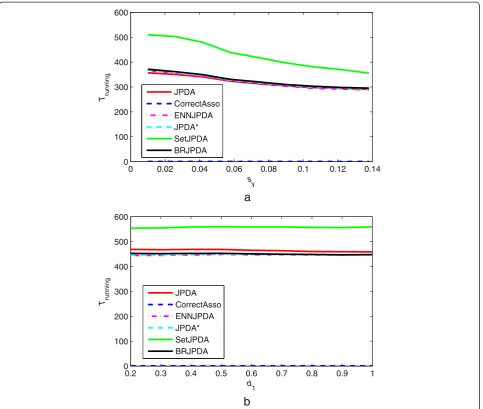
The fourth performance criterion (denoted byTrunning) is the total running time for every method, in MATLAB, for 300 Monte Carlo runs in s on an Intel Core i5 2.80 GHz.
4.2 Results and discussions
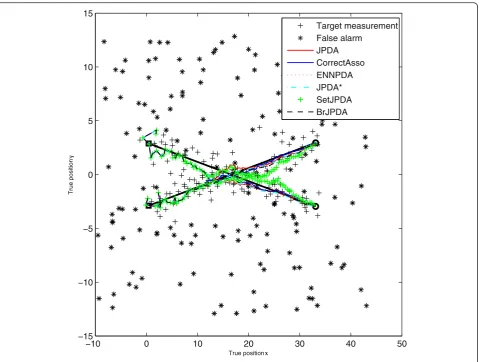
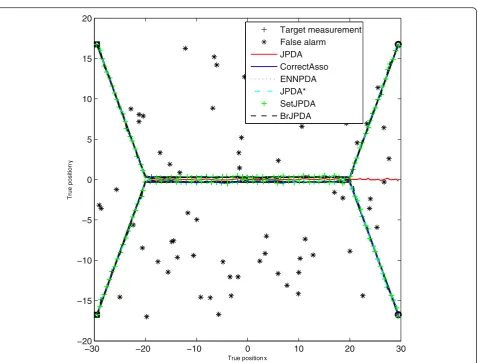
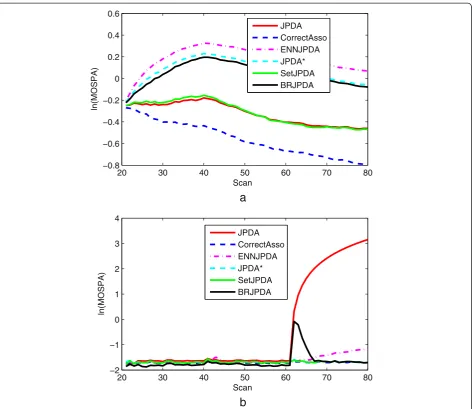
Figures 3 and 4 gave results of one Monte Carlo run for the two scenarios.
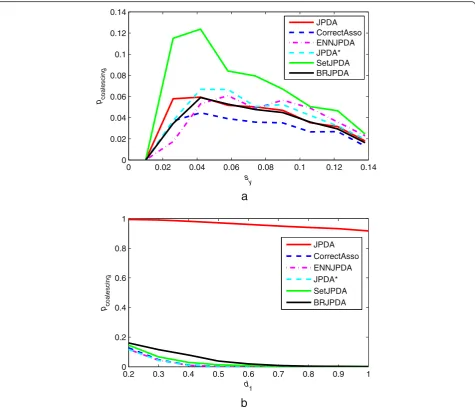
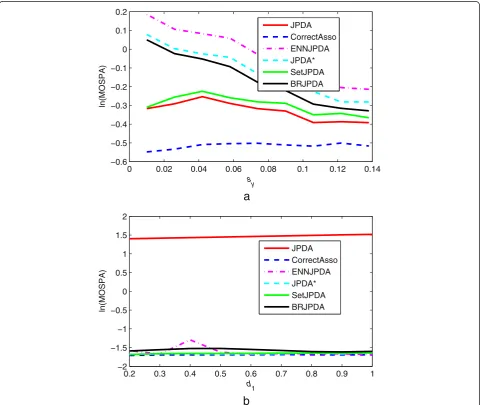
The pcoalescing, psuccess, MOSPA, and Trunning curves were shown in Figures 5, 6, 7, 8, and 9.
From thepcoalescing plots in Figure 5, it was clear that the performances of all the methods varied with the changing of the scenario and the scenario parameter. And the best method under different parameter in sce-nario 1 was different. Specifically, BRJPDA was the only one which was better than JPDA in scenario 1. The performance improvements of all the anti-coalescing methods compared with JPDA seemed almost the same in scenario 2. Therefore, when pcoalescing was used, the simulation results showed that BRJPDA could outper-form all the other anti-coalescing methods. Note that
the CorrectAsso should not be considered as an effec-tive method, and it just acted as a performance reference.
Figure 6 showed that thepsuccessperformance of all the anti-coalescing methods was worse than that of JPDA. And BRJPDA had the best performance during all the anti-coalescing methods. In this criterion, SetJPDA was not considered for comparison since it had no target iden-tity and thus was senseless.
The results in Figure 7a showed that SetJPDA signifi-cantly outperformed the other three anti-coalescing methods. It is because that the SetJPDA was specially de-signed to minimize the MOSPA measure at the cost of the lost of target identity. If SetJPDA was not considered for comparison, then BRJPDA seemed to be the best anti-coalescing method. For the results in Figure 7b, all the
0 0.02 0.04 0.06 0.08 0.1 0.12 0.14 −0.6
−0.5 −0.4 −0.3 −0.2 −0.1 0 0.1 0.2
sy
a
ln(MOSPA)
JPDA CorrectAsso ENNJPDA JPDA* SetJPDA BRJPDA
0.2 0.3 0.4 0.5 0.6 0.7 0.8 0.9 1 −2
−1.5 −1 −0.5 0 0.5 1 1.5 2
d1
b
ln(MOSPA)
JPDA CorrectAsso ENNJPDA JPDA* SetJPDA BRJPDA
anti-coalescing methods appeared to have almost the same performance.
To give more detailed information, the MOSPA perfor-mances for two scenarios with special parameters were given in Figure 8. The results in Figure 8a were consistent with those in Figure 7a. However, there was an interesting phenomenon in Figure 8b. Particularly, for the keeping parallel period of the two targets, the BRJPDA showed the best performance. Although a performance decrease oc-curred when the targets began to separate, this decrease could continue for only a few scans.
Figure 9 showed that the SetJPDA had a rather bad performance in computation complexity when compared with the other coalescing methods. And all the anti-coalescing methods except for the SetJPDA had almost the same computation complexity.
No doubt that the evaluation of the performance of a multi-target tracking system is a difficult problem, since the performance of the method is highly criterion, sce-nario, and parameter dependent. It may be impossible that a practical algorithm can outperform all the other algorithms over all the scenarios and all the parameter values. For example, JPDA showed the best performance in Figure 6; however, it showed the worst performance in Figures 5b, 7b, and 8b. Another example is that SetJPDA showed the best performance in Figure 7b; however, it showed the worst performance in Figures 5a and 9. This drastic variation of performance may also in-dicate that JPDA and SetJPDA are not robust. As for the other methods, BRJPDA were shown to be able to outperform ENNJPDA and JPDA* in Figures 5a, 6, 7a, and 8a and have almost the same performance as
20 30 40 50 60 70 80
−0.8 −0.6 −0.4 −0.2 0 0.2 0.4 0.6
Scan
a
ln(MOSPA)
JPDA CorrectAsso ENNJPDA JPDA* SetJPDA BRJPDA
20 30 40 50 60 70 80
−2 −1 0 1 2 3 4
Scan
b
ln(MOSPA)
JPDA CorrectAsso ENNJPDA JPDA* SetJPDA BRJPDA
ENNJPDA and JPDA* in other simulation results. More-over, BRJPDA exhibited a rather robust performance. By analyzing the simulation results in different scenarios and performance criteria, BRJPDA appeared to show better performance than JPDA and the other three anti-coalescing algorithms, which could be taken as a good choice for the MTT system.
5 Conclusions
In this paper, a novel solution to the inherent track co-alescence problem of the well-known JPDA algorithm, from a target state bias removal point of view, is studied. First, the reason why JPDA could cause bias is analyzed. Then, the bias is estimated in the general and practical case, through its expectation over target detection
hypotheses and target-to-target association hypotheses space. Finally, the bias is removed. Monte Carlo simu-lations are applied to evaluate the performance of the proposed method and the existing methods. From an overall point of view, BRJPDA exhibits better perfor-mance than the traditional algorithms.
Competing interests
The authors declare that they have no competing interests.
Author details
1Science and Technology on Automatic Target Recognition Laboratory, National University of Defense Technology, Changsha 410073, China.2School of Information Science and Engineering, Central South University, Changsha 410083, China.
Received: 7 April 2014 Accepted: 5 February 2015 0 0.02 0.04 0.06 0.08 0.1 0.12 0.14 0
100 200 300 400 500 600
sy
a
T running JPDA
CorrectAsso ENNJPDA JPDA* SetJPDA BRJPDA
0.2 0.3 0.4 0.5 0.6 0.7 0.8 0.9 1 0
100 200 300 400 500 600
d1
b
T running
JPDA CorrectAsso ENNJPDA JPDA* SetJPDA BRJPDA
References
1. S Blackman, R Popoli,Design and Analysis of Modern Tracking System
(MA: Artech House, Boston, 1999)
2. Y Bar-Shalom, XR Li,Multitarget-Multisensor Tracking: Principles and Techniques(CT: YBS Publishing, Storrs, 1995)
3. DB Kim, SM Hong, Multiple-target tracking and track management for an FMCW radar network. EURASIP J. Adv. Signal Process. (2013). doi:10.1186/1687-6180-2013-159
4. C Hu, T Zeng, C Zhou, Accurate three-dimensional tracking method in bistatic forward scatter radar. EURASIP J. Adv. Signal Process. (2013). doi:10.1186/1687-6180-2013-66
5. SS Blackman, Multiple hypothesis tracking for multiple target tracking. IEEE Aero. Electron. Syst. Mag.19(1), 5 (2004)
6. D Vivet, P Checchin, R Chapuis, P Faure, A mobile ground-based radar sensor for detection and tracking of moving objects. EURASIP J. Adv. Signal Process. (2012). doi:10.1186/1687-6180-2012-45
7. TE Fortmann, Y Bar-Shalom, M Scheffe, Sonar tracking of multiple targets using joint probabilistic data association. IEEE J. Ocean. Eng.8(3), 173 (1983) 8. Y Bar-Shalom, E Tse, Tracking in a cluttered environment with probabilistic
data association. Automatica11(5), 451 (1975)
9. B Habtemariam, R Tharmarasa, T Thayaparan, M Mallick, T Kirubarajan, A multiple-detection joint probabilistic data association filter. IEEE J Sel. Topic Signal Process.7(3), 461 (2013)
10. RJ Fitzgerald,Development of practical PDA logic for multitarget tracking by microprocessor, in American Control Conference. (Seattle, 1986), p. 889–898 11. HAP Blom, EA Bloem,Joint Probabilistic Data Association Avoiding Track
Coalescence, in IEE Colloquium on Algorithms for Target Tracking, (London, 1995), p. 1–3
12. EA Bloem, HAP Blom,Joint Probabilistic Data Association Methods Avoiding Track Coalescence, in Proc. of the 34th IEEE Conference on Decision and Control, (New Orleans, 1995), p. 2752–2757
13. HAP Blom, EA Bloem, Probabilistic data association avoiding track coalescence. IEEE Trans. Automat. Contr.45(2), 247 (2000)
14. K Romeo, DF Crouse, Y Bar-Shalom, P Willett,A Fast Coalescence-Avoiding JPDAF, in Proc. SPIE 8339, Signal and Data Processing of Small Targets, (Baltimore, 2012)
15. HL Kennedy,Controlling Track Coalescence with Scaled Joint Probabilistic Data Association, in 2008 International Conference on Radar, (Adelaide, 2008), p. 440–445
16. SL Chen, YB Xu,Modified Joint Probability Data Association Algorithm Avoiding Track Coalescence. Materials Science and Information Technology, (2012), p. 2298
17. YB Xu, GM Wang, M Zhu, SL Chen,A Scaled Joint Probabilistic Data Association Algorithm, in 2012 International Conference on Communication Systems and Network Technologies, (Rajkot, 2012), p. 238–242
18. YB Xu, JS Ma, Y Wen, M Zhu,Comparing of Several Modified Joint Probabilistic Data Association Algorithms, in Proc. SPIE 8768, International Conference on Graphic and Image Processing, (Singapore, 2012) 19. X Yibing, C Songlin, W Zhaohui, K Lianrui,Modified Joint Probability Data
Association Algorithm Controlling Track Coalescence, in 2011 Fourth International Conference on Intelligent Computation Technology and Automation, (Shenzhen, 2011), p. 442–445
20. K Evan, L Thomas Alan, L Taeyoung,Optimal Joint Probabilistic Data Association Filter Avoiding Coalescence in Close Proximity, in 2014 European Control Conference, (Strasbourg, 2014), p. 2709–2714
21. S Lennart, S Daniel, W Peter,Set JPDA Algorithm for Tracking Unordered Sets of Targets, in 12th International Conference on Information Fusion, (Seattle, 2009), p. 1187–1194
22. S Lennart, S Daniel, G Marco, W Peter, Set JPDA filter for multitarget tracking. IEEE Trans. Signal Process.59(10), 4677 (2011)
23. RJ Fitzgerald, Track biases and coalescence with probabilistic data association. IEEE Trans. Aero. Electron. Syst.AES-21(6), 822 (1985) 24. D Schuhmacher, BT Vo, BN Vo, A consistent metric for performance evaluation
of multi-object filters. IEEE Trans. Signal Process.56(8), 3447 (2008) 25. B Ristic, BN Vo, D Clark, BT Vo, A metric for performance evaluation of
multi-target tracking algorithms. IEEE Trans. Signal Process.59(7), 3452 (2011)
Submit your manuscript to a
journal and benefi t from:
7Convenient online submission
7Rigorous peer review
7Immediate publication on acceptance
7Open access: articles freely available online
7High visibility within the fi eld
7Retaining the copyright to your article