R E S E A R C H
Open Access
A performance optimization strategy based
on degree of parallelism and allocation
fitness
Changtian Ying
1,2, Changyan Ying
2and Chen Ban
2*Abstract
With the emergence of big data era, most of the current performance optimization strategies are mainly used in a distributed computing framework with disks as the underlying storage. They may solve the problems in traditional disk-based distribution, but they are hard to transplant and are not well suitable for performance optimization especially for an in-memory computing framework on account of different underlying storage and computation architecture. In this paper, we first give the definition of the resource allocation model, parallelism degree model, and allocation fitness model on the basis of the theoretical analysis of Spark architecture. Second, based on the model presented, we propose a strategy embedded in the evaluation model which is easy to perform. The optimization strategy selects the worker with a lower load that satisfies requirements to assign the latter tasks, and the worker with a higher load may not be assigned tasks. The experiments consisting of four variance jobs are conducted to verify the effectiveness of the presented strategy.
Keywords:Performance optimization, Parallelism degree, Allocation fitness
1 Introduction
In recent years, big data processing framework [1, 2], especially for in-memory computing framework, en-riches and develops constantly [3, 4]. The in-memory computing has appeared in our view and attracted wide attention in the industry after the SAP TechEd global conference in 2010.
With the development of the in-memory computing framework, some research results are committed to the expansion and improvement of the system. A sim-ple and efficient parallel pipelined programming model based on BitTorrent was proposed by Napoli et al. [5]. Chowdhury et al. implemented the broadcast commu-nication technology for the in-memory computing framework. Lamari et al. [6] put forward the standard architecture of relational analysis for big data. A study by Cho et al. [7] proposed a parallel design scheme. An algorithm using programs to analyze and locate com-mon subexpressions was designed in a study by Kim et
al. [8]. A study by Seol et al. [9] proposed a fine granu-larity retention management for deep submicron DRAMs. et al. designed a unified memory manager separating the memory storage function from comput-ing framework. In a study by Tang et al. [10], a stand-ard engine for distributed data stream computing was designed. A high-performance SQL query system was implemented in a study by Jo et al. [11]. A parallel computing method for the applications with the differ-ential data stream and prompt response was proposed in a study by McSherry et al. [12]. Zeng et al. designed a general model for interactive analysis. A study by Corrigan-Gibbs et al. realized the privacy information communication system of in-memory computing. A study by Sengupta et al. [13] used SIMD-based data parallelism to speed up sieving in integer-factoring algorithms. Ifeanyi et al. [14] presented a compre-hensive survey fault tolerance mechanisms for the high-performance framework.
Some research results focus on the performance optimization for distributed computing framework, which may not suitable for the in-memory framework. Ananthanarayanan et al. proposed the algorithm, * Correspondence:[email protected]
2School of Information Science and Engineering, Xinjiang University, Urumqi 830008, People’s Republic of China
Full list of author information is available at the end of the article
making full use of the data access time and data local-ity. By analyzing the impact of task parallelism on the cache effectiveness, Ananthanarayanan et al. designed a coordinated caching algorithm that adapted to in-memory computing. By monitoring computation overhead, Babu et al. found that the parallelism of the reduce task has a great influence on the performance of MapReduce system, and the task scheduling algorithm is designed to adapt to resource status. In order to predict the response time of worker node, Zou et al. divided a task into different blocks, which can improve the efficiency of tight synchronization ap-plication. In a study by Sarma et al., the communica-tion cost frontier model of worker node was proposed, and the tradeoff between the task parallelism and communication cost were achieved by adjusting the boundary threshold. A study by Pu et al. presented FairRide, a near-optimal, fair cache sharing to improve the performance. Chowdhury et al. proposed an algo-rithm to balance multi-resource fairness for correlated and elastic demands.
However, most of the current performance optimization strategies are mainly used in distributed computing framework with disks as the underlying storage, in which we pay the most attention to two aspects: task scheduling and resource allocation. Therefore, it is of practical significance to study the optimization mechanism of IMC framework from the perspective of underlying memory-based storage and computation architecture.
Therefore, we consider the degree of parallelism and allocation fitness which differs from the existing strat-egy. First, taking the task scheduling into consideration, the rationality of the parallelism degree of the shuffle process for the in-memory framework is easier to ig-nore that may directly affect the efficiency of job execu-tion and the utilizaexecu-tion rate of cluster resources. But the degree of parallelism is usually determined based on user experience, and it is hard to adapt to the exist-ing state of the in-memory framework. Second, achiev-ing the rationality of the hardware allocation, especially memory allocation, as well as the acceleration of job execution, is concerned by modifying the fitness of re-source allocation.
2 Modeling and analysis 2.1 Resource allocation model
Definition 1 Resource allocation type. Denotes
Worker= {w1,w2,…,wm} as the set of workers, Resource= {
r1,r2,…,rn} as a collection of resource types including CPU, memory, disk, and rw= (rw1,rw2,…,rwl) represents l avail-able resource vector of worker wm, where rwi is the ith available resource in the workerw, and theith resource in all workers could be normalized as:
Normalizeðrwi→ð0;1ÞÞ
rtypeðcpu;memory;diskÞ ð1Þ
j = {j1,j2,…,jn} denotes as the set of running jobs at the same time, Vrj= (vrj1,vrj2,…,vrjk) represents the resource requirement vector of job j, since the resource ment of each job is different, and the resource require-ments of all jobs are represented as:
RV¼ ðVr1;Vr2; :::;VrjÞ
¼ ððvr11;vr12; :::;vr1kÞ;ðvr21;vr22; :::;vr2kÞ; :::; ðvrj1;vrj2; :::;vrjkÞÞÞ;vrjk≥0
ð2Þ
Then, the resource requirements type for all jobs are expressed as:
The resource requirements are submitted to the sys-tem before the execution of the job, and the jobs will be assigned to workers with idle resources that can feed their requirements. Assume workers= {w1,w2,…,wm} as workers dealing with task j, vaj= (vaj1,vaj2iw2,…,vajk) as the resource allocation vector of taski in worker w1. In principle, workers should strictly allocate resources in accordance with the resource requirements table, which is represented as:
vajk ¼
vrjk
workerNum;j∈jobs ð4Þ
2.2 Parallelism degree model
In Spark, task parallelism degree is used to measure the number of concurrent tasks, which can be specified by the user, and it could not exceed the whole instance number that equals to the product of the number of worker and the number of CPU cores in each worker.
Definition 2Parallelism degree. Denotes the number of workers as workerNum, the number of CPU cores in each worker node ascoreNum;therefore, the tasks exe-cuting concurrently is workerNum×coreNumsupported by the hardware environment. If the parallelism param-eter specified by the user is puser, then parallelism de-gree parallelismDegree is the minimum value of
parallelismDegree¼ minðpuser;workerNumcoreNumÞ ð5Þ
Definition 3 Idle time. It is defined to indicate idle time due to uneven task allocation. According to Defin-ition 5, when user parallelism is greater than the hard-ware parallelism, that is puser= (workerNum×coreNum), the number of pipelines within the stage is greater than task parallelism. Then, the worker needs to allocate task in multiple turns, and the number of turns can be expressed as:
turnNum¼ceilingð puser
workerN umcoreNumÞ ð6Þ
where the result of ceiling function is the smallest inte-ger that is greater than or equal to the value of the par-ameter. By formula 6, we can obtain that when l is an integral multiple of (workerNum×coreNum), all workers should execute the task in each round of distribution. If the remainder when puser divides (workerNum×
core-Num) is not 0, there is at least one idle node in the final round, and the number of idle workers can be expressed as:
idleNum¼ ðworkerNum
coreNumÞmodðpuser;ðworkerN um
coerNumÞÞ
ð7Þ
where mod(puser, (workerNum×coreNum)) represents
reminder. Due to random allocation of tasks, the probability that puser is the integer times of (
worker-Num×coreNum)is very small, then the allocation load of tasks in the final round is likely to be uneven.
As-sume the set of h pipeline tasks in the final round as
Taskpipeslast¼ fTaskpipei1;Taskpipei2;…;Taskpipeihg, where
h< (workerNum×coreNum). Then, the idle time of
the bye node is:
Tidlew¼ maxðTpipei1;Tpipei2;…;TpipeihÞ ð8Þ
2.3 Allocation fitness model
Definition 4Resource occupancy rate. AssumeTfixedas a measurement interval, Tjobi as the actual execution time of the job i. The occupancy rate of rth resources
OCir is defined as the proportion of the resources used by the workers, which is expressed as:
OCjr¼ ðvrj
Tjobj
Tfixed
Þ;rR ð9Þ
Definition 5 Allocation fitness degree. Assume workLoad as the total workload, CAs = {ca1,cpa2,… ,-can} represents the set of computing ability of each worker in the workers= {w1,w2,…wn}. Thus, the mean value of the task execution time in all workers can be defined as:
meanV alue¼ workLoadX
w∈workers
cawi
ð10Þ
Without considering the waiting time, the execution time of tasks in worker wi with the task allocation amount allocationLoadwican be expressed as:
Ttaskwi ¼
allocationLoadwi cawi
;wi∈workers ð11Þ
Therefore, the variance of task execution time is repre-sented as:
variancewi¼ ðTfinishwi−meanV alueÞ
2 ð
12Þ
The allocation fitness degree of worker wican be for-mulated as:
allocation Fitnesswi ¼ 1 Lemma 1 For all workers involved in the calculation, the greater the allocation fitness, the shorter the execution time of the job and the higher the computational efficiency. Proof From the point of view of task allocation, the execution time of the job can be expressed as:
Tjob ¼ maxðTfinish1;Tfinish2;…;TfinishnÞ ð14Þ
According to formula, the allocation fitness is inversely proportional to the variance. If the fitness value is greater, the variance is smaller, which means the completion time of tasks in the work is closer to the mean. So, when recov-ery entropy takes a maximum value, job execution time is shortest and execution efficiency is the highest. Therefore, we select the worker with the higher load to immigrate the latter task to the worker with the lower load to reach a higher degree of parallelism and allocation fitness.
3 The performance optimization strategy 3.1 Construct basic data
To deploy the performance optimization strategy in Spark, it is necessary to implement the scheduling method in the spark.scheduler.TaskSchedulerImpl interface. The DAG scheduler contains all the topology information of current cluster operation, including all kinds of parameter configuration information and mapping between thread and the component ID; cluster object contains all status formation of the current cluster, including the mapping in-formation between each thread, node and executor of topology, the use and information of idle workers, and slots. The above information can be obtained through the API object. The CPU occupancy information of each thread in the topology can be obtained through the getThreadCpu-Time (long id) method in ThreadMXBean class of Java API, where id is the thread ID; network bandwidth occu-pancy information of each thread can be obtained by meas-uring each RDD size in the experiment as well as monitoring the data transmitting rate of each thread in Spark UI, then estimating by simple accumulation. Due to the threads existing shared memory, the memory occu-pancy of each thread can only be roughly estimated by the -Xss parameter in the configuration file; in addition, the hardware parameters and load information in operating system could through the /proc. directory to access relevant documents. When the code is written, it will package jar to the Spark_HOME/lib directory and run after configuring spark.scheduler in spark.yaml of the master node.
3.2 Performance optimization strategy
The key problem of the optimization strategy is the selec-tion of the destinaselec-tion node. However, in order to meet the requirements of the worker, it is necessary to exclude the nodes that do not meet the resource constraint model.
Denote ms and md as the total amount of memory resource in the source node and the alternative destination node respectively. In the process of decision-making to as-sign the latter task, it is necessary to continue to move out of other tasks, until the source node resources occupied are less than the threshold. Finally, select the optimal destin-ation node to ensure the allocdestin-ation fitness reaching the lar-ger value. It should be noted that, when the memory, disk, or network bandwidth resources overflow, the optimization strategy is the same as this section, only to calculate the corresponding type of resource.
Then, the detail steps for the process of optimization strategy are shown in algorithm 1.
Step 1. Initialize the read data path and the number of data partitions. Spark uses RDD’s text file operator to read the data from HDFS to the memory of the Spark cluster. Step 2. Obtain the default parallelism degree and collect statistical information to calculate data resource occupancy degree in the system.
Step 3. The degree of parallelism and allocation fitness are updated based on the former function shown in sections 2.2 and 2.3 in combination with the data information acquired in step 2, and then, select the id of workers with the higher load.
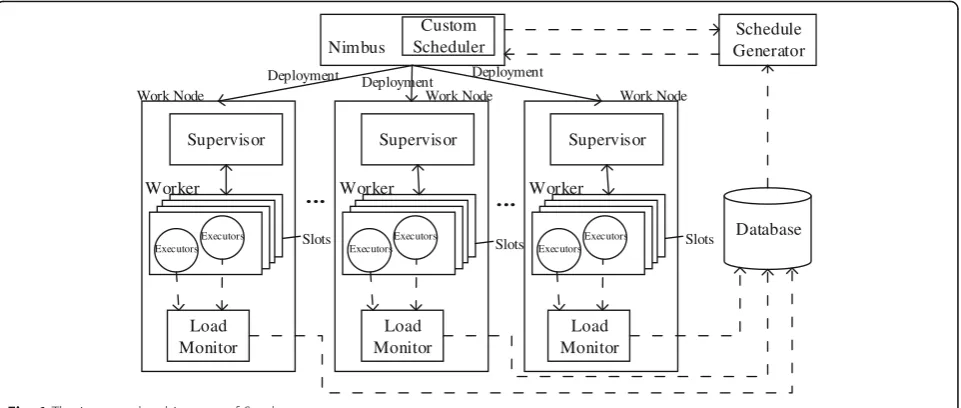
Step 4. Save the corresponding parameters to the database and update the information when the status of the resource changes. After selecting the source node and destination node, exchange their tasks and refresh the remaining CPU, memory, and network bandwidth resource of the source node and the destination node. Step 5. The TaskScheduler then selects the set of workers with the lower load to assign a task to get a larger degree of parallelism and the allocation fitness. Nimbus
4 Result and discussion 4.1 Experimental platform
We established a computing cluster by using 1 server and 8 work nodes; the server is set as Master Hadoop and NameNode Spark, and the others are set as Hadoop Slavers and Spark DataNodes. The details of the configuration are shown in Table 1. The task
execution time is acquired from the Spark console, and nomon monitors the memory usage.
4.2 Execution time evaluation
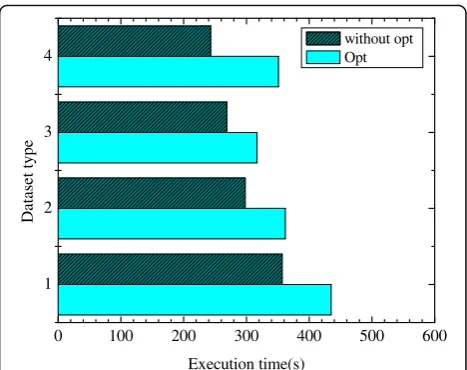
In order to verify the algorithm in several different types of operations under the concurrent environment perform-ance, we use the Spark official work examples to form a working set, including the type of four algorithms; dataset type 1, 2, 3, 4 denotes WordCount, TeraSort, K-Means, and PageRank as jobs. Figure2is a comparison of the exe-cution time for different strategies.
Figure 2 shows that in the case of performance optimization, the recovery acceleration of the K-Means and PageRank of the proposed strategy is better than that of without the optimization strategy, which is a compari-son of the operations of wide dependency in K-Means and PageRank, WordCount and TeraSort. The corresponding acceleration rate are 17.9%, 17.6%, 15.1%, and 30%
Table 1Configuration parameters
Parameters Values
CPU Intel CORE i7/2.2GHZ
RAM 4GB
NIC 1000Mbit/s
Hard Disk 200GB/SATA3.0(6Gbps)
OS ubuntu 12.04
Spark Apache Spark 2.1.0
Hadoop Apache Hadoop 2.6
Scala Scala-2.10.4
JDK OpenJDK 1.8.0 25
1 2 3 4
0 100 200 300 400 500 600
Execution time(s)
Da
ta
se
t type
without opt Opt
Fig. 2Comparison of execution time for different strategies
0 50 100 150 200 250 300 200
400 600 800 1000
Me
mory Usua
ge/MB
Execution Time/s
optimization strategy
respectively. The improper parallelism degree and task al-location may induce a large amount of out of memory and increased disk I/O, which will decrease the execution effi-ciency and lead to higher overhead in execution time.
Thus, compared to the existing scheduling mechanism, the scheduling with performance optimization strategy can more effectively reduce the latency, and the imple-mentation process will not have a greater impact on the performance of the cluster.
4.3 Memory utilization evaluation
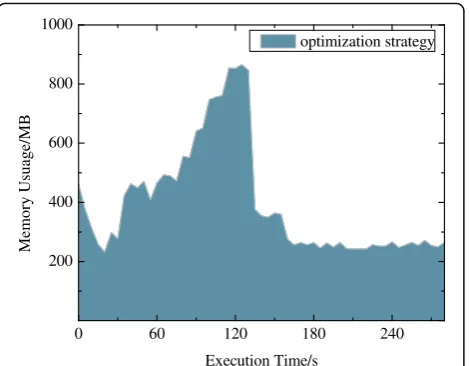
Figures 3, 4, 5, and 6 are monitored under the optimization strategy proposed in this paper. Memory utilization of four different job changes during the execu-tion of worker 3.
Memory utilization is related to the type of job and the distribution of input data. For the same algorithm, the greater the amount of data processed is, the greater the
amount of memory occupied. As shown in Figs. 3, 4, 5, and 6, WordCount and TeraSort have a relatively stable memory footprint with the increase of execution time, while K-means and PageRank have different memory oc-cupancy rates as the processing task phases are different.
4.4 Disk I/O evaluation
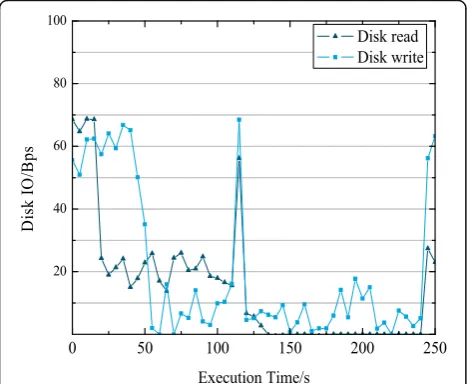
Similarly, the disk I/O has different characteristics as the type of job varies. Figures 7,8,9, and10 are monitored under the optimization strategy proposed in this paper. The memory utilization of four different job changes during the execution of worker 3.
As far as the disk I/O rate is concerned for the task processing the data from the local disk, the correspond-ing local data reads on a worker will be generated, and a certain disk I/O is consumed. If the network data is processed, additional network I/O is also produced 0 60 120 180 240
200 400 600 800 1000
Me
mory Usua
ge/MB
Execution Time/s
optimization strategy
Fig. 4The memory utilization of TerSort
0 50 100 150 200 250 0
200 400 600 800 1000
Memor
y
usuage
(MB)
Execution time(s)
optimization strategy
Fig. 5The memory utilization of K-Means
0 40 80 120 160 200 240 0
200 400 600 800 1000
Memory usuage(M
B
)
Execution time(s)
optimization strategy
Fig. 6The memory utilization of PageRank
Disk read Disk write
0 50 100 150 200 250 300 10
20 30 40 50
Execution Time/s
Disk IO/Bps
because the worker needs to read data from the remote disk, and memory outrage may produce more frequent disk I/O. As it is known in Figs.7,8,9, and10, disk I/O of WordCount is more obvious, and the other three jobs are lower. At the beginning of execution for K-Means and TeraSort, disk I/O is significantly increased because the task is assigned to worker 3, and it needs to read some data from the disk at this time.
5 Conclusions
In this paper, our contributions can be summarized as follows. First, we analyze a theoretical relationship of de-gree of parallelism and allocation fitness. Second, we propose an evaluation model that is pluggable for task assignment. Third, on the basis of the evaluation model, the strategy can take resource characteristics into con-sideration and assign tasks to the worker with a lower
load to increase execution efficiency. Numerical analysis and experimental results verified the effectiveness of the presented strategy.
Our future work is mainly concentrated on analyzing the general principles of the requirements for different types of operating resources for in-memory computing framework and design the optimization strategy adapting to the load and type of jobs.
Abbreviations
CPU:Central processing unit; DAG: Directed acyclic graph; IMC: In-memory computing; SAP: System applications and products; SIMD: Single instruction, multiple data; SQL: Structured query language
Acknowledgements
The authors would like to thank the reviewers for their thorough reviews and helpful suggestions.
Funding
This paper was supported by the National Natural Science Foundation of China under Grant No. 61262088, 61462079, 61562086.
Availability of data and materials
All data are fully available without restriction.
Authors’contributions
CTY is the main writer of this paper. She proposed the main idea, completed the experiment, and analyzed the result. CYY and CB gave some important suggestions for this paper. All authors read and approved the final manuscript.
Competing interests
The authors declare that they have no competing interests.
Publisher’s Note
Springer Nature remains neutral with regard to jurisdictional claims in published maps and institutional affiliations.
Author details 1
School of Mechanical and Electrical Engineering, Shaoxing University, Shaoxing 312000, People’s Republic of China.2School of Information Science and Engineering, Xinjiang University, Urumqi 830008, People’s Republic of China.
Fig. 8The disk utilization of TeraSort
0 50 100 150 200 250
Fig. 9The disk utilization of K-Means
0 50 100 150 200
Received: 24 July 2018 Accepted: 18 September 2018
References
1. S. John Walker, Big data: a revolution that will transform how we live, work, and think. Int. J. Advert.33(1), 181–183 (2014)
2. K. Kambatla, G. Kollias, V. Kumar, et al., Trends in big data analytics[J]. J Parallel Distrib Comput74(7), 2561–2573 (2014)
3. C.L.P. Chen, C.Y. Zhang, Data-intensive applications, challenges, techniques and technologies: a survey on big data. Inf. Sci.275(11), 314–347 (2014) 4. F. Provost, T. Fawcett, Data science and its relationship to big data and
data-driven decision making. Big Data1(1), 51–59 (2013)
5. C. Napoli, G. Pappalardo, E. Tramontana, A mathematical model for file fragment diffusion and a neural predictor to manage priority queues over BitTorrent. Int J Appl Math Comput Sci26(1), 147–160 (2016)
6. Y. Lamari, S.C. Slaoui, Clustering categorical data based on the relational analysis approach and MapReduce. J Big Data4(1), 28 (2017) 7. C. Cho, S. Lee, Effective five directional partial derivatives-based image
smoothing and a parallel structure design[J]. IEEE Trans. Image Process. 25(4), 1617–1625 (2016)
8. Kim W S, Lee J, An H M, et al. Image Filter Optimization Method based on common sub-expression elimination for Low Power Image Feature Extraction Hardware Design. 10(2), 192–197 (2017)
9. H. Seol, W. Shin, J. Jang, et al., Elaborate refresh: a fine granularity retention management for deep submicron DRAMs. IEEE Trans. Comput.99, 1–1 (2018) 10. Y. Tang, B. Gedik, Autopipelining for data stream processing. IEEE Trans
Parallel Distrib Syst24(12), 2344–2354 (2013)
11. I. Jo, D.H. Bae, A.S. Yoon, et al., YourSQL: a high-performance database system leveraging in-storage computing. Proc of the Vldb Endowment 9(12), 924–935 (2016)
12. R. Wu, L. Huang, P. Yu, et al., SunwayMR: a distributed parallel computing framework with convenient data-intensive applications programming. Futur. Gener. Comput. Syst.71, 43–56 (2017)
13. B. Sengupta, A. Das, Use of SIMD-based data parallelism to speed up sieving in integer-factoring algorithms[J]. Appl. Math. Comput.293(1), 204–217 (2017) 14. I.P. Egwutuoha, D. Levy, B. Selic, S. Chen, A survey of fault tolerance