Adaptive Iterative Soft-Input Soft-Output
Parallel Decision-Feedback Detectors for
Asynchronous Coded DS-CDMA Systems
Wei Zhang
School of Information Technology and Engineering (SITE), University of Ottawa, 800 King Edward Avenue, Ottawa, ON, Canada K1N 6N5
Email:[email protected]
Claude D’Amours
School of Information Technology and Engineering (SITE), University of Ottawa, 800 King Edward Avenue, Ottawa, ON, Canada K1N 6N5
Email:[email protected]
Abbas Yongac¸o ˘glu
School of Information Technology and Engineering (SITE), University of Ottawa, 800 King Edward Avenue, Ottawa, Ontario, Canada K1N 6N5
Email:[email protected]
Received 29 April 2004; Revised 4 October 2004
The optimum and many suboptimum iterative soft-input soft-output (SISO) multiuser detectors require a priori information about the multiuser system, such as the users’ transmitted signature waveforms, relative delays, as well as the channel impulse response. In this paper, we employ adaptive algorithms in the SISO multiuser detector in order to avoid the need for this a priori information. First, we derive the optimum SISO parallel decision-feedback detector for asynchronous coded DS-CDMA systems. Then, we propose two adaptive versions of this SISO detector, which are based on the normalized least mean square (NLMS) and recursive least squares (RLS) algorithms. Our SISO adaptive detectors effectively exploit the a priori information of coded symbols, whose soft inputs are obtained from a bank of single-user decoders. Furthermore, we consider how to select practical finite feedforward and feedback filter lengths to obtain a good tradeoffbetween the performance and computational complexity of the receiver.
Keywords and phrases:soft-input soft-output multiuser detection, adaptive multiuser detection, parallel decision-feedback de-tection, adaptive soft-input soft-output parallel decision-feedback dede-tection, asynchronous coded CDMA systems.
1. INTRODUCTION
Iterative soft-input soft-output (SISO) multiuser receivers for coded multiuser systems have received widespread atten-tion since they can provide near single-user performance in a system with multiple-access interference (MAI) by itera-tively combining multiuser detection and single-user decod-ing. The optimum SISO multiuser detector employs either the cross-entropy minimization [1] or the maximuma pos-teriori (MAP) algorithm [2]. The computational complex-ity of these techniques is exponentially proportional to the
This is an open access article distributed under the Creative Commons Attribution License, which permits unrestricted use, distribution, and reproduction in any medium, provided the original work is properly cited.
number of users which can be prohibitive for large systems. Therefore, much work has been done on reduced-complexity suboptimum SISO multiuser detectors.
Channel I Modulator &spreader 1
I
Figure1: A general coded DS-CDMA system with an iterative receiver (IandDdenote interleavers and deinterleavers, respectively).
of users. In [9,10], nonlinear MMSE-based SISO decision-feedback detectors are investigated.
The above optimum and suboptimum SISO multiuser detectors require accurate a priori information about the multiuser system, such as all users’ received signature wave-forms which are functions of their transmitted signature waveforms, relative delays, and the channel impulse re-sponse. In practical situations, this information may not be easily obtainable for time-varying fading channels.
Fortunately, if the system parameters are constant or slowly varying, adaptive detectors (non-SISO) can success-fully track these parameters from the received signal [11,
12,13,14,15]. In [16], an adaptive SISO parallel decision-feedback detector for synchronous direct-sequence code-division multiple-access (DS-CDMA) systems with short spreading sequences is presented. By employing an approxi-mate least squares algorithm and soft symbol estiapproxi-mates, the detector exploits the joint statistics of soft symbol estimates and transmitted symbols.
In this paper, we use adaptive algorithms in the iterative SISO parallel decision-feedback detector (PDFD) for asyn-chronous coded DS-CDMA systems in order to avoid the need for the a priori information about system parameters, such as multiple users’ spreading codes and relative delays between users. First, we derive the optimum SISO paral-lel decision-feedback detector assuming the receiver knows the transmitted signature waveforms and relative delays be-tween all the users. Then, we propose two adaptive versions of this SISO detector, which employ the normalized least mean square (NLMS) and recursive least squares (RLS) al-gorithms to estimate the filter coefficients of the detector. All users are assumed to employ short spreading codes. A train-ing sequence is required for each user. Our adaptive SISO de-tectors effectively exploit the a priori information of coded symbols, which is obtained from the soft outputs of a bank of single-user decoders, to further improve their convergence performance.
Furthermore, for adaptive implementation of the SISO PDFD for asynchronous DS-CDMA systems, we select prac-tical finite feedforward and feedback filter lengths to obtain a good tradeoffbetween the system performance and com-putational complexity of the receiver. We employ a feedfor-ward filter which covers a two-symbol duration for each user and we consider several options for the feedback filter length.
Monte-Carlo simulation results for these adaptive SISO de-tectors are presented and compared.
The outline of the rest of this paper is as follows. A system model of asynchronous coded DS-CDMA systems is intro-duced inSection 2. The optimum SISO PDFD with a general processing window for asynchronous coded DS-CDMA sys-tems is derived inSection 3. Adaptive SISO PDFDs are pro-posed inSection 4, which are based on the NLMS and RLS al-gorithms. Monte-Carlo simulation results are presented and compared inSection 5. Finally inSection 6, the conclusions are given.
2. SYSTEM MODEL AND NOTATION
Throughout the paper, matrices and vectors are denoted as boldface uppercases and lowercases, respectively. Notations (·)∗, (·)H, and (·)T denote the complex conjugate, Hermi-tian transpose, and transpose, respectively.
A general coded DS-CDMA system with an iterative re-ceiver is shown in Figure 1. There are K active users in the system. The information bits of each user are first en-coded, then interleaved, modulated, and spread before they are transmitted over the channel. The iterative receiver con-sists of two parts, an adaptive soft-input soft-output mul-tiuser detector and a bank of SISO single-user decoders, which are separated by deinterleavers and interleavers. These two parts cooperate iteratively by transferring updated ex-trinsic soft information of coded symbols between them.
In our paper, we consider an asynchronous coded DS-CDMA system over the additive white Gaussian noise (AWGN) channel. The equivalent baseband received mul-tiuser signal is
whereKis the number of active users,Nbis the number of symbols transmitted by each user,bk(i) is theith coded sym-bol of thekth user,sk(t) is its transmitted signature wave-form,τkandTare the delay of userkand the symbol inter-val, respectively, andn(t) is an additive white Gaussian noise process with double-sided power spectral densityN0/2. Each
Sk=
τk/Tc
N
0
(N−τk/Tc) N(Nb+ 1)×Nb 0
. ..
Figure2: System signature matrixSkof userk, where the nonzero part of each column is the signature vectorskof userk.
For simple implementation, we consider a chip-synchro-nous and symbol-asynchrochip-synchro-nous DS-CDMA system. All us-ers’ delays are uniformly distributed in [0,T] and are mul-tiples ofTc, which is the chip interval. In the receiver, first we employ a chip-matched filter on the received signalr(t) and then sample its output at frequency 1/Tc. If the system is chip-asynchronous, we can oversample the output of the chip-matched filter and design a fractionally spaced feedfor-ward filter instead. Without loss of generality and for sim-plicity of notation, we assume the delays of multiple users satisfy the following inequality:
0≤τ1≤τ2≤ · · · ≤τK ≤T. (2)
The symbol vector consisting of the transmitted symbols of all users is denoted as
b=bT1,. . .,bTk,. . .,bTKT
KNb×1, (3)
where
bk=bk(1),bk(2),. . .,bkNbT. (4)
The received signal vector r at the output of the chip-matched filter during the whole symbol transmission interval can be expressed as follows:
r=Sb+n, (5)
whereSis the system signature matrix and can be expressed as
S=S1,. . .,Sk,. . .,SKN(Nb+1)×KNb. (6)
The construction ofSkin (6) is shown inFigure 2, where the nonzero part of each column is the signature vectorskof user
kandNis the number of chips per coded symbol. The vec-tornin (5) is anN(Nb+ 1)×1 column vector which repre-sents the output noise component of the chip-matched filter. It has zero mean and covariance matrixσ2
nI, whereσn2is the variance of the output noise component.
3. OPTIMUM SISO PDFD FOR ASYNCHRONOUS DS-CDMA SYSTEMS
In general, the optimum SISO PDFD filters for asynchronous DS-CDMA systems have infinite lengths [17]. For imple-mentation purposes, we consider finite-length feedforward and feedback filters. Furthermore, these filters are suitable for use in adaptive applications. The use of these filters in our adaptive detectors will be discussed in detail inSection 4.
In the receiver, we assume that the processing window length is Np, which is measured in chips and is much less than Nb×N. In each processing window, the received sig-nal vector is denoted asrNp×1, which consists ofNprows ofr
falling to this processing window. The windowed system sig-nature matrixSNp×KNband noise vectornNp×1consist ofNp corresponding rows of Sandn, respectively. Therefore, we have the following equation:
r=Sb+n. (7)
We can writebas the following sum:
b=bU+bD, (8)
wherebU consists of the symbols which are not fedback and its other elements are zeros. The nonzero elements ofbD con-sist of the fedback symbols. They have no common elements. In the same way by which we constructbUandbD, we extract columns ofSand construct the corresponding signature ma-trices SU andSD. Therefore, the windowed received signal vectorrcan also be expressed as
r=SUbU+SDbD+n. (9)
The feedforward filter of user khasNp taps and is de-noted by a column vectormf k. The feedback filtermbk of userkhas the sizeKNb×1, whose nonzero elements are cor-responding to fedback symbols. That is, its effective number of taps is determined by the number of fedback symbols. The optimum filters satisfy the following minimum mean square error (MMSE) criterion:
min mf k,mbkE
bk(i)−mHf k·r−mHbk·bD
2
. (10)
Nonzero elements ofbDare soft symbol estimates of those el-ements ofbD, respectively. We will introduce the soft symbol estimate of each coded symbol in the following.
The soft inputs of a SISO multiuser detector,{λin[bk(j)], 1≤k≤K, 1≤ j ≤Nb}, are extrinsic log-likelihood ratios (LLRs) of{bk(j)}provided by a bank ofK single-user de-coders. Based on these inputs, we can obtain the soft symbol estimate of{bk(j)}:
bk(j)=Ebk(j) λin
bk(j)=tanh
λ
in
bk(j) 2
. (11)
to nonfedback symbols. Denoteuandvas one of the nonzero elements ofbUandbD, respectively. The soft symbol estimate ofvis denoted asv. Thus, we have
E[u]=0,
Eu2=1, E[v]=v,
Ev2=1−(v)2.
(12)
We also assume that all users’ transmitted symbols are inde-pendent of one another and of the background noise vector
nas well.
Employing the above statistics about the coded symbols, we can get the optimum feedforward and feedback filters of userkwhich satisfy the MMSE criterion in (10):
mf k=RU+RD+σn2I−1·sbk(i), (13)
mbk= −SHD·mf k, (14)
where
RU =SUSHU,
RD=SDI−diagbDbHDSHD, (15)
andsbk(i)is a one column ofSU, whose column index is the
same as the row index ofbk(i) inbU. The feedforward filter in (13) is actually a linear MMSE filter which suppresses the interference from non-fedback symbols, as well as the resid-ual interference after canceling the fedback symbols and the background Gaussian noise.
From (15), we can see that the optimum feedforward and feedback filters require the knowledge of all users’ signature vectors and delays. In order to avoid the need for this infor-mation, we can adaptively implement the SISO PDFD, which will be discussed in the next section.
4. ADAPTIVE SISO PDFD FOR ASYNCHRONOUS DS-CDMA SYSTEMS
In this section, we assume that both short spreading codes and delays of all users are unknown to the receiver. We design and employ adaptive SISO PDFDs to track these parameters from the received signal directly.
It is well known that the asynchronous system perfor-mance can be improved by using detection filters with an in-creased number of taps. However, increasing the number of taps increases the computational complexity of the detector. Moreover, this will have an adverse effect on the convergence speed. Therefore, we need to select suitable filter lengths to achieve a good tradeoffamong the system performance, de-tector complexity, and system overhead.
In the parallel decision-feedback detector, the feedfor-ward and feedback filters cooperate to suppress the multiple-access interference. Specifically, the feedback filter tries to cancel some interfering symbols, while the feedforward filter
τ1
τ2
τK b1(i−1) b2(i−1)
The processing window for theith symbol b1(i) b1(i+ 1) b2(i) b2(i+ 1)
bK(i−1) bK(i) bK(i+ 1) .
. .
Figure3: An asynchronous system.
suppresses the remaining MAI, as well as the residual inter-ference due to imperfect cancellation by the feedback filter and the background Gaussian noise. Therefore, if the feed-back filter effectively cancels most of the interference caused by the interfering symbols, the remaining interference to be suppressed by the feedforward filter is reduced.
On each iteration except for the first one, the SISO PDFD can obtain soft symbol estimates of all symbols from soft in-puts. Thus, we have both causal and noncausal soft symbol decisions of interfering symbols for the interested symbol. We may cancel part or all of them by the feedback filter.
In this paper, we employ a feedforward filter which covers a two-symbol duration and consider several options for the feedback filter length. The length of the observation interval is 2T, which is the minimum length such that one complete symbol of each user falls in this interval regardless of its rel-ative delay.Figure 3shows the processing window of the de-tector in theith signaling interval. The output vectorr(i) of the chip-matched filter in this processing window is
r(i)=P− P0 P+
b(i−1)
b(i)
b(i+ 1)
+n(i), (16)
whereb(i)= [b1(i) b2(i) · · · bK(i)]T andn(i) is a
Gaus-sian random vector with zero mean and covariance matrix
σ2
nI(2N×2N). We define the punctured signature vectors of user kas
p−k =srkH 0H H
(2N×1),
p0
k=
0H(1×Nr
k) s H k 0H(1×Nl
k)
H
(2N×1),
p+k =0H slkH H
(2N×1),
(17)
where0is a column vector.slkandsrkare denoted inFigure 4
and are parts ofsk:
sk=slkH srkH H
slk srk
Nl
kchips Nkrchips
The processing window edge
Figure4: Punctured signatures of thekth user in the asynchronous system.
Thus, when multiple users’ delays are unknown to the re-ceiver, for the symbol of interest bk(i) of user k, it has at most (3K−1) interfering symbols. For implementation of the adaptive SISO multiuser detector inFigure 1, we consider three adaptive SISO PDFDs with the same feedforward filter length, that is, 2N taps. The feedback filter of the first de-tector (labeled as dede-tector1) has (K−1) taps which tries to cancel the current (K −1) interfering symbols for the de-sired symbol. Detector2 has a feedback filter with (2K−1) taps which tries to cancel the current (K−1) and previous
K interfering symbols. The feedback filter of detector3 has (3K−1) taps and tries to cancel all possible previous, cur-rent, and future interfering symbols.
In the following, we employ the NLMS and RLS algo-rithms in adaptive SISO PDFDs to update the feedforward filtermf kand feedback filtermbk. Moreover, the a priori in-formation of coded symbols is employed efficiently to im-prove the performance of the adaptive detector. The adaptive SISO PDFD requires only a training sequence for each user to estimate all filter coefficients.
The adaptive detector employing the NLMS algorithm to resolve the MMSE criterion in (10) updates the feedforward and feedback filters of userkas follows form=0, 1, 2,. . .:
wheremis the recursive index and also the time index, ˜µf and ˜µb ∈ (0, 2) and are step sizes for the feedforward and feedback filters, respectively. a is a small positive constant. The error signal for themth recursion is
ek(m)=˜bk(m)−mHf k(m)·r(m)−mHbk(m)·b˜D(m), (21)
where ˜bk(m)=bk(m) and ˜bD(m)= bD(m) in the training mode, ˜bk(m)=bk(m) and ˜bD(m)=bD(m) in the
decision-directed mode. Furthermore, in the decision-decision-directed mode, |bk(m)|is used as the reliability of the error signalek(m) in (20). Both filters are updated per symbol and their initial states aremf k(0)=0andmbk(0)=0.
When the detector employs the RLS algorithm, we denote
wk(m)=[mHf k(m) mHbk(m)]Handu(m)=[rH(m) ˜bHD(m)]H.
Both of the adaptive detectors described above try to ex-ploit the joint statistics of the received signal vector r, the transmitted symbol bk or its soft estimatebk, and the soft symbol estimatesbDwhich are fedback. In the first iteration, since there is no fedback information of coded symbols, we only employ a linear MMSE feedforward filter and set the feedback filter coefficients to zeros for each user.
The output of the adaptive SISO PDFD is
yk(m)=mHf k(m)·r(m) +mHbk(m)·bD(m). (23)
Applying the Gaussian assumption to the output in (23), we can calculate the soft outputs of the SISO PDFD. For themth symbol of thekth user, the outputyk(m) can be expressed as
yk(m)=µkbk(m) +ηk, (24)
whereµkis a constant andηkis a Gaussian random variable with zero mean and varianceσ2
ηk:
Estimates of (25) can be obtained by the corresponding sam-ple averages in (26), respectively, where we replacebk(m) by
The soft output, that is, the extrinsic log-likelihood ratio, of
5. SIMULATION RESULTS
The DS-CDMA system which we simulate in this section has 12 active users. All users employ the same convolutional code with rate 1/2, constraint length 7, and generators [1011011], [1111001]. Each user has a randomly selected short spread-ing code. The spreadspread-ing factor is 16 chips per information bit. The system load is 12/16 (K/spreading factor). Multiple users’ delays are randomly selected and fixed during simula-tion.
There are 300 training symbols which are randomly se-lected and inserted at the beginning of coded symbol frames of each user. SISO single-user decoders are based on the log-MAP algorithm in [18]. Noise random variables at the output of the chip-matched filter are identical independent Gaussian random variables with zero mean andN0/2
vari-ance.
At the first iteration, since there are no soft inputs from single-user decoders, only a feedforward filter is employed for each user. That is, at this time, a linear minimum mean square error filter is used instead. It is initially trained by the training symbols, and then is used for the following trans-mitted coded symbols. For the later iterations, both the feed-forward and feedback filters are employed. After the train-ing mode, they are updated by fedback symbol decisions. In the first two iterations, the filter coefficients are initial-ized to zeros before the adaptive algorithm is employed. In each of the following iterations, the filter coefficients are set to the values obtained at the end of the previous itera-tion.
We consider an asynchronous DS-CDMA system over the additive white Gaussian noise (AWGN) channel. It is assumed that the receiver has no knowledge of the short spreading codes used by the users and their delays. Three adaptive SISO PDFDs proposed inSection 4are simulated. Figures5and6show average bit error rates of all users in the first, second, and tenth iterations provided by three adaptive detectors based on the NLMS and RLS algorithms, respec-tively. In (20) of the NLMS algorithm, we usea=0.00001, and step sizes ˜µf = µ˜b = 0.2 in the training mode and
˜
µf = µ˜b = 0.05 in the decision-directed mode. Parameters in (22) of the RLS algorithm areλ = 1 andδ = 0.04. For comparison, we also show the bit error rate performance of the single-user system in these two figures, where the user’s spreading code and delay are known to the receiver. In Fig-ures5and6, we observe that after the first iteration, all three detectors have similar performances and their curves appear to overlap. A similar behaviour is observed for the second it-eration of detector1 and detector2 in Figure 5and all three detectors inFigure 6.
We can see that with our adaptive SISO detectors, the system performance is improved with the increased num-ber of iterations. Furthermore,Figure 6shows that the per-formance provided by the adaptive RLS receiver approaches the performance of the single-user system after a few itera-tions at high signal-to-noise ratios. Among the three adaptive SISO PDFDs proposed inSection 4, detector3 provides the best performance, though it has the highest computational
100
10−1
10−2
10−3
10−4
10−5
2 3 4 5 6 7 8
Eb/N0(dB)
Bi
t
er
ror
ra
te
Detector1, 1 iter. Detector1, 2 iter. Detector1, 10 iter. Detector2, 1 iter. Detector2, 2 iter.
Detector2, 10 iter. Detector3, 1 iter. Detector3, 2 iter. Detector3, 10 iter. SU
Figure5: Bit error rate performance provided by three NLMS adap-tive SISO PDFDs for the asynchronous DS-CDMA system at the first, second, and tenth iterations, and that of the single-user system (SU).
100
10−1
10−2
10−3
10−4
10−5
2 2.5 3 3.5 4 4.5 5 5.5 6 6.5 7 Eb/N0(dB)
Bi
t
er
ror
ra
te
Detector1, 1 iter. Detector1, 2 iter. Detector1, 10 iter. Detector2, 1 iter. Detector2, 2 iter.
Detector2, 10 iter. Detector3, 1 iter. Detector3, 2 iter. Detector3, 10 iter. SU
Figure6: Bit error rate performance provided by three RLS adap-tive SISO PDFDs for the asynchronous DS-CDMA system at the first, second, and tenth iterations, and that of the single-user system (SU).
2.5
2
1.5
1
0.5
0
0 50 100 150 200 250 300
Update number in the adaptive algorithms
Sq
uar
ed
er
ro
r
RLS algorithm NLMS algorithm
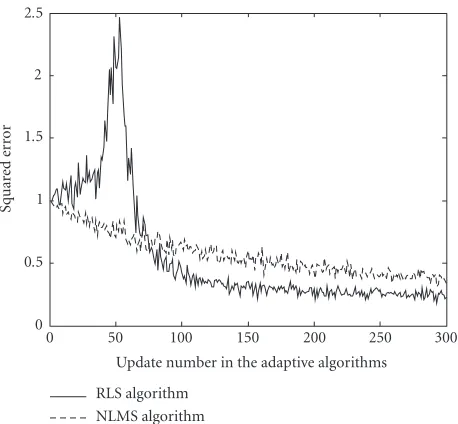
Figure7: Comparison between the experimental learning curves of the adaptive SISO PDFD detector3 based on the NLMS and RLS algorithms after the second iteration during the training mode at SNR=6 dB.
By comparing average bit error rates of all the users provided by the adaptive detector based on the RLS algo-rithm in Figure 6 and those obtained by the NLMS algo-rithm in Figure 5, we can see that the bit error rate per-formance provided by the adaptive SISO PDFD based on the RLS algorithm is better than the one provided by the detector based on the NLMS algorithm. For example, at a bit error rate 10−3, detector3 based on the RLS
algo-rithm has about 0.7 dB gain with respect to detector3 based on the NLMS algorithm. This is due to the faster conver-gence property of the RLS algorithm, which is shown by
Figure 7. The averaged squared errorse2
k(m) and ξk2(m) af-ter the second iaf-teration of the adaptive detector3 during the training mode versus the number of updates in the NLMS and RLS algorithms, respectively, are shown and compared inFigure 7. We set the signal-to-noise (SNR) ra-tio of each user to 6 dB. Each curve of the squared er-ror is averaged over 200 independent trials of the exper-iment. However, the RLS algorithm has a greater com-putational complexity. Denote the length of the adaptive filter as L. The computational complexity of the RLS and the NLMS algorithms are∼O(L2) and∼O(L) per update,
respectively.
6. CONCLUSIONS
In this paper, first we presented an optimum SISO paral-lel decision-feedback detector for asynchronous coded DS-CDMA systems, and then proposed an adaptive implemen-tation of it when all users’ signature waveforms and relative delays were unknown to the receiver. All users were assumed to employ short spreading codes. A chip-synchronous and symbol-asynchronous DS-CDMA system was considered.
A training sequence was required by each user. We showed that the resulting system performance provided by adaptive SISO PDFDs approaches that of the single-user system af-ter a few iaf-terations at high signal-to-noise ratios. Moreover, the adaptive detector employing the RLS algorithm provides a better bit error rate performance than the adaptive detec-tor based on the NLMS algorithm, though at the expense of higher computational complexity. For asynchronous coded DS-CDMA systems, we further showed that the adaptive de-tector with more feedback filter taps gives a better bit error rate performance.
REFERENCES
[1] M. Moher, “An iterative multiuser decoder for near-capacity communications,” IEEE Trans. Commun., vol. 46, no. 7, pp. 870–880, 1998.
[2] L. R. Bahl, J. Cocke, F. Jelinek, and J. Raviv, “Optimal decoding of linear codes for minimizing symbol error rate (Corresp.),” IEEE Trans. Inform. Theory, vol. 20, no. 2, pp. 284–287, 1974. [3] P. D. Alexander, M. C. Reed, J. A. Asenstorfer, and C. B. Schlegel, “Iterative multiuser interference reduction: turbo CDMA,”IEEE Trans. Commun., vol. 47, no. 7, pp. 1008–1014, 1999.
[4] Z. Qin, K. C. Teh, and E. Gunawan, “Iterative multiuser de-tection for asynchronous CDMA with concatenated convolu-tional coding,” IEEE J. Select. Areas Commun., vol. 19, no. 9, pp. 1784–1792, 2001.
[5] P. Alexander, A. Grant, and M. Reed, “Iterative detection in code-division multiple-access with error control coding,” Eu-ropean Transactions on Telecommunication, vol. 9, no. 5, pp. 419–426, 1998.
[6] Z. Shi and C. Schlegel, “Joint iterative decoding of serially concatenated error control coded CDMA,”IEEE J. Select. Ar-eas Commun., vol. 19, no. 8, pp. 1646–1653, 2001.
[7] W. Zhang and C. D’Amours, “Iterative multiuser detection and decoding for highly correlated narrowband systems and heavily loaded CDMA systems,”Canadian Journal of Electrical and Computer Engineering, vol. 28, no. 2, pp. 75–80, 2003. [8] X. Wang and H. V. Poor, “Iterative (turbo) soft interference
cancellation and decoding for coded CDMA,” IEEE Trans. Commun., vol. 47, no. 7, pp. 1046–1061, 1999.
[9] H. E. Gamal and E. Geraniotis, “Iterative multiuser detec-tion for coded CDMA signals in AWGN and fading channels,” IEEE J. Select. Areas Commun., vol. 18, no. 1, pp. 30–41, 2000. [10] B. F. Beidas, H. E. Gamal, and S. Kay, “Iterative interference cancellation for high spectral efficiency satellite communica-tions,”IEEE Trans. Commun., vol. 50, no. 1, pp. 31–36, 2002. [11] M. L. Honig and H. V. Poor, “Adaptive interference
suppres-sion in wireless communication systems,” inWireless Commu-nications: Signal Processing Perspectives, Prentice-Hall, Upper Saddle River, NJ, USA, 1998, chapter 2.
[12] H. V. Poor, “Adaptivity in multiple-access communications,” inProc. 34th Conference on Decision and Control, pp. 835–840, New Orleans, La, USA, December 1995.
[13] P. B. Rapajic and B. S. Vucetic, “Adaptive receiver structures for asynchronous CDMA systems,”IEEE J. Select. Areas Com-mun., vol. 12, no. 4, pp. 685–697, 1994.
[14] P. B. Rapajic and D. K. Borah, “Adaptive MMSE maximum likelihood CDMA multiuser detection,” IEEE J. Select. Areas Commun., vol. 17, no. 12, pp. 2110–2122, 1999.
[16] M. L. Honig, G. Woodward, and P. D. Alexander, “Adaptive multiuser parallel-decision-feedback with iterative decoding,” inProc. IEEE International Symposium on Information Theory (ISIT ’00), p. 335, Sorrento, Italy, June 2000.
[17] A. Duel-Hallen, “A family of multiuser decision-feedback de-tectors for asynchronous code-division multiple-access chan-nels,” IEEE Trans. Commun., vol. 43, no. 234, pp. 421–434, 1995.
[18] A. J. Viterbi, “An intuitive justification and a simplified imple-mentation of the MAP decoder for convolutional codes,”IEEE J. Select. Areas Commun., vol. 16, no. 2, pp. 260–264, 1998.
Wei Zhangreceived the B.A.Sc. degree from XiDian University, China, in 1995, and the M.A.Sc. degree from Beijing University of Posts and Telecommunications, China, in 1998. Now she is pursuing a Ph.D. de-gree at the University of Ottawa, Canada. All of these are in electrical engineering. She worked as a software engineer in CTC Communication Development Ltd, China, in 1998. In 1999, she joined Agilent
Tech-nologies, Beijing, China, as a Research Scientist. Her research inter-est is in signal processing for the physical layer of wireless commu-nications.
Claude D’Amoursgraduated with the de-grees of B.A.Sc., M.A.Sc., and Ph.D. in elec-trical engineering from the University of Ottawa in 1990, 1992, and 1995, respec-tively. He was employed briefly at the Com-munications Research Centre in Ottawa as a Systems Engineer in 1995. From 1995–1999, he was employed as an Assistant Professor in the Department of Electrical and Com-puter Engineering, the Royal Military
Col-lege in Kingston, Ontario, Canada. He is presently employed as an Assistant Professor in the School of Information Technology and Engineering, the University of Ottawa.
Abbas Yongac¸o˘glureceived the B.S. degree from Bo˘gazic¸i University, Turkey, in 1973, the M. Eng. degree from the University of Toronto, Canada, in 1975, and the Ph.D. de-gree from the University of Ottawa, Canada, in 1987, all in electrical engineering. He worked as a researcher and a System En-gineer at TUBITAK Marmara Research In-stitute, Turkey, Philips Research Labs, Hol-land, and Miller Communications Systems,