R E S E A R C H A R T I C L E
Open Access
An investigation of dispositional
mindfulness and mood during pregnancy
Adele Krusche
1,2*, Catherine Crane
1and Maret Dymond
1Abstract
Background:Mindfulness courses are being offered to numerous groups and while a large body of research has investigated links between dispositional mindfulness and mood, few studies have reported this relationship during pregnancy. The aim of this study was to investigate this relationship in pregnant women to offer insight into whether an intervention which may plausibly increase dispositional mindfulness would be beneficial for this population. Methods:A cross-sectional analysis was conducted to explore potential relationships between measures of mindfulness and general and pregnancy-specific mood. A sample of pregnant women(n= 363) was recruited using online advertising and community-based recruitment and asked to complete a number of questionnaires online.
Results:Overall, higher levels of mindfulness were associated with improved levels of general and pregnancy-related mood in pregnant women. Controlling for general stress and anxiety, higher scores for mindfulness in (psychologically) healthy women were associated with lower levels of pregnancy-related depression, distress and labour worry but this relationship was not apparent in those with current mental health problems. In participants without children, higher mindfulness levels were related to lower levels of pregnancy-related distress.
Conclusions:These results suggest a promising relationship between dispositional mindfulness and mood though it varies depending on background and current problems. More research is needed, but this paper represents a first step in examining the potential of mindfulness courses for pregnant women. Increasing mindfulness, and therefore completing mindfulness-based courses, is potentially beneficial for improvements in mood during pregnancy.
Keywords:Dispositional mindfulness, Pregnancy, Prenatal mood, Stress, Labour worry
Background
Existing research evaluating mindfulness and pregnancy has explored the utility of mindfulness courses during pregnancy but the mechanism of change is unclear. Ex-ploration of how mindfulness relates to mood during pregnancy should be conducted to expand the literature and support studies examining the change which takes place during and after mindfulness-based courses but very few studies have examined the relationship between dispositional mindfulness and mood in non-intervention samples. One study found that higher dispositional mind-fulness was associated with lower anxiety during preg-nancy and less self-regulation problems and negative affect in the 10 month old infant [1]. A further small study
[2] found that higher‘act aware’dispositional mindfulness (a subscale on the FFMQ [3]) during pregnancy was re-lated to lower postnatal depression and anxiety scores and that as prenatal mindfulness decreased over time, postna-tal depression and anxiety scores increased. A recent study found a similar relationship with dispositional mindfulness during pregnancy such that higher levels of mindfulness were related to lower levels of depression and distress [4].
Pregnancy-specific and general anxiety and stress likely reflect different emotional constructs [5–8]. However, re-search to date has not examined the association between dispositional mindfulness and pregnancy specific measures.
This study aimed to extend previous work by examining the association of dispositional mindfulness with general and pregnancy specific measures in a large sample of pregnant women. The results were examined to evaluate whether increasing dispositional mindfulness during preg-nancy may be beneficial, something which mindfulness
© The Author(s). 2019Open Access This article is distributed under the terms of the Creative Commons Attribution 4.0 International License (http://creativecommons.org/licenses/by/4.0/), which permits unrestricted use, distribution, and reproduction in any medium, provided you give appropriate credit to the original author(s) and the source, provide a link to the Creative Commons license, and indicate if changes were made. The Creative Commons Public Domain Dedication waiver (http://creativecommons.org/publicdomain/zero/1.0/) applies to the data made available in this article, unless otherwise stated.
* Correspondence:[email protected] 1University of Oxford, Oxford, UK
2Psychology Department, University of Southampton, Shackleton Building
courses are purported to do [9]. It appears important to elucidate the relationship between dispositional mindful-ness and mood during pregnancy to better understand whether, and how, courses offered during this time may be helpful. Individual difference variables such as disposi-tional mindfulness may have a greater impact on variables such as worry about labour in those who have no prior experiences of childbirth to pattern their beliefs, fears and expectations. Therefore we divided and analysed the sam-ple for those with and without children. In individuals with pre-existing mental health problems, anxiety about pregnancy and labour may reflect underlying psychopath-ology in addition to situation specific concerns. As such individual differences in mindfulness may play a different, perhaps lesser role in determining distress in these partici-pants. Therefore we divided and analysed the sample in two groups as a function of their pre-existing mental health problems.
Methods
Participants
Data was drawn from three samples of expectant mothers: a cross-sectional survey sample investigating various aspects of mindfulness and mood during pregnancy (n= 157) and baseline data from two studies exploring the potential of an online mindfulness course for use during pregnancy (n= 207). The sample was non-clinical; re-sponses to the questionnaires were expected to vary within the normal range. The minimum age was 18 years. Only participants who completed all questionnaires were included; the data collection website was configured to prevent incomplete pages from being submitted.
Procedure
Participants were recruited using online advertising, in-cluding Facebook, Twitter, motherhood forums and through distribution of information about the project to local community buildings. Participants were directed to a study website where the participant information was displayed and if they wanted to take part, they were di-rected to sign consent (on the website, by ticking boxes to agree to the consent form statements and entering their name and date) and complete questionnaires using the Online Survey website [10], see Additional file 1for the Checklist for Reporting Results of Internet E-Surveys [11]. Informed consent was obtained from all individual participants included in the study.
Measures
A demographic questionnaire included questions about familial and occupational status and the birth (Additional file 2). The following measures were then presented:
Dispositional mindfulness
The Five-Facet Mindfulness Questionnaire-15 (FFMQ [3,12]) measures dispositional mindfulness ranging from 15 to 75. The scale incorporates mindfulness facet sub-scales: observe; describe; non-judgement; non-reactivity; awareness. FFMQ mindfulness has shown to increase following mindfulness courses [12]. Cronbach’sαfor the present study = .75.
Perceived stress
The Perceived Stress Scale (PSS [13]) was included in this study to measure general stress and measures how uncontrollable and overwhelming past month events are perceived to have been, ranging from 0 to 40. Cronbach’s
α= .78.
General anxiety
The General Anxiety Disorder Scale (GAD-7 [14]), mea-sures general anxiety for two preceding weeks and has decreased in a highly anxious pregnant sample following mindfulness courses [15]. Scores range from 0 to 21. Cut-offs are 5, 10 and 15 for mild, moderate and severe anxiety. Cronbach’sα= .90.
Perinatal depression
The Edinburgh Postnatal Depression Scale (EPDS [16]) measures levels of depression over the previous week and ranges from 0 to 30. The measure is designed to as-sess levels of depression during pregnancy and does not include items that might be confounded by physical as-pects of pregnancy (e.g. fatigue, sleep disturbance). A score of 9/10 indicates possible depression; 12/13 likely depression. It has been used during the prenatal and postnatal phases [17,18]. Cronbach’sα= .76.
Pregnancy distress
The Tilburg Pregnancy Distress Scale (TPDS [19]) mea-sures pregnancy-related distress for the preceding 7 days and ranges from 0 to 48. A score of more than 17 indi-cates‘distressed’. High TPDS distress has been associated with lower levels of dispositional mindfulness in pregnant samples [4]. Cronbach’sα= .82.
Worries about labour
The following measures were completed by the survey study and pilot study samples (n= 178).
Prenatal distress
The Revised Prenatal Distress Questionnaire (PDQ [7]; PDQ-R [8]) measures pregnancy-related distress ranging from 0 to 34, with questions added at the second and third trimesters. Scores are calculated by dividing the sum by the number of items; normative non-clinical scores are 0.77 overall (SD 0.435 [20]) and 0.72 (SD 0.35), 0.59 (SD 0.32) and 0.55 (0.30) for the three trimes-ters [8]. Cronbach’sα= .85.
Pregnancy-related discomforts
The scale for Pregnancy-Related Discomforts (PRD [21]), asks about the previous week. The ranges are 0–75, 0–65 and 0–65 for the three trimesters respectively. Normative scores for the three trimesters are 36.9, 26.0 and 29.2 [21]. Cronbach’s α= .90 for first trimester discomforts (n= 30) and .86 for second trimester discomforts (n= 126).
Pregnancy experience
The Pregnancy Experience Scale (PES-Brief [22]) has 10 questions for positive and negative experiences (uplifts, hassles) of pregnancy, rated from 0 to 3. Frequency scores are calculated by totalling endorsed questions for uplifts and hassles; previous mean scores are 9.5 for up-lifts and 6.5–7.5 for hassles. Intensity scores are calcu-lated by summing the scores for hassles or uplifts and dividing them by the frequency; previous means are 2.4 for uplifts and 1.4 for hassles [22,23]. Cronbach’sα= .88 for uplifts and .81 for hassles.
Statistical analysis
A series of Pearson’s correlations were run on mood and mindfulness data to investigate relationships. When exploring pregnancy-specific experience, partial correla-tions were used to control for general stress (PSS data) and anxiety (GAD-7 data). T-tests were conducted to explore any differences between participants who were currently well and those experiencing mental health difficulties.
Results
Data checks
One participant was removed (the first answer was al-ways given), leaving 363 completers. PES hassles showed positive kurtosis (4.609) and the Shapiro Wilk’s test was significant for uplifts and hassles with first and third trimester subsamples (sample split into trimesters for analysis (first n= 27, second n= 116, third n= 13), indi-cating that trimester analyses conducted using this measure should be non-parametric or bootstrapped.
Sample characteristics
Approximately half of the sample (56.5%, n= 205) had children. Most participants were in their second trimes-ter of pregnancy with 76.6% (n= 278) in their second, 12.9% (n= 47) in their first and 10.5% (n= 38) in their third. Demographic data is shown in Table 1. Most par-ticipants were located in the UK, educated to degree level or higher, married or cohabiting and employed.
Sample means
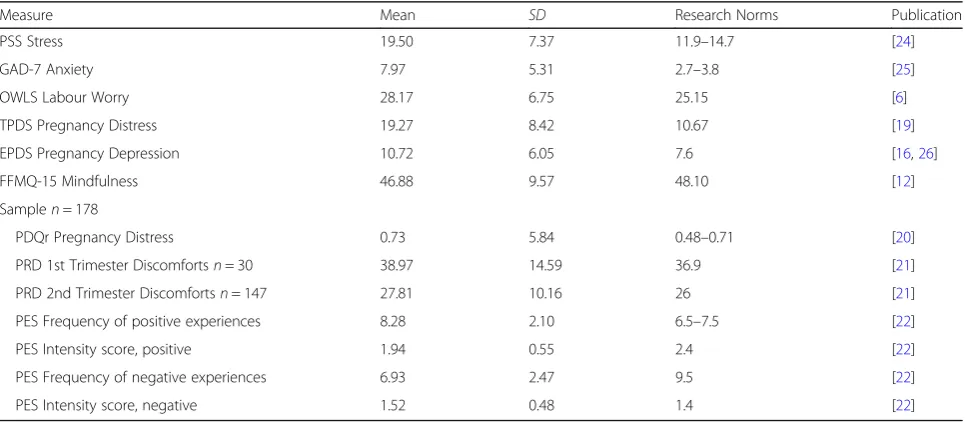
Mean scores are presented in Table2. Sample means were typically above population norms with higher scores for stress, anxiety, TPDS distress (meeting the threshold of 17 for ‘distressed’ [19]) and depression. The smaller sample (made up of survey and pilot samples, n= 178) showed moderate pregnancy distress (PDQr [20]), and discomforts [21]. Mean mindfulness was 46.88 (SD 9.57), similar to that found with non-clinical pregnant samples previously (48.10,SD7.01) [12].
Dispositional mindfulness and general mood
Correlations examining the relationship with disposi-tional mindfulness and general measures of stress, anx-iety and depression showed a negative relationship with PSS stress (r=−.622,p< .001), GAD-7 anxiety (r=−.551,
p< .001) and EPDS Depression, (r=−.660,p< .001).
Dispositional mindfulness and pregnancy-related distress
To examine the hypothesis that higher dispositional mindfulness would be associated with lower levels of pregnancy-related distress, correlations were computed between the FFMQ-15, the TPDS (pregnancy distress) and the OWLS (labour worry). There were significant cor-relations between mindfulness TPDS distress (r=−.501,
p< .001) and OWLS labour worry (r= .180,p <.005).
Mindfulness and other aspects of pregnancy experience
Participants from the survey and pilot study samples,n= 178, completed several additional measures. These showed that mindfulness was significantly negatively correlated with PDQr distress (r=−.430, p< .001), first trimester discomfort (r=−.447, p< .05, n= 30), second trimester discomfort (r=−.373,p< .001,n= 147) and the frequency (bootstrapped based on 1000 samplesr=−.360,
p< .001, 95% CIs−.469, −.227) and intensity (boot-strapped based on 1000 samples r=−.432, p< .001, 95% CIs−.550, −.296) of negative pregnancy experiences. There was no correlation between mindfulness and the frequency (bootstrappedr= .111,p =.139, 95% CIs−.057, .266) or intensity (bootstrapped r= .118, p.117, 95% CIs
Mindfulness and pregnancy experiences
Controlling for general mood; the PSS for perceived stress and GAD-7 for anxiety, partial correlations were re-run with FFMQ mindfulness and pregnancy-related measures (n= 363). Mindfulness was still correlated with EPDS depression (rPSS,GAD-7=−.325,p< .001) and TPDS distress (rPSS,GAD-7=−.233, p< .001) but not to OWLS labour worry (rPSS,GAD-7= .026,p =.623).
With the smaller sample (n= 178), mindfulness was cor-related with PDQr distress (rPSS,GAD-7=−.185,p< .05) and negative pregnancy experiences, both in frequency (boot-strapped based on 1000 samples rPSS,GAD-7=−.235,
p< .005, 95% CIs−.360, −.094) and intensity (boot-strapped based on 1000 samples rPSS,GAD-7=−.176,
[image:4.595.57.540.98.336.2]p< .05, 95% CIs−.315, −.016). There was no relationship with first trimester (rPSS,GAD-7=−.165,p =.400,n= 30) or Table 1Dispositional Mindfulness Study Participant Sociodemographics
Participant Characteristicsn= 363 % n
Survey Age (participant age taken in brackets: 18–20 - 46-50) mode: 26–30, 31.1%n= 113, mean: 31–35
UK residents 77.7% 282
Currently married or cohabiting 93.7% 340 (259, 81)
Relationship length (range 1 month - 21 years) mean: 6.44 years, mode: 3 years
Educated to degree level 36.6% 133
Educated to postgraduate level 33.9% 123
Currently employed 69.4% 252
Unemployed status-homemaker 21.5% 78
Multiparous 56.5% 205
First trimester 12.9% 47
Second trimester 76.6% 278
Third trimester 10.5% 38
Physical ailments (non-perinatala
) 21.8% 79
Mental health problemsb 14.3% 52
Practice yoga (mode once per weekn= 38) 19.3% 70
Practice meditation (mode: once per weekn= 9) 10.2% 37
b
Including asthma, fibromyalgia, diabetes and various problems with muscles and joints
b
Most indicating depression, anxiety or comorbid depression and anxiety. Other psychological issues noted included Obsessive Compulsive Disorder, bipolar depressive disorder and Attention Deficit Disorder
Table 2Baseline mood scores of total samplen= 363
Measure Mean SD Research Norms Publication
PSS Stress 19.50 7.37 11.9–14.7 [24]
GAD-7 Anxiety 7.97 5.31 2.7–3.8 [25]
OWLS Labour Worry 28.17 6.75 25.15 [6]
TPDS Pregnancy Distress 19.27 8.42 10.67 [19]
EPDS Pregnancy Depression 10.72 6.05 7.6 [16,26]
FFMQ-15 Mindfulness 46.88 9.57 48.10 [12]
Samplen= 178
PDQr Pregnancy Distress 0.73 5.84 0.48–0.71 [20]
PRD 1st Trimester Discomfortsn= 30 38.97 14.59 36.9 [21]
PRD 2nd Trimester Discomfortsn= 147 27.81 10.16 26 [21]
PES Frequency of positive experiences 8.28 2.10 6.5–7.5 [22]
PES Intensity score, positive 1.94 0.55 2.4 [22]
PES Frequency of negative experiences 6.93 2.47 9.5 [22]
[image:4.595.57.540.521.732.2]second trimester (rPSS,GAD-7=−.067, p = .423, n= 147) discomforts.
Dispositional mindfulness and pregnancy-specific mood by parity
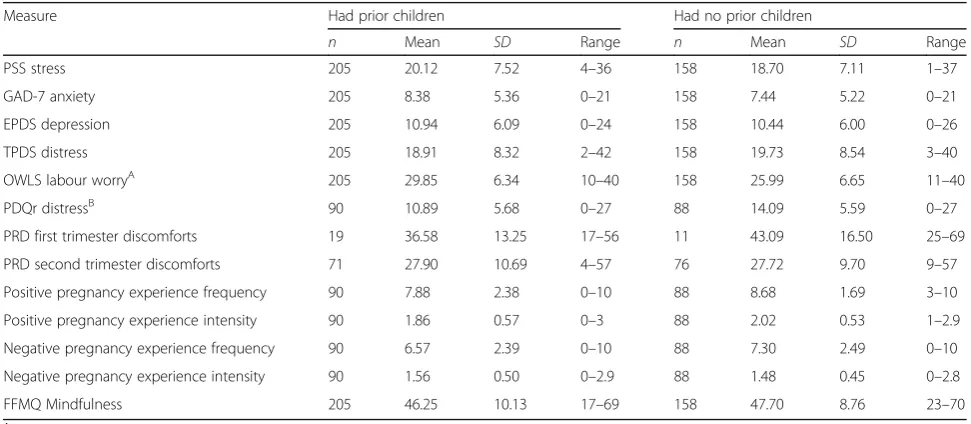
See Table3for the difference in measures by parity. Partial correlations, controlling for general PSS stress and GAD-7 anxiety were run to examine any difference in those who already had children (n= 205) and those who did not (n= 158), see Table4.
In those who had previous children, mindfulness was correlated with EPDS depression (rPSS,GAD-7=−.443,
p <.001) and TPDS distress (rPSS,GAD-7=−.204,p <.005). OWLS labour worry was not correlated with mindfulness in those with (rPSS,GAD-7= .011,p =.880) children.
Examining the measures completed by fewer partici-pants (n= 178), comparing those with (n= 90) and with-out children (n= 88), mindfulness was not correlated with PDQr distress in those with children (rPSS,GAD-7=
−.074,p =.495).
Correlations with mindfulness and pregnancy experi-ence showed that there was still a relationship with the frequency of negative pregnancy experiences and mindful-ness in those who already had children (bootstrapped based on 1000 samples rPSS,GAD-7=−.297, p = .005, 95% CIs−.482, −.116).There was a trend for the intensity of negative pregnancy experiences in those with children (bootstrapped based on 1000 samples rPSS,GAD-7=−.207,
p =.053, 95% CIs−.401, .025). Examining second trimes-ter discomforts, mindfulness was not correlated in those who had children (rPSS,GAD-7=−.035,p =.773,n= 71).
In those without children, EPDS depression was no longer correlated with mindfulness (rPSS,GAD-7=−.147,
p = .067) and was still correlated with TPDS distress (rPSS,GAD-7=−.305, p < .001). OWLS labour worry was not correlated with mindfulness in those without chil-dren (rPSS,GAD-7= .084,p =.299).
Examining the measures completed by fewer partici-pants (n= 178), comparing those with (n= 90) and with-out children (n= 88), mindfulness was correlated with PDQr distress (rPSS,GAD-7=−.357, p =.001) in those who had no previous children.
In those without prior children, there was no longer a relationship between negative pregnancy experience and mindfulness, either frequency (bootstrapped based on 1000 samplesrPSS,GAD-7=−.145,p =.182, 95% CIs−.309, .017) or intensity (bootstrapped based on 1000 samples
rPSS,GAD-7=−.158,p =.147, 95% CIs−.321, .019). Examin-ing second trimester discomforts, mindfulness was not correlated in those who did not have children (rPSS,GAD-7=
−.194,p =.097,n= 76).
Mindfulness, general mood and current mental health problems
[image:5.595.55.541.505.717.2]Participants were asked whether or not they had current mental health problems and if so, what they were. Of those who did have mental health problems (n= 52) a variety of problems were stated including depression (n= 22), anxiety (n= 15), bipolar depression (n= 1) or a mixture of two or more co-morbidities (n= 14) includ-ing issues such as depression, anxiety, obsessive compul-sive disorder, borderline personality disorder, bipolar depression and post-traumatic stress disorder.. A conser-vative effect size of 0.25 (f) [27] was used to determine the t-test power with a sample of 52 compared with 311
Table 3Measure by Parity
Measure Had prior children Had no prior children
n Mean SD Range n Mean SD Range
PSS stress 205 20.12 7.52 4–36 158 18.70 7.11 1–37
GAD-7 anxiety 205 8.38 5.36 0–21 158 7.44 5.22 0–21
EPDS depression 205 10.94 6.09 0–24 158 10.44 6.00 0–26
TPDS distress 205 18.91 8.32 2–42 158 19.73 8.54 3–40
OWLS labour worryA 205 29.85 6.34 10–40 158 25.99 6.65 11–40
PDQr distressB 90 10.89 5.68 0–27 88 14.09 5.59 0–27
PRD first trimester discomforts 19 36.58 13.25 17–56 11 43.09 16.50 25–69
PRD second trimester discomforts 71 27.90 10.69 4–57 76 27.72 9.70 9–57
Positive pregnancy experience frequency 90 7.88 2.38 0–10 88 8.68 1.69 3–10
Positive pregnancy experience intensity 90 1.86 0.57 0–3 88 2.02 0.53 1–2.9
Negative pregnancy experience frequency 90 6.57 2.39 0–10 88 7.30 2.49 0–10
Negative pregnancy experience intensity 90 1.56 0.50 0–2.9 88 1.48 0.45 0–2.8
FFMQ Mindfulness 205 46.25 10.13 17–69 158 47.70 8.76 23–70
A
significant difference between groups t (361) = 5.62,p< .001
B
healthy participants, using G*Power software [28]. The estimated power for such a test was 80% (df361).
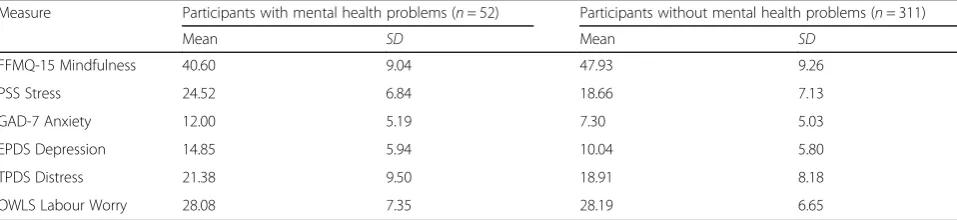
Compared with currently well participants (n= 311), participants with mental health issues (n= 52) had sig-nificantly higher perceived stress, t(361) = 5.52, p< .001 and anxiety t (361) = 6.21, p< .001. Dispositional mind-fulness was also significantly lower for participants ex-periencing mental health problems, t (361) =−5.30,
p< .001. See Table5.
Correlations examining the relationship with mindfulness and mood in participants with (n= 52) and without (n= 311) current mental health problems showed that perceived stress was correlated with mindfulness in the two groups,
r =−.455, p< .005 and r=−.612, p< .001 respectively and so was anxiety,r=−.355,p< .05 andr=−.536,p< .001.
Mindfulness, pregnancy-related mood and current mental health problems
Participants with mental health issues (n= 52) had sig-nificantly higher EPDS pregnancy-related depression, t
(361) = 5.52, p< .001 and pregnancy-related TPDS dis-tresst(361) = 1.97,p= .05 compared with their currently healthy counterparts (n= 311).
Correlations split by current mental health problems (n= 52) or not (n= 311) showed that, in those without problems, mindfulness was correlated with pregnancy-related depression, r=−.665, p< .001, distress, r=−.57,
p< .001 and labour worry,r= .244,p< .001. For partici-pants with current problems, mindfulness was correlated with pregnancy-related depression, r=−.433, p< .005 but not correlated with distress, r=−.78, p= .58, nor labour worry,r=−.140,p= .32.
Partial correlations in those with no current mental health problems (n= 311), controlling for general mood (PSS stress, & GAD-7 anxiety) showed that mindfulness was correlated with pregnancy-related depression, r (PSS, GAD-7)=−.359,
p <.001 and distress,r(PSS, GAD-7)=−.333,p <.001 and not with labour worry, r (PSS, GAD-7)= .078, p = .17. Examining participants with current problems (n= 52), mindfulness was not correlated with pregnancy-related depression,r(PSS,
GAD-7)=−.133, p= .36, distress, r(PSS, GAD-7)= .136, p= .35, nor labour worry,r(PSS, GAD-7)=−.192,p= .18.
Discussion and conclusions
[image:6.595.60.539.99.266.2]The intention of this study was to evaluate the relation-ship between mood and mindfulness in a cross-sectional analysis of pregnant women to further limited research. Table 4Partial Correlations of Mindfulness and Pregnancy-related Mood, controlling for PSS Stress and GAD-7 Anxiety
Measure Had prior children Had no prior children
n r p n r p
EPDS depression 205 −.443 .000 158 −.147 .067
TPDS distress 205 −.204 .004 158 −.305 .000
OWLS labour worry 205 .011 .880 158 .084 .299
PDQr distress 90 −.074 .495 88 −.357 .001
PRD first trimester discomforts 19 −.246 .342 11 .251 .515
PRD second trimester discomforts 71 −.035 .773 76 −.194 .097
Positive pregnancy experience frequencya 90 .067 .535 88 −.024 .828
Positive pregnancy experience intensitya 90 −.052 .629 88 .129 .235
Negative pregnancy experience frequencya 90 −.297 .005 88 −.145 .182
Negative pregnancy experience intensitya 90 −.207 .053 88 −.158 .147
a
PES analysis bootstrapped based on 1000 samples
These scores represent the values of statistical significance and one near-to significance
Table 5Outcomes by Current Mental Health Problems
Measure Participants with mental health problems (n= 52) Participants without mental health problems (n= 311)
Mean SD Mean SD
FFMQ-15 Mindfulness 40.60 9.04 47.93 9.26
PSS Stress 24.52 6.84 18.66 7.13
GAD-7 Anxiety 12.00 5.19 7.30 5.03
EPDS Depression 14.85 5.94 10.04 5.80
TPDS Distress 21.38 9.50 18.91 8.18
[image:6.595.58.537.621.731.2]The level of dispositional mindfulness had a significant association with mood such that higher mindfulness scores were related to lower scores of general stress and anxiety and controlling for general mood, pregnancy-related depression, distress and rates of negative preg-nancy experiences.
For participants who had children, when accounting for levels of general stress and anxiety, higher mindfulness scores were associated with lower scores of pregnancy-related depression, distress and negative pregnancy experi-ences. In those without children, higher mindfulness was associated with lower pregnancy-related distress.
Higher levels of mindfulness were related to lower levels of general stress and anxiety whether or not participants had current mental health problems. In those without current problems, when controlling for general stress and anxiety, higher mindfulness scores were associated with lower levels of pregnancy-related depression and distress but for participants who had current mental health prob-lems, there was no relationship.
The current findings show that, in a sample with higher scores of negative mood overall, higher levels of disposi-tional mindfulness are associated with lower levels of gen-eral and pregnancy-related negative mood, but that the background of the participants should be taken into account. The current analysis, being correlational in nature, can only show a relationship and not causality, i.e. it is unclear whether lower levels of mindfulness incur higher levels of stress etc. or that higher levels of stress incur lower levels of mindfulness. While the current findings suggest that offering a mindfulness-based stress reduction course to women during pregnancy may be beneficial, more research should be conducted to investigate the relationship and po-tential benefits in more detail. This paper presents an initial exploration of how mood and mindfulness relate to each other during pregnancy and is a precursor to future studies investigating mindfulness interventions for pregnant populations.
Research has found that higher dispositional mindful-ness during pregnancy was associated with improved mood during and after pregnancy if it was maintained or increased [2]. Potentially, sustaining levels of mindfulness over pregnancy could be beneficial for low mood. Offering a course with mindfulness-based elements, specifically aimed at alleviating low mood during pregnancy, may be most beneficial.
This study has limitations. First, the study is cross-sectional with no follow-up data so it is difficult to posit how these women would have felt later in pregnancy. While splitting the sample by trimester gives an indica-tion of mood during different times, it would be more informative to investigate how mood changes during pregnancy. Second, measures of pregnancy-specific anx-iety and stress were not included to limit participant
burden; while pregnancy-specific and general anxiety and stress may reflect different emotional constructs, potential differences cannot be currently evaluated be-cause of this omission and it may be helpful to include them in future studies.
This is one of the first studies to explore mood and dispositional mindfulness during pregnancy and as such, is a good precursor to future studies. Proceeding studies should investigate whether mindfulness mediates mood improvement and use this work to improve the rationale and research surrounding the utility of mindfulness courses for use in this population.
Additional files
Additional file 1:Checklist for Reporting Results of Internet E-Surveys (CHERRIES). (DOCX 15 kb)
Additional file 2:Sociodemographic Questionnaire. (DOCX 20 kb)
Acknowledgements
This work was supported by a studentship from the Mental Health Foundation with additional financial support from the Oxford Mindfulness Centre. The authors would like to thank all of the women who participated in this study.
Authors’contributions
AK, CC and MD were involved in study conception and design. AK collected and managed the data. AK completed statistical analysis and all authors contributed to statistical interpretation. AK prepared the manuscript and completed revisions. CC and MD provided critical feedback on all manuscript drafts. All authors approved the manuscript. AK is the guarantor.
Funding
This work was funded by a studentship from the Mental Health Foundation with additional financial support from the Oxford Mindfulness Centre. The funding bodies had no input into the study and were updated annually on the progress of the DPhil.
Availability of data and materials
The datasets used during the current study are not publicly available but are available from the corresponding author on reasonable request.
Ethics approval and consent to participate
All procedures performed in studies involving human participants were in accordance with the ethical standards of the institutional research committee, the Central University Research Ethics Committee (CUREC; MSD-IDREC- C1–2013-016) and with the 1964 Helsinki declaration and its later amendments or comparable ethical standards. This article does not contain any studies with animals performed by any of the authors. Informed consent was obtained from all individual participants included in the study via the se-cure Online Surveys website [10], by ticking boxes to agree to the consent form statements and entering their name and date.
Consent for publication
Participants consented to the use of their anonymous data to be use in publications.
Competing interests
Received: 1 March 2019 Accepted: 19 July 2019
References
1. van den Heuvel MI, Johannes MA, Henrichs J, Van den Bergh BRH. Maternal mindfulness during pregnancy and infant socio-emotional development and temperament: The mediating role of maternal anxiety. Early Hum Dev. 2015;91(2):103–8.https://doi.org/10.1016/j.earlhumdev.2014.12.003. 2. Zoeterman SE. In the moment: prenatal mindful awareness and its relationship to depression, anxiety, and birth experience. (Doctoral dissertation, Teachers College, Columbia University). 2013.
3. Baer RA, Smith GT, Hopkins J, Krietemeyer J, Toney L. Using self-report assessment methods to explore facets of mindfulness. Assessment. 2006; 13(1):27–45.https://doi.org/10.1177/1073191105283504.
4. Truijens SEM, Nyklíček I, van Son J, Pop VJM. Validation of a short form Three Facet Mindfulness Questionnaire (TFMQ-SF) in pregnant women. Pers Individ Dif. 2015.https://doi.org/10.1016/j.paid.2015.06.037.
5. Roesch SC, Schetter CD, Woo G, Hobel CJ. Modeling the types and timing of stress in pregnancy. Anxiety Stress Coping. 2004;17(1):87–102. 6. Redshaw M, Martin C, Rowe R, Hockley C. The Oxford worries about labour
scale: Women's experience and measurement characteristics of a measure of maternal concern about labour and birth. Psychol Health Med. 2009; 14(3):354–66.https://doi.org/10.1080/13548500802707159.
7. Yali AM, Lobel M. Coping and distress in pregnancy: an investigation of medically high risk women. J Psychosom Obstet Gynecol. 1999;20(1):39–52. 8. Lobel M, Cannella DL, Graham JE, DeVincent C, Schneider J, Meyer BA.
Pregnancy-specific stress, prenatal health behaviors, and birth outcomes. Health Psychol. 2008;27(5):604.
9. Carmody J, Baer RA. Relationships between mindfulness practice and levels of mindfulness, medical and psychological symptoms and well-being in a mindfulness-based stress reduction program. J Behav Med. 2008;31(1):11. 10. Online surveys.https://www.onlinesurveys.ac.uk/. Accessed 18 July 2019. 11. Eysenbach G. Improving the quality of Web surveys: the Checklist for
Reporting Results of Internet E-Surveys (CHERRIES). J Med Internet Res. 2004; 6(3):e34.
12. Baer RA, Carmody J, Hunsinger M. Weekly change in mindfulness and perceived stress in a mindfulness-based stress reduction program. J Clin Psychol. 2012;68(7):755–65.https://doi.org/10.1002/jclp.21865.
13. Cohen S, Kamarck T, Mermelstein R. A global measure of perceived stress. J Health Soc Behav. 1983;24(4):385–96 doi:citeulike-article-id:2078058. 14. Spitzer RL, Kroenke K, Williams JBW, Lowe B. A brief measure for assessing
generalized anxiety disorder: the GAD-7. Arch Intern Med. 2006;166(10): 1092–7.https://doi.org/10.1001/archinte.166.10.1092.
15. Goodman J, Guarino A, Chenausky K, Klein L, Prager J, Petersen R, et al. CALM pregnancy: results of a pilot study of mindfulness-based cognitive therapy for perinatal anxiety. Arch Women’s Ment Health. 2014;17(5):373–87. https://doi.org/10.1007/s00737-013-0402-7.
16. Cox JL, Holden JM, Sagovsky R. Detection of postnatal depression. Development of the 10-item Edinburgh postnatal depression scale. Br J Psychiatry. 1987;150(6):782–6.https://doi.org/10.1192/bjp.150.6.782. 17. Pearson RM, Evans J, Kounali D, Lewis G, Heron J, Ramchandani PG, et al.
Maternal depression during pregnancy and the postnatal period: risks and possible mechanisms for offspring depression at age 18 years. JAMA Psychiatry. 2013;70(12):1312–9.https://doi.org/10.1001/jamapsychiatry.2013.2163. 18. Edmondson OJ, Psychogiou L, Vlachos H, Netsi E, Ramchandani PG.
Depression in fathers in the postnatal period: assessment of the Edinburgh postnatal depression scale as a screening measure. J Affect Disord. 2010; 125(1):365–8.
19. Pop V, Pommer A, Pop-Purceleanu M, Wijnen H, Bergink V, Pouwer F. Development of the Tilburg pregnancy distress scale: the TPDS. BMC Pregnancy Childbirth. 2011;11(1):80.
20. Coussons-Read ME, Lobel M, Carey JC, Kreither MO, D’Anna K, Argys L, et al. The occurrence of preterm delivery is linked to pregnancy-specific distress and elevated inflammatory markers across gestation. Brain Behav Immun. 2012;26(4):650–9.
21. Shinkawa H, Shimada M, Hirokane K, Hayase M, Inui T. Development of a scale for pregnancy-related discomforts. J Obstet Gynaecol Res. 2012;38(1): 316–23.https://doi.org/10.1111/j.1447-0756.2011.01676.x.
22. DiPietro JA, Christensen A, Costigan K. The pregnancy experience scale– brief version. J Psychosom Obstet Gynaecol. 2008;29(4):262–7.
23. DiPietro JA, Costigan K, Hawkins M. Measuring the ups and downs of pregnancy stress. J Psychosom Obstet Gynaecol. 2004;25(3–4):189–201. 24. Cohen S, Williamson G. Perceived stress in a probability sample of the
United States. In: Spacapan S, Oskamp S, editors. The social psychology of health: Claremont Symposium on applied social psychology; 1988. p. 31–67. 25. Löwe B, Decker O, Müller S, Brähler E, Schellberg D, et al. Validation and
standardization of the generalized anxiety disorder screener (GAD-7) in the general population. Med Care. 2008;46(3):266–74.https://doi.org/10.1097/ MLR.0b013e318160d093.
26. Cox JL, Murray D, Chapman G. A controlled study of the onset, duration and prevalence of postnatal depression. Br J Psychiatry. 1993;163(1):27–31. https://doi.org/10.1192/bjp.163.1.27.
27. Cohen S. A power primer. Psychol Bull. 1992;112(1):155–9.
28. Erdfelder E, Faul F, Buchner A. GPOWER: a general power analysis program. Behav Res Methods Instrum Comput. 1996;28(1):1–11.
Publisher’s Note