Guidelines and Framework for a Large Scale Arabic Diacritized Corpus
Wajdi Zaghouani
1, Houda Bouamor
1, Abdelati Hawwari
2, Mona Diab
2,
Ossama Obeid
1, Mahmoud Ghoneim
2, Sawsan Alqahtani
2and Kemal Oflazer
11Carnegie Mellon University in Qatar
{wajdiz,hbouamor,owo}@cmu.edu, [email protected]
2George Washington University
{mdiab,abhawwari,ghoneim,sawsanq}@gwu.edu
Abstract
This paper presents the annotation guidelines developed as part of an effort to create a large scale manually diacritized corpus for various Arabic text genres. The target size of the annotated corpus is 2 million words. We summarize the guidelines and describe issues encountered during the training of the annotators. We also discuss the challenges posed by the complexity of the Arabic language and how they are addressed. Finally, we present the diacritization annotation procedure and detail the quality of the resulting annotations.
Keywords:Arabic Diacritization, Guidelines, Annotation
1.
Introduction
Written Modern Standard Arabic (MSA) poses many chal-lenges for natural language processing (NLP). Most written Arabic text lacks short vowels and diacritics rendering a mostly consonantal orthography (Schulz, 2004). Arabic di-acritization is an orthographic way to describe Arabic word pronunciation, and to avoid word reading ambiguity. Ara-bic writing system has two classes of symbols: letters and diacritics. diacritics are the marks that reflect the phonolog-ical, morphological and grammatical rules. Diacritization may be classified according to the linguistic rules they are representing, into two types: a) word form diacritization, which shows how a word is pronounced, except the last letter diacritization, and b) case and mood diacritization, which exists above or below the last letter in each word, indicating its grammatical function in the sentence. There are three types of diacritics: vowel, nunation, and shadda (gemination).
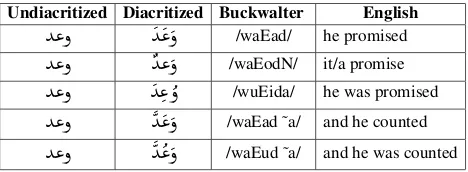
[image:1.595.307.541.337.423.2]The lack of diacritics leads usually to considerable lexical and morphological ambiguity as shown in the example in Table 1.1 Full diacritization has been shown to improve
state-of-the-art Arabic automatic systems such as speech recognition (ASR) systems (Kirchhoff and Vergyri, 2005) and statistical machine translation (SMT) (Diab et al., 2007). Hence, diacritization has been receiving increased attention in several Arabic NLP applications (Zitouni et al., 2006; Shahrour et al., 2015; Abandah et al., 2015; Belinkov and Glass, 2015).
Building models to assign diacritics to each letter in a word requires a large amount of annotated training corpora cover-ing different topics and domains to overcome the sparseness problem. The currently available MSA diacritized corpora are generally limited to newswire stories (those distributed by the LDC), religious texts such as the Holy Quran, or ed-ucational texts.
1We use the Buckwalter transliteration encoding system to
rep-resent Arabic in Romanized script (Buckwalter, 2002)
Undiacritized Diacritized Buckwalter English
Y«ð
Y
« ð
/waEad/ he promisedY«ð
Y« ð
/waEodN/ it/a promiseY«ð
Y«
ð
/wuEida/ he was promisedY«ð
Y
« ð
/waEad ˜a/ and he countedY«ð
Y
« ð
/waEud ˜a/ and he was countedTable 1: Possible pronunciations and meanings of the undi-acritized Arabic word
Y«ð
/wEd/This paper presents the work carried out within the opti-mal diacritization scheme for Arabic orthographic repre-sentation (OptDiac) project. The focus of this work is to manually create a large-scale annotated corpus with the di-acritics for a variety of Arabic texts covering more than 10 genres. The target size of the annotated corpus is 2 mil-lion words. The present work was mainly motivated by the lack of equivalent multi-genres large scale annotated cor-pus. The creation of manually annotated corpus usually presents many challenges and issues. In order to address those challenges, we created comprehensive and simplified annotation guidelines that were used by a team consisting of five annotators and an annotation manager. The guide-lines were defined after an initial pilot annotation experi-ment described in Bouamor et al. (2015). In order to ensure a high annotation agreement between the annotators, multi-ple training sessions were held and a regular inter-annotator agreement (IAA) measures were performed to check anno-tation quality. To the best of our knowledge, this is the first Arabic diacritized multi-genres corpus.
We present the diacritization annotation procedure in sec-tion 6 and analyze the quality of the resulting annotasec-tions in 7. Finally we conclude and present our future work in section 8.
2.
Related Work
Since, our paper is mainly about the creation and evaluation of a large annotated corpus, we will focus mostly on this aspect in the previous works. There have been numerous approaches to build an automatic diacritization system for Arabic using rule-based, statistical and hybrid methods. We refer to the recent literature review in Abandah et al. (2015) for a general overview of these methods and tools.
The most relevant resource to our work is the Penn Ara-bic Treebank (PATB), a large corpus annotated by the Lin-guistic Data Consortium (Maamouri et al., 2010). Most of the LDC Treebank corpora are also manually diacritized, but they cover mainly news and weblog text genres. The PATB served later to build the first Arabic Proposition Bank (APB) using the fully specified diacritized lemmas (Diab et al., 2008; Zaghouani et al., 2010).
The Tashkeela classical Arabic vocalized corpus (Zerrouki, 2011) is another notable dataset covering six million words. Tashkeela was compiled from various web sources covering Islamic religious heritage (mainly classical Arabic books). Moreover, Dukes and Habash (2010), created the Quranic Arabic Corpus, a fully diacritized annotated linguistic re-source which we used later on to build the first Quranic Arabic Proposition Bank Zaghouani et al. (2012).
The Qatar Arabic Language Bank (Zaghouani et al., 2014; Zaghouani et al., 2015; Zaghouani et al., 2016) is another relevant work that aims to build a large corpus of manu-ally corrected Arabic text for building automatic correction tools for three Arabic text genres: native, non-native and machine translation post-edited text.
Recently, in Bouamor et al. (2015), we conducted vari-ous annotation experiments to find the most suitable and efficient annotation procedure in creating a large scale dia-critized corpus.
3.
Arabic Diacritics
Arabic script consists of two classes of symbols: letters and diacritics. Letters comprise long vowels such as A, y, w as well as consonants. Diacritics on the other hand com-prise short vowels, gemination markers, nunation markers, as well as other markers (such as hamza, the glottal stop which appears in conjunction with a small number of let-ters, e.g.,
@
,@
,@
, etc., dots on letters, elongation and emphatic markers)2which in all, if present, render a more or lessex-act precise reading of a word. In this study, we are mostly addressing three types of diacritical marks: short vowels, nunation, and shadda (gemination). In this study, short vowel diacritics refer to the three short vowels in Modern Standard Arabic (MSA)3 and a diacritic indicating the
ab-2
Most encodings do not count hamza as a diacritic and the dots on letters are obligatory, other markers are truly optional hence the exclusion of all these classes from our study.
3All reference to Arabic in this paper is specifically to the
MSA variant.
sence of any vowel. The following are the three vowel dia-critics exemplified in conjunction with the letter
Ð
/m:Ð
/ma (fatha),Ð
/mu (damma),Ð
/mi (kasra), andÐ
/mo (no vowel aka sukuun). Nunation diacritics can only occur word fi-nally in nominals (nouns, adjectives) and adverbs. They indicate a short vowel followed by an unwritten n sound:A
Ó
/mAF,4Ð
/mN andÐ
/mK. Nunation is an indicator ofnom-inal indefiniteness. The shadda is a consonant doubling di-acritic:
Ð
/m˜(/mm/). The shadda can combine with vowelor nunation diacritics:
Ð
/m˜u orÐ
/m˜uN.Functionally, diacritics can be split into two different kinds:
lexical diacritics andinflectional diacritics (Diab et al., 2007) .
Lexical diacritics : distinguish between two lexemes.5
We refer to a lexeme with its citation form as the lemma. Arabic lemma forms are third masculine singular perfec-tive for verbs and masculine singular (or feminine singular if no masculine is possible) for nouns and adjectives. For example, the diacritization difference between the lemmas
I
.
KA
¿
/kAtib/ ’writer’ andI
.
KA
¿
/kAtab/ ’to correspond’ tinguishes between the meanings of the word (lexical dis-ambiguation) rather than their inflections. Any of diacritics may be used to mark lexical variation. A common exam-ple with the shadda (gemination) diacritic is the distinction between Form I and Form II of Arabic verb derivations. Form II, indicates, in most cases, added causativity to the Form I meaning. Form II is marked by doubling the second radical of the root used in Form I:É
¿
@
/Akal/’ate’vs.É
¿ @
/Ak˜al/ ’fed’. Generally speaking, however, deriving word meaning through lexical diacritic placement is largely un-predictable and they are not specifically associated with any particular part of speech.
Inflectional diacritics : distinguish different inflected forms of the same lexeme. For instance, the final diacrit-ics in
H.A
J»
/kitAbu/ ’book [nominative]’ andH.A
J»
/kitAba/ ’book [accusative]’ distinguish the syntactic case of ’book’ (e.g., whether the word is subject or object of a verb). Addi-tional inflecAddi-tional features marked through diacritic change, in addition to syntactic case, include voice, mood, and def-initeness. Inflectional diacritics are predictable in their po-sitional placement in a word. Moreover, they are associated with certain parts of speech.4.
Corpus Description
We use the corpus of contemporary Arabic (CCA) com-piled by Al-Sulaiti and Atwell (2006). It is a balanced cor-pus divided into the following genres: autobiography, short stories, children’s stories, economics, education, health and medicine, interviews, politics, recipes, religion, sociology,
4
Buckwalter’s transliteration symbols for nunation, F, N and K, are pronounced /an/, /un/ and /in/, respectively.
5
science, sports, tourism and travel. The CCA corpus text genres were carefully selected by its compilers since the tar-get users of the corpus were mostly language teachers and teachers of Arabic as a foreign language. Various metadata information are included in the corpus such as the infor-mation about the text, the author and the source. In order to use the CCA corpus, a normalization effort was done to produce a consistent XML mark-up format to be used by our annotation tool.
5.
Development of the Guidelines
We provided the annotators with detailed guidelines, de-scribing our diacritization scheme and specifying when and where to add the diacritics. We describe the annotation pro-cedure and explained how to deal with borderline cases. We also include several annotated examples to illustrate the specified rules.
Our guidelines are mostly inspired from the LDC POS an-notation guidelines (Maamouri et al., 2008). Since, the LDC guidelines are mainly designed for the POS annota-tion and not specifically for the diacritizaannota-tion per se, we created a simplified version and added some specific dia-critization rules to make the annotation process consistent. Below we provide some examples of diacritization excep-tions and specific rules.
The Shadda: The shadda mark should be added in all cases specified in the guidelines except the following in the definite artilce, where it should not be added to the letter
È
/l/ of the definite article (e.g.àñÒJÊË@
/Allymwn/ ’lemon’ and notàñÒJÊ
Ë@
/A˜llymwn/). Moreover, the shadda should be added to the first letter that follows the definite article with a solar letter construction such as inA
JË@
/Al˜nAs/ ’The people’ and notA JË@
/AlnAs/.The Soukoun: The sukuun sign should not be indicated at the end of silent words (e.g.,
áÓ
/mn/ ’from’).The Proper Nouns: The proper noun case endings are not to be added as they are defined by their nature with the exception of an accusative proper noun of Arabic origin as in
AJÊ
«
IÊK
. A
¯
/qAbaltu Eali ˜AF/ ’I met Ali’.Abbreviations: Abbreviations are not to be diacritized (
Õ»
’km’ /km/,©»
/kg/ ’kg’).Nunations: In the case of nunation at the end of a word, if the word ends with an accusative nunation as in
A K@ð
Y
«
/EudowAnAF/ ’Hostile’, the nunation -an signs are placed on the letter Alif and not on the nunated letter as inA
K@ð
Y
«
/EudowAnFA/ ’Hostility’.6Deterministic Diacritization: In some cases, the dia-critization is deterministically found in the case of letters followed by a long letter Alif should not be diacritized as in
AJJÓ
/miyvAqu/ ’Treaty’ and notA
JJÓ
/miyvaAqu/. A summary of the common Arabic diacritization rules is also added as a reference in the guidelines.76The addition of a final Nun sound to a noun or adjective
indi-cates that it is a declinable and unmarked for definiteness.
7The guidelines will be soon made publicly available.
6.
Annotation Framework
As a large scale corpus annotation project, this project in-volves a team of annotators, lead annotation managers and consists of five annotators and a programmer.
6.1.
Annotation Management
The lead annotation manager is responsible for the whole annotation workflow. This includes corpus selection and normalization and the annotation of the gold standard used to compute the Inter-Annotator Agreement (IAA) level. Moreover, the lead annotator is responsible for writing and updating the annotation guidelines when deemed necessary, evaluate the quality of the annotation, monitor and report on the annotation progress.
To control the quality of the annotation of each newly hired annotator, we proceed as follows. After an initial training phase, the annotator’s work is closely monitored during the initial weeks, afterwards, the annotator can join the official production phase. Recently, a dedicated on-line discussion group was created to keep track of the issues raised during the annotation so that the annotators and the lead annotator can have a better communication.
6.2.
Annotator Training
The annotators in this project are mostly university grad-uates who are native Arabic speakers.8 During the hir-ing phase, the annotators were tested on an Arabic lan-guage screening test (syntax and Arabic diacritization re-lated questions). Once selected, the annotators were trained as a group for the task. The training consisted of various an-notation tasks to be done by all the participants, guidelines reading and meetings with the annotation manager and the other annotators.
6.3.
The Annotation Tool
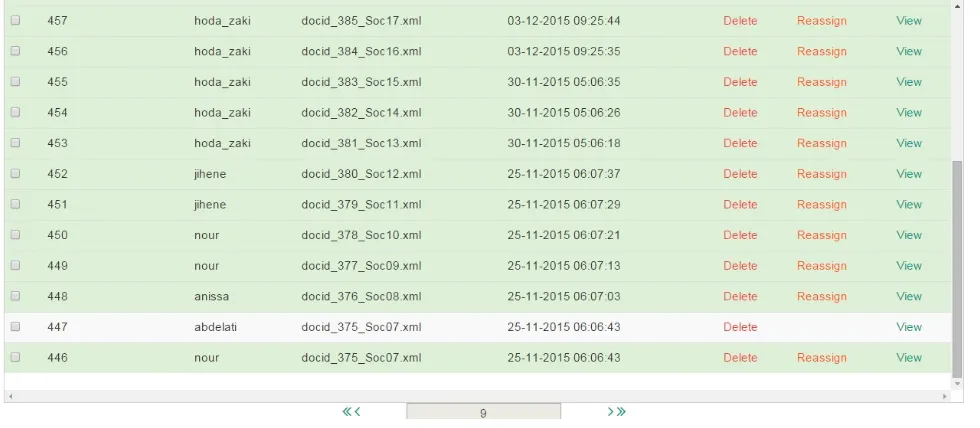
We designed and implemented a web-based annotation tool and a work-flow management interface (Obeid et al., 2016). Our online interface allows annotators to select from an au-tomatically generated diacritized words and/or edit words manually as shown in Figure 1. The annotation interface allows users to undo/redo actions, and the history is kept over multiple sessions. The interface includes a timer to keep track of how long each sentence annotation has taken. The annotation work-flow management interface is used by the lead annotator to organize the annotation pipeline in-cluding: (i) the organization of the corpus to be annotated, (ii) tasks assignment, (iii) tracking the annotation progress and (iv) measuring automatically and regularly the agree-ment between annotators. Once an annotator submits his task, the annotation manager is alerted through the inter-face by a green highlight of the task, as shown in Figure 2. Then, the annotation manager can view and check on the quality of the annotation (Figure 3).
6.4.
The Annotation Procedure
Following the recommendations obtained from the pilot study conducted in Bouamor et al. (2015), we formulated the diacritization annotation as a selection task. Annotators
8
Figure 1: The annotation interface showing a selection action
Figure 2: The annotation management interface showing completed tasks highlighted in green
are provided with a list of automatically diacritized can-didates and are asked to choose the correct one, if it ap-pears in the list. Otherwise, if they are not satisfied with the given candidates, they can manually edit the word and add the correct diacritics. This technique reduces annota-tion time, increases annotaannota-tion quality and especially re-duce annotator workload. For each word, we generate a list of diacritized candidates using MADAMIRA (Pasha et al., 2014). MADAMIRA is able to achieve a lemmatization ac-curacy of 99.2% and a diacritization acac-curacy of 86.3%. An example of diacritization candidates is given in Figure 1.
7.
Annotation Analysis and Results
[image:4.595.55.545.375.589.2]Figure 3: The view annotation menu in the annotation management interface.
lower their agreement.
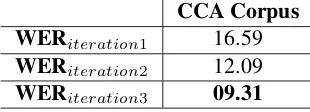
During the annotation of the CCA corpus, we conducted three iterations to improve and simplify and update our guidelines and also to address borderline annotation issues. After each iteration, we measure the IAA to check for pos-sible consistency improvement. The results given in Table 2 show a steady IAA improvement after each iteration with a WER reduced to 9.31%.
CCA Corpus
WER
iteration116.59
WER
iteration212.09
WER
iteration309.31
Table 2: Average WER obtained after each annotation iter-ation on the CCA corpus.
7.1.
Error Analysis
During the multiple IAA evaluations, we observed various sources of inconsistent annotation between the annotators. In some cases, there was no agreement on whether to add the diacritics or not, while in in other cases, the annota-tors disagreed on the syntactic interpretation of the word. We compiled below the list of the most important cases of disagreement sorted from the most frequent to the less fre-quent.
1. Disagreement due to two possible sentence interpreta-tions.
2. foreign words and proper noun diacritics disagree-ment.
3. Diacritization disagreement in misspelled words.
4. Case endings disagreement.
5. Shadda diacritization disagreement.
6. Soukoun diacritization disagreement.
7. Dialectal Arabic expressions diacritization.
We will continue our annotator training and update our guidelines in order to reach better IAA scores.
8.
Conclusion and future work
In this paper, we presented large-scale diacritizaton annota-tion effort for multi-genre Arabic texts, including guideline development and the annotation framework. We discussed the challenges inherent in corpus diacritization including the most frequent cases of annotation disagreement. The results obtained during the evaluation suggest that the anno-tation consistency improved overtime following the guide-lines updates.
We will continue working to improve the inter-annotator agreement and we plan to make the annotated data available soon for the research community to develop related natural language processing applications. Finally, we hope that the annotated data could be used as part of a shared task to build automatic diacritization tools for Arabic in a similar way to the shared tasks we organized in recent years on automatic text correction of Arabic (Mohit et al., 2014; Rozovskaya et al., 2015).
Acknowledgements
[image:5.595.91.246.472.528.2]the Qatar National Research Fund (a member of the Qatar Foundation). The statements made herein are solely the re-sponsibility of the authors.
9.
References
Abandah, G. A., Graves, A., Al-Shagoor, B., Arabiyat, A., Jamour, F., and Al-Taee, M. (2015). Automatic Diacriti-zation of Arabic Text using Recurrent Neural Networks.
International Journal on Document Analysis and Recog-nition (IJDAR), 18(2):183–197.
Al-Sulaiti, L. and Atwell, E. S. (2006). The design of a corpus of Contemporary Arabic. International Journal of Corpus Linguistics, 11(2):135–171.
Belinkov, Y. and Glass, J. (2015). Arabic Diacritization with Recurrent Neural Networks. InProceedings of the 2015 Conference on Empirical Methods in Natural Lan-guage Processing, pages 2281–2285, Lisbon, Portugal. Bouamor, H., Zaghouani, W., Diab, M., Obeid, O., Oflazer,
K., Ghoneim, M., and Hawwari, A. (2015). A Pilot Study on Arabic Multi-Genre Corpus Diacritization. In
Proceedings of the Association for Computational Lin-guistics Second Workshop on Arabic Natural Language Processing, pages 80–88, Beijing, China.
Buckwalter, T. (2002). Buckwalter Arabic Morphological Analyzer Version 1.0. Technical Report LDC2002L49, Linguistic Data Consortium.
Diab, M., Ghoneim, M., and Habash, N. (2007). Ara-bic Diacritization in the Context of Statistical Machine Translation. In Proceedings of MT-Summit, Copen-hagen, Denmark.
Diab, M., Mansouri, A., Palmer, M., Babko-Malaya, O., Zaghouani, W., Bies, A., and Maamouri, M. (2008). A pilot arabic propbank. InProceedings of the 7th Interna-tional Conference on Language Resources and Evalua-tion (LREC).
Dukes, K. and Habash, N. (2010). Morphological anno-tation of quranic arabic. InProceedings of the Interna-tional Conference on Language Resources and Evalua-tion (LREC).
Kirchhoff, K. and Vergyri, D. (2005). Cross-Dialectal Data Sharing for Acoustic Modeling in Arabic Speech Recog-nition.Speech Communication, 46(1):37–51.
Maamouri, M., Bies, A., and Kulick, S. (2008). Enhancing the arabic treebank: a collaborative effort toward new annotation guidelines. InProceedings of the Sixth Inter-national Conference on Language Resources and Evalu-ation (LREC 2008), Marrakech, Morocco.
Maamouri, M., Bies, A., Kulick, S., Zaghouani, W., Graff, D., and Ciul, M. (2010). From speech to trees: Applying treebank annotation to arabic broadcast news. In Pro-ceedings of International Conference on Language Re-sources and Evaluation (LREC 2010).
Mohit, B., Rozovskaya, A., Habash, N., Zaghouani, W., and Obeid, O. (2014). The first qalb shared task on automatic text correction for arabic. In Proceedings of the EMNLP Workshop on Arabic Natural Language Pro-cessing, page 39.
Obeid, O., , Bouamor, H., Zaghouani, W., Ghoneim, M., Hawwari, A., Diab, M., and Oflazer, K. (2016). MAN-DIAC: A Web-based Annotation System For Manual
Arabic Diacritization. In Proceedings of the Interna-tional Conference on Language Resources and Evalua-tion (LREC-2016) Workshop on Free/Open-Source Ara-bic Corpora and Corpora Processing Tools (OSACT2). Pasha, A., Al-Badrashiny, M., Kholy, A. E., Eskander, R.,
Diab, M., Habash, N., Pooleery, M., Rambow, O., and Roth, R. (2014). MADAMIRA: A Fast, Comprehensive Tool for Morphological Analysis and Disambiguation of Arabic. InProceedings of the 9th International Confer-ence on Language Resources and Evaluation, Reykjavik, Iceland.
Rozovskaya, A., Bouamor, H., Habash, N., Zaghouani, W., Obeid, O., and Mohit, B. (2015). The second qalb shared task on automatic text correction for arabic. In
Proceedings of the ACL-IJCNLP Workshop on Arabic Natural Language Processing, page 26.
Schulz, E. (2004). A Student Grammar of Modern Stan-dard Arabic. Cambridge University Press.
Shahrour, A., Khalifa, S., and Habash, N. (2015). Improv-ing Arabic Diacritization through Syntactic Analysis. In
Proceedings of the 2015 Conference on Empirical Meth-ods in Natural Language Processing, pages 1309–1315, Lisbon, Portugal.
Snover, M., Dorr, B., Schwartz, R., Micciulla, L., and Makhoul, J. (2006). A study of translation edit rate with targeted human annotation. In Proceedings of AMTA, pages 223–231.
Zaghouani, W., Diab, M., Mansouri, A., Pradhan, S., and Palmer, M. (2010). The revised arabic propbank. In
Proceedings of the Association for Computational Lin-guistics Fourth Linguistic Annotation Workshop, pages 222–226. Association for Computational Linguistics. Zaghouani, W., Hawwari, A., and Diab, M. (2012). A pilot
propbank annotation for quranic arabic. InProceedings of the Fourth Workshop on Computational Linguistics for Literature co-located with the North American Asso-ciation Computational Linguistics conference (NAACL-HLT 2012, page 78.
Zaghouani, W., Mohit, B., Habash, N., Obeid, O., Tomeh, N., Rozovskaya, A., Farra, N., Alkuhlani, S., and Oflazer, K. (2014). Large scale arabic error annotation: Guidelines and framework. InProceedings of the Ninth International Conference on Language Resources and Evaluation (LREC-2014), Reykjavik, Iceland, May 26-31, 2014., pages 2362–2369.
Zaghouani, W., Habash, N., Bouamor, H., Rozovskaya, A., Mohit, B., Heider, A., and Oflazer, K. (2015). Cor-rection annotation for non-native arabic texts: Guide-lines and corpus. InProceedings of the Association for Computational Linguistics Fourth Linguistic Annotation Workshop, pages 129–139.
Zaghouani, W., Habash, N., Obeid, O., Mohit, B., Bouamor, H., and Oflazer, K. (2016). Building an arabic machine translation post-edited corpus: Guidelines and annotation. In International Conference on Language Resources and Evaluation (LREC 2016).
Zerrouki, T. (2011). Tashkeela: Arabic vocalized text cor-pus.