Filtering Wiktionary triangles
by linear mapping between distributed word models
Márton Makrai
Research Institute for Linguistics Hungarian Academy of Sciences Benczúr u. 33, H-1068 Budapest [email protected]Abstract
Triangulation infers word translations in a pair of languages based on translations to other, typically better resourced ones called pivots. This method may introduce noise if words in the pivot are polysemous. The reliability of each triangulated translation is basically estimated by the number of pivot languages (Tanaka and Umemura, 1994).
Mikolov et al. (2013b) introduce a method for scoring word translations. Translation is formalized as a linear mapping between distributed vector space models (VSM) of the two languages. VSMs are trained on monolingual data, while the mapping is learned in supervised fashion, using a seed dictionary of some thousand word pairs.
We apply linear mapping to filter triangulated translations, and show that scores by the mapping are smoother measure of merit than the number of pivots. The methods we use are language-independent, and the training data is easy to obtain for many languages. We chose the German-Hungarian pair for evaluation, in which the filtered triangles resulting from our experiments are the greatest freely available list of word translations we are aware of.
Keywords:word triangulation, word embedding, Wiktionary
Word translations arise in dictionary-like organization as well as via machine learning from corpora. The former is exemplified by Wiktionary, a crowd-sourced dictionary with editions in many languages. Ács et al. (2013) ob-tain word translations from Wiktionary with the pivot-based method, also called triangulation, that infers word transla-tions in a pair of languages based on translatransla-tions to other, typically better resourced ones called pivots. Triangulation may introduce noise if words in the pivot are polysemous. The reliability of each triangulated translation is basically estimated by the number of pivot languages (Tanaka and Umemura, 1994).
Mikolov et al. (2013b) introduce a method for generating or scoring word translations. Translation is formalized as a linear mapping between distributed vector space models (VSM) of the two languages. VSMs are trained on mono-lingual data, while the mapping is learned in a supervised fashion, using a seed dictionary of some thousand word pairs. The mapping can be used to associate existing trans-lations with a real-valued similarity score.
This paper exploits human labor in Wiktionary combined with distributional information in VSMs. We train VSMs on gigaword corpora, and the linear translation mapping on direct (non-triangulated) Wiktionary pairs. This mapping is used to filter triangulated translations based on scores. The motivation is that scores by the mapping may be a smoother measure of merit than considering only the number of pivot for the triangle. We evaluate the scores against dictionar-ies extracted from parallel corpora (Tiedemann, 2012). We show that linear translation really provides a more reliable method for triangle scoring than pivot count.
The methods we use are language-independent, and the training data is easy to obtain for many languages. We chose the German-Hungarian pair for evaluation, in which the filtered triangles resulting from our experiments are the greatest freely available list of word translations we are
aware of.
1.
Triangulation
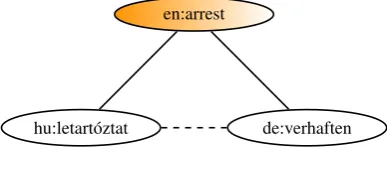
A method for creating dictionaries is triangulation through better-resourced ones called the pivot (Tanaka and Umemura, 1994). The idea is that if the English transla-tion of the Hungarian word letartóztat is arrest, and the German translation ofarrestisverhaften, then the German translation ofletartóztatisverhaften, see fig. 1.
hu:letartóztat de:verhaften en:arrest
Figure 1: Triangulation
Triangles are corrupted by ambiguity in the pivot word (the one in the middle): GermanDosecan be translated ascan
to English (as a synonym oftin), which, as a verb, translates totudin Hungarian, which is unrelated toDose. Saralegi et al. (2011) analyze two methods for pruning wrong tri-angles: one based on exploiting the structure of the source dictionaries, and the other based on distributional similar-ity computed from comparable corpora. This paper is more similar to the later in that it uses distributional information applying a method connected to neural language modeling.
2.
Vector space language models
weights (word embeddings) in neural networks (deep learn-ing). Interestingly, the probably most popular neural lan-guage model, skip-gram with negative sampling (Mikolov et al., 2013a) is not so deep in architecture, and has been shown (Levy and Goldberg, 2014) to be equivalent with a method based on the co-occurrence matrix, shifted point-wise mutual information.
The primary source of information about the meaning of a word is how often it is used in different contexts, an idea called thedistributional hypothesisby linguists going back to Harris (1951), and often quoted in the form that “You shall know a word by the company it keeps" (Firth, 1957). One simple formalization of word distribution in a corpus is theco-occurrencematrix whose rows correspond to words in the vocabulary, columns to contexts, and cells contain the occurrence count of the word corresponding to the row ap-pearing in the context corresponding to the column. What is meant by context depends on the application. In Latent Semantic Analysis (Deerwester et al., 1990), columns of the original (unreduced) matrix correspond to documents. In matrix-based vector space language models (Turney and Pantel, 2010) on the other hand, columns originally corre-spond to words, and counts express how often the words corresponding to the row and the column collocate in a window of some fixed length (say 5). Both in LSA and co-occurrence based VSMs, the number of contexts is at least in the thousands and gets reduced to some hundred dimensions for computation efficiency.
Neural language models (Bengio et al., 2003), on the other hand, are neural nets, trained on gigaword corpora by iterat-ing over words in their contexts and updatiterat-ing some weights of the model at each word. The resulting VSMs represent similar words with similar vectors, and VSMs also reflect relational similarities between words likeking−queen≈ man−woman(Mikolov et al., 2013c).
3.
Linear translation
Mikolov et al. (2013b) discovered that VSMs of different languages have such similarities that a linear mapping can map representations of source language words to the repre-sentation of their translations. The method belongs to the paradigm of supervised machine learning: specifically it makes use of a great amount of monolingual data i.e. gi-gaword corpora for training, needing to be supervised by a seed dictionary of some thousand words. Mikolov et al. formalize translation as linear mappingW ∈Rd2×d1from the source (monolingual) VSMRd1 to the target one
Rd2: the translation zi ∈ Rd2 of a source word x
i ∈ Rd1 is approximately its imageW xiby the mapping. The
trans-lation model is trained with linear regression on the seed dictionary
and can be used to collect translations for the whole vocab-ulary (by choosing zito be the nearest neighbor of W xi)
or to score a translationzcoming from some other source (with the score being the distance betweenW xi andzi).1
1
Mikolov et al. use a surprising combination of vector
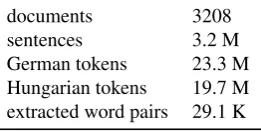
dis-documents 3208
sentences 3.2 M
German tokens 23.3 M Hungarian tokens 19.7 M extracted word pairs 29.1 K
Table 1: The German Hungarian section of the OpenSubti-tles2013 parallel corpus (Tiedemann 2012)
In the original setting of the collection mode, evaluation is done on another thousand seed pairs.
A common error in linear translation is when there are target words that are returned as the translation of many words, which is wrong in most of the cases. Dinu et al. (2015) propose a method for downplaying the importance of such target words they callglobal correction. Our exper-iments use this method.
4.
Data
Direct and triangulated Wiktionary translations have been extracted with wikt2dict2(Ács et al., 2013) that handles 43
editions of Wiktionary.
The German VSMs have been trained on SdeWaC (Ba-roni et al., 2009) and the Hungarian on the concatenation of the Hungarian Webcorpus (Halácsy et al., 2004) and the Hungarian National Corpus (Oravecz et al., 2014) with word2vec3(Mikolov et al., 2013a).4
For training and using the linear mapping, we forked5the implementation by Dinu et al. (2015). The German to Hun-garian mapping was trained on the 5K direct word pairs that are supported by the most pivots in Wiktionary. All the tri-angles were scored. Glue code we wrote for this project is freely available6.
The scoring has been evaluated against a dictionary in the OPUS project7 that has been extracted by Tiedemann
(2012) from the OpenSubtitles2013 parallel corpus, a col-lection of translated movie subtitles8. OpenSubtitles2013
contains 59 languages. Some sizes of the German Hungar-ian section are shown in table 1.
Most of our training data are general in theirdomain: web corpora (SdeWaC, the Hungarian Webcorpus), a curated corpus (the Hungarian National Corpus, as far as a corpus of 754 million words may be curated), and a crowd-sourced but otherwise causal dictionary (Wiktionary). One may ask whether the domain of the reference dictionary extracted
tances, Euclidean distance in training and cosine similarity (and distance) in collection (and, respectively, scoring) of translations. This choice is theoretically unmotivated, but we (Makrai, 2015) also found it to work better than more consistent combinations of metrics. However, see Xing et al. (2015) for opposing results.
2https://github.com/juditacs/wikt2dict 3
https://code.google.com/p/word2vec/
4
The German VSM has been a continuous bag of words model in 300 dimensions (infrequent words have been cut off at 100 oc-currences), the Hungarian a 600 dimensional one (with a cut-off of 10). The choice of meta-parameters was not fully systematic.
5https://github.com/makrai/dinu15/ 6https://github.com/makrai/efnilex-vect 7
http://opus.lingfil.uu.se/
0 0.5 1 1.5
·105 0
0.2 0.4 0.6 0.8
rank of word
accurac
y
by pivot counting by score in linear mapping
Figure 2: Accuracy curve of triangles sorted by their pivot count as baseline, or score in linear translations (cos). The later is smoother.
from movie subtitles is general to an appropriate extent, or how far a problem of domain mismatch between train and test may arise. We hypothesize that the mismatch is negli-gible and defer a more subtle analysis to further research.
5.
Evaluation
We evaluated the vector-based scoring of triangulated trans-lational word pairs (triangles) in comparison with a dictio-nary created from the parallel corpus OpenSubtitles2013. For each (German) word, we consider as gold translations all the (Hungarian) words that are listed in the OpenSubti-tles2013 dictionary as its translation.
For evaluation, we sort the triangles in two orders: as base-line, by the number of pivots for the triangle, and more im-portantly, by the score in the linear mapping (cos). Then in each order, we compute accuracy on each 1000-word slice of the list (e.g. triangles 1–1000, then 1001–2000, etc.) tak-ing OpenSubtitles2013 translations as gold.
While overall accuracy of the linear scoring (8.58%) is slightly worse than that of pivot counting (9.32%), fig. 2 suggests that in sort by cos, accuracy descends more smoothly than in sort by pivot count. (The last 22.73% of the nearly 160 K triangles is out of the vocabulary of one or both of the VSMs, socoscannot be computed.) Now we turn to a more quantitative support of this visual analysis.
5.1.
Quantitative analysis of smoothness
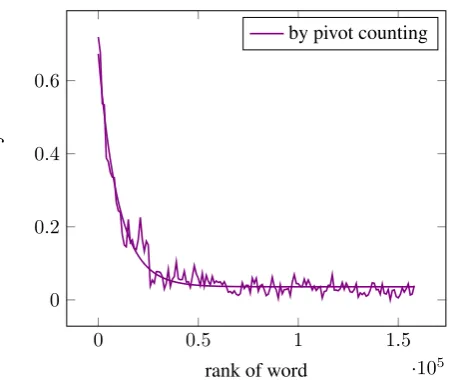
We measure the smoothness of the accuracy curves by how well they can be approximated by a function in some para-metric family, see figs. 3 to 6. We tried two families with similar results. The fist family is exponential functions of the form
a·exp(−bx) +c,
wherexis the index of the vocabulary slice (0 for words 0– 1000, 1 for 1001–2000, etc), anda, b, andcare parameters to fit. The second family is that of power law functions
a·(bx+c)k,
0 0.5 1 1.5
·105 0
0.2 0.4 0.6
rank of word
accurac
y
by pivot counting
Figure 3: The accuracy curve of pivot counting approxi-mated by an exponential function.
0 0.5 1 1.5
·105 0
0.2 0.4 0.6 0.8
rank of word
accurac
y
by score in linear mapping
Figure 4: The accuracy curve of scores by the linear map-ping approximated by an exponential function.
wherekis another parameter to fit, and the remaining vari-ables play similar roles as in the exponential case. The error of the fit (i. e. the lack of smoothness) is quantified as the mean squared error (MSE) between the two curves. The MSE of the two accuracy curves (scoring translations by pivot counting or cosine score) approximated by the two families (exponential or power law functions) are shown in table 2. The MSE of the accuracy curve in pivot counting is 2.51 (resp. 4.42) times more than that in scoring by the linear mapping, when both curves are modeled as exponen-tial (resp. power law) functions. It is probably also worth mentioning that the accuracy is slightly better for 20–30 000 higher-ranked words in the proposed method than in the baseline, see figs. 7 and 8.
6.
Acknowledgement
0 0.5 1 1.5
·105 0
0.2 0.4 0.6 0.8
rank of word
accurac
y
by pivot counting by score in linear mapping (cos)
Figure 5: Accuracy curves of scores by pivot count approx-imated by power law functions.
0 0.5 1 1.5
·105 0
0.2 0.4 0.6 0.8
rank of word
accurac
y
by pivot counting by score in linear mapping (cos)
Figure 6: Accuracy curves of scores by the linear mapping approximated by power law functions.
Sass, Attila Zséder, and András Kornai for useful discus-sions. Work supported by the EFNILEX project of the Eu-ropean Federation of National Institutions for Language.
7.
Bibliographical References
Baroni, M., Bernardini, S., Ferraresi, A., and Zanchetta, E. (2009). The wacky wide web: A collection of very large linguistically processed web-crawled corpora. InLREC 2009, volume 3, pages 209–226.
scoring method exp power law
pivot counting 6.1859e-04 5.2182e-04 linear mapping 2.4574e-04 1.1789e-04
Table 2: The mean squared error of fitting parametric curves to the accuracy values obtained by translation scor-ing methods. Linear mappscor-ing produces a smoother accu-racy decay than pivot counting.
0 0.5 1 1.5
·105 0
0.2 0.4 0.6
rank of word
accurac
y
by pivot counting by score in linear mapping
Figure 7: The exponential approximations of the accuracy curves.
0 0.5 1 1.5
·105 0
0.2 0.4 0.6 0.8
rank of word
accurac
y
by pivot counting by score in linear mapping
Figure 8: The power law approximations of the accuracy curves.
Bengio, Y., Ducharme, R., Vincent, P., and Janvin, C. (2003). A neural probabilistic language model. Journal of Machine Learning Research, 3:1137–1155.
Deerwester, S. C., Dumais, S. T., and Harshman, R. A. (1990). Indexing by latent semantic analysis. Jour-nal of the American Society for Information Science, 41(6):391–407.
Dinu, G., Lazaridou, A., and Baroni, M. (2015). Improv-ing zero-shot learnImprov-ing by mitigatImprov-ing the hubness prob-lem. InICLR 2015, Workshop Track.
Firth, J. R. (1957). A synopsis of linguistic theory. In Stud-ies in linguistic analysis, pages 1–32. Blackwell. Harris, Z. (1951). Methods in Structural Linguistics.
Uni-versity of Chicago Press.
Levy, O. and Goldberg, Y. (2014). Linguistic regulari-ties in sparse and explicit word representations. In Pro-ceedings of the Eighteenth Conference on Computational Natural Language Learning, pages 171–180. Associa-tion for ComputaAssocia-tional Linguistics.
lan-guage models on medium-resourced lanlan-guages. In At-tila Tanács, et al., editors, XI. Magyar Számítógépes Nyelvészeti Konferencia (MSZNY 2015).
Mikolov, T., Chen, K., Corrado, G., and Dean, J. (2013a). Efficient estimation of word representations in vector space. In Y. Bengio et al., editors, Proceedings of the ICLR 2013.
Mikolov, T., Le, Q. V., and Sutskever, I. (2013b). Ex-ploiting similarities among languages for machine trans-lation. Xiv preprint arXiv:1309.4168.
Mikolov, T., Yih, W.-t., and Geoffrey, Z. (2013c). Linguis-tic regularities in continuous space word representations. InProceedings of NAACL-HLT 2013, pages 746–751. Saralegi, X., Manterola, I., and Vicente, I. S. (2011).
An-alyzing methods for improving precision of pivot based bilingual dictionaries. InProceedings of the Conference on Empirical Methods in Natural Language Processing, pages 846–856. Association for Computational Linguis-tics.
Tanaka, K. and Umemura, K. (1994). Construction of a bilingual dictionary intermediated by a third language. InProceedings of the 15th conference on Computational linguistics-Volume 1, pages 297–303. Association for Computational Linguistics.
Turney, P. D. and Pantel, P. (2010). From frequency to meaning: Vector space models of semantics. Journal of Artificial Intelligence Research, 37:141–188.
Xing, C., Liu, C., CSLT, R., Wang, D., TNList, C., and Lin, Y. (2015). Normalized word embedding and orthogonal transform for bilingual word translation. InNAACL.
8.
Language Resource References
Ács, J., Pajkossy, K., and Kornai, A. (2013). Building ba-sic vocabulary across 40 languages. InProceedings of the Sixth Workshop on Building and Using Comparable Corpora, pages 52–58, Sofia, Bulgaria. ACL.
Halácsy, P., Kornai, A., Németh, L., Rung, A., Szakadát, I., and Trón, V. (2004). Creating open language re-sources for Hungarian. InProceedings of the 4th Inter-national Conference on Language Resources and Evalu-ation (LREC2004), pages 203–210.
Oravecz, Cs., Váradi, T., and Sass, B. (2014). The Hungar-ian Gigaword Corpus. InProceedings of LREC 2014. Tiedemann, J. (2012). Parallel data, tools and