R E S E A R C H
Open Access
An emerging intelligent optimization
algorithm based on trust sensing model for
wireless sensor networks
Yongmei Wang
1*, Min Zhang
2and Wanneng Shu
3Abstract
Due to the limitation of battery power, processing capacity, and storage, the sensor nodes are easy to be captured, destroyed, or attacked in an open environment. As a result, the security and reliability of data transmission cannot be guaranteed. In order to resist the internal attacks from malicious nodes, an ant colony optimization algorithm for secured routing based on trust sensing model (ACOSR) in wireless sensor networks is proposed. Firstly, a reliable evaluation model of trust perception is presented, which can estimate the node’s trust value derived from its behavior to identify or isolate the malicious nodes effectively. The penalty function and regulator function are applied to reflect the effect of state changes on the trust value according to the node’s behavior in the process of the communication. Secondly, the trust evaluation model is introduced into the ant colony routing algorithm to improve the security for data forwarding. The simulation results show that the proposed algorithm has improved the performance significantly in terms of packet loss rate, end to end delay, throughput, and energy consumption and demonstrates good resistance to black hole attack.
Keywords:Edge-of-things computing, Wireless sensor networks, Internet of things, Energy consumption, Emerging intelligent optimization algorithm
1 Introduction
The rapid developments of Internet of things (IoT) give impetus to the construction of cloud computing and constantly promote the popularization of applications for social network service and even the smart city [1]. Depending on different types of distributed smart equip-ment, smart city can offer wide applications for urban residents in aspects of telemedicine diagnosis, intelligent community, environmental monitoring, and surveillance; owing to the characteristics of low cost, easy-to-deploy and specialized wireless sensor networks (WSNs) have played a crucial role in promoting the various facilities of the smart city. On the one hand, the ubiquitous sen-sor nodes can be used for collecting the physical infor-mation around the environment. On the other hand, they can make use of the widely distributed facilities to realize unattended management. However, the inherent
characteristics of an open and distributed system, WSNs are of vulnerability due to the simplicity and limitation of design in the structure of hardware units [2]. In addition, the communication of the wireless channel makes the attack more convenient. Since the traditional secure routing protocols are usually complex and energy-consuming, the existing protocol design is not suitable for resource-constrained WSNs [3].
At present, the researches on wireless sensor network security have made many achievements, and the security measures mainly include authentication, encryption, in-formation integrity verification, and intrusion detection. Nevertheless, most of the above security mechanisms can only deal with the intrusion or attack from the net-work outside, and the malicious nodes will enter into the network smoothly and launch the specific attacks in-side the network while the occurrence of the internal at-tacks of wireless sensor networks [4]. The typical malicious attacks include selfish node, malicious for-warding, black hole, rushing, or worm attack [5, 6]. In view of the malicious node attack in WSNs, the trust
* Correspondence:[email protected]
1School of Computer Science and Technology, Hefei Normal University, Hefei
230031, China
Full list of author information is available at the end of the article
model-based management mechanism is proven to be a popular and effective method [7]. Besides, trust evalu-ation model has low computevalu-ation and communicevalu-ation load, which demonstrate a significant advantage in re-spect of solving the internal attacks and identifying the malicious nodes [8].
The rest of this paper is organized as follows: In Section 2, we briefly introduce the related work. In Sections3and 4, the assumptions and explanations of the details of our method are described. The experiment methods are shown, and the result is discussed regarding the perform-ance evaluation in Section5. Finally, Section6concludes this paper and discusses the future work.
2 Related works
To protect the security of the link or constrain the mali-cious attack within a certain range, researchers have pro-posed different defense strategies, such as TTSS, SPINS, and INSENS [9–11]. Generally, those protocols usually adopt the technology of encryption, authentication, or key management mechanism to resist the attacks, in-cluding selective forwarding, SYBIL attack, wormhole at-tack, and HELLO flooding [12,13].
Ganeriwal et al. [14, 15] presented a reputation-based trust management framework (RFSN) and applied to wireless sensor networks, which uses Watchdog system to monitor the neighbor node communication behavior. Besides, the trust value of sensor node is generated by putting the monitoring results into the credit system module, and reputation value is measured by Bayes for-mula for quantitative analysis of node’s uncertainty. The trust framework is complete and robust, but requires a priori distribution of the subjective assumption of repu-tation value. Shaikh et al. [16] presented a trust manage-ment scheme for hierarchical WSNs. The trust value is obtained by monitoring the communication behavior be-tween the neighbor nodes by the predefined detective node. The trust mechanism can be established from sev-eral aspects to resist attack of malicious nodes, and it can consume less communication overhead as well as ef-ficient memory usage. Feng et al. [17] put forward a credible trust management scheme for WSNs based on Bayesian theory. Firstly, the trust value can be estimated by RFSN model. Then, they utilized statistical data and Bayesian method to acquire the comprehensive trust value. Moreover, considering the influence of the uncer-tain factors of third parties on the value of trust in the process of evaluation, time sliding window is applied for trust value’s renovation. Jiang et al. [18] proposed a dis-tributed trust evaluation model for WSNs, in which the direct trust value and the recommended trust value are selectively evaluated depending on the number of nor-mal packets received by the sensor nodes.
To promote the accuracy of recommendation trust, multiple indicators, such as communication behavior, node’s residual energy, and the number of normal packets, are taken into consideration. Then, the model defines the trust reliability and familiarity to evaluate node’s trustworthiness. Hossein et al. [19] proposed a distributed trust management system with fuzzy theory to measure the trust value of nodes in WSNs. Yenumula et al. [20] examined the behavior of malicious nodes under the attack of selective forwarding and conducted the performance evaluation of the impact quantitatively. Due to the packets from normal nodes be selectively dis-carded, it will result in network failure or even collapse. To ensure the authenticity and reliability of the aggre-gated data, Hu et al. [21] proposed a security model based on trusted data fusion to resist the capacity of the risks derived from data tampering. Amol R et al. [22] presented a trust evaluation model for intrusion detec-tion to identify malicious nodes or selfish nodes effect-ively, and the trusted routing is allowed by eliminating malicious nodes. Zhang et al. [23] proposed a dynamic trust establishment and management framework, and a trust varying function is defined to generate certain weight value for adapting to the dynamic changes of the network. Mejia et al. [24] proposed a trust evaluation model with game theoretic for online distributed evolu-tion. Considering that the game theory is an auxiliary method for decision making rather than a prediction tool, it may not be suitable for resolving the trust prob-lem of the sensor node. Bao et al. [25] presented a hier-archical trust management protocol by formulating social trust and QoS (quality of service) trust, which regards intimacy or honesty as a metric of trust evalu-ation and selects QoS’ trust by energy dissipation and node selfishness.
The existing trust evaluation methods are proposed for the characteristics of the node’s past behavior and different application scenarios. However, it is not enough to consider the trust assessment which combines sub-jective judgment and obsub-jective evaluation. In addition, the trust value is expressed by floating point number in-stead of integer value with single byte, which will result in excessive energy consumption between the nodes while passing the recommendation trust.
3 Trust sensing model
3.1 Direct trust value
node. In addition, the uncertainty of a random signal or event can be estimated by entropy theory. Based on in-formation entropy theory, the uncertainty of a random signal or event can be measured.
Assuming that the prior distribution obeys the Beta distribution, the trust value between the nodes can be measured by the expected value, and the following for-mula is obtained.
Tdirð Þ ¼i;j αij þ1
αijþβijþ2 ð
1Þ
whereαijandβijdenote the record number of successful or failed communication interaction between nodeiand jat the time intervalΔt, respectively.
In the actual environment, the communication behav-ior between nodes is easily affected by the uncertain fac-tors such as network congestion and noise. It is essential to introduce valid regulatory mechanism to reflect the impact of these uncertainties on the value of trust. Most trust models do not take these factors into consider-ation. As a result, the trust value of the nodes is often ideal and not true. Considering that the number of failed exchange between the sensor nodes increase in a short time, the node’s behavior indicates as malicious, and the trust value of the node will be reduced quickly. In order to suppress malicious nodes more quickly and effect-ively, penalty function is the punishment of trust value through dynamic changes of malicious behaviors in communication between nodes. Here, the penalty func-tion is defined as:
δ¼1−e
βij
αijþβij ð2Þ
By introducing penalty function, the trust value of the suspected node should be punished according to its ab-normal behavior, which can identify malicious behaviors of nodes quickly and accurately. In addition, to avoid rapid promotion of trust values of malicious nodes through conspiracy or mutual touting, a regulator func-tion should be applied to modify the trust value to pre-vent irregular swift growth. The regulator function can be defined as:
μ¼1− 1
lnαijþ1 ð3Þ
With the increasing number of successful interactive communication between nodes, the value of the regula-tor function is more and more close to one with steady growth. It reflects the actual situation that the dynamic changes in the behavior of successful communication between nodes should be a long-term stable process, and the steady increase of node’s trust value can alleviate the possibility of conspiracy attacks on the system.
Based on above analysis, the formula of the direct trust value can be modified.
The indirect trust value refers to the evaluation of the node’s behavior from the recommendation nodes, which are composed of the neighbor nodes of nodeiand node j. It should be noted that not all recommended nodes are trustworthy, and the false recommendation from untrusted nodes will impair the quality of the true cred-ibility of the node. Therefore, to obtain the right evalu-ation of the indirect trust value through the recommended nodes, it is necessary to select a set of credible nodes from common neighbors as the recom-mendation ones.
Initially, the trust value of all nodes is assigned to 0.5, and the threshold of trust value as recommendation node is λ. According to theoretical analysis, the nodes from common neighbors of node i and jwith the trust value no less thanλcan be selected as the recommenda-tion ones. Assuming that k neighbors of node i and j meet the requirement of trust value threshold, and the trust value isTi1,Ti2, ⋯,Tis. On the basis of the
transi-tivity of the trust value, the indirect trust value can be given as: number of common recommendation nodes by nodes i andj.
Next, the comprehensive trust value of the node can be estimated by the sum of direct trust and indirect trust, which will be given as:
Ttotalð Þ ¼i;j θTdirþð1−θÞTind ð6Þ
whereTtotal(i,j) indicates the comprehensive trust value of node i to node j. Tdir and Tind represent the direct and indirect trust values, respectively. θ denotes the weight of direct trust.
4 Secured routing method
whole ant colony will obtain the optimal path. It is very suitable for the characteristics of wireless sensor network routing.
To resist the possible attacks from malicious nodes, the node trust evaluation model is introduced into the ant colony algorithm, and the security and energy con-sumption of nodes should be regarded as the optimization objective. The main idea is to select the next hop neighbor nodejof node iaccording to phero-mone, sensor node’s residual energy and evaluated trust value. Usually, the selection of the node in the next hop should be satisfied with higher trust value and more re-sidual energy.
Assuming thatmants are generated from source node, the initial pheromone of the path and the node’s energy are equal. Each ant tries to find the optimal path with minimum cost, and the transition probability of the ant kmoving from nodeito nodejfor the next hop can be
where τij(t) denotes the amount of pheromone in the path at time t, ηij(t) denotes the heuristic value of the path, and ψj(t) is the factor of residual energy of node
j. α, β, γ are the weight value of pheromone, heuristic value, and factor of residual energy, respectively. They should satisfy the condition that 0 <α, β, γ≤1 and α +β+γ= 1.
During the data forwarding, energy-efficiency should be referred to as important aspect by which the network lifetime prolongs. The transition probability should re-flect the superiority of the node with more residual en-ergy among the neighbors of node i. Therefore, the factorψj(t) can be defined as:
¼jN ið Þj Eresð Þj=
X
s∈N ið ÞðEresð Þs Þ ð8Þ
By selecting the node with the highest comprehensive trust value from the neighbor nodes set as the next hop, the heuristic factor will be derived as:
ηijð Þ ¼t arg maxj∈N ið ÞfθTdirþð1−θÞTindg ð9Þ
Since the direct trust relationship between nodes is unable to involve all nodes, the estimation of the indir-ect trust value from the adjacent recommendation node. Besides, the smaller the weight valueγis, the more obvi-ous the effect of the indirect trust demonstrates.
As the energy of the sensor node is constrained, the residual energy of the nodes located in the path and the link length should be taken into account during the phase of updating the pheromone. It can effectively bal-ance the network energy load and reduce the residual energy gap between the nodes. Thus, when the residual energy of the nodes from different link is the same, the shortest path routing will be selected. Therefore, after k ants arrive in the aggregation node, the increment of the pheromone can be obtained according to:
Δτkð Þ ¼t E the average residual energy and maximum residual en-ergy of all neighbor nodes from node i, respectively.E0 represents the initial energy of all sensor node.
The pheromone factor on the path will be updated ac-cording to formula (10):
τijð Þ ¼t ð1−ρÞτijð Þ þt Δτkð Þt ð11Þ
where ρ represents the volatilization coefficient of pheromone and 0≤ρ< 1. Δτk(t) represents the incre-ment of the pheromone during the current round.
5 Results and discussion
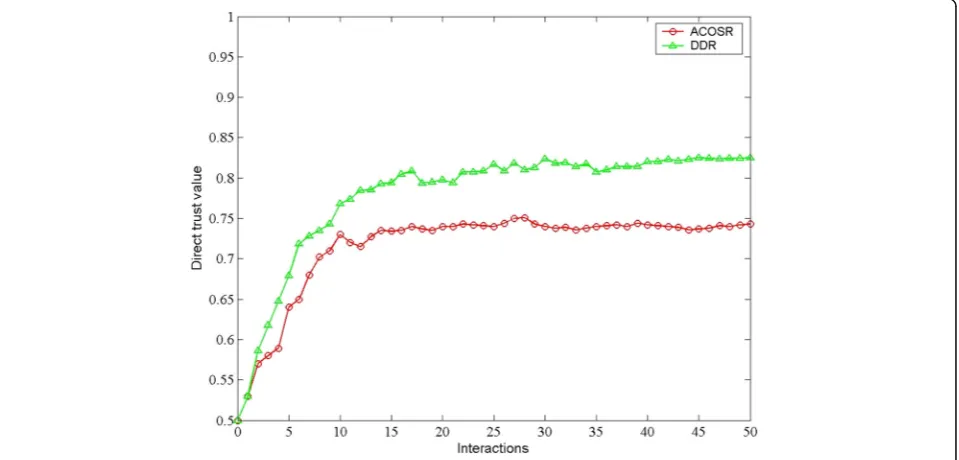
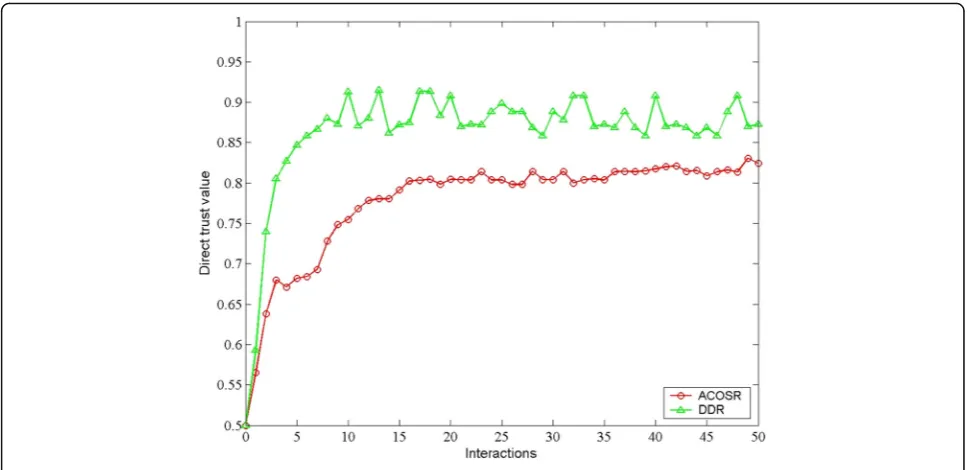
To verify the performance of proposed algorithm for se-cured routing, the simulation experiments are conducted with MATLAB. Firstly, the influence of punishment and regulation mechanism on direct trust value is verified with dynamic change of communication behavior be-tween nodes in our trust model. Then, our model com-pares with DDR (Detecting Dishonest Recommendation) [29] in terms of trust value under the condition of no at-tack or malicious node’s attack. Subsequently, the com-parison of ACOSR, DDR, and SRC (Secure and Robust Clustering) [30] algorithm demonstrates in aspects of the average energy consumption, the average time delay, throughput, and the packet loss rate. We use the energy model presented in [31], and the specific parameters are shown in Table1.
successful interactions in a short time. The design goal of slow growth of trust value is more adaptable to the ef-fect of normal behaviors on the trust relationship be-tween the nodes in wireless sensor networks than in traditional network.
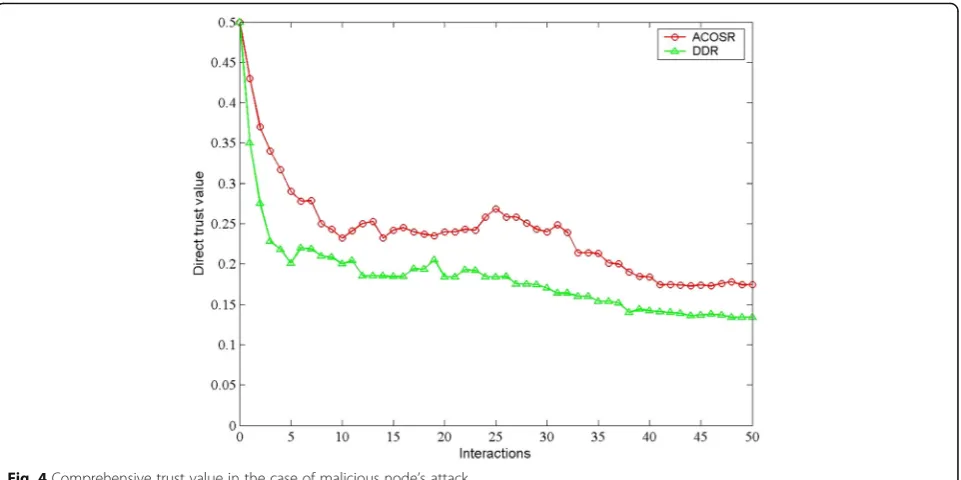
The direct and comprehensive trust value in the case of malicious node’s attack is depicted in Figs. 3 and 4. Due to the malicious nodes’attack behavior, the number of nodes’unsuccessful interaction continues to increase. For ACOSR, the penalty function operates on the trust value due to the attack behavior from malicious nodes.
As can be illustrated from the results, when the number of unsuccessful interaction increases rapidly, the trust value between nodes is reduced quickly, and the goal of fast decline of trust value is realized.
In this scenario, the trust value of the proposed algo-rithm is always lower than the trust value of DDR. It fully reflects that the trust value of ACOSR is more sen-sitive to malicious communication behavior and mali-cious attacks than DDR as the frequent occurrence of unsuccessful interactions. It also evaluates the trust rela-tionship between nodes in ACOSR more accurately and reliably and identifies malicious nodes more quickly and effectively.
Next, the performance of each algorithm is simulated under black hole attack. As shown in Fig. 5, the total trend of the packet loss rate of all algorithms increase as the increase of the malicious nodes with aggressive be-haviors. When there are no attacks in the network, the packet loss rates of SRC, DDR, and ACOSR is 1.94, 2.87, and 3.93%, respectively. Owing of the low complexity and small delay, the packet loss rate of SRC is slightly lower than that of the other algorithms. However, SRC does not adopt trust mechanism, which is incapable to resist black hole attack, and thus, its packet loss rate has increased dramatically with the continuous growth of the attack nodes. ACOSR and DDR utilize the trust model to evaluate the node’s behavior, and the trend of package loss is relative slow. In general, the trust model can isolate malicious nodes to some extent. However, the nodes launching the black hole attack as selfish nodes who can affect the forwarding of data packets, and it will still cause a certain number of packet loss.
Table 1The specific parameters
Parameters Value
E0 0.5 J
Initial trust value 0.5
Packet length 2000 bits
d0 37 m
Eelec 50 nJ/bit
EDA 5 nJ/(bit⋅signal)
λ 0.6
θ 0.6
MAC protocol MAC 802.11
Queue type PriQueue
Data flow rate 448 kbit/s
α 0.2
β 0.5
γ 0.3
ρ 0.3
The final packet loss rate of the ACOSR algorithm is 13.8% lower than that of the DDR algorithm. That is be-cause that ACOSR algorithm considers the distance the ants walk when the pheromone updates and make the path pheromone concentration closer to the conver-gence node. It will increase the speed of path search and reduce the time delay, and then, the packet loss rate can be reduced.
Figure 6 shows the average time delay as well as the increment of the number of malicious nodes. Due to
frequent packet loss in the scenario, the upper layer of transmission protocol needs to wait for the establish-ment of links and the packet re-transmission between the nodes, which results in the increase of time delay. When there is no attack node, the time delay of the SRC is 19 ms, which is lower than that of the ACOSR and the DDR. That is because the other two algorithms need to acquire the sensor’s trust value for a long time. When the number of malicious nodes increases in ACOSR, the routing stability drops sharply due to the excess packet
Fig. 2Comprehensive trust value in the case of no attack
loss and it will increase the delay of packet packets arriv-ing at the destination. In comparison, the trust evalu-ation model is used in both ACOSR and DDR, and the time delay trend is relatively close. Since ACOSR takes the residual energy directly as a selection probability fac-tor, it can effectively improve the search efficiency and obtain the optimal path, it can achieve lower delay than DDR.
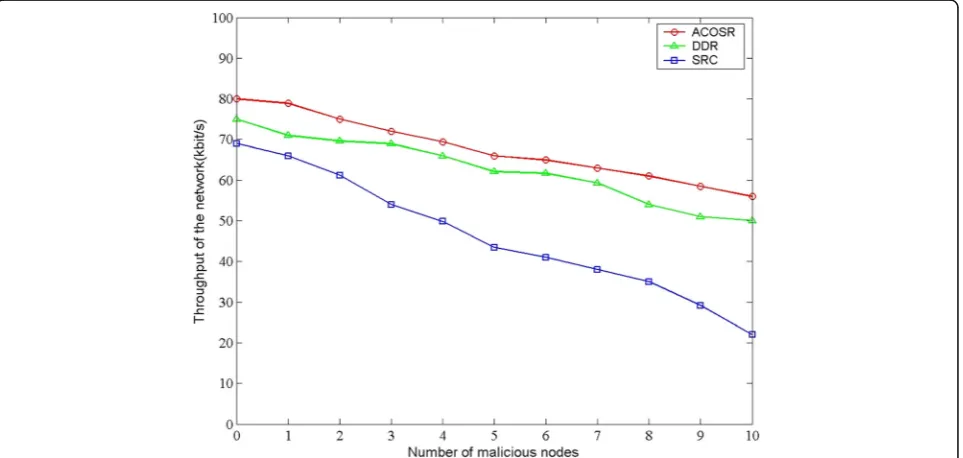
Figure 7 illustrates the comparison of throughput of the network. The overall trend of network throughput is
decreasing. The reason is that the black hole attack be-ing produced by malicious nodes makes the packets routing more and more difficult to remain stable, and large amount of data packet loss leads to the reduction of throughput. As can be seen from Fig.7, the through-put of the network is rapidly reduced from 69.87 to 22.45 kbit/s in SRC. The trust evaluation model applied in ACOSR and DDR effectively guarantees the stability of the network, which avoids the sharp decline of throughput caused by the massive loss of data packets.
Fig. 4Comprehensive trust value in the case of malicious node’s attack
Since the packet loss rate of ACOSR is less than that of DDR, the overall throughput can demonstrate better performance.
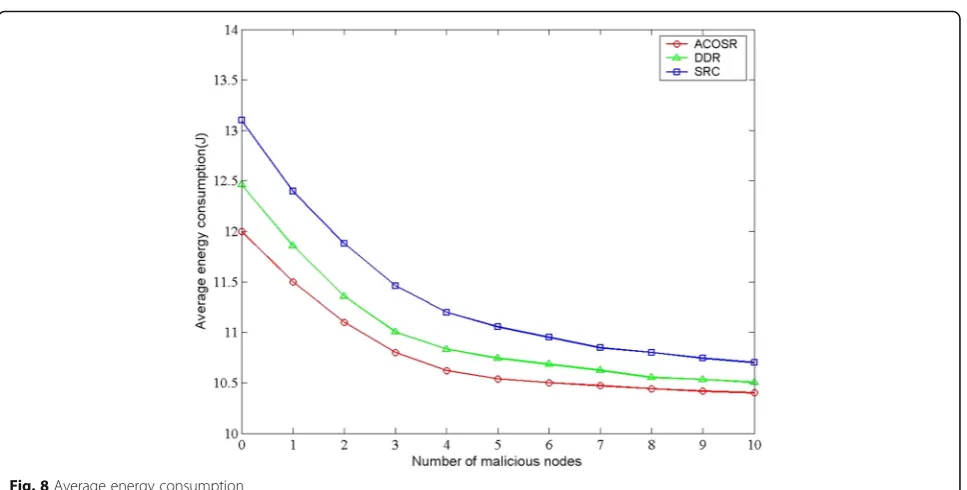
Figure 8 is the comparison of average energy con-sumption as different number of malicious nodes. Since the energy consumption of the network mainly depends on the number of times of the data packet interaction, the increase of packet loss rate makes the number of in-teractions decline. Thus, the average energy consump-tion of sensor nodes decreases. SRC has no resistance to
malicious node attacks, and then, the packets will be largely lost owing to the existence of malicious nodes undertaking the data relay and result in a sharp decrease in average energy consumption from 13.1 to 10.9 J. Compared with DDR, the residual energy of the node is taken as the key factor of the selection probability in ACOSR in terms of updating pheromone. It can effect-ively balance the energy expenditure among all sensor nodes and reduce the average energy consumption of the whole network.
Fig. 6Average time delay
6 Conclusions
In order to resist internal attacks from malicious nodes, this paper proposes an ant colony optimization algo-rithm for secured routing based on trust sensing model in WSNs. Firstly, aiming at the problems of internal at-tacks such as black hole atat-tacks, the ACOSR adopts the trust evaluation model to isolate malicious nodes effect-ively according to the behavior of nodes, which can re-duce the packet loss rate and establish secure routing. In addition, by adopting the residual energy of the node as the key factor of the selection probability and taking into account of the node’s average energy when updating pheromone, it can effectively balance the energy expend-iture among all nodes and reduce the average energy consumption of the whole network. In the future work, we will expand the model for node’s behavior evaluation under more complex attack mode as well as reducing the energy consumption of exchange of recommenda-tion trust.
Abbreviations
ACO:Ant colony optimization; ACOSR: Ant colony optimization algorithm for
secured routing; DDR: Detecting dishonest recommendation;
INSENS: Intrusion-tolerant routing in wireless sensor networks; QoS: Quality of service; SPINS: Security protocols for sensor networks; SRC: Secure and robust clustering; TTSS: Three-tier security scheme; WSNs: Wireless sensor network
Acknowledgements
The authors thank the reviewers for giving the helpful comments and suggestions, which help to improve the quality of the manuscript.
Funding
This work was supported by the National Natural Science Foundation of China under grant no. 61603420.
Authors’contributions
YW and WS contributed to the conception and algorithm design of the study. YW and MZ contributed to the acquisition of simulation. YW, MZ, and WS contributed to the analysis of simulation data and approved the final manuscript.
Authors’information
Yongmei Wangreceived a M.S. degree from Anhui University, in 2011. She is an experimentalist in School of Computer Science and Technology, Hefei Normal University, Hefei, China. His research interests lie in computer application, intelligent arithmetic, and Internet of things.
Min Zhangreceived a M.S. degree from Anhui University, in 2011. She is an experimentalist in College of Information and Computer, Anhui Agricultural University, Hefei, China. His research interests lie in network of computer and Internet of things.
Wanneng Shureceived a M.S. and Ph.D. degree from Central China Normal University and Wuhan University, in 2007 and 2013. He is an assistant professor in the College of Computer Science, South-Central University for Nationalities, Wuhan 430074, China. His research interests lie in Green cloud computing, parallel computing, and Internet of things.
Competing interests
The authors declare that they have no competing interests.
Publisher’s Note
Springer Nature remains neutral with regard to jurisdictional claims in published maps and institutional affiliations.
Author details
1School of Computer Science and Technology, Hefei Normal University, Hefei
230031, China.2College of Information and Computer, Anhui Agricultural University, Heifei 230036, China.3College of Computer Science, South-Central
University for Nationalities, Wuhan 430074, China.
Received: 17 April 2018 Accepted: 4 June 2018
References
1. MR Eslaminejad, M Sookhak, SA Razak, M Haghparast, A review of routing
mechanisms in wireless sensor networks. Int. J Comput. Sci. Telecommun.
10(2), 1–9 (2011)
2. A Kellner, O Alfandi, DA Hogrefe, Survey on measures for secure routing in wireless sensor networks. Int. J. Sens. Netw. Data Commun
1(10), 1–17 (2012)
3. A Chakrabarti, V Parekh, A Ruia, A trust based routing scheme for wireless
sensor networks. Lect Notes Inst Comput Sci Soc Inf Telecommun Eng
1(84), 159–168 (2012)
4. J Duan, D Yang, H Zhu, et al., TSRF: a trust-aware secure routing framework
in wireless sensor networks. Int. J. Distrib. Sens Netw.2014(1), 1–14 (2014)
5. F Ishmanov, AS Malik, SW Kim, et al., Trust management system in wireless
sensor networks: design considerations and research challenges. Trans.
EmergiTelecommun. Technol.26(2), 107–130 (2015)
6. F Lin, JB Xiahou, ZX Xu, TCM clinic records data mining approaches based
on weighted-LDA and multi-relationship LDA model. Multimed. Tools. Appl.
75(22), 14203–14232 (2016)
7. W Wei, Q Yong, Information potential fields navigation in wireless ad-hoc
sensor networks. Sensors11(5), 4794–4807 (2011)
8. N Marchangl, R Datta, Light-weight trust-based routing protocol for mobile
ad hoc networks. IET Inf. Secur..6(2), 77–83 (2012)
9. A Rasheed, RN Mahapatra, The three-tier security scheme in wireless
sensor networks with mobile sinks. IEEE. Trans. Parallel. Distrib. Syst.
23(5), 958–965 (2012)
10. J Deng, R Han, S Mishra, INSENS: intrusion-tolerant routing for wireless
sensor networks. Comput. Commun..29(2), 216–230 (2006)
11. A Perrig, R Szewczyk, JD Tygar, et al., SPINS: security protocols for sensor
networks. Wirel. Netw8(5), 521–534 (2002)
12. MS Syed, HB Safdar, et al., Neighbor node trust based intrusion detection
system for WSN. Procedia. Comput. Sci.8(3), 183 (2015)
13. H Safa, H Artail, D Tabet, A cluster-based trust-aware routing protocol for
mobile ad hoc networks. Wirel. Netw.16(2), 969–984 (2010)
14. L Lintao, H Lei, Z Na, Hierarchical routing trust model for wireless sensor
networks. Comput. Eng.23(6), 101–103 (2010)
15. S Ganeriwal, LK Balzano, MB Srivastava, Reputation-based framework for
high integrity sensor networks. ACM. Trans. Sens. Netw.4(3), 66–77 (2004)
16. RA Shaikh, H Jameel, BJ D'Auriol, et al., Group-based trust management
scheme for clustered wireless sensor networks. IEEE. Trans. Parallel. Distrib.
Syst.20(11), 1698–1712 (2009)
17. R Feng, X Han, Q Liu, et al., A credible Bayesian-based trust
management scheme for wireless sensor networks. Int. J. Distrib. Sens.
Netw.2015(2), 1–9 (2015)
18. J Jiang, G Han, F Wang, et al., An efficient distributed trust model for
wireless sensor networks. IEEE. Trans. Parallel. Distrib. Syst.26(5), 1228–
1237 (2015)
19. J Hossein, RA Mohammad, et al., A fuzzy fully distributed trust
management system in wireless sensor networks. Int. J. Electron.
Commun..9(17), 1–10 (2015)
20. Y Reddy, J Durand, S Kafle, inProc. of IEEE 7th International Conference on
Information Technology, IEEE Press. Detection of packet dropping in wireless
sensor networks (2010), pp. 879–884
21. HU Xiangdong, W Qinfang, T Hui, Model and simulation of
creditability-based data aggregation for the internet of things. Chin. J. Sci. Instrum.
31(11), 2636–2640 (2010)
22. AR Dhakne, PN Chatur, TCNPR: trust calculation based on nodes properties
and recommendations for intrusion detection in wireless sensor network.
Int. J. Comput. Sci. Netw. Secur.16(12), 1–10 (2016)
23. J Zhang, R S Hankaran, MA Orgun, et al., inProc. of 2010 IEEE/IFIP 8th
International Conference on Embedded and Ubiquitous Computing (EUC), Hong Kong, China. A dynamic trust establishment and management
framework for wireless sensor networks (2010), pp. 484–491
24. M Mejia, N Peña, JL Muñoz, et al., A game theoretic trust model for
online distributed evolution of cooperation in MANETs. J. Netw.
Comput. Appl..34(1), 39–51 (2011)
25. F Bao, IR Chen, MJ Chang, et al., Hierarchical trust management for
wireless sensor networks and its applications to trust-based routing
and intrusion detection. IEEE Trans. Netw. Serv. Manag..9(2), 169–183
(2012)
26. MK Denko, T Sun, I Woungang, Trust management in ubiquitous
computing: a Bayesian approach. Comput. Commun.34(3), 398–406 (2011)
27. M Mendonca, JS Aguilar, N Perozo,An Emergent Ontology for Ambient
Intelligence Based on an Ant Colony Optimization Algorithm, Computing Conference (CLEI), September 15–19, 2014(IEEE Press, Montevideo,
2014), pp. 1–11
28. F Lin, XZ Zhou, WH Zeng, Sparse online learning for collaborative filtering.
Int. J. Comput. Commun. Control.11(2), 248–258 (2016)
29. N Iltaf, A Ghafoor, U Zia, A mechanism for detecting dishonest
recommendation in indirect trust computation. EURASIP J. Wirel. Commun.
Netw. 2013(1), 1–13 (2013)
30. M Majdi, K Lyes, N Hazem, Secure and robust clustering for quantized
target tracking in wireless sensor networks. J. Commun. Netw. 15(2),
164–172 (2013)
31. P Padh, RK Dash, K Martinez, A utility-based adaptive sensing and multihop
communication protocol for wireless sensor networks. ACM. Trans. Sens.