Farouk K El-Baz1*, Frahat F Ali2, Ahmed A Abd El-Rahman2, Hanan F Aly3, Safaa A Saad1, Amal A Mohamed1
1
Plant Biochemistry Department, National Research Centre (NRC), Dokki, Cairo, Egypt.
2
Biochemstry Department, Fac. of Agric., Benha University,Moshtohor, Egypt.
3
Therapeutic Chemistry Department, National Research Centre (NRC), Dokki, Cairo, Egypt. *Corresponding author’s E-mail:[email protected]
Accepted on: 09-09-2014; Finalized on: 31-10-2014. ABSTRACT
Petroleum ether, ethyl acetate, successive and crude methanolic extracts of Jatropha curcas leaves were evaluated for their phytochemical screening, total polyphenol content and antioxidant activities. Qualitative phytochemical screening was tested and showed positive results for flavonoids, tannins, phenolics, Saponins, Coumarins, sterols and triterpenes compounds. The highest total phenolic content (104.40±9.33 mg GAE/g d.w.) was found in successive methanolic extract. However, the highest total flavonoid content (64.17±0.51 mg QUE/g d.w.) was detected in crude methanolic extract. The antioxidant activity was assessed by using three assays; free radical scavenging activity (DPPH), total antioxidant activity and reducing power activity. The successive methanolic extract exhibited the highest antioxidant activity in all assays. Individual polyphenolic compounds were evaluated in successive methanolic extract using HPLC and the major compound detected was catechin (0.15%). Results confirmed the presence of therapeutically potent compounds in the leaf extracts predominantly phenolic and flavonoid.
Keywords: Antioxidant activity, DPPH, Flavonoid, J. curcas, Phenolic, Reducing power.
INTRODUCTION
edicinal plants are known to produce certain bioactive molecules, such as phenolics, flavonoids, tannins and terpenoids. Numerous studies have shown that medicinal plants are sources of diverse phytochemicals.1,2 Many of which display antioxidant properties that can protect the human body against cellular oxidation reactions, free radicals and reactive oxygen species (ROS) effects. Polyphenolic substances possess many biological effects which are mainly attributed to their antioxidant activities in scavenging free radicals, inhibition of peroxidation and chelating transition metals.3 Moreover, flavonols, cinnamic acids, Coumarins and caffeic acids are well known polyphenolic compounds with strong antioxidant properties. Moreover, phenolics support human health with improvement and lowering the danger of many diseases.4 Additionally, flavonoids exhibit biological
activities, including antiallergenic, antiviral, anti-inflammatory, and vasodilatation actions.5 Recently, the most commonly used synthetic antioxidants are butylated hydroxyanisole (BHA), butylated hydroxytoluene (BHT) and propylgallate. However, BHA and BHT have been restricted by legislative rules due to doubts over their toxic and carcinogenic effects.6 Therefore, the importance of searching for natural antioxidants has increased greatly in the present years.
J. curcas, shrub belonging to the family Euphorbiaceae,
has a lot of economic prominence due to its industrial and medicinal values.7 J. curcas was used to cure many diseases such as fever, mouth infections, jaundice, guinea worm sores and joint rheumatism.8 The extracted
compounds from J. curcas leaves included; flavonoids, sterols, glucosides and alkaloids.9 Different phenolic compounds from J. curcas stems were determined and identified by Xu and Tan10 who isolated fourteen phenolic compound and among them 5,4'-dihydroxy-3, 7, 3'-trimethoxyflavone, 5, 3', 4'-trihydroxy-3,dimethoxyflavone, 3-O-methylquercetin and 5, 6, 7-trimethoxycoumarin were isolated from the genus of Jatropha for the first time.
Therefore, the objective of the present study is to elucidate the antioxidant activity of J. curcas different leaves extracts (petroleum ether, ethyl acetate, successive and crude methanolic) and evaluate the polyphenolic content in successive methanolic extract by HPLC as well.
MATERIALS AND METHODS
Chemical reagents and solvents
Potassium ferricyanide [K3Fe (CN)6], ammonium molybdate, Folin-Ciocalteu reagent, sodium carbonate, aluminum chloride and gallic acid were purchased from Merck Company (Darmstadt, Germany). Butylated hydroxyltoluene (BHT) and 2, 2-diphenyl-1-picrylhydrazyl (DPPH) were purchased from Sigma Chemical Co., Ltd (St. Louis, MO, USA). All other reagents and solvents were of analytical grade.
Plant material and collection
Fresh leaves of J. curcas were collected from the farm of Aromatic and Medicinal Plant, Agriculture Research Centre-Egypt, during July 2013. The plant was authenticated by Agricultural Engineer Terese Labib, El
HPLC Evaluation of Phenolic Profile, and Antioxidant Activity of Different Extracts of
Jatropha curcas Leaves
M
Orman Botanical Garden, Cairo, Egypt (http://wikimapia.org/9432/Orman-Botanical-Gardens-Giza).
Preparation of sample
Fresh leaves of J. curcas were washed with tap water followed with distilled water to remove any dust and dirt. Leaves were air dried under shade condition then grinded and homogenized to coarse powder finally stored in opaque screw tight jars until use.
Preliminary phytochemical screening of J. curcas leaves
The powdered leaves of J. curcas were screened for qualitative detection of flavonoids, tannins, phenolics, saponins, coumarines and sterols and/or triterpenes applying chemical tests.11-13 As a result of these tests, the color intensity or the precipitate formation was used as an indicator for the presence or absence of phytochemicals.
Successive and crude extracts preparation
Successive extracts preparation
Powdered leaves of J. curcas were extracted by soaking using successive three solvents with different polarities.14 Solvents used were: petroleum ether (referred as E1), ethyl acetate (referred as E2) and methanol (referred as E3) with percentage of extraction 1:3 w/v. Briefly, 2.5 kg of J. curcas powdered leaves were soaked in 7.5 liter of petroleum ether and shaked on shaker (Heidolph UNIMAX 2010) for 48 hrs. at 150 rpm. The extract was filtered using a Buchner funnel and Whatman No. 4 filter paper and the plant residue was re-extracted with the addition of fresh petroleum ether for another two times. Combined filtrates were concentrated using Rotary evaporator (Heidolph-Germany) at 40°C under vacuum. The remaining plant residue was dried and soaked in ethyl acetate and methanol successively as described earlier. Finally, all resulting dry extracts were re-dissolved
in fresh methanol to make (10 µg/µl) stock solution and
kept at 4°C for further analysis. The percent was calculated with the formula:
Crude methanolic extract preparation
About 300 g of J. curcas powdered leaves were extracted using 900 ml methanol by soaking and shaked on shaker at 150 rpm (referred as E4) for 48 hrs. The extract was filtered using a Buchner funnel and Whatman No. 4 filter paper. The filtrate was concentrated using Rotary evaporator at 40°C under vacuum. The resulting dry extract was re-dissolved in fresh methanol to make (10
µg/µl) stock solution and kept at 4°C for further analysis.
The percent of extraction yield of crude methanolic extract was measured and reported.
Determination of total phenolic content
Total phenolic content of each extract was determined using the Folin-Ciocalteu reagent.15 0.05 ml of each extract was made up to 3 ml using methanol, then 1 ml of Folin-Ciocalteau’s reagent (1/10 dilution) was added. The solution was incubated for three minutes and 1 ml of Na2CO3 (7.5%, w/v) was added and the mixture was incubated at room temperature for 1 h. Concentrations of
2, 4, 6, 8 and 10 µg/ml of gallic acid were prepared in methanol to give gallic acid calibration standard curve. The absorbance of all samples was measured at 765 nm using a spectrophotometer (Unicam UV 300). Results were expressed as milligram of gallic acid equivalent (GAE) per gram of dry extract (mg GAE/g d.w.).
Determination of total flavonoid content
Total flavonoid content was determined.16 A volume of 0.05 ml of each extract were made up to 2 ml with methanol then mixed with 0.1 ml of 10% hydrated aluminum chloride and subsequently with 0.1 ml of 1M sodium acetate. The methanol was added to the mixture to bring the total volume to 5 ml. After 30 min incubation at room temperature, the absorbance was measured at 415 nm with a spectrophotometer (Unicam UV 300). The amount of extract was substituted by the same amount of methanol in blank.
Concentrations of 10 to 100 µg/ml of quercetin were prepared in methanol to give quercetin calibration standard curve. The total flavonoid content was expressed as milligram of quercetin equivalent (QUE) per gram of dry extract (mg QUE/g d.w.).
Antioxidant activities of different J. curcas leaves extract
Determination of DPPH free radical scavenging activity
Quantitative measurement of radical scavenging properties of different J. curcas leaves extract was carried out.17 0.1 mM solution of DPPH in methanol was prepared and 1 ml of this solution was added to 3 ml of each extract at different dilutions (50, 100, 150 and 250 µg/ml). Butylated hydroxyltoluene (BHT) was used as a positive control. Discoloration was measured at 517 nm after incubation for 30 min. The activity to scavenge the DPPH radical was calculated using the following equation:
DPPH scavenging activity (%) = [ADPPH-Asample / ADPPH] x100
Where, ADPPH is the absorbance of the DPPH solution and AS is the absorbance of the solution when the sample extract was added.
Determination of total antioxidant activity
Total antioxidant activity of J. curcas extracts was determined.18 Different dilutions of each extract (250, 500 and 750 µg/ml) was made up to 1 ml by methanol. Then the solution was combined with 3 ml of the reagent solution (0.6 M sulfuric acid, 28 mM sodium phosphate and 4 mM ammonium molybdate). The sample was capped and incubated in a boiling water bath at 95°C for
Dry weight of extract recovered after extraction (g)
90 min. After the samples had cooled at room temperature, the absorbance was measured at 695 nm. For the blank, 1 ml methanol was mixed with 3 ml of the reagent. The total antioxidant activity was expressed as mean values of absorbance.
Determination of reducing power activity
Determination of reducing power activity was carried out.19 A volume of 0.2 ml from each extract was made up to 1 ml by methanol. Then the extracts were mixed with phosphate buffer (2.5 ml, 0.2 M, pH 6.6) and 2.5 ml of 1 % [K3Fe (CN)6]. The mixture was incubated at 50° C for 20 min. A portion (2.5 ml) of trichloroacetic acid solution (10%) was added to the mixture, which was then centrifuged using cooling centrifugation (Hermle Z 323 K) at 10000 rpm for10 min at 4°C. The upper layer of solution (2.5 ml) was mixed with water (2.5 ml) and FeCl3 (0.5 ml, 0.1%) and the absorbance was measured at 700 nm. The BHT calibration standard curve was prepared by dissolving different dilutions of 30, 40, 50, 60, 100 and
200 µg/ml in methanol. The final results were expressed
as milligram of BHT equivalents per gram of dry extract (mg BHT/g).
Analysis of polyphenolic compounds by HPLC
Identification of individual polyphenolic compounds in successive methanolic extract was performed using JASCO HPLC (Agilent technologies 1260 infinity), with a hypersil C18 reversed-phase column Eclipse plus (250x4.6
mm) and 5 µm particle size. HPLC analysis of successive methanolic extract was performed by re-dissolving 100 mg of extract in 1 ml of methanol (80%) and filtered
through a 0.2 µm filter sterilized membrane prior to HPLC analysis. Injection by means of a Rheodyne injection value (Model 7125) with 50 pJ fixed loop was used. A constant flow rate of 1 ml/min was used with two mobile phases: (A) 0.5% acetic acid in distilled water at pH 2.65; and solvent (B) 0.5% acetic acid in 99.5% acetonitrile. The elution gradient was linear starting with (A) and ending with (B) over 50 min, using an UV detector set at wavelength 254 nm.20 The concentration of individual polyphenolic compounds was calculated on the basis of peak area measurements.
Statistical analysis
Statistical analysis was carried out using Microsoft Corporation Computer Excel Program. All experiments were performed in triplicate. Results are presented as a value ± standard division of mean (SD).
RESULTS AND DISCUSSION
Preliminary phytochemical screening
Phytochemical screening is of paramount importance in identifying new source of therapeutically and industrially valuable compounds having medicinal significance, to make the best and judicious use of available natural wealth. The in vitro phytochemical screening of J. curcas leaves powder (Table 1) revealed that flavonoids, tannins,
phenolics and saponins are presented in medium amounts while, coumarins, sterols and triterpenes are present in small quantities. Different phytochemicals have been found to possess a wide range of medicinal properties, which may help in protection against various diseases. Such as, alkaloids protect against chronic diseases, saponins protect against hypercholesterolemia and steroids and triterpenoids show the analgesic properties.
Table 1: Qualitative phytochemical screening of J. curcas leaves
Constituents Tests Results
Flavonoids Residue + Lead acetate solu. ++
Tannins Extract + 5% FeCl3 ++
Phenolics Extract + 5% FeCl3 ++
Saponins Foam test ++
Coumarins Sublimintion +
Sterols Liebermann-Burchard reaction +
Triterpenes Salkowski test +
Where, (++): Medium intensity reaction, (+): Weak intensity reaction
The phytochemical screening of J. curcas leaves in the present study (Table 1) showed the presence of many phytochemicals such as flavonoids, tannins, phenolics, saponins, coumarins, sterols and triterpenes. The presence of phenolics, diterpenes, flavonoids, tannins and phenolic acids in medicinal plants supports their antioxidant activity.21 Flavonoids have many of pharmacological activities including; anti-atherosclerotic, anti-inflammatory, anti-osteoporotic, antibacterial and antifungal.22 Moreover, tannins are secondary metabolites responsible for antimicrobial properties in various plants.23 In addition, the functional hydroxyl groups of flavonoid support their antioxidant effects by scavenging free radicals and/or by chelating metal ions.24 Phenolic compounds have showed higher in vitro antioxidant activity more than other antioxidants, such as
ascorbic acid and α-tocopherol.25 The antioxidant activity of phenolic compounds is due to their redox properties, which make them act as reducing agents, hydrogen donors, singlet oxygen quenchers, heavy metal chelators and hydroxyl radical quenchers.26
The percentage of extraction yield of different J. curcas extracts
Table (2) indicated the percent of extraction yield of different J. curcas extracts. The crude methanolic extract gave the highest percentage of extraction yield (5.97%) followed by successive methanolic (3.69%) and petroleum ether (1.36%) extracts, while the ethyl acetate extract recoded the lowest yield of extraction (1.32%).
Table 2: Percentage of extraction yield of J. curcas different extracts
Plant extract Extraction yield % (w/w)
Petroleum ether 1.36
Ethyl acetate 1.32
Successive methanol 3.69
Crude methanol 5.97
The present results show that, crude methanolic extract (polar solvent) exhibited the highest yield of extraction (5.97%) as shown in (Table 2), this may be explained on the basis of, methanol is a universal solvent that is capable of dissolving all types of compounds; polar, semi-polar and non-semi-polar as compared to other solvents. These results run in parallel with the results of Al-Asady et al.29
Total phenolic and flavonoid contents of different J.
curcas extracts
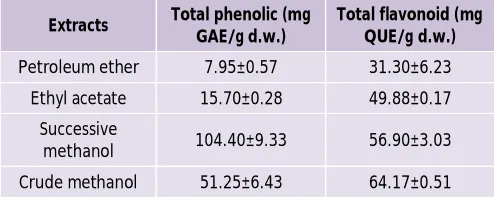
The total phenolic and flavonoid contents of J. curcas leaves extracted with petroleum ether, ethyl acetate, successive methanol and crude methanol extracts are presented in Table (3). The results showed that all the extracts of J. curcas leaves contained phenolic and flavonoid compounds. However, successive methanolic extract showed the highest level of phenolic content; it gave 104.40 mg GAE/g d.w. while petroleum ether extract gave the lowest value, 7.95 mg GAE/g d.w. The order of flavonoid content in the different extracts was as follows: crude methanolic extract (64.17 mg QUE/g d.w.), successive methanolic extract (56.90 mg QUE/g d.w.), ethyl acetate extract (49.88 mg QUE/g d.w.) and petroleum ether extract (31.30 mg QUE/g d.w.), respectively.
Table 3: Total phenolic and flavonoid contents of different extracts of J. curcas leaves
Extracts Total phenolic (mg
GAE/g d.w.)
Total flavonoid (mg QUE/g d.w.)
Petroleum ether 7.95±0.57 31.30±6.23 Ethyl acetate 15.70±0.28 49.88±0.17
Successive
methanol 104.40±9.33 56.90±3.03 Crude methanol 51.25±6.43 64.17±0.51 Total phenolic and total flavonoid contents are expressed as mean ± S.D (n = 3).
The present results (Table 3) prove that polar solvents (methanol) demonstrated the highest content of
polyphenolic contents as compared to the non polar solvents (petroleum ether and ethyl acetate). This different level of polyphenolic content may be attributed to the difference in the polarity of the extracting solvents.30 Where, polar solvents extract the phytochemicals more rapidly and efficiently than the non polar solvents.31 It is well known that, phenolic concentration often is higher than flavonoid concentration. The current results indicated that the phenolic content in crude methanolic extract (51.25 mg GAE/g d.w.) is lower than the flavonoid content (64.17 mg QUE/g d.w.). In contrast with the present results, the phenolic content in methanolic extract of J. curcas leaves was higher than the flavonoid content where, the
phenolics content was 38.80 in µg gallic acid equivalent (GAE) and the flavonoids content was 1.72 in µg quercetin
equivalent (QUE).32 Additionally, the phenolic concentration of J .curcas stem bark methanolic extract was 28.87 mg/g tannic acid equivalent and flavonoid concentration was 11.18 mg/g quercetin equivalent.33 Yet, the present results are found to be an inverse trend where, all extracts (except the successive methanolic extract) showed phenolic content lower than flavonoid content. This can be explained by; the differences in extracted solvent polarity may lead to variation in the extract polyphenolic contents. Besides, higher concentrations of flavonoid more than phenolic were found.34,35 This is may be due to the Folin-Ciocalteu method is a rapid and widely-used assay to detect the phenolics content but different phenolics have different responses in the Folin-Ciocalteu method.36
Antioxidant activity of different extracts of J. curcas leaves
DPPH radical scavenging activity
The DPPH test provides information on the reactivity of the test compounds with a stable free radical. DPPH gives a strong absorption band at 517nm in visible region. When the odd electron becomes paired off in the presence of a free radical scavenger, the absorption reduces and the DPPH solution is decolorized as the color changes from deep violet to light yellow. The degree of reduction in absorbance measurement is indicative of the radical scavenging (antioxidant) power of the extract.37 In the present study, the successive methanolic extract exhibited the highest DPPH scavenging activity (Figure 1)
among all extracts. At the 50 µg/µl concentration, the
successive methanolic extract showed DPPH radical scavenging activity 37.02 % while, BHT (which used as positive control) showed high DPPH radical scavenging activity 67.55 %. The extracts possessed a dose-dependent DPPH free radical scavenging activity.
highest phenolics content (104.40 mg GAE/g d.w.) and the highest DPPH free radical scavenging activity (37.02%)
at the concentration of 50 µg/ml. In concern with the present results, the antioxidant activity of different J.
curcas leaves extract may depend on their content of
phenolics.38 Additionally, the methanolic extract of J.
curcas stem bark exhibited the highest DPPH scavenging
activity (91.5%) at 1 mg/ml as compared to the aqueous (80.5%) and ethanolic (78.2%) extracts and the pharmacological activities associated with free radicals scavenging activities could be related to the presence of phenolic compounds that can donate hydrogen atom to a free radical and get rid of the abnormal electron resulting in radical’s reactivity.33
Figure 1: DPPH free radical scavenging activity of different
J. curcas extracts
Total antioxidant activity
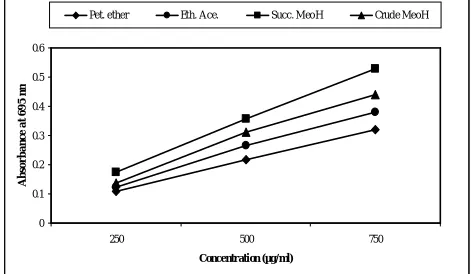
The principle of total antioxidant activity relies on the reduction of Mo (VI) to Mo (V) by the sample and subsequent formation of a green phosphate/Mo (V) complex.39 The results indicated that successive methanolic extract had the highest total antioxidant activity among all other extracts and the value at
concentration 250 µg was 0.173 as shown in Figure (2).
Figure 2: Total antioxidant activity of different J. curcas extracts
The phosphomolybdenum method usually detects antioxidant compounds such as ascorbic acid, some phenolics, tocopherols and carotenoids. In the present study, the successive methanolic extracts show the
highest total antioxidant activity among all extracts and the higher the concentration. In addition, total antioxidant activity of all extracts found to increase in a dose dependent manner. A good correlation is found between the total antioxidant capacity and the total phenolic content of the extract that appears in many plants.40 In the current results the successive methanolic extract showed the highest content of phenolics (104.40 mg GAE/g d.w.) with the highest total antioxidant activity in all assays (Figure 2).
Reducing power activity
Substances, which have reduction ability, react with potassium ferricyanide (Fe3+) to form potassium ferrocyanide (Fe2+), which subsequently reacts with ferric chloride to form ferric ferrous complex that has an absorption maximum at 700 nm.41 The reducing power activity of different extracts of J. curcas leaves indicated that the successive methanolic extract exhibited the highest value of reducing power activity (105.86 mg/g) followed by crude methanolic (59.15 mg/g), ethyl acetate (17.15 mg/g) and petroleum ether (13.58 mg/g) extracts as shown in Figure (3).
Figure 3: Reducing power activity of different J. curcas extracts
Reducing power is associated with antioxidant activity and may serve as a significant reflection of the antioxidant potency.42 Compounds with reducing power activity can act as primary and secondary antioxidants due to; they are electron donors and can reduce the oxidized intermediates of lipid peroxidation process.43 Polyphenolic substances produce many vital activities depending on their ability to scavenge free radicals; inhibit peroxidation and chelat transition metals.3 Antioxidant activity has been related to reductones, as they considered as terminators of free radical chain reactors.44 These reductants ones such as antioxidant substances cause the reduction of the Fe3+ to Fe2+ form. However, the redox active metal ions such as Cu+ or Fe2+ can interact with hydrogen peroxide (H2O2) and form hydroxyl free radicals (OH•), which eliminate hydrogen from molecules and encourage the free radical chain reactions.45
0 0.1 0.2 0.3 0.4 0.5 0.6
250 500 750
Concentration (µg/ml)
A
b
so
rb
a
n
ce
a
t
6
9
5
n
m
In concomitant with the present results, polar methanolic extracts exhibited high reducing activity that may be due to their high phenolic and flavonoid contents. These results are confirmed with the results of Mohamed et al.46 Also, the reducing power of J. curcas methanolic extract recorded the highest reducing power activity as compared to ethanolic and aqueous extracts.33 Thus, phenolic and flavonoid compounds detected in J. curcas leaves extracts proved their reducing power activity.
Polyphenolic composition of successive methanolic extract of J. curcas by HPLC
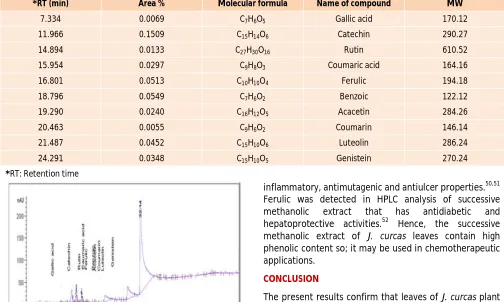
As was found the successive methanolic extract showed the highest content of total phenolic and the highest antioxidant activity in all assays, therefore it was selected to be detected for the individual Polyphenolic compounds by HPLC. The HPLC analysis of successive methanolic extract of J. curcas leaves has shown many Polyphenolic compounds including gallic acid, catechin, rutin, coumaric acid, ferulic, benzoic acid, acacetin, coumarin, luteolin and genistein as shown in (Figure 4, Table 4). The major polyphenolic compounds presented in the successive methanolic extract were catechin (0.1509%), benzoic acid (0.0549%) and ferulic acid (0.0513%).
Table 4: Polyphenolic compounds in successive methanolic leaves extract of J. curcas by HPLC
*RT (min) Area % Molecular formula Name of compound MW
7.334 0.0069 C7H6O5 Gallic acid 170.12
11.966 0.1509 C15H14O6 Catechin 290.27
14.894 0.0133 C27H30O16 Rutin 610.52
15.954 0.0297 C9H8O3 Coumaric acid 164.16
16.801 0.0513 C10H10O4 Ferulic 194.18
18.796 0.0549 C7H6O2 Benzoic 122.12
19.290 0.0240 C16H12O5 Acacetin 284.26
20.463 0.0055 C9H6O2 Coumarin 146.14
21.487 0.0452 C15H10O6 Luteolin 286.24
24.291 0.0348 C15H10O5 Genistein 270.24
*RT: Retention time
Figure 4: The HPLC Chromatogram of polyphenolic profile of successive methanolic leaves extract of J. curcas.
The profile of polyphenolic compounds were identified in successive methanolic extract by HPLC and the results were given in Table (4). Ten compounds were identified and the major were: catechin, rutin, coumaric acid, ferulic, benzoic acid and luteolin. The previous results detected by HPLC analysis revealed some phenolic compounds which may have antibacterial activity such as gallic acid and rutin in various parts of J. curcas plant.47 Gallic acid (phenolic compound) and rutin (flavonoid compound) have a strong antioxidant activity.48,49 With respect to the present results, the potential antioxidant activity of successive methanolic extract may be due to the presence of gallic acid and rutin in the extract. In addition, catechin (flavonoid compound) has
anti-inflammatory, antimutagenic and antiulcer properties.50,51 Ferulic was detected in HPLC analysis of successive methanolic extract that has antidiabetic and hepatoprotective activities.52 Hence, the successive methanolic extract of J. curcas leaves contain high phenolic content so; it may be used in chemotherapeutic applications.
CONCLUSION
The present results confirm that leaves of J. curcas plant are rich source in some important phytochemical compounds. The successive methanolic extract is highly valuable source of natural antioxidants and showed the presence of different bioactive compounds with high antioxidant activity. Diverse methods are essential in case of the determination of antioxidant activity due to the complexity of the oxidation-antioxidation processes. Future research should be addressed on the application of using J. curcas leaves as natural agent protect against peroxidative damage in living systems related to aging and carcinogenesis.
REFERENCES
1. Mamta S, Jyoti S, Phytochemical screening of Acorus and
Lantana camara, International Research Journal Of
Pharmacy, 3(5), 2012, 324-326.
2. Pandey D, Pandey S, Hemalatha S, Hypolipidemic activity of aqueous extract of Melothria maderaspatana,
3. Nickavar B, Kamalinejad M, Izadpanah H, In Vitro free radical scavenging activity of five salvia species, Pak. J. Pharm. Sci, 20(4), 2007, 291-294.
4. Khoddami A, Meredith A, Wilkes, Roberts TH, Techniques for analysis of plant phenolic compounds, Molecules, 18, 2013, 2328-2375.
5. Pietta PG, Flavonoids as antioxidants, J Nat Prod, 63(7), 2000, 1035-1042.
6. Soubra L, Sarkis D, Hilan C, Verger P, Dietary exposure of children and teenagers to benzoates, sulphites, butylhydroxyanisol (BHA) and butylhydroxytoluen (BHT) in Beirut (Lebanon), Regul. Toxicol. Pharm, 47(1), 2007, 68-77. 7. Prasad C, Krishna M, Reddy C, Mohan K, Performance evaluation of non-edible vegetable oils as substitute fuels in low heat rejection diesel engines, J. of Automobile Eng, 214 (2), 2012, 181-187.
8. Oliver-Bever BB, Medicinal Plants in Tropical West Africa, Cambridge University Press; London, 2000.
9. Calabrone L, Milella L, Greco I, Martelli G, Isolation of putative LAR (leucoanthocyanidin reductase) gene fragment differentially expressed in Jatropha curcas L. leaves, Emir, J. Food Agric, 25(3), 2013, 225-230.
10. Xu JJ, Tan NH, Phenolic compounds from Jatropha curcas, Zhongguo Zhong Yao Za Zhi, 37(20), 2012, 3074-3077. 11. Harborne JB, The Flavonoids: Advances in Research since
1980. (New York: Chapman and Hall), 1988.
12. Harborne JB, Phytochemical methods: A guide to modern technique of plant analysis, Champman and Hall, London, 1998.
13. Dahiru D, Sini JM, John-Africa L, Antidiarrhoeal activity of
Ziziphus mauritiana root extract in rodents, Afr. J.
Biotechnol, 5(10), 2006, 941-945.
14. Niranjana K, Sathiyaseelanb V, Jeyaseelana EC, Screening for anti-microbial and phytochemical properties of different solvents extracts of leaf of Pongamia pinnata, International Journal of Scientific and Research Publications, 3(1), 2013, 1-3.
15. Javanmardi J, Stushnoff C, Locke E, Vivanco JM, Antioxidant activity and total phenolic content of Iranian Ocimum accessions, Food Chemistry, 83, 2003, 547-550.
16. Woisky R, Salatino A, Analysis of propolis: some parameters and procedures for chemical quality control, J. Apic. Res, 37, 1998, 99-105.
17. Blois MS, Antioxidant determinations by the use of stable free radical, Nature, 26, 1958, 1199-1200.
18. Prieto P, Pineda M, Agular M, Spectrophotometric quantitation antioxidant capacity through the formation of a phosphomolybdenum complex, Analytical Biochemistry, 269, 1999, 337-341.
19. Zhao H, Fan W, Dong J, Lu J, Chen J, Shan L, Lin Y, Kong W, Evaluation of antioxidant activities and total phenolic contents of typical malting barley varieties, Food Chemistry, 107, 2008, 296-304.
20. Khalil MY, Moustafa AA, Naguib NY, Growth, phenolic compounds and antioxidant activity of some medicinal
plants grown under organic farming condition, World Journal of Agricultural Sciences, 3(4), 2007, 451-457 21. Dawidowicz AL, Wianowska D, Baraniak B, The antioxidant
properties of alcoholic extracts from Sambucus nigra L. (antioxidant properties of extracts), Lebensmittel-Wissenschaft und Technologic, 39, 2006, 308-315.
22. Agrawal AD, Pharmacological activities of flavonoids: A review, International Journal of Pharmaceutical Sciences and Nanotechnology, 4(2), 2001, 1394-1398.
23. Chung KT, Tannins and human health: a review, Criti Rev.Food. Sci. Nutr, 6, 1998, 421-464.
24. Kumar S, Gupta A, Pandey AK, Calotropis procera root extract has the capability to combat free radical mediated damage, ISRN Pharmacology, 2013, 1-8.
25. Pulido R, Bravo L, Saura-Calixto F, Antioxidant activity of dietary polyphenols as determined by a modified ferric reducing/antioxidant power assay, J Agric Food Chem, 48, 2000, 3396-3402.
26. Rice-Evans CA, Miller NJ, Bolwell PG, Bramley PM, Pridham JB, The relative antioxidant activities of plant derived polyphenolic flavonoids, Free Radic. Res, 22, 1995, 375-383.
27. Thite SV, Chavan YR, Aparadh VT, Kore B.A, Preliminary phytochemical screening of some medicinal plants, International Journal of Pharmaceutical, Chemical and Biological Sciences, 3(1), 2013, 87-90.
28. Sparg SG, Light ME, Van Staden J, Biological activities and distribution of plant saponins, J Ethnopharmacol, 94, 2004, 219-243.
29. AL-Asady AAB, Ahmed NY, Mustafa TA, Cytotoxic and cytogenetic effects of aqueous and methanol crude extracts of Nicotiana tabacum on Rhabdomyosarcoma (RD) and L20B cell lines in vitro, European Journal of Experimental Biology, 4(2), 2014, 164-171.
30. Choi Y, Jeong HS, Lee J, Antioxidant activity of methanolic extracts from some grains consumed in Korea, Food Chem, 103, 2007, 130-138.
31. Chaitanya PJ, Alagoud ML, Chandrashekar R, Bhavani NL, Kudle KR, Phytochemical and Antimicrobial screening of the polar and non-polar solvent root extracts of Vanda
tessellate (Roxb.) Hook.ex G.Don, International Journal of
Pharmacognosy and Phytochemical Research, 14, 5(4), 2013, 315-320.
32. Sharma AK, Gangwar M, Tilak R, Nath G, Sinha ASK, Comparative in vitro antimicrobial and phytochemical evaluation of methanolic extract of root, stem and leaf of
Jatropha curcas Linn, Pharmacognosy Journal, 4(30), 2012.
33. Igbinosa OO, Igbinosa IH, Chigor VN, Uzunuigbe OE, Oyedemi SO, Odjadjare EE, Okoh AI, Igbinosa EO, Polyphenolic contents and antioxidant potential of stem bark extracts from Jatropha curcas (Linn), Int J Mol Sci, 12(5), 2011, 2958-2971.
35. Sultana B, Farooq A, Muhammad A, Effect of extraction solvent/technique on the antioxidant activity of selected medicinal plant extracts, Molecules, 14, 2009, 2167-2180. 36. Kahkonen MP, Hopia AI, Vuorela HJ, Rauha J, Pihlaja K,
Kujala TS, Heinonen M, Antioxidant activity of plant extracts containing phenolic compounds, J. Agric. Food Chem, 47, 1999, 3954-3962.
37. Contreras-Guzman ES, Strong FC, Determination of tocopherols (Vitamin E) by reduction of cupric ion, JAOAC, 65, 1982, 1215-1222.
38. Mohamed AA, Khalil AA, El-Beltagi HES, Antioxidant and antimicrobial properties of kaff maryam (Anastatica
hierochuntica) and doum palm (Hyphaene thebaica),
Grasas Y Aceites, 6, 1 (1), 2010, 67-75.
39. Ozen T, Turkekul I, Antioxidant activities of Sarcodon
imbricatum wildly grown in the Black Sea Region of Turkey,
Pharmacogn Mag, 6(22), 2010, 89-97.
40. Shahriar M, Hossain I, Sharmin FA, Akhter S, Haque A, Bhuiyan MA In vitro antioxidant and free radical scavenging activity of Withania somnifera root, Iosr Journal Of Pharmacy, 3, 2, 2013, 38-47.
41. Jayanthi P, Lalitha P, Reducing power of solvent extracts of
Eichhornia crassipes (MART.) SOLMS, Int J Pharm Pharm
Sci, 3, 2011, 126-128.
42. Oktay M, Gulcin I, Kufrevioglu OI, Determination of in vitro antioxidant -activity of fennel (Foeniculum vulgare) seed extracts, Lebensm. Wiss. Technol. D Food Sci. Technol, 36, 2003, 263-271.
43. Chanda S, Dave R, In vitro models for antioxidant activity evaluation and some medicinal plants possessing antioxidant properties: An overview, African Journal of Microbiology Research, 3(13), 2009, 981-996.
44. Milliauskas G, Venskutonis PR, Van-Beek TA, Screening of radical scavenging activity of some medicinal and aromatic plant extracts, Food Chem, 85, 2004, 231-237.
45. Dai J, Mumper RJ, Plant phenolics: extraction, analysis and their antioxidant and anticancer properties, Molecules, 15, 2010, 7313-7352.
46. Mohamed AA, Ali SI, El-Baz FK, Antioxidant and antibacterial activities of crude extracts and essential oils of
Syzygium cumini leaves, PLOS ONE, 2013, 1-7.
47. Namuli A, Abdullah N, Sieo CC, Zuhainis SW, Oskoueian E, Phytochemical compounds and antibacterial activity of
Jatropha curcas extracts, Journal of Medicinal Plants
Research, 5(16), 2011, 3982-3990.
48. Bhadoriya U, Sharma P, Solanki SS, In vitro free radical scavenging activity of gallic acid isolated from Caesalpinia
decapetala Wood, Asian Pacific Journal of Tropical Disease,
2012, 833-836.
49. Zielinska D, Szawara-Nowak D, Zielinski H, Determination of the antioxidant activity of rutin and its contribution to the antioxidant capacity of diversed buckwheat origin material by updated analytical strategie, Pol. J. Food Nutr. Sci, 60, (4), 2010, 315-321.
50. Lee MJ, Wang ZY, Li H, Chen L, Sun Y, Gobbo S, Balentine DA, Yang CS, Analysis of plasma and urinary tea polyphenols in human subjects, Cancer Epidemiol. Biomarkers Prev, 4, 1995, 393-399.
51. Sato K, Kanazawa A, Ota N, Nakamura T, Fujimoto K, Dietary supplementation of catechins and alpha-tocopherol accelerates the healing of trinitrobenzene sulfonic acid-induced ulcerative colitis in rats, J Nutr Sci Vitaminol (Tokyo), 44, 1998, 769-78.
52. Paiva LB, Goldbeck R, Santos WD, Squina FM, Ferulic acid and derivatives: molecules with potential application in the pharmaceutical field, Brazilian Journal of Pharmaceutical Sciences, 49(3), 2013.