of that shoot, but if a portion of the inflorescence
was retained the shoot continued to grow. fifth internodes of unmown plants was 1.2, 32, 40, The rhizomes of mown plants of sideoats grama and 19 mm, respectively. The second, third, fourth, and switchgrass, instead of remaining underground and fifth internodes of mown sideoats grama plants were 14, 4, 5, and 18 mm respectively. This rela- to start new growth the following season, immedi- tionship held true for all collection dates that were ately turned upward and produced aerial shoots.
These shoots grew and produced seedheads, if the examined, June 19, July 3, and August 4. plants were mown before June 26 (switchgrass) Literature Cited
and July 3 (sideoats grama). The rhizomes of BRANSON, FARREL A.
switchg-rass plants mown after June 26, and sideoats sistance of grasses to grazing. 1953. Two new factors affecting J. Range Manage. 6:165- re- grama plants mown after July 3, turned upward 171.
and produced small leaves and then went dormant. EVANS, MORGAN W., AND F. 0. GROVER. 1940. The devel- Mowing after these critical dates did not seem to opmental morphology of the growing point of the shoot activate rhizome growth. When a plant was mown, and the inflorescence of grasses. J. Agr. Res. 61:481-520. not only the rhizomes produced aerial shoots, but GRAY, A. 1879. Structural botany. American Book Com- the proaxis buds of both sideoats grama and switch- pany, New York. 442 p.
grass also produced shoots. Mowing resulted in LAUDE, HORTON M. 1957. Growth of the annual grass more tillers from the rhizomes and proaxes of plant in response to herbage removal. J. Range Manage. sideoats grama than of switchgrass. 10:37-38.
All of the sideoats grama plants mown between SHARMAN, B. C. 1947. The biology and developmental June 19 and July 3 exhibited a much-reduced elon- morphology Phytol. 46:20-34. of the shoot apex in the Gramineae. New gation of the third and fourth internodes. The WEATHERWAX, PAUL. 1923. The story of the maize plant. average length of the second, third, fourth, and Illus. Univ. Chicago Press, Chicago. 247 p.
Some Soil Age-Range Vegetation Relationships1
E. M. WHITE
Professor of Plant Science (Soils), South Dakota State University, Brooking.
Highlight
Soil texture and development determine the kinds of range plants that grow in west central South Dakota. Bluestems, sideoats grama, and prairie sandreed are important species on very weakly developed soils but are less important on more strongly developed soils than cool-season mid- and tall-grasses. Western wheatgrass, green needlegrass, and buffalograss are important on well developed soils except those that are very coarse textured where needleandthread is im- portant. Soil structure and fertility changes probably are the important factors iffecting vegetation as a soil develo’ps.
Some environmental factors af- fecting vegetation were discussed by Weaver and Darland (1949), Weaver and Albertson (1956), and Weaver (1958) for the plains species. Al- bertson (1937) reported certain kinds of mixed prairie were asso- ciated with certain kinds of soils in western Kansas. In North Dakota, Hanson and Whitman (1938) de- scribed the general kind of soil for nine vegetation t Y
Pes
and Dix1 South Dakota Agricultural Experi- ment Station Journal Series 882. Re- ceived October 5, 1970.
(1958) related the vegetation to slope gradient and slope aspect. Some soil-plant relationships were described for southwestern South Dakota by Tolstead (1941) and by Larson and Whitman (1941). Mixed prairie species that are found on soils in different stages of develop- ment have noIt been discussed in detail. The need for soil-vegetation interpretation studies in range man- agement has b,een discussed by Klemmedson (1970).
The effect soil age and texture has on plant composition on well- drained slopes has been studied for
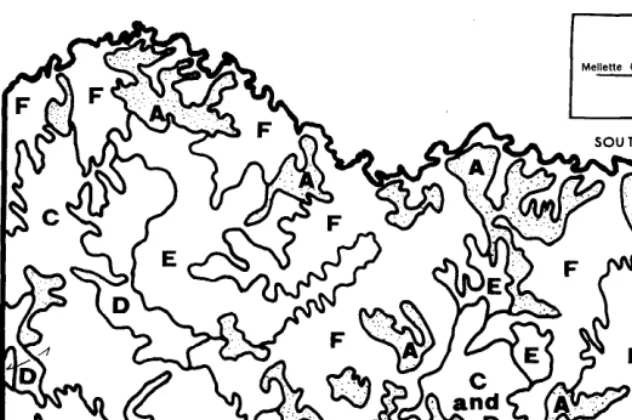
10 years (1958 to 1968) as part of the soil survey of 1Mellette County, South Dakota. This county (Fig.
1) has an area of about 834,000 acres and is about 30 miles north of the Nebraska line and 100 miles east of the Black Hills. The annual pre- cipitation ranges from about 18 inches in the SE corner to 16 inches in the NW corner of the county (Hodges, 1960). Average July and January temperatures are about 77 F and 21 F, respectively. Soils are derived from Cretaceous-Age Pierre shale, from Tertiary-Age shales, silt- stones, and sandstone, and from
Quaternary-Age alluvial and eo- lian sediments. The area has had several erosion cycles which have removed some of the older soils from the landscape. Soils derived from each parent material range from weakly developed to well de- veloped and the vegetation growing on them forms a successional se- quence.
FIG. 1. Generalized soil-vegetation map of Mellette County: (A) (Stippled pattern)
Loamy or sandy soils derived from eolian and stream terrace deposits with the needle- andthread-blue grama-western wheatgrass or the bluestem sp.-sideoats grama vegeta- tion types: (B) silty soils derived from Tertiary siltstone with needleandthread- blue grama-western wheatgrass vegetation type; (C) Badlands with barren areas interspersed with areas of vegetation similar to B, D, and F; (C) and (D). Complex of many small areas of C and D; (D) Silty clay loam and clay soils from Tertiary shales with western wheatgrass-green needlegrass (or needleandthread on silty clay loams)-blue grama vegetation types: (E) Clay soils derived from Cretaceous Pierre shale with western wheatgrass-green needlegrass-blue grama vegetation types; (F) Thin clay Eoils derived from Cretaceous Pierre shale with little bluestem-big bluestem- sideoats grama vegetation types.
Forest (Po@lus-Salix-Ulmus) vege-
tation types. The generalized soil- vegetation map of Mellette County (Fig. 1) is more detailed than Kiich- ler’s map. In addition, ponderosa pine (Pinus ponderosa) occurs in some Badlands and burr oak (@er- CZGS macrocarpa) grolws in some up- land drainageways and low stream terraces or floodplains.
Materials and Methods Vegetation, by species (Fernald, 1950; Hitchcock and Chase, 1950; Kelsey and Dayton, 1942), is re- ported on a relative weight basis by visual estimation. These com- position estimates are similar to those reported by Lewis et al. (1963, Appendix Table 3) that are used for range management. In the proc- ess of soil mapping, each soil profile was related to the plant composi- tion at that location. Thus, thou- sands of individual observations made over the IO-year period have been summarized graphically in this paper.
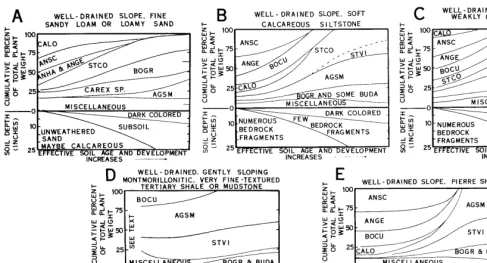
Tentative soil series for the dia- grams in Figure 2 are from left to right with increasing soil develop- ment: (1) for sands-Valentine, Dunday, Mander, Anselmo, and Tuthill; (2) for siltstone-Epping, Keota, and Huggins; (3) for silty clay loam shale-Imlay and Norrest;
(4) for Pierre shale-Samsil, La- koma, and Opal;
(5)
for fine- textured shale-unnamed series and Larvie. Parent materials with only 1 or 2 series have other soils, which will be named in the future.Changes in soil profiles with in- creasing age in southwestern South Dakota are similar to1 those com- monly recognized in more humid areas. However, the weathering of the parent material is slower so the soil morphological properties are slightly different and will be de- scribed briefly. Very young soils in Mellette County inherit properties from the parent material which may be fractured hard rock, soft rock, or sediment deposited by wind or water. As rock fragments weather
the soil initially becomes finer tex- tured and later clay and silt are weathered or transported from the A horizon and added to the B hori- zon. Thus the A horizon may be coarse textured initially, then fine textured when the rock fragments are weathered, and coarser textured again as clay moves from A into the B horizon. The development of soil structure (White, 1967) has been discussed as a factor causing Dense Clay and Clayey Range soils
(White and Lewis, 1969).
Observations and Discussion
Grass Species in Relationship to Soil Development and Texture Changes in plant composition associated with increasing soil age and development (Fig. 2) are quite similar irrespective of parent mate- rial. Warm-season tall bunch-grasses probably are dominant on very weakly developed soils because in- sufficient nitrogen and phosporus is available so the cool-season grasses can grow and use plant-available water before the warm-season bunchgrasses initiate rapid growth (White, 1961). Weakly developed soils on steep slopes with much water runoff and on low terraces with little water runoff have tall warm-season grasses ( if not over- grazed) so water runoff does not seem to be a factor. In more humid regions these warm-season grasses probably grow on well-developed soils because precipitation is suffi- cient to replenish soil moisture after the cool-season grasses have ma- tured. A few moderately moist areas in Mellette County, either subirrigated or with considerable run-in water, have the tall warm- season grasses if the dark-colored soil is moderately fine to coarse textured. If the moist-area soil is fine textured, western wheatgrass usually (Agropyron smithii) is dom- inant although green needlegrass
(Stipu viridula), big bluestem, side- oats grama (Bouteloua curtipen-
WELL - DRAINED SLOPE. SOFT
A
WELL- DRAINED SLOPE, FINESANDY LOAM OR LOAMY SAND
Y
CALCAREOUS S I LTSTONE
INCREASES * n WELL- DRAINED. GENTLY SLOPING
u MONTMORILLONITIC. VERY FINE -TEXTURED ;
$j
100 TERTIARY SHALE OR MUDSTONE BOCU
%ig75-+ AGSM
INCREASES p
C
WELL-DRAINED SLOPE. CALCAREOUS. WEAKLY CEMENTED SILTY CLAYL LOAM SHALE
-FRAGMENTS
25 EFFECTIVE SO AGE AND DEVELOPMENT IkREASES --
E
WELL-DRAINED SLOPE, PIERRE SHALEz
._- ANSC 50 z75 AGSM
pQ~&*
MISCELLANEOUS
DARK COLORED w
-SHALE FRAGMENTS
= 25’EFbkCTIVE SOIL AGE AND DEVELOPMEN INCREASES - --
FIG. 2. Relationship of the abundance of common mixed prairie grasses to the development of soils derived from different parent materials on well-drained slopes that do not collect run-in water. AGSM, Agropyron smithii; ANGE, Andropogon gerardi; ANHA,
Andropogon hallii; ANSC, Andropogon scoparius; BOCU, Bouteloua curtipendula; BOGR, Bouteloua gracilis; BUDA, Buchloe dactyloides; CALO, Calamovilfa longifolia; SPCR, Sporobolus cryptandrus; STUCO, ,Stipa comata; and STVI, Stipa viridula.
order form weakly developed to more strongly developed soils.
Prairie sandreed (Calamouilfa Zongifolia) is most abundant on the weakly developed soils, particularly those with lolose sandy and silty pro- files in Mellette County (Fig. Z-A and B, Fig. 3). Other weakly de- veloped soils with considerable prai- rie sandreed have coarse-textured profiles formed from sand- or pebble-size fragments of the bed- rock. A rhizomatous plant such as prairie sandreed or sand bluestem
(Andropogon hallii), may be adapted to weakly developed sandy soils mainly because one seedling can spread over an area where seed- lings of other species cannot grow. The relationship of sand bluestem to big bluestem supports this hy- pothesis.
Sand bluestem and big bluestem usually grows on weakly develo’ped soils with respectively, sandy and clayey textures. The two species interbreed because plants of inter- mediate phenotype occur at the border of weakly developed sandy and clayey soils. However, in very
small sandy areas, this interbreed- ing is either (1) very limited so sand bluestem can be preserved as a distinct species, or (2) a single sand bluestem plant spreads and maintains itself for a very long time by producing new plants vegeta- tively from long rhizomes. Sand bluestem must be more adapted to weakly developed sandy soils than big bluestem because of the long rhizomes or some related root char- acteristics. On gravelly soils, big bluestem seems to be adapted al- though the gravel deposits are thin in Mellette County so, the finer underlying material may be the controlling factor.
Little bluestem (Andropogon sco- parius) cg;rows with big bluestem or sand bluestem on weakly developed soils. Little and big bluestems will grow on very fine textured soils if they contain shale fragments but not if the shale fragments are not present (Fig. 2, D in comparison to E). Little bluestem may grow on well-developed soils which have been disturbed by burrowing ani- mals or by man. Competition from
other species has been eliminated in these disturbed soils so they are similar to the weakly developed soils where competition is reduced because of the low fertility. Little bluestem grows on soils that are derived from calcareous and non- calcareous siltstone so carbonate content is not a factor. Wilding (1960) discussed the different soils where little bluestem was abun- dant, including some which were not well drained.
SPECIES SOIL ADAPTION RANGE ____ - - ~~
TEXTURE D RELATIVE ABUNDANCE
RANGE ON
CLAY SILT SAND GRAVEL AGROPYRON SMITHII A WK
A M b ANDROPOGON GERARD1 A WK 1____ ANDROPOGON HALLII n WK __ _ Bm___ BOUTELOUA GRACILIS A M -
P WK - BUCHLOE DACTYLOIDES n WK
A m A?_1 CALAMOVILFA LONGIFOLIAP WK _-_
A”\. M SPOROBOLUS CRY P- ii WK :=
TANDRUS A M __ ST I PA COMATA
STIPA VIRIDU,LA 2
A M -__
AMORPHA CANESCENS P WK _-- DALEA AUREA P WK _ - IPOMOEA LEPTOPHYLLA n WK _~ PETALOSTEMUM VILLOSUMA WK _~~_ * P PURPUREUM /ii M - PSORALEA ARGOPHYLLA A M /-\ PSORALEA CUSPIDATA h M L- ~ .-__ PSORALEA ESCULENTA n
M% PSORALEA LANCEOLATA n WK PSORALEA TENUIFLORA p M -
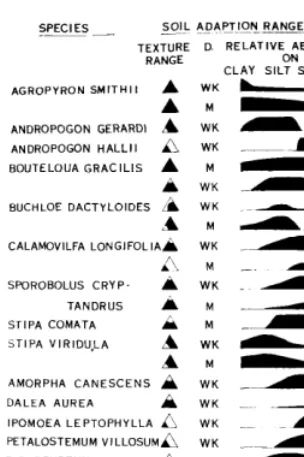
FIG. 3. Relationship of common mixed prairie species to soil texture. The shaded area of the standard soil tex- ture triangle (apex = 100% clay, lower left = 100% sand, lower right = 100% silt) shows the range of soil textures that were found where the species commonly grows when the soil is (Column D. = Development) weak (WK) and mod- erate or well (M) developed. The lin- ear array of texture, clay through gravel, shows by the height of the shading the relative abundance of a species on soils with the different dominant kinds of soil particles. It cannot be used to com- pare the abundance of different species on a certain texture.
warm- season tall bunch-grasses and western wheatgrass, has shallow rhi- zomes with nodal roots that spread down and through the soil.
Needleandthread (Sti@z comata) grows on coarse-textured soils and not on fine-textured soils. In con- trast, green needlegrass grows on fine-textured soils and not on coarse-textured soils. Both grow on medium and moderately fine textured soils but as the clay con- tent increases, green needlegrass in- creases relatively to needleand- thread. The relationship of these species to texture has been discussed by Archer and Bunch (1953). How- ever, Hoover et al. (1948, p. 698) reported green needlegrass grew best on the sandier soils and Weaver and Albertson (1956, p. 29) con-
curred if water is sufficient. Needle- andthread does not grow on clay soils in South Dakota, irrespective of moisture regimes, although green needlegrass grows profusely on the more moist clay soils. Needleand- thread has a fine root system (Weaver and Albertson, 1956) that may be damaged more by the desic- cation shrinking and cracking in clay soils than the coarse, tough, wiry roots of green needlegrass. In soil derived fro’m moderately fine textured parent materials, horizon textures determine which species is most important (Fig. Z-C). If the A horizon is a silt loam and the B horizon is a clay, needleandthread may grow provided the B horizon contains many moderately hard silt- stone or shale fragments. Needle- andthread grows with green needle- grass on soils that have fragment- free clay B horizons if the A hori- zon is a silt loam or loam and at least 6 or 8 inches thick. On weakly developed soils, green needlegrass is the sole Stipa sp. if the clay con- tent is more than 40 or 50 percent regardless of the shale fragment content.
Buffalograss grows in association with green needleg-rass on many soils. Like green needlegrass, it does not grow well on sandy soils (Weaver and Albertson, 1956; Ar- cher and Bunch, 1953). In Mellette County, buffalolgrass is found occa- sionally on soils with sandy surfaces that are underlain by clay but not where the entire profile is sandy. It grows on silty soils where green needlegrass is replaced by needle- andthread but not on very weakly developed fine-textured clay soils where green needlegrass grows but needleandthread doles not. Holw- ever, buffalograss will grow on these fine-textured clay sodls, derived from very weakly bedded, poorly consolidated shales or from clay alluvium, when they develop a granular surface layer and a weak prismatic B horizon. Apparently, buffalograss cannot grow unless the surface and sub-surface layers of a fine-textured clay soil has fairly stable prismatic and blocky struc- ture. The plant will not grow if
parallelepipeds are present in the surface or within the subsoil to a depth of 10 or 15 inches. Presum- ably the fine roots of buffalograss are damaged either by constriction or by stretching as the soil dries, shrinks, and cracks (White and Lewis, 1969).
Blue grama, like buffalograss, will not grow on very fine textured soils until the structure becomes fairly stable in the upper part of the soil. However, blue grama does grow on all other soils in Mellette County including the coarse- textured ones where buffalograss does not occur. The sandy soil charcateristics that limit the one species and not the other are not known. Presumably, the unstable surface-layer structure in very sandy soils may be detrimental to buffalo- grass.
Miscellaneous Perennial Grasses Sand dropseed (Sporobolus crypt- andrus) was common on sandy or silty soils and less common on fine- textured soils. In contrast, tall dropseed (Sporobolus asper) was observed mainly on moderately fine and fine-textured soils with at least weak development. Prairie junegrass (Koeleria cristuta) and red threeawn (Aristida Zongiseta) were observed most frequently on silty, loamy, or fine sandy soils with A and B horizons. Stonyhills muhly
(Muhlenbergia cuspidata) grew on weakly developed soils formed from any bedrock parent material where erosion was rapid. It usually is asso- ciated with little bluestem. Indian ricegrass (Oryxopsis hymenoides) oc-
curred on very weakly developed soils on cliffs in the Badlands where vegetation was sparse. Hairy grama
(Bouteloua hirsuta) was found in a very few areas on weakly developed silty or sandy soils. Blowoutgrass
(Redfieldiu flexuosa) and sand love- grass (Eragrostis trichodes) were found only in a few sandy formerly cultivated areas where they could have been introduced in domestic seed. These two are common Sand- Hills species where dunes are wind eroded. Their absence in Mellette County may suggest wind blowout activity is recent on formerly sta- bilized dunes where these species could not grow. Canada wildrye
(Elymus canadensis) and Virginia wildrye (E. virginicus) were ob- served rarely on well-drained slop- ing silty or sandy soils. Switchgrass grew infrequently on well-drained weakly developed soils, possibly where snow accumulated to increase the plant-available soil water. It was common on moist soils.
Forb Species in Relationship to Soil Texture and Development Some forbs grow only on well- drained soils with a certain range of textures and are listed in Figure 3 with the genera1 texture range of the soils where they occur frequently. Obviously, most species do grow occasionally in atypical soils where other species are better adapted. Several species seem to’ be restricted
in Mellette County to very weakly developed sandy soils. These are bush morningglory (Ipomoea Zepto- phylla), silky prairieclover (Petalo- sternum villosum), lemon scurfpea
(Psoralea Zanceolata), sand sage- brush (Artemisia filifolia), and annual eriogonum (Eriogonum an- num). Leadplant amorpha (Amor- pha canescens) occurs on weakly developed sandy or silty soils. How- ever, the sand may consist of flakes of fissile shale which are exposed by erosion. Dwarfindigo amorpha
(Amorpha nana) also occurs most frequently on weakly developed soils but they are derived from weathered clay-rich shale or silt- stone. Silktop dalea (Dalea aurea)
and plume dalea (Dalea enneandru)
are both found on weakly developed soils. Silktop dalea grows on ridges and slopes that have a gravelly sub- soil. The gravel may be water de- posited or consist of shale or silt- stone fragments. Plume dalea grows on finer material where erosion is rapid. White prairieclover (Petalo- sternum candidium) occurs on very weakly developed soils derived from silty alluvium or partially weath- ered siltstone or shale. Purple prai- rieclover (Petalostemum @.qbu- reum) grows on more strongly de- veloped soils than white prairie- clover. These soils usually have at least a weak B horizon and a dark- colored A horizon. Tall bread scurf- pea (Psoralea cuspidata) grows only on weakly to strongly developed soils which are clays or have clay layers in the profile or substratum. It is as diagnostic of clay as lemon scurfpea is of a weakly developed sandy soil. Silverleaf scurfpea (P. urgophylla) grows readily on most soils except possibly on those which are very gravelly or have a very high clay content. Common breadroot scurfpea (P. esculenta) seems to be most prevalent on silty or loamy soils. Slimflower scurfpea (P. tenui- flora) grows on nearly any well- drained soil which has a friable sub- soil at a depth of 3 or 4 feet.
Most forbs growing on weakly de- veloped soils are legumes that may have root nodules with symbiotic organisms that fix nitrogen in soils with a low nitrogen content. As soil
organic matter accumulates, other forbs and grasses get sufficient ni- trogen to compete for the area. Reasons for the non-leguminous forbs growing on soils with a certain texture are not known. Pos- sibly the root systems of some spe- cies are damaged in clay soils while others cannot grow through sandy materials for some unexplained rea- son.
Selective Effect of Soil Texture and Development on Plant Species The selective effect texture has for certain species is evident (Figs. 2 and 3 ). Texture is a factor in air and water movement in the soil, in the amount of water a well-drained soil can retain that is available to plants, in structure formation (White, 1967), and, in some cases, soil fertility, so its effect on plants is difficult to evaluate. A species may grow on a soil because it can utilize some nonsoil resource more efficiently than other species. How- ever, this species may grow equally well or better on some other soil where some other species is more efficient. However, a comparison of the successional sequences formed with increasing soil development on different kinds of parent material will eliminate some species from those affected by texture.
Little bluestem, sideoats grama, and western wheatgrass grow on soils of any texture except pure gravel if soil development is correct for the species. Other species grow only on soils of certain textural groups. Some of these species are big bluestem, sand bluestem, needle- andthread, green needlegrass, buf- falograss, tallbread scurfpea, lemon scurfpea, and silky prairieclover. The logical place to find differ- ences between these species would be in the roots but no consistent difference is apparent. The effect of soil development on certain spe- cies supports this idea.
blocks and prisms. These same spe- cies do occur on very weakly de- veloped silty soils which have little structure development of any kind. Therefore, stable structure in fine clay soils seems to compensate for the texture as was discussed previ- ously. In other cases, structure de- velopment in a soil of a certain textural group does not seem to affect the distribution of the spe- cies. Presumably morphoNlogical or physiological differences in the roots must permit one species to grow where others cannot.
Literature Cited
ALBERTSON, F. W. 1937. Ecology of mixed prairie in west central Kansas. Ecol. Monogr. 7:481-457.
ARCHER, S. G., AND C. E. BUNCH. 1953. The American grass book. Univer- sity of Oklahoma, Press, Norman, Oklahoma, 330 p.
DIX, R. L. 1958. Some slope-plant relationships in the grasslands of the Little Missouri Badlands of North Dakota. J. Range Manage.
11:88-92.
FERNALD, M. L. 1950. Gray’s Manual of Botany. Eight Ed., American Book Co., New York.
HANSON, H. C., AND W. WHITMAN. LEWIS, J. K., L. R. ALBEE, 1938. Characteristics of major grass- HOWARD. South Dakota land types in western North Dakota. nature and use. S. Dak. Ecol. Monogr. 8:57-l 14. lege, Ext. Circ. 605. HOM;ES, W. T. 1960. Climate of the
States-South Dakota. Climatogra- phy of the United States No. 60-39. Weather Bureau, U. S. Dep. of Com- merce, Washington, D. C.
HOOVER, M. M., M. A. HEIN, W. A. DAYTON, AND C. 0. ERLANSON. The main grasses for farm and home. (IN) Yearbook of Agriculture. 1948: 639-700.
TOLSTEAD, W. L. 1941. Plant com- AND P. L. Range-Its
State Col-
HITCHCOCK, A. S., AND A. CHASE. 1950. Manual of the grasses of the United States. U. S. Dep. Agr. Misc. Pub. No. ZOO.
KELSEY, H. P., AND W. A. DAYTON. 1942. Standardized plant names. Ed. 2. J. Horace McFarland Co., Harrisburg, Pa. 675 p.
KLEMIMEDSON, J. 0. 1970. Needs for soil information in the management of range resources. J. Range Man- age. 23: 139-143.
K~~CHLER, A. W. 1964. Potential nat- ural vegetation of the conterminous United States. Amer. Geographical Sot. Spec. Pub. 36.
LARSON, F., AND W. WHITMAN. 1942. A comparison of used and unused grassland in the Badlands of South Dakota. Ecology 23:438-445.
munities and secondary succession in southcentral South Dakota. Ecology 22: 322-328.
WEAVER, J. E. 1958. Summary and interpretation of underground de- velopment in natural grassland com- munities. Ecol. Monogr. 28:55-78. WEAVER, J. E., AND F. W. ALBERTSON.
1956. Grasslands of the Great Plains. Johnsen Publishing Com- pany. Lincoln, Nebraska, 395 p. WEAVER, J. E., AND R. W. DARLAND.
1949. Soil-root relationships of cer- tain native grasses in various soil types. Ecol. Monogr. 19:303-338. WHITE, E. M. 1961. A possible re-
lationship of little bluestem to soils. J. Range Manage. 14:243-247. WHITE, E. M. 1967. Soil age and tex-
ture factors in subsoil structure gen- esis. Soil Sci. 103:288-298.
WHITE, E. M., AND J. K. LEWIS. 1969. Ecological effect of a clay soil’s struc- ture on some native grass roots. J. Range Manage. 22:40 l-404.
WILDING, L. P. 1960. The distribu- tion of little bluestem on certain soils in Mellette County, South Da- kota. S. Dak. Acad. Sci. Proc. (1959) 38:74-78.
COMMONWEALTH AGRICULTURAL BUREAUX
Publishers of: HERBAGE ABSTRACTS, FZELD CROP ABSTRACTS
AUTOMATION OF CAB SERVICES
The Commonwealth Agricultural Bureaux are introducing computer techniques for the pro- vision of specialist scientific information services for agricultural research workers. The new sys- tem will facilitate:
(a) speedier journal production and earlier notice of papers; (b) the inclusion of improved indexes in each journal issue;
(c) the search of the whole CAB data base to provide special outputs on selected topics, cur- rent awareness, personal and group services, annotated bibliographies, etc.;
(d) the interchange of information with other major information services in this field; (e) the supply of magnetic tapes.
Some automated journal production will start in 1972 and further details will be announced in due course. Any enquiries should be addressed to: