2(3): 405-412, 2012
SCIENCEDOMAINinternational
www.sciencedomain.org
Abduction of Children by Their Parents: A
Psychopathological Approach to the Problem in
Mixed-Ethnicity Marriages
A. Douzenis
1*, K. Kontoangelos
2, O. Thomadaki
2, G. N. Papadimitriou
2and L. Lykouras
11
2ndDept. of Psychiatry, University of Athens Medical School, Attikon Hospital, Greece.
2
1stDept. of Psychiatry, University of Athens Medical School, Eginition Hospital, Greece.
Authors’ Contributions
AD designed the study protocol and wrote the first draft of the manuscript. KK collected the data performed the literature search and contributed to the first draft of the manuscript. OT performed the statistical analyses. GNP and LL had the overall supervision and corrected the final draft. All authors have read and approved the final manuscript.
Received 5thFebruary 2012 Accepted 6thJune 2012 Online Ready 11thJune, 2012
ABSTRACT
Aim:Child abduction by one parent and their transport to a foreign country is increasing worldwide but has not received adequate scientific interest. When inter-marital relationships reach the point of break-up and divorce, one of the parents abducts his/her child/children.
Method: Records of forty seven (47) cases of inter family abduction that took place in 2007 in Greece were obtained. The majority of cases concerned relocation of children in a foreign country. A special inventory was developed for data collection. This consisted of three distinctive parts, for the father, the mother, or the abducted child.
Results: Results showed that a typical abductive mother is of non Greek nationality, more likely of having psychiatric symptoms, without indication of substance abuse and no signs of violent behavior. Abductive fathers are of Greek nationality, less likely of having psychiatric symptoms, no substance abuse, and tend to exhibit violent behavior.
resolved, a phenomenon that has obvious implications on the mental health of the children and the parents involved.
Keywords: Parental abduction; child abduction; forensic psychiatry; child psychiatry.
1. INTRODUCTION
Parental abduction is defined as the “taking, retention, or concealment of a child or children by a parent, other family member, or their agent, in derogation of the custody rights, including visitation rights, of another parent or family member” (Forehand et al., 1989).
If put more simplistically, abduction by a parent refers to the child being taken by one parent without the knowledge and permission of the other and without any legal sanction (Agopian, 1980). This phenomenon is predominantly observed after a marital break-up, either before or after custody has been decided by the court (Agopian, 1984). In most of the cases the parent does not know where the abducted child is (Cole et al., 1992). Greif and Hegar (1993) in their book on parental kidnapping made direct link between the presence of family violence and parental abduction. Johnston et al., 2000 report a study of 634 abduction cases in two California counties and they found that mothers who abducted were more likely to take the children when they or the children were victims of abuse and fathers who abducted were more likely to take the children when they were abusers (Shetty et al., 2005).
From the existing literature it emerges that 90% of the divorces are litigated without custodial disputes and in 10% of the cases conflict and disagreement occurred (Gidner, 1994). An important variable in cases of parental abduction is the motive. Through a number of studies the following reasons prevail: the abductive parent’s dissatisfaction with visitation arrangements, his/her emotional instability (or existing psychopathology) (Grief, 1988), anger at the other parent and desire for punishment or revenge, or the belief that the child is in danger or is being harmed by the custodial parent. In exploring how abductions by mothers and fathers differ, it is important to consider the social context of role differences in marriage, childcare, and child custody, as well as gender differences in patterns of domestic violence and child abuse. Despite the rising number of women in the work force (in most countries, and in Greece), it is well established that women and men have different roles in family life (Hegar et al., 1991; Gidner, 1994). Women usually remain the most consistent caretakers of children. Because of this and the traditional thinking about sex roles, women are much more likely to assume sole custody of children after divorce (Johnston, 2006).
2. MATERIALS AND METHODS
The present study involved examination of data collected from the International Social Services. Access to the 47 cases was granted through a special license from the personal Data Protection Council. The licence permitted access to the data of the International Social services (Greek Division) only for a limited amount of time (three months). A special inventory was developed for data collection. Data were analysed statistically.
The first step of the analysis used chi-square tests to identify and measure the relationship between parental abduction and several parental characteristics: nationality, psychopathology, substance abuse, as well as violent behavior.
Chi-square test was used in order to examine the relationship between violent behavior and psychopathology.Logistic regression was used to predict the gender of the abductive parent by parent’s nationality, psychiatric history, substance abuse and violent behavior as predictors. Analysis of Variance (ANOVA) was used to test whether any of the maternal or paternal characteristics affected the length of court trial.
3. RESULTS
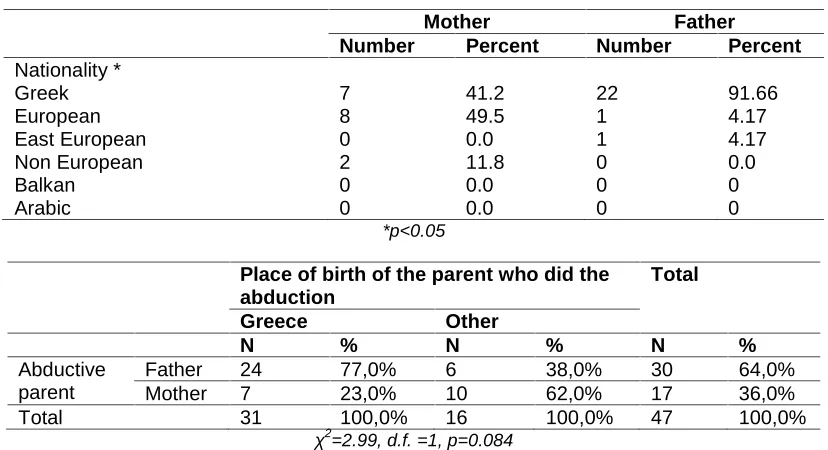
Of the cases that involved relocation of the children, fathers were the abductors in the 63.83% (n=30) of the cases. Only in 10% of the cases the abducted children had been relocated. The relocation of children was to the country of origin of the abductive parent.
The mothers were the abductors in 38.17% (n=17). The vast majority of the fathers who abducted their children were of Greek origin (n=24) (Table 1). The nationality of the abductive mother in 17 cases were more varied with 7 being Greek, 8 being of European origin and 2 of non-European origin.
Table 1. Ethnicity of the parent who did the abduction
Mother Father
Number Percent Number Percent
Nationality *
Greek 7 41.2 22 91.66
European 8 49.5 1 4.17
East European 0 0.0 1 4.17
Non European 2 11.8 0 0.0
Balkan 0 0.0 0 0
Arabic 0 0.0 0 0
*p<0.05
Place of birth of the parent who did the abduction
Total
Greece Other
Ν % Ν % N %
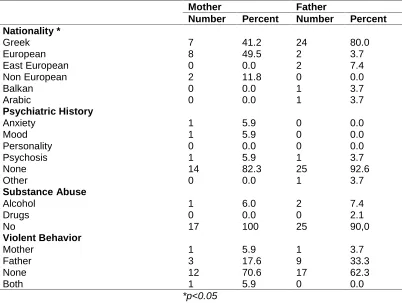
Psychiatric histories: Data from the social services files indicated that there were few individuals with problems; 4.2% of the fathers had received a diagnosis of some mood and anxiety disorders and only a 2.1% had a history of psychosis. For mothers the percentages were slightly higher with 10.7% of them suffering from mood or anxiety disorders, again 2.1% with a history of psychosis and 2.1% a personality disorder. Clinically diagnosed mothers were more likely to abduct their children (17.7% of the abducting mothers compared to 7.4% of the abductive fathers). Moreover, the psychiatric history of the non-abductive parent did not seem to be the reason of abduction by the other parent. In only 9% of the cases the non-abductive parent exhibited psychiatric symptoms. These differences failed to reach the level of significance (Table 2). Our analysis did not reveal any significant relationships between psychiatric history of the parents and abduction. However mothers who exhibited psychopathology (anxiety and mood disorders or psychosis) were more likely to abduct their children.
This finding is in agreement with the impressions of Schetky and Haller (8). Moreover the psychiatric history of the non-abductive parent did not seem to be the reason for the abduction by the other parent. This finding however might be affected by the small sample size.
Table 2. Parental abduction by gender, psychiatric history, substance abuse and violent behavior
Mother Father
Number Percent Number Percent Nationality *
Greek 7 41.2 24 80.0
European 8 49.5 2 3.7
East European 0 0.0 2 7.4
Non European 2 11.8 0 0.0
Balkan 0 0.0 1 3.7
Arabic 0 0.0 1 3.7
Psychiatric History
Anxiety 1 5.9 0 0.0
Mood 1 5.9 0 0.0
Personality 0 0.0 0 0.0
Psychosis 1 5.9 1 3.7
None 14 82.3 25 92.6
Other 0 0.0 1 3.7
Substance Abuse
Alcohol 1 6.0 2 7.4
Drugs 0 0.0 0 2.1
No 17 100 25 90,0
Violent Behavior
Mother 1 5.9 1 3.7
Father 3 17.6 9 33.3
None 12 70.6 17 62.3
Both 1 5.9 0 0.0
*p<0.05
addiction (2.1%). Interestingly, no significant differences were found in substance abuse by the abductor. This could be explained by the very few cases of substance abuse reported in the sample (2 cases reported for abductive fathers compared to only 1 case for abductive mothers). Similarly, substance abuse by the non abductive parent did not affect the possibility of abduction by the other parent.
Similarly, substance abuse by the non abductive parent did not affect the possibility of abduction by the other parent. This finding is in contrast with the findings of Long et al. (1991) who found that 47% of abductive parents proceeded to the abduction in order to protect their child from being raised in an unhealthy environment. The explanation for this discrepancy between the studies should be attributed to the different characteristics of the groups studied.
None of the fathers had a criminal record whilst 6.4% of the mothers had. On the matter of domestic violence in 66% of the cases no signs of domestic violence were reported from the social services, while on 25.5% the father had been violent and in 6.4% χ2(6)=7.4, p=.041 of cases the mother had been violent. In one case (2.1%) both parents were violent. However, only 14.9% of children have had signs of physical abuse. Abductive fathers were significantly more violent (33.3%) than abductive mothers (5.9%), χ2 (6) =7.4, p=.041. Continuing the statistical analysis, again using chi-square test, the relationship between violent behavior and psychopathology was examined. This analysis showed that fathers with no psychiatric symptoms were more violent (91.7%) than fathers with psychiatric symptoms, χ2(9) =18.37, p=.031. This pattern applied to mothers as well. Mothers with no psychiatric history were reported to be more violent (66.7%) than mothers with psychiatric history (33.3%), χ2 (12) =27.43, p=.007.
Finally, the court proceedings on these cases had a mean (in years) 3.6 (SD=2.89). The maximum length reported for these cases to be resolved was 10 years while the minimum was 1. In the majority of the cases the final ruling gave the custody to the mother (48.9%), in 14.9% to the father, shared custody was decided for the 6.4%, other family members took custody of the child in only one case. About twenty seven percent (27.7%) of the studied cases were still pending at the time of the study.
We used logistic regression analysis to predict the gender of the abductive parent by parent’s nationality, psychiatric history, substance abuse, and violent behavior as predictors (Table 3). The logistic regression employed a dichotomous dependent variable which was the gender of the abductive parent, with fathers coded as 1 and mothers coded as 2. The analysis predicted the abductive parent’s gender, male or female, based on parent’s nationality, psychiatric history, substance abuse and violent behavior. Regression diagnostics did not reveal multicollinearity between the predictors. The analysis did not support any of the predictions. The independent variables could not predict the gender of the abductive parent. The hypothesis though cannot be ruled out as limited data on some of the categories affected the power of the analysis.
p=.89. However, violent behavior revealed a significant main effect, F (1, 39) =4.23, p=.046, indicating that the violent behavior of the father decreased the length of the court trial (M=2.33, S.D. =.40) in comparison to the nonviolent father (M=4.02, S.D. =.53). None of the interactions reached the level of significance.
Table 3. Logistic regression results of parental characteristics by gender of the abductive parent
Parental characteristics Total
B Exp (B) Sig.
Psychiatric history of father .327 1.387 (1.284) .799
Substance abuse of father .044 1.045 (1.440) .976
Nationality of father .073 1.076 (.995) .942
Violent behavior of father -1.322 .2661 (.068) .215
Psychiatric history of mother .842 2.322 (1.529) .582
Substance abuse of mother 19.887 4.332 (4.019) 1.000
Nationality of mother .766 2.151 (1.236) .285
Violent behavior of mother -.863 .422 (1.236) .485
Constant .401 1.493 (1.036) .699
Standard errors in parentheses
For mothers results were quite similar. No main effects were obtained; psychiatric history, F(1,39)=.115, p=.74, nationality, F(1,39)=.004, p=.95, substance abuse, F(1,39)=.095, p=.76 and violent behavior, F(1,39)=.657, p=.42. Again, none of the interactions were significant. For either father or mother no main effects or interactions reached a level of significance or revealed a strong tendency.
These findings should be interpreted with caution. The sample, even though representative of the existing study population was small. In some variables the obtained data ended up with few cases in each category, as in the case of substance abuse. Thus, the non significant results could be attributed to a specific factor. Still, the present research first conducted in Greece, and provides the basis for future more thorough investigation of the subject. These findings do have the limitations of a retrospective study with a small sample size and in many cases with very limited available information on psychiatric history however, they are the first available data from cases of abduction in Greece. We hope that this study will generate more research interest in this societal phenomenon.
4. CONCLUSION
It has been established that marriages dissolve much more frequently in recent years than in the past. Various explanations have been suggested. They all hold true for the dissolution of mixed ethnicity marriages that have the additional burden of the cultural and national differences.
research suggesting that violence within the family is not associated with psychiatric diagnosis (Douglas et al., 2009; Fazel et al., 2009).
Psychiatric and child psychiatry literature has little information, to our knowledge, about the short and long term consequences this ordeal can have on a child (Grief, 1992), although some suggestions for assessment and interventions have been made (Long, 1991). This is especially pertinent since international law states that a child should return to its initial country of residence and treaties have been signed between countries to this effect. Further research is urgently needed as well as the establishment of a known and accessible support system for families of mixed marriage going through separation.
Finally the length of court proceedings is alarming. Children might be adolescents by the time the court decides their country of residence. This undoubtedly increases the trauma all family members suffer. One could argue based on this finding that child abduction and the prolonged legal proceedings constitute a form of abuse.
CONSENT
Access to the data was possible after permission was given by the Data Protection Council of Greece and for a limited period of time, under strict conditions
ETHICAL APPROVAL
All authors hereby declare that the research was approved by the appropriate ethics committee and have therefore been performed in accordance with the ethical standards laid down in the 1964 Declaration of Helsinki
COMPETING INTERESTS
Authors have declared that no competing interests exist.
REFERENCES
Agopian, M.W. (1980). Parental child-stealing: Participants in the victimization process. Victimology: An international Journal, 5, 263-273.
Agopian, M.W. (1984). The impact on children of abduction by parents. Child Welfare, 63, 511-519.
Cole, W.A., Bradford, J.M. (1992). Abduction during custody and access disputes. Can J Psychiatry, 37(4).
Douglas, K.S., Guy, L.S., Hart, S.D. (2009). Psychosis as a risk factor for violence to others: a meta-analysis. Psychological Bulletin, 135(5), 679-706.
Fazel, S., Gulati, G., Linsell, L., Geddes, J.R., Grann, M. (2009). Schizophrenia and violence: systematic review and meta-analysis. PLoS Medicine, 6(8), e1000120. Forehand, R. et al. (1989). Child abduction. Parent and child functioning following return.
Greif, G.L., Pabst, M.S. (1988). Mothers without custody. Lexington, MA: Lexington Books. Greif, G.L., Hegar, R.L. (1992). Impact on children of abduction by a parent: A review of the
literature. Amer. J. Orthopsychiat, 62(4), 599-604.
Hegar, R.L, Geoffrey, L.G. (1991). Abduction of children by their parents: A Survey of the problem. Social Work, 36(5), 421-6.
Johnston, J.R. et al. (1999). Developing profiles for parental abduction of children from a comparison of families victimized by abduction with families litigating custody. Behavioral Sciences and the Law, 17(3), 305-22.
Johnston, J.R. (2006). A child centered approach to high conflict and domestic violence families: Differential assessment and Interventions. Journal of Family Studies, 12(1), 15-35.
Long, N., Forehand, R., Zogg, C. (1991). Preventing Parental Child abduction: Analysis of a National Project. Clinical Pediatrics, September.
Shetty, S., Edleson, J. (2005). Adult domestic violence in cases of international parental child abduction. Violence against Women, 11(1), 115-138.