On the Security of TLS Renegotiation
(full version)
∗†
Florian Giesen
1Florian Kohlar
1Douglas Stebila
21 Horst G¨ortz Institute for IT-Security, Ruhr-University Bochum, Bochum, Germany
[email protected],[email protected]
2 Science and Engineering Faculty, Queensland University of Technology, Brisbane, Australia
August 22, 2013
Abstract
The Transport Layer Security (TLS) protocol is the most widely used security protocol on the Internet. It supports negotiation of a wide variety of cryptographic primitives through different cipher suites, various modes of client authentication, and additional features such as renegotiation. Despite its widespread use, only recently has the full TLS protocol been proven secure, and only the core cryptographic protocol with no additional features. These additional features have been the cause of several practical attacks on TLS. In 2009, Ray and Dispensa demonstrated how TLS renegotiation allows an attacker to splice together its own session with that of a victim, resulting in a man-in-the-middle attack on TLS-reliant applications such as HTTP. TLS was subsequently patched with two defence mechanisms for protection against this attack.
We present the first formal treatment of renegotiation in secure channel establishment protocols. We add optional renegotiation to the authenticated and confidential channel establishment model of Jager et al., an adaptation of the Bellare–Rogaway authenticated key exchange model. We describe the attack of Ray and Dispensa on TLS within our model. We show generically that the proposed fixes for TLS offer good protection against renegotiation attacks, and give a simple new countermeasure that provides renegotiation security for TLS even in the face of stronger adversaries.
Keywords: Transport Layer Security (TLS); renegotiation; security models; key exchange
∗The research leading to these results has received funding from the European Community (FP7/2007-2013) under grant agreement number ICT-2007-216646 - European Network of Excellence in Cryptology II (ECRYPT II), the Australian Technology Network–German Academic Exchange Service (ATN-DAAD) Joint Research Co-operation Scheme, and the Australian Research Council (ARC) Discovery Project scheme.
†This is the full version of an extended abstract published in theProceedings of the 20th ACM Conference on Computer and
Contents
1 Introduction 3
1.1 The TLS Renegotiation Issue . . . 4
1.2 Countermeasures Added to TLS . . . 4
1.3 Contributions . . . 5
2 Security Definitions for Multi-Phase and Renegotiable ACCE 7 2.1 Overview . . . 7
2.2 Execution Environment . . . 7
2.3 Security Definitions. . . 10
2.3.1 Confidentiality. . . 11
2.3.2 Secure multi-phase ACCE. . . 11
2.3.3 Secure renegotiable ACCE. . . 12
2.3.4 Weakly secure renegotiable ACCE. . . 12
3 Renegotiation (In)security of TLS 13 3.1 TLS without countermeasures is not a (weakly) secure renegotiable ACCE. . . 13
4 Renegotiation Security of TLS with SCSV/RIE Countermeasures 14 4.1 TLS with SCSV/RIE is not a secure renegotiable ACCE . . . 14
4.2 Tagged-ACCE model and tagged TLS . . . 15
4.2.1 Tagged-ACCE security model . . . 15
4.2.2 Tagged-ACCE-fin security model . . . 15
4.2.3 Tagged TLS. . . 16
4.2.4 Proof of Lemma 1: client . . . 17
4.2.5 Proof of Lemma 1: server . . . 20
4.2.6 Proof of Confidentiality . . . 23
4.3 TLS with SCSV/RIE is multi-phase-secure . . . 25
4.4 TLS with SCSV/RIE is a weakly secure renegotiable ACCE . . . 28
5 Renegotiation Security of TLS with a New Countermeasure 30 6 Conclusion 31 References 32 A Additional Definitions 33 A.1 Matching Conversations . . . 33
A.2 Stateful Length-Hiding Authenticated Encryption (sLHAE) . . . 34
A.3 The PRF-Oracle-Diffie-Hellman Assumption. . . 34
B Protocols without Forward Security 35 B.1 Model . . . 35
B.2 On Renegotiation Security of TLS RSA with SCSV/RIE . . . 36
C TLS DHE DSS WITH 3DES EDE CBC SHA Protocol with Renegotiation Extensions 37
1
Introduction
The Transport Layer Security (TLS) protocol, the successor of the Secure Sockets Layer (SSL) protocol, provides secure channel establishment on the Internet. It is commonly used to protect information sent via the Hypertext Transfer Protocol (HTTP) on the web, and many other application layer protocols such as email and file transfer. TLS consists of ahandshake protocol, used to agree on security parameters, establish a secret key, and authenticate the parties; and arecord layer protocol, used to send encrypted data.
Despite the importance of TLS, progress on formally modelling the security of TLS has been slow. A technicality of TLS prevents it from being proven secure in standard authenticated key exchange (AKE) models: in AKE, the session key must be indistinguishable from a random key of the same length. However, the final handshake message of the TLS protocol is encrypted under the session key, so an adversary can distinguish the session key from a random key by trying to verify the final handshake message. Some analyses [20, 27] have shown that a truncated form of the TLS handshake is AKE-secure. Others [14] deal with a substantially weaker security requirement, namely unauthenticated key agreement. Krawczyk [22] analyzed a variant of the TLS record layer.
Only very recently have analyses of unmodified TLS functionality appeared. Patersonet al.[28] showed that TLS’s MAC-then-encode-then-encrypt record layer when used with CBC encryption (with certain length restrictions) satisfieslength-hiding authenticated encryption (LHAE). Jageret al. [18] gave the first full proof of the security of (one ciphersuite of) unmodified TLS in a strong security model. Jager et al.
introduced a variant of the Bellare–Rogaway authenticated key exchange model, calledauthenticated and confidential channel establishment (ACCE). They proved that the TLS 1.2 protocol using theTLS DHE DSS
WITH 3DES EDE CBC SHAciphersuite (which we shorten toTLS DHE DSS ) is a secure ACCE protocol, under
standard assumptions on the cryptographic components. Ciphersuites based on RSA key transport and static Diffie–Hellman have since been shown ACCE-secure by both Kohlaret al.[21] and Krawczyket al. [24]. (An alternative modular approach to proving the full security of TLS was given by Brzuskaet al.[7].)
But TLS is not just a basic secure channel: it consists of hundreds of variants with many optional complex functionalities. Alert messages report various error conditions. Previous sessions can be resumed with a shortened handshake. As of August 2013, over 300 ciphersuites—combinations of cryptographic primitives— have been standardized. Client authentication is optional, and can be certificate-based or password-based. Various additional options can be specified via extensions and optional fields. Record layer communication can be compressed. And most importantly for this paper, after a TLS handshake has been completed and transmission on the record layer has started, parties can renegotiate the handshake. There have been many attacks on TLS over the years, such Bleichenbacher’s attack [6] and others involving padding, and Ray and Dispensa’s renegotiation attack [29], all of which exploit flaws outside the core cryptographic primitives of TLS.
In this paper, we focus on renegotiation, which allows two parties to either (a) obtain a fresh session key, (b) change cryptographic parameters, or (c) change authentication credentials. For example, if a client needs to authenticate using a client certificate but wishes to not reveal her identity over a public channel, she could first authenticate anonymously (or with pseudonymous credentials), then renegotiate using her real certificate; since the renegotiation messages are transmitted within the existing record layer, the transmission of her certificate is encrypted, and thus she obtains privacy for her identity. We will examine TLS renegotiation in detail, especially in light of previously identified practical attacks related to TLS renegotiation.
Alice Eve Bob (TLS server)
Bob (application)
handshakeEB
record layerEB
m0 m0
handshakeAB
dela
y
ed
b
y
Ev
e
record layerAB
m1 m1 m0km1
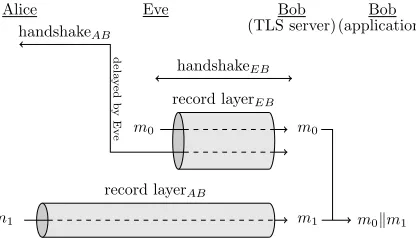
Figure 1: Ray and Dispensa’s man-in-the-middle renegotiation attack on TLS-reliant applications
1.1
The TLS Renegotiation Issue
All versions of TLS [9, 10,11], and SSL v3 [13] before it, support optional renegotiation. After the initial handshake is completed and secure communication begins in the record layer, either party can request renegotiation. The client can request renegotiation by sending a new ClientHellomessage in the current record layer (i.e., encrypted under the current session key); the server can request renegotiation by sending a
HelloRequestmessage in the record layer, which triggers the client to send a newClientHello message. In November 2009, Ray and Dispensa [29] described a man-in-the-middle attack that exploits how certain TLS-reliant applications—such as HTTP over TLS [30]—process data across renegotiations. The attack is shown in Figure1. The attacker Eve observes Alice attempting to establish a TLS session with Bob. Eve delays Alice’s initialClientHelloand instead establishes her own TLS session with Bob and transmits a messagem0 over that record layer. Then Eve passes Alice’s initialClientHello to Bob over the Eve–Bob
record layer. Bob views this as a valid renegotiation and responds accordingly; Eve relays the handshake messages between Alice and Bob, who eventually establish a new record layer to which Eve has no access. Alice then transmits a message m1 over the Alice–Bob record layer.
This is not strictly speaking an attack on TLS but on how some applications process TLS-protected data. It results from some applications, including HTTPS [29] and SMTPS [34], concatenatingm0 andm1and
treating them as coming from the same party in the same context. For example, if Eve sends the HTTP requestm0 and Alice sends the HTTP requestm1, where
m0= “GET /orderPizza?deliverTo=123-Fake-St←
-X-Ignore-This: ”
m1= “GET /orderPizza?deliverTo=456-Real-St←
-Cookie: Account=111A2B”
(where←-denotes new-line character), then the concatenated request (across multiple lines for readability) is
m0km1= “GET /orderPizza?deliverTo=123-Fake-St←
-X-Ignore-This: GET /orderPizza?deliverTo=456-Real-St←
-Cookie: Account=111A2B”
The “X-Ignore-This:” prefix is an invalid HTTP header, and since this header, without a new line character, is concatenated with the first line of Alice’s request, so this line is ignored. However, the following line, Alice’s account cookie, is still processed. Eve is able to have the pizza delivered to herself but paid for by Alice.
It should be noted that Ray and Dispensa’s attack works for both server-only authentication and mutual authentication modes of TLS: the use of client certificates in general does not prevent the attack [29,34].
1.2
Countermeasures Added to TLS
versions 1.0–1.2. Two countermeasures were standardized: theSignalling Ciphersuite Value (SCSV) and the
Renegotiation Information Extension (RIE). These were adopted by major TLS implementation providers and web browsers and servers, including Apache, Apple, Google, Microsoft, Mozilla, and OpenSSL. In RIE, the parties include the key confirmation value from the previous handshake in aClientHello/ServerHello
extension [5], demonstrating they have the same view of the previous handshake, or a distinguished null value if not renegotiation. SCSV is a slight modification that is more compatible with buggy implementations. A diagram showing the message flow for a generic TLS ciphersuite with SCSV/RIE countermeasures appears in Figure5in Appendix D. According to one survey [33], as of July 2013, 82% of TLS-enabled websites support SCSV/RIE, with 9% still supporting insecure renegotiation and 9% not supporting renegotiation.
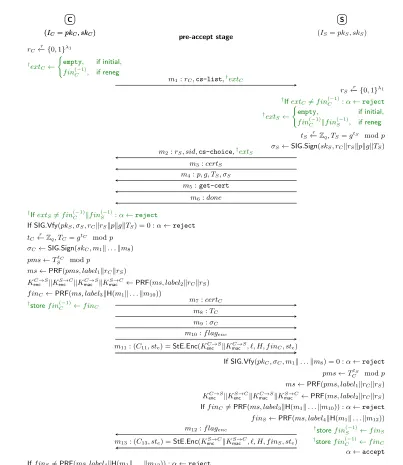
Renegotiation Information Extension (RIE). This countermeasure essentially provides handshake recognition, confirming that when renegotiating both parties have the same view of the previous handshake. With this countermeasure, each client or server always includes a renegotiation information extension in its respectiveClientHello orServerHello message. This extension contains one of three values. If the party is not renegotiating, then it includes a fixed “empty” string which denotes that the party supports and understands the renegotiation extension, and the party is in fact not renegotiating. If the party is renegotiating, then it includes the handshake/key confirmation value from the previous handshake: the client sends the previousclient verify datavalue while the server sends the concatenation of the previous
client verify data andserver verify data values. Intuitively, by including the verify data from the
previous handshake, the parties can be assured that they have the same view of the previous handshake, and thus the attack in Figure1is avoided.
Signalling Ciphersuite Value (SCSV). SCSV was designed to avoid interoperability problems with TLS 1.0 and SSL 3.0 implementations that did not gracefully ignore extension data at the end of ClientHello
andServerHellomessages. With SCSV, the client uses an alternative method in its initial handshake—an
extra, fixed, distinguished ciphersuite value (byte codes 0x00,0xFF) including in its ciphersuite list—to indicate that it knows how to securely renegotiate. Old servers will ignore this extra value; new servers will recognize that the client supports secure renegotiation, and the server will use the RIE in the remainder of the session. In other words, the only difference between SCSV and RIE is in theClientHellomessage of the initial handshake: with RIE, the client sends an empty extension, whereas with SCSV the client sends a distinguished value in the list of supported ciphersuites.
1.3
Contributions
Security model for renegotiable channel establishment protocols. In Section2, we present a new security model for renegotiable protocols. Since our goal is to analyze the security of TLS, we start from the ACCE model, rather than AKE security models. The primary difference in our model for renegotiable protocols is that each party’s oracle (session) can have multiple phases; each new phase corresponds to a renegotiation in that session, and can involve the same or different long-term keys.1 This is qualitatively different than simply having multiple sessions, since short-term values from one phase of a session may be used in the renegotiation for the next phase, whereas multiple sessions only share long-term values. Each oracle maintains state and encryption/MAC keys for each phase. Like in TLS, our formalism allows control messages to be sent on the encrypted channel. Our extension to the ACCE model also models server-only authentication in addition to mutual authentication.
The basic goals of asecure renegotiable ACCE protocol are that (a) the adversary should not be able to read or inject messages on the encrypted channel, and (b) whenever parties successfully renegotiate, they should have exactly the same view of all previous negotiations and all encrypted messages sent in all previous phases of that session, even when values from previous phases have been compromised.
Analysis of TLS without and with SCSV/RIE countermeasures. Based on the TLS renegotiation attack of Ray and Dispensa, we see in Section 3that TLS without countermeasures is not secure in our
model for renegotiation. We subsequently show in Section 4that, generically, TLS with the SCSV/RIE countermeasures of RFC 5746 [31] is aweakly secure renegotiable ACCE protocol. In this slightly weaker—but still quite reasonable—model, the adversary is slightly restricted in the previous secrets she is allowed to reveal.
Our approach for proving the renegotiable security of TLS with SCSV/RIE countermeasures is modular. We cannot generically prove that an ACCE-secure TLS ciphersuite is, with SCSV/RIE, a weakly secure renegotiable ACCE, because the protocol itself is modified by including SCSV/RIE and hence a black-box approach does not work. Instead, we consider tagged TLS where an arbitrary tag can be provided as an extension. Via a chain of results and models, we show that if a tagged TLS ciphersuite is secure in an ACCE variant whereFinishedmessages are revealed, then that TLS ciphersuite with SCSV/RIE is a weakly secure renegotiable ACCE protocol. This provides a generic justification for the security of SCSV/RIE. Proving that TLS ciphersuite secure in this tagged variant model seems to be almost no harder than a proof that it is ACCE-secure; we only needed to change a few lines from the ACCE security proof of TLS DHE DSS [18].
Current formulations of ACCE focus on protocols with forward secrecy. Although ephemeral Diffie– Hellman TLS ciphersuites are not currently as widely used as RSA key transport-based ciphersuites, they are growing in use, for example with Google’s 2011 announcement that their default ciphersuite is ephemeral elliptic curve Diffie–Hellman [25]. We also describe how our approach to renegotiation could be extended if and when ciphersuites without forward secrecy, such as RSA key transport, are shown ACCE-like-secure.
New countermeasure for TLS. TLS with SCSV/RIE cannot meet our strongest notion of renegotiable security, only the weaker notion described above. In the strong definition, even if the adversary learns the session key of one phase, parties who later renegotiate still should detect any earlier message injections by the adversary. Though the ability to learn session keys of phases while the protocol is still running makes the adversary quite powerful, this may be realistic in scenarios with long-lived session keys, for example with session resumption. We present in Section 5a simple adjustment to the renegotiation information extension—adding a fingerprint of the transcript of the previous phase’s record layer—so TLS can achieve this stronger security notion. This countermeasure can be seen as providingrecord layer recognition, confirming that both parties have the same view of all communicated messages, rather than justhandshake recognition
as in the SCSV/RIE countermeasure.
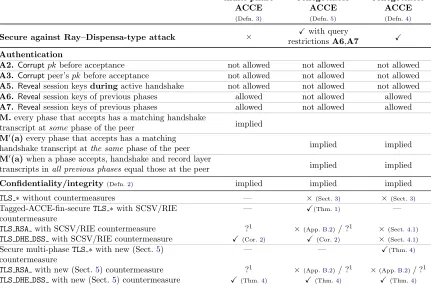
Table 1 summarizes our results on TLS and renegotiation countermeasures. While our theorems are specific to TLS, our definitional framework is suitable for any channel establishment protocol that involves renegotiation, and could for example be used to check if renegotiation in the Secure Shell (SSH) protocol really is secure [26].
On composability and the choice of ACCE. It would be desirable to prove the security of the TLS renegotiation countermeasures via some kind of composability framework, such as universal composability or the game-based composability framework of Brzuskaet al.[7]. Unfortunately, this is not possible with existing security definitions for TLS. The TLS renegotiation countermeasures are not achieved bycomposing
in a black-box manner one protocol or primitive with another. Instead, the SCSV/RIE countermeasure looks inside the protocol and changes it in a white-box way: itmodifies the messages sent by the protocol, and
re-uses an internal value. Thus we cannot make use of existing security results in a black-box compositional way. Our approach is the “next best thing”: we modify an existing security definition (ACCE) in what seems to be a minimal way, adding just enough “hooks” to get at the internal values needed to modify and re-use the required values for the SCSV/RIE countermeasure. We are then able to prove in a fully generic way that any TLS protocol that satisfies this slightly modified ACCE notion with hooks is, when using the SCSV/RIE countermeasure, secure against renegotiation attacks. Since the hooks added are quite small, it is not much work to change a proof that a TLS ciphersuite is ACCE secure to show that it satisfies this slightly modified ACCE notion as well.
Of the two existing definitional approaches for proving the full security of the TLS protocol [18,7], we chose the ACCE approach over the game-based composability approach because renegotiation in TLS makes extensive use of the interplay between the handshake and record layer.
2
Security Definitions for Multi-Phase and Renegotiable ACCE
In this section we describe what a multi-phase authenticated and confidential channel establishment (ACCE) protocol is and our various renegotiation security notions. Essentially, a multi-phase protocol can have many key exchanges—each called aphase—linked to a single session. Our definition builds on the ACCE definition of Jageret al.[18], which combined the Bellare–Rogaway model for authenticated key exchange [2] with a Jageret al.’s stateful variant of Patersonet al.’s length-hiding authenticated encryption [28] , described in detail in AppendixA.2.
Notation. IfSis a set,x←$ Sdenotes sampling a valuexuniformly at random fromS. x← A$ (y) denotes the outputxof the probabilistic algorithmAwhen run on inputy and randomly chosen coins. AO(·) means Ais run with access to oracleO(·). The notation [1, n] denotes the set{1,2, . . . , n};phases[`] denotes the`th entry in the 1-indexed arrayphasesand|phases|denotes the number of entries in the array. πAs.xdenotes variablexstored in oracle instanceπsA.
2.1
Overview
The first security notion, asecure multi-phase ACCE protocol, is a straightforward extension of the ACCE model to allow multiple, independent phases per session; notably, we require essentially no link between phases:
• An adversary breaks (multi-phase) authentication if a party accepts in a phase with uncorrupted long-term keys, but no matching phase exists at the peer.
• An adversary breaksconfidentiality/integrityif it can guess the bitbinvolved in a confidentiality/integrity experiment similar to stateful length-hiding authenticated encryption.
Our main security definition is a secure renegotiable ACCE protocol, which strengthens the authentication notion: parties should successfully renegotiate only when they have exact same view of everything that happened before.
• An adversary breaksrenegotiation authentication if a party accepts in a phase where long-term keys have not been corrupted, but either no matching phase exists at the peeror some previous handshake or record layer transcript does not match.
However, it is not possible to prove that TLS with the SCSV/RIE countermeasures is a secure renegotiable ACCE protocol: as we will see in Section 3, the strong definition requires that the views of parties match when successfully renegotiating, even when previous sessions’ long-term secret keys or session keys were revealed. TLS’s SCSV/RIE countermeasures do not fully protect against the case when these secret values are revealed.
As a result, we introduce the weaker, though still quite reasonable, notion of aweakly secure renegotiable ACCE protocol, and prove in Section3that the SCSV/RIE countermeasure for TLS generically provides it:
• An adversary breaksweak renegotiation authentication if a party accepts in a phase with uncorrupted long-term keysand session keys for each earlier phase were not revealed while that phase was active, but either no matching phase exists at the peer or some previous handshake or record layer transcript does not match.
We proceed by describing the execution environment for adversaries interacting with multi-phase ACCE protocols, then define the various security notions described above.
2.2
Execution Environment
Parties. The environment consists ofnpa parties,{P1, . . . , Pnpa}. Each partyPA is a potential protocol
participant, and has a list ofnke long-term key pairs (pkA,1, skA,1), . . . ,(pkA,nke, skA,nke). We assume that
each party PA is uniquely identified by any one of its public keyspkA,∗. In practice, there may be other
Sessions. Each partyPA can participate in up tonse sessions, which are independent executions of the
protocol and can be concurrent or subsequent; all of a party’s sessions have access to the same list of its long-term key pairs, as well as a trusted list of all parties’ public keys. Each sessions∈[1, nse] is presented
to the environment as an oracleπs
A. Each oracleπ s
A records in a variableπ s
A.dthe oracle corresponding to
the intended communication partner, e.g.πs A.d=π
t
B. As well, the variableρ∈ {Client,Server} records the
role of the oracle. Parties can play the role of the client in some sessions and of the server in other sessions, but their role is fixed across all phases within a session.
Phases. Each session can consist of up to nph phases. Each phase consists of two stages: a pre-accept,
or “handshake”, stage, which is effectively an AKE protocol that establishes a session key and performs mutual or server-only authentication; and apost-accept, or “record layer”, stage, which provides a stateful communication channel with confidentiality and integrity. A list πs
A.phases of different phase states is
maintained; we sometimes use the notationπs,`A forπs
A.phases[`]. There can be at mostnphphases per oracle.
The last entry of πsA.phases contains the state of the current phase, which may still be in progress. Each entryπsA.phases[`] in the log contains:
• pk, the public key used byπs
A in that phase,
• pk0, the public key thatπs
A observed as being used for its peer in that phase2,
• ω∈ {0,1}, denoting the authentication mode used, where 0 indicates that server-only authentication is used in that phase and 1 indicates mutual authentication,
• ∆, a counter used to keep track of the current status of the protocol execution,
• α, eitheraccept,reject, or∅ (for in-progress),
• k, the encryption and/or MAC key(s) established byπAs in that phase,
• T, the transcript of all (plaintext) messages sent and received byπs
A during the pre-accept stage of that
phase,
• RTsandRTr, the transcripts of all ciphertexts sent and received (respectively) in the post-accept phase
byπs
Aencrypted under the key established in that phase,
• b, a random bit sampled by the oracle at the beginning of the phase, and
• st, some additional temporary state (which may, for instance, be used to store ephemeral Diffie–Hellman exponents for the handshake, or state for the sLHAE scheme for the record layer).
The internal state is initialized to d ← ∅, pk ← ∅, pk0 ← ∅, ω ← ∅, ∆ ← 1, α ← ∅, k ← ∅, T ← ∅,
RT ← ∅,b← {$ 0,1}, andst← ∅. When describing a protocol, we will enumerate the protocol messages. The oracles keep track of the protocol execution by setting the counter state equal to the message number that the oracles expect to receive next, and update the counter on each message sent (∆←∆ + 1). Once a phase of a protocol accepts (that is, an encryption key has been negotiated and authentication is believed to hold), then αis set to accept. If the protocol rejects and the oracle wishes to discontinue operation, the counter ∆ can be set to the special symbolreject. Whenever a new handshake initialization message is received, the oracle adds a new entry to itsphases list. The variableω is set at some point during (or before) the protocol execution, depending on the protocol specification (e.g.in case of TLS, the server can send the messageCertificateRequestto request client, i.e. mutual, authentication, otherwise server-only authentication is used). Application data messages sent and received encrypted under a newly established encryption key (e.g. messages sent in the TLS record layer) will be appended to variablesRTsand RTrin
the latest entry of the log. If handshake messages for the renegotiation of a new phase are encrypted under the previous phase’s session key (as they are in TLS), the plaintext messages are appended to variableT in the new entry of the phase log, and ciphertexts are appended toRT in the previous phase.
Remark 1. The introduction of multiple phases is the main difference compared to previous AKE and ACCE models. We need to allow multiple authentications and key exchanges within one oracle to capture the functionality of renegotiation. When limited to a single phase and when each party has only one long-term key pair, our execution environment/security experiment is equivalent to the original ACCE model of Jager et al. [18].
Adversarial interaction. The adversary interacts with oracles by issuing the following queries, which allow her to control (forward/alter/create/drop) all communication on the public channel (Send), learn parties’ long-term secret keys (Corrupt), learn session keys (Reveal), and control sending and receiving of arbitrary messages on the encrypted record layer (Encrypt/Decrypt) using a stateful symmetric encryption schemeStE(AppendixA.2).
• Send(πs
A, m): The adversary can use this query to send any (plaintext) messagem of its choosing
to (the current phase of) oracle πs
A. The oracle will respond according to the protocol specification,
depending on its internal state. Some distinguished control messages have special behaviour:
– m= (newphase, pk, ω) triggers an oracle to initiate renegotiation of a new phase (or new session if first phase). Note that the action here may vary based on the role of the party: for example, when renegotiating in TLS, a client would prepare a newClientHellomessage, encrypt it by calling the Encryptoracle below, and then return the ciphertext to the adversary for delivery; a server would correspondingly prepare an encryptedServerHelloRequestmessage.
– m= (ready, pk, ω) activates a (server) oracle to use the public keypk in its next phase.
For the above control messages, pkindicates the long-term public keypk the oracle should use in the phase andωindicates the authentication mode to use; the oracle returns⊥if it does not hold the secret key forpk. Since the control messages do not specify the identity of the peer, this is instead learned during the run of the protocol: we are using a post-specified peer model [8]. Delivery of encrypted messages in the post-accept stage are handled by the Decryptquery below. For protocols such as TLS that perform renegotiation within the encrypted channel, the oracle may reply with an error symbol⊥
if it has at least one entry in phasesandm6= (newphase,·) or (ready,·).
• Corrupt(PA, pk): Oracleπ1Aresponds with the long-term secret keyskA,i corresponding to public key
pk=pkA,i of partyPA, or⊥if there is noisuch thatpk=pkA,i. This is theweak corruption model,
meaning we do not allow the adversary to obtain the party’s internal state nor register rogue keys.
• Reveal(πAs, `): OracleπAs responds with the key(s)πAs.phases[`].kused in phase `, or∅if no such value exists. Since the TLS record layer is unidirectional, there are both encryption and decryption keys, and for most ciphersuites also MAC keys, so all 4 keys (KencC→S, KencS→C, KmacC→S, KmacS→C) would be revealed,
though one could refine if desired.
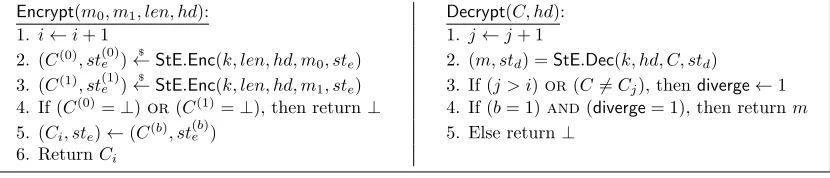
• Encrypt(πs
A, ctype, m0, m1, len, hd): This query takes as input a content typectype, messages m0 and
m1, a length len, and header datahd. Content type controlis used for handshake messages. The
adversary cannot query this oracle withctype=control. Through an abuse of notation, we allow the party itself to call this oracle with controlto encrypt protocol messages that must be sent encrypted; this abuse of notation allows the party to construct encrypted protocol messages while all aspects of the security experiment remain synchronized. Content type datais used for record layer messages; in this case, one of the two messages (chosen based on bitb) is encrypted for the adversary to distinguish.
Encryptdepends on the random bitbsampled byπs
Aat the beginning of the current phase. It maintains
a counteruinitialized to 0 and an encryption stateste, and proceeds as follows:
1. us
A←usA+ 1
2. If (ctype=control)andcaller is notπs
A, then return⊥
3. (C(0), st(0)
e ) $
←StE.Enc(k, len, hd, ctypekm0, ste)
4. (C(1), st(1)
e ) $
←StE.Enc(k, len, hd, ctypekm1, ste)
5. If (C(0)=⊥)
or (C(1)=⊥), then return⊥
6. (Cs
A[usA], ste)←(C(b A s), st(b
s A)
e )
7. ReturnCs A[usA]
• Decrypt(πs
A, C, hd): This query takes as input a ciphertext C and header data hd. If π
s
A has not
accepted in the current phase, then it returns ⊥. Decryptmaintains a counterv and a switchdiverge, both initialized to 0, and a decryption statestd, and proceeds as described below. If the decryption
of C contains a control message, then the oracle processes the message according to the protocol specification, which may include updating the state of the oracle and/or creating a new phase, and returns any protocol response message to the adversary, which may or may not be encrypted by calling
Encrypt according to the protocol specification. Technically it proceeds as follows: 1. (B, t)←πs
2. (ctypekm, std) =StE.Dec(k, hd, C, std)
3. If (vAs > utB)or(C=6 CBt[vsA]), thendiverge←1 4. If (bs
A= 1)and(diverge= 1), thenm0 ←m
5. Ifctype=control, thenr0←protocol response form
6. Elser0 ← ⊥
7. Return (m0, r0)
Remark 2. Note that kmay be a ‘multi-part’ key with different parts for encryption, decryption, and MAC; we assumeStE.EncandStE.Decknow which parts to use. Also note that the ‘protocol response form0 may be encrypted by the party internally making anEncrypt call.
The behaviour of the Decryptoracle in this combined definition for confidentiality and integrity can be somewhat difficult to understand. It extends that of stateful length-hiding authenticated encryption , for which we give the definition and an explanation in Appendix A.2.
Let us review how an adversary would use the oracles to carry out a normal TLS negotiation and renegotiation. First the adversary uses the Send query to deliver newphase and ready messages to the client and server. The client responds to theSendquery with aClientHellomessage; the server responds with⊥. The adversary delivers the first message from the client to the server by calling the server’sSend
oracle, which returns the next message from the server to the client (ServerHello, ServerKeyExchange, etc.). The adversary delivers these to the client via aSend query. The client responds with several plain text messages (such as ClientKeyExchange) as well as a ChangeCipherSpecmessage. There is one more message, the client’sFinishedmessage, which the client first encrypts using an internalEncryptcall. The plaintext messages are delivered by the adversary to the server using Send and the encrypted message is delivered usingDecrypt. The response by the server from Sendwill be a ChangeCipherSpecmessage and the response by the server fromDecryptwill the server’sFinishedmessage, which the server first encrypts using an internalEncrypt oracle call. The encrypted message is delivered by the adversary usingDecrypt. The parties set α=acceptand are now ready to use the record layer, which the adversary can make use of by matchingEncrypt/Decrypt queries. When the adversary wants to trigger client-initiated renegotiation, it sends a newphase message via aSend query to the client, who responds with aClientHello message encrypted via an internalEncryptcall. The adversary delivers this to the server by a Decryptcall; the server responds with an encrypted protocol message, and so on. Note that the plaintext handshake messages are appended to the new phase’s transcriptT and the ciphertext handshake messages are also appended to the current existing phase’s transcriptRT. When the parties accept in the phase, they begin using the encryption keys for the new phase.
2.3
Security Definitions
In the original security definition for ACCE protocols, security is defined by requiring that (i) the protocol is a secure authentication protocol, thus any partyπsA reaches the post-accept state only if there exists another partyπtB such thatπsAhas a matching conversation (in the sense of [18] , reproduced in AppendixA.1) to
πtB, and (ii) data transmitted in the post-accept stage over a secure channel is secure (in a sense similar to sLHAE).
We extend this notion to include security when a session has multiple phases that can be renegotiated. We will give several security definitions with different levels of security against renegotiation attacks, as described in the introduction to Section2.
Each security notion is formally defined as a game played between an adversaryAand a challengerC, with the same overall setup but different winning conditions. In each game, the challenger implements the collection of oracles{πs
A:A∈[1, npa], s∈[1, nse]}. At the beginning of the game, the challenger generates nke long-term key pairs (pkA,1, skA,1), . . . ,(pkA,nke, skA,nke) for each partyPA; we assume that, within a
party, all public key pairs are distinct. (That distinct parties have distinct key pairs comes as a consequence of the protocol being secure.) The adversary receives all parties’ public keys as input. The adversary may issueSend,Corrupt,Reveal,Encrypt, andDecrypt queries to the oracles and eventually terminates.
Definition 1 (Correct multi-phase ACCE). We say Π is a correct multi-phase ACCE protocol if, for all oracles πsA with destination address πAs.d = πtB, and for all `, `0 ∈ [1, nph] for which πAs.phases[`].T andπt
B.phases[`0].T are matching conversations, it holds that π s
A.phases[`].α=π t
B.phases[`0].α=accept,
πs
A.phases[`].ω=π t
B.phases[`].ω andπ s
A.phases[`].k=π t
B.phases[`
0].k.
2.3.1 Confidentiality.
All of our notions for secure ACCE protocols will require confidentiality/integrity of the post-accept stage record layer in each uncorrupted phase. Intuitively, an adversary should not be able to guess the bitb used in theEncrypt/Decryptoracles in a phase where she has not impersonated the parties (i.e., corrupted the long-term secret keys before the phase accepted) or revealed the session key of the party or its peer. As with the ACCE notion of Jageret al. [18], this notion ensures forward security: corrupting long-term secret keys after completion of a session should not impact confidentiality/integrity of messages. (We discuss how these definitions could be extended to the non-forward-secure case in AppendixB.)
Definition 2 (Confidentiality/integrity). Suppose an algorithm A with running time τ interacts with a multi-phase ACCE protocolΠ in the above execution environment and returns a tuple (A, s, `, b0). If
C1. πs
A.phases[`].α=accept; and
C2. A did not queryCorrupt(PA, πAs.phases[`].pk)beforeπ s
A accepted in phase`; and
C3. A did not queryCorrupt(PB, πAs.phases[`].pk0)beforeπsA accepted in phase`, whereπAs.d=πtB; and
C4. A did not queryReveal(πs
A, `); and
C5. Adid not query Reveal(πt
B, `0), whereπtB=πAs.dis πAs’s intended communication partner, and `0 is any phase for whichπt
B.phases[`0].T is a matching conversation toπAs.phases[`].T; and
C6. |Pr [πs
A.phases[`].b=b0]−1/2| ≥,
then we say A(τ, )-breaks confidentiality/integrity of Π.
2.3.2 Secure multi-phase ACCE.
First we state a straightforward extension of the ACCE model to protocols with multiple phases, but with essentially no security condition relating one phase to another. This definition captures the properties of TLS without any renegotiation countermeasures, and will be used as a stepping stone in our generic result in Section4. For this simplest notion of authentication, an adversary should not be able to cause a phase to accept unless there exists a phase at the peer with a matching pre-accept handshake transcript, provided she has not impersonated the parties (i.e., corrupted long-term secret keys before the phase accepted).
Definition 3 (Secure multi-phase ACCE). Suppose an algorithmAwith running time τ interacts with a multi-phase ACCE protocolΠin the above execution environment and terminates. If, with probability at least
, there exists an oracleπs
A withπsA.d=πtB and a phase`such that
A1. πs
A.phases[`].α=accept; and
A2. Adid not queryCorrupt(PA, πAs.phases[`].pk)beforeπAs accepted in phase`; and
A3. Adid not queryCorrupt(PB, πsA.phases[`].pk0) beforeπAs accepted in phase`; and
A4. ifπs
A.phases[`].ω= 0 thenπsA.ρ=Client; and
A5. Adid not queryReveal(πt
B, `0) beforeπAs accepted in phase`for any`0 such thatπBt.phases[`0].T is a matching conversation to πs
A.phases[`].T; and
M. there is no`0 such that πBt.phases[`0].T is a matching conversation toπAs.phases[`].T
then we say thatA(τ, )-breaks authentication of Π.
A protocol Πis a (τ, )-secure multi-phase ACCE protocol if there exists no algorithmAthat(τ, )-breaks confidentiality/integrity (Def.2) or authentication (as above) ofΠ.
The secure multi-phase ACCE definition when limited to a phase per session and a single key pair per party (nph=nke= 1) collapses to an extension of the original ACCE definition, the extension being support
for server-only authentication.
2.3.3 Secure renegotiable ACCE.
We next strengthen the authentication notion to include renegotiation. Intuitively, an adversary should not be able to cause a phase to accept unless there exists a phase at the peer with a matching pre-accept handshake transcript and all previous phases’ handshake and record layer transcripts match, provided she has not impersonated the parties in the current phase. We will show in Section5that TLS with our proposed countermeasure satisfies this definition.
Definition 4 (Secure renegotiable ACCE). Suppose an algorithmA with running timeτ interacts with a multi-phase ACCE protocolΠin the above execution environment and terminates. If, with probability at least
, there exists an oracleπs A withπ
s A.d=π
t
B and a phase`
∗ such that
A1–A5 as in Definition3with `∗, and either
M0(a) πt
B.phases[`∗].T is not a matching conversation to π s
A.phases[`∗].T or
M0(b) for some` < `∗,πs
A.phases[`].TkRTskRTr6=πtB.phases[`].TkRTrkRTs; we say A(τ, )-breaks renegotiation authentication of Π.
A protocol Πis a (τ, )-secure renegotiable ACCE protocolif there exists no algorithmAthat(τ, )-breaks confidentiality/integrity (Def.2) or renegotiation authentication (as defined above) ofΠ.
2.3.4 Weakly secure renegotiable ACCE.
Unfortunately, TLS with SCSV/RIE does not meet Def.4because, as we will see in Section 4.1, revealing session keys in earlier phases allows the adversary to change the messages on the record layer in earlier phases, but SCSV/RIE will not detect this.
Of course, revealing earlier phases’ session keys while that phase is active and still expecting detection when renegotiating later is a strong security property, and the lack of this property does not imply an attack in most scenarios. Our desire to characterize the renegotiable security of the SCSV/RIE countermeasure motivates a slightly weaker renegotiation notion: when previous phases’ session keys are not revealed while that phase is active and the current phase’s long-term secret keys are not corrupted, no adversary should be able to cause a phase to accept unless there exists a phase at the peer with a matching pre-accept handshake transcript and all previous phases’ handshake and record layer transcripts match.
Definition 5 (Weakly secure renegotiable ACCE). Suppose an algorithmAwith running time τ interacts with a multi-phase ACCE protocol Πin the above execution environment and terminates. If, with probability at least, there exists an oracleπs
A withπsA.d=πBt and a phase`∗ such that all conditions from Def. 4, as well as the following additional conditions are satisfied:
A6. Adid not issue a Reveal(πs
A, `)query before πsA accepted in phase`+ 1, for every` < `∗, and
A7. Adid not issue a Reveal(πt
B, `)query before πAs accepted in phase`+ 1, for every` < `∗; then we say thatA(τ, )-breaks weak renegotiation authentication of Π.
A protocol Π is a (τ, )-weakly secure renegotiable ACCE protocolif there exists no algorithm Athat
(τ, )breaks confidentiality/integrity (Def. 2) or weak renegotiation authentication (as defined above) ofΠ.
Remark 3. While conditions A6and A7prohibit the adversary from revealing encryption keys of previous phases while active for the purposes of breaking authentication, the confidentiality/integrity aspect of Def.5 still places no such restriction on previous encryption keys being revealed.
Remark 4. The chain of implications between Defns.3–5is as follows: secure renegotiable ACCE protocol (Defn. 4) =⇒ weakly secure renegotiable ACCE (Defn.5) =⇒ secure multi-phase ACCE (Defn.3) =⇒
Secure multi-phase
ACCE
Weakly secure renegotiable
ACCE
Secure renegotiable
ACCE
(Defn.3) (Defn.5) (Defn.4)
Secure against Ray–Dispensa-type attack × Xwith query
restrictionsA6,A7 X
Authentication
A2. Corruptpkbefore acceptance not allowed not allowed not allowed
A3. Corruptpeer’spkbefore acceptance not allowed not allowed not allowed
A5. Revealsession keysduringactive handshake not allowed not allowed not allowed
A6. Revealsession keys of previous phases allowed not allowed allowed
A7. Revealsession keys of previous phases allowed not allowed allowed
M.every phase that accepts has a matching handshake
transcript atsomephase of the peer implied
M0(a)every phase that accepts has a matching
handshake transcript atthe samephase of the peer implied implied
M0(a)when a phase accepts, handshake and record layer
transcripts inall previous phasesequal those at the peer implied implied
Confidentiality/integrity(Defn.2) implied implied implied
TLS∗without countermeasures — ×(Sect.3) ×(Sect.3) Tagged-ACCE-fin-secureTLS∗with SCSV/RIE
countermeasure
— X(Thm.1) —
TLS RSA with SCSV/RIE countermeasure ?1 ×(App.B.2)/ ?1 ×(Sect.4.1) TLS DHE DSS with SCSV/RIE countermeasure X(Cor.2) X(Cor.2) ×(Sect.4.1) Secure multi-phaseTLS∗with new (Sect.5)
countermeasure
— — X(Thm.4)
TLS RSA with new (Sect.5) countermeasure ?1 ×
(App.B.2)/ ?1 ×(App.B.2)/ ?1 TLS DHE DSS with new (Sect.5) countermeasure X(Thm.4) X(Thm.4) X(Thm.4)
Table 1: Summary of security notions and results on TLS
1
TLS RSA key transport ciphersuites may be able to be shown secure under notions with suitable restrictions on forward security; see discussion in AppendixB.
3
Renegotiation (In)security of TLS
We now discuss how the original TLS protocol, without SCSV/RIE countermeasures, fits into our model, and show how the attack of Ray and Dispensa is captured in the model.
Jageret al.[18] in their full version [19, Fig. 3] described how to map TLS into the ACCE model. We highlight a few components of that mapping, and the alterations needed for renegotiation.
Oracles generally respond toSend,Encrypt, and Decryptqueries as specified by the TLS handshake and record layer protocols. TheSendcontrol message m= (newphase, pk) when sent to a client causes the client to send a newClientHellomessage, and when sent to a server causes the server to send a newHelloRequest
message. For theEncrypt andDecrypt queries, we use a content type field ctype that corresponds to the
ContentTypefield of theTLSPlaintext data type in the TLS record layer specification [11,§6.2.1]:
Packets withContentType=change cipher spec (20)orhandshake (22)are considered in our model to have ctype =control and packets with ContentType=application data (23)are considered in our model to havectype=data. We do not explicitly handleContentType=alert (21)messages. TheReveal
query reveals the encryption and MAC keys derived from the master secret key,not the master secret key itself.
3.1
TLS without countermeasures is not a (weakly) secure renegotiable ACCE
that record layer. Then Eve passes Alice’s initialClientHello to Bob over the Eve–Bob record layer. Bob views this as a valid renegotiation and responds accordingly; Eve relays the handshake messages between Alice and Bob, who will eventually establish a new record layer to which Eve has no access. Alice then transmits a messagem1 over the Alice–Bob record layer. Intuitively, this is a valid attack: Alice believes this
is the initial handshake, but Bob believes this is a renegotiated handshake.
Formally, this attack is captured in our weakly secure renegotiable ACCE model of Definition 5as follows. Assume Alice and Bob each have a single oracle instance, and Eve has carried out the above attack. Then for Bob’s oracleπ1
Bob, the value of`∗ is 2: the last entry inphaseswhere Bob has a matching handshake
transcript to some handshake transcript in Alice’s oracleπ1
Alice is the second (and last)phasesentry. The
attacker has broken renegotiation authentication at both Alice and Bob’s instances. At Alice by satisfying conditionM0(a)(Alice’s first handshake transcript does not match Bob’s first handshake transcript), and at Bob by satisfying bothM0(a)(Bob’s second handshake transcript does not match Alice’s second handshake transcript) andM0(b)(for every` <2, Bob’s `th handshakes/record layer transcripts do not match Alice’s). Thus TLS without countermeasures is not a weakly secure or secure renegotiable ACCE.
4
Renegotiation Security of TLS with SCSV/RIE
Countermea-sures
In this section we analyze the security of TLS with the SCSV/RIE countermeasures proposed in RFC 5746 [31]. We first see, in Section 4.1, that the SCSV/RIE countermeasures are not enough to prove that TLS satisfies our strongest notion, a secure renegotiable ACCE (Defn.4).
Our goal will be to show that TLS with the SCSV/RIE countermeasures is a weakly secure renegotiable ACCE. Ideally, we would do so generically, with a result saying something like “If a TLS ciphersuite is a secure ACCE, then that TLS ciphersuite with SCSV/RIE is a weakly secure renegotiable ACCE.” As noted in the introduction, we do so generically since the protocol ismodified to include the countermeasure values in theClientHelloandServerHello messages, and thus we cannot make use of the ACCE security of the particular TLS ciphersuite in a black-box way. Moreover, we must ensure that revealing theFinishedvalues from the previous handshake does not impact its security. Although these barriers prevent a generic black-box result, a white-box examination of the proof details of TLS DHE DSS [18] finds that only small changes are needed in the proof.
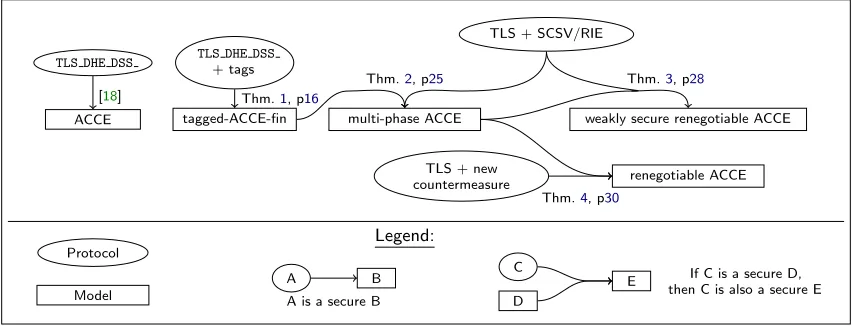
We will provide a sequence of definitions and results that justifies the security of the SCSV/RIE countermeasure. Figure2 summarizes our approach.
1. Define a modified ACCE security model, calledtagged-ACCE-fin, specific to TLS, in which the adversary can revealFinishedmessages after the handshake completes and supply tags to be used in extensions. 2. Definetagged TLS as a modification of a standard ciphersuite in which arbitrary opaque data can be
placed in an extension field in the ClientHelloandServerHellomessages.
3. Explain how the existing proof of thatTLS DHE DSS is ACCE secure can be modified in a very minor way to show that taggedTLS DHE DSS is tagged-ACCE-fin-secure. For completeness, we give a full proof of this fact in the appendix.
4. Show that, if a TLS ciphersuite is tagged-ACCE-fin secure, then that TLS ciphersuite with SCSV/RIE is a secure multi-phase ACCE.
5. Show that, if a TLS ciphersuite with SCSV/RIE is a secure multi-phase ACCE, then it is also a weakly secure renegotiable ACCE.
Combined, these results yield (a) a general result justifying the security of the SCSV/RIE countermeasure, and (b) thatTLS DHE DSS with SCSV/RIE countermeasures is a weakly secure renegotiable ACCE.
4.1
TLS with SCSV/RIE is not a secure renegotiable ACCE
TLS DHE DSS
ACCE [18]
TLS DHE DSS
+ tags
tagged-ACCE-fin Thm.1, p16
multi-phase ACCE
TLS + SCSV/RIE
Thm.2, p25
weakly secure renegotiable ACCE Thm.3, p28
TLS + new
countermeasure renegotiable ACCE Thm.4, p30
Legend:
Protocol
Model
A B
A is a secure B
C
D
E If C is a secure D, then C is also a secure E
Figure 2: Summary of results on TLS and renegotiation
modify record layer messages but Alice and Bob will still successfully renegotiate a new phase (although the adversary must not alter the number of messages sent, as thenumber of record layer messages sent in the previous phase happens to be protected by SCSV and RIE countermeasures).
We emphasize that while this demonstrates a theoretical weakness in TLS renegotiation countermeasures compared to our very strong security model, it does not translate into an attack on TLS renegotiation countermeasures when intermediate phases’ encryption and MAC keys are not revealed. SCSV/RIE meets its original goal of authenticating the previous handshake.
4.2
Tagged-ACCE model and tagged TLS
In this section we introduce a variant of the ACCE model from which we can prove a generic result on the renegotiable security of TLS with countermeasures. In our models, the tag can be an arbitrary string. For our purpose of analyzing TLS with SCSV/RIE countermeasures, the tag will be the previous phase’sFinished
messages.
4.2.1 Tagged-ACCE security model
The tagged-ACCE security model is an extension of the ACCE security model to allow arbitrary tags as follows. Since the original ACCE definition of Jageret al.[18] does not support server-only authentication, while our definition allows both authentication modes, we extend the ACCE definition implied by limiting multi-phase ACCE (Definition3) to a single phase (nph= 1) and at most one public key per party (nke= 1).
The phases log phasesis extended with an additional per-phase variabletag.
• Send(πs
A, m). The adversary can specify an arbitrary tag during session initialization.
– Ifm= (newphase, ω, tag), the party sets its internal variableρ←Client, sets authentication mode
ω, storestag, and responds with the first protocol message.
– Ifm= (ready, ω, tag), the party setsρ←Server, authentication modeω, storestag, and responds with the next protocol message, if any.
The freshness and winning conditions of tagged-ACCE are unchanged from ACCE.
4.2.2 Tagged-ACCE-fin security model
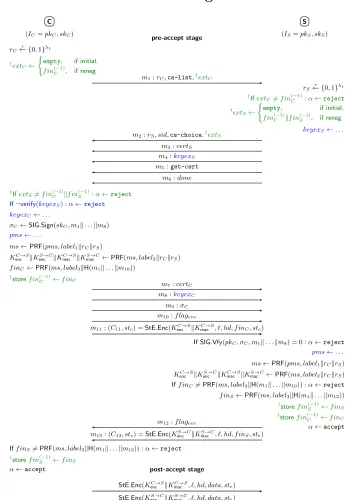
We will work with a further variant,tagged-ACCE-fin, which is not a fully general security model but instead is tied specifically to generic TLS protocols of the form given in Figure5. It adds the following query:
• RevealFin(πs
A): If α= accept, then return thef inC and f inS values sent/received by the queried
• Encrypt(πAs, ctype, m0, m1, len, hd): The adversary is not prevented from querying with ctype = control.
• Decrypt(πs
A, C, hd): No semantic meaning is associated withctype=controlmessages. In other words,
line 5 ofDecryptis removed.
We extend the Encrypt- and Decrypt-queries to allow the adversary to send and receive messages on the encrypted channel with content typecontrol. The freshness and winning conditions of tagged-ACCE-fin are as in ACCE.
Remark 5. Revealing theFinishedmessages is very specific to the TLS protocol family and is not necessarily relevant for other protocols. Imagine, for example, a variant of the SCSV/RIE countermeasure where a separate hash of the complete transcript as it was sent over the channel is used as an authenticator. Since this value can be computed by any passive adversary, leaking this value could not affect security.
4.2.3 Tagged TLS
Figure5shows a generic TLS ciphersuite, along with the SCSV/RIE extensions denoted in green with a dagger. Bytagged TLS, we mean the generic TLS ciphersuite from Figure5, without any of the SCSV/RIE extensions shown in green, but where an arbitrary string can be placed in theextC andextS fields. In other
words, it is a normal TLS ciphersuite, but with an arbitrary extension field that just carries strings that are not being interpreted as having any particular meaning.
As noted in the beginning of this section, we cannot generically prove that, if a TLS ciphersuite is ACCE-secure, then the tagged version of that ciphersuite is tagged-ACCE- or tagged-ACCE-fin-secure, as we have made white-box modifications to the TLS protocol in introducing the SCSV/RIE countermeasure. Thus we cannot use its security results in a black-box manner. However, in most cases, a white-box approach, where the actual security proof is modified or extended, should be possible, and even very easy. This was indeed the case when we examined taggedTLS DHE DSS.
For completeness, we will show thatTLS DHE DSS is a secure tagged-ACCE-fin protocol. The proof follows almost exactly the proof by Jager et al.[18] that TLS DHE DSS is a secure ACCE protocol. The intuition that leaking theFinishedmessages does not affect security is as follows. The ACCE proof ofTLS DHE DSS
exploits the fact that the pseudo-random function is keyed with a value chosen uniformly at random; the proof then replaces the application keys andFinishedmessages with uniformly random values, which are then completely independent of any information exchanged during the handshake. We can use the same technique to show that no adversary having access to the plaintextFinishedmessages can break the security of the sLHAE scheme used in the record layer. Including arbitrary extra data in the handshake messages does not impact security.
Theorem 1 (TaggedTLS DHE DSS is a secure tagged-ACCE-fin). Letµ be the output length ofPRFand let
λbe the length of the noncesrC and rS. Assume that the pseudo-random function PRFis (τ, prf)-secure, the
signature scheme is(τ, sig)-secure, theDDH-problem is(τ, ddh)-hard in the groupGused to compute the TLS
premaster secret, the hash function is (τ, H)-collision resistant, and thePRFODH-problem is (τ, prfodh)-hard
with respect toGandPRF. Suppose that the stateful symmetric encryption scheme is(τ, sLHAE)-secure.
For any adversary that (τ0, tls)-breaks the tagged TLS DHE DSS in the sense of Definition3in the tACCE
execution environment withτ≈τ0 it holds that
tls≤
(npanse)2
2λ−2 +npanse·
4npasig+ 3ddh+ (npanse+ 2)
PRFODH+prf+H+
1
2µ +sLHAE
Recall that npa andnse are the maximum number of parties and sessions per party; in tagged-ACCE-fin, the
number of phasesnph and number of keypairsnke are both at most1.
To prove Theorem1, we closely follow the approach of Jageret al.[19] and divide the set of all adversaries into two categories:
1. Adversaries that succeed in making an oracle accept maliciously. We call such an adversary an
authentication-adversary.
Note that our proof proceeds exactly as the proof of Jageret al. to enable comparison, thus we also prove Theorem1 by two lemmas. Lemma1 bounds the probabilityauth that an authentication-adversary succeeds,
Lemma2 bounds the probabilityencthat an encryption-adversary succeeds. Then we have
tls≤auth+enc .
Lemma 1. For any adversary running in time τ0 ≈τ, the probability that there exists an oracle πs i that accepts maliciously is at most
auth≤
(npanse)2
2λ−1 +npanse·
2npasig+ddh+ (npanse+ 2)
PRFODH+prf+H+
1
2µ +sLHAE
where all quantities are defined as stated in Theorem1.
Note that auth≤client+server, whereclient is an upper bound on the probability that there exists an
oracle withρ=Clientthat accepts maliciously in the sense of Definition3, and server is an upper bound on
the probability that there exists an oracle withρ=Serverthat accepts maliciously. Also note that asServer
is an upper bound, this implicitly covers the case of performing server-only authentication in all phases (and by definition no server oracle can then accept maliciously, resulting inServer= 0).
We claim that
client≤
(npanse)2
2λ +npanse·
npasig+npanse
PRFODH+prf+H+
1
2µ +sLHAE
server≤
(npanse)2
2λ +npanse·
npasig+ddh+ 2prf+H+
1
2µ +sLHAE
and thus
auth≤client+server
≤(npanse) 2
2λ−1 +npanse·
2npasig+ddh+ (npanse+ 2)
PRFODH+prf+H+
1
2µ +sLHAE
.
4.2.4 Proof of Lemma1: client
Proof. We first show, that the probability that there exists an oracle withρ=Clientthat accepts maliciously in the sense of Definition3is negligible. The proof proceeds in asequence of games, following [3,32]. The first game is the real security experiment. We then describe several intermediate games that modify the original game step-by-step, and argue that our complexity assumptions imply that each game is computationally indistinguishable from the previous one. We end up in the final game, where no adversary can break the security of the protocol.
Let break(1)δ be the event that occurs when the first oracle that accepts maliciously in the sense of Definition3withρ=Clientin Gameδ.
Game 0. This game equals the multi-phase ACCE security experiment used in Section2.2. Thus, for some
client we have
Pr[break(1)0 ] =client .
Game 1. In this game we add an abort rule. The challenger aborts if there exists any oracle πsi that chooses a random noncerC orrS which is not unique. More precisely, the game is aborted if the adversary
ever makes a firstSendquery to an oracle πis, and the oracle replies with random noncerC or rS such that
there exists some other oracleπs0
i0 which has previously sampled the same nonce.
In total less thannpanse noncesrC andrS are sampled, each uniformly random from{0,1}λ. Thus, the
probability that a collision occurs is bounded by (npanse)2·2−λ, which implies
Pr[break(2)0 ]≤Pr[break(2)1 ] +(npanse)
2
2λ .
Note that now each oracle has a unique noncerC orrS, which is included in the signatures. We will use this
Game 2. We try to guess which client oracle will be the first oracle to accept maliciously and the phase in which this happens. If our guess is wrong, i.e., if there is another (Client orServer) oracle that accepts before or if they accept in a different phase, then we abort the game.
Technically, this game is identical, except for the following. The challenger guesses two random indices (i∗, s∗)←$ [npa]×[nse]. If there exists an oracleπisthat accepts maliciously, and (i, s)6= (i∗, s∗) and πishas
ρ6=Client, then the challenger aborts the game. Note that if the first oracleπs
i that accepts maliciously has
ρ=Client, then with probability 1/(npa·nse) we have (i, s) = (i∗, s∗), and thus
Pr[break(2)1 ] =npanse·Pr[break (2) 2 ] .
Note that in this game the attacker can only break the security of the protocol if oracleπs∗
i∗ is the first oracle
that accepts maliciously and hasρ=Client; otherwise the game is aborted.
Game 3. Again the challenger proceeds as before, but we add an abort rule. We want to make sure that
πs∗
i∗ receives as input exactly the Diffie–Hellman valueTS that was selected by some other uncorrupted oracle
that received the noncerC chosen byπs
∗
i∗ as first input (note that there may be several such oracles, since
the attacker may send copies ofrC to many oracles).
Technically, we abort and raise event abortsig, if oracleπs
∗
i∗ ever receives as input a messagem3=certS
indicating intended partner Π =j and messagem4 = (p, g, TS, σS) such that σS is a valid signature over
rCkrSkpkgkTS, but there exists no oracleπjtwhich has previously outputσS. Clearly we have
P r[break(1)2 ]≤Pr[break(1)3 ] + Pr[abortsig] .
Note that the experiment is aborted, ifπsi∗∗ does not acceptmaliciously, due to Game 2. This means that
partyPj must not be corrupted whenπs
∗
i∗ accepts (as otherwiseπs ∗
i∗ does not acceptmaliciously). To show
that Pr[abortsig]≤npa·sig, we construct a signature forger as follows. The forger receives as input a public
key pk∗ and simulates the challenger forA. It guesses index φ←$ [npa], setspkφ=pk∗, and generates all
long-term public/secret keys as before. Then it proceeds as the challenger in Game3, except that it uses its chosen-message oracle to generate a signature underpkφwhen necessary.
Ifφ=j and the corresponding public key ispkj, which happens with probability 1/(npa), then the forger
can use the signature received byπis∗∗ to break the EUF-CMA security of the signature scheme with success
probabilitysig. Therefore we gain that Pr[abortsig]/(npa)≤sig; if Pr[abortsig] is not negligible, thensig is
not negligible as well and we have
P r[break(1)2 ]≤Pr[break(1)3 ] +npasig .
Note that in Game 3oracleπs∗
i∗ receives as input a Diffie–Hellman valueTS such thatTS was chosen by
another oracle, but not by the attacker. Note also that there may be multiple oracles that issued a signature
σS containingrC, since the attacker may have sent several copies ofrC to several oracles.
Game 4. In this game we want to make sure that we know the oracle πt
j which will issue the signature
σS that πs
∗
i∗ receives. Note that this signature includes the random nonce rS, which is unique due to
Game 1. Therefore the challanger in this game proceeds as before, but additionally guesses two indices (j∗, t∗)←$ [npa]×[nse]. It aborts, if the attacker doesnot make aSend-query containingrC toπt
∗
j∗ andπt ∗
j∗
responds in this phase with messages containingσS such that σS is forwarded toπs
∗
i∗.
We know that there must exist at least one oracle that outputsσS in some phase such thatσS is forwarded
toπs∗
i∗, due to Game3. Thus we have
Pr[break(1)3 ]≤npansePr[break (1) 4 ] .
Note that in this game we know exactly that oracleπt∗
j∗ chooses the Diffie–Hellman shareTS thatπs
∗
i∗ uses to
Game 5. Recall thatπis∗∗ computes the master secret asms=PRF(TStc, label1krCkrS), whereTS denotes
the Diffie–Hellman share received fromπjt∗∗, andtcdenotes the Diffie–Hellman exponent chosen byπs
∗
i∗. In this
game we replace the master secretmscomputed byπs∗
i∗ with an independent random valuemsf. Moreover, if πt∗
j∗ receives as input the same Diffie–Hellman shareTC that was sent fromπs
∗
i∗, then we set the master secret
ofπt∗
j∗ equal tomsf. Otherwise we compute the master secret as specified in the protocol. We claim that
P r[break(1)4 ]≤Pr[break(1)5 ] +PRFODH .
Suppose there exists an adversaryAthat distinguishes Game5 from Game4. We show that this implies an adversaryBthat solves thePRFODHproblem.
Adversary B outputs (label1krCkrS) to its oracle and receives in response (g, gu, gv, R), where either
R=PRF(guv, label1krCkrS) or R $
← {0,1}µ. It runsAby implementing the challenger forA, and embeds
(gu, gv) as follows. Instead of lettingπs∗
i∗ chooseTC =gtC for randomtC $
←Zq,BdefinesTC:=gu. Similarly,
the Diffie–Hellman shareTS ofπt
∗
j∗ is defined asTS :=gv. Finally, the master secret ofπs
∗
i∗ is set equal toR.
Note that πs∗
i∗ computes the master secret after receivingTS fromπt
∗
j∗, and then it sendsm8 =TC. If
the attacker decides to forwardm8 toπt ∗
j∗, then the master secret of πt ∗
j∗ is set equal toR. If πt ∗
j∗ receives TC0 6=TC, thenBqueries its oracle to computems0=PRF(TCv0, label1krCkrS), and sets the master secret of
πt∗
j∗ equal toms0.
Note that in any case algorithmB knows the master secret ofπis∗∗ and πt ∗
j∗, and thus is able to compute
all further protocol messages (in particular the finished messages finC andfinS) and answer a potential
Reveal-query toπjt∗∗ as required (note that there is noReveal-query toπs ∗
i∗, as otherwise the experiment is
aborted, due to Game2). IfR=PRF(guv, label
1krCkrS), then the view ofAis identical to Game4, while if
R← {$ 0,1}µ then it is identical to Game5, which yields the above claim.
Game 6. In this game we replace the functionPRF(ms,f ·) used byπs∗
i∗ with a random functionF. Ifπt ∗
j∗
uses the same master secretmsf asπs∗
i∗ (cf. Game5), then the functionPRF(ms,f ·) used byπt ∗
j∗ is replaced as
well. Of course the same random function is used for both oracles sharing the samemsf. In particular, this function is used to compute theFinishedmessages by both partner oracles.
Distinguishing Game6from Game 5implies an algorithm breaking the security of the pseudorandom functionPRF, thus
Pr[break(1)5 ]≤Pr[break(1)6 ] +prf .
Game 7. In Game6we have replaced the functionPRF(ms,f ·) with a random function. We now want to make sure, that the ServerFinishedmessage still cannot be predicted by an attacker. Remember that the ServerFinishedis computed as
fin∗C=F(label4||H(m1|| · · · ||m12)),
where m1|| · · · ||m12denotes the transcript of all messages sent and received by πs ∗
i∗.
Before we can do so, we need to make sure that the only other oracle potentially having access to F, which isπt∗
j∗, never evaluates the functionF on any inputlabel4||H(m0) with m06=m1|| · · · ||m12 and H(m0) =H(m1|| · · · ||m12).
We now abort the game, if oracleπtj∗∗ ever evaluates the conditions hold. Since that directly implies a
collision for the hash functionH, we have