_____________________________________________________________________________________________________ *Corresponding author: E-mail: [email protected], [email protected];
www.sciencedomain.org
Effect of Depressive Mood on NK Cells in Patients
with Pancreatic Tumor – Pilot Study
Jindřich Kopecký
1*, Ladislav Slováček
1, Birgita Slováčková
2,
Zuzana Šinkorová
3, Jiří Knížek
4, Stanislav Filip
1,
Petronela Trojanová
1, Ondřej Kubeček
1and Otakar Kopecký
51
Department of Oncology and Radiotherapy, Charles University in Prague, Medical Faculty and University Hospital in Hradec Králové, Czech Republic. 2Department of Psychiatry, Charles University in Prague, Medical Faculty and University Hospital in
Hradec Králové, Czech Republic. 3
Department of Radiobiology, University of Defance, Brno, Faculty of Military Medicine in Hradec Králové, Czech Republic. 4Department of Medical Biophysic, Charles University in Prague, Medical Faculty and University
Hospital in Hradec Králové, Czech Republic. 5
Department of Clinical Immunology and Microbiology, Regional Hospital Náchod, Czech Republic.
Authors’ contributions
This work was carried out in collaboration between all authors. Authors Jindrich Kopecky, LS and Otakar Kopecky designed the study. Authors PT, Ondrej Kubecek, SF, ZS and Jindrich Kopecky managed the literature searches and collected data. Author BS performed psychiatric examination. Author Jiri Knizek performed statistical analysis. Author Jindrich Kopecky wrote the first draft of the manuscript and performed critical reviews of the Manuscript. All authors read and approved the final manuscript.
Article Information
DOI: 10.9734/BJMMR/2016/25200 Editor(s): (1)E. Umit Bagriacik, Department of Immunology, Gazi University, Turkey.
Reviewers: (1) Samuel Victor Nuvor, University of Cape Coast, Ghana. (2)Vlachaki Efthymia, Aristotle University, Thessaloniki, Greece. Complete Peer review History:http://sciencedomain.org/review-history/14004
Received 23rd February 2016 Accepted 24th March 2016 Published 5th April 2016
ABSTRACT
Aims: In up to 50% of cases is pancreatic cancer accompanied with depressive symptoms or already developed depression. There is well described connection between pancreatic cancer and qualitative changes in immune system. The purpose of this pilot study was to observe the quantitative changes in levels of NK cells and the state of expression of activation and inhibitory
receptors on the surface of NK cells in the peripheral blood of patients with pancreatic tumor. Study Design: This is prospective analytical study.
Place and Duration of Study: The study was carried out between December 2010 and April 2011 at the University Hospital Hradec Králové, Czech Republic.
Methodology: Twenty-one patients with locally advanced or metastatic adenocarcinoma of the pancreas were divided into two groups based on the presence of depressive symptoms. The control group consisted of healthy volunteers. The presence of depressive symptoms was assessed by the Zung self-rating depression and psychiatric examination. Measurement and analysis of peripheral venous blood was performed by flow cytometry to estimate quantitative changes in NK cells. The statistical significance was considered as p < .05.
Results: There was reduced number of CD56brightCD16- subset (P = .01), decreased levels of NKp46 positive NK cells in patients with pancreatic cancer and depressive symptoms (P = .03), but without statistical significant for patient without depression (P = .054). We found decreased number of NKG2A-positive circulating NK cells in patients without depressive symptoms in comparison to control group (P = .05). No differences in NK cells, its subsets and receptors were observed when comparing each group of patients with each other.
Conclusion: The main immunomodulating factor in the case of NK cells in pancreatic cancer is the tumor itself. This is valid particularly for reduced levels of NK cell activation receptors. The presence of chronic stress or depression plays its role in affecting the number and distribution of NK cells and might play an important role in tumor escape mechanism.
Keywords: Pancreatic neoplasms; natural killer cells receptors; natural killer cells; depression.
1. INTRODUCTION
Pancreatic cancer is one of the most malignant diseases with poor prognosis. Most patients die within one year of diagnosis, and only 2-5% of patients survive more than 5 years [1]. This is due to the biological nature of the tumor that is characterized by the ability of aggressive growth into surrounding tissue; lymphatic involvement in the early stages of cancer; perineural and vascular invasion; and early metastases to the liver and peritoneum. Because of few early indicators of illness, and the lack of screening tests for this disease, the diagnosis is made often in advanced, already inoperable stage. Despite progress in the understanding of the molecular processes participating in a tumor pathogenesis and new diagnostic possibilities, the prognosis of patients with pancreatic cancer stays de facto unchanged.
Pancreatic cancer itself has direct effect on the immune system of the patient and can modify it. Tumour microenvironment is determined with cytokines produced by tumour cells and further attracted cells (e.g. T cells, dendritic cells, etc.). Patients with advanced pancreatic cancer have often impaired cell-mediated immunity associated with a switch from T helper 1(Th1) to Th2. Further, there are reported changes in activity of intratumourous immunocompetent cells (e.g. cytotoxic T cells (Tc), Natural Killer (NK) cells or dendritic cells (DC)) caused directly
by tumour itself or indirectly by cytokine activity [2].
In up to 50% of cases, the presence of depressive symptoms or already developed depression is related to pancreatic cancer [3]. The combination of depression with cancer generally constitutes an important factor affecting the quality of life and leads to increased morbidity. Despite a well-documented relationship between the function of subcortical brain centers, and the immune and endocrine system, the impact of long-term stress and depression on the blood homeostasis is often ignored.
In our study, we focused on NK cells, which play an important role in antitumor activity, which is enabled by its direct cytotoxic activity without the need for previous activation against modified tumor cells. Two main subsets of NK cells,
CD56dimCD16+ and CD56brightCD16dim, are
distinguished. These two subsets differ not only by their different locations but also by their functional abilities related to different representations of surface molecules, including
activating and inhibitory receptors. The balance between these two kinds of receptors
resulting in pro-activated or pro-inhibiting signal is responsible for the resultant NK cell
The purpose of this pilot study was to observe the quantitative changes in levels of NK cells in the peripheral blood of patients with pancreatic cancer under the circumstances of the presence of depressive symptoms as a further possible modulating factor of the immune system. Due to our knowledge, there has not been any similar study made yet. Furthermore, our interest was also to describe the state of expression of activation (NKp46, NKG2D, KIR3DL1) and inhibitory receptors (NKG2A, KIR2DS4) on the surface of NK cells.
2. MATERIALS AND METHODS
2.1 Patients
The study was carried out between December 2010 and April 2011 at the University Hospital Hradec Králové, Czech Republic. Twenty-one (11 women and 10 men) patients with locally advanced or metastatic adenocarcinoma of the pancreas were enrolled. The patients were medically checked up and the peripheral venous blood was collected in tubes with EDTA solution after signing an informed consent, which was approved by the Local Ethics Committee of University Hospital Hradec Králové. The median age of patients was 64 years (range 50-80). Twelve patients enrolled in to the study were on chemotherapy with gemcitabine (day 1,8,15). The median number of chemotherapy cycles, at the time of collecting blood sample, was 2,5 (2-6). The patients were divided into two groups based on the presence or absence of depressive symptoms (Table 1). The control group consisted of healthy volunteers without depression and tumor. We evaluated the following parameters from peripheral venous blood: whole blood count with blood differential test, basic biochemical parameters of serum, NK cells (CD3-CD16 +/-CD56), and various cell surface receptors on NK cells.
2.2 Depression Assessment
The presence of depressive symptoms in patients with pancreatic cancer was assessed both by the Zung self-rating depression scale and by the examination by a psychiatrist. The Zung self-rating depression scale enables us to evaluate the incidence and severity of depression. The questionnaire comprises a total of 20 questions (10 positive and 10 negative). The result is expressed in the form of an SDS score (range 25-100). The presence of
depressive symptomatic is determined by an SDS score ≥ 50.
2.3 Flow Cytometry
Measurement and analysis of peripheral venous blood was performed by flow cytometry on CyAnTM ADP (DAKO Glostrup, Denmark). To determine levels of NK cells and its subsets, we used anti-human monoclonal antibodies CD3, CD56 from Beckman Coulter (Prague, Czech Republic) and CD16 from BioLegend® (London, United Kingdom). For determination of specific surface receptors of NK cells, we used the following monoclonal antibodies purchased from Beckman Coulter (Prague, Czech Republic): CD335 (NKp46), CD316 (NKG2D), CD159a (NKG2A), CD158i (KIR2DS4), and CD158e1/e2 (KIR3DL1).
2.4 Statistics
For statistical analysis, the statistical program by Hintze J. NCSS (Kaysville, Utah, USA) was used. At first, the normality test was performed using Kolmogorov-Smirnov test and, subsequently, parametric or nonparametric paired or unpaired tests (paired t-test or Wilcoxon matched pairs test or unpaired t-test or Mann-Whitney U test) were performed. The statistical significance was considered as p < .05.
3. RESULTS
3.1 The Percentage of NK Cells and CD3
-CD56dimCD16+ and CD3-CD56bright
CD16dim Subsets
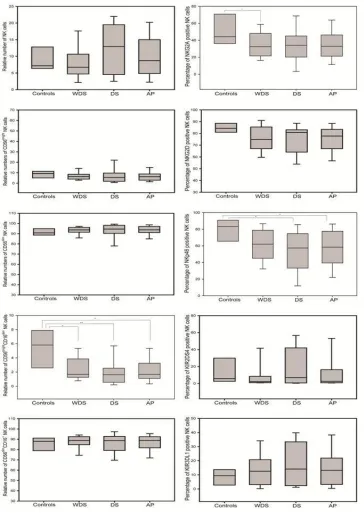
Using specific monoclonal antibodies CD3, CD16, and CD56, we determined the percentage of total NK cells in peripheral blood of patients with pancreatic cancer and in the control group. Furthermore, with the help from these monoclonal antibodies, we observed the relative percentage of NK cells subsets (Table 2 and Fig. 1).
Regarding each subset of NK cells, we have demonstrated a significantly reduced number of
CD56brightCD16- subset in patients with
pancreatic cancer in comparison to the control group (P = .01). This difference was observed regardless of the presence or absence of depressive symptoms (P = .01 and P = .003, respectively). However, no differences in NK cells and its subsets were observed in patients with or without depressive symptoms.
3.2 The Percentage of Surface Receptor Positive Circulating NK Cells
We determined the percentage of five surface receptor positive circulating NK cells in both the control group and patients with pancreatic cancer. The results are presented in Table 2 and Fig. 1.
Compared to the control group, significantly decreased levels of NKp46 positive NK cells were observed in patients with pancreatic cancer (P = .03). The same result was seen for patients with depressive symptoms (P= .03) but not in patients without depressive symptoms (P = .054). However, we also showed a reduction in the levels of NKG2A-positive circulating NK cells in patients without depressive symptoms in comparison to the control group (P = .05).
No differences were observed when comparing each groups of patients based on the presence or absence of depressive symptoms with each other.
4. DISCUSSION
Pancreatic tumors are a heterogeneous group of diseases and belong to one of the most malignant diseases. Pancreatic adenocarcinoma holds the third position in incidence among gastrointestinal tumors in Czech Republic [5] and has a very poor prognosis. The 5-year survival is below 5% irrespective of the stage of the disease and the race [1].
Cancer itself is a stressful situation (dealing with the deadly disease, lifestyle changes, etc.) and it is accompanied with changes in the humoral mediators especially those regulatory mediators which are involved in the hypothalamic-pituitary-adrenal axis. All together these may lead to patients with pancreatic cancer, along with other influences in the development of depressive symptoms or even depressive disorders. The humoral changes are characterized by changes in catecholamine plasma levels, neurotransmitter
imbalance, or metabolic impairment of these neurotransmitters or their precursors [6]. The final result of these changes is reflected in alterations of hormones and cytokines levels, which lead last but not least to changes in antitumor immunity that are both innate and adaptive. There is a known relationship between the number of T, B, and NK cells and changes in the levels of serotonin and glucocorticoids [7,8].
Chronic stress and depression effects quantitatively change in leukocyte count – there are higher levels of neutrophils and a conversely decreased number of total lymphocytes and circulating B and T cells [9]. The impact of depression at the level of NK cells is disputed. There are studies that describe increased levels of NK cells in patients with major depressive disorder [10,11]; on the other hand, there exist studies, as in our case, describing contrary results [12,13]. These differences may be given by different settings of immunological parameters in each study or by the heterogeneity of the patient groups in terms of demographic characteristics (smoking, sex, general health status with regard to the primary disease and its extent).
In this study, we quantified the subsets of NK cells CD56brightCD16- and CD56dimCD16+. Our results show, for the first time, that patients with pancreatic tumors have significantly reduced CD56brightCD16- subset of NK cells. This subset is responsible for the cytokines production IFN-γ, TNF-β, GM-CSF, IL-10, and IL-13 [4,14]. No significant changes were observed in CD56dimCD16+ NK cells, which are responsible for the NK cell cytotoxic activity due to its receptor equipment and the presence of a large number of cytoplasmic granules containing perforins and granzymes.
cells are considered as phylogenetically younger form of NK cells that gradually differentiate into CD56dim NK cells [15]. The meaning of this disproportion in NK cell subsets is still unknown.
But there are anecdotal reports in literature, that this decrease might be linked to unfavorable prognosis, when this subset of NK cells is found also in tumor microenvironment.
Fig. 1. Distribution of the relative numbers of NK cells and its subsets and distribution of the percentage of surface receptor positive circulating NK cells in healthy controls (Controls), all
patients with pancreatic cancer (AP), patients without depressive symptoms (WDS) and patients with depressive symptoms (DS)
Table 1. Basiccharacteristic of the patients and healthy controls included in the study
Without depressive symptoms
With depressive symptoms
Healthy controls
Number of patients 11 10 10
Female 6 5 6
Male 5 5 4
Age [min-max] 59 [50-72] 68 [57-80] 43 [32-80]
Median SDS score [min-max] 38 [27-48] 63 [51-77] N*
AJCC stage
IIB 7 5 N
III 1 2 N
IV
Chemotherapy
3 6
2 6
N N Whole blood count (Mean ± Standard deviation)
Red blood cells (1012/L) 3.8±0.49 4.25±0.73 4.45±0.39
Hemoglobin (g/L) 115.33±16.07 119.89±14.65 133.2±18.73
Trombocyty (109/L) 227.70±126.56 293.0±164.75 273.4±53.46
Leukocyty (109/L) 9.42±4.66 5.97±1.75 6.65±2.75
Biochemical parametrs (Mean ± Standard deviation)
Kortisol (nmol/L) 450.68±164.277 510.38±199.38 319.4±170.02
C reactiv protein (mg/L) 10.97±18.41 27.38±41.60 0.76±0.76
Lactate dehydrogenase (µkat/L)
3.82±1.20 5.48±3.51 3.93±0.52
Albumin (g/L) 40.3±4.61 39.66±2.58 46.84±3.98
Thyroid-stimulating hormone (mU/L)
3.04±3.31 1.60±0.91 2.24±1.56
* Not done
Table 2. Comparison of the relative numbers of NK cells, its subsets and surface receptors in healthy controls and patients with pancreatic cancer
All patients with pancreatic cancer
Without depressive symptoms
With depressive symptoms
Healthy controls
NK cells 10.15±6.63* 8.1±5.33 12.41±7.31 9.11±3.42
CD56dimCD16+ 85.95±10.79 86.78±8.13 85.03±13.3 85.61±8.22
CD56brightCD16- 2.26±1.71 2.44±1.61 2.07±1.83 5.36±2.79
NKp46 55.88±22.78 59.42±20.67 51.99±24.84 79.2±14.49
NKG2D 75.31±12.67 74.93±13.16 75.74±12.44 84.68±4.99
NKG2A 34.61±18.52 34.74±16.76 34.47±20.84 51.68±17.9
KIR2DS4 14.09±20.73 9.18±17.62 19.49±22.92 14.17±20.89
KIR3DL1 15.79±13.32 13.93±11.49 17.84±15.09 8.42±5.71
* Data expressed as means ± standard deviations
The changes in the expression of activation and inhibitory receptors on NK cells are closely related to the actual tumor extent. It is known that patients with tumor progression show a reduced expression of activating receptors such as NKp30, NKG2D, and conversely, an increase of inhibitory receptors such as NKG2A [16,17]. In accordance with Peng et al. [18], we demonstrated a reduction in NKp46-positive NK cells in patients with pancreatic cancer. NKp46 receptor is specific receptor for NK cells in both the resting and activated stages. It is proven that NKp46 is the main activating receptor, which
leads to the mobilization of intracellular calcium that results in cytotoxic activity and production of various cytokines [19].
across the population and within a single individual [21].
In this study, we observed no differences in the expression of KIR3DL1 receptor in patients with pancreatic cancer. However, there are some studies showing much higher levels of this receptor in patients with tumor [18]. In case of NKG2A positive NK cells, we observed a reduction in patients with pancreatic cancer. After closer analysis, we found that this reduction occurred only in patients with pancreatic cancer without depression, but not in patients with depressive symptoms. This finding may indicate that the presence of chronic stress, as what happens during depression, may result due to the overwhelming inhibitory signals to anergy or even apoptosis of NK cells, which ultimately can result in a reduction of NK cell antitumor activity.
5. CONCLUSION
Despite a well-known relationship between the functions of brain subcortical centers, immune and endocrine systems, the impact of prolonged stress and symptoms of depression is often underestimated. However, it seems that the main immunomodulating factor in the case of NK cells in patients with pancreatic cancer is the tumor itself, and this is valid particularly for reduced levels of NK cell activation receptors. The presence of chronic stress or depression plays its role in affecting the number and distribution of NK cells and might play a role in tumor escape mechanism. Based on this pilot study we defined the most sensitive NK cell subset and receptors towards stressful situation as pancreatic cancer. We are aware of possible limitations of this pilot study due to small number of patients, or absence of functional tests. However, these results might be helpful for future research.
Whether these quantitative alterations of NK cells subsets and receptors are also associated with disruption function of NK cells, especially in an unchanged subset of CD56dimCD16+ NK cells, which are responsible for antitumor cytotoxic activity is subject for further research.
ETHICAL APPROVAL
All authors hereby declare that all experiments have been examined and approved by the Ethics committee of University hospital in Hradec Králové (201012 S02P) and have therefore been performed in accordance with the ethical standards laid down in the 1964 Declaration of Helsinki.
ACKNOWLEDGEMENTS
The work was supported by the grant SVV-2016-260286 and PRVOUK 37/06.
COMPETING INTERESTS
Authors have declared that no competing interests exist.
REFERENCES
1. Fazal S, Saif M. Supportive and palliative care of pancreatic cancer. JOP. 2007;8(2): 240–253.
2. Pillarisetty VG. The pancreatic cancer microenvironment: An immunologic battle-ground. Oncoimmunology. 2014;3(8): e950171.
3. Massie MJ. Prevalence of depression in patients with cancer. J Natl Cancer Inst Monogr. 2004;32:57-71.
4. Cooper MA, Fehniger TA, Caligiuri MA. The biology of human natural killer-cell subsets. Trends Immunol. 2001;22(11): 633-640.
5. UZIS CR, Current Information 5/2013 Incidence of Malignant Neoplasms in the Czech Republic in 2010.
Available:http://www.uzis.cz/rychle-informace/zhoubne-nadory-roce-2010 [cited 2014 Dec 12]
6. Kovaru H, Pav M, Kovaru F, Raboch J, Fiserova A. Cell signalling in CNS and immune system in depression and during antidepressant treatment: Focus on glial and natural killer cells. Neuro Endocrinol Lett. 2009;30(4):421-428.
7. Hsueh CM, Chen SF, Lin RJ, Chao HJ. Cholinergic and serotonergic activities are required in triggering conditioned NK cell response. J Neuroimmunol. 2002;123(1-2): 102–111.
8. Abdouh M, Albert PR, Drobetsky E, Filep JG, Kouassi E. 5-HT1A-mediated promotion of mitogen-activated T and B cell survival and proliferation is associated with increased translocation of NF-kappaB to the nucleus. Brain Behav Immun. 2004;18(1):24–34.
10. Griffiths J, Ravindran AV, Merali Z, Anisman H. Neuroendocrine measures and lymphocyte subsets in depressive illness: Influence of a clinical interview concerning life experiences. Psycho-neuroendocrinology. 1997;22(4):225–236. 11. Ravindran AV, Griffiths J, Merali Z,
Anisman H. Circulating lymphocyte subsets in obsessive compulsive disorder, major depression and normal controls. J Affect Disord. 1999;52(1-3):1–10.
12. Andreoli AV, Keller SE, Rabaeus M, Marin P, Bartlett JA, Taban C. Depression and immunity: Age, severity, and clinical course. Brain Behav Immun. 1993;7(4): 279–292.
13. Schleifer SJ, Keller SE, Bartlett JA. Depression and immunity: Clinical factors and therapeutic course. Psychiatry Res. 1999;85(1):63–69.
14. Fehniger TA, Cooper MA, Nuovo GJ, Cella M, Facchetti F, Colonna M, et al. CD56bright natural killer cells are present in human lymph nodes and are activated by T cell derived IL-2: A potential new link between adaptive and innate immunity. Blood. 2003;101(8):3052–3057.
15. Farag SS, Caligiuri MA. Human natural killer cell development and biology. Blood Rev. 2006;20(3):123–137.
16. Garcia-Iglesias T, Del Toro-Arreola A, Albarran-Somoza B, Del Toro-Arreola S, Sanchez-Hernandez PE, Ramirez-Dueñas
MG, et al. Low NKp30, NKp46 and NKG2D expression and reduced cytotoxic activity on NK cells in cervical cancer and pre-cursor lesions. BMC Cancer. 2009;9:186. 17. Mamessier E, Sylvain A, Thibult ML,
Houvenaeghel G, Jacquemier J,
Castellano R, et al. Human breast cancer cells enhance self tolerance by promoting evasion from NK cell antitumor immunity. J Clin Invest. 2011;121(9):3609-3622. 18. Peng YP, Zhu Y, Zhang JJ, Xu ZK, Qian
ZY, Dai CC, et al. Comprehensive analysis of the percentage of surface receptors and cytotoxic granules positive natural killer cells in patients with pancreatic cancer, gastric cancer, and colorectal cancer. J Transl Med. 2013;11(1):262.
19. Moretta L, Bottino C, Pende D, Castriconi R, Mingari MC, Moretta A. Surface NK receptors and their ligands on tumor cells. Sem Immunol. 2006;18(3):151–158. 20. Duan X, Deng L, Chen X, Lu Y, Zhang Q,
Zhang K, et al. Clinical significance of the immunostimulatory MHC class I chain-related molecule A and NKG2D receptor on NK cells in pancreatic cancer. Med Oncol. 2011;28:466–474.
21. Yawata M, Yawata N, Draghi M, Little AM, Partheniou F, Parham P. Roles for HLA and KIR polymorphisms in natural killer cell repertoire selection and modulation of effector function. J Exp Med. 2006;203(3): 633–645.
_________________________________________________________________________________ © 2016 Kopecký et al.; This is an Open Access article distributed under the terms of the Creative Commons Attribution License
(http://creativecommons.org/licenses/by/4.0), which permits unrestricted use, distribution, and reproduction in any medium,
provided the original work is properly cited.
Peer-review history: