_____________________________________________________________________________________________________
*Corresponding author: E-mail: [email protected];
www.sciencedomain.org
Office-Based Olfaction Assessment
Erdem Atalay Çetinkaya
1*, Nuray Bayar Muluk
2and Cemal Cingi
31
Department of ENT, Antalya Ataturk State Hospital, Antalya, Turkey. 2
Department of ENT, Faculty of Medical, University of Kırıkkale, Kırıkkale, Turkey. 3
Department of ENT, Faculty of Medical, University of Eskisehir Osmangazi, Eskisehir, Turkey.
Authors’ contributions
This work was carried out in collaboration between all authors. Author EAC designed the study, wrote the protocol and wrote the first draft of the manuscript. Authors NBM and CC managed the literature searches, analyses of the study. All authors read and approved the final manuscript.
Article Information
DOI: 10.9734/BJMMR/2016/25060 Editor(s): (1) Gauri Mankekar, ENT Department, PD Hinduja Hospital, Mumbai, India. Reviewers: (1) Roberta Di Mauro, University of Rome Tor Vergata, Italy. (2)Badr Eldin M. Ostafa, Ain-Shams University, Egypt. (3)Pushappreet Kaur, Guru Nanak Dev Dental Hospital, Sultanpur Lodhi, India. (4)Silvia Regina D. T. de Siqueira, University of Sao Paulo, Brazil. Complete Peer review History:http://sciencedomain.org/review-history/13838
Received 16th February 2016 Accepted 16th March 2016 Published 24th March 2016
ABSTRACT
A simple assessment of olfactory acuity is essential and can play a vital role in patient care and quality-of-life parameters. Any process that interferes with the physiologic environment of the nasal mucosa can be associated with restricted olfaction. Studies have examined how the human sense of smell likely integrates information from complex arrays of odorant chemicals that, individually, would seem to produce conflicting odorous sensations. “Scratch and sniff” format screening tests are readily available and have been standardized for age, gender, and ethnicity. It is important to identify a scent that can be used as in an initial olfactory test If a patient cannot identify this scent, they should take further diagnostic testing.
In this review, we give some essential information on office-based olfaction assessment and attempt to cover important aspects of the evaluation, especially from a clinical perspective.
Keywords: Smell; olfaction; screening tests.
1. INTRODUCTION
Olfaction plays an important role in assessment of food quality, food identification, sexual behavior, and is important in the home and work environment. Olfaction atrophy is associated with numerous nasal, sinus, and other pathologies. Additionally, olfaction is an integral part of the memory of combined events and situations: odors are associated with the storage and recall of past events and their emotional context. The olfactory sense memory shows a high degree of resistance and persistence to interference [1]. The interaction between intact olfaction and the sense of taste is well known and patients typically report a decrease in olfactory sensitivity within the context of perceived declines in the senses of both taste and smell [2].
A simple olfactory acuity assessment is necessary and can have a vital role in patient care and quality-of-life parameters. Moreover, an objective olfactory assessment may be needed in a medico-legal context. In this paper, our aim is to present key information on office-based olfaction assessments and attempt to cover important aspects of the evaluation, especially from a clinical perspective.
2. ASSESSING ENDOGENOUS AND
EXOGENOUS CAUSES
The significant role that odors have played throughout the course of human history has been presented [1,2]. A number of key studies, events, and trends have been identified that form the backdrop of much of today’s chemosensory research enterprise [1-3].
Olfactory sensory neurons have dendritic components mixed within the olfactory epithelium in the mid-uppermost portion of the nasal vault. Curiously, each neuron is specific for only one type of odor molecule. As odor molecules come into contact with the mucosa in this area, they act reciprocally with a variety of mucopolysaccharides, enzymes, ionic salts, or odorant-binding proteins. Upon activation, the receptor spreads a signal along axonal projections through the cribriform plate to the olfactory bulb, and then onward to brain stem structures and cortical integrity [3,4].
Any process that interferes with the physiologic ambiance of the nasal mucosa can be associated with restricted olfaction. The first main group of endogenous causes involves
excretions. Alteration of the quality of nasal secretions may include increased viscosity inhibiting molecule diffusion, inflammatory disorders – accompanying sinusitis, Wegener’s granulomatosis, sarcoidosis, Sjogren’s syndrome, decrease in mucous production causing change in hydration status of mucosa and other physiologic changes associated with atopy [5,6]. The second main group of endogenous causes is about anatomy. Alteration of nasal anatomy creates a greater distance between the environment and the olfactory neurons or increases airflow to the olfactory region. Allergy and nasal polyps inhibit contact between odor molecules and receptors. Septal deviation, hypertrophy of turbinates, hypertrophic adenotonsillitis, and mass lesions/neoplasm do not allow proper airflow to olfactory mucosa. Paradoxically, prior surgery with residual hyper-patency of airway diminishes airflow [7,8]. When ENT examination fails to identify any nasal etiology, a neurological or sometimes psychiatric opinion may be sought, depending on the findings of the interview. The interview is primary in establishing etiology and classifying dysosmia. It should focus on onset circumstances such as cranial trauma, infection, medication, occupational or personal toxic exposure such as wood dust, which increases the risk of olfactory cleft cancer [8,9].
Additionally, assessing endogenous causes of loss of olfaction, possible exogenous causes should be investigated. Excessive alcohol, nicotine, and other smoked recreational substance usage cause demonstrable decline or loss of the sense of smell in any patient [4,10]. Drugs in every major pharmacological category can impair smell function and have negative effects on a patient’s olfaction (Table 1).
These effects may be created via alteration in the olfactory mucosa or the mucous overlying this mucosa. There may also be altered receptor expression or changes in circulation to the region or alteration of signal spread that would confuse olfaction sensitivity [10,11].
Table 1. Drug list that have been associated with an impairment in olfaction. (Adopted from references 4-11)
Active ingredient Pharmacological category
ACE inhibitors, beta-blockers, calcium channel blockers Antihypertensive
allopurinol; colchicine; gold; levamisole Antirheumatic
aminoglycosides, macrolides, fl uoroquinolones, tetracyclines, and beta lactam drugs
Antibiotic
amphetamine Sympathomimetic
amphotericin B, griseofulvin Antifungal
azathioprine, methotrexate, glucocorticoids, vincristine, anthracyclines, and cisplatin
Immunosuppressant and anticancer
baclofen; chlormezanone Muscle relaxant
benzocaine, cocaine hydrochloride; and tetracaine Local anesthetic
carbamazepine; lithium carbonate Psychopharmacologic
carbimazole; methizole; methylthiouracil; propylthiouracil; thiouracil Antithyroid
chlorpheniramin Antihistamine
clofibrate Anticholesteremic
d -penicillamine; phenylbutazone Analgesic-antipyretic
diazoxide; ethacrynic acid, acetazolamide Diuretic
doxepin, nortriptyline, amitriptyline, imipramine Antidepressant
ethambutol Antitubercular
glipizide; phenformin Hypoglycemic
hydromorphone hydrochloride; morphine Opiates codeine
levodopa Antiparkinson
metronidazole; niridazole Amebicidand anthelmintic
Oksimetazolin e.g., Efedrin, Decongestant
phenindione Anticoagulant
phenytoin; psilocybin; trifluoperazine Antiepileptic
sodium lauryl sulfate (toothpaste) Dental hygiene
also have anticholinergic affects that may lead to diminished olfaction. Antiepileptics and psychopharmacological drugs may alter nerve cell distribution. Antibiotics, most notably aminoglycosides, may have neurotoxic effects that manifest as decreased olfaction. Curiously, the ototoxic effect of aminoglycosides is often mentioned, but their potential negative effect on olfaction is overlooked. Topical zinc administration also has neurotoxic effects. Many medications have idiopathic mechanisms. For instance, opiates and anesthetics change the perception of odor, but there is also a paradoxical residual anosmic or hyposmic effect [4,9,11,12].
3. OFFICE TESTING FOR OLFACTORY
The region of the olfactory cleft in the nose composes an environment where any of a variety of changes in a previously normal nasal environment can alter olfaction. Office testing for olfactory sharpness has proven to be very useful. If asked, many patients will complain of an olfactory disorder, which can be proven upon testing. When present, testing establishes a baseline situation and can be used for evaluating the response to therapy [13,14].
Psychophysical tests are easy to apply in office-based olfaction assessment but are time-consuming and should be interpreted with caution, in the light of their limitations. Evaluating a patient’s olfaction requires some confidence on subjective data, in that we are required to use the patient’s report to try to objectify our assessment. Studies have examined how the human sense of smell likely integrates information from complex arrays of odorant chemicals that, individually, would seem to produce conflicting odorous sensations. Scratch and sniff” format screening tests are readily available and have been standardized for age, gender, and ethnicity [4,5,15,16].
3.1 Identification Tests
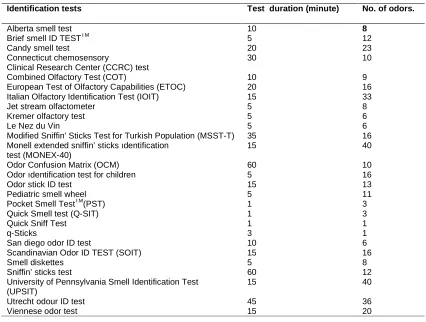
Table 2. Identification Tests (Adopted from references 4,15-20)
Identification tests Test duration (minute) No. of odors.
Alberta smell test 10 8
Brief smell ID TESTTM 5 12
Candy smell test 20 23
Connecticut chemosensory
Clinical Research Center (CCRC) test
30 10
Combined Olfactory Test (COT) 10 9
European Test of Olfactory Capabilities (ETOC) 20 16
Italian Olfactory Identification Test (IOIT) 15 33
Jet stream olfactometer 5 8
Kremer olfactory test 5 6
Le Nez du Vin 5 6
Modified Sniffin' Sticks Test for Turkish Population (MSST-T) 35 16
Monell extended sniffin’ sticks ıdentification test (MONEX-40)
15 40
Odor Confusion Matrix (OCM) 60 10
Odor ıdentification test for children 5 16
Odor stick ID test 15 13
Pediatric smell wheel 5 11
Pocket Smell TestTM(PST) 1 3
Quick Smell test (Q-SIT) 1 3
Quick Sniff Test 1 1
q-Sticks 3 1
San diego odor ID test 10 6
Scandinavian Odor ID TEST (SOIT) 15 16
Smell diskettes 5 8
Sniffin’ sticks test 60 12
University of Pennsylvania Smell Identification Test (UPSIT)
15 40
Utrecht odour ID test 45 36
Viennese odor test 15 20
3.2 Detection and Recognition Threshold Tests
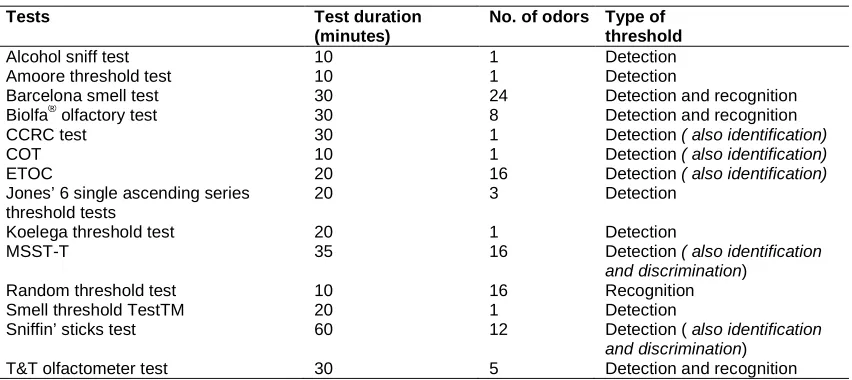
The two types of threshold method that are used most widely clinically and industrially are the ascending method of limits and single-staircase procedures (Table 3) [4,20-25].
3.3 Discrimination Tests
The discrimination test requires individuals to detect whether two stimuli are the same or different. In psychophysics, even the lowest amount of a stimulus may alter the perception (Table 4) [19-26].
3.4 Memory Tests
The assessment of odor memory is not always easy, especially in relatively short tests applicable to clinical settings. In a typical odor recognition memory test, a subject is exposed to a small set of odorants and asked to select, after an interval of time ranging from less than a minute to hours, that odorant or set of odorants from foils.
Identification is not always necessary. This method is relatively crude, despite the fact that it is perhaps the most common means used by neurologists to measure olfactory function [24,26].
In this section, we reviewed the literature (1983-2015) regarding psychophysical tests associated
with olfactory function. It is important to identify a scent that can be used as an instrument to decide whether to undertake further
diagnostic testing. Similar tests are designed for pediatric use and involve a game-like test procedure.
Our clinical perspective is that the identification of normal olfactory function by means of a simple and trustworthy test should minimize
olfactory test procedures in the office. An accurate calculation of the optimum number
Table 3. Detection and recognition threshold tests (Adopted from references 4, 20-24)
Tests Test duration
(minutes)
No. of odors Type of threshold
Alcohol sniff test 10 1 Detection
Amoore threshold test 10 1 Detection
Barcelona smell test 30 24 Detection and recognition
Biolfa® olfactory test 30 8 Detection and recognition
CCRC test 30 1 Detection ( also identification)
COT 10 1 Detection ( also identification)
ETOC 20 16 Detection ( also identification)
Jones’ 6 single ascending series threshold tests
20 3 Detection
Koelega threshold test 20 1 Detection
MSST-T 35 16 Detection ( also identification
and discrimination)
Random threshold test 10 16 Recognition
Smell threshold TestTM 20 1 Detection
Sniffin’ sticks test 60 12 Detection ( also identification
and discrimination)
T&T olfactometer test 30 5 Detection and recognition
Table 4. Discrimination tests (Adopted from references19-25)
Tests Test duration (minute) No. of odors. Additional info
Dusseldort odour Discrimination test
15 15 -
Odor discrimination/memory TestTM (ODMT) 15 12 Also memory test.
MSST-T 35 16 Also identification and
discrimination test
Sniffin’ sticks test 60 12 Also identification and
discrimination test
4. CONCLUSION
Olfactory disorders are common in the general population. Assessment, on the other hand, is seldom performed by ENT specialists, even in reference centers. The identification of normal olfactory function by means of a simple and reliable test is one method that could minimize olfactory test procedures in the office. The importance of olfaction in a variety of clinical fields has grown, largely as a consequence of the continued proliferation of commercially available clinical olfactory tests. Additionally, diminished smell function is one of the earliest signs of neurodegenerative diseases and detection thereof is important.
CONSENT
It is not applicable.
ETHICAL APPROVAL
It is not applicable.
COMPETING INTERESTS
Authors have declared that no competing interests exist.
REFERENCES
1. McLaughlin N. Odor identification deficits in frontotemporal dementia: A preliminary study. Arch Clin Neuropsychol. 2008; 23(1):119–23.
2. Margot C. A noseful of objects. Nat Neurosci. 2009;12(7):813–4.
3. Wilson DA, Chapuis J, Sullivan RM. Cortical olfactory anatomy and physiology. In: Doty RL, editor. Handbook of olfaction and gustation. New Jersey: Wiley Blackwell. 2015;209-226
4. Doty RL, Laing DG. Psychophysical measurement of human olfactory function. In: Doty RL, editor. Handbook of olfaction and gustation. New Jersey: Wiley Blackwell. 2015;227-260.
5. Kern RC. Chronic sinusitis and anosmia: Pathologic changes in the olfactory mucosa. Laryngoscope. 2000;110(7): 1071–7.
6. Litvack JR, Mace JC, Smith TL. Olfactory function and disease severity in chronic rhinosinusitis. Am J Rhinol Allergy. 2009;23(2):139–44.
hypertrophic adenotonsillitis on olfaction and quality of life. J Med Updates. 2013;3(3):87-90.
8. Guss J, Doghramji L, Reger C, Chiu AG. Olfactory dysfunction in allergic rhinitis. ORL J Otorhinolaryngol Relat Spec. 2009; 71(5):268–72.
9. Tuccori M. Drug-induced taste and smell alterations: A case/non-case evaluation of an Italian database of spontaneous adverse drug reaction reporting. Drug Saf. 2011;34(10):849–59.
10. Ackerman BH. Disturbances of taste and smell induced by drugs. Pharmacotherapy. 1997;17(3):482–96.
11. Wrobel BB, Leopold DA. Clinical assessment of patients with smell and taste disorders. Otolaryngol Clin North Am. 2004;37(6):1127–1142
12. Doty RL, Mishra A. Olfaction and its alteration by nasal obstruction, rhinitis, and rhinosinusitis. Laryngoscope. 2001;111(3): 409–23.
13. Miman MC, Karakaş M, Altuntaş A, Cingi C. How smell tests experience and education affect ENT specialists' attitudes towards smell disorders? A survey study. Eur Arch Otorhinolaryngol. 2011; 268(5):691-4.
14. Simsek G, Muluk NB, Arikan OK, et al. Marked changes in olfactory perception during early pregnancy: A prospective case-control study. Eur Arch Otorhinolaryngol. 2015;272(3):627-30. 15. Doty RL, Frye R. Infl uence of nasal
obstruction on smell function. Otolaryngol Clin N Am. 1989;22(2):397–411.
16. Amoore JE, Ollman BG. Practical test kits for quantitatively evaluating the sense of smell. Rhinology. 1983;21:49–54.
17. Anderson J, Maxwell L, Murphy C. Odorant identification testing in the young child. Chem. Senses. 1992;17:590. 18. Bonfils P, Faulcon P, Avan P. Screening of
olfactory function using the Biolfa olfactory test: İnvestigations in patients with
dysosmia. Acta Otolaryngol. (Stockh). 2004;124:1063–1071.
19. Booth DA. Cognitive processes in odorant mixture assessment. Chem. Senses. 1995;20:639–643.
20. Freiherr J, Gordon AR, Alden EC, et al. The 40-item monell extended sniffin’ sticks ıdentification test (MONEX-40). J. Neurosci.Methods. 2012;205:10–16. 21. Oniz A, Erdogan I, Ikiz AO, Evirgen N,
Ozgoren M. The modified sniffin’ sticks test in turkish population based on odor familiarity survey. J Neurol Sci Turk. 2013;30(2):270–80.
22. El Rassi E, Mace JC, Steele TO, Alt JA, Soler ZM, et al. Sensitivity analysis and diagnostic accuracy of the brief smell ıdentification test in patients with chronic rhinosinusitis. Int Forum Allergy Rhinol; 2015.
DOI: 10.1002/alr.21670. (Epub ahead of print)
23. Cain WS, Gent J, Catalanotto FA, Goodspeed RB. Clinical evaluation of olfaction. Am. J. Otolaryngol. 1983;4:252– 256.
24. Deems DA, Doty RL, Settle RG, Moore-Gillon V, Shaman P, Mester AF, Kimmelman CP, Brightman VJ, et al. Smell and taste disorders, a study of 750 patients from the University of Pennsylvania Smell and Taste Center. Arch.Otolaryngol. Head Neck Surg. 1991;117:519–528.
25. Doty RL, Smith R, McKeown D, Raj J. Tests of human olfactory function: Principal components analysis suggests that most measure a common source of variance. Percept. Psychophys. 1994;56:701–707. 26. Hummel T, Pfetzing U, Lotsch J. Ashort
olfactory test based on the identification of three odors. J. Neurol. 2010;257:1316– 1321.
27. Lötsch J, Ultsch A, Hummel T. How many and which odor ıdentification ıtems are needed to establish normal olfactory function? Chem Senses. 2016;pii:bjw006. [Epub ahead of print].
_________________________________________________________________________________ © 2016 Çetinkaya et al.; This is an Open Access article distributed under the terms of the Creative Commons Attribution License (http://creativecommons.org/licenses/by/4.0), which permits unrestricted use, distribution, and reproduction in any medium, provided the original work is properly cited.
Peer-review history: