Security Evaluations Beyond Computing Power
How to Analyze Side-Channel Attacks you Cannot Mount?
Nicolas Veyrat-Charvillon, Benoˆıt G´erard, Fran¸cois-Xavier Standaert
UCL Crypto Group, Universit´e catholique de Louvain. Place du Levant 3, B-1348, Louvain-la-Neuve, Belgium.
Abstract. Present key sizes for symmetric cryptography are usually re-quired to be at least 80-bit long for short-term protection, and 128-bit long for long-term protection. However, current tools for security evalu-ations against side-channel attacks do not provide a precise estimation of the remaining key strength after some leakage has been observed, e.g. in terms of number of candidates to test. This leads to an uncomfortable situation, where the security of an implementation can be anywhere be-tween enumerable values (i.e. 240−250 key candidates to test) and the full key size (i.e. 280−2128key candidates to test). In this paper, we mit-igate this important issue, and describe a key rank estimation algorithm that provides tight bounds for the security level of leaking cryptographic devices. As a result and for the first time, we are able to analyze the full complexity of “standard” (i.e. divide-and-conquer) side-channel attacks, in terms of their tradeoff between time, data and memory complexity.
Keywords: symmetric cryptography, concrete security, experimental cryptanalysis, divide & conquer attacks, side-channel analysis, leakage.
1
Introduction
Concrete security evaluations are at the core of cryptographic research. Taking the example of symmetric cryptography, they are at the same time central in formal definitions of security (e.g. as introduced by Bellare et al. [2]) and in the evaluation of attacks such as linear and differential cryptanalysis [4, 23]. Their goal is to provide bounds on the success probability of an adversary as a function of the resources she expends, typically measured in time, data and memory. But somewhat surprisingly, while such concrete (and complete) evaluations are usual in the context of mathematical cryptanalysis (e.g. [3], Table 5), they appear much harder to obtain in the context of physical cryptanalysis, even for “classical” attacks such as Kocher et al.’s Differential Power Analysis (DPA) [20].
can even guarantee security against large classes of statistical attacks [9]. By con-trast, there is no general theory explaining how to build secure implementations, and most countermeasures used by device manufacturers highly depend on the chosen technology. Therefore,present security evaluations against side-channel attacks need to rely on experimental validation. For example, certification reports emitted by national authorities such as the ANSSI in France [1], or the BSI in Germany [6], are based on extensive analysis from evaluation laboratories.
From a cryptographic point of view, a purely empirical approach is hardly satisfying, as it only determines whether a given laboratory (with given equip-ment, time, data and memory) is able to recover some secret information con-tained in a leaking device. Hence, a fundamental question is to determine which parts of the physical security evaluations actually need experiments. Since the leakage in cryptographic implementations is technology-dependent, it is clear that some characterization through measurements is unavoidable, in order to determine its informativeness. Yet, given a certain amount of information leak-age, it remains to analyze the impact of the time and memory complexities on the success probability of actual side-channel attacks. Answering these two ques-tions (i.e. information extraction and exploitation) is the main goal of evaluation frameworks such as [31]. In the context of block ciphers (that will be our running example), most distinguishers published in the literature are based on a divide-and-conquer strategy1. As a result, the usual solution to exploit computational power is to perform enumeration [26, 32]. Butthis implies that present security evaluations are limited to the computational power of the evaluator. That is, the only leaking devices for which we can evaluate the security are the ones that are “practically insecure” (i.e. for which the leakage allows key enumeration). It leaves the (most interesting) evaluation of “practically secure” devices as an open problem. For example, an evaluation laboratory could claim that he could not recover an AES key within time complexity 250. But this does not give clear hints whether the security level of the target leaking device is 251or 2100.
Main result.In this paper, we show that in the (realistic) scenario where the evaluator of a leaking device knows its secret key, it is possible to estimate the probability of success of “standard” side-channel attacks (e.g. the ones listed in footnote 1) that he is unable to perform (e.g. attacks of time complexities beyond 280). For this purpose, we provide a rank estimation algorithm solving the following problem: “given a set of discrete probability distributions for inde-pendent parts of a key, and a correct key k∗, provide tight bounds for the rank of this key among the set of all possible ones”. Based on several experiments, we further show that our algorithm features small ratios between the lower and higher bounds on the key rank, and small running times (e.g. ratios between 22 and 210for a 128-bit key are obtained in a couple of seconds on a modern PC).
1 Including Kocher et al.’s DPA, Brier et al.’s Correlation Power Analysis (CPA) [5],
Consequences.Besides being a tool of choice for side-channel evaluation labo-ratories, our algorithm has a number of important consequences for the theory and practice of side-channel attacks. First, and for the first time, it allows the estimation of all the metrics put forward in [31] (namely, the success rates of all orders and guessing entropy). For example, the estimation of the guessing entropy for large master keys was previously impossible, as illustrated by the reports of the DPA contests v1 and v2 [27]. Our rank estimation algorithm could be directly used in further versions of such contests. Second, it provides a method to connect actual side-channel attacks with the need of “limited informa-tion leakage” in certain formal works aiming to prove security against physical attacks. For example, it allows quantifying the hardness assumption in Dodis et al.’s cryptography with auxiliary input [11], or the seed-preserving assumption used in [34]. Although less directly connected, it also provides a lower bound on theλ-bit leakage required in leakage-resilient cryptography [12]. Third, rank estimation yields an exact solution to evaluate the complexity of a number of “non-standard” side-channel attacks. For example, it would be perfectly suited to estimate the workload of collision attacks such as [25, 29] (see [13], Section 5). It would also be handy for analyzing the key-dependent algorithmic noise in the CHES 2012 leakage-resilient PRF [24], where most subkeys cannot be highly rated by the adversary. Fourth, our experiments suggest a cautionary note for the use of lightweight ciphers with small key sizes in leaking devices, as a few measurements can be enough to degrade their security within adversarial reach. Finally, we note that the proposed algorithm is not limited to physical security evaluations, and is potentially useful in any mathematical cryptanalysis setting where experiments are still needed to validate an hypothetical model.
2
Rank estimation: an overview
This section describes the approach that allows us to perform efficient and ac-curate rank estimation for standard key spaces (i.e. from 280 to 2256, typically).
Let us denote the independent parts of the key for which information has been obtained as subkeys. Our general idea is to organize the key space by sorting each of these subkeys according to their posterior likelihood, in decreasing order. As a result, the full key space is partitioned into 2 main volumes. The first one is defined by all key candidates with probability higher than the correct key. The second one is defined by all key candidates with probability smaller than the correct key2. Given this geometrical representation, our rank estimation problem can be stated as the one of finding bounds for the “higher” and “lower” volumes.
Organizing the key space with such volumes has one main advantage. Namely, the “higher” (resp. “lower”) set of key candidates is delimited by a concave (resp. convex) surface within the key space. This means that if we pick a key candidate
2 Between these volumes, we may find other volumes where all key candidates have
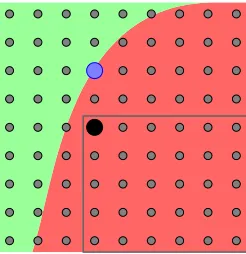
with a probability higher (resp. lower) than the target key, all keys with index lower (resp. higher) will also have the same property. This fact is illustrated in Figure 1 for a simplified 2-dimension case, with small subkey spaces. In this example, the correct key is the blue circle, and the equipotential surface splits the key space into candidates with higher (green, light) and lower (red, dark) probabilities. If one picks a key candidate within the lower probability set (e.g. the black circle), we notice that all candidates with higher indexes (inside the gray rectangle) will be on the same side of the surface. Hence, they will have a lower probability than that of the correct key. Taking advantage of this fact, our method for rank estimation essentially consists in “carving” such boxes of key candidates on each side of the probability surface, and use the volumes of these boxes to progressively refine the (lower and higher) bounds on the key rank.
Fig. 1.Sorted key space in a simplified two-subkeys case.
Note that for small key spaces such as in Figure 1, standard quadrature tools could be used to bound the key rank. But as soon as typical cryptographic parameters are considered, e.g. 16 dimensions supported by 28 discrete points for the case of AES-128, such tools do not work anymore. Even when partially merging some dimensions3 (e.g. in order to obtain 4 dimensions with support 232), such tools fail to provide an answer in reasonable time. To the best of our knowledge, the algorithm carefully described in the next section is the first one to provide an efficient solution that fits cryptographic evaluation purposes.
3
Algorithms for efficient rank estimation
This section aims at presenting the rank estimation algorithm. First, a high-level description of the algorithm is provided. For this algorithm to work efficiently in practice, several refinements are needed, detailed in the subsequent sections.
3
3.1 High-level algorithm representation
Algorithm 1 is a high-level view of the rank estimation algorithm. For the sake of simplicity, we assume that the target cipher isaes-128 (that is we are provided 16 subkey probability mass functions of support 28each). The algorithm remains valid for other ciphers by just modifying the corresponding entries.
Algorithm 1: Rank estimation algorithm.
Input: Subkey distributionsD= (Di)1≤i≤16and the key probabilityp∗. Output: An intervalI= [I0;I1] containing the key rank.
L ← {[0; 255]16};
I←[0; 2128]; PreProcess(D);
whileL 6=∅do
(V,L)←PickVolume(L);
if IsCarved(V) = falsethen
(V0, I)←CarveBox(V, I, p∗,D);
L ←InsertVolume(L, V0);
else
{Vi0} ←SplitVolume(V);
L ←InsertVolume(L,{Vi0});
returnI;
As stated in Section 2, the algorithm is based on the fact that when distri-butions are sorted by decreasing probability, the frontier between the “lower” and “higher” key spaces is convex. Thus, aPreProcess()procedure is first used to sort distributions. It also performs other treatments in order to improve the algorithm efficiency (that will be discussed in Section 3.2). After initializing a listLwith a volume containing the whole key space, we iterate over volumes in this list until it is depleted or the target accuracy is reached. The choice of the volume to consider is made by the PickVolume() procedure that removes the largest volume from L. Since we are only interested in the largest volume, this list is efficiently implemented using an heap-based priority queue. The extracted volume is then processed. For reasons that will be clarified later in the section, we store volumes as either simple boxes (i.e. a Cartesian product of intervals), or the set difference of two such boxes that we will denote as carved volumes. Depending on the case, two alternative procedures are possible.
remaining carved volume is inserted back into listL using theInsertVolume()
procedure. Else the volume extracted from list L is a carved volume, in which case the SplitVolume() procedure is used first, that splits it into smaller vol-umes having simpler geometries. As in the first case, these volvol-umes are then inserted back into the list using theInsertVolume()procedure.
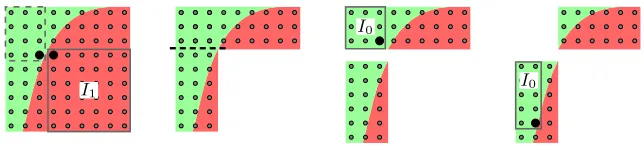
An run of the algorithm is illustrated in Figure 2. First, a box is carved from the key space and subtracted from the higher bound. The resulting carved box is then split in two. In the third step, a new box is carved on the green (light) side of the top box, and added to the lower bound. Finally, another box is carved from the green (light) side of the bottom box. After several additional steps, an exact bound can be given for the correct key in Figure 1. Note that during the rank estimation for an actual cipher, the limiting surface has too many details to be exactly computed, hence we are limited to an estimation of the rank.
I1
I0
I0
Fig. 2.Example run of Algorithm 1.
This algorithm is seemingly simple, but any direct implementation results in either intractable computation time or memory requirements. We only managed to attain tractability (and efficiency) through several specific choices and refine-ments for the different procedures, described in the remainder of the section.
3.2 The PreProcess procedure
In addition to sorting the distributions by decreasing probability, thePreProcess
procedure also lowers the number of dimensions in the key space by merging some subkey lists. Instead of treating a 16-dimension cube of side length 28, we will work, for instance, on a 6-dimension space with sides up to 224. This merging step leads to significant improvements in the algorithm efficiency and should be applied as far as memory allows it. The impact of such merging on the algorithm performances will be illustrated in the experiments of Section 4.
3.3 The PickVolume procedure
But this strategy has high computation time and becomes intractable as the algorithm gets lost in the details of the equipotential surface. By contrast, picking the largest volumes first is equivalent to performing a breadth-first search, and allows bounds to converge faster. The problem now is the increasing memory requirements (as many more volumes have to be stored at any given time). Hence, improvements were needed to minimize the memory cost, as described next.
3.4 The InsertVolume procedure
When the number of volumes stored in the queue increases beyond what we can efficiently store on a computer, we have two solutions: either switch to a depth-first search (which does stop the storage increase but has the side-effect of slowing down the convergence of bounds almost to a stop), or we can truncate the smallest volumes in the heap (since we use a heap and not a binary tree, we actually truncate volumesamong the smallest ones, not exactly the smallest ones). The second approach naturally leads to accuracy losses in the estimation. Fortunately, we are not interested in the exact rank of the key but on “good enough” bounds. Hence, we opted for this second strategy. In practice, truncation is acceptable if the accuracy loss is small compared to the key rank, which depends on the storage limit set in the algorithm. We will show in the Section 4 that current computer memories allow very satisfactory results in this respect.
3.5 The IsCarved procedure
Iterations of Algorithm 1 essentially take boxes from the key space and carve other boxes out of them. If we were only able to represent plain boxes, we would need to perform splits along each dimension each time a box is carved. Essentially, carving a piece out of a box would lead to an increase in memory requirements (due to the storage of the resulting pieces): a naive split would generate up to 2d−1 new boxes withdthe number of dimensions. The storage technique suggested in Section 3.1 allows a significant reduction of this cost. By allowing the representation ofdifferences between key boxes, we can store carved volumes within as much memory as “plain ones”. As a result, the IsCarved
procedure is used each time a volume is picked, in order to determine whether the volume passed as an argument is a plain box or a carved one.
3.6 The SplitVolume procedure
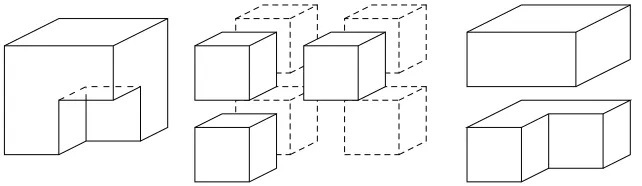
axis used to split is chosen so as to maximize the volume of the resulting simple box. This solution is illustrated in Figure 3. The carved box (left) can either be split into seven smaller boxes (middle), or into a larger box and another carved volume (right). We note that the latter approach, on top of minimizing the size of the volume list, preserves larger volumes. This additionally improves the refinement of bounds during the subsequent carving steps.
Fig. 3.Possible approaches to the volume split.
3.7 The CarveBox procedure
The carving point. In order to refine rank estimation, we classify key candi-dates inside a volume as more or less probable than the correct key, and carve pieces of this volume. The easiest way to do this is to pick the central point in the box, estimate its probability and carve the corresponding box. Unfortu-nately, this approach is rather inefficient as it will only classify one 2−d-th of the box volume wheredis the number of dimensions. Instead, we perform an heuris-tic optimization on the number of keys contained in the carved part, repeated on both sides of the equipotential surface. In practice, the surface is sufficiently “well-behaved” so that simple heuristics such as hill climbing (with some random restarts) suffice. More computationally intensive approaches (such as simulated annealing) only offer a marginal improvement while hampering speed.
4
Experimental results
The goal of this section is two-fold. In a first part we evaluate the speed and accuracy of our rank estimation algorithm. In a second part we apply this tool in the context of a security evaluation and discuss its usefulness. Our experi-ments are based on a c++ implementation of the rank estimation algorithm. Its functional correctness was tested by comparing the results to those of an enumeration algorithm for computationally reachable key ranks.
4.1 Performances of the rank estimation algorithm
In this first part, we are only interested in gaging the efficiency of the rank es-timation algorithm proposed in the previous section. To this end, we used for inputs the results of simulated template attacks against an unprotected aes -128 implementation. That is, we considered standard DPA as described in [21], targeting the 16 S-boxes in the first aes round and taking advantage of leak-age samples of the shape: li = HW(S[xi⊕ki]) +ni, with HW the Hamming weight function,xi (resp.ki) theith byte of the plaintext (resp. key), andni a Gaussian-distributed noise variable. As a result, we obtained attack outcomes in the form of 16 lists of 256 posterior probabilities. Note that our following analysis is quite independent of the exact type of side-channel attack implemented. As discussed in [32], key enumeration (hence, rank estimation) apply to any profiled or non-profiled DPA. In fact, the only important parameter for our performance evaluations is the rank of the correct key candidate that is suggested by the at-tack. In practice, we played with the noise variable and number of measurements in order to make this rank vary. The main criteria used to measure the efficiency of our algorithm are speed, memory and the tightness of the bounds.
In this context, a first task is the study of the impact of merging subkey lists during thePreProcess procedure. We analyzed convergence of the bounds obtained by our rank estimation algorithm as a function of the execution time in the following contexts: (i) No merging has been done on the subkey posterior distributions, i.e. the algorithm considers 16 dimensions of support 28, leading to 4 kbof memory requirements for the tables; (ii) Subkey lists were merged two by two, i.e. the algorithm considers 8 dimensions of support 216, leading to 524
kb of memory requirements for the tables; (iii) Subkey lists were been merged
by three, i.e. the algorithm considers 5 dimensions of support 224 and one of 28, leading to 83
mb of memory requirements for the tables. Merging further
would require more than 4gbof memory and was not necessary in our context. As can be noticed in Figure 4, merging has a strongly positive impact on the performances of the algorithm performances and thus merging should always be performed up to the memory limit. The different experiments presented in the rest of this section were always obtained by merging lists as per (iii).
50 60 70 80 90 100 110
Rank
estima
tion
(
log
2
)
5 15 30 45 60 75 90 105
Algorithm running time (seconds)
16×28 8×216 5×224
,1×28
Fig. 4.Convergence of bounds versus running time depending on merge options.
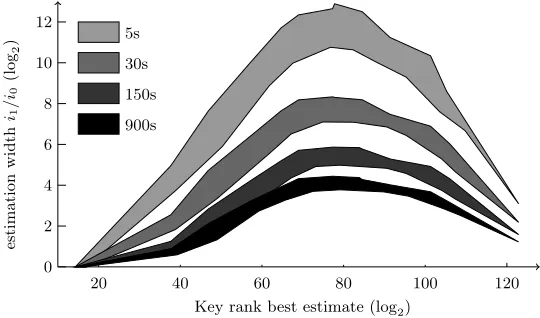
an estimated interval [i0;i1], then we plot log2(i1/i0) on the Y-axis to show the relative accuracy of the current estimation, against the geometrical mean of the best estimated bounds on the X-axis. By repeating the experiment and removing outliers4, we obtain the banana-shaped envelopes illustrated on the figure. Each envelope corresponds to a given running-time between 5 and 900 seconds.
0 2 4 6 8 10 12
estimation
width
i1
/i
0
(log
2
)
20 40 60 80 100 120
Key rank best estimate (log2)
5s
30s
150s
900s
Fig. 5.Estimation accuracy versus rank (best estimate) given running time.
These results highlight that in our setting, most of the estimation work is done after 150 seconds. We also note that in 5 seconds, the ratio between higher and lower bounds is at most of 14 binary orders of magnitude, which is actually a very good indicator when evaluating the security of a cryptographic component. In this respect, ranks from 260 to 2100 are the most difficult to estimate, while ranks smaller than 230 can be accurately determined within a few seconds.
4
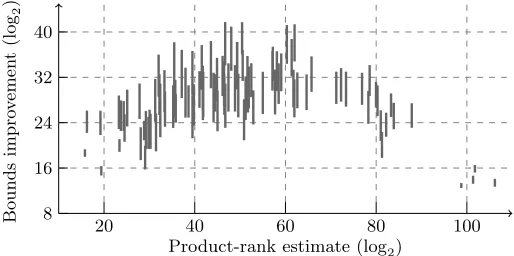
Eventually, another natural question is to determine how much our rank estimation algorithm allows improving crude lower bounds obtained by simply multiplying the subkey ranks together. Figure 6 shows the ratio between this approximation and the bounds returned by our algorithm after only 30s. Esti-mated intervals are plotted as gray vertical segments, with bound values divided by the rank product estimate. It can be observed that the product bound un-derestimates the actual rank by 20 to 40 binary orders of magnitude.
8 16 24 32 40
Bounds
impro
v
emen
t
(log
2
)
20 40 60 80 100
Product-rank estimate (log2)
Fig. 6.Improvement obtained by rank estimation over rank-product lower bound.
4.2 Using rank estimation in physical security evaluations
In general, the main objective of a physical security evaluation is to determine how many encryption traces allow an adversary to recover the secret key with non-negligible probability, given some reasonable restrictions of its computing power and memory requirements. For this purpose, a natural solution is to esti-mate the metrics introduced in [31], namely theo-th order success rate (which gives the probability that the correct key stands among theofirst ones provided by the attack), and the guessing entropy (which is the expected rank of the cor-rect key after the attack). However, and as already mentioned in introduction, the estimation of these metrics was so far limited to subkeys, or to success rates of enumerable orders for master keys. In the remainder of this section, we show how efficient rank estimation can be used to mitigate this limitation, and provide the complete picture for side-channel attack security evaluations.
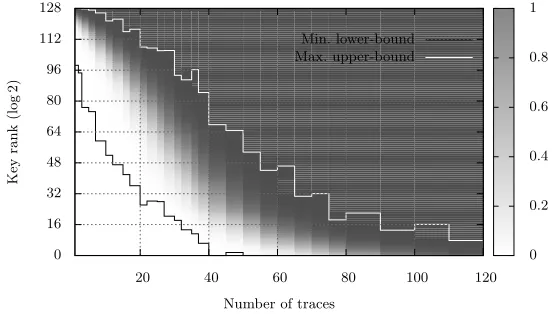
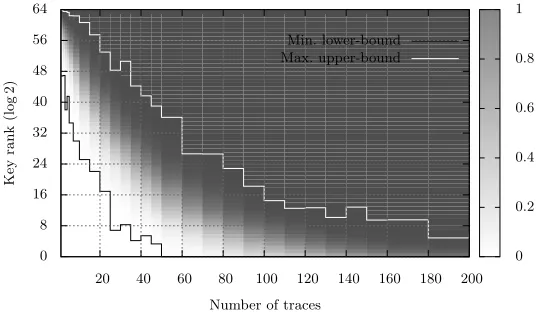
Building such a graph simply requires to perform several rank estimations, for different values of the number of encryption traces measured. These data provide a set of intervals that can then be used as input to a kernel density estimation (e.g. with uniform kernels). What is actually of interest to an eval-uator is the cumulant of the density function resulting from this estimation: it indicates the probability that a key will be found, depending of the amount of keys that the adversary can enumerate. Interestingly, such density estima-tions converge quickly. For example, the security graphs in Figures 7, 8 were obtained by performing 100 attacks and estimating the key rank during 5 sec-onds, which amounts to less than 10 minutes of computation for each possible number of traces. The continuous black (resp. white) lines indicate the minimum (resp. maximum) ranks observed. Basically, any data/enumeration point below the black line appears safe, while points above the white line lead to certain key recovery. The medium zone indicates a non-negligible probability of key recovery.
Min. lower-bound Max. upper-bound
20 40 60 80 100 120
Number of traces 0
16 32 48 64 80 96 112 128
Key
rank
(log
2)
0 0.2 0.4 0.6 0.8 1
Fig. 7.Example of a security graph for a template attack against unprotected AES.
Min. lower-bound Max. upper-bound
20 40 60 80 100 120 140 160 180 200
Number of traces 0
8 16 24 32 40 48 56 64
Key
rank
(log
2)
0 0.2 0.4 0.6 0.8 1
Fig. 8.Example of a security graph for a template attack against unprotected LED.
5 in the example of Figure 8) already allows decreasing the computing power required for key recovery down to approximately 240 (whereas it is still around 280 for the AES given the same number of traces). In general, the graphs of Figures 7 and 8 can be used directly to determine the re-keying rate in a leakage-resilient construction. The designer just has to choose an enumeration threshold corresponding to the computing power of the adversary considered, then he extracts the number of measurements that can be tolerated without risking a key recovery (using the figures black line minus a small security margin). Note that the rank and related enumeration effort can be translated into both time and memory costs thanks to the enumeration algorithm presented in [32]. Exemplary performances are reported in Table 1 (where enumeration times do not include the key testing as it depends on the cipher under attack). Figures 7 and 8 thus show the security of the device for different data/time/memory trade-offs.
220 230 240 250 260
Enumeration Time 0.25 s 6 m 2 w 165 y 77×105 y
(using [32]) Memory <3mb100mb 11.5gb1.35tb 157tb
Table 1.Time and memory requirements for key enumeration.
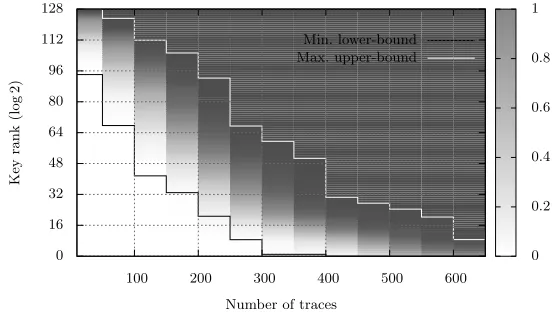
available online. Namely, the best attack reported in the contest needs 1173 traces to reach an 80% key recovery success rate when no enumeration is done. By adding enumeration up to rank 232, the data complexity requirement falls down to only 439 traces! In the “easier” context of the public database (described in Figure 9), the security graph shows that only 350 traces are needed with a 232-key enumeration, while a first-order success rate reaches 80% for 935 traces. To conclude, we mention that just as our rank estimation applies to profiled and non-profiled DPA, it also applies to protected implementations (e.g. with mask-ing [7, 15] or shufflmask-ing [17, 22]). The main reason is that standard side-channel attacks against such implementations would produce lists of subkey scores or probabilities, as described beforehand and exploited in this paper.
Min. lower-bound Max. upper-bound
100 200 300 400 500 600
Number of traces 0
16 32 48 64 80 96 112 128
Key
rank
(log
2)
0 0.2 0.4 0.6 0.8 1
Fig. 9.Security graph for the latest attack of DPA contest v2 (public traces).
References
1. ANSSI. Agence nationale de la securite des systemes d’information,
http://www.ssi.gouv.fr/en/products/certified-products/, retrieved on aug. 1, 2012. 2. Mihir Bellare, Anand Desai, E. Jokipii, and Phillip Rogaway. A concrete security treatment of symmetric encryption. In FOCS, pages 394–403. IEEE Computer Society, 1997.
3. Eli Biham, Orr Dunkelman, and Nathan Keller. New results on boomerang and rectangle attacks. In Joan Daemen and Vincent Rijmen, editors,FSE, volume 2365
ofLecture Notes in Computer Science, pages 1–16. Springer, 2002.
4. Eli Biham and Adi Shamir. Differential cryptanalysis of DES-like cryptosystems. In Alfred Menezes and Scott A. Vanstone, editors,CRYPTO, volume 537 ofLecture
Notes in Computer Science, pages 2–21. Springer, 1990.
5. Eric Brier, Christophe Clavier, and Francis Olivier. Correlation power analysis with a leakage model. In Joye and Quisquater [18], pages 16–29.
7. Suresh Chari, Charanjit S. Jutla, Josyula R. Rao, and Pankaj Rohatgi. Towards sound approaches to counteract power-analysis attacks. In Wiener [33], pages 398– 412.
8. Suresh Chari, Josyula R. Rao, and Pankaj Rohatgi. Template attacks. In Burton S. Kaliski Jr., C¸ etin Kaya Ko¸c, and Christof Paar, editors,CHES, volume 2523 of
Lecture Notes in Computer Science, pages 13–28. Springer, 2002.
9. Joan Daemen and Vincent Rijmen. The wide trail design strategy. In Bahram Honary, editor,IMA Int. Conf., volume 2260 ofLecture Notes in Computer Science, pages 222–238. Springer, 2001.
10. Joan Daemen and Vincent Rijmen. Probability distributions of correlation and differentials in block ciphers. Journal of Mathematical Cryptology, 1(3):221–242, 2007.
11. Yevgeniy Dodis, Yael Tauman Kalai, and Shachar Lovett. On cryptography with auxiliary input. In Michael Mitzenmacher, editor, STOC, pages 621–630. ACM, 2009.
12. Stefan Dziembowski and Krzysztof Pietrzak. Leakage-resilient cryptography. In FOCS, pages 293–302. IEEE Computer Society, 2008.
13. Benoˆıt G´erard and Fran¸cois-Xavier Standaert. Unified and optimized linear col-lision attacks and their application in a non-profiled setting. to appear in the
proceedings of CHES 2012, 2012.
14. Benedikt Gierlichs, Lejla Batina, Pim Tuyls, and Bart Preneel. Mutual information analysis. In Elisabeth Oswald and Pankaj Rohatgi, editors,CHES, volume 5154
ofLecture Notes in Computer Science, pages 426–442. Springer, 2008.
15. Louis Goubin and Jacques Patarin. DES and differential power analysis (the ”du-plication” method). In C¸ etin Kaya Ko¸c and Christof Paar, editors,CHES, volume 1717 ofLecture Notes in Computer Science, pages 158–172. Springer, 1999. 16. Jian Guo, Thomas Peyrin, Axel Poschmann, and Matthew J. B. Robshaw. The
LED block cipher. In Bart Preneel and Tsuyoshi Takagi, editors, CHES, volume 6917 ofLecture Notes in Computer Science, pages 326–341. Springer, 2011. 17. Christoph Herbst, Elisabeth Oswald, and Stefan Mangard. An aes smart card
implementation resistant to power analysis attacks. In Jianying Zhou, Moti Yung, and Feng Bao, editors,ACNS, volume 3989 ofLecture Notes in Computer Science, pages 239–252, 2006.
18. Marc Joye and Jean-Jacques Quisquater, editors. Cryptographic Hardware and Embedded Systems - CHES 2004: 6th International Workshop Cambridge, MA,
USA, August 11-13, 2004. Proceedings, volume 3156 ofLecture Notes in Computer
Science. Springer, 2004.
19. Pascal Junod. On the complexity of Matsui’s attack. In Serge Vaudenay and Amr M. Youssef, editors,Selected Areas in Cryptography, volume 2259 ofLecture
Notes in Computer Science, pages 199–211. Springer, 2001.
20. Paul C. Kocher, Joshua Jaffe, and Benjamin Jun. Differential power analysis. In Wiener [33], pages 388–397.
21. S. Mangard, E. Oswald, and F.-X. Standaert. One for all – all for one: unifying standard differential power analysis attacks. IET Information Security, 5(2):100– 110, 2011.
22. Stefan Mangard, Elisabeth Oswald, and Thomas Popp. Power analysis attacks
-revealing the secrets of smart cards. Springer, 2007.
24. Marcel Medwed and Fran¸cois-Xavier Standaert. Towards super-exponential side-channel security with efficient leakage-resilient PRFs, non-profiled setting. to
ap-pear in the proceedings of CHES 2012, 2012.
25. Amir Moradi, Oliver Mischke, and Thomas Eisenbarth. Correlation-enhanced power analysis collision attack. In Stefan Mangard and Fran¸cois-Xavier Standaert, editors,CHES, volume 6225 ofLecture Notes in Computer Science, pages 125–139. Springer, 2010.
26. Jing Pan, Jasper G. J. van Woudenberg, Jerry den Hartog, and Marc F. Witteman. Improving DPA by peak distribution analysis. In Alex Biryukov, Guang Gong, and Douglas R. Stinson, editors,Selected Areas in Cryptography, volume 6544 ofLecture
Notes in Computer Science, pages 241–261. Springer, 2010.
27. Telecom ParisTech. http://www.dpacontest.org/, retrieved on aug. 1, 2012. 28. Werner Schindler, Kerstin Lemke, and Christof Paar. A stochastic model for
dif-ferential side channel cryptanalysis. In Josyula R. Rao and Berk Sunar, editors, CHES, volume 3659 ofLecture Notes in Computer Science, pages 30–46. Springer, 2005.
29. Kai Schramm, Gregor Leander, Patrick Felke, and Christof Paar. A collision-attack on AES: Combining side channel- and differential-attack. In Joye and Quisquater [18], pages 163–175.
30. Ali Aydin Sel¸cuk. On probability of success in linear and differential cryptanalysis.
J. Cryptology, 21(1):131–147, 2008.
31. Fran¸cois-Xavier Standaert, Tal Malkin, and Moti Yung. A unified framework for the analysis of side-channel key recovery attacks. In Antoine Joux, editor,
EU-ROCRYPT, volume 5479 of Lecture Notes in Computer Science, pages 443–461.
Springer, 2009.
32. Nicolas Veyrat-Charvillon, Benoˆıt G´erard, Mathieu Renauld, and Fran¸cois-Xavier Standaert. An optimal key enumeration algorithm and its application to side-channel attacks. to appear in the proceedings of SAC 2012, 2012.
33. Michael J. Wiener, editor. Advances in Cryptology - CRYPTO ’99, 19th Annual International Cryptology Conference, Santa Barbara, California, USA, August
15-19, 1999, Proceedings, volume 1666 ofLecture Notes in Computer Science. Springer,
1999.
34. Yu Yu, Fran¸cois-Xavier Standaert, Olivier Pereira, and Moti Yung. Practi-cal leakage-resilient pseudorandom generators. In Ehab Al-Shaer, Angelos D. Keromytis, and Vitaly Shmatikov, editors, ACM Conference on Computer and