_____________________________________________________________________________________________________ (Past name: British Journal of Medicine and Medical Research, Past ISSN: 2231-0614, NLM ID: 101570965)
Blood Loss at Caesarean Section: A Five-Year
Single Centre Experience in the Niger Delta
E. H. Ikhobo
1and A. O. Addah
1*1
Department of Obstetrics and Gynaecology, Niger Delta University Teaching Hospital, Okolobiri, Bayelsa State, Nigeria.
Authors’ contributions
This work was carried out in collaboration between the two authors. Author EHI designed the study, performed the statistical analysis. Author AOA wrote the Abstract, Introduction, protocol, and wrote the first draft of the manuscript. Author AOA managed the analyses of the study. Author AOA managed the literature searches. Both authors read and approved the final manuscript.
Article Information
DOI: 10.9734/JAMMR/2017/30614 Editor(s): (1) Edward J. Pavlik, University Kentucky Medical Center, Division of Gynecological Oncology, USA. Reviewers: (1)Joe Liu, WSU, Detroit Medical Center, USA. (2)Jan Jakobsson, Danderyds University Hospital, Sweden. (3)Akwasi Antwi-Kusi, Kwame Nkrumah University of Science and Technology, Ghana. Complete Peer review History:http://www.sciencedomain.org/review-history/20755
Received 21st November 2016 Accepted 23rd January 2017 Published 31st August 2017
ABSTRACT
Objective: The objective of this study is to review outcomes of our caesarean delivery in terms of: - amount of intraoperative blood loss and whether this compares favourably with blood loss at
other centres.
- to compare the effects various calibers of surgeons and experience impact on blood loss at caesarean section.
- the effects unbooked emergencies impact on blood loss at caesarean section. - the impact of the time spent by the surgeon on the degree of blood loss.
- the effect of fetal macrosomia, gestational age at caesarean delivery, previous caesarean section has on blood loss at caesarean section.
- to identify areas where improvements can be made.
Methodology: This was a descriptive, cross-sectional, retrospective study. This study was carried out at the Department of Obstetrics and Gynaecology, Niger Delta University Teaching Hospital, Okolobiri, Bayelsa state Nigeria. Eight hundred and forty eight subjects who delivered between
January 2008 and January 2013 (both those who registered for antenatal care and those who were referred as emergencies) were recruited into the study. The records of the subjects for the study were extracted from their hospital files and the results so obtained coded into SPSS version 20 for analysis.
Results: The Mean blood loss at caesarean section for the study was 712.3 ml ± 389.5. There was no statistically significance difference between group means of blood loss by Consultants, Seniour Residents and Juniour Residents at Caesarean section as determined by one-way ANOVA ( F.803= 1.252, P= .721 and .207 ). The mean time duration of surgery for the study was 63.57 ± 18.74 minutes. There was no statistically significant difference between the means of the time spent by Consultants, Seniour Residents and Juniour Residents as determined by the Oneway ANOVA test (F 1.021= -801, P= .444, .787).
Conclusion: Unbooked emergencies contributed so much to the degree of blood loss amongst other variable factors in this study. This is an issue that has plagued obstetric practice in sub-Saharan Africa and a major contributor to maternal morbidity and mortality. Caregivers and stake holders alike including governments, non-governmental organizations need to invest money and time including advocacy to reduce this ugly trend.
Keywords: Blood loss; Caesarean section; Calibre of surgeon; time duration of caesarean section; elective and emergency Caesarean setions; haemorrhage.
1. INTRODUCTION
Caesarean Section, the surgical act of delivering the baby by incising the anterior abdominal and uterine muscles has undergone tremendous revolutions since its inception in the times of Emperor Numa Pompilius of Rome –Lex Caesarea 715-673 BC [1]. Maternal mortality at inception then was almost 100%, from sepsis, haemorrhage and non-existent anesthesia. The discovery of antibiotics, blood transfusion, modern anaesthesia with the introduction of the lower segment caesarean section by Munro Kerr transformed Caesarean section and Obstetric Practice [1,2].
Currently, caesarean section is the most frequently performed operation in obstetric practice because of its safety [3,4]. However, haemorrhage continues to plague caesarean
delivery especially those complicated by
adhesion formation from previous abdominal surgeries including caesarean sections. Other causes of peripartum haemorrhage include placenta praevia, morbidly adherent placenta,
obstructed labour, previous abdominal
myomectomy, the presence of fibroids in the lower uterine segment [5]. The skill of the surgeon and the mode of anaesthesia used for the surgery also contribute to intraoperative haemorrhage. Obstetric haemorrhage is a leading cause of maternal mortality both in developing and developed countries [6]. Efforts are ongoing with clinical trials of prior administration of tranexamic acid to patients
undergoing caesarean section to reduce blood loss [7].
Blood loss of ≥ 1,000 ml is regarded as excessive intraoperative haemorrhage [8,9] or any amount of blood loss that is able to compromise the haemodynamics of the patient.
Quantification of blood loss at caesarean delivery is, therefore, necessary for an adequate replacement to preserve the haemodynamics of the patient.
There is not yet an accurate clinical technique for the quantification of blood loss at caesarean section [10].
Traditionally, blood loss at caesarean section is estimated by reading the volume of blood collected into graduated jars and bottles of suction machines. Additional estimation of blood loss is made by recording the number of soaked standard abdominal towels plus the visual estimation of blood soaked in linens used for the surgery. However, this method is associated with high degree of underestimation of blood loss [10,11,12]. Most times, there is a discrepancy between estimated blood loss between the
Surgeon and Anaesthetist that impacts
negatively on prompt treatment of intrapartum haemorrhage [10].
The goal of this study is to observe the determinants of intraoperative haemorrhage at cesarean section and to see how it impacts on patient care.
2. METHODOLOGY
The study was carried out in the Niger Delta University Teaching Hospital, Okolobiri, Bayelsa state, Southern Nigerian. It was a cross-sectional retrospective study of 848 Subjects who delivered by caesarean section at this centre between first January 2008 to January 2013. Both booked and unbooked antenatal patients who underwent elective or emergency caesarean delivery within the study period were included in the study. Excluded from the study were those with diagnosed haemostatic and coagulation problems. Ethical Committee approval was obtained specifically for the privacy of patients used for the study.
The data was collected from the labour ward and theatre records of subjects recruited for the study. Information sought from the records includes the social demographic characteristics of subjects, mean blood loss at caesarean section, and the proficiency of the surgeon with regards to blood loss and duration of surgery. The indication[s] for surgery, the booking status of the patient, elective or emergency operations, the number of previous caesarean section(s), baby’s weight, gestation at delivery, mean units of blood transfused and 48-hour postoperative haematocrit.
The conventional method of recording blood loss at the centre was used for the study. The Anaesthetist and the Obstetrician independently estimate their various blood losses after the surgery and the values are added for an average to be calculated. This average is then recorded in the operating notes as a single value.
The blood loss at surgery was estimated by a combination of factors: The abdominal towels used by the Obstetrician during the surgery are each held up by a sponge holding forceps, any of these towels fully soaked with blood but not dripping is said to hold 120 ml of blood while that which is dripping with blood is said to hold 150 ml of blood. The blood collected directly into suction machine bottles is measured directly. The blood that accumulated in the vagina during the surgery is collected into graduated metallic jars. The blood that spilled into linen (if enough) is also scooped into a graduated jar. The blood that
is soaked in linen is visually estimated. All the various blood losses are summed up to give the estimated blood loss. The level of statistical significance for the study was set at 95% confidence interval [p<0.05].
Data was collected and coded into SPSS version 20 for windows. Data obtained were presented as numbers with percentages, and ranges. The results were analyzed using Means ± SD, Pearson Chi Square tests, Regression analysis. P-value of < 0.05 was considered statistically significant.
3. RESULTS
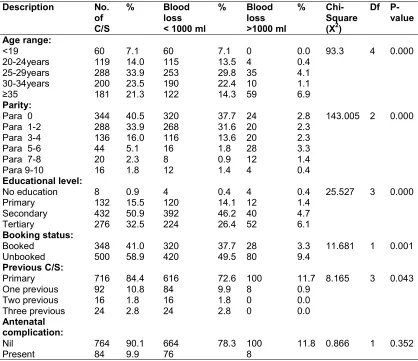
Eight hundred and forty eight subjects who delivered by caesarean section during the study period were enrolled for the study. The mean maternal age was 28.8 ± 6.2 years, the minimum age was 15 years, and the maximum age was 43 years. Sixty subjects [7.1%] were under 19 years and 119 [14.0%] were between 20-24 years. The mean parity for the study population was 2.9 ± 2.0. Primigravidae were 344 [40.5%], Para 1-2 were 288 [33.9%]. Education - One hundred and thirty-two [15.7%] had primary
education, 432 [50.9%] had secondary
education. Three hundred and forty-eight [41.0%] were booked while 500 [59.0%] were unbooked antenatal clients. Seven hundred and sixteen [84.4%] had a primary caesarean section, 92[10.8%] had one previous caesarean section. Seven hundred and sixty-four [90.1%] had no comorbid condition during the antenatal period while 84[9.9%] had one form of issue or the other during the same period.
See Table 1 for blood loss analysed in terms of age, parity, education, booking status and complications of subjects.
The Mean blood loss at caesarean section for the study was 712.3 ml ± 389.5. The mean blood loss for the surgeries performed by Consultants was 711.8 ± 315.9, the mean blood loss by the Seniour Residents was 715.5ml ± 476.4 ml while the blood loss for the Juniour Residents was 708.8 ± 346.1 ml. There was no statistically significance difference between group means of blood loss by Consultants, Seniour Registrars
and registrars at Caesarean section as
Table 1. Maternal Socio-demographic distribution and blood loss during caesarean section
Description No. of C/S
% Blood loss < 1000 ml
% Blood loss >1000 ml
% Chi-Square (X2)
Df P-value Age range: <19 20-24years 25-29years 30-34years ≥35 60 119 288 200 181 7.1 14.0 33.9 23.5 21.3 60 115 253 190 122 7.1 13.5 29.8 22.4 14.3 0 4 35 10 59 0.0 0.4 4.1 1.1 6.9
93.3 4 0.000
Parity: Para 0 Para 1-2 Para 3-4 Para 5-6 Para 7-8 Para 9-10 344 288 136 44 20 16 40.5 33.9 16.0 5.1 2.3 1.8 320 268 116 16 8 12 37.7 31.6 13.6 1.8 0.9 1.4 24 20 20 28 12 4 2.8 2.3 2.3 3.3 1.4 0.4
143.005 2 0.000
Educational level: No education Primary Secondary Tertiary 8 132 432 276 0.9 15.5 50.9 32.5 4 120 392 224 0.4 14.1 46.2 26.4 4 12 40 52 0.4 1.4 4.7 6.1
25.527 3 0.000
Booking status: Booked Unbooked 348 500 41.0 58.9 320 420 37.7 49.5 28 80 3.3 9.4
11.681 1 0.001
Previous C/S: Primary One previous Two previous Three previous 716 92 16 24 84.4 10.8 1.8 2.8 616 84 16 24 72.6 9.9 1.8 2.8 100 8 0 0 11.7 0.9 0.0 0.0
8.165 3 0.043
Antenatal complication: Nil Present 764 84 90.1 9.9 664 76
78.3 100
8
11.8 0.866 1 0.352
At 95% confidence interval, there was a statistical significant relationship between maternal age ( P = 0.000), Parity (P = 0.000), educational level (P = 0.000), booking status (P = 0.001), previous caesarean section (P =
0.043) and blood loss. No statistical significant relationship was observed between presence of complication during antenatal and blood loss during surgery (P = 0.352)
Table 2. Category of surgeon and blood loss during caesarean section
Variable No. of C/S
% Blood loss < 1000 ml
% Blood loss >1000 ml
% Chi-square (X2)
Df P-value
Calibre of surgeon: Junior Resident Senior Resident Consultant 252 308 288 29.7 36.3 33.9 220 276 244 25.9 32.5 28.7 32 32 44 3.7 3.7 5.1
3.200 2 0.202
The mean time duration of surgery for the study was 63.5 ± 18.7 minutes. The mean time duration of surgery by Consultants was 62.7 ± 20.1 minutes, Seniour Residents mean time duration of surgery was 63.73 ± 19.47
minutes and the mean duration of surgery for Juniour Residens was 64.2 ± 16.1 minutes.
There was no statistically significance difference between group means of duration of caesarean section by Consultants, Seniour Registrars and registrars as determined by one-way ANOVA test ( F.803= 1.021 =.801, P=
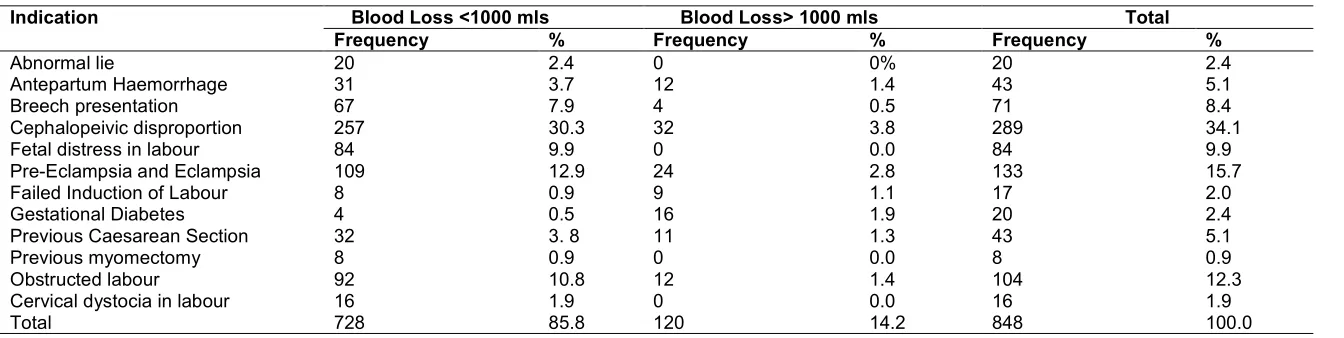
The indications for caesarean sections and the amount of blood loss attributed to them are as follows: Twenty [2.4%] were done for abnormal lie, 71 [8.4%)] for breech presentation, and 289
[34.1%] were done for cephalopelvic
disproportion in labour. See Table 3 for indications for caesaren sections and blood loss attributed to them.
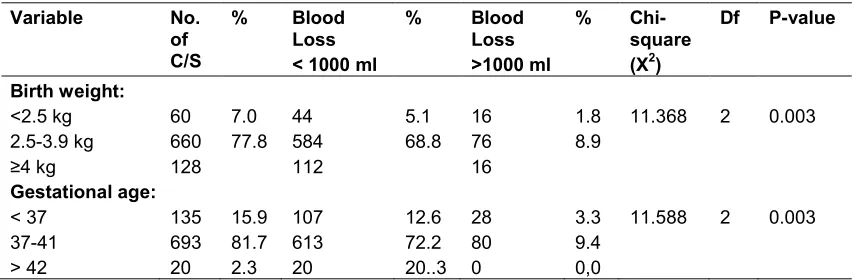
Sixty babaies [7.0%] weighed below 2,5 kg while 660 [77.8] weighed between 2.5 – 3.9 kg.
One hundred and thirty five [15.9%] babies were delivered at a gestational age less than 37 weeks while 693 [81.7%] babies were delivered between the gestational ages between 37- 41 weeks.
Table 5 shows the influence of birth weight and gestationa at caesarean section and blood lossassociated with them.
4. DISCUSSION
One in five [1:5] women in our study were of advanced maternal age. Women globally and in Nigeria tend to delay childbearing until advanced maternal age because of educational pursuit [14,15]. The benefits of education cannot be underrated, however, advanced age of the
prospective mother predisposes to both
increased tendencies towards medical disorders and post-partum haemorrhage [16,17]. There
was a statistically significant relationship
between maternal age and blood loss in this
study. This is consistent with a large
retrospective study done in Tochigi, Japan where maternal age ≥ 35 years was an independent risk factor for blood loss at parturition irrespective of the mode of delivery [17]. There was an association between high parity, numbers of previous caesareans and tendency towards intrapartum haemorrhage in the study and this is in agreement with studies done in Saudi Arabia [18] and Port-Harcourt, Nigeria respectively [18,19]. However, these results were different from another Saudi Arabian study [20] where there was no statistical significance between
higher order caesarean sections and
intraoperative blood loss [20].
The educational attainment of subjects in the study was very high. Globally, high educational status is associated with high knowledge of antenatal care issues and the utilization of health care services [21,22]. There was a statistical
significance between maternal educational status and the degree of intrapartum blood loss at caesarean section for this study.
The mean blood loss at caesarean operations for this study was higher than studies in Pakistan with a mean blood loss of 592 ml [9] and that of the joint Egyptian and Saudi Arabia with a mean blood loss of 539 ml [12]. These differences in the blood loss may be explained by the
preponderance of emergency to elective
caesarean sections in our study of 82.7% to 17.3% respectively to that of Pakistan study where 34% were emergency and 66 % elective caesarean sections [9]. All subjects recruited for the Egyptian study had elective caesarean sections. Substantial evidence abounds that emergency caesarean section is associated with
more maternal morbidity and mortality,
haemorrhage inclusive, compared with elective
caesarean section [19,23,24,25]. Elective
caesarean section cases do not only have better preoperative preparations and outcome, the majority of subjects in our study were unbooked
emergencies with many of obstetric
complications and tendency towards obstetric haemorrhage [26,27]. There was statistical
significance in intrapartum haemorrhage
between booked and unbooked patients in our study.
Our observed mean blood loss compares favourably with global standards of ≥ 1,000 ml being defined as excessive intraoperative haemorrhage.
6
Table 3. Correlation between mean blood loss at caesarean section and mean duration of surgery
S/N Category of surgeon
No. of C/S
% Type of C/S elective
% Emergency
caesarean section
% Mean blood loss (ml)
Mean duration of surgery (Mins)
r/p-value
1 Junior Resident 252 29.7 6 0.7 246 29.0 708.8 ± 346.1 64.2± 16.1
1 (0.000)
2 Senior Resident 308 36.3 38 4.5 270 31.8 715.5 ± 476.4 63.7 ±19.4
3 Consultant 288 33.9 103 12.1 185 21.8 711.8 ± 315.9 62.7± 20.1
Total/Mean 848 100 147 17.3 701 82.7 712 ± 389.5 63.5± 18.7 848
At r = 1, p = 0.000, there was a statistically significant relationship and a correlation between blood loss and duration of surgery
Table 4. Indications for caesarean sections and associated blood loss
Indication Blood Loss <1000 mls Blood Loss> 1000 mls Total Frequency % Frequency % Frequency %
Abnormal lie 20 2.4 0 0% 20 2.4
Antepartum Haemorrhage 31 3.7 12 1.4 43 5.1
Breech presentation 67 7.9 4 0.5 71 8.4
Cephalopeivic disproportion 257 30.3 32 3.8 289 34.1
Fetal distress in labour 84 9.9 0 0.0 84 9.9
Pre-Eclampsia and Eclampsia 109 12.9 24 2.8 133 15.7
Failed Induction of Labour 8 0.9 9 1.1 17 2.0
Gestational Diabetes 4 0.5 16 1.9 20 2.4
Previous Caesarean Section 32 3. 8 11 1.3 43 5.1
Previous myomectomy 8 0.9 0 0.0 8 0.9
Obstructed labour 92 10.8 12 1.4 104 12.3
Cervical dystocia in labour 16 1.9 0 0.0 16 1.9
Table 5. Fetal variables and blood loss during caesarean section
Variable No. of C/S
% Blood Loss < 1000 ml
% Blood Loss >1000 ml
% Chi-square (X2)
Df P-value
Birth weight: <2.5 kg 2.5-3.9 kg ≥4 kg
60 660 128
7.0 77.8
44 584 112
5.1 68.8
16 76 16
1.8 8.9
11.368 2 0.003
Gestational age: < 37
37-41 > 42
135 693 20
15.9 81.7 2.3
107 613 20
12.6 72.2 20..3
28 80 0
3.3 9.4 0,0
11.588 2 0.003
There was a statistically significant relationship between fetal variables and blood loss during caesarean section for both birth weight and gestational age (P = 0.003)
There was no statistical difference between junior, senior residents and consultant surgeons in terms of the degree of blood loss at caesarean section in the study. These results were comparable with a study done in Morocco where there was no difference in operating time and techniques based on the experience of the surgeon [30]. The resident is only allowed to be the lead surgeon in our centre if he has acquired such proficiency based on standards set by ‘The
West African College of Surgeons’ the
supervising authority for residency training in the sub-region [31]. However, the results are not in agreement with the study in North Western Nigeria and in the Bronx Lebanon Hospital, New York where there was a statistical difference in the degree of blood loss and the experience of the surgeon [27,32]. The results from North Western Nigeria may have differed from that in our centre because 25.7% of their subjects who had caesarean delivery were cases of obstructed labour [26] as compared to 10% of subjects who had obstructed labour at ‘The Niger Delta University Teaching Hospital. In the Bronx Lebanon hospital study, the discrepancy may have been due to proficiency because both their estimated intraoperative blood loss and duration of surgery were in excess of the figures from our centre [32].
There was a statistically significant difference between the indications for caesarean section and the degree of intraoperative blood loss amongst subjects studied. Obstructed labour and its forerunner, cehaphalopelvic disproportion contributed 2:5 of the indications for caesarean section in our study. These results have been the trend in most of the sub-Saharan region [33,34]. The acute angle of pelvic inclination in the African woman delays entry of the fetal
presenting part into the maternal pelvis in labour,
often times culminating in cephalopelvic
disproportion and obstructed labour [35].
Strenuous work in childhood years, nature, and nurture also contibutes to the formation of contracted pelvis [36]. All these issues among others lead to protracted labour with higher tendencies to intraoperative haemorrhage at cesarean section.
There was statistically significant variation between fetal weight and the amount of blood loss at caesarean section amongst study subjects. Fetal macrosomia is associated with intrapartum haemorrhage [37]. This may be due to large placentae with wide area of attachment to the uterine decidua which is prone to bleeding after its removal. The likelihood of uterine wound
extension intraoperatively and associated
haemorrhage is more with macrosomic babies than average sized ones.
There was also a statistically significant relationship between gestational age and degree of blood loss at caesarean section. This may be due to the fact that premature births are more prone to have adherent placetae that are more difficult to separate at delivery either by vaginal
or caesarean delivery with concomitant
haemorrhage. At the other extreme of gestational age beyond term fetal macrosomia with large placenta site and with a wider area of attachment are more prone to hemorrhage.
5. CONCLUSION
can be made: however, the results of our audit have shown that perioperative blood loss is still an issue which will continue to plague caesarean delivery both in the sub-Saharan region and globally. The solution will rest on the ability of health institutions to improve and enlarge their capacity to handle obstetric emergencies especially the unbooked patients which featured
prominently in this study. Stakeholders,
Government and Non-Governmental
Organizations, sub-regional and world bodies need to intervene to stem the tide of this factor that is a forerunner of maternal mortality and morbidity in Africa.
CONSENT
It is not applicable.
COMPETING INTERESTS
Authors have declared that no competing interests exist.
REFERENCES
1. Medical Center Isreal. The truth about
Julius Caesar and ‘Caesarean’ sections. Available: www.hmcisreal.com
2. United States Library of Medicine (NLM).
Caesarean Section-A brief History;
1998.
Available:www.nlm.nih.gov/accessibility.ht ml
3. Skozynski M, Jakiel G, Kwansniewska A,
Craczkowski JJ, Semczuk M. Forceps Delivery after two previous caesarean sections. Ann Uni Mariae Curie (Med). 2004;59(2):15-18.
4. Ikechebelu JI, Mbamara SU, Afuba
AN. Vaginal birth after one caesarean section: A review of the practice at Nnewi, Southeast Nigeria. Journal of
Medicine and Medical Sciences.
2010;1(7):309-313.
5. Khursheed F, Sirichand P, Jatoi N.
Intraoperative Complications encountered
in Patients with Repeat Caesarean
Section. JLUMHS. 2009;88(1):76-79.
6. World Health Organisation. WHO
recommendations for the prevention and treatment of postpartum haemorrhage. Geneva. WHO; 2012.
7. Tarabin O, Galich S, Tkachenko R,
Gulyaev A, Scherbkov S, Gavrychenko D.
Reduced blood loss during caesarean section under the action of a tranexamic
acid: 6AP2-11. European Journal
Anaesthesiology. 2012;29:97.
8. Beazley JM. Caesarean section. In:
Obstetrics. Turnbull A, Chamberlain G., Eds. Churchill Livingstone, Edinburgh. 1989;857-575.
9. Khan FA, Khan M, Ali A, Chohan U.
Estimation of blood loss at caesarean section: An audit. J Pak Med Assoc. 2006;56(12):572-575.
10. Brecher ME, Monk T, Goodnough LT. A
standard method for calculating blood loss. Transfusion. 1997;37(10):1070-4.
11. Duthie SJ, Ven D, Yung GL, Guang DZ,
Chan SY. The discrepancy between
Laboratory determination and visual
estimation of blood loss during normal vaginal delivery. Eur J Obstet Gynecol Reprod Biol. 1991;38(2):1119-24.
12. Ashraf AH, Hisham MR. Assessment of
blood loss during caesarean section under
general anaesthesia and epidural
anaesthesia using different methods.
Alexandria J Anaesth Intern. 2006;9(1):25-34.
13. Dildy GA, Paine AR, George NC, Velasco
C. Estimating blood loss: Can teaching significantly improve visual estimation? Obstetrics & Gynecology. 2004;104(3): 601-606.
14. Orazulike NC, Jeremiah I, Green KI,
Uzoigwe SA. Effect of age on childbearing in Port Harcourt, Nigeria. Int J Biomed Sci. 2015;11(2):82–85.
15. Ferré C. Age at first child: does education delay fertility timing? The case of Kenya. The World Bank South Asia Region, Human Development Division; 2009. Available:https://openknowledge.worldban k.org/bitstream/handle/10986/4029/WPS48 33
16. Bergholt T, Stenderup JK,
Vedsted-Jakobsen A, Helm P, Lenstrup C
Intraoperative surgical complication during
cesarean section: An observational
study of the incidence and risk factors. Acta Obstet Gynecol Scand. 2003;82(3): 251.
17. Ohkuchi A, Ogawa T, Usui R, Koike T,
Hiratsuka M, Izumi A, Ohkusa T,
Matsubara S, Sato I, Suzuki M, Minakami H. Effect of maternal age on blood loss
multivariate analysis of 10,053 cases. J Perinat Med. 2003;31(3):209-15.
18. Rowaily MAA, Alsalem FA, Mostafa A,
Abolfotouh MA. Cesarean section in a high-parity community in Saudi Arabia: clinical indications and obstetric outcomes.
BMC Pregnancy and Childbirth.
2014;14:92.
DOI: 10.1186/1471-2393-14-92 e-Pp 1-10. Available:http://bmcpregnancychildbirth.bio medcentral.com/articles/10.1186/1471-2393-14-92
19. Obuna JA, Ugboma HAA, Ejikeme BN,
Umeora OUJ, UM Agwu UM. Pattern and outcome of higher order caesarean section in a secondary health facility in Nigeria. Res in Obstet and Gynecol. 2012;1(3):19-22.
20. Chaudhary GA, Patell M, Suleiman HA.
The effects of repeated caesarean
sections on maternal and fetal outcomes. Saudi Journal of Medicine and Medical Sciences. 2015;3(1):33-49.
21. Adewoye KT, Musa IO, Atoyebi OA,
Babatunde OA. Knowledge and utilisation of antenatal care services by women of childbearing years in Ilorin – Est Local Government Area, North Central Nigeria. Int J Sc. Tech. 2013;3(3):188-193.
22. Ghaffar A, PonganichS, Chapman RS,
Panza A, Mureed S, et al. Provision and utilisation of routine antenatal care in Rural Balochistan province, Pakistan: A survey of knowledge, attitudes, practices of pregnant women. J App Med Sc. 2012;1(1):93-116.
23. Kolås T, Øian P, Skjeldestad FE. Risks for
preoperative excessive blood loss in cesarean delivery. Acta Obstet Gynecol Scand. 2010;89(5):658-63.
DOI: 10.3109/00016341003605727.
24. Mettu K, Reshma CR. Study of
intraoperative difficulties in repeat
caesarean sections. Paripex- Ind J Res. 2015;41:124-125.
25. Fabamwo A, Akinola D, Mojoyinola O. The
tragic consequences of unsupervised pregnancies among patients referred to a tertiary maternity unit in Lagos, South West Nigeria. The Internet Journal of Tropical Medicine. 2009;7(1).
Available:http//ispub.com/IJTM/12195
26. Daniel CN, Singh S. Caesarean delivery:
An experience from a tertiary institution in
North Western Nigeria. Nig. J Clin Pract. 2016;19(1):18-24.
27. Belay T, Yusuf L, Negash S. A
comparative study on the first stage versus the second stage caesarean section on the
maternal and perinatal outcome. Ethiop
Med J. 2014;52(1):1-8.
28. Fasubaa OB, Ezechi OC, Orji EO,
Ogunniyi SO, Akindele ST, Loto
OM, Okogbo FO. Delivery of the impacted head of the fetus at caesarean section after prolonged obstructed labour: A randomised comparative study of two methods. J Obstet Gynaecol. 2002;22(4): 375-83.
29. Doherty DA, Magann EF, Chauhan SP,
O’Boyle AL, Busch JM, Morrison JC. Factors affecting caesarean operative time on Pregnancy outcomes. Austr. and NZ J Obstet & Gynaecol. 2008;286-291.
30. Benzouina S, Boubkraoui ME, Mrabet M,
Chahid N, Kharbach A, El-hassani A, Amina Barkat A. Fetal outcome in
emergency versus elective cesarean
sections at Souissi Maternity Hospital, Rabat, Morocco. The Pan African Medical Journal. 2016;23:197.
DOI:10.11604/PAMJ.2016.23.197.7401 Available:
www.paafrican-med-journal.com/content/article/23/197/full/ (Accessed on: 27-8-2016)
31. West African College of Surgeons: Faculty
Obstetrics and Gynaecology. Training Programmes and Curricula, Febuary; 2014.
Available:www.wascoac.org/index.php/fac ulties/obstetric-gynaecology
32. Marroquin GA, Tudorica N, Hetch R,
Mikhail M. Residence Experience and blood loss in Primary Caesarean Section. General Medicine. 2013;2:125.
DOI:10.4172/2327-5146.1000125.
33. Dumont A, de Bernis L, Bouvier-Colle MH.
Caesarean section rate for maternal
indication in sub-Saharan Africa: A
systematic review. Lancet. 2001;
358(9290):1328-33.
34. Chu K, Cortier H, Maldonado F, Mashant
T, Ford N, et al. Caesarean section rates and indications in sub-Saharan Africa: A multi-country study from Medicines sans Frontiers; 2012.
35. Baker PN. Labour. In: Ten Teachers. Baker PN (ED), Eighteen Edition. Hodder Arnold, London NWI 3BH. 2006;221.
36. Aaron Leong A. Sexual dimorphism of the
pelvic architecture: A struggling response to destructive and parsimonious forces by
natural & mate selection. Mcgill J Med. 2006;9(1):61–66.
37. Walfish M, Neuman A, Wlody D. Maternal
haemorrhage. Br J Anaesth. 2009;
103(Suppl. 1):i47–i56.
_________________________________________________________________________________
© 2017 Ikhobo and Addah; This is an Open Access article distributed under the terms of the Creative Commons Attribution License (http://creativecommons.org/licenses/by/4.0), which permits unrestricted use, distribution, and reproduction in any medium, provided the original work is properly cited.
Peer-review history: