Volume 8, No. 5, May – June 2017
International Journal of Advanced Research in Computer Science
RESEARCH PAPER
Available Online at www.ijarcs.info
ISSN No. 0976-5697
Designing a New Hybrid K-Means Optimization Algorithm
Navreet Kaur
Shruti Aggarwal
Assistant Professor: Department of Computer Science andEngineering
Sri Guru Granth Sahib World University, Research Scholar: Department of Computer Science and
Engineering
Sri Guru Granth Sahib World University
Fatehgarh Sahib, India Fatehgarh Sahib, India
Abstract- Clustering is an unsupervised learning process with the main objective of organizing data into certain clusters and groups such that the data objects in the same cluster have higher similarity but dissimilar to the objects in other clusters. Many algorithms have been presented till now. These algorithms are k-means algorithm, hybrid k-means algorithms, and variants of k-means. The hybrid k-means optimization algorithms are those that combines k-means algorithm with various optimization algorithms like KBAT, CGA, KFA etc. The k-means algorithms have many problems like k-means algorithm converges to local minima rather than giving a global optimum results, hybrid k-mean algorithms have accuracy and efficiency problems. A new hybrid k-means optimization clustering algorithm is presented in the proposed study to solve the problems of existing k-means algorithm and hybrid k-mean algorithms. The output parameters like intra cluster distance, purity, recall etc are use to compare the performance of existing hybrid k-means algorithm with a new hybrid k-means optimization clustering algorithm. The results of these output parameters show that the proposed ABCGA technique is more efficient and it requires less computational time than existing hybrid k-means algorithm. Also the recall and purity of proposed hybrid algorithm is better than existing hybrid k-means algorithms and k-means algorithm but still there is scope for improvement in the proposed technique to extend this approach to handle variety of situations and information.
Keywords- Data mining, Clustering, K-means algorithm, Clustering based genetic algorithm, ABPPO algorithm, ABCGA technique
I. INTRODUCTION
Data mining [1] is a powerful concept for data analysis and process of discovering interesting pattern from the large amount of data. It is also defined as mining of knowledge from huge amount of data. The goals of data mining are fast retrieval of data or information and knowledge discovery. Clustering [2] is an unsupervised learning process with the main objective of organizing data into certain clusters and groups such that the data objects in the same cluster have higher similarity but dissimilar to the objects in other clusters. Clustering is known as unsupervised learning because the class label information is not present. Clustering techniques [3] are widely used in many application areas such as Artificial intelligence, image processing, biology, marketing, pattern reorganization, machine learning, data mining and Information retrieval. To perform clustering various clustering techniques are used and these techniques are partitioning based, hierarchical based, density based and grid based techniques. The partitioning based clustering technique is that which organizes the object of data set into groups or clusters and in this partitioning technique the clusters formed are of spherical shape. For example k-means, k-mediods, k-mode etc. The hierarchical based techniques are also used to find the clusters of spherical shaped clusters but the clusters are formed in the form of hierarchy or tree. To find the clusters of arbitrary shape density based clustering technique is used. For example DBSCAN (Density–based clustering based on connected regions with high Density). Grid based techniques used space-driven approach by partitioning the embedding space into cells independent of distribution of input objects. For Example: STING (Statistical Information Grid).
A. K-means Algorithm
The k-means algorithm [4] is popular clustering method which falls in the category of partitioning based clustering method. It was firstly proposed by MacQueen in 1967. K-means is an unsupervised, numerical, iterative method of clustering. To measure similarity, mean value of the objects within a cluster is used.
The algorithm consists of two separate phases:
1st Phase: The k centroids are selected randomly where the value of k is fixed.
2nd Phase: In data set each object belongs to the nearest the centroid. The distance between each object of data set and centroid of cluster is measured by using the euclidean distance.
Steps for k-means algorithm
The steps for the k-means algorithm for clustering are given below:
Start
Input: Number of desired clusters, k and a database X={x1, x2, x3 ...xn} containing n data objects.
Output: A set of k clusters Method:
Let X ={x1, x2, x3…xn} be the set of data points
1. Choose the number of clusters k to be formed. 2. The cluster centroids are selected randomly.
3. The distance between each data point and cluster centers is calculated.
4. The data point is assigned to the cluster center where distance between cluster center and data point is minimum than other cluster centers.
5. The new cluster center is recalculated.
7. Repeat from third step if data point was reassigned otherwise stop.
The algorithm of k-means shows the steps to be carried out for clustering. In this approach, First the number clusters to be formed are selected and then the cluster centers are chosen randomly from data points that are being clustered, after that choose centroids initially and then compute distance between objects and centroid. Clusters are formed based on minimum distance. The data point is assigned to the cluster center where distance between cluster center and data point is minimum than other cluster centers. The new cluster center is recalculated. Also the distance between each data point and new obtained cluster centers is recalculated. Repeat from third step if data point was reassigned otherwise stop.
The K-means algorithm is simple and flexible and also easily implemented. But it has various limitations like in k-means algorithm user need to specify the number of cluster in advanced, k-means algorithm converges to local minima rather than giving a global optimum result, the definition of means limits the application only to numerical variables and
also k-means is sensitive to outliers and noise.
II. REVIEWOFLITERATURE
In review of literature the various hybrid k-mean algorithms are discussed like KFA, KABC, K-Krill herd, KACO, PSO-ACO-K etc and also the Clustering based genetic algorithm used for clustering is explained here. The optimization technique adaptive biogeography based predator-prey optimization is also described in the literature review.
A. Hybrid k-mean Algorithms
Hybrid k-means algorithms are those algorithms that combines means algorithm with means variants or k-means optimization algorithms. The hybrid k-k-means algorithms are used to improve performance of k-means algorithm and these algorithms provides better clustering than k-means algorithm. The hybrid k-mean algorithms KFA, KABC, KACO etc. are described below.
In KGA [5] genetic algorithms are commonly used to generate high-quality solutions for optimization and search problems by relying on bio-inspired operators such as mutation, crossover and selection. In KFA algorithm [6] the k-means clustering algorithm is combined with firefly algorithm [7]. The firefly is used to find the centroids for specified number of clusters and then k-means is used to refine the centroids and clusters. In KACO algorithm [8] firstly ACO is applied to starting condition because cluster quality is based on it. PSO-ACO-K algorithm [9] combines the particle swarm optimization, ant colony optimization and k-means. In KCUCKOO algorithm [10] Cuckoo search randomly select initial centroids and leads too many iterations to overcome the problem of k-means. In KFP algorithm [11] the flower pollination algorithm is used to reduce the disadvantages of k-means local optima and its results are used to select the centroids of clusters in k-means. In KBAT algorithm [12] the optimization BAT algorithm helps to reduce the local optimal problem of means clustering algorithm. In KABC algorithm [13] the k-means is combined with artificial bee colony algorithm for
optimization and clusters formed are better than in simple k-means algorithm. In K-Krill herd algorithm [14] the krill herd is used to initialize the centers for clusters in k-means. The local search strategy of krill herd is used to provide local optimal results. In BAT k-medoids [15] k-medoids clustering algorithm is combined with BAT algorithm to solve the optimization problems of k-medoids algorithm. IGSA-KHM algorithm [16] not only helps the KHM clustering escape from local optima but also overcomes the slow convergence speed of the IGSA. In KPSO algorithm [17] the results of PSO algorithm [18] is used as the initial seed for the k-means algorithm. The k-means algorithm will be applied for refining and final results. The Tabu-KHM algorithm [19] combines the k-harmonic algorithm with the tabu search algorithm. It combines the optimization property of tabu search and the local search capability of k-harmonic means algorithm together.
These all hybrid k-mean algorithms have many limitations like efficiency and accuracy problems. Due to these limitations there is needed to design a new hybrid k-means optimization clustering algorithm.
B. Clustering based Genetic Algorithm
CGA [20] is clustering based Genetic Algorithm with polygamy selection and dynamic population control technique. Genetic Algorithm is related to biological background, in sense that it follows Darwin theory of natural evolution “the survival of the fittest”. This theory state that the individual who is fit among the whole population will survive and next generation is reproduces by that individual. The genetic algorithm is first proposed by John Holland in 1975. In genetic algorithms first of all some terminologies are understand to get insight of the process. Main terms are gene, chromosome, individual, population. Gene is smallest unit of information carrying capacity. Individual is a set of genes carrying information and further set of individuals is population. According to CGA the fitness values obtained from chromosomes in each generation were clustered into two non-overlapping clusters. The surviving chromosomes in the selected cluster were subjected to polygamy crossover mating process while the population of the off springs which would form the next generation was subjected to dynamic population control mechanisms.
Steps for CGA
The steps for Clustering based genetic algorithm are described below:
Start
Input: Read unstructured data Output: Clustered Data Method:
1. The unstructured data is read.
2. After unstructured data is readed then initial value for centroids are generated.
3. The centroids are chosen randomly. 4. if cluster formed then results are generated 5. Else
6. The population (t) is initialized randomly. 7. Fitness of population (t) is determined.
9. The parents from population (t) are selected and then polygamy crossover is performed on parents and it creates population (t+1)
10. Apply dynamic population control involves birth control and population growth control.
11. The mutation of population (t+1) is performed. 12. Fitness of population (t+1) is determined. 13. Until best individual is good enough 14. Generate Results
15. End
In CGA algorithm mutating the chromosomes does not give additional new chromosomes to population due to polygamy crossover and population control. The CGA algorithm solves the problem with multiple solutions but it has many problems like the CGA algorithm does not give better performance when number of generation is more, some optimization problems cannot be solved by CGA algorithm, no absolute assurance that it will find global optimum results and it requires more computation time when population is large.
C. ABPPO Algorithm
ABPPO Algorithm [21] means adaptive biogeography based predator-prey optimization is also a bio inspired optimization technique that includes adaptive mutation combined with predator-prey pattern for attaining the global optimal point. In adaptive mutation scheme, the diversity measure of distance-to-average point is the predominant feature that dodges the supremacy of extremely feasible solutions throughout enhancing the population diversity. The predators explore around the elite prey in a determined way, whereas the preys search the solution space to evade from the predators. This tool improves the utilization and searching abilities of the BBO exploration procedure.
Steps for ABPPO
The steps for algorithm of adaptive biogeography based predator-prey optimization are described below:
Start
1. Initial population of habitats is generated 2. While t < t max
3. The HSI of individual habitat is calculated
4. The immigration rate and emigration rate for each habitat are calculated using equation (1) and equation (2).
5. Based on the immigration rates probabilistically choose the immigrating habitats.
6. To select the emigrating habitats use roulette wheel selection based on the emigration rates.
7. After this based on the selected habitats in previous step migrate randomly chosen SIVs.
8. For each habitat based on the mutation rate probabilistically perform mutation.
9. The population diversity is evaluated based on equation (4).
10. The mutation rate is computed based on equation (3).
11. The solutions are hunt using equation (5) and equation (6).
12. t = t+1 13. End
The equations used in the above ABPPO algorithm are given:
µk = Emax (kn) (1)
Here, Emax
ʎ
is maximum emigration rate and n is maximum number of species in the population.
k = Imax (1-(
k
n)) (2)
Here, Imax
P
is maximum immigration rate and n is maximum number of species in the population.
m (t+1) = P
0 m.
1+(D(1)−D(T))
D(1) (3)
Here, D (t) is diversity measure at generation t, Pm is rate of mutation and P0m is initial mutation rate.
D (t) = 1
nh .X. ∑𝑛𝑛ℎ𝑖𝑖=11(∑𝑗𝑗=1𝑛𝑛ℎ 1(hij - hj)2)1/2
(4)
Here, D (t) is diversity measure at generation t, nh is number of habitats, hij is jth SIV of ith habitat.
Here, D (t) is diversity measure at generation t, nh is number of habitats, hij is jth SIV of ith habitat.
hpredator (t) = hworst (t) +𝜌𝜌. (1- t1
max) (5)
Here, 𝜌𝜌 is rate of hunting, hpredator (t) is a possible solution
that represents a predator at generation t, hworst (t) the worst solution in the population at generation t and tmax is maximum number of generations.
h (t+1) = h(t) + 𝜌𝜌.e-|d| And h (t+1) = h (t) - 𝜌𝜌.e
if(d>0)
-|d| if (d<0) (6)
Here, 𝜌𝜌 is rate of hunting, emigration, d is euclidean distance between predator and prey and n is maximum number of species in the population.
The ABPPO algorithm is more efficient, fast and robust, ABPPO algorithm requires less number of iterations to reach the optimal point, it does not form the grouping of the habitats that have similar characteristics and its solutions
survive forever.
III. PROPOSEDWORK
A. Clustering using ABCGA Hybrid Technique
The ABCGA means Adaptive Biogeography Clustering based genetic algorithm. In hybrid technique the CGA which means Clustering based Genetic Algorithm is used along with ABPPO which stands for Adaptive biogeography based predator-prey optimization. In the proposed technique the clustering process is similar to k-means algorithm and then ABPPO technique is applied for selection in genetic algorithm which is much robust and efficient in converging to the global optimal point with minimum computational time. After this the other steps like mutation, polygamy crossover of genetic algorithm are performed. The ABCGA algorithm combines the functionalities of the CGA algorithm with the functionalities of ABPPO optimization algorithm. The ABCGA technique is used to reduce the limitations of Clustering based genetic algorithm and improves the results of existing Clustering based genetic algorithm. The Steps for ABCGA algorithm are given
below. Steps for ABCGA
The steps for algorithm of adaptive biogeography clustering based genetic algorithm are described below:
Start
Input: Read unstructured data
Output: Clustered Data Method:
1. The unstructured data is read.
2. After unstructured data is readed then initial population is generated.
3. The centroids are chosen randomly.
4. Choose Probable elements for ABPPO optimization technique.
5. Apply Adaptive biogeography based predator-prey
optimization for selection
6. if cluster formed then results are generated 7. Else
8. The population (t) is initialized randomly. 9. Fitness of population (t) is determined.
10. Repeat the steps given below until best individual is good enough.
11. The parents from population (t) are selected and then polygamy crossover is performed on parents and it creates population (t+1)
12. Apply the dynamic population control involves the birth rate control and the population growth rate control.
13. The mutation of population (t+1) is performed. 14. Fitness of population (t+1) is determined. 15. Until best individual is good enough 16. Generate Results
17. End
In flowchart for ABCGA algorithm firstly the unstructured data is readed and then the initial population is generated. The flowchart for ABCGA is shown in Figure1.
After this the centroids are chosen randomly. Next step is to calculate the similarity matrix and after calculating the similarity matrix the ABPPO technique is applied. The mutation operation is performed for cluster formation and then chromosome and distance computation is performed. The next step is to perform the new chromosome clustering and if there are changes then again the then chromosome and distance computation is performed. After that the new chromosome clustering is performed and if no change then polygamy crossover is applied and after applying polygamy crossover the dynamic population control is performed and
then mutation is performed for centroid selection and then fitness function is evaluated. After this the optimal centroids are selected and the centroids for clustering are chosen from these optimal selected centroids
ABCGA algorithm requires less computation time than CGA algorithm, Also this algorithm converges to global solution with few generations and efficiency of ABCGA algorithm is more.
IV. RESULTS
In results the various data sets used and also the output parameters are discussed that are used to compare the performance of new designed algorithm with the existing algorithms like k-means and CGA algorithm. The experimental results are shown with the help of bar graphs.
A. Data Set
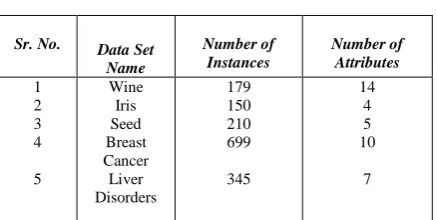
The data sets used are data sets from the UCI Machine Learning Repository are Wine, Iris, Seed, Breast Cancer and Liver Disorders data set. Also number of attributes and number
[image:5.595.50.269.365.475.2]of instances in these data sets are described. These data sets are shown in Table 1.
Table 1: Data Sets
Sr. No. Data Set Name
Number of Instances
Number of Attributes
1 2 3 4
5
Wine Iris Seed Breast Cancer Liver Disorders
179 150 210 699
345
14 4 5 10
7
This table shows that the total number of attributes in Wine data set is 14 and number of instances is 179, total number of attributes in Iris data sets is 4 and total number of instances is 150. The total number of attributes in Seed data set is 5 and total number of instances is 210.The total number of attributes in breast cancer data set is 10 and total number of instances is 699. The total number of attributes in Liver disorders data set is 7 and total number of instances is 345.
B. Output Parameters
The output parameters are those parameters based upon which the performance of existing clustering algorithm is compared with the new hybrid k-means optimization algorithm. Some output parameters are described below:
• TP : True Positive
It measures the proportion of positives that are correctly identified. It is also known as Sensitivity. Example: Sick people who are correctly identified as having the
condition. • TN : True Negative
It measures the proportion of negatives that are correctly identified. It is also known as Specificity. Example: The percentage of sick people who are correctly identified as not having the condition.
• FP : False Positive
They are incorrectly identified. Example: Healthy people incorrectly identified as sick.
• FN : False Negative
They are those which are incorrectly rejected. Example: Sick people incorrectly identified as healthy.
Some major parameters based upon which the performance of proposed algorithm is evaluated and compared with existing algorithm are described below:
• Recall
It may be defined as the number of most relevant features data set of cluster upon total number of data set features clustered.
Recall= No of most relevant features data set of cluster / total no of data set features Clustered
Recall = TP
TP +FN (1)
Where, TP= True Positive, FN= False Negative Larger value of it gives better clustering results.
• Purity
Purity is defined as the percent of the total number of objects that were classified correctly. To compute purity each cluster is assigned to the class which is most frequent in a cluster. It describes the cluster quality.
Purity =N1∑kmax j|wk∩cj| (2)
Where N = number of objects, k = number of clusters, cj is set of classes and wk is the set of clusters.
• Intra Cluster Distance
Intra Cluster Distance may be simply the distance between a point and its cluster centre and by taking the average of all of these distances the intra cluster distance is given below.
Intra Cluster Distance =𝑁𝑁1∑ ∑ ||x−zi||2 𝑥𝑥∈𝐶𝐶𝑖𝑖
𝑘𝑘
𝑖𝑖=1 (3)
Where N is number of objects, k is the number of clusters and
zi is the cluster centre of Ci • Computation Time
Computation time means the time taken required by the computer to perform a given set of computations. If Computation time is less than the clustering algorithm is better than algorithms having more Computation time. • Computational Complexity
Computational Complexity of an algorithm is a measure of how many steps the algorithm will require in the worst case for an instance or input of given size. The number of steps is measured as a function of size.
C. Experimental Results
1) Comparison using Recall
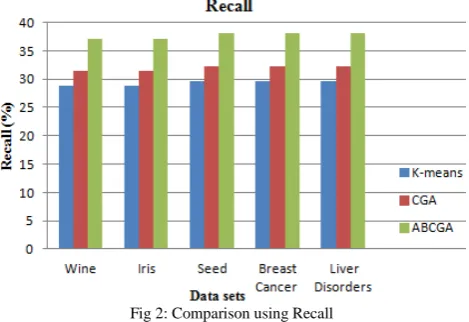
The comparison of CGA algorithm and k-means algorithm with the newly designed ABCGA algorithm using recall when number of clusters is 8 for five data sets that are Wine, Iris, Seed, Breast cancer and Liver Disorders is done.
[image:6.595.44.279.161.322.2]The results for recall value of CGA, k-means and proposed ABCGA algorithms is shown using the bar graph that is shown in the Figure 2.
Fig 2: Comparison using Recall
It shows that the recall is improved for proposed ABCGA algorithm than CGA algorithm and k-means algorithm. 2) Comparison using Purity
[image:6.595.326.560.423.567.2]The comparison using purity when number of clusters is 8 for five data sets that are Wine, Iris, Seed, Breast cancer and Liver Disorders. The values for purity are shown in Table 2 given below.
Table 2: Comparison using Purity
Sr. No.
Dataset K-means CGA ABCGA
1 2 3 4
5
Wine Iris Seed Breast Cancer Liver Disorders
30.52 30.52 31.34 31.35
31.37
34.04 34.04 34.92 34.96
34.97
40.7 40.7 41.8 41.5
41.9
This table shows that the value of purity is increased for ABCGA algorithm than k-means and CGA algorithm for all these five Data sets.
3) Comparison using Intra Cluster Distance
The comparison for three algorithms using intra cluster distance when number of clusters is 8 for five data sets that are Wine, Iris, Seed, Breast cancer and Liver Disorders. These results are shown in Figure 3.
Fig 3: Comparison using intra cluster distance
It shows that the intra cluster distance is improved for proposed ABCGA algorithm than CGA algorithm and k-means algorithm.
4) Comparison using Computation Time
[image:6.595.43.279.431.530.2]The comparison of CGA algorithm and k-means algorithm with the newly designed ABCGA algorithm using computation time when number of clusters is 8 for five data sets that are Wine, Iris, Seed, Breast cancer and Liver Disorders is done. The values for computation time are shown in Table 3.
Table 3: Comparison using Computation Time (m sec)
Sr. No.
Dataset K-means CGA ABCGA
1 2 3 4
5
Wine Iris Seed Breast Cancer Liver Disorders
31 16 32 31
16
47 47 47 47
46
16 16 15 15
16
This table shows that the value of Computation time is increased for ABCGA algorithm than k-means and CGA algorithm for all these five Data sets.
5) Comparison using Computational Complexity
[image:6.595.38.262.634.779.2]The comparison of CGA algorithm and k-means algorithm with the newly designed ABCGA algorithm using computational complexity when number of clusters is 8 using five data sets that are Wine, Iris, Seed, Breast cancer and Liver Disorders. These results are shown with the help of bar graph in Figure 4.
Fig 4: Comparison using Computational Complexity
It shows that the Computation time is improved for proposed ABCGA algorithm than CGA and k-means algorithm.
V. CONCLUSION
recall, purity, computation time etc. The ABCGA algorithm requires less computation time than existing CGA hybrid k-means algorithm. The recall is also improved for clustering in ABCGA algorithm than k-means and its hybrid CGA algorithm.
There is scope for improvement in the proposed technique to handle variety of information. Also more than one nature inspired algorithm for optimization is used to hybrid with k-means and variant of k-k-means. This approach can be used for largest data sets. Other optimization techniques can be used to improve the performance of clustering and also other clustering algorithm can be used for best results.
VI. REFERENCES
[1] Ming-Syan Chen, Jiawei Han, Ps Yu, “Data Mining: An overview from database perspective” IEEE Transaction on knowledge and data engineering, Vol. 8, Issue 6, pp. 886-883, 1996.
[2] Anil .Jan, “Data Clustering: 50 years beyond k-means” Pattern Recognition Letters, Elsevier, Vol. 31, pp. 651-666, 2010.
[3] Lior Rokach and Oded Maimon, “Clustering methods” Data mining and Knowledge handbook, pp. 321-352, 2005.
[4] J.B. MacQueen, “Some Methods for Classification and Analysis of Multivariate Observations” Proceedings of Fifth Berkeley Symposium on Mathematics Statistics and Probability, University of California Press, Vol. 1, pp. 281-297, 1967.
[5] M.Mary and Shanthi Rani, “A Genetic Algorithm Based K-Means Algorithm For Compressing Images” International Journal Of Engineering And Computer Science ISSN, Vol. 4, Issue 9, pp. 14359-14362, 2015.
[6] S.J Nanda, G. Panda, “A Survey on nature inspired metaheuristic algorithm for partition clustering” Swarm and Evolutionary Computation, Elsevier, Vol. 16, pp. 1-18, 2014.
[7] Xin-She Yang, "Firefly algorithms for multimodal optimization" Stochastic Algorithms: Foundations and Applications, SAGA 2009. Lecture Notes in Computer Sciences, Vol.5792, pp.169–178, 2009.
[8] K.Aparana and Mydhili K.Nair, “Enhancement of k-means algorithm using ACO as optimization technique on high dimensional data” 2014 international conference on Electronics and Communication Systems (ICECS) IEEE, pp. 1-5, 2014.
[9] Taher Niknam and Babak Amiri, “An efficient hybrid approach based on PSO, ACO and k-means for cluster
analysis” Applied Soft Computing, Elsevier, vol. 10, pp. 183–197, 2010.
[10] Saida Ishak Boushaki, Kamel Nadjet and Omar Bendjeghaba, “ A New Hybrid Algorithm for Document Clustering based on Cuckoo Search and K-means”, Recent advances on Soft Computing and Data Mining SCDM Springer, pp. 59-68, Vol. 287, 2014.
[11] Tang Rui, Fong Simon, Yang Xin-She and Deb Sujay, “Integrating nature-inspired optimization algorithms to k-means clustering” 2012 seventh International Conference on Digital Information Management ICDIM, IEEE, pp. 116-123, 2012.
[12] E. Obsab, X. S. yang, F. Diaz, P. Lopez-Garcia, R. Carballedo, “An Improved Discrete Bat Algorithm for Symmetric and Asymmetric Travelling Salesman Problems”, Engineering Applications of Artificial Intelligence, Vol. 48, pp. 59-71, 2016.
[13] Karaboga K, Dervis D, Ozturk, “A novel clustering approach: Artificial Bee Colony (ABC) algorithm” Applied Soft Computing, Springer, Vol. 11, pp. 7-652, 2011.
[14] Hamed Nikbakht, Hamid Mirvaziri, “A new clustering approach based on K-means and Krill Herd algorithm” 23rd
[15] Monica Sood and Shilpi Bansal, “K-Medoids Clustering Technique using Bat Algorithm”, International Journal of Applied Information Systems, pp. 20-22, 2013.
Iranian Conference on Electrical Engineering, IEEE, 2015.
[16] Minghao Yin, Yanmei Hu, Fengqin Yang, Xiangtao Li, Wenxiang Gu, “A novel hybrid K- harmonic means and gravitational search algorithm approach For clustering” Expert Systems with Applications, Elsevier, Vol. 38, pp. 9319-9324, 2011.
[17] Yucheng Kao, Szu-Yuan Lee, “Combining K-means and particle swarm optimization for dynamic data clustering problems”, IEEE International Conference on Intelligent Computing and Intelligent Systems, 2009.
[18] Kennedy.J and Eberhart.R,
[19] Gungor. Z and Unler. A, "k-Harmonic Means Data Clustering with Tabu Search Method" Applied Mathematical Modeling, Vol. 32, pp. 1115-1125, 2008.
on Neural Networks. pp. 1942–1948, 1995.
[20] A.M. Aibinu, H.Bello Salau, Najeeb Arthur Rahman, M.N. Nwohu, C.M. Akachukwu, “A novel Clustering based Genetic Algorithm for route optimization”, Engineering Science and Technology an International Journal, Vol. 19, pp. 2022– 2034, 2016.