Volume 8, No. 5, May-June 2017
International Journal of Advanced Research in Computer Science RESEARCH PAPER
Available Online at www.ijarcs.info
Automatic Selection of Better Image from a Series of Same Scene
Jisha Mohan
M. Tech Scholar, Dept. of CSE Govt. Engineering College Idukki
Idukki, India
Philumon Joseph
Asst.Prof.in Dept of CSE Govt. Engineering College IdukkiIdukki, India
Abstract: As with the introduction of new and wide variety of mobile phones the ease of people to take photographs has been increasing redundantly. The photos taken from camera may be good or bad with respect to quality, resolution, eye openness, smile etc. The selection of photos for uploading or for any other use should be from a range of good or high quality pictures. To capture a vacation, party or other event, people often take a series of shots of a particular scene with varied camera parameters and content arrangement, in the hope of later being able to pick a few good photos to edit, post or share. However, selecting photos to keep or share from a large collection is a painful process. To address this problem, we seek a relative quality measure within a series of photos taken of the same scene, which can be used for automatic photo triage. This selection takes a lot of time by human. As a result of this a new technique for selecting good or better images automatically is introduced. Thus triage of photos solves the problem of selecting good or perfect images from a group of unedited image set or series.
Keywords: photo triage, photo quality, resolution, automatic, openness.
I. INTRODUCTION
Today the craze of taking photos in day today life is increasing as a rockets speed. The introduction of selfie is the main reason for such a huge arise in capturing a moment or scene. Selfie play a vital role in the ever increasing craze of capturing photos. The digital world of photos is an emergent or vast area for research. Automatic triage is the process of selecting high quality or better or perfect images from a series of same scene. Our goal is to facilitate the process of finding better images from a group of images of same scene. The best image selection from the group is based on several methods which are discussed in the upcoming sections.
Existing methods that produce absolute scores tend to yield similar scores for similar images, and therefore perform poorly for our problem. There are also methods for selecting the best among a photo series typically based only on low level features like blurriness but higher-level features such as composition and content are also required for effective comparison.
The main application is creating smart album viewers and also this can be used as a sub problem for image summarisation. As this method only focuses on finding the best images from photo series, but does not consider the representativeness of these images to the whole album. Thus this can be used as a component to improve existing summarisation system. The selection of better image to share or keep is a painful core by human and thus this method will be a solution for that.
II. RELATED WORKS
A. Image Collection: Personal Photo series[13]
Image Collections Recent research demonstrates convincing graphics application with big data, such as scene completion tone adjustment, and super-resolution. The
collection of images is a hard task and there is no public dataset to address the problem of triage for a series of photos. Such data is hard to harvest online, since most online public photo sharing sites (e.g. Flickr) only contain images that the users have selected to submit, and most users only select a small number of good photos from their photo series to share. Furthermore, a large portion of images submitted to these sites have already been edited or enhanced. Other cloud storage services such as Apple iCloud do store users raw photo series, but their data is inaccessible.
B. Image Analogies[13]
Image Analogies in the sense that input : hallucinated image :: matched frame : target frame where the matched and target frames are from the time-lapse video. However, we cannot simply copy the patches from target frame onto input image, because the texture and color in input are different from time-lapse video. To accommodate the texture differences, we introduce the local affine models to transfer the color appearance from the time-lapse video to the input.
C. Face recognition for improved face annotation[1],[2] Proposed a novel collaborative face recognition framework helpful the accuracy of face annotation. For this, use many Recognition engines available in an OSN. In this collaborative FR framework contain two main parts, selection of FR engines and merge multiple FR results. The selection of FR engines helps to determining a set of customized FR engine which are appropriate for knowing query. Mainly this query for facial images belonging to a particular user. For this purpose, use social network group context in social sites and social context in phone galleries.
D. Summarization of Images[13]
diversity. Propose content- and context-based optimization functions for summarizing large personal photo collections and also a summarization approach that is more tailored towards 3D scenes.
E. Eigen faces for Recognition[12]
Eigen face approach is used for face recognition. Eigen faces are a set of features that characterize the variation between face images. Each training face image can be represented in terms of combination of the eigen faces. Collect a set of training images of known individuals. The set may have a number of images for each person. Then find its eigenvectors and eigen values and combine the normalized training set of images. Calculate the class vector by averaging the eigen face pattern vectors calculated from the original images of the individual. The Eigen face approach is easy to implement.
[image:2.595.42.289.263.519.2]III. SYSTEM
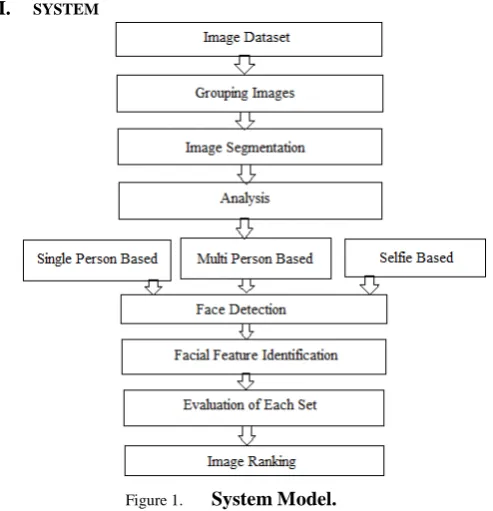
Figure 1. System Model.
A. Image Dataset and Grouping of Images
The standard image dataset are collected for processing. The image dataset may contain thousands and thousands of images. The similar images in these dataset are grouped into pairs for further evaluation by the system. The image in the database are stored with an id.
B. Image Segmentation
Image segmentation is the process of partitioning a digital image into multiple segments (sets of pixels, also known as super-pixels). The goal of segmentation is to simplify and/or change the representation of an image into something that is more meaningful and easier to analyse. Image segmentation [15], [17], [23] is typically used to locate objects and boundaries in images. Image segmentation is the process of assigning a label to every pixel in an image such that pixels with the same label share certain characteristics.
C. Analysis
The segmented images are then analysed for finding the best or better image from the series of images captured from
the same scene. The analysis is based on the following methods explained in the next sections.
D. Face Detection
The detection of frontal face in an image is done during this stage using the standard face detection algorithm[16], [24],[28],[32],[33],[35]. It works for single face and for multiple faces in the image. This detection will return information about each detected face such as face centres, face width. A face detection threshold function is used to set a threshold value for face detection in such a way that, if D>T then face detection is not possible and if D≤T then face is detected, where D is distance and T is threshold.
The function allows adjusting the sensitivity of the detection. If the threshold value is set to a higher value, the detector will only recognize faces with sharp, clearly defined details, thus reducing the number of false positive detections. Setting the threshold lower allows detecting more faces with less clearly defined features at the expense of increased number of false positives. face detection is not straightforward because it has lots of variations of image appearance, such as pose variation, occlusion, image orientation, illuminating condition and facial expression. The feature invariant approaches are used for feature detection [3], [4], [22] of eyes, mouth, ears, nose, etc. The appearance-based methods are used for face detection with eigen face [5], [6], [7], [26], neural network [8], [9], [25], and information theoretical approach [10], [11].
E. Facial Feature Identification
After the detection of faces in the image the system will detect the facial features of each face. This facial feature detection detects 20 facial feature points [20], [22].
F. Evaluation and Image Ranking
The images with facial features are evaluated by applying several evaluation schemes. These evaluation mainly focuses on finding the percentage of eye openness and percentage of smile in an image. These are best explained in next sections. After evaluating the images they are ranked using the standard ranking algorithm[14], [30], and the image with highest is rank is outputted. The ranking is done in such a way that the image with higher percentage value is given rank 1.
IV. SINGLE PERSON BASED
Figure 2. Single Person Based Image Dataset
[image:2.595.317.564.585.745.2]images containing single person of the same scene. Then using the standard face detection algorithm[22] the face of the single person is detected. After detection of the face in the image the facial features of that face is extracted which contains 20 facial feature points. This extraction will help in finding whether the eye is opened or closed and also for finding whether smile is present or not by detecting the eye centres and also the contour points of the mouth. The eye centre detection will return the two coordinates of the left end right eye centres. This can be generalised to facial expression recognition. After detecting all the facial points the system check whether the eye is opened or closed and whether smile is present or not. If the eye is opened then the next process is calculating the percentage of eye openness[22], [29], [34], and smile percentage [16], [20], [22], [27], is also calculated. After calculating these percentages the percentage in each image is compared. The image with high percentage value will be the best image to keep or share. The standard image ranking algorithm[14], [30], is applied for ranking the images and the highly ranked image is outputted.
V. MULTIPLE PERSON BASED
Figure 3. Multiple Person Based Image Dataset
The multi person based approach firstly take the images from the dataset which contains same pairs of images containing multiple persons in the image of the same scene. Then using the standard face detection algorithm[9], [22], the face of the multiple persons is detected. After detection of the face in the image the facial features of that face is extracted which contains 20 facial feature points.
This will extract the facial features of the multiple faces in the image. The median[13] of the faces in the image are calculated. After finding the facial features the percentage of smile and eye openness is calculated. After calculating the percentage smile and eye openness of each face in the image, the average value[12], of the percentage in each image is calculated. Then the image ranking is done using the standard ranking algorithm[14], [30], and the image with maximum average value is outputted.
VI. SELFIE BASED
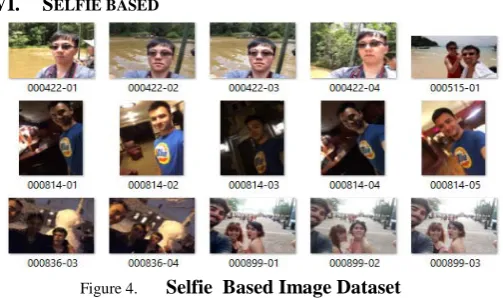
Figure 4. Selfie Based Image Dataset
The selfie[18], [19], based approach firstly take the images from the dataset which contains same pairs of selfie images containing persons with same scene. Then using the standard face detection algorithm the face of the person is detected. After detection of the face in the image the facial features of that face is extracted which contains 20 facial feature points. This extraction will help in finding whether the eye is opened or closed and also for finding whether smile is present or not by detecting the eye centres and also the contour points of the mouth. The eye centre detection will return the two coordinates of the left end right eye centres. After finding the facial features the percentage of smile and eye openness is calculated. The edge detection[21] method is applied for checking the overlapping[13] of persons in the image in case of multiple persons in the selfie images. If multiple persons are present in the selfie image then it is needed to find the average of the percentage of smile and eye openness. Then using the standard ranking algorithm [14], [30], the best image is outputted.
VII. RESULTS AND DISCUSSIONS
The standard image dataset consisting of 15545 personal photos from a large group of contributors are collected. Then these photos are grouped into 5953 photo series which contain similar images into folders using the clustering algorithm[31], [35]. The images which are grouped into pairs are analysed using the explained methods. The pairs are managed in such a way that the pairs containing nearly similar images from which we need to output the better image among them. The pairs contain single person based images, multi person based images, selfie based images. The images are analysed in such a way that the human presence and the facial features of each human are evaluated. This facial feature detection detects 20 facial feature points. The facial features of each image are stored for further evaluation. After detecting the facial features the percentage of eye openness and smile are detected using the standard algorithms. After detecting the percentage the images are ranked based on the evaluated percentage using ranking algorithm.
[image:3.595.317.569.58.207.2]detected. The percentage of eye openness and smile percentage is detected from the obtained facial features. This percentage is displayed within a rectangular box around the human face. If multiple human are present in an image then this percentage is calculated for all the faces. Then using the
[image:4.595.31.566.120.265.2]standard image ranking algorithm the images are ranked using this percentage. The images above a threshold percentage is only taken for ranking from which the image with higher percentage value is given rank 1 and so on.
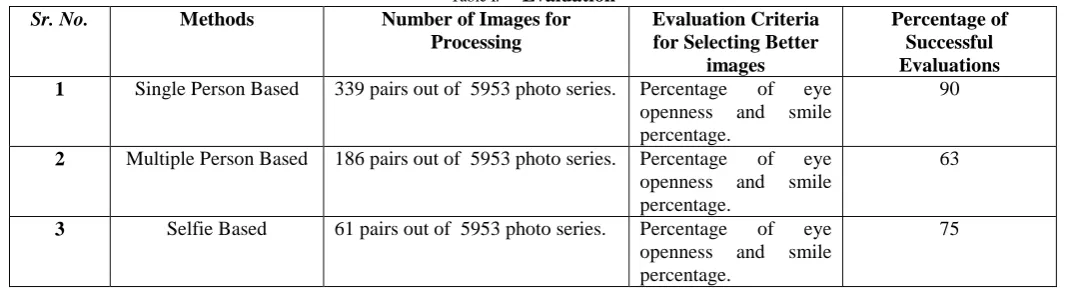
Table I. Evaluation
Sr. No. Methods Number of Images for
Processing
Evaluation Criteria for Selecting Better
images
Percentage of Successful Evaluations 1 Single Person Based 339 pairs out of 5953 photo series. Percentage of eye
openness and smile percentage.
90
2 Multiple Person Based 186 pairs out of 5953 photo series. Percentage of eye openness and smile percentage.
63
3 Selfie Based 61 pairs out of 5953 photo series. Percentage of eye openness and smile percentage.
75
VIII. CONCLUSION
The problem of evaluating relative image quality in a series of photos capturing roughly the same scene, a key step towards automatic, intelligent triage of personal photos are studied. The contributions include the first large-scale unedited photo series dataset collected from personal photo albums. This work can outperform previous methods on this task. Thus this method is the best method to solve the problem of selecting photos to keep or share from a large collection. The main drawback of this system is that it only deals with the case of images with human presence in it. It fails in case of images without human since this system evaluation scheme is mainly based on the percentage of eye openness and the percentage of smile. But since the personal photo collection mainly contains images with human presence and other images will be nearly less compared to images with human, so this problem merely affects.
IX. REFERENCES
[1] K. Choi, H. Byun, and K.-A. Toh. A collaborative face
recognition framework on a social network platform. In Automatic Face Gesture Recognition, 2008. FG 08. 8th IEEE International Conference on, pages 16, 2008.
[2] CHOPRA, S., HADSELL, R., AND LECUN, Y. 2005. Learning
a similarity metric discriminatively, with application to face verification. In Computer Vision and Pattern Recognition, 2005. CVPR 2005. IEEE Computer Society Conference on, vol. 1, IEEE, 539546.
[3] T. K. Leung, M. C. Burl, and P. Perona, Finding faces in
cluttered scenes using random labeled graph matching, Proc. 5th IEEE intl Conf. Computer Vision, pp. 637-644, 1995.
[4] B. Moghaddam and A. Pentland, Probabilistic visual learning for
object recognition, IEEE Trans. Pattern Analysis and Machine Intelligence, vol.19, no.7. pp. 696-710, July, 1997.
[5] M. Turk and A. Pentland, Eigenfaces for recognition, J. of
Cognitive Neuroscience, vol.3, no. 1, pp. 71-86, 1991.
[6] M. Kirby and L. Sirovich, Application of the Karhunen-Loeve
procedure for the characterization of human faces, IEEE Trans. Pattern Analysis and Machine Intelligence, vol.12, no.1, pp. 103-108, Jan. 1990.
[7] I. T. Jolliffe, Principal component analysis, New York:
Springer-Verlag, 1986.
[8] T, Agui, Y. Kokubo, H. Nagashi, and T. Nagao, Extraction of
face recognition from monochromatic photographs using neural
networks, Proc. 2nd Intl Conf. Automation, Robotics, and Computer Vision, vol.1, pp. 18.81-18.8.5, 1992.
[9] O. Bernier, M. Collobert, R. Feraud, V. Lemaried, J. E. Viallet,
and D. Collobert, MULTRAK: A system for automatic multiperson localization and tracking in real-time, Proc, IEEE. Intl Conf. Image Processing, pp. 136-140, 1998.
[10] A. J. Colmenarez and T. S. Huang, Face detection with
information based maximum discrimination, Proc. IEEE Conf. Computer Vision and Pattern Recognition, pp. 782-787, 1997. [11] M. S. Lew, Information theoretic view-based and modular face
detection,Proc. 2nd Intl Conf. Automatic Face and Gesture Recognition, pp. 198-203, 1996.
[12] J.M. Turk and A. Pentland. Eigenfaces for recognition. Journal of cognitive neuroscience, 3(1):7186, 1991.
[13] Automatic Triage for a Photo Series, Huiwen Chang, Fisher Yu1 Jue Wang, Douglas Ashley, Adam Finkelstein,Princeton University, Adobe Research, SIGGRAPH 16 Technical Paper,, July 24 - 28, 2016.
[14] Image Ranking with Eye Movements, Kitsuchart Pasupa,Sandor Szedmak,David R. Hardoon, School of Electronics Computer Science, University of Southampton, Institute for Infocomm Research (I2R), 2009
[15] Image Segmentation Based on Watershed and Edge Detection Techniques, Nassir Salman, Computer Science Department, Zarqa Private University, Jordan, The International Arab Journal of Information Technology, Vol. 3, No. 2, April 2006.
[16] FACE DETECTION AND SMILE DETECTION, Yu-Hao
Huang, ChiouShann Fuh, Dept. of Computer Science and Information Engineering, National Taiwan University, 2014.
[17] Image Segmentation Methods: A Comparative Study A. M.
Khan, Ravi. S, International Journal of Soft Computing and Engineering (IJSCE) ISSN: 22-2307, Volume-3, Issue-4, September 2013.
[18] An Example-Based Super-Resolution Algorithm for Selfie
Images, Jino HansWilliam, N. Venkateswaran, Srinath Narayanan, and Sandeep RamachandranDepartment of ECE, SSN College of Engineering, Chennai, Tamil Nadu 603 110, India Correspondence should be addressed to Jino HansWilliam; [email protected] Received 15 November 2015; Revised 28 January 2016; Accepted 8 February 2016.
[19] How to Take a Good Selfie? Mahdi M. Kalayeh, Misrak Seifu Wesna LaLanne, Mubarak Shah, Center for Research in Computer Vision at University of Central Florida, Jackson State University, MM15, October 2630, 2015, Brisbane, Australia. 2015 ACM. ISBN 978-1-4503-3459- 4/15/10.
[20] Facial Smile Detection Based on Deep Learning Features,
(NLPR), Institute of Automation, Chinese Academy of Sciences, Beijing, China, 2015.
[21] Edge Detection with a Preprocessing Approach, Mohamed Abo-Zahhad, Reda Ragab Gharieb1, Sabah M. Ahmed, Ahmed Abd El-Baset Donkol, Department of Electrical Engineering Communication and Electronics, Assuit University, Assiut, Egypt, Department of Electrical Engineering and Computer Sciences, Nahda University, Beni-Suef, Egypt, November 2014. [22] An Algorithm for Face Detection and Feature Extraction, Anjali,
Avinash Kumar, Mr. Ravi Ranjan,Students of M.TECH (CSE), SRM University, India, Assistant Professor in SRM University, India, International Journal of Science, Engineering and Technology Research (IJSETR), Volume 3, Issue 4, April 2014. [23] Image Segmentation and Detection using Watershed Transform
and Region Based Image Retrieval, Niket Amoda, Ramesh K Kulkarni, Department of Electronics and Telecommunication Engineering, Vivekanand Institute of Technology, University of Mumbai, M.G. Road Fort, Mumbai, India, International Journal of Emerging Trends Technology in Computer Science (IJETTCS), Volume 2, Issue 2, March April 2013.
[24] J. Wang and H. Yang, 2008, Face Detection Based On Template Matching And 2DPCA Algorithm, Proc. 2008 Congress on Image and Signal Processing, pp.575-579, Hainan, China. [25] C.C. Tsai, W.C. Cheng, J.S. Taur and C.W. Tao, 2006, Face
Detection Using Eigenface And Neural Network, Proc. 2006 IEEE International Conference on Systems, Man, and Cybernetics, pp.4343-4347, Taipei, Taiwan.
[26] A. R. Mohan and N. Sudha, 2009, Fast Face Detection Using Boosted Eigenfaces, Proc. 2009 IEEE Symposium on Industrial Electronics and Applications (ISIEA 2009), pp.102-1006, Kuala Lumpur, Malaysia.
[27] Efficient smiledetectionbyExtremeLearningMachine Le Ann,
SongfanYang,BirBhanu Cente for Research in Intelligent Systems, University of California, Riverside, CA92521, USA, September 2014.
[28] Variability in photos of the same face Rob Jenkins, David White, Xandra Van Montfort, A. Mike Burton, School of
Psychology, University of Glasgow, 58 Hillhead Street, Glasgow G12 8QQ, United Kingdom , Department of Psychology, University of New South Wales, Australia , Department of Psychology, University of Aberdeen, United Kingdom, August 2011.
[29] International Journal of Innovative Research in Computer and Communication Engineering Vol. 1, Issue 3, May 2013, Detecting the Location of Eyes on the Front Facial Images Using Two-Phase Method, Noopur Desai, Vidhi Dharia, Ishani Shah, Ghanshyam Prajapati Students, Dept. of Computer Science Engineering, Shri Sad Vidya Mandal Institute of Technology, Bharuch, India1,2,3 Asst. Prof., Dept. of Computer Science and Engineering, Shri S’ad Vidya Mandal Institute of Technology, Bharuch,India.
[30] Unsupervised Image Ranking, Eva Hrster, Malcolm Slaney,
MarcAurelio Ranzato, Kilian Weinberger Research Sunnyvale, CA 94089, 2010.
[31] A Rank-Order Distance based Clustering Algorithm for Face Tagging, Chunhui Zhu, Tsinghua University, Beijing, China , Fang Wen Jian Sun, Microsoft Research Asia, Beijing, China, 2011.
[32] Advanced Survey on Face Detection Techniques in Image
Processing, Neeraj Singla, M.Tech Student, CSE, CGC, Gharuan, India, Sugandha Sharma, Assistant Professor, CSE, CGC, Gharuan, India, March 2014.
[33] 21st Computer Vision Winter Workshop Luka Cehovin, Rok
Mandeljc, Vitomir Struc (eds.), Rimske Toplice, Slovenia, February 35, 2016. Real- Time Eye Blink Detection using Facial Landmarks Tereza Soukupova and Jan C ech Center for Machine Perception, Department of Cybernetics Faculty of Electrical Engineering, Czech Technical University in Prague. [34] An Efficient Approach for Clustering Face Images, Charles
Otto, Brendan Klare, Noblis Brendan, Anil Jain, Michigan State Universtiy, 2015.
[35] An Analysis of the Viola-Jones Face Detection Algorithm
Yi-Qing Wang CMLA, ENS Cachan, France