Czech Named Entity Corpus and SVM-based Recognizer
Jana Kravalov´a Charles University in Prague Institute of Formal and Applied Linguistics
Zdenˇek ˇZabokrtsk´y Charles University in Prague
Institute of Formal and Applied Linguistics [email protected]
Abstract
This paper deals with recognition of named entities in Czech texts. We present a recently released corpus of Czech stences with manually annotated named en-tities, in which a rich two-level classifica-tion scheme was used. There are around 6000sentences in the corpus with roughly 33000marked named entity instances. We use the data for training and evaluating a named entity recognizer based on Support Vector Machine classification technique. The presented recognizer outperforms the results previously reported for NE recog-nition in Czech.
1 Introduction
After the series of Message Understanding Conferences (MUC; (Grishman and Sundheim, 1996)), processing of named entities (NEs) be-came a well established discipline within the NLP domain, usually motivated by the needs of Infor-mation Extraction, Question Answering, or Ma-chine Translation. For English, one can find liter-ature about attempts at rule-based solutions for the NE task as well as machine-learning approaches, be they dependent on the existence of labeled data (such as CoNLL-2003 shared task data), unsuper-vised (using redundancy in NE expressions and their contexts, see e.g. (Collins and Singer, 1999)) or a combination of both (such as (Talukdar et al., 2006), in which labeled data are used as a source of seed for an unsupervised procedure exploiting huge unlabeled data). A survey of research on named entity recognition is available in (Ekbal and Bandyopadhyay, 2008).
There has been considerably less research done in the NE field in Czech, as discussed in ( ˇSevˇc´ıkov´a et al., 2007b). Therefore we focus on it in this paper, which is structured as follows. In
Section 2 we present a recently released corpus of Czech sentences with manually annotated in-stances of named entities, in which a rich classi-fication scheme is used. In Section 3 we describe a new NE recognizer developed for Czech, based on the Support Vector Machine (SVM) classifi-cation technique. Evaluation of such approach is presented in Section 4. The summary is given in Section 5.
2 Manually Annotated Corpus
2.1 Data Selection
We have randomly selected 6000 sentences from the Czech National Corpus1 from the re-sult of the query ([word=".*[a-z0-9]"] [word="[A-Z].*"]). This query makes the relative frequency of NEs in the selection higher than the corpus average, which makes the sub-sequent manual annotation much more effective, even if it may slightly bias the distribution of NE types and their observed density.2
2.2 Annotation NE Instances with Two-level NE Classification
There is no generally accepted typology of Named Entities. One can see two trends: from the view-point of unsupervised learning, it is advantageous to have just a few coarse-grained categories (cf. the NE classification developed for MUC confer-ences or the classification proposed in (Collins and Singer, 1999), where only persons, locations, and organizations were distinguished), whereas those interested in semantically oriented applica-tions prefer more informative (finer-grained) cat-egories (e.g. (Fleischman and Hovy, 2002) with
1http://ucnk.ff.cuni.cz 2
The query is trivially motivated by the fact that NEs in Czech (as well as in many other languages) are often marked by capitalization of the first letter. Annotation of NEs in a cor-pus without such selection would lower the bias, but would be more expensive due to the lower density of NE instances in the annotated material.
Types of NE
a - Numbers in addresses
c - Bibliographic items
g - Geographical names
i - Institutions
m - Media names
n - Specific number usages
o - Artifact names
p - Personal names
q - Quantitative expressions
t - Time expressions
ah - street numbers
at - phone/fax numbers az - zip codes
cb - volume numbers
cn - chapt./sect./fig. numbers cp - page numbers
cr - legisl. act numbers cs - article titles
gc - states
gh - hydronyms gl - nature areas / objects
gp - planets, cosmic objects gq - urban parts
gr - territorial names gs - streets, squares
gt - continents gu - cities/towns
g_ - underspecified ia - conferences/contests
ic - cult./educ./scient. inst. if - companies, concerns...
io - government/political inst. i_ - underspecified
mi - internet links
mn - periodical mr - radio stations
mt - TV stations na - age
nc - sport score ni - itemizer
nm - in formula np - part of personal name
nq - town quarter nr - ratio
nw - flat size n_ - underspecified
oa - cultural artifacts (books, movies)
oc - chemical oe - measure units
om - currency units op - products
or - directives, norms o_ - underspecified
pb - animal names pc - inhabitant names
pd - (academic) titles
pf - first names pm - second names
pp - relig./myth persons ps - surnames p_ - underspecified
qc - cardinal numbers
qo - ordinal numbers tc - centuries
td - days tf - feasts
th - hours tm - months tn - minutes
tp - epochs ts - seconds
[image:2.595.95.534.86.665.2]ty - years
eight types of person labels, or Sekine’s Extended NE Hierarchy, cf. (Sekine, 2003)).
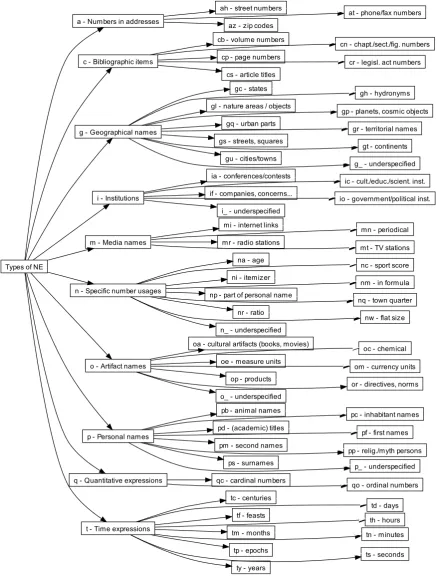
In our corpus, we use a two-level NE classifi-cation depicted in Figure 1. The first level corre-sponds to rough categories (called NE supertypes) such as person names, geographical names etc. The second level provides a more detailed classi-fication: e.g. within the supertype of geographi-cal names, theNE typesof names of cities/towns, names of states, names of rivers/seas/lakes etc. are distinguished.3 If more robust processing is necessary, only the first level (NE supertypes) can be used, while the second level (NE types) comes into play when more subtle information is needed. Each NE type is encoded by a unique two-character tag (e.g., gufor names of cities/towns, gcfor names of states; a special tag, such asg, makes it possible to leave the NE type underspec-ified).
Besides the terms of NE type and supertype, we use also the termNE instance, which stands for a continuous subsequence of tokens expressing the entity in a given text. In the simple plain-text for-mat, which we use for manual annotations, the NE instances are marked as follows: the word or the span of words belonging to the NE is delimited by symbols<and>, with the former one immediately followed by the NE type tag (e.g.<pfJohn>loves <pfMary>).
The annotation scheme allows for the embed-ding of NE instances. There are two types of em-bedding. In the first case, the NE of a certain type can be embedded in another NE (e.g., the river name can be part of a name of a city as in <guUst´ı nad´ <ghLabem>>). In the second case, two or more NEs are parts of a (so-called) con-tainer NE (e.g., two NEs, a first name and a sur-name, form together a person name container NE such as in<P<pfPaul> <psNewman>>). The container NEs are marked with a capital one-letter tag: Pfor (complex) person names,Tfor tempo-ral expressions,Afor addresses, andCfor biblio-graphic items. A more detailed description of the NE classification can be found in ( ˇSevˇc´ıkov´a et al., 2007b).
3
Given the size of the annotated data, further subdivi-sion into even finer classes (such as persons divided into cat-egories such as lawyer, politician, scientist used in (Fleis-chman and Hovy, 2002)) would result in too sparse annota-tions.
2.3 Annotated Data Cleaning
After collecting all the sentences annotated by the annotators, it was necessary to clean the data in or-der to improve the data quality. For this purpose, a set of tests was implemented. The tests revealed wrong or “suspicious” spots in the data (based e.g. on the assumption that the same lemma should manifest an entity of the same type in most its oc-currences), which were manually checked and cor-rected if necessary. Some noisy sentences caused e.g. by wrong sentence segmentation in the origi-nal resource were deleted; the fiorigi-nal size of the cor-pus is 5870 sentences.
2.4 Morphological Analysis of Annotated Data
The sentences have been enriched with morpho-logical tags and lemmas using Jan Hajiˇc’s tagger shipped with Prague Dependency Treebank 2.0 (Hajiˇc et al., 2006) integrated into the TectoMT environment ( ˇZabokrtsk´y et al., 2008). Motivation for this step was twofold
• Czech is a morphologically rich language, and named entities might be subject to paradigms with rich inflection too. For example, male first name Tom´aˇs (Thomas) migh appear also in one of the following forms:Tom´aˇse, Tom´aˇsovi, Tom´aˇsi, Tom´aˇsem, Tom´aˇsov´e, Tom´aˇs˚um. . . (according to gram-matical case and number), which would make the training data without lemmatization much sparser.
• Additional features (useful for SVM as well as for any other Machine Learning approach) can be mined from the lemma and tag se-quences, as shown in Section 3.2.
2.5 Public Data Release
Manually annotated and cleaned 6000 sentences with roughly33000named entities were released as Czech Named Entity Corpus 1.0. The corpus consists of manually annotated sentences and mor-phological analysis in several formats: a simple plain text format, a simple xml format, a more complex xml format based on the Prague Markup Language (Pajas and ˇStˇep´anek, 2006) and contain-ing also the above mentioned morphological anal-ysis, and the html format with visually highlighted NE instances.
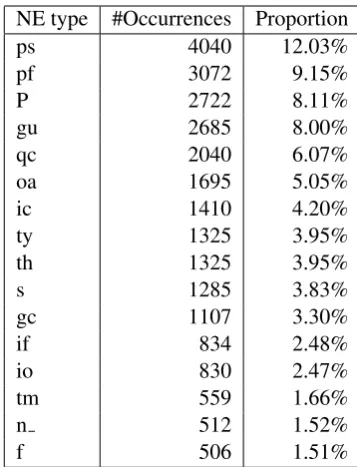
and evaluation subset is provided in the corpus. The division into training, development and evalu-ation subsets was made by random division of sen-tences into three sets, in proportion80%(training), 10%(development) and10%(evaluation), see Ta-ble 1. Other basic quantitative properties are sum-marized in Table 2 and Table 3.
The resulting data collection, called
Czech Named Entity Corpus 1.0, is
now publicly available on the Internet at http://ufal.mff.cuni.cz/tectomt.
Set #Sentences #Words #NE instances
train 4696 119921 26491
dtest 587 14982 3476
etest 587 15119 3615
[image:4.595.325.504.60.294.2]total 5870 150022 33582
Table 1: Division of the annotated corpus into training, development test, and evaluation test sets.
Lenght #Occurrences Proportion
one-word 23057 68.66%
two-word 6885 20.50%
three-word 1961 5.84%
longer 1679 5.00%
total 33582 100.00%
Table 2: Occurrences of NE instances of different length in the annotated corpus.
3 SVM-based Recognizer
3.1 NER as a classification task
In this section, we formulate named entity recog-nition as a classification problem. The task of named entity recognition as a whole includes sev-eral problems to be solved:
• detecting “basic” one-word, two-word and multiword named entities,
• detecting complex entities containing other entities (e.g. an institution name containing a personal name).
Furthermore, one can have different require-ments on what a correctly recognized named entity is (and train a separate recognizer for each case):
• an entity whose span and type are correctly recognized,
NE type #Occurrences Proportion
ps 4040 12.03%
pf 3072 9.15%
P 2722 8.11%
gu 2685 8.00%
qc 2040 6.07%
oa 1695 5.05%
ic 1410 4.20%
ty 1325 3.95%
th 1325 3.95%
s 1285 3.83%
gc 1107 3.30%
if 834 2.48%
io 830 2.47%
tm 559 1.66%
n 512 1.52%
[image:4.595.85.279.354.440.2]f 506 1.51%
Table 3: Distribution of several most frequent NE types in the annotated corpus.
• an entity whose span and supertype are cor-rectly recognized,
• an entity whose span is correctly recognized (without regard to its type).
Therefore, we subdivide the classification prob-lem into a few subprobprob-lems. Firstly, we indepen-dently evaluate the recognition system for one-word named entities, for two-one-word named enti-ties and for multiword named entienti-ties. For each of these three problems, we define three tasks, or-dered from the easiest to the most difficult:
• Named entityspan recognition– all words of named entity must be found but the type is not relevant. For one-word entities, this re-duces to 0/1 classification problem, that is, each word is either marked as named entity (1) or as regular word (0). For two-word en-tities, this0/1decision is made for each cou-ple of subsequent words (bigram) in the sen-tence.
• Named entity type recognition – all words of named entity must be found and the type must be correct.
In our solution, a separate SVM classifier is built for one-word named entities, two-word named entities and three-word named entities. Then, as we proceed through the text, we apply the classifier on each “window” or “n-gram” of words – one-word, two-word and three-word, classifying the n-gram with the corresponding SVM classi-fier. We deliberately omit named entities contain-ing four and more words, as they represent only a small portion of the instances (5%).
3.2 Features
Classification features which were used by the SVM classifier(s), are as follows:
• morphological features– part of speech, gen-der, case and number,
• orthographic features – boolean features such as capital letter at the beginning of the word or regular expression for time and year ,
• listsof known named entities – boolean fea-tures describing whether the word is listed in lists of Czech most used names and sur-names, Czech cities, countries or famous in-stitutions,
• lemma– some lemmas contain shortcuts de-scribing the property of lemma, for example “Prahou” (Prague, 7th case) would lemma-tize to “Praha ;G” with mark “ ;G” hinting that “Praha” is a geographical name,
• context features – similar features for pre-ceding and following words, that is, part of speech, gender, case and number for the pre-ceding and following word, orthographic fea-tures, membership in a list of known entities and lemma hints for the preceding and fol-lowing word.
All classification features were transformed into binary (boolean) features, resulting in roughly 200-dimensional binary feature space.
3.3 Classifier implementation
For the classification task, we decided to use Sup-port Vector Machine classification method. First,
this solution has been repeatedly shown to give better scores in NE recognition in comparison to other Machine Learning methods, see e.g. (Isozaki and Kazawa, 2002) and (Ekbal and Bandyopad-hyay, 2008). Second, in our preliminary experi-ments on our data it outperformed all other solu-tions too (based on naive Bayes, k nearest neigh-bors, and decision trees).
As an SVM classifier, we used its CPAN Perl implementationAlgorithm-SVM.4
Technically, the NE recognizer is implemented as a Perl module included into TectoMT, which is a modular open source software framework for im-plementing NLP applications, ( ˇZabokrtsk´y et al., 2008).5
4 Evaluation
4.1 Evaluation metrics
We use the following standard quantities for eval-uating performance of the presented classifier:
• precision – the number of correctly predicted NEs divided by the number of all predicted NEs,
• recall – the number of correctly predicted NEs divided by the number of all NEs in the data,
• f-score – harmonic mean of precision and re-call.
In our opinion, simpler quantities such as accu-racy (the percentage of correctly marked words) are not suitable for this task, since the number of NE instances to be found is not known in ad-vance.6
4.2 Results
The results for SVM classifier when applied on the evaluation test set of the corpus are summa-rized in Table 4. The table evaluates all subtasks as defined in Section 3.1, that is, for combination
4
http://www.cpan.org/authors/id/L/LA/LAIRDM/ 5One of the reasons for integrating the classifier into
Tec-toMT is the fact that it requires the input texts to be sentence-segmented, tokenized, tagged and lemmatized; all the nec-essary tools for such preprocessing are already available in TectoMT.
6Counting also all non-NE words predicted as non-entities
All NEs One-word NEs Two-word NEs
P R F P R F P R F
span+type 0.75 0.62 0.68 0.80 0.71 0.75 0.68 0.62 0.65 span+supertype 0.75 0.67 0.71 0.87 0.78 0.82 0.71 0.64 0.67
[image:6.595.118.480.61.132.2]span 0.84 0.70 0.76 0.89 0.80 0.84 0.76 0.69 0.72
Table 4: Summary of the SVM classifier performance (P=precision, R=recall, F=f-measure). Recogni-tion of NEs of different length is evaluated separately. The other dimension corresponds to the gradually released correctness requirements.
true type predicted type true type description predicted type description errors
oa x cultural artifacts (books, movies) no entity 184
ic x cult./educ./scient. inst. no entity 74
x gu no entity cities/towns 71
x P no entity personal name container 66
if x companies, concerns . . . no entity 60
x ic no entity cult./educ./scient. inst. 59
io x government/political inst. no entity 57
x ps no entity surnames 47
P x personal name container no entity 43
ps x surnames no entity 41
gu x cities/towns no entity 37
x td no entity days 35
op x products no entity 33
x pf no entity first names 31
[image:6.595.75.522.191.417.2]T x time container no entity 30
Table 5: The most frequent types of errors in NE recognition made by the SVM classifier.
of subtask defined for all entities, one-word enti-ties and two-word entienti-ties and with gradually re-leased requirements for correctness: correct span and correct (detailed) type, correct span and cor-rect supertype, corcor-rect span only.
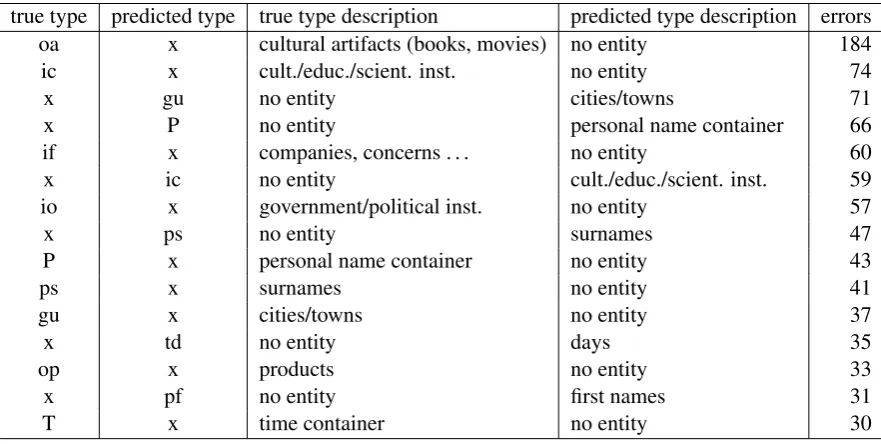
The most common SVM classification errors are shown in Table 5.
4.3 Discussion
As we can see in Table 4, the classifier recognizes span and type of all named entities in text with f-measure = 0.68. This improves the results re-ported on this data in ( ˇSevˇc´ıkov´a et al., 2007a), which was0.62. For one-word named entities, the improvement is also noticeable, from0.70to0.75. In our opinion, the improvement is caused by better feature selection on one hand. We do not use as many classification features as the authors of ( ˇSevˇc´ıkov´a et al., 2007a), instead we made a preliminary manual selection of features we con-sidered to be helpful. For example, we do not use the whole variety of15Czech morphological
cat-egories for every word in context, but we use only part of speech, gender, case and number. Also, we avoided using features based on storing words which occurred in training data, such as boolean feature, which is true for words, which appeared in training data as named entity. We tried employ-ing such features, but in our opinion, they result in sparsity in space searched by SVM.
It would be highly difficult to correctly compare the achieved results with results reported on other languages (such as f-score 88.76% achieved for English in (Zhang and Johnson, 2003)), especially because of different task granularity (and obvi-ously highly different baselines). Furthermore, in Czech the task is more complicated due to inflec-tion: many named entities can appear in several many different forms. For example, the Czech capital city “Praha” appeared in these forms in training data:Praha, Prahy, Prahou, Prahu.
[image:6.595.78.519.195.417.2]which mostly remain unrecognized. The problem is that, cultural artifacts like books or movies, or institutions, tend to have quite new and unusual names, as opposed to personal names, for which fairly limited amount of choice exists, and cities, which do not change and can be listed easily.
Institutions also tend to have long and com-plicated names, for which it is especially diffi-cult to find the ending frontier. We believe that dependency syntax analysis (such as dependency trees resulting from the maximum spanning tree parser, (McDonald et al., 2005)) might provide some clues here. By determining the head of the clause, e.g.theatre, university, galleryand it’s de-pendants, we might get some hints about which words are part of the name and which are not.
Yet another improvement in overall perfor-mance could be achieved by incorporating hyper-nym discovery (making use e.g. of Wikipedia) as proposed in (Kliegr et al., 2008).
5 Conclusions
We have presented a new recently published cor-pus of Czech sentences with manually annotated named entities with fine-grained two-level annota-tion. We used the data for training and evaluating a named entity recognizer based on Support Vector Machines classification technique. Our classifier reached f-measure0.68in recognizing and classi-fying Czech named entities into62categories and thus outperformed the results previously reported for NE recognition in Czech in ( ˇSevˇc´ıkov´a et al., 2007a).
We intend to further improve our classifier, especially recognition of institution and object names, by employing dependency syntax features. Another improvement is hoped to be achieved us-ing WWW-based ontologies.
Acknowledgments
This research was supported by MSM 0021620838, GAAV ˇCR 1ET101120503, and M ˇSMT ˇCR LC536.
References
Michael Collins and Yoram Singer. 1999. Unsuper-vised Models for Named Entity Classification. In Proceedings of the Conference on Empirical Meth-ods in Natural Language Processing and Very Large Corpora (EMNLP/VLC), pages 189–196.
Asif Ekbal and Sivaji Bandyopadhyay. 2008. Named Entity Recognition using Support Vector Machine: A Language Independent Approach . International Journal of Computer Systems Science and Engineer-ing, 4(2):155–170.
Michael Fleischman and Eduard Hovy. 2002. Fine Grained Classification of Named Entities . In Pro-ceedings of the 19th International Conference on Computational Linguistics (COLING), volume I, pages 267–273.
Ralph Grishman and Beth Sundheim. 1996. Mes-sage Understanding Conference - 6: A Brief History. InProceedings of the 16th International Conference on Computational Linguistics (COLING), volume I, pages 466–471.
Jan Hajiˇc, Jarmila Panevov´a, Eva Hajiˇcov´a, Petr Sgall, Petr Pajas, Jan ˇStˇep´anek, Jiˇr´ı Havelka, Marie Mikulov´a, Zdenˇek ˇZabokrtsk´y, and Magda ˇSevˇc´ıkov´a. 2006. Prague Dependency Treebank 2.0.
Hideki Isozaki and Hideto Kazawa. 2002. Effi-cient Support Vector Classifiers For Named Entity Recognition. In Proceedings of the 19th Inter-national Conference on Computational Linguistics (COLING’02).
Tomas Kliegr, Krishna Chandramouli, Jan Nemrava, Vojtech Svatek, and Ebroul Izquierdo. 2008. Wikipedia as the premiere source for targeted hy-pernym discovery.WBBT ECML08.
Ryan McDonald, Fernando Pereira, Kiril Ribarov, and Jan Hajiˇc. 2005. Non-Projective Dependency Pars-ing usPars-ing SpannPars-ing Tree Algorithms. In Proceed-ings of Human Langauge Technology Conference and Conference on Empirical Methods in Natural Language Processing (HTL/EMNLP), pages 523– 530, Vancouver, BC, Canada.
Petr Pajas and Jan ˇStˇep´anek. 2006. XML-based rep-resentation of multi-layered annotation in the PDT 2.0. In Richard Erhard Hinrichs, Nancy Ide, Martha Palmer, and James Pustejovsky, editors, Proceed-ings of the LREC Workshop on Merging and Layer-ing LLayer-inguistic Information (LREC 2006), pages 40– 47, Paris, France.
Satoshi Sekine. 2003. Sekine’s Extended Named En-tity Hierarchy. http://nlp.cs.nyu.edu/ene/.
Partha Pratim Talukdar, Thorsten Brants, Mark Liber-man, and Fernando Pereira. 2006. A Context Pat-tern Induction Method for Named Entity Extraction. In Proceedings of the 10th Conference on Com-putational Natural Language Learning (CoNLL-X), pages 141–148.
Magda ˇSevˇc´ıkov´a, Zdenˇek ˇZabokrtsk´y, and Oldˇrich Kr˚uza. 2007. Zpracov´an´ı pojmenovan´ych entit v ˇcesk´ych textech. Technical report, ´UFAL MFF UK, Praha.
Zdenˇek ˇZabokrtsk´y, Jan Pt´aˇcek, and Petr Pajas. 2008. TectoMT: Highly Modular MT System with Tec-togrammatics Used as Transfer Layer. In Proceed-ings of the 3rd Workshop on Statistical Machine Translation, ACL.