A Multimodal Home Entertainment Interface via a Mobile Device
Alexander Gruenstein Bo-June (Paul) Hsu James Glass Stephanie Seneff
Lee Hetherington Scott Cyphers Ibrahim Badr Chao Wang Sean Liu
MIT Computer Science and Artificial Intelligence Laboratory 32 Vassar St, Cambridge, MA 02139 USA
http://www.sls.csail.mit.edu/
Abstract
We describe a multimodal dialogue system for interacting with a home entertainment center via a mobile device. In our working proto-type, users may utilize both a graphical and speech user interface to search TV listings, record and play television programs, and listen to music. The developed framework is quite generic, potentially supporting a wide variety of applications, as we demonstrate by integrat-ing a weather forecast application. In the pro-totype, the mobile device serves as the locus of interaction, providing both a small touch-screen display, and speech input and output; while the TV screen features a larger, richer GUI. The system architecture is agnostic to the location of the natural language process-ing components: a consistent user experience is maintained regardless of whether they run on a remote server or on the device itself.
1 Introduction
People have access to large libraries of digital con-tent both in their living rooms and on their mobile devices. Digital video recorders (DVRs) allow peo-ple to record TV programs from hundreds of chan-nels for subsequent viewing at home—or, increas-ingly, on their mobile devices. Similarly, having accumulated vast libraries of digital music, people yearn for an easy way to sift through them from the comfort of their couches, in their cars, and on the go. Mobile devices are already central to accessing digital media libraries while users are away from home: people listen to music or watch video record-ings. Mobile devices also play an increasingly
im-portant role inmanagingdigital media libraries. For instance, a web-enabled mobile phone can be used to remotely schedule TV recordings through a web site or via a custom application. Such management tasks often prove cumbersome, however, as it is challeng-ing to browse through listchalleng-ings for hundreds of TV channels on a small display. Indeed, even on a large screen in the living room, browsing alphabetically, or by time and channel, for a particular show using the remote control quickly becomes unwieldy.
Speech and multimodal interfaces provide a nat-ural means of addressing many of these challenges. It is effortless for people to say the name of a pro-gram, for instance, in order to search for existing recordings. Moreover, such a speech browsing ca-pability is useful both in the living room and away from home. Thus, a natural way to provide speech-based control of a media library is through the user’s mobile device itself.
In this paper we describe just such a prototype system. A mobile phone plays a central role in pro-viding a multimodal, natural language interface to both a digital video recorder and a music library. Users can interact with the system—presented as a dynamic web page on the mobile browser—using the navigation keys, the stylus, or spoken natural language. In front of the TV, a much richer GUI is also available, along with support for playing video recordings and music.
In the prototype described herein, the mobile de-vice serves as the locus of natural language in-teraction, whether a user is in the living room or walking down the street. Since these environments may be very different in terms of computational
sources and network bandwidth, it is important that the architecture allows for multiple configurations in terms of the location of the natural language pro-cessing components. For instance, when a device is connected to a Wi-Fi network at home, recogni-tion latency may be reduced by performing speech and natural language processing on the home me-dia server. Moreover, a powerful server may enable more sophisticated processing techniques, such as multipass speech recognition (Hetherington, 2005; Chung et al., 2004), for improved accuracy. In sit-uations with reduced network connectivity, latency may be improved by performing speech recognition and natural language processing tasks on the mobile device itself. Given resource constraints, however, less detailed acoustic and language models may be required. We have developed just such a flexible ar-chitecture, with many of the natural language pro-cessing components able to run on either a server or the mobile device itself. Regardless of the configu-ration, a consistent user experience is maintained.
2 Related Work
Various academic researchers and commercial busi-nesses have demonstrated speech-enabled interfaces to entertainment centers. A good deal of the work focuses on adding a microphone to a remote con-trol, so that speech input may be used in addition to a traditional remote control. Much commercial work, for example (Fujita et al., 2003), tends to fo-cus on constrained grammar systems, where speech input is limited to a small set of templates corre-sponding to menu choices. (Berglund and Johans-son, 2004) present a remote-control based speech interface for navigating an existing interactive tele-vision on-screen menu, though experimenters man-ually transcribed user utterances as they spoke in-stead of using a speech recognizer. (Oh et al., 2007) present a dialogue system for TV control that makes use of concept spotting and statistical dialogue man-agement to understand queries. A version of their system can run independently on low-resource de-vices such as PDAs; however, it has a smaller vo-cabulary and supports a limited set of user utterance templates. Finally, (Wittenburg et al., 2006) look mainly at the problem of searching for television programs using speech, an on-screen display, and a
remote control. They explore a Speech-In List-Out interface to searching for episodes of television pro-grams.
(Portele et al., 2003) depart from the model of adding a speech interface component to an exist-ing on-screen menu. Instead, they a create a tablet PC interface to an electronic program guide, though they do not use the television display as well. Users may search an electronic program guide using con-straints such as date, time, and genre; however, they can’t search by title. Users can also perform typi-cal remote-control tasks like turning the television on and off, and changing the channel. (Johnston et al., 2007) also use a tablet PC to provide an inter-face to television content—in this case a database of movies. The search can be constrained by attributes such as title, director, or starring actors. The tablet PC pen can be used to handwrite queries and to point at items (such as actor names) while the user speaks.
We were also inspired by previous prototypes in which mobile devices have been used in conjunc-tion with larger, shared displays. For instance, (Paek et al., 2004) demonstrate a framework for building such applications. The prototype we demonstrate here fits into their “Jukebox” model of interaction. Interactive workspaces, such as the one described in (Johanson et al., 2002), also demonstrate the utility of integrating mobile and large screen displays. Our prototype is a departure from these systems, how-ever, in that it provides for spoken interactions.
Finally, there is related work in the use of mobile devices for various kinds of search. For instance, of-ferings from Microsoft (Acero et al., 2008), Vlingo,1 and Promptu2 allow users to search for items like businesses and songs using their mobile phones. These applications differ from ours in that speech is used only for search, without any accompanying command and control capabilities. Also, these ser-vices do not allow interaction with your own de-vices at home. Efforts have been made to use mo-bile devices for control of devices in the home, such as in (Nichols and Myers, 2006), however these ef-forts have not involved the use of speech as an input modality.
1http://www.vlingo.com
Navigation pad or stylus can be used to navigate GUI Status icon indicates connection to server,
microphone icon when listening
Hold-to-talk button
Opera
web browser
Synchronized selection on mobile and television displays
Firefoxweb browser Tabs allow easy switching
among domains Media playback
[image:3.612.148.461.64.267.2]controls
Figure 1: User interface overview.
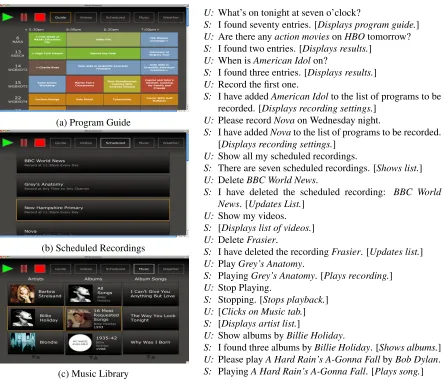
(a) Program Guide
(b) Scheduled Recordings
(c) Music Library
U: What’s on tonight at seven o’clock?
S: I found seventy entries. [Displays program guide.] U: Are there anyaction moviesonHBOtomorrow? S: I found two entries. [Displays results.]
U: When isAmerican Idolon?
S: I found three entries. [Displays results.] U: Record the first one.
S: I have addedAmerican Idolto the list of programs to be recorded. [Displays recording settings.]
U: Please recordNovaon Wednesday night.
S: I have addedNovato the list of programs to be recorded. [Displays recording settings.]
U: Show all my scheduled recordings.
S: There are seven scheduled recordings. [Shows list.] U: DeleteBBC World News.
S: I have deleted the scheduled recording: BBC World News. [Updates List.]
U: Show my videos. S: [Displays list of videos.] U: DeleteFrasier.
S: I have deleted the recordingFrasier. [Updates list.] U: PlayGrey’s Anatomy.
S: PlayingGrey’s Anatomy. [Plays recording.] U: Stop Playing.
S: Stopping. [Stops playback.] U: [Clicks on Music tab.] S: [Displays artist list.]
U: Show albums byBillie Holiday.
S: I found three albums byBillie Holiday. [Shows albums.] U: Please playA Hard Rain’s A-Gonna FallbyBob Dylan. S: PlayingA Hard Rain’s A-Gonna Fall. [Plays song.]
[image:3.612.84.528.297.677.2]3 User Experience
Our current prototype system implements the basic functionalities that one expects from a home enter-tainment center. Users can navigate through and record programs from the television’s electronic pro-gram guide, manage recording settings, and play recorded videos. They can also browse and listen to selections from their music libraries. However, un-like existing prototypes, ours employs a smartphone with a navigation pad, touch-sensitive screen, and built-in microphone as the remote control. Figure 1 provides an overview of the graphical user interface on both the TV and mobile device.
Mirroring the TV’s on-screen display, the proto-type system presents a reduced view on the mobile device with synchronized cursors. Users can navi-gate the hierarchical menu structure using the arrow keys or directly click on the target item with the sty-lus. While away from the living room, or when a recording is playing full screen, users can browse and manage their media libraries using only the mo-bile device.
While the navigation pad and stylus are great for basic navigation and control, searching for media with specific attributes, such as title, remains cum-bersome. To facilitate such interactions, the cur-rent system supports spoken natural language inter-actions. For example, the user can press the hold-to-talk button located on the side of the mobile device and ask “What’s on theNational Geographic Chan-nelthis afternoon?” to retrieve a list of shows with the specified channel and time. The system responds with a short verbal summary “I found six entries on January seventh” and presents the resulting list on both the TV and mobile displays. The user can then browse the list using the navigation pad or press the hold-to-talk button to barge in with another com-mand,e.g.“Please record the second one.” Depress-ing the hold-to-talk button not only terminates any current spoken response, but also mutes the TV to minimize interference with speech recognition. As the previous example demonstrates, contextual in-formation is used to resolve list position references and disambiguate commands.
The speech interface to the user’s music library works in a similar fashion. Users can search by artist, album, and song name, and then play the
songs found. To demonstrate the extensibility of the architecture, we have also integrated an exist-ing weather information system (Zue et al., 2000), which has been previously deployed as a telephony application. Users simply click on theWeathertab to switch to this domain, allowing them to ask a wide range of weather queries. The system responds ver-bally and with a simple graphical forecast.
To create a natural user experience, we designed the multimodal interface to allow users to seam-lessly switch among the different input modalities available on the mobile device. Figure 2 demon-strates an example interaction with the prototype, as well as several screenshots of the user interface.
4 System Architecture
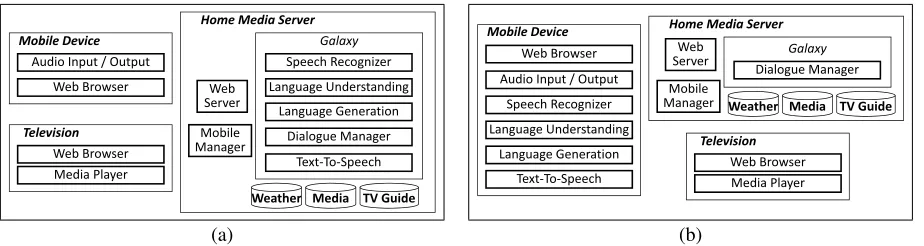
The system architecture is quite flexible with re-gards to the placement of the natural language pro-cessing components. Figure 3 presents two possible configurations of the system components distributed across the mobile device, home media server, and TV display. In 3(a), all speech recognition and nat-ural language processing components reside on the server, with the mobile device acting as the micro-phone, speaker, display, and remote control. In 3(b), the speech recognizer, language understanding com-ponent, language generation comcom-ponent, and text-to-speech (TTS) synthesizer run on the mobile de-vice. Depending on the capabilities of the mobile device and network connection, different configu-rations may be optimal. For instance, on a power-ful device with slow network connection, recogni-tion latency may be reduced by performing speech recognition and natural language processing on the device. On the other hand, streaming audio via a fast wireless network to the server for processing may result in improved accuracy.
Galaxy
Speech Recognizer
Language Understanding
Dialogue Manager Language Generation
Text‐To‐Speech Web
Server
Television Web Browser Media Player
TV Guide Media
Mobile Device
Web Browser
Home Media Server
Weather Mobile Manager
Audio Input / Output Galaxy
Dialogue Manager Web
Server
Television Web Browser Media Player
TV Guide Media
Mobile Device Web Browser
Home Media Server
Weather Mobile
Manager Audio Input / Output
Speech Recognizer
Language Generation
Text‐To‐Speech Language Understanding
[image:5.612.78.540.53.176.2](a) (b)
Figure 3: Two architecture diagrams. In (a) speech recognition and natural language processing occur on the server, while in (b) processing is primarily performed on the device.
Based on the resulting meaning representation, the dialogue manager (Polifroni et al., 2003) incorpo-rates contextual information (Filisko and Seneff, 2003), and then determines an appropriate response. The response consists of an update to the graph-ical display, and a spoken system response which is realized via the GENESIS (Baptist and Seneff, 2000) language generation module. To support on-device processing, all the components are linked via the GALAXY framework (Seneff et al., 1998) with an additionalMobile Managercomponent responsi-ble for coordinating the communication between the mobile device and the home media server.
In the currently deployed system, we use a mo-bile phone with a 624 MHz ARM processor run-ning the Windows Mobile operating system and Opera Mobile web browser. The TV program and music databases reside on the home media server running GNU/Linux. The TV program guide data and recording capabilities are provided via MythTV, a full-featured, open-source digital video recorder software package.3 Daily updates to the program guide information typically contain hundreds of unique channel names and thousands of unique pro-gram names. The music library is comprised of 5,000 songs from over 80 artists and 13 major gres, indexed using the opsource text search en-gine Lucene.4 Lastly, the TV display can be driven by a web browser on either the home media server or a separate computer connected to the server via a fast Ethernet connection, for high quality video stream-ing.
3http://www.mythtv.org/
4http://lucene.apache.org/
While the focus of this paper is on the natural lan-guage processing and user interface aspects of the system, our work is actually situated within a larger collaborative project at MIT that also includes sim-plified device configuration (Mazzola Paluska et al., 2008; Mazzola Paluska et al., 2006), transparent ac-cess to remote servers (Ford et al., 2006), and im-proved security.
5 Mobile Natural Language Components
Porting the implementation of the various speech recognizer and natural language processing com-ponents to mobile devices with limited computa-tion and memory presents both a research and en-gineering challenge. Instead of creating a small vo-cabulary, fixed phrase dialogue system, we aim to support—on the mobile device—the same flexible and natural language interactions currently available on our desktop, tablet, and telephony systems; see e.g., (Gruenstein et al., 2006; Seneff, 2002; Zue et al., 2000). In this section, we summarize our ef-forts thus far in implementing the SUMMIT speech recognizer and TINA natural language parser. Ports of the GENESIS language generation system and of our dialogue manager are well underway, and we ex-pect to have these components working on the mo-bile device in the near future.
5.1 PocketSUMMIT
(Hether-ington, 2007) utilizes only the landmark features, initially forgoing segment features such as phonetic duration, as they introduce algorithmic complexities for relatively small word error rate (WER) improve-ments.
In the current system, we quantize the mean and variance of each Gaussian mixture model dimension to 5 and 3 bits, respectively. Such quantization not only results in an 8-fold reduction in model size, but also yields about a 50% speedup by enabling table lookups for Gaussian evaluations. Likewise, in the finite-state transducers (FSTs) used to represent the language model, lexical, phonological, and class di-phone constraints, quantizing the FST weights and bit-packing not only compress the resulting binary model files, but also reduce the processing time with improved processor cache locality.
In the aforementioned TV, music, and weather do-mains with a moderate vocabulary of a few thou-sand words, the resulting PocketSUMMIT recog-nizer performs in approximately real-time on 400-600 MHz ARM processors, using a total of 2-4 MB of memory, including 1-2 MB for memory-mapped model files. Compared with equivalent non-quantized models, PocketSUMMIT achieves dra-matic improvements in speed and memory while maintaining comparable WER performance.
5.2 PocketTINA
Porting the TINA natural language parser to mobile devices involved significant software engineering to reduce the memory and computational requirements of the core data structures and algorithms. TINA utilizes a best-first search that explores thousands of partial parses when processing an input utterance. To efficiently manage memory allocation given the unpredictability of pruning invalid parses (e.g. due to subject-verb agreement), we implemented a mark and sweep garbage collection mechanism. Com-bined with a more efficient implementation of the priority queue and the use of aggressive “beam” pruning, the resulting PocketTINA system provides identical output as server-side TINA, but can parse a 10-best recognition hypothesis list into the corre-sponding meaning representation in under 0.1 sec-onds, using about 2 MB of memory.
6 Rapid Dialogue System Development
Over the course of developing dialogue systems for many domains, we have built generic natural lan-guage understanding components that enable the rapid development of flexible and natural spoken di-alogue systems for novel domains. Creating such prototype systems typically involves customizing the following to the target domain: recognizer lan-guage model, lanlan-guage understanding parser gram-mar, context resolution rules, dialogue management control script, and language generation rules.
Recognizer Language Model Given a new do-main, we first identify a set of semantic classes which correspond to the back-end application’s database, such asartist, album, and genre. Ideally, we would have a corpus of tagged utterances col-lected from real users. However, when building pro-totypes such as the one described here, little or no training data is usually available. Thus, we create a domain-specific context-free grammar to generate a supplemental corpus of synthetic utterances. The corpus is used to train probabilities for the natural language parsing grammar (described immediately below), which in turn is used to derive a class n -gram language model (Seneff et al., 2003).
Classes in the language model which corre-spond to contents of the database are marked as dynamic, and are populated at runtime from the database (Chung et al., 2004; Hetherington, 2005). Database entries are heuristically normalized into spoken forms. Pronunciations not in our 150,000 word lexicon are automatically generated (Seneff, 2007).
To build a grammar for a new domain, a devel-oper extends the generic syntactic grammar by aug-menting it with domain-specific semantic categories and their lexical entries. A probability model which conditions each node category on its left sibling and parent is then estimated from a training corpus of utterances (Seneff et al., 2003).
At runtime, the recognizer tags the hypothesized dynamic class expansions with their class names, allowing the parser grammar to be independent of the database contents. Furthermore, each semantic class is designated either as a semanticentity, or as anattributeassociated with a particularentity. This enables the generation of a semantic representation from the parse tree.
Dialogue Management & Language Generation Once an utterance is recognized and parsed, the meaning representation is passed to the context res-olution and dialogue manager component. The con-text resolution module (Filisko and Seneff, 2003) applies generic and domain-specific rules to re-solve anaphora and deixis, and to interpret frag-ments and ellipsis in context. The dialogue man-ager then interacts with the application back-end and database, controlled by a script customized for the domain (Polifroni et al., 2003). Finally, the GENESIS module (Baptist and Seneff, 2000) ap-plies domain-specific rules to generate a natural lan-guage representation of the dialogue manager’s re-sponse, which is sent to a speech synthesizer. The dialogue manager also sends an update to the GUI, so that, for example, the appropriate database search results are displayed.
7 Mobile Design Challenges
Dialogue systems for mobile devices present a unique set of design challenges not found in tele-phony and desktop applications. Here we describe some of the design choices made while developing this prototype, and discuss their tradeoffs.
7.1 Client/Server Tradeoffs
Towards supporting network-less scenarios, we have begun porting various natural language processing components to mobile platforms, as discussed in Section 5. Having efficient mobile implementations further allows the natural language processing tasks
to be performed on either the mobile device or the server. While building the prototype, we observed that the Wi-Fi network performance can often be un-predictable, resulting in erratic recognition latency that occasionally exceeds on-device recognition la-tency. However, utilizing the mobile processor for computationally intensive tasks rapidly drains the battery. Currently, the component architecture in the prototype system is pre-configured. A more robust implementation would dynamically adjust the con-figuration to optimize the tradeoffs among network use, CPU utilization, power consumption, and user-perceived latency/accuracy.
7.2 Speech User Interface
As neither open-mic nor push-to-talk with automatic endpoint detection is practical on mobile devices with limited battery life, our prototype system em-ploys a hold-to-talk hardware button for microphone control. To guide users to speak commands only while the button is depressed, a short beep is played as an earcon both when the button is pushed and released. Since users are less likely to talk over short audio clips, the use of earcons mitigates the tendency for users to start speaking before pushing down the microphone button.
In the current system, media audio is played over the TV speakers, whereas TTS output is sent to the mobile device speakers. To reduce background noise captured from the mobile device’s far-field mi-crophone, the TV is muted while the microphone button is depressed. Unlike telephony spoken di-alogue systems where the recognizer has to con-stantly monitor for barge-in, the use of a hold-to-talk button significantly simplifies barge-in support, while reducing power consumption.
7.3 Graphical User Interface
2006; McGraw and Seneff, 2007). The resulting in-terface is largely platform-independent and allows display updates to be “pushed” to the client browser. As many users are already familiar with the TV’s on-screen interface, we chose to mirror the same in-terface on the mobile device and synchronize the selection cursor. However, unlike desktop GUIs, mobile devices are constrained by a small display, limited computational power, and reduced network bandwidth. Thus, both the page layout and infor-mation detail were adjusted for the mobile browser. Although AJAX is more responsive than traditional web technology, rendering large formatted pages— such as the program guide grid—is often still un-acceptably slow. In the current implementation, we addressed this problem by displaying only the first section of the content and providing a “Show More” button that downloads and renders the full content. While browser-based GUIs expedite rapid prototyp-ing, deployed systems may want to take advantage of native interfaces specific to the device for more responsive user interactions. Instead of limiting the mobile interface to reflect the TV GUI, improved us-ability may be obtained by designing the interface for the mobile device first and then expanding the visual content to the TV display.
7.4 Client/Server Communication
In the current prototype, communication between the mobile device and the media server consists of AJAX HTTP and XML-RPC requests. To enable server-side “push” updates, the client periodically pings the server for messages. While such an im-plementation provides a responsive user interface, it quickly drains the battery and is not robust to net-work outages resulting from the device being moved or switching to power-saving mode. Reestablish-ing connection with the server further introduces la-tency. In future implementations, we would like to examine the use of Bluetooth for lower power con-sumption, and infrared for immediate response to common controls and basic navigation.
8 Conclusions & Future Work
We have presented a prototype system that demon-strates the feasibility of deploying a multimodal, natural language interface on a mobile device for
browsing and managing one’s home media library. In developing the prototype, we have experimented with a novel role for a mobile device—that of a speech-enabled remote control. We have demon-strated a flexible natural language understanding ar-chitecture, in which various processing stages may be performed on either the server or mobile device, as networking and processing power considerations require.
While the mobile platform presents many chal-lenges, it also provides unique opportunities. Whereas desktop computers and TV remote controls tend to be shared by multiple users, a mobile device is typically used by a single individual. By collect-ing and adaptcollect-ing to the usage data, the system can personalize the recognition and understanding mod-els to improve the system accuracy. In future sys-tems, we hope to not only explore such adaptation possibilities, but also study how real users interact with the system to further improve the user interface.
Acknowledgments
This research is sponsored by the TParty Project, a joint research program between MIT and Quanta Computer, Inc.; and by Nokia, as part of a joint MIT-Nokia collaboration. We are also thankful to three anonymous reviewers for their constructive feed-back.
References
A. Acero, N. Bernstein, R. Chambers, Y. C. Jui, X. Li, J. Odell, P. Nguyen, O. Scholz, and G. Zweig. 2008. Live search for mobile: Web services by voice on the cellphone. InProc. of ICASSP.
L. Baptist and S. Seneff. 2000. Genesis-II: A versatile system for language generation in conversational sys-tem applications. InProc. of ICSLP.
A. Berglund and P. Johansson. 2004. Using speech and dialogue for interactive TV navigation. Universal Ac-cess in the Information Society, 3(3-4):224–238. G. Chung, S. Seneff, C. Wang, and L. Hetherington.
2004. A dynamic vocabulary spoken dialogue inter-face. InProc. of INTERSPEECH, pages 327–330. E. Filisko and S. Seneff. 2003. A context resolution
server for the GALAXY conversational systems. In Proc. of EUROSPEECH.
K. Fujita, H. Kuwano, T. Tsuzuki, and Y. Ono. 2003. A new digital TV interface employing speech recog-nition. IEEE Transactions on Consumer Electronics, 49(3):765–769.
J. Glass. 2003. A probabilistic framework for segment-based speech recognition. Computer Speech and Lan-guage, 17:137–152.
A. Gruenstein, S. Seneff, and C. Wang. 2006. Scalable and portable web-based multimodal dialogue interac-tion with geographical databases. InProc. of INTER-SPEECH.
I. L. Hetherington. 2005. A multi-pass, dynamic-vocabulary approach to real-time, large-dynamic-vocabulary speech recognition. InProc. of INTERSPEECH. I. L. Hetherington. 2007. PocketSUMMIT:
Small-footprint continuous speech recognition. In Proc. of INTERSPEECH, pages 1465–1468.
B. Johanson, A. Fox, and T. Winograd. 2002. The in-teractive workspaces project: Experiences with ubiq-uitous computing rooms. IEEE Pervasive Computing, 1(2):67–74.
M. Johnston, L. F. D’Haro, M. Levine, and B. Renger. 2007. A multimodal interface for access to content in the home. InProc. of ACL, pages 376–383.
J. Mazzola Paluska, H. Pham, U. Saif, C. Terman, and S. Ward. 2006. Reducing configuration overhead with goal-oriented programming. In PerCom Workshops, pages 596–599. IEEE Computer Society.
J. Mazzola Paluska, H. Pham, U. Saif, G. Chau, C. Ter-man, and S. Ward. 2008. Structured decomposition of adapative applications. InProc. of 6th IEEE Confer-ence on Pervasive Computing and Communications. I. McGraw and S. Seneff. 2007. Immersive second
lan-guage acquisition in narrow domains: A prototype IS-LAND dialogue system. In Proc. of the Speech and Language Technology in Education Workshop. J. Nichols and B. A. Myers. 2006. Controlling home and
office appliances with smartphones. IEEE Pervasive Computing, special issue on SmartPhones, 5(3):60– 67, July-Sept.
H.-J. Oh, C.-H. Lee, M.-G. Jang, and Y. K. Lee. 2007. An intelligent TV interface based on statistical dia-logue management. IEEE Transactions on Consumer Electronics, 53(4).
T. Paek, M. Agrawala, S. Basu, S. Drucker, T. Kristjans-son, R. Logan, K. Toyama, and A. Wilson. 2004. To-ward universal mobile interaction for shared displays. InProc. of Computer Supported Cooperative Work. J. Polifroni, G. Chung, and S. Seneff. 2003. Towards
the automatic generation of mixed-initiative dialogue systems from web content. InProc. EUROSPEECH, pages 193–196.
T. Portele, S. Goronzy, M. Emele, A. Kellner, S. Torge, and J. te Vrugt. 2003. SmartKom-Home - an ad-vanced multi-modal interface to home entertainment. InProc. of INTERSPEECH.
S. Seneff, E. Hurley, R. Lau, C. Pao, P. Schmid, and V. Zue. 1998. GALAXY-II: A reference architecture for conversational system development. InProc. IC-SLP.
S. Seneff, C. Wang, and T. J. Hazen. 2003. Automatic in-duction ofn-gram language models from a natural lan-guage grammar. InProceedings of EUROSPEECH. S. Seneff. 1992. TINA: A natural language system
for spoken language applications. Computational Lin-guistics, 18(1):61–86.
S. Seneff. 2002. Response planning and generation in the MERCURY flight reservation system. Computer Speech and Language, 16:283–312.
S. Seneff. 2007. Reversible sound-to-letter/letter-to-sound modeling based on syllable structure. InProc. of HLT-NAACL.
K. Wittenburg, T. Lanning, D. Schwenke, H. Shubin, and A. Vetro. 2006. The prospects for unrestricted speech input for TV content search. InProc. of AVI’06. V. Zue, S. Seneff, J. Glass, J. Polifroni, C. Pao, T. J.