Volume 3, No. 1, Jan-Feb 2012
International Journal of Advanced Research in Computer Science
RESEARCH PAPER
Available Online at www.ijarcs.info
ISSN No. 0976-5697
Performance Comparison of Routing Protocols with Variable Transmission Power
P.S.Hiremath
Professor,
Department of PG Studies and Research in Computer Science Gulbarga University, Gulbarga,
Karnataka, India.
S.M.Joshi*
Research Scholar,
Department of PG Studies and Research in Computer Science Gulbarga University, Gulbarga,
Karnataka, India.
Abstract:A mobile ad hoc network (MANET) is a collection of wireless mobile nodes dynamically forming a network topology without the use of any existing network infrastructure or centralized administration. A major issue with ad-hoc networks is the energy consumption of mobile nodes as they are battery-operated. Transmission range of a node plays an important role in the design of an energy efficient routing protocol. In this paper our objective is to study the impact of varying transmission range of mobile nodes on the performance of the three routing pr otocols namely, Dynamic Source Routing (DSR), Ad-Hoc On Demand and Distance Vector Routing (AODV), and Destination-Sequenced Distance-Vector Routing (DSDV). From the simulation experiments it is observed that the routing protocols with variable transmission range perform better than the protocols with fixed transmission range.
Keywords:transmission range, routing protocol, DSR, AODV, DSDV.
I. INTRODUCTION
Mobile devices coupled with wireless network interfaces will become an essential part of future computing environment that consist of infrastructure or infrastructureless mobile networks. Wireless local area network based on IEEE 802.11 technology is the most prevalent infrastructure mobile network, where a mobile node communicates with a fixed base station, and thus, a wireless link is limited to one hop between the node and the base station. Mobile ad hoc network (MANET) is an infrastructureless multihop network where each node communicates with other nodes directly or indirectly through intermediate nodes. Thus, all nodes in a MANET basically function as mobile routers participating in some routing protocol required for deciding and maintaining the routes. Since MANETs are infrastructure-less, self-organizing, rapidly deployable wireless networks, they are highly suitable for applications involving special outdoor events, communications in regions with no wireless infrastructure, emergencies and natural disasters, and military operations. Routing is one of the key issues in MANETs due to their highly dynamic and distributed nature. There are several problems that we encounter while dealing with routing in MANETs.
i. Asymmetric links: Most of the wired networks rely on the symmetric links which are always fixed. But this is not the case with ad-hoc networks as the nodes are mobile and are constantly changing their positions within network.
ii. Routing Overhead: In wireless ad hoc networks, nodes often change their locations within a network. Hence, some stale routes are generated in the routing table which leads to unnecessary routing overhead.
iii. Interference: This is the major problem with mobile ad-hoc networks as links get linked or delinked depending
on the transmission characteristics, one transmission might interfere with another one and a node might overhear transmissions of other nodes. It can corrupt the total transmission.
iv. Dynamic Topology: The topology changes dynamically, since the mobile node might move or medium characteristics might change. In ad-hoc networks, the routing tables must somehow reflect these changes in topology and thus the routing algorithms need to be adaptive.
v. Energy constrained operation: As the mobile nodes are battery operated, they have limited energy. Routing mechanisms should take the residual power of the mobile node into account while forwarding the packets through such nodes.
II. MANET ROUTING PROTOCOLS
The three commonly used routing protocols are DSR, AODV and DSDV.
A. Dynamic Source Routing:
B. Ad-hoc on Demand Distance Vector Protocol: The Ad hoc on demand Distance Vector (AODV) routing protocol uses Hello beacon for connectivity among the nodes. The AODV uses routing table to avoid loop and to distinguish between stale and fresh route. The routing table contains the sequence number and next hop information. If source has data to send, it floods the RREQ packet. The destination sends RREP packet in response to the request. If the link breaks then the intermediate node sends RERR (route error) message to the source node for information about the broken link. The AODV protocol uses the route discovery process as in DSR and routing table as in DSDV.
C. Destination-Sequenced Distance Vector Protocol: Destination-Sequenced Distance Vector (DSDV) routing protocol is a variation of the Distributed Bellman-Ford algorithm which is modified to address problems inherent to ad-hoc networks, such as time dependent topologies. These modifications tend to reduce the looping properties that would otherwise be present. Since DSDV is table-driven, each node maintains a routing table with the next hop entry for each destination and the metric for the link. In addition, each link has a sequence number associated with it. This sequence number is periodically incremented by the destination node for the link. Then, other nodes choose the route with highest sequence number, as that is the least stale route to the destination. If a node detects that a link has of DSR, and AODV using speed and pause time. It is shown that both, the protocols have good performance in their own categories. In [2], the behavior of routing protocols under varying node densities and mobility patterns has been studied. It is observed that, AODV is largely affected by the node density as compared to the other routing protocols, the reason being the internal routing mechanism of the AODV protocol. Comparative performance study of LAR, AODV and FSR routing protocols is done by Ahmed et.al. [3], in which experimental results show that FSR protocol has low control overhead as compared to AODV and LAR. Further, AODV has a high throughput as compared to the other protocols. Considering the end to end delay, LAR protocol shows better performance over FSR and AODV protocols.
Performance comparison of AODV, DSDV, OLSR and DSR routing protocols is done by Ade & Tijare [4]. It is observed that, the reactive protocol AODV is better in view of its ability to maintain connection by periodic exchange of information, which is required for TCP based traffic. The AODV delivers virtually all packets at low node mobility,
and fails to converge as node mobility increases. Meanwhile DSR is very good at all mobility rates and movement speeds. The DSDV performs almost as well as DSR, but still requires the transmission of many routing overhead packets. A.Boukhalkhall e.t. al. [5], have observed that DSDV performs badly at high movement speed and for a large number of nodes. The AODV performs better as the mobility increases. It is also observed that, CBRP has high packet delivery ratio in all cases. Performance evaluation of routing protocols for MANETs under different traffic conditions is done in [6]. In [7], the authors have done the survey of routing protocols with focus on the characteristics, functionality, benefits and limitations and then carried out the comparative analysis of their performance. In [8], the study of comparative performance of DSR and AODV has been done. It is observed that DSR outperforms AODV in dense situations and also DSR consistently generates less routing load than AODV. Most of the above works focus on the study of performance of routing protocols by varying parameters like node density, node speed, node mobility, node pause time etc. Not much work has been done to study the impact of variations in transmission range of mobile nodes on the performance of the routing algorithms.
IV. PROPOSEDWORK
Energy efficient routing is considered to be the most important design criteria for MANETs, since mobile nodes are powered by batteries with limited capacity. Power failure of a mobile node not only affects the node itself but also affects its ability to forward packets on behalf of others and, thus, the overall network lifetime. For this reason, be accomplished by minimizing mobile nodes’ energy, not only during active communication, but also when they are inactive. Transmission power control and load distribution are two approaches to minimize the active communication energy, and sleep/power-down mode is used to minimize energy during inactivity.
the proposed routing protocols based on variable range transmission control technique in terms of system performance metrics, namely, packet delivery fraction (PDF), throughput, end to end delay and energy consumption. This study is done for different node densities by simulating the performance of the proposed routing protocols.
A. Implementation:
Transmission range of a node refers to the average maximum distance in usual operating conditions between two nodes. We can change the radio range by varying the transmitter power (RADIO-TX-POWER) or the receiver power (RADIO-RX-THRESHOLD). It is somehow advisable to change the transmitter power, because the receiver power depends on the radio environment, while we can control the transmitter power. We considered 100, 200, 300, 400 and 500 meters as radio ranges. The default transmission range of a node is 250 meters. The implementation is done using NS2 simulator and C programs for computing transmission power, with the simulation parameter values as shown in the Table 1.
Table 1. Simulation parameters and their values.
Parameter Value
Simulation Time 500sec
Terrain Area 500 X 500 sq. mtr
Number of Nodes 10, 50, 100
Node Placement Strategy Random
Mobility Model Random Way Point
Pause Time 100.0 msec.
Propagation Model Two Ray Ground
Channel Frequency 2.4 G.Hz
Routing Protocol DSR, AODV and DSDV
Transmission Range 100, 200,300, 400, 500 mts.
B. Performance Metrics:
a. Packet Delivery Ratio/Fraction: It is the ratio of total number of data packets received successfully at destination to number of data packets generated at the source. PDF values range from 0 to 1. Higher PDF values decide the consistency of the protocol.
b. End-to-End Delay: The end to end delay is the Average time interval between the generation of a packet at a source node and the successful delivery of the packet at the destination node. Low end to end delay gives better performance of the network.
c. Throughput: It is the rate of successfully transmitted data packets per second in the network during the simulation.
d. Average energy consumption: It is the average energy consumed by all nodes in the network. The energy consumption should be as low as possible so as to make fair utilization of limited battery power.
V. RESULTSANDDISCUSSIONS
The simulation experiments have been performed using NS2 simulator to obtain the variations in the different performance measures due to varying transmission range for different number of nodes, namely, 10, 50 and 100. The
experimental results are presented in graphical form in the Figs.1-3.
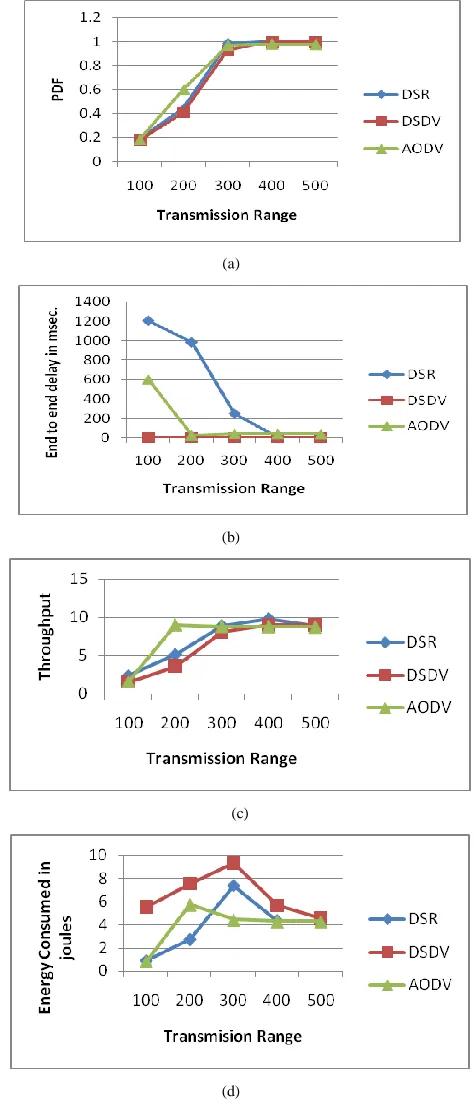
From the Fig.1 (a), it is observed that, at low density, i.e., when the number of nodes is less, as the transmission range increases, the PDF of AODV increases more sharply till the transmission range reaches 300. The PDF of DSDV is always less as compared to DSR and AODV.
(a)
(b)
(c)
(d)
From the Fig.1(b), we see that DSDV has least delay. This is due to the fact that, it need not have to perform route discovery again and again. From the Fig.1(c), it can be seen that, the throughput of DSR and AODV increases more sharply with the increase in transmission range till it reaches 300 mts. The DSDV performs poorly even with respect to throughput. In all the routing protocols, for higher transmission range, the average energy consumption is less. This is shown in the Fig.1(d).
From the Fig.2(a and b), it is observed that, when the node density is medium, the DSR and AODV algorithms perform well with respect to PDF and throughput. Again, till the transmission range reaches 300mts, PDF and throughput increase more sharply, thereafter, it remains almost constant. The DSDV fairs better with regard to end to end delay as shown in the Fig.2(c). From the Fig.2(d), we see that the AODV consumes more energy.
(a)
(b)
(c)
(d)
Figure.2. The variation of (a) PDF, (b) end-to-end-delay, (c) throughput and (d) energy consumed with transmission range for 50 nodes
From the Fig.3 (a), it is observed that, in the case of high node density, the DSR and AODV perform well as compared to DSDV in terms of PDF. But, there is no significant change in the PDF with the increase in the transmission range for AODV after the transmission range exceeds 200mts. It can be observed from Fig.3(c) that, for lower transmission range, the DSR and AODV have better throughputs. The Fig.3(b) shows that the DSDV performs better as far as end to end delay is concerned.
(a)
(b)
(d)
Figure.3. The variation of (a) PDF, (b) end-to-end-delay, (c) throughput and (d) energy consumed with transmission range for 100 nodes
VI. CONCLUSION
In this paper, we have studied the impact of variation in performance of MANET routing protocols DSR, AODV and DSDV, when variable transmission range is allowed. From the simulation experiments, it is observed that these routing protocols with variable transmission range perform better than the protocols with fixed transmission range,
VII. REFERENCES
[1].Sunil Taneja, Ashwani Kush and Amandeep Makkar, Experimental Analysis of DSR, AODV using Speed and Pause time, International Journal of Innovation, Management and Technology, Vol. 1, No. 5, December 2010.
[2].Deepa.S, Dr. D.M Kadhar Nawaz , A Study on the Behavior of MANET Routing Protocols with Varying Densities and Dynamic Mobility Patterns, IJCA Special Issue on “Mobile Ad-hoc Networks” MANETs, 2010
[3].Ahmed A. Radwan, Tarek M. Mahmoud and Essam H. Houssein, Performance Measurement of Some Mobile Ad Hoc Network Routing Protocols, IJCSI International Journal of Computer Science Issues, Vol. 8, Issue 1, January 2011
[4].S. A. Ade & P.A.Tijare, Performance Comparison of AODV, DSDV, OLSR and DSR Routing Protocols in Mobile Ad Hoc Networks, International Journal of Information Technology and Knowledge Management July-December 2010, Volume 2, No. 2, pp. 545-548
[5].A.Boukhalkhal, M.B. Yagoubi, M. Djoudi, Y. Ouinten, M. Benmohammed, Simulation of Mobile Ad hoc Routing Strategies, 978-1-4244-1841-1/08/ ©2008 IEEE.
[6].Vasudha Arora, C. Rama Krishna, Performance Evaluation of Routing Protocols for MANETs under Different Traffic Conditions, 978-1-4244-6349-7/10/ © 2010 IEEE
[7].Sunil Taneja and Ashwani Kush, A Survey of Routing Protocols in Mobile Ad Hoc Networks, International Journal of Innovation, Management and Technology, Vol. 1, No. 3, August 2010.
[8].Nidhi Sharma, Sanjeev Rana, R.M. Sharma, Provisioning of Quality of Service in MANETs Performance Analysis & Comparison (AODV and DSR ) , 978-1-4244-6349-7/10/ © 2010 IEEE