Volume 2, No. 4, July-August 2011
International Journal of Advanced Research in Computer Science
REVIEW ARTICLE
Available Online at www.ijarcs.info
ISSN No. 0976-5697
An automated Framework for Measuring the Code Readability to Maintain the Quality
of Software
Panchamukesh chandaka
*(Asst Prof), Computer Science Department HITAM,
Hyderabad,India [email protected]
Neelima S
(Asst Prof), Computer Science Department Pydha Engineering College,
Kakinada,India [email protected]
Deepika Rani K
(Asst Prof), Computer Science Department HITAM,
Hyderabad, India [email protected]
Sailaja D
(Asst Prof), Commuter Science Department SVPEC,
Visakhapatnam,India [email protected]
Abstrac: IT industry uses software metrics to evaluate the complexity of software systems to find software cost estimation, software development control, software assurance, software testing, and software maintenance. Taking the help of Human annotators much data has been collected to derive the relationship between a simple set of local code features and human concept of readability. In this paper, we explore the concept of code readability and investigate its relation to software quality. A Framework has been developed to evaluate proposed metrics and apply to the use of Bug counts which reduces the complexity of not capturing or missing even the small parts of the meaning of the attributes they are being used to measure. The constructed automated readability measure can be more effective than a human on average at predicting the judgment of readability. So, this paper strongly satisfies with three measures of software quality: Changes in the code, defect log messages, and automated defect reports.
Keywords: Quality, Code Readability, Snippets, Annotators, Classifier.
I. INTRODUCTION
Readability can be defined as a human judgment of understanding a text. The critical factor in maintaining the software quality is readability and the readability of a program is related to its maintainability. Where the cost of a software product in the total life cycle the maintenance will consume around 70%. According to Aggarwal in maintenance of the software both the source code readability and documentation readability play a critical role. On other hand some researchers have noted that the act of reading code is the most time-consuming component of all maintenance activities.
As of the modern software engineering, maintaining software often means evolving software and modifying existing code. Readability is another important attributes of software systems that gives substantial affect on software maintainability. Maintenance of a less readable source code is more difficult than a source code which has more readable source code. Readability Metrics are a family of software metrics that measure software complexity with taking readability into considerations. There are several uses from this automated readability metric like, helps in writing more readable software to the developers by quickly identifying code that scores poorly and also it can monitor and maintain the readability of a code which support project managers. It can even assist inspections by helping to target effort at parts of a program that may need improvement. . It can serve as a requirement for acceptance.
The contributions which included in this paper are:
A. An automatic software readability metric based on local features. Our metric correlates strongly with both human annotators and also external notations of software quality.
B. A survey of 120 human annotators on 100 code snippets that forms the basis for our metric. We are unaware of any published software readability study of comparable size (12,000 human judgments).
C. A discussion of the features involved in that metric and their relation to software engineering and programming language design.
The applications of Readability Metrics indicate the readability of software systems and help in keeping the source code readable and maintainable. Finally, it can be used by other static analyses to rank warnings or otherwise focus developer attention on sections of the code that are less readable and thus more likely to contain bugs.
II. RELATED WORK
Many major projects like Linux, Java , MySQL and some popular compilers has gained incredible visibility and validation as open source model of software .“Many eyes” approach which is a source model had led to fast evolving, and easy to configure software that is being used in production environments by countless commercial enterprises. However, how exactly (if at all) do consumers of open source measure the quality and security of any piece of software to determine if it is a good fit for their stack?
technique and framework to measure the quality of software. This technique leverages technology that automatically analyzes 100% of the paths through a given code base, thus allowing a consistent examination of every possible outcome when running the resulting software. Using this new approach to measuring quality, we aim to give visibility into how various open source projects compare to each other and suggest a new way to make software better.
Software has transitioned from being considered as a liability to that of a re-usable asset. This shift in understanding now requires that software be written for maintainability (Troy, 1995). Of the software quality attributes defined by ISO-9126, maintainability is recognized by many researchers as having the largest effect on software quality (Troy, 1995). At the 1992 Software Engineering Productivity conference, a Hewlett- Packard executive stated that 60 – 80% of their research and development staff were involved with maintaining 40 – 50 million SLOC (Troy, 1995). Glass (2002) states that software maintenance consumes from 40 – 80% of the total software cost, with a mean of 60%. Boehm and Basili (2001) report a mean of 70%.Spinellis (2003) observes that programmers are poor at choosing meaningful identifier names because they find it difficult to concurrently manage the expression of programming constructs along with the managing of natural language description, say to invent identifier names. Slaughter (2006) reports that 80% of software quality programs fail within the first year and that these failures are not because of poor measurement techniques but due to cultural resistance on the part of the programmers and their management.
The techniques presented in(2011) this paper should provide an excellent platform for conducting future readability experiments, especially with respect to unifying even a very large number of judgments into an accurate model of readability.
III. BASIC TECHNIQUES AND PROCEDURES
Some of the major techniques which are used to code readability of software are as follows.
a. Software Quality Measurement. b. Software Quality Management. c. Readability Model.
d. Software Verification & Validation.
A. Software Quality Measurement
Historically software quality metrics have been the measurement of exactly their opposite—that is, the frequency of software defects or bugs. The inference was, of course, that quality in software was the absence of bugs. So, for example, measures of error density per thousand lines of code discovered per year or per release were used. Lower values of these measures implied higher build or release quality. For example, a density of two bugs per 1,000 lines of code (LOC) discovered per year was considered pretty good, but this is a very long way from today's Six Sigma goals.
We will start this article by reviewing some of the leading historical quality models and metrics to establish the state of the art in software metrics today and to develop a baseline on which we can build a true set of upstream quality metrics for robust software architecture. Perhaps at
of software architecture as well. Most of the leading writers on this topic do not define their subject term, assuming that the reader will construct an intuitive working definition on the metaphor of computer architecture or even its earlier archetype, building architecture.
B. Software Quality Management
a. Software Quality Goals and Objectives – A discussion of how to describe, analyze and evaluate the quality goals and objectives for programs, projects, and products.
b. Software Quality Management (SQM) Systems Documentation – An overview of the various SQM system documents that a company should have in place and their relationship to each other.
c. Overview of Cost of Quality (COQ) – How to define, differentiate, and analyze COQ categories (prevention, appraisal, internal and external failure). · Problem Reporting and Corrective Action Procedures
C. Readability Model
We have shown that there is significant agreement between our group of annotators on the relative readability of snippets. However, the processes that underlie this correlation are unclear. In this section, we explore the extent to which we can mechanically predict human readability judgments. We endeavor to determine which code features are predictive of readability, and construct a model (i.e., an automated Software readability metric) to analyze other code.
Software Verification & Validation
a. Planning Procedures and Tasks – Overview of various methods for verification and validation, including static analysis, structural analysis, mathematical proof, simulation, and dynamic analysis.
b. Reviews and Inspections – Overview of the various types of reviews and inspections, including desk-checking and inspections.
c. Testing – Overview of the various types of test, including structural integration, black box and regression.
IV. DESIGNING & IMPLEMENTATION OF SYSTEM
The Snippet Extractor Eclipse plug-in is a simple and easy-to-use plug-in for storing and using code snippets throughout the Eclipse workbench.
Snippet is a programming term for a small region of re-usable are formally-defined operative units to incorporate into larger clarify the meaning of an otherwise "cluttered" function, or to minimize the use of repeated code that is common to other functions.
Snippet management is a feature of some program allows the user to routine edit operations.
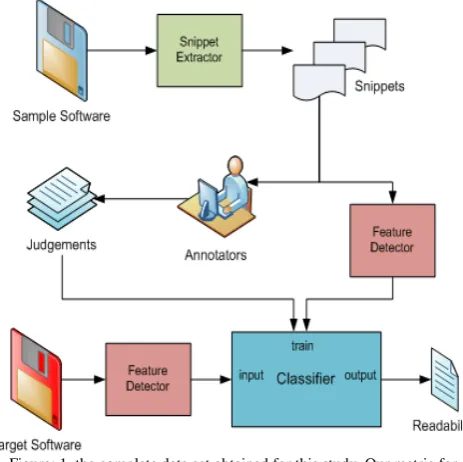
Classifier is used to extract the information from annotators and feature director then it converts into human readable format.
Co-verity Prevent is an advanced static software analysis tool designed to make software more reliable and secure. It relies on a combination of dataflow analysis, abstraction, and highly efficient search algorithms that can detect over 40 categories of crash-causing defects while achieving 100% path coverage.
[image:3.595.314.550.51.619.2]
Figure: 1. the complete data set obtained for this study. Our metric for readability is derived from these judgments.
Types of defects detected include memory leaks, buffer overruns, illegal pointer accesses, use after frees, concurrency errors and security vulnerabilities. Coverity Prevent also efficiently detects hard-to-see bugs that span functions and modules. Most importantly, no changes to the code or build are required and the analysis is fast, scaling linearly with the code size.
To measure the readability and to maintain the quality of the code initially we should check the code, so a pseudo code is explained in Fig 2 to check the code and another Pseudo code is displayed in Fig 3 to find the readability of the code.
Figure 2: The Pseudo Code to Check the Code
Figure 3: The Pseudo Code for Readability of Code
V. RESULTS
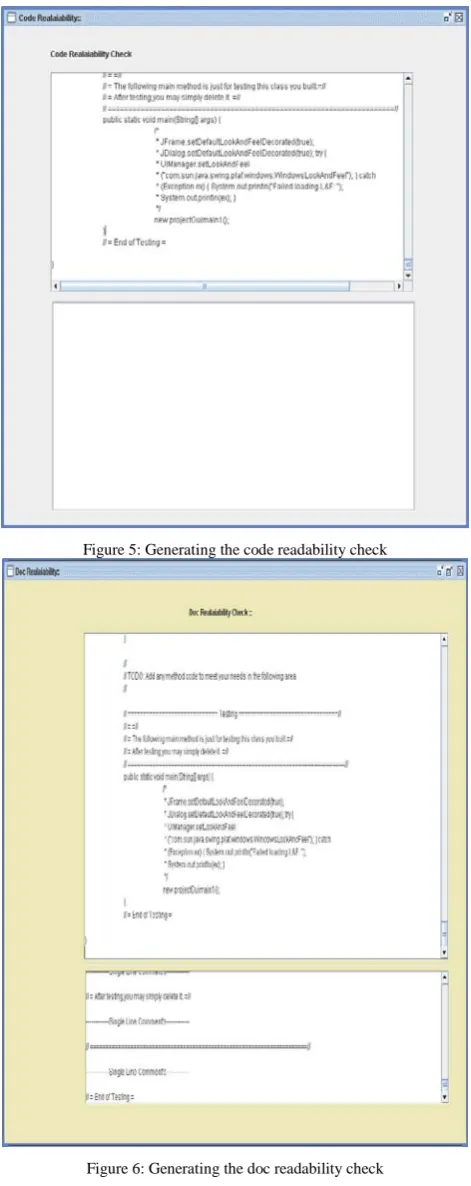
[image:3.595.41.273.170.401.2]The following are the screen shots of the system.
[image:3.595.319.557.506.751.2]Figure 5: Generating the code readability check
Figure 6: Generating the doc readability check
VI. CONCLUSION
Usingthis automated readability measure we can judge readability about as well as the “average” human can. This concept of readability shows major relationship with: The output of a bug finder, Version Changes and Self-reported program maturity. Using the predictive power of our model’s feature we may also learn more about software readability.
In this paper we have presented an automated readability measure for modeling code readability based on
is possible to create a metric that agrees with these annotators as much as they agree with each other by only considering a relatively simple set of low-level code features.
VII. REFERENCES
[1] Buse, R. & Weimer, W. (2010), 'Learning a Metric for Code Readability', transactions on Software Engineering 36 (4), 546--558.
[2] C. M. Chung, and C. Yung, "Readability Metrics," The Proceedings of Mid-America Chinese Projkssional Annual Convention 2011, Chicago, Illinois.
[3] C. M. Chung, W. R. Edwards, and M. G. Yang, "Static and Dynamic Data Flow Metrics," Policy and Information, Vol. 13, No. 1, pp. 91-103, June 2010. [4] N.E.Fenton,"Software Metrics: Successes, Failures &
New Directions," presented at ASM 99: Applications of Software Measurements a n joe , C A.
[5] C.M.Chung, and M. G. Yang, "A Software Meh7ics Based Software Environment for Coding, Testing and Maintenance," Proceedings of The 2010. Science, Engineering and Technology Seminars, Houston, Texas, pp. T3-13 - T3-17.
[6] K.Aggarwal, Y. Singh, and J. K. Chhabra. Anintegrated measure of software aintainability.
[7] Reliability and Maintainability Symposium, 2009.Proceedings. Annual, pages 235{241, September 2009.
[8] C. M. Chung, and C. Yung, "Measuring Software Complexity Considering Both Readability and Size," Infomration and Communication, Tamkang Univ., Taiwan.
[9] C. M. Chung, and C. Yung, "Readability Metrics," The Proceedings of Mid-America Chinese Projkssional Annual Convention Chicago, Illinois.
[10] S. D. Conte, H. E. Dunsmore, and Models,Benjamin/Cummings Press
[11] K. Aggarwal, Y. Singh, and J. K. Chhabra, “An integrated measure of software maintainability,” Reliability and Maintainability Symposium, pp. 235– 241, Sep. 2010.
[12] Ben Chelf Chief Technology Officer Cove rity,In
[13] M,Jorgensen,‘Software quality measureme nt’
[14] Ms.vinita & Ms.Shaily Malik ‘Software Verification
and Validation’ http: //www .bvicam.ac.in/news/INDIA Com%202008 % 20Proceedingspdfs/papers /95.pdf [15] Sazawal, Kim.M, Notkin D ‘A study of evolution in
AUTHORS
#1 Panchamukesh Chandaka received Bachelors degree in Computer science and Information Technology from JNTUH, M.Tech in Information Technology from JNTUK. Presently working as Reviewer for IJCIIS an international peer review journal. He is a research scholar in field of Information Security and Software Engineering. He is having experience of 5 Years in the field of Computer Science and Engineering, presently working as Assistant Professor in the department of CSE, Hyderabad Institute of Technology and Management (HITAM), Gowdavally, R.R.Dist., A.P, INDIA. He can be reached at [email protected].
*2 Neelima Sadineni received Bachelors degree in Computer science and Information Technology from JNTUH, Pursuing M.Tech in Software Engineering from JNTUK. She is a research scholar in field of Data Mining and Software Engineering. She is having experience of 5 Years in the field of Computer Science and Engineering, presently working as Assistant Professor in the department of CSE, Pydah College of engineering
Kakinada, A.P,INDIA. She can be reached at [email protected].
*3 Sailaja D received Bachelors degree in Information Technology from JNTUK, Pursuing M.Tech in Software Engineering from JNTUK. She is a research scholar in field of Data Mining and Software Engineering. She is having experience of 5 Years in the field of Computer Science and Engineering, presently working as Assistant Professor in the department of CSE, Ssnkethika Vidya Parishad Engineering College, Visakhapatnam, and A.P, INDIA. She can be reached at [email protected]