DOI:
Com
Abstr
task, and b can v line p vertic
Keyw
1. IN
THE is a docu text over non-extra etc., to th woul Line base Glob mach diffe skew Houg skew when adop of sk On tocha gaps theef the affec docu smoo each recla thate Start : http://dx.doi.
A COMP
Nee Assistant Pr mmunication Eract: Segmenta many of the m background inf vary greatly dep
portion of cont cal technique. T
words: handwrit
NTRODUCTI
EDocument im a criticalstag ument recogni
lines or a rlapping or to -Manhattan l action. Due to methods that he propertieso ld be more rob e extraction te
d, groupin balprojections hineprinted do erentskew ang w correctionin gh-based meth w angle betw
n the skew of pt piece-wise p kew angle vari
the other ha aracters' size sbetween succ ffectiveness o resultsof tw cting the dr ument width. T
oth version o h zone into c
assify these re enhances stat ting fromleft .org/10.26483/
Interna
PARATIV
erugatti Varip rofessor, Depa Engineering, Hyderabation of handwr methods produc formation. Thes
pending on the tent, and a wor This paper surve
tten document i
ION mage segment ge towards ition. Variatio along thesam ouching lines layout are t o high variabi do not use an of the docum
bust[1]. chniques may ng, smeari -based appro ocuments but gles. Howeve n documents hodhandle do ween textlines f a text line va projections w iation[2]. and, piece-wi
variation wit cessive words. of smearing m wo adjacent
rawing oftext To deal with t of the projec candidate text egions by app tistics from and moving /ijarcs.v9i1.542
Volu
ational Jou
Av
VE ANAL
HAND
pally Vishwaartment of Ele St.Peter’s Eng bad,India
D.HariSa
St. P
itten image is th e poor recognit se characteristic e user skills, dis rd section from eys numerous e
image analysis,
tation to text unconstraine on of the skew me text line
s, variablecha the challeng ility of writing ny prior know ment image, a
y be categoriz ing and
aches are ve cannot handl er, they can
with consta ocuments with s but are not ariesalong its w which candeal
ise projection thin text lines . These occurr methods too[3] zones may t-line separat theseproblems ction profiles
t and gap re plying an HM
the whole d g to the righ 28
ume 9, No.
urnal of Ad
RESE
vailable On
LYSIS OF
WRITTE
anath ectronics and gineering CollaiRam, T.Leel
UG studen Peter’s Engine
he challenging tion rate. Text cs variations tu sposition and c m line and char essential and pr
,Text line segm
lines and wor ed handwritt w angle betwe , existence aracter size a ges of textli g styles, scrip wledge and ada as the propose
zed as projecti Hough-base ry effective f e text lines w
be applied f ant skew ang h variation in t t very effecti width. Thus, w
with both typ
ns are sensiti s and significa
rences influen ]. In such cas be ambiguou tors along t s we introduce
to oversegme egions. Then,w MM formulati
document pag ht we combi
1, January
dvanced Re
EARCH PA
nline at ww
F LINE AN
EN DOCU
lege, Com
la Sai and Sh
nts, Departme eering College
task in Optical characteristics urn the process cultural backgro racter fragment ropelled division mentation, Word rds ten een of and ine pts, apt ed, ion ed. for with for gle. the ive we pes ive ant nce es, us, the e a ent we ion ge. ine se an G fa de co co In te su an C ch m re so Pr al C pe Th re of in of co 6, 2. In an w A ac
y-February
esearch in C
APER
ww.ijarcs.in
ND WOR
UMENT I
Associate Pr mmunication E hashank Nanent of ECE, e, Hyderabad,
Character Rec can vary in siz of word detect ound. The segm
from word. T n strategies of w
d segmentation,
eparators of c nd the local fo Grouping appro
ailto distinguis eal withsuch omponent (C orresponding t n word s echniquescons uccessive CCs nd “between”
Cs shape, e.g haracter “t”. W more tolerant esultsfrom the oft-marginline reliminary ver lgorithmswere ontestin ICD erformed the b
he organizatio ecent related w
f text-line extr n section III.In f segmentatio omparisons an , respectively.
. RELATED W
n this section, nd word segm were presented As far as w chievedthe bes
y 2018
Computer
nfo
RD SEGM
IMAGE
Muru rofessor, Depa Engineering, Hyderab nda Kumar Indiaognition. Due t ze, font, alignm tion complex a mentation shoul his should be p written by hand
Optical Charac
consecutiveon oreground den oaches can ha sh touching te a case by sp CC)and assign
text lines. egmentation, sidera spatial
s and define ” word gaps[5 g. a simple ex
We introduce to such c e optimal valu ear SVM that s rsions of the t e submitted to DAR07, under bestresults[6]. on of the rest works present raction from h n section IV, on in text lin nd conclusion
WORK
, the brief rev mentation in
.
e know, the st results in th
Science
ISSN NMENTATI
ugan R
artment of Ele St.Peter’s Eng bad,India
to the improper ment, color, orie and difficult. Si ld be possible b possible by the d archive picture
cter Recognition
nes considerin nsity.
andle complex ext lines[4]. In litting the res n the individ
most of measure of athreshold to 5].Themeasure xtension of th
e a novel gap ases. The p ue of the obje
separates cons text-line and w o the Handwri
r the name I .
of the paper ts in Section I handwritten d
the various p nes into word s arepresented
view of recen handwritten e following he correspondi o. 0976-5697
ION FOR
ectronics and gineering Collr segmentation o entation, and co ince handwritte based on zoom e utilization of
es.
n
ng their prox
x layouts, but n our approach spective conn dual parts to
f the prop the gap bet o classify “wi es are sensiti ehorizontal pa p measurewhi proposed me ctive function secutive CCs. word segment iting Segment ILSP-LWSeg,
is as follows II. The descri document imag
proposed techn dsis presented d in Sections
nt work on tex document im
techniques e ing test datase
R
lege, of this ontrast en text ming, a level, ximity t they h, we nected o the posed tween ithin” ve to art of ich is easure n of aareelements of integrated systems for specific tasks. One of themost accurate methods uses piece-wise projection pro- files to
obtain an initial set of candidate lines and bivariate Gaussiandensities to assign overlapping CCs into text lines [7].
Trial comes about on an accumulation of 720 archives (English, Arabic and youngsters' penmanship) demonstrate that 97.31% of content lines were portioned accurately.The writersmention that “a more intelligent approach to cut anoverlapping component is the goal of future work”. A recentapproach [8] uses block-based Hough transform to detect lines
and merging methods to correct false alarms. Although thealgorithm achieves a 93.1% detection rate and a 96%recognition rate, it is not flexible to follow variation of skewangle along the same text line and not very precise in theassignment of accents to text lines.
Li et al. [9] examine the content line identification undertaking as a picture division issue. They utilize a Gaussian window to change over a double picture into a smooth dark scale. Then they adopt the level set method toevolve text-line boundaries and finally, geometrical constrainsare imposed to group CCs or segments as text lines. Theyreport pixel-level hit rates varying from 92% to 98% ondifferent scripts and mention that “the major failures happenbecause two neighboring text lines touch each othersignificantly”. A similar method [10] evaluates eight differentspatial measures between pairs of CCs to locate words inhandwritten postal ad- dresses. The best metric proved to bethe one which combines the result of the minimum run-lengthmethod and the vertical overlapping of two successive CCs.
Additionally, this metric is adjusted by utilizing the results ofa punctuation detection algorithm (periods and commas).Then, a suitable threshold is computed by an iterativeprocedure. The algorithm tested on 1000 address images andperformed an error rate of about 10%. Manmatha andRothfeder [11] propose an effective for noisy historicaldocuments scale space approach. The line image is filteredwith an anisotropic Laplacian at several scales in order toproduce blobs which correspond to portions of characters atsmall scales and to words at larger scales. The optimum scaleis estimated by three different techniques (line height, pageaveraging and free search) from which the line height showed
best results. Much more challenging task is line segmentationin historical documents due to a great deal of noise. Feldbach and Tonnies [12] have proposed a bottom up method forhistorical church documents that requires parameters to be setaccording to the type of handwriting. They report a 90%correct segmentation rate for constant parameter values whichrises to 97% for adjusted ones. Another integrated system for such documents [13] creates aforeground/background transition count map to find probablelocations of text lines and applies min-cut/max-flow algorithmto separate initially connected text lines .The method performshigh accuracy (over 98%) in 20 images of GeorgeWashington's manuscript.
3. OPTICAL CHARACTER RECOGNITION SYSTEM
Machine-printed text recognition system originated in he late 1950s and has been widely used since mid 1990s in desktop computers. Many of the world's information is held in hard copy documents. OCR system releases this information via text on paper through an electronic shape. Once in this form, theinformation retrieval system can be used to locate matter of interest, and word processing software can be used foraltering the text. OCR technology has been developed so much that today's system is indeed useful in dealing with an expansive variety of machine-printed documents.
processing a neatly printed image can deliver results withan accuracy of 99% or more [14].
When a scanner scans a page of text into a system(i.e. a PC or a laptop), the text is saved in theform of an electronic file composed of minute dots, alsoknown as pixels that is appeared in figure 1. A omputer does not consider these set of pixels as text, in fact, itis considered as an image of the text [15].
Figure 1: Image of text
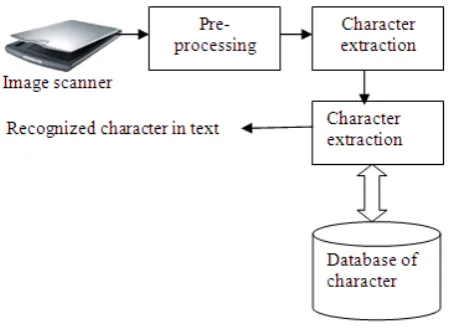
These images cannot be processed by the word processors. So, to be able to edit the group of pixels they must first be converted into words. For this, the picture must undergo a complex phenomenon called the Optical Character Recognition[16]. The following image shows the general OCR system:
[image:2.595.327.552.537.703.2]
Figure 2: General OCR System
character extraction; it is pretreated to perform the line, word and character separation.[17]. The last phase is mindful for the feature extraction and selection resulting in image recognition.
A. Steps of Optical Character Recognition
[image:3.595.319.558.59.192.2]The steps of OCR system is shown in the following figure 3
Figure 3. Block diagram of hand written document image line ,word and character segmentation.
1. Image acquisition
This includes checking a report and putting away it as a picture. Their answer (number of dabs per inch, dpi) decides the rate of process [17].
2. Pre-processing
Procedure of speaking to the examined picture of further handling. Preprocessing plans to deliver information that are simple for the OCR framework to work precisely. It decreases commotion and mutilation, evacuates skewness and performs skeleton sing of the picture, consequently streamlining the preparing whatever is left of the stages [18].
3. Segmentation
After the pre-processing a 'spotless' report is acquired. The following stage is division. In this stage, portioning the report into its sub-segments. It isolates the diverse legitimate parts, similar to content from designs, line of a section, and characters of a word. Division is a vital period of OCR, in light of the fact that it can reach in partition of words, lines or
characters specifically influence the acknowledgment rate of the content. Actually right acknowledgment in light of right division. The precision of the manually written character acknowledgment framework absolutely relies upon division process [19].
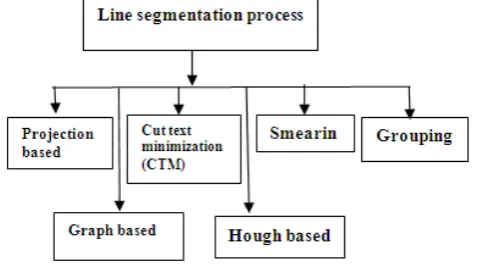
The segmentation task is very difficult in document images because hand written characters exhibit my properties like shape, structure, touching, not proper alignment, lot of variations in character size and skew angle.So, many research people have been published research on line, word and character segmentation which is quite good still there is requirement.For any hand written character recognition system the segmentation process is must .Figure shows the different segmentation process. in figure 4 shows the different line segmentation process.
Figure 4. Different segmentation process.
4. Feature Extraction
An arrangement of standards put away on OCR motor looking at against character's shape and its highlights that recognizes each character distinguish a character. The fundamental piece of the acknowledgment framework configuration is the determination of a steady illustrative arrangement of highlights. It is the most significant issue in the planning issues associated with building an OCR framework [20].
5. Classification
The fundamental basic leadership phase of an OCR framework is order. Order utilizes the highlights removed in the element extraction stage to distinguish the content section [20].
4. SEGMENTATION
The preprocessing stage yields a spotless archive. The adequate measure of shape data, high pressure and low commotion on standardized picture is gotten. The following stage subsequent to preprocessing is division. Division is the way toward sectioning the entire record into sub segments. Division is of two sorts, outside and inside division. While outside division is the detachment of the sentences, sections, and other such written work units. Interior division is the seclusion of the characters and letters [21].
A. Segmentation processes
The Segmentation processeshave the following steps:
1. Line segmentation
Line division is the procedure in which from the picture, we extricate just lines or separate the lines. Flat projection of an archive picture is most ordinarily used to extricate the lines from the report. The even projection will have isolated pinnacles and valleys for the lines that are all around isolated and are not tiled, which fill in as the separators of the content lines. These valleys are effectively identified and used to decide the area of limits between the lines. Word division is the procedure in which from the line division, we separate just words. As we realize that there is a separation between single word another word, this idea is utilized for word division [22].
2.Word segmentation
[image:3.595.39.270.165.289.2]vertical projection profile, one can get segment wholes. By searching for minima in level projection profile of the page, we can isolate the lines and after that different words by taking a gander at minima in the vertical projection profile of a solitary
line. By utilizing the valleys in the vertical projection of a line picture, one can remove words from a line and furthermore extricating singular characters from the word [22].
3. Character segmentation
In character division, we extricate just characters from word. Character division is a troublesome advance of OCR frameworks as it separates important areas for examination. This progression breaks down the pictures into classifiable units called character. As indicated by Casey and Lecolnet [22].
5. COMPARISONS
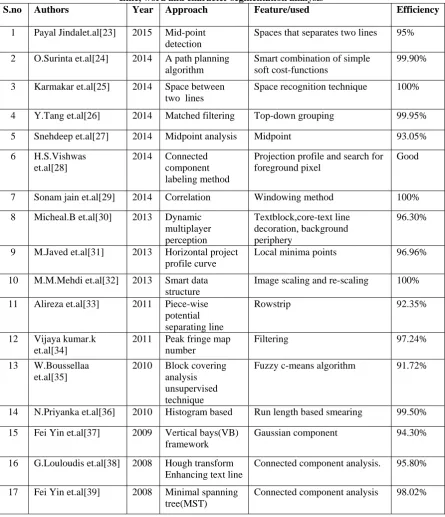
[image:4.595.76.522.235.753.2]Many segmentation methods are proposed for achieving high recognition accuracy. The comparison of line word and character segmentation if found in table 1.
TABLE 1:
Line, word and character segmentation analysis
S.no Authors Year Approach Feature/used Efficiency
1 Payal Jindalet.al[23] 2015 Mid-point detection
Spaces that separates two lines 95%
2 O.Surinta et.al[24] 2014 A path planning algorithm
Smart combination of simple soft cost-functions
99.90%
3 Karmakar et.al[25] 2014 Space between two lines
Space recognition technique 100%
4 Y.Tang et.al[26] 2014 Matched filtering Top-down grouping 99.95%
5 Snehdeep et.al[27] 2014 Midpoint analysis Midpoint 93.05%
6 H.S.Vishwas et.al[28]
2014 Connected component labeling method
Projection profile and search for foreground pixel
Good
7 Sonam jain et.al[29] 2014 Correlation Windowing method 100%
8 Micheal.B et.al[30] 2013 Dynamic multiplayer perception
Textblock,core-text line decoration, background periphery
96.30%
9 M.Javed et.al[31] 2013 Horizontal project profile curve
Local minima points 96.96%
10 M.M.Mehdi et.al[32] 2013 Smart data structure
Image scaling and re-scaling 100%
11 Alireza et.al[33] 2011 Piece-wise potential separating line
Rowstrip 92.35%
12 Vijaya kumar.k et.al[34]
2011 Peak fringe map number
Filtering 97.24%
13 W.Boussellaa et.al[35]
2010 Block covering analysis
unsupervised technique
Fuzzy c-means algorithm 91.72%
14 N.Priyanka et.al[36] 2010 Histogram based Run length based smearing 99.50%
15 Fei Yin et.al[37] 2009 Vertical bays(VB) framework
Gaussian component 94.30%
16 G.Louloudis et.al[38] 2008 Hough transform Enhancing text line
Connected component analysis. 95.80%
17 Fei Yin et.al[39] 2008 Minimal spanning tree(MST)
18 Parthapratim Roy et.al[40]
2008 Morphological operation and run length smearing algorithm
Foreground portion, erosion boundary information background portion
92.68%
19 S.Basu et.al[41] 2006 Face obstruction method
Hypothetical water flow 91.44%
20 Yili et.al[42] 2006 Structure using a gausian window
Level set method to evolve text line boundaries
92%
21 William A.Bet.al[43] 2006 Min-cut/max-flow graph algorithm
Adaptive local connectivity map Good
22 Zhiuin Shi et.al[44] 2004 Adaptive local connectivity map
Local project profiles 95%
6. CONCLUSION
OCR of any handwritten/printed documents involves various stages ranging from scanning of the document to get its digital image, text line extraction, word extraction, character segmentation to the character recognition. In this paper, we made a comparative analysis of text line extraction, word extraction, character segmentation for the last twenty years. This analysis will help to know the complete frame work for text line extraction, word
extraction,character segmentation.In future work we will
propose one efficient algorithm for text line extraction, word
extraction, character segmentation on unconstrained
handwritten documents.
REFERENCES
[1] A. Chahi, I. El khadiri, Y. El merabet, Y. Ruichek, and R. Touahni, “Block wise local binary count for off-Line text-independent writer identification,” Expert Syst. Appl., vol. 93, pp. 1–14, 2018.
[2] Q. N. Vo, S. H. Kim, H. J. Yang, and G. Lee, “Binarization of degraded document images based on hierarchical deep supervised network,” Pattern Recognit., vol. 74, pp. 568– 586, 2018.
[3] T. Mondal, N. Ragot, J.-Y. Ramel, and U. Pal, Comparative study of conventional time series matching techniques for word spotting, vol. 73. 2018.
[4] P. P. Roy, A. K. Bhunia, and U. Pal, “Date-field retrieval in scene image and video frames using text enhancement and shape coding,” Neurocomputing, vol. 274, pp. 37–49, 2018. [5] F. Jia, C. Shi, K. He, C. Wang, and B. Xiao, “Degraded
document image binarization using structural symmetry of strokes,” Pattern Recognit., vol. 74, pp. 225–240, 2018. [6] B. Gatos, A. Antonacopoulos, N. Stamatopoulos,
ICDAR2007 handwriting segmentation contest, in: Proceedings ofInternational Conference on Document Analysis and Recognition, 2007, pp. 1284–1288.
[7] Z. Razak, K. Zulkiflee, et al., Off-line handwriting text line segmentation: a review, International Journal of Computer Science and Network Security 8 (7) (2008) 12–20 .
[8] G. Louloudis, B. Gatos, C. Halatsis, Text line detection in unconstrained handwritten documents using a blockbased Hough transform approach, in: Proceedings of International Conference on Document Analysis and Recognition, 2007, pp. 599–603.
[9] Y. Li, Y. Zheng, D. Doermann, S. Jaeger, Scriptindependent text line segmentation in freestylehandwritten documents, IEEE Transactions on Pattern Analysis and Machine Intelligence 30 (8) (2008) 1313–329
[10] G. Seni, E. Cohen, External word segmentation of offline handwritten text lines,Pattern Recognition 27(1994)41–52. [11] R. Manmatha, J.L. Rothfeder, A scale spaceapproach
forautomatically segmenting words from historicalhandwritten documents, IEEE Transactions on PatternAnalysis and Machine Intelligence 27 (8) (2005) 1212–1225.
[12] M. Feldbach, K.D. Tonnies, Line detection andsegmentation in historical church registers, in:Proceedings of International Conference onDocumentAnalysis and Recognition, 2001, pp. 743–747.
[13] D.J. Kennard, W.A. Barrett, Separating lines of text infree-form handwritten historical documents, inProceedings of International Workshop on DocumentImage Analysis for Libraries, 2006, pp. 12–23.
[14] G. Louloudisa, B.Gatosb, I.Pratikakisb,C.HalatsisaText line and word segmentation of handwritten documents. Pattern Recognition (2008) pp. 3169 – 3183.
[15] Fei Yin, Cheng-LinLiu. Handwritten Chinese text line segmentation by clustering with distance metric learning Pattern Recognition (2009) pp. 3146 -- 3157.
[16] Vassilis Papavassiliou, Themos Stafylakis, et al..,Handwritten document image segmentation into textlines and words. Pattern Recognition (2010), pp. 369 – 377.
[17] Alireza Alaei UmapadaPal, et al..,. A new scheme for unconstrained handwritten text-line segmentation. Pattern Recognition (2011), pp. 917–928.
[18] Liwicki, M., Scherz, M., Bunke, H.: Word Extraction from On-Line Handwritten Text Lines. In: 18th International Conference on Pattern Recognition, Vol. 2, pp.929–933, (2006).
[19] Blumenstein, M., Verma, B.: A New Segmentation Algorithm for Handwritten Word Recognition. In: International Joint Conference on Neural Networks, Vol. 4, pp.2893–2898, Washington, DC , (1999).
[20] Chiang, J.-H.: Hybrid Neural Network Model in Handwritten Word Recognition. In:Neural Networks, Vol. 11(2) (1998), pp. 337–346.
[21] Gader, P., Whalen, M. ,Ganzberger, M., Hepp, D.:Handprinted Word Recognitionon a NIST Data Set. In: Machine VisionApplications, Vol. 8(1) (1995), pp. 31–40. [22] Kurniawan, F., Khan, A. R., Mohamad, D.: Contour
vsNon-Contour based Wordegmentation from Handwritten Text Lines: an experimental analysis. In: InternationalJournal of Digital Content Technology and its Applications Vol. 3(2) (2009),pp. 127–131.
[23] PayalJindal,Drbala Krishan Jindal " line and word segmentation of hand written text documents written in GURUMUKI script using mid point detection technique".Proceedings of 2015 RAECS UIET Punjab university chandigarh 21-22nddec 2015.
Marco.W."A*path planning for line segmentation of hand written documents"DOI 10.1109/ICFHR.2014.37.
[25] P.Karunakar,B.nayak and Nilaman.B."line and word segmentation of printed text document" IJCSIT,Vol 5(1),2014,157-160 ISSN : 0975-9646.
[26] Y.Tang,weibu,"text line segmentation based on matched filtering and top -down grouping for hand written documents" 11th IAPR,IWDAS 2014
[27] snehdeep, manojkumar,"segmentation of connected components and overlapping lines in Gurumukhi hand written documents",IJCA,(0975-8887) Vol 102-no.13,september 2014.
[28] H.S.Vishwas , Bindu,A.Thomas and C.Naveena"text line segmentation of unconstrained handwritten kannada historical script documents.
[29] sonamjain,Harawindarsinghsohal,"A Noval approach of word segmentation in correlation based OCR system",IJCA(0975-8887)Vol 99-no.18 august 2014.
[30] M.Cheal.B,Marcus.L,Rolf.I,"textline extraction using DMLP classifiers for historical manuscripts" 2013 12th ICDAR.15.20-5363/13.
[31] M.Javed,P.Nagabhushanam and .B.ChaudariExtraction of line word charecter segments directly from run length compressed printed text documents" 1403-7783.
[32] M.N.Mehdi, Aqsa Riaz" optimized word segmentation for the word based cursive hand writing recognition",IEEE 2013 european modelling symposium.978-1-4799-2578-0/3. [33] Alireza.A,P.Nagabhusham,U.Pal,"piecewise painting
technique for line segmentation of unconstrained handwritten text:a specific study with persian text documents" pattern Anal Applic (2011) 14:381-394.
[34] vijaykumar.k, AthulNegi,"fringe map based text line segmentation of printed telugu document images ",2011
,ICDAR,1520-5363/11.
[35] W.Boussella,A.Zahour,H.Elabed,A.Benabdelhafid,and Adel Alimi"Unsupervised block covering analysis for text line segmentation of arabic ancient handwritten document images" 2010 ICRR 1051-4651/10.
[36] N.Priyanka,Srikantapal,Ranju Mandal," line and word segmentation approach for printed documents IJCA,RTIPPR 2010
[37] Fie Yin,Cheng-hi liu"Avariational Bayes method for handwritten textline segmentation" 2009,10th ICDAR 978-0-7695-2/09.
[38] G.Louloudis,B.Gatos,I.Pratikakis,C.Halatsis"Text line detection in handwritten documents"pattern recognition 41(2008)3758-3772.
[39] Fie Yin,Cheng-hi liu"Handwrittenchinese text line segmentation by clustering with distance metric learning",pattern recognition 42,(2009)3146-3157.
[40] ParthapratimRoy,U.Pal,JosephLlados,morphology based handwritten line segmentation using foreground and background information " 2008.
[41] S.Basu,C.Chaudhari,M.Kundu,M.Nasipuri,and
D.K.Basu,"Text line extraction from multi-skewed handwritten documents",pattern recognition,40,2007,1825-1839
[42] Yili,Y.Zheng,DavidD,Stefan.J,"A new algorithm for detecting textline handwritten documents" 10th IWFHR oct2006.
[43] William.A.B,D.J Kennard "separating lines of text free from handwritten historical documents"2006-04-11 IEEE proceedings 2nd DIAL 8812-23 Lyon,France,April.