Department of Information
Studies
University of Tampere
[email protected]
Abstract
This paper presents a new management method for morphological variation of keywords. The method is called FCG, Fre-quent Case Generation. It is based on the skewed distributions of word forms in natural languages and is suitable for lan-guages that have either fair amount of mor-phological variation or are mormor-phologically very rich. The proposed method has been evaluated so far with four languages, Fin-nish, Swedish, German and Russian, which show varying degrees of morphological complexity.
1
Introduction
Word form normalization through lemmatization or stemming is a standard procedure in information retrieval because morphological variation needs to be accounted for and several languages are morphologically non-trivial. Lemmatization is effective but often requires expensive resources. Stemming is also effective, generally almost as good as lemmatization and typically much less expensive; besides it also has a query expansion effect. However, in both approaches the idea is to turn many inflectional word forms to a single lemma or stem both in the database index and in queries. This means extra effort in creation of database indexes.
In this paper we take an opposite approach: we leave the database index un-normalized and enrich the queries to cover for surface form variation of keywords. A potential penalty of the approach
would be long queries and slow processing. How-ever, we show that it only matters to cover a negli-gible number of possible surface forms even in morphologically complex languages to arrive at a performance that is almost as good as that deliv-ered by stemming or lemmatization. Moreover, we show that, at least for typical test collections, it only matters to cover nouns and adjectives in que-ries. Furthermore, we show that our findings are particularly good for short queries that resemble normal searches of web users.
Our approach is called FCG (for Frequent Case (form) Generation). It can be relatively easily im-plemented for Latin/Greek/Cyrillic alphabet lan-guages by examining their (typically very skewed) nominal form statistics in a small text sample and by creating surface form generators for the 3−9 most frequent forms. We demonstrate the potential of our FCG approach for four languages of varying morphological complexity: Swedish, German, Russian, and Finnish in well-known test collec-tions (CLEF 2003 and 2004). Applicacollec-tions include in particular Web IR in languages poor in morpho-logical resources.
2
Word Form Distributions
Helsinki, has besides the dominating nominative and genitive singular forms mainly occurrences of locative cases. A person’s name like Martti occurs mostly in nominative singular. Same kind of analy-sis is given by Kostić et al. (2003) for Serbian, al-though they seem to be hesitant about the semantic origins of the phenomenon. We shall not explore the semantic factors of case distribution any deeper, but analyze the distribution of cases on morpho-logical level only.
In Kettunen and Airio (2006) we first sought for corpus statistics of Finnish nominal word forms. Then we verified these statistics with two inde-pendent automatic analyses of larger corpuses. Our analysis and earlier corpus statistics showed, that six cases (out of 14) constituted about 84 – 88 % of the token level occurrences of case forms for nouns – thus covering 84 – 88 % of the possible variation of about 2000 distinct inflectional forms of nouns. Our analysis also showed that the huge number of grammatical forms is mainly due to cli-tics and possessive endings that are almost non-existent even in a reasonably large textual corpus (10.3 M nouns). This analysis demonstrated that, while a language may in principle be morphologi-cally complex, in practice it is much less so.
2.1 Distribution Based Management of
Key-word Variation for IR
Our FCG method and its language specific IR evaluation are simply as follows:
1) For a morphologically complex enough lan-guage the distribution of different nominal case/other word forms is first studied through cor-pus analysis (if such results are not available for the language). The used corpus can be quite small, because variation at this level of language can be detected even from smaller corpuses. Variation in textual styles may affect slightly the results, so a style neutral corpus is the best. If style specific re-sults are sought for, then an appropriate corpus needs to be used in word form occurrence analysis. 2) After the most frequent (case) forms for the language have been found with corpus statistics, the IR results of using only these forms for noun and adjective keyword forms are evaluated in a standard IR collection. As a comparison best avail-able normalization method (lemmatization or stemming) is used. The number of tested FCG processes depends on the morphological
complex-ity of the language: more processes can be tested for a complex language, only a few for a simpler one.
3) After evaluation, the best FCG process with respect to normalization is usually distinguished. The evaluation process will probably also show that more than one FCG process is giving quite good results, and thus a varying number of key-word forms can be used for different retrieval pur-poses, if necessary.
We have been simulating the process of key-word generation in our tests, but as key-word form generation programs are available for many lan-guages, their output could be modified accordingly for real use, i.e., only the most frequent forms of generated forms would be used in search.
Based on this method, we evaluated four differ-ent FCGs in two differdiffer-ent full-text collections of Finnish, TUTK (with multi-valued relevance) and CLEF 2003 (with binary relevance) with long title and description queries. The results of Kettunen and Airio (2006) showed that frequent case form generation works in full-text retrieval of inflected indexes in a best-match query system and com-petes at best well with the gold standard, lemmati-zation, for Finnish. Our best FCG procedures, FCG_9 and FCG_12 - with 9 and 12 variant key-word forms - achieved about 86 % of the best av-erage precisions of FINTWOL lemmatizer in TUTK and about 90 % in CLEF 2003. We thus performed successful information retrieval of Fin-nish with nine and twelve variant keyword forms, which is 0.48 % and 0.64 % of the possible gram-matical forms of Finnish nouns (∑ = 1872) and about 34.6 % and 46.2 % of the productive forms (∑ = 26).
Method Mean average precision
FINTWOL, compounds split 42.8 %
Stemmed 41.3 % (-1.5)
As can be seen from Table 1, difference between the best FCG method and the best achieved results, FINTWOL with index where compounds are split, is about 5 absolute per cent with short queries. Thus the method works also well with short and realistic queries, and about 88−89 % of the maxi-mal retrieval result is achieved with both nine and twelve most frequent nominal forms of the
key-Figure 1. P/R-curves for Finnish short queries: precision by eleven recall levels 0.0−1.0
3
FCGs for Three More Languages
In this study we evaluated further our word form frequency based method with three European languages, Swedish, German, and Russian. They are all morphologically moderately complex, i.e. clearly much more complex than English, but also clearly much simpler than Finnish (or Hungarian) measured in the number of possible word forms
per lexeme. The chosen languages represent two major language groups of the Indo-European language family, Germanic (German and Swedish) and Slavonic (Russian), and are thus also characteristic samples for other languages in the same language groups. The languages were chosen on the basis of available IR collections and complex enough nominal morphology from the CLEF materials. From the morphological complexity point of view there would have been other and perhaps more interesting languages among the official EU languages (e.g., Estonian, Lithuanian, Latvian, Slovak, Czech and Hungarian), but either lack of available IR collections or detailed enough linguistic knowledge in the languages made inclusion of these languages impossible in this study.
3.1 Materials and Methods
CLEF collections for all the three languages were utilized in this study. For Swedish and German we used materials of CLEF 2003. The retrieval system was InQuery. For Russian we used Russian collec-tion of CLEF 2004 and the Lemur retrieval system. Character encoding for Russian was UTF-8. In Ta-ble 2, the number of documents and topics in each collection is shown (Airio, 2006; Tomlinson, 2004).
Language Collection Collection
size (docs)
Table 2. Swedish, German and Russian collections used in the study
morphologically annotated Tiger corpus. For Rus-sian we obtained the case distribution information from the Russian national corpus. Statistics of the distribution analysis are published in Kettunen et al. (2007).
On the basis of these corpus analyses we formed FCG procedures for each language with different number of keywords. Swedish got two procedures, Sv-FCG_2 and Sv-FCG_4, as did also German with procedures De-FCG_2 and De-FCG_4. As Russian was morphologically the most complex language of these, it got three FGC procedures, Ru-FCG_3, Ru-FCG_6 and Ru-FCG_8. The figure in the name of the procedure gives the approximate number of morphological keyword variants for each procedure.
Queries for the FCG procedures of each lan-guage were formed manually from the topics by using different language tools in the web (elec-tronic dictionaries, word form generators or both). After we had formed the queries, we evaluated the retrieval results for each language. As a compari-son we used lemmatization with TWOL programs for Swedish and German and also Snowball stem-mers for both of the languages. For Russian we only had access to Snowball stemmer. Also plain topic words were used in the queries of all lan-guages to get a baseline result.
Our queries were structured with InQuery’s #SYN operator. With the operator morphological variant forms of the keyword are treated as syno-nyms of the key, and InQuery treats them all as instances of one key.
As a FCG query example we can take one query from the CLEF 2003 collection. A short version of query #142 for the Sv-FCG_4 process is as fol-are left in the form they were in the original topic. Nouns are self-evidently most important for que-ries, but adding variant forms of adjectives seems
also to increase mean average precision of queries with 1−3 % in each language.
4
Results
4.1 Swedish results
We ran both long and short queries for all the lan-guages. Here we show and discuss only results of short title queries. Full results are presented in Ket-tunen et al. (2007).
Results of the Swedish very short queries (aver-age length 3.17 words with stop words) are shown in Table 3.
Method Mean average
preci-sion
Table 3. Results of the 54 Swedish title queries
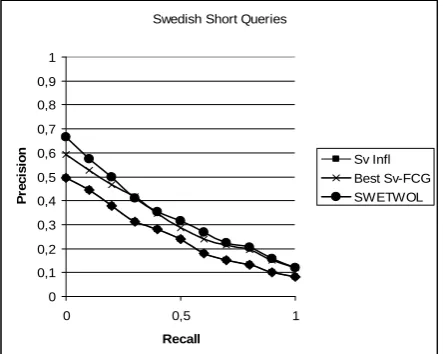
Figure 2 shows P/R-curves of the best Swedish FCG procedure (Sv-FCG_4), SWETWOL with split compounds and plain query words for short queries.
4.2 German results
Results of the German very short queries (average length 3.15 words with stop words) are shown in Table 4.
Method Mean average
GerTWOL, compounds split 29.6 %
Stemmed 30.9 % (+1.3)
Table 4. Results of the 56 German title queries
The Snowball stemmer performs the best with a 1.3 % margin to GERTWOL using split compound index. De-FCG_4 is also slightly better than GERTWOL, and De-FCG_2 outperforms also GERTWOL without compound splitting. Non-processed queries perform worst, and the margin of non-processing to the best performing system, Snowball, is 5.5 %. The margin of non-processing to the worst performing normalization is 2.7 %.
Figure 3 shows P/R-curves of the best German FCG procedure (De-FCG_4), German Snowball and plain query words for short queries.
German Short Queries precision by eleven recall levels 0.0−1.0
4.3 Russian results
Results for Russian short queries are shown in Table 5. Mean length of the queries was 3.18 words (with stopwords).
Method Mean average
pre-cision
Table 5. Results of 34 Russian title queries
Our Russian results are not as clear as those of Swedish and German, because results of long and short queries in Russian were quite different. Overall it seems that short Russian queries show some advantage for FCGs, but as the collection is small and has very few relevant documents, the interpretation of the Russian results remains incon-clusive.
Figure 4 shows P-R-curves of the best Rus-sian FCG procedure (Ru-FCG_6), RusRus-sian Snow-ball and plain query words for short queries.
Russian Short Queries precision by eleven recall levels 0.0−1.0.
5
Discussion
way to estimate the performance gains is relative percentage improvement of mean average preci-sions between different methods. For comparison purposes of methods a slightly different point of view could also be used: the difference between doing nothing for the query words and the best mean average precision shows the need of morpho-logical processing for the language in question. The bigger the discrepancy between these figures, the bigger the need to do something for the key-words.
In Figures 1−4 P/R-curves of Finnish, Swedish, German and Russian short queries for the best normalization method, best FCG method and no processing at all were shown. As can be seen from the figures and Tables 1, 3, 4 and 5, the largest dif-ference between non-processing and best normali-zation method is in Finnish (20.4 %) and smallest in Swedish (4.1 %). German and Russian have slightly greater differences than Swedish, 5.7 % and 6.9 % respectively. Figures show that the FCG method gives clear gains for Finnish and smaller gains for German, Swedish and Russian. For three languages FCG works well in comparison to lem-matization; for Finnish 88 % of the performance of lemmatization is achieved and 95 % for Swedish and German. The P/R graphs also show that the FCG method pushes close to normalization even when the gap between normalization and non-processing is narrow. Gains over no morphological processing at all are greater than losses against normalization.
For the three new languages evaluated two, Swedish and German, showed quite clearly that the FCG method works well for both languages. In short queries the differences between all the meth-ods were smallest, but also the margin between plain keywords and the best method increased. In German runs overlap of inflectional noun forms slightly disturbed results.
Our Russian results remained partly counterin-tuitive. Although recall rose steadily when more case forms were put into the query, the mean aver-age precision of short queries did not get much better, when forms were added. Overall it seemed that short Russian queries showed some advantage for FCGs. As the collection was small and had very few relevant documents, the interpretation of the Russian results remained inconclusive. Thus the method should be re-evaluated in a better Rus-sian collection.
References
Per Ahlgren. 2004. The effects of indexing
strategy-query term combination on retrieval effectiveness in a Swedish full text database. Department of Library
and Information Science/Swedish School of Library and Information Science. University college of Borås/Göteborg University.
Eija Airio. 2006. Word Normalization and decom-pounding in mono- and bilingual IR. Information
Re-trieval 9: 249–271.
R. Harald Baayen. 1993. Statistical Models for Word Frequency Distribution. Computers and the
Humani-ties 26: 347–363.
R. Harald Baayen. 2001. Word Frequency Distributions. Kluwer Academic Publishers, Dordrecht Boston London.
Fred Karlsson. 1986. Frequency Considerations in
Mor-phology. Zeitsschrift für Phonetik,
Sprachwissenschaft und Kommunikationsforschung
39: 19–28.
Fred Karlsson. 2000. Defectivity. In: Booij G. et al. (eds.): Morphology. An International Handbook on
Inflection and Word-Formation. Volume 1. Walter
de Gruyter, Berlin, 647–654.
Kimmo Kettunen and Eija Airio. 2006. Is a morphologi-cally complex language really that complex in full-text retrieval? In T. Salakoski et al. (Eds.): Advances
in Natural Language Processing, LNAI 4139.
Springer-Verlag Berlin Heidelberg, 411–422.
Kimmo Kettunen, Eija Airio and Kalervo Järvelin. 2007. Restricted Inflectional Form Generation in Management of Morphological Keyword Variation.
Information Retrieval (to appear).
Alexandar Kostić, Tanja Marković and Alexandar
Bau-cal. 2003. A. Inflectional Morphology and Word Meaning: Orthogonal or Co-implicative Cognitive Domains. In: Baayen, R.H. and Schreuder R. (eds.):
Morphological Structure in Language Processing.
Trends in Linguistics, Studies and Monographs 151. Mouton de Gruyter, Berlin, 1–43.
Tiger corpus. http://www.ims.uni-stuttgart.de/projekte/-TIGER/TIGERCorpus/ (visited June 7th, 2006).
Stephen Tomlinson. 2004. Finnish, Portuguese and Rus-sian Retrieval with Hummingbird SearchServerTM at CLEF 2004. Working Notes for the CLEF 2004
Workshop, 15-17 September, Bath, UK.