The ISL Phrase-Based MT System for the 2007 ACL Workshop on
Statistical Machine Translation
M. Paulik1,2, K. Rottmann2, J. Niehues2, S. Hildebrand1,2and S. Vogel1
1Interactive Systems Laboratories, Carnegie Mellon University, Pittsburgh, PA, USA
2Institut f¨ur Theoretische Informatik, Universit¨at Karlsruhe (TH), Karlsruhe, Germany
{paulik|silja|vogel}@cs.cmu.edu;{jniehues|rottmann}@ira.uka.de
Abstract
In this paper we describe the Interactive Sys-tems Laboratories (ISL) phrase-based ma-chine translation system used in the shared task ”Machine Translation for European Languages” of the ACL 2007 Workshop on Statistical Machine Translation. We present results for a system combination of the ISL syntax-augmented MT system and the ISL phrase-based system by combining and rescoring the n-best lists of the two systems. We also investigate the combination of two of our phrase-based systems translating from different source languages, namely Spanish and German, into their common target lan-guage, English.
1 Introduction
The shared task of the ACL 2007 Workshop on Sta-tistical Machine Translation focuses on the auto-matic translation of European language pairs. The workshop provides common training sets for trans-lation model training and language model training to allow for easy comparison of results between the participants.
Interactive Systems Laboratories participated in the English ↔ Spanish Europarl and News Commen-tary task as well as in the English ↔ German Eu-roparl task. This paper describes the phrase-based machine translation (MT) system that was applied to these tasks. We also investigate the feasibility of combining the ISL syntax-augmented MT system (Zollmann et al., 2007) with our phrase-based
sys-tem by combining and rescoring the n-best lists pro-duced by both systems for the Spanish → English Europarl task. Furthermore, we apply the same com-bination technique to combine two of our phrase-based systems that operate on different source lan-guages (Spanish and German), but share the same target language (English).
The paper is organized as follows. In section 2 we give a general description of our phrase-based sta-tistical machine translation system. Section 3 gives an overview of the data and of the final systems used for the English↔Spanish Europarl and News Commentary tasks, along with corresponding per-formance numbers. Section 4 shows the data, final systems and results for the English↔ German Eu-roparl task. In Section 5, we present our experiments involving a combination of the syntax-augmented MT system with the phrase-based MT system and a combination of the Spanish→English and German
→English phrase-based systems.
2 The ISL Phrase-Based MT System
2.1 Word and Phrase Alignment
rel-ative frequency estimates found in the phrase trans-lation tables are then smoothed by applying modi-fied Kneser-Ney discounting as explained in (Foster et al., 2006). The resulting phrase translation tables are pruned by using the combined translation model score as determined by Minimum Error Rate (MER) optimization on the development set.
2.2 Word Reordering
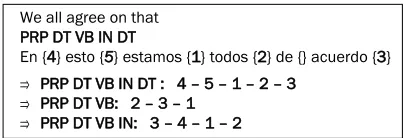
We apply a part-of-speech (POS) based reordering scheme (J. M. Crego et al., 2006) to the POS-tagged source sentences before decoding. For this, we use the GIZA++ alignments and the POS-tagged source side of the training corpus to learn reordering rules that achieve a (locally) monotone alignment. Fig-ure 1 shows an example in which three reordering rules are extracted from the POS tags of an En-glish source sentence and its corresponding Span-ish GIZA++ alignment. Before translation, we con-struct lattices for every source sentence. The lattices include the original source sentence along with all the reorderings that are consistent with the learned rules. All incoming edges of the lattice are anno-tated with distortion model scores. Figure 2 gives an example of such a lattice. In the subsequent lattice decoding step, we apply either monotone decoding or decoding with a reduced local reordering window, typically of size 2.
2.3 Decoder and MER Training
The ISL beam search decoder (Vogel, 2003) com-bines all the different model scores to find the best translation. Here, the following models were used:
• The translation model, i.e. the phrase-to-phrase translations extracted from the bilingual corpus, annoted with four translation model scores. These four scores are the smoothed for-ward and backfor-ward phrase translation proba-bilities and the forward and backward lexical weights.
• A 4-gram language model. The SRI language model toolkit was used to train the language model and we applied modified Kneser-Ney smoothing.
• An internal word reordering model in addition to the already described POS-based reordering.
We all agree on that PRP DT VB IN DT
En {4} esto {5} estamos {1} todos {2} de {} acuerdo {3} ⇒ PRP DT VB IN DT : 4 – 5 – 1 – 2 – 3
⇒ PRP DT VB: 2 – 3 – 1 ⇒ PRP DT VB IN: 3 – 4 – 1 – 2
Figure 1: Rule extraction for the POS-based reorder-ing scheme.
This internal reordering model assigns higher costs to longer distance reordering.
• Simple word and phrase count models. The former is essentially used to compensate for the tendency of the language model to prefer shorter translations, while the latter can give preference to longer phrases, potentially im-proving fluency.
1 “Honourable Members, we have a challenging agenda”
Figure 2: Example for a source sentence lattice from the POS-based reordering scheme.
English Spanish
sentence pairs 1259914
unique sent. pairs 1240151
sentence length 25.3 26.3
words 31.84 M 33.16 M
vocabulary 266.9 K 346.3 K
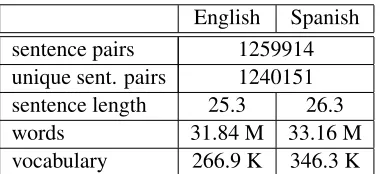
Table 1: Corpus statistics for the English/Spanish Europarl corpus.
3 Spanish↔English Europarl and News Commentary Task
3.1 Data and Translation Tasks
The systems for the English↔ Spanish translation tasks were trained on the sentence-aligned Europarl corpus (Koehn, 2005). Detailed corpus statistics can be found in Table 1. The available parallel News Commentary training data of approximately 1 mil-lion running words for both languages was only used as additional language model training data, to adapt our in-domain (Europarl) system to the out-of-domain (News Commentary) task.
The development sets consist of 2000 Europarl sentences (dev-EU) and 1057 News Commentary sentences (dev-NC). The available development-test data consists of 2 x 2000 Europarl sentences (devtest-EU and test06-EU) and 1064 News Com-mentary sentences (test06-NC). All development and development-test sets have only one reference translation per sentence.
3.2 Data Normalization
The ACL shared task is very close in form and con-tent to the Final Text Editions (FTE) task of the TC-STAR (TC-TC-STAR, 2004) evaluation. For this rea-son, we decided to apply a similar normalization scheme to the training data as was applied in our TC-STAR verbatim SMT system. Although trained on
”verbatimized” data that did not contain any num-bers, but rather had all numbers and dates spelled out, it yielded consistently better results than our TC-STAR FTE SMT system. When translating FTE content, the verbatim system treated all numbers as unknown words, i.e. they were left unchanged dur-ing translation. To compensate for this, we applied extended postprocessing to the translations that con-ducts the necessary conversions between Spanish and English numbers, e.g. the conversion of deci-mal comma in Spanish to decideci-mal point in English. Other key points which we adopted from this nor-malization scheme were the tokenization of punc-tuation marks, the true-casing of the first word of each sentence, as well as extended cleaning of the training data. The latter mainly consisted of the re-moval of sections with a highly unbalanced source to target words ratio and the removal of unusual string combinations and document references, like for example ”B50918/2000”, ”(COM(2000) 335 -C5-0386/2000 - 2000/0143(CNS))”, etc.
Based on this normalization scheme, we trained and optimized a baseline in-domain system on accord-ingly normalized source and reference sentences. For optimization, we combined the available de-velopment sets for the Europarl task and the News Commentary task. In order to further improve the applied normalization scheme, we experimented with replacing all numbers with the string ”NMBR”, rather than spelling them out and by replacing all document identifiers with the string ”DCMNT”, rather than deleting them. This was first done for the language model training data only, and then for all data, i.e. for the bilingual training data and for the development set source and reference sentences. In the latter case, the respective tags were again re-placed by the correct numbers and document identi-fiers during postprocessing. Table 2 shows the case sensitive BLEU scores for the three normalization approaches on the English↔Spanish Europarl and News Commentary development sets. These scores were computed with the official NIST scoring script against the original (not normalized) references.
3.3 In-domain System
Task baseline LM only all data
Europarl 30.94 31.20 31.26
News Com. 31.28 31.39 31.73
Table 2: Case sensitive BLEU scores on the in-domain and out-of-in-domain development sets for the three different normalization schemes.
Task Eng→Spa Spa→Eng
dev-EU 31.29 31.77
dev-NC 31.81 31.12
devtest-EU 31.01 31.40
test06-EU 31.87 31.76
test06-NC 30.23 29.22
Table 3: Case sensitive BLEU scores for the final English↔Spanish in-domain systems.
set of scaling factors, i.e. the in-domain system applies the same scaling factors for translating in-domain data as for translating out-of-in-domain data. Our baseline system applied only monotone lattice decoding. For our final in-domain system, we used a local reordering window of length 2, which accounts for the slightly higher scores when compared to the baseline system. The BLEU scores for both trans-lation directions on the different development and development-test sets can be found in Table 3.
3.4 Out-of-domain System
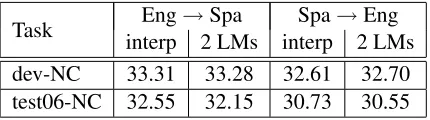
In order to adapt our in-domain system towards the out-of-domain News Commentary task, we consid-ered two approaches based on language model adap-tation. First, we interpolated the in-domain LM with an out-of-domain LM computed on the avail-able News Commentary training data. The inter-polation weights were chosen such as to achieve a minimal LM perplexity on the out-of-domain de-velopment set. For both languages, the interpo-lation weights were approximately 0.5. Our sec-ond approach was to simply load the out-of-domain LM as an additional LM into our decoder. In both cases, we optimized the translation system on the out-of-domain development data only. For the sec-ond approach, MER optimization assigned three to four times higher scaling factors to the consider-ably smaller out-domain LM than to the original in-domain LM. Table 4 shows the results in BLEU on the out-of-domain development and development-test sets for both translation directions. While
load-Eng→Spa Spa→Eng
Task
interp 2 LMs interp 2 LMs
dev-NC 33.31 33.28 32.61 32.70
test06-NC 32.55 32.15 30.73 30.55
Table 4: Case sensitive BLEU scores for the final English↔Spanish out-of-domain systems.
ing a second LM gives similar or slightly better re-sults on the development set during MER optimiza-tion, we see consistently worse results on the unseen development-test set. This, in the context of the rela-tively small amount of development data, can be ex-plained by stronger overfitting during optimization.
4 English↔German Europarl Task
The systems for the English↔German translation tasks were trained on the sentence-aligned Europarl corpus only. The complete corpus consists of ap-proximately 32 million English and 30 million Ger-man words.
We applied a similar normalization scheme to the training data as for the English↔Spanish system. The main difference was that we did not replace numbers and that we removed all document refer-ences. In the translation process, the document ref-erences were treated as unknown words and there-fore left unchanged. As above, we trained and op-timized a first baseline system on the normalized source and reference sentences. However, we used only the Europarl task development set during opti-mization. To achieve further improvements on the German → English task, we applied a compound splitting technique. The compound splitting was based on (Koehn and Knight, 2003) and was applied on the lowercased source sentences. The words gen-erated by the compound splitting were afterwards true-cased. Instead of replacing a compound by its separate parts, we added a parallel path into the source sentence lattices used for translation. The source sentence lattices were augmented with scores on their edges indicating whether each edge repre-sents a word of the original text or if it was gener-ated during compound splitting.
task Eng→Ger Ger→Eng
dev-EU 18.58 23.85
devtest-EU 18.50 23.87
test06-EU 18.39 23.88
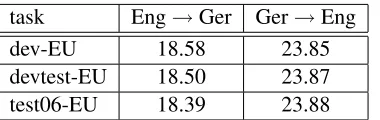
Table 5: Case sensitive BLEU scores for the final English↔German in-domain systems.
syntactical reorderings.
5 System Combination via n-best List Combination and Rescoring
5.1 N-best List Rescoring
For n-best list rescoring we used unique 500-best lists, which may have less than 500 entries for some sentences. In this evaluation, we used sev-eral features computed from different information sources such as features from the translation sys-tem, additional language models, IBM-1 word lex-ica and the n-best list itself. We calculated 4 fea-tures from the IBM-1 word lexica: the word proba-bility sum as well as the maximum word probabil-ity in both language directions. From the n-best list itself, we calculated three different sets of scores. A position-dependent word agreement score as de-scribed in (Ueffing and Ney, 2005) with a position window instead of the Levenshtein alignment, the n-best list n-gram probability as described in (Zens and Ney, 2006) and a position-independent n-gram agreement, which is a variation on the first two. To tune the feature combination weights, we used MER optimization.
Rescoring the n-best lists from our individual sys-tems did not give significant improvements on the available unseen development-test data. For this rea-son, we did not apply n-best list rescoring to the indi-vidual systems. However, we investigated the feasi-bility of combining two different systems by rescor-ing the joint n-best lists of both systems. The corre-sponding results are described in the following sec-tions.
5.2 Combining Syntax-Augmented MT and Phrase-Based MT
On the Spanish→ English in-domain task, we par-ticipated not only with the ISL phrase-based SMT system as described in this paper, but also with the ISL syntax-augmented system. The
syntax-task PHRA SYNT COMB
dev-EU 31.77 32.48 32.77
test06-EU 31.76 32.15 32.27
Table 6: Results for combining the syntax-augmented system (SYNT) with the phrase-based system (PHRA).
augmented system was trained on the same normal-ized data as the phrase-based system. However, it was optimized on the in-domain development set only. More details on the syntax-augmented system can be found in (Zollmann et al., 2007). Table 6 lists the respective BLEU scores of both systems as well as the BLEU score achieved by combining and rescoring the individual 500-best lists.
5.3 Combining MT Systems with Different Source Languages
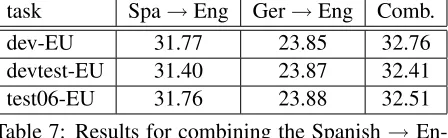
task Spa→Eng Ger→Eng Comb.
dev-EU 31.77 23.85 32.76
devtest-EU 31.40 23.87 32.41
test06-EU 31.76 23.88 32.51
Table 7: Results for combining the Spanish→ En-glish and German→English phrase-based systems on the in-domain tasks.
6 Conclusion
We described the ISL phrase-based statistical ma-chine translation systems that were used for the 2007 ACL Workshop on Statistical Machine Translation. Using the available out-of-domain News Commen-tary task training data for language model adapta-tion, we were able to significantly increase the per-formance on the out-of-domain task by 2.3 BLEU for English→Spanish and by 1.3 BLEU for Span-ish → English. We also showed the feasibility of combining different MT systems by combining and rescoring their resprective n-best lists. In particular, we focused on the combination of our phrase-based and syntax-augmented systems and the combination of two phrase-based systems operating on different source languages. While we saw only a minimal im-provement of 0.1 BLEU for the phrase-based and syntax-augmented combination, we gained up to 1 BLEU, in case of the multi-source translation.
References
G. Foster, R. Kuhn, and H. Johnson. 2006. Phrasetable Smoothing for Statistical Machine Translation. In Proc. of Empirical Methods in Natural Language Pro-cessing, Sydney, Australia.
J. M. Crego et al. 2006. N-gram-based SMT System Enhanced with Reordering Patterns. In Proc. of the Workshop on Statistical Machine Translation, pages 162–165, New York, USA.
P. Koehn and K. Knight. 2003. Empirical Methods for Compound Splitting. InProc. of the tenth conference on European chapter of the Association for Computa-tional Linguistics, pages 187–193, Budapest, Hungary.
P. Koehn and C. Monz. 2006. Manual and Automatic Evaluation of Machine Translation between European Langauges. In Proc. of the Workshop on Statisti-cal Machine Translation, pages 102–121, New York, USA.
P. Koehn. 2005. Europarl: A Parallel Corpus for Statis-tical Machine Translation. InProc. of Machine Trans-lation Summit.
F.J. Och and H. Ney. 2000. Improved Statistical Align-ment Models. In Proc. of the 38th Annual Meet-ing of the Association for Computational LMeet-inguistics, Hongkong, China.
F. J. Och and H. Ney. 2001. Statistical Multi-Source Translation. InProc. of Machine Translation Summit, pages 253–258, Santiago de Compostela, Spain.
F. J. Och. 2003. Minimum Error Rate Training in Statis-tical Machine Translation. InProc. of the 41st Annual Meeting of the Association for Computational Linguis-tics, pages 160 – 167, Sapporo, Japan.
M. Paulik, S. Stueker, C. Fuegen, T. Schultz, T. Schaaf, and A. Waibel. 2005. Speech Translation Enhanced Automatic Speech Recognition. InProc. of the Work-shop on Automatic Speech Recognition and Under-standing, San Juan, Puerto Rico.
TC-STAR. 2004. Technology and Corpora for Speech to Speech Translation.http://www.tc-star.org.
N. Ueffing and H. Ney. 2005. Word-Level Con-fidence Estimation for Machine Translation using Phrase-Based Translation Models. In Proc. of HLT and EMNLP, pages 763–770, Vancouver, British Columbia, Canada.
S. Vogel. 2003. SMT Decoder Dissected: Word Re-ordering. In Proc. of Int. Conf. on Natural Lan-guage Processing and Knowledge Engineering, Bei-jing, China.
R. Zens and H. Ney. 2006. N-gram Posterior Proba-bilities for Statistical Machine Translation. In Proc. of the Workshop on Statistical Machine Translation, pages 72–77, New York, USA.
Y. Zhang and S. Vogel. 2006. Suffix Array and its Ap-plications in Empirical Natural Language Processing. Inthe Technical Report CMU-LTI-06-010, Pittsburgh, USA.