3665
Performance Analysis of Track Keeping of Unmanned
Ship Navigation Using Gauss Jordan Matrix Inversion
Technique
Adinatha Dr. S.A. Hari Prasad Dr. Anitha G S
Abstract: Accurate Track keeping in navigation of unmanned surface vehicle is very essential which results in saving fuel as well time. To achieve accurate track keeping by navigation of unmanned surface vehicle several controllers like PID, Predictive controller, and Adaptive controllers are used. Each controller is having its own advantages and disadvantages but the Predictive controller provides better track keeping of unmanned surface vehicle. The only major drawback of predictive controller is that this controller is taking more time to compute. In order to reduce the computational time, researches have come up with various matrix inversion techniques in predictive controller. In this work an effort is made to estimate the performance of a predictive controller in terms of decreasing computational time. Computational outcome is estimated by MATLAB shows that predictive controller with Gauss Jordan matrix inversion technique provides better tracking and takes less time compared with MATLAB inverse function.
Key words: Predictive controller, matrix inversion. Model Predictive Controller.
1. INTRODUCTION
In unmanned surface vehicle navigation, accurate track keeping of vehicle is very important to save time as well to save fuel consumption also which is very essential component to be considered in the unmanned surface vehicle. For proper navigation, keeping the vehicle on track is challenging task. To generate proper heading angles to keep the vehicle on track a robust controller design is a must which should consider sea instabilities, hydrodynamics of ship and noise factors in both internal and external.
To retain the vehicle on trajectory several techniques are used by researchers, namely PID, adaptive and predictive controllers. The PID controller is discussed by A .S White [1] for controlling the vehicle by taking the error in the heading angle. To navigate the ship, the coefficients of the controller are changed due to environmental fluctuations like wind, waves, currents, random disturbances, and internal inaccuracies etc. The PID controller coefficients are changed to accommodate these changes and also needs support of other controllers to identify the error like neural, fuzzy, genetic, etc. which results in increasing the complexity of the overall
controller system. Hence PID controllers are not suitable for surface vehicle navigation applications. A special type of nonlinear control system explained by Juan Martin [2] called adaptive controller which adapts to the sea environment and as well the ship condition. To obtain the optimal solutions for changing environmental conditions, the adaptive controller adjusts the weight function, this is the measure merit of this controller. But adaptive controller cannot predict the future variations in the control output which is very important in sea water surface vehicle navigation.
In the control system, the advanced technique of course control is the predictive controller as Eduardo F [3] explains the Predictive Controller. The predictive controller procedures the complex operations to predict the performance of the system depending on the previous and future variables of the dynamic system. The predictions are the major advantage of the predictive controller over adaptive controller and also tune the parameters for future steps by reducing the heading angle error.
The predictive controllers take more time to predict and compute [4] and research [5] is going on to reduce this computational time. Few researchers are also working on predictive controller‟s computational time by considering the matrix inversion part used in the controller design. The Gauss Jordan method of matrix inversion takes Director
School of Engineering and Technology, Jain University,
Bengaluru [email protected]
Associate Professor, Department of Electrical and
Electronics Engineering R.V.College of Engineering
Bengaluru. [email protected] Assistant Professor,
Department of Electrical and Electronics Engineering R.V.College of Engineering
3666 less time compare to other matrix inversion
technique with respect to the complexity of the system [6]. This paper compares the computational time of predictive controller by using Gauss Jordan Matrix inversion technique with MATLAB matrix inverse function. The predictive controller is discussed in Section ІІ. The matrix inversion technique is discussed in Section ІІІ, section ІV gives the implementation and simulation results of proposed work and conclusion of the work.
2. PREDICTIVE CONTROLLER
In unmanned ship navigation, the major challenges are the sea dynamics. The sea dynamics are very difficult to identify and to overcome these dynamics is a challenge in unmanned ship maneuvering. Due to dynamic condition in the sea, ship navigation is a non-linear control process. For the unmanned ship navigation, initially path is given to the system. The path consists of the waypoints. The controller job is to observe the path followed by the ship. During this process, considering the sea dynamics the controller must act accordingly and follow the path by keeping the ship on track. The predictive controller is used to compute a sequence of varied values which has to be adjusted to optimize the behavior of the ship. The predictive controller is given with a rudder angle and taken the output as heading angle. The predictive controller takes present rudder angle, next heading angle and predicts the future nonlinearity conditions of the sea and take course correction in ship navigation. The next heading angle is predicted by using [5]
( )
∑ ( ) ∑ ( )
∑ ( ) (1)
where (t) is the heading angle, (t) is the commanded rudder angle, 1(t) is the disturbance term. The desired heading can be obtained by [5]
(
) (2) where ( ) are the coordinates of the ship position taken from GPS system and ( ) are the coordinates of next waypoints. Equation (1) gives the minimum variance predictor of desired heading angle. Using the reference trajectory given by equation (1) the controller is given by [5]
( ) (3)
The optimal control input vector is given by [5]
[ ] {
( )
} (4) where
(5)
Fig. 1 Basic Block diagram of Predictive Controller The control inputs to the system are optimised by using equation (4). The predictor is used to predict the change in the rudder angle with future prediction along with past heading angle.
The basic predictive controller block diagram is shown in the fig. (1). Input to predictive controller system is given with waypoints along with optimal control rudder angle. Sea disturbance is also taken into consideration into the predictor, which predicts the sea disturbances also.
3. MATRIX INVERSION METHOD
The predictive controller is used to predict and give the input rudder angle as per the cost function error. The main matrix inversion used to optimize the input rudder angle which is given in the equation (4). The matrix inversion takes around 2p3 times the addition and multiplication, 2p3 times the multiplication and division [5]. Most of the researchers are using several matrix inversion techniques. Some of them are, Gauss Jordan matrix inversion technique, general matrix inversion technique, and recursive matrix inversion technique. The Gauss Jordan matrix inversion is a large scale matrix inversion [7]. The proposed work is compared the Gauss Jordan technique with MATLAB matrix inverse function.
The matrix inversion using Gauss Jordan technique uses row elimination method of reducing the matrix with identity matrix. Taking a square matrix with any order, the same order identity matrix is used and a square matrix is transformed to identity
Sea
Disturbance
Waypoints
Predictive
Controller
Output
heading
3667 matrix, identity matrix is transformed to inverse of
the matrix [8].
The matrix inversion from equation (4) is [HT H +
I] –1 where H is given by equation (5). H consists of 19x19 matrix, G is also 19x19 which is given as
The inversion part is given as
(7)
Now dividing the first row (pivot row) by a11 (pivot element) then multiplying successively by a21, a31, a41, and subtracting from 2
3668
Thus the required matrix is,
And the obtained inverse of the matrix is same as the original matrix,
4. IMPLEMENTATION OF MATRIX
INVERSION
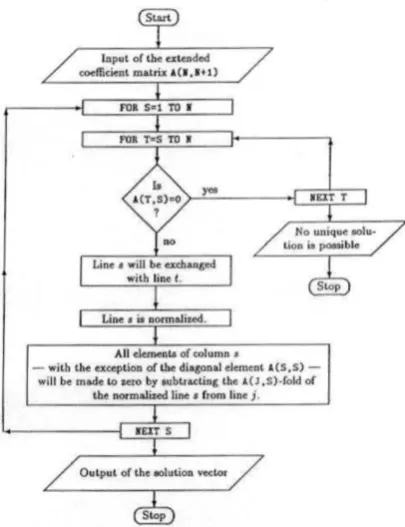
The matrix inversion is implemented using MATLAB. The matrix inversion is implemented with MATLAB inverse function and as well is implemented Gauss Jordan algorithm. Gauss Jordan implementation steps and flowchart as follows:
Gauss Jordan Implementation Steps [8]:
1. Start
2. Read the order of the matrix „A‟ and read the coefficients of the linear equations.
3669 Fig. 2 Flow chart of Gauss Jordan algorithm
The algorithm performs row elementary operations on the matrix by interchanging two rows, multiply a row by a nonzero scalar, add one row to another, and finally add a nonzero scalar multiple of one row to another row.
Simulation Results:
The way points are given to the predictive controller, and output heading angle is taken as path following. The simulation result shown in fig. 3, the ship track keeping is observed at the output of the predictive controller by giving reference trajectory as an input to the system.
Fig. 3 Simulation result of reference trajectory for Gauss Jordan technique
The ship following the given path with high efficiency as the output heading angles are same as the input rudder angle given and the ship follow the path.
Fig. 4 Simulation result of reference trajectory for MATLAB inverse function
The MATLAB inverse function is also used to execute the matrix inversion, the fig. 4 shows the simulation result of trajectory is plotted along with reference trajectory. The efficiency in the MATLAB inverse function is lightly less compare to the Gauss Jordan technique.
Table 1: Comparison of simulation results
Matrix Inversion Techniques
Time
Computation Obtained
Deviation From Reference (Accuracy)
Profiler Tic Toc
Gauss - Jordan
0.632 sec
0.0018
sec 98.22 % MATLAB
Inverse function
1.56 sec 0.0012
sec 95.65% In table 1 computation time is captured. Both profile time and tic toc time is captured. The computation time in terms of profiler is more in MATLAB function compared with Gauss Jordan technique. The tic toc time is less compared with Gauss Jordan, but the track keeping efficiency is more in Gauss Jordan technique.
5. CONCLUSION
The predictive controller major challenge is the computational time due to its complexity. In ship navigation prediction time also plays an important role, the proposed work is carried out to reduce the computational time by using Gauss Jordan matrix inversion technique and is also compared with MATLAB matrix inverse function. Further, the work carried out can be compared with the other matrix inversion techniques.
REFERENCES
3670 [2] Juan Martin, “Adaptive Predictive control
system”, United States Patent, April 8, 1980. [3] Eduard F.Camacho and Carlos Bordons,
“Model predictive controller”,springer, Berlin, 1999, ISBN 3540762418.
[4] Y. L. Huang, Helen H. Lou, J. P. Gong, and Thomas F. Edgar “ Fuzzy Model Predictive Control” IEEE Transactions On Fuzzy Systems, Vol. 8, No. 6, December 2000 [5] Yaoua Hu, Suwu Xu “Generalized Predictive
Controller Design for Ship Track Keeping” IJCSNS VOL.9 No.5, May 2009
[6] Girish Sharma, Abhishek Agarwala, Baidurya Bhattacharya, “A fast parallel Gauss Jordan algorithm for matrix inversion using CUDA”, Elsevier Computers and Structures, Vol 128, 31-37, September 13, 2013
[7] Ling Shang, Serge Petiton, Maxime Hugues, “A New Parallel Paradigm for Block-based Gauss-Jordan Algorithm”, Eighth International Conference on Grid and Cooperative Computing, IEEE, 78-0-7695-3766-5/09, 2009 [8] Gaithuru Juliet Nyokabi, Mazleena Salleh,