A Total Variation Regularization Based Super-Resolution
Reconstruction Algorithm for Digital Video
Michael K. Ng,1Huanfeng Shen,1, 2Edmund Y. Lam,3and Liangpei Zhang2
1Department of Mathematics, Hong Kong Baptist University, Kowloon Tong, Hong Kong
2The State Key Laboratory of Information Engineering in Surveying, Mapping and Remote Sensing,
Wuhan University, Wuhan, Hubei, China
3Department of Electrical and Electronic Engineering, The University of Hong Kong, Pokfulam Road, Hong Kong
Received 13 September 2006; Revised 12 March 2007; Accepted 21 April 2007
Recommended by Russell C. Hardie
Super-resolution (SR) reconstruction technique is capable of producing a high-resolution image from a sequence of low-resolution images. In this paper, we study an efficient SR algorithm for digital video. To effectively deal with the intractable problems in SR video reconstruction, such as inevitable motion estimation errors, noise, blurring, missing regions, and compression artifacts, the total variation (TV) regularization is employed in the reconstruction model. We use the fixed-point iteration method and preconditioning techniques to efficiently solve the associated nonlinear Euler-Lagrange equations of the corresponding variational problem in SR. The proposed algorithm has been tested in several cases of motion and degradation. It is also compared with the Laplacian regularization-based SR algorithm and other TV-based SR algorithms. Experimental results are presented to illustrate the effectiveness of the proposed algorithm.
Copyright © 2007 Michael K. Ng et al. This is an open access article distributed under the Creative Commons Attribution License, which permits unrestricted use, distribution, and reproduction in any medium, provided the original work is properly cited.
1. INTRODUCTION
Solid-state sensors such as CCD or CMOS are widely used nowadays in many image acquisition systems. Such sensors consist of rectangular arrays of photodetectors where their physical sizes limit the spatial resolution of acquired images. In order to increase the spatial resolution of images, one pos-sibility is to reduce the size of rectangular array elements by using advanced sensor fabrication techniques. However, this method would lead to a small signal-to-noise ratio (SNR) be-cause the amount of photons collected in each photodetec-tor decreases correspondingly. On the other hand, the cost of manufacturing such sensors increases rapidly as the number of pixels in a sensor increases. Moreover, in some applica-tions, we only obtain low-resolution (LR) images. In order to get a more desirable high-resolution (HR) images, super-resolution (SR) technique can be employed as an effective and efficient alternative.
Super-resolution image reconstruction refers to a pro-cess that produces an HR image from a sequence of LR images using the nonredundant information among them. It overcomes the inherent resolution limitation by bringing together the additional information from each LR image.
Generally, SR techniques can be divided into two classes of algorithms, namely, frequency domain algorithms and spa-tial domain algorithms. Most of the earlier SR work was developed in the frequency domain using discrete Fourier transform (DFT), such as the work of Tsai and Huang [1], Kim et al. [2,3], and so on. More recently, discrete cosine transform- (DCT-) based [4] and wavelet transform-based [5–7] SR methods have also been proposed. In the spatial domain, typical reconstruction models include nonuniform interpolation [8], iterative back projection (IBP) [9], pro-jection onto convex sets (POCS) [10–13], maximum likeli-hood (ML) [14], maximum a posteriori (MAP) [15,16], hy-brid ML/MAP/POCS [17], and adaptive filtering [18]. Based on these basic reconstruction models, researchers have de-veloped algorithms with a joint formulation of reconstruc-tion and registrareconstruc-tion [19–22], and other algorithms for mul-tispectral and color images [23,24], hyper-spectral images [25], and compressed sequence of images [26,27].
LR sequence
HR sequence
Figure1: Illustration of the SR reconstruction of all frames in the video.
algorithm to solve the nonlinear TV-based SR reconstruc-tion model using fixed-point and precondireconstruc-tioning methods. Preconditioned conjugate gradient methods with factorized banded inverse preconditioners are employed in the itera-tions. Experimental results show that our method is more ef-ficient than the gradient descent method. Secondly, we com-bine image inpainting and SR reconstruction together to ob-tain an HR image from a sequence of LR images. We con-sider that there exist some missing and/or corrupted pix-els in LR images. The filling-in of such missing and/or cor-rupted pixels in an image is called image inpainting [32]. By putting missing and/or corrupted pixels in the image obser-vation model, the proposed algorithm can perform image in-painting and SR reconstruction simultaneously. Experimen-tal results validate that it is more robust than the method of conducting image inpainting and SR reconstruction sepa-rately. Thirdly, while our algorithm is developed for the cases where raw uncompressed video data (such as a webcam di-rectly linked to a host computer) is used, it can be applied to the MPEG compressed video. Simulation results show that the proposed algorithm is also capable of SR reconstruction with the compressed artifacts in the video.
It is noted that this paper aims to reconstruct an HR frame from several LR frames in the video. Using the pro-posed algorithm, all the frames in the video can be SR re-constructed in such a way [33]: for a given frame, a “sliding window” determines the set of LR frames to be processed to produce the output. The window is moved forward to pro-duce successive SR frames in the output sequence. An illus-tration of this procedure is given inFigure 1.
The outline of this paper is as follows. In Section 2, we present the image observation model of the SR prob-lem. The motion estimation methods used in this paper are described in Section 3. InSection 4, we present the TV regularization-based reconstruction algorithm. Experimen-tal results are provided inSection 5. Finally, concluding re-marks are given inSection 6.
2. IMAGE OBSERVATION MODEL
In SR image reconstruction, it is necessary to select a frame from the sequence as the referenced one. The image ob-servation model is to relate the desired referenced HR im-age to all the observed LR imim-ages. Typically, the imaging process involves warping, followed by blurring and down-sampling to generate LR images from the HR image. Let the underlying HR image be denoted in the vector form by
z = [z1,z2,. . .,zL1N1×L2N2]T, whereL1N1×L2N2 is the HR
image size. LettingL1andL2denote the down-sampling
fac-tors in the horizontal and vertical directions, respectively, each observed LR image has the sizeN1×N2. Thus, the LR
image can be represented asyk = [yk,1,yk,2,. . .,yk,N1×N2]T,
wherek = 1, 2,. . .,P, withP being the number of LR im-ages. Assuming that each observed image is contaminated by additive noise, the observation model can be represented as [17,34,35]
yk=DBkMkz+nk, (1)
whereMk is the motion (shift, rotation, zooming, etc.) ma-trix with the size ofL1N1L2N2×L1N1L2N2,Bkrepresents the
blur (sensor blur, motion blur, atmosphere blur, etc.) matrix also of sizeL1N1L2N2×L1N1L2N2,Dis anN1N2×L1N1L2N2
down-sampling matrix, andnkrepresents theN1N2×1 noise
vector.
In fact, in an unreferenced frame, there often exists oc-clusions that cannot be observed in the referenced frame. Obviously, these occlusions should be excluded in the SR reconstruction. Furthermore, there are also missing and/or corrupted pixels in the observed images in some cases. In order to deal with the occlusion problem and perform the image inpainting along with the SR, the observation model (1) should be expanded. We use the termunobservableto de-scribe all the occluded, missing, and corrupted pixels, and ob-servableto describe the other pixels. The unobservable pixels can be excluded by modifying the observation model as
ykobs=Ok
DBkMkz+nk
, (2)
whereOkis an operator cropping the observable pixels from
yk, andykobs is the cropped result. This model provides the
possibility to deal with the occlusion problem and to con-duct simultaneous inpainting and SR. A block diagram cor-responding to the degradation process of this model is illus-trated inFigure 2.
3. MOTION ESTIMATION METHODS
Motion estimation/registration plays a critical role in SR re-construction. In general, the subpixel motions between the referenced frame and the unreferenced frames can be mod-eled and estimated by a parameter model, or they may be scene dependent and have to be estimated for every point [36]. This section introduces the motion estimation meth-ods employed in this paper. For a comparative analysis of the subpixel motion estimation methods in SR reconstruction, please refer to [37].
3.1. Parameter model-based motion estimation
Typically, if the objects in the scene remain stationary while the camera moves, the motions of all points often can be modeled by a parametric model. Generally, the relationship between the observedkth andlth frames can be expressed by
yk
xu,xv
=yk(l,θ)
xu,xv
+εl,k
xu,xv
where (xu,xv) denotes the pixel site, yk(xu,xv) is a pixel in
framek,θis the vector containing the corresponding motion parameters, yk(l,θ)(xu,xv) is the predicted pixel of yk(xu,xv)
from framelusing parameter vectorθ, andεl,k(xu,xv) denotes
the model error. In the literature, the six-parameter affine model and eight-parameter perspective model are widely used. Here we concentrate on the affine model, in which yk(l,θ)(xu,xv) can be expressed as
yk(l,θ)
xu,xv
=yl
a0+a1xu+a2xv,b0+b1xu+b2xv
. (4)
In this model,θ = (a0,a1,a2,b0,b1,b2)T contains six
geo-metric model parameters. To solveθ, we can employ the least square criterion, which has the following minimization cost function:
E(θ)=yk−y (l,θ)
k
2
2. (5)
Using the Gaussian-Newton method, the six affine parame-ters can be iteratively solved by
Δθ=JnTJn−1−JnTrn, θn+1=θn+Δθ
.
(6)
Here,nis the iteration number,Δθdenotes the corrections of the models parameters,rnis the residual vector that is equal
toyk−y (l,θn)
k , andJn=∂rn/∂θndenotes the gradient matrix
ofrn.
3.2. Optical flow-based motion estimation
In many videos, the scene may consist of independently mov-ing objects. In this case, the motions cannot be modeled by a parametric model, but we can use optical flow-based meth-ods to estimate the motions of all points. Here we intro-duce a simple MAP motion estimation method. Let us de-notem=(mu,mv) as a 2D motion field which describes the
motions of all points between the observed framesyk and
yl withmuandmvbeing the horizontal and vertical fields,
respectively, and yk(l,m) is the predicted version ofyk from
framelusing the motion fieldm, the MAP motion estima-tion method has the following minimizaestima-tion funcestima-tion [38]:
E(m)=yk−y (l,m)
k
2
2+λ1U(m), (7)
whereU(m) describes prior information of the motion filed
m, andλ1is the regularization parameter. In this paper, we
chooseU(m) as a Laplacian smoothness constraint consist-ing of the termsQmu2+Qm
v2, whereQis a 2D
Lapla-cian operator. Using steepest descent method, we can itera-tively solve the motion vector field by
mnu+1=mnu+α
∂yk(l,m)
∂mu
yk−y (l,m) k
−λ1QTQmu ,
mn+1
v =mnv+α
∂yk(l,m)
∂mv
yk−y (l,m) k
−λ1QTQmv ,
(8)
wherenagain is the iteration number, andαis the step size. The derivative in the above equation is computed on a pixel-by-pixel basis, given by
∂yk(l,m)xu,xv
∂mu =
yl
xu+mu+ 1,xv
−yl
xu+mu−1,xv
2 ,
∂yk(l,m)xu,xv
∂mv =
yl
xu,xv+mv+ 1
−yl
xu,xv+mv−1
2 .
(9)
Whether using parameter-based model or using opti-cal flow-based model, the unobservable pixels defined in Section 2 should be excluded in the SR reconstruction. Sometimes their positions are known, such as when some pixels (the corresponding sensor array elements) are not functional. However, in many cases when they are not known in advance, a simple way to determine them is to make a threshold judgment on the warping error of each pixel by
yk−y(l,θ)
k < d (10)
or
yk−y(l,m)
k < d (11)
depending on which motion estimation model is used. Here, dis a scalar threshold.
4. TOTAL VARIATION-BASED RECONSTRUCTION ALGORITHM
4.1. TV-based SR model
should be stabilized to become well-posed. Traditionally, reg-ularization has been described from both the algebraic and statistical perspectives [39]. Using regularization techniques, the desired HR image can be solved by
z=arg min
k
ykobs−O
kDBMkz
2
+λ2Γ(z)
, (12)
wherekykobs−OkDBMkz2is the data fidelity term,Γ(z)
denotes the regularization term, andλ2is the regularization
parameter. It is noted that we assume all the images have the same blurring function, so the matrix Bk has been
substi-tuted byB.
For the regularization term, Tikhonov and Gauss-Markov types are commonly employed. A common criti-cism to these regularization methods is that the sharp edges and detailed information in the estimates tend to be overly smoothed. When there is considerable motion error, noise, or blurring in the system, the problem is magnified. To ef-fectively preserve the edge and detailed information in the image, some edge-preserving regularization should be em-ployed in the SR reconstruction.
An effective total variation (TV) regularization was first proposed by Rudin et al. [40] in image processing field. The standard TV norm looks like
Γ(z)=
Ω|∇z|dx dy=
Ω
|∇z|2dx dy, (13)
whereΩis the 2-dimensional image space. It is noted that the above expression is not differentiable when∇z=0. Hence, a more general expression can be obtained by slightly revising (13), given as
Γ(z)=
Ω
|∇z|2+β dx dy. (14)
Here,βis a small positive parameter which ensures diff eren-tiability. Thus the discrete expression is written as
Γ(z)= ∇zTV=
i
j
∇z1
i,j
2
+∇z2
i,j
2
+β, (15)
where∇z1
i,j =z[i+1,j]−z[i,j] and∇z 2
i,j=z[i,j+1]−z[i,j].
The TV regularization was first proposed for image denoising [40]. Because of its robustness, it has been applied to image deblurring [41], image interpolation [42], image inpainting [32], and SR image reconstruction [24,28–31].
In [43], the authors used thel1regularization
Γ(z)=
i
j
∇z1
i,j+∇zi2,j (16)
to approximate the TV regularization. In [24,31], Farsiu et al. proposed the so-called bilateral TV (BTV) regularization in SR image reconstruction. The BTV regularization looks like
Γ(z)=
P
l=−P P
m=0
α|m|+|l|z−Sl
xSmyz1, (17)
where operatorsSl
xandSmy shiftzbylandmpixels in
hori-zontal and vertical directions, respectively. The scalar weight α, 0< α < 1, is applied to give a spatially decaying effect to the summation of the regularization terms [31]. The authors also pointed out that thel1regularization can be regarded as
a special case the BTV regularization.
We call these two regularizations (l1 and BTV) as
TV-related regularizations in this paper. However, the distinction between these two regularizations and the standard TV reg-ularization should be kept in mind. Bioucas-Dias et al. [44] have demonstrated that TV regularization can lead to better results than thel1regularization in image restoration.
There-fore, we employ the standard TV regularization (15) in this paper. By substituting (15) in (12), the following minimiza-tion funcminimiza-tion can be obtained:
z=arg min
k
yobs
k −OkDBMkz2+λ2∇zTV
.
(18)
4.2. Efficient optimization method
We should note that although the TV regularization has been applied to SR image reconstruction in [24,28–31], most of these methods use the gradient descent method to solve the desired HR image. In this section, we introduce a more ef-ficient and reliable algorithm for the optimization problem (18).
The Euler-Lagrange equation for the energy function in (18) is given by the following nonlinear system:
∇E(z)=
k
MTkBTDTOTkOkDBMkz−yobsk
−λ2Lzz=0,
(19)
whereLzis the matrix form of a central difference approxi-mation of the differential operator∇ ·(∇/|∇z|2+β) with
∇·being the divergence operator. Using the gradient descent method, the HR imagezis solved by
zn+1=zn−dt∇Ezn, (20) wherenis the iteration number, anddt >0 is the time step parameter restricted by stability conditions (i.e.,dthas to be small enough so that the scheme is stable). The drawback of this gradient descent method is that it is difficult to choose time steps for both efficiency and reliability [43].
One of the most popular strategies to solve the nonlinear problem in (19) is the lagged diffusivity fixed point iteration introduced in [45,46]. This method consists in linearizing the nonlinear differential term by lagging the diffusion coef-ficient 1/|∇z|2+βone iteration behind. Thuszn+1 is
ob-tained as the solution to the linear equation
k=1
MT
kBTDTOTkOkDBMk−λLnz
zn+1
=
k=1
MTkBTDTOTkykobs.
(a) (b)
Figure3: The 24th frame in the “Foreman” sequence. (a) The original 352×288 image and (b) the extracted 320×256 image.
It has been showed in [45] that the method is monotoni-cally convergent. To solve the above linear equation, any lin-ear optimization solution can be employed. Generally, the preconditioned conjugate gradient (PCG) method is desir-able. To suit the specific matrix structures in image restora-tion and reconstrucrestora-tion, several precondirestora-tioners have been proposed [47–51]. An efficient way to solving the matrix equations in high-resolution image reconstruction is to ap-ply the factorized sparse inverse preconditioner (FSIP) [50]. Let A be a symmetric positive definite matrix, and let its Cholesky factorization beA= GGT. The idea of FSIP is to find the lower triangular matrix L with sparsity pattern S such that
I−GLF (22)
is minimized, where · F denotes the Frobenius norm.
Kolotilina and Yeremin [50] showed thatLcan be obtained by the following algorithm.
Step 1. ComputeLwith sparse patternSsuch that [LA]x,y=
δx,y, (x,y)∈S.
Step 2. LetD =(diag(L))−1andL=D1/2L.
According to this algorithm,msmall linear systems need to be solved, wheremis the number of rows in the matrix
A. These systems can be solved in parallel. Thus the above algorithm is also well suited for modern parallel computing. Motivated by the FSIP preconditioner, we consider the factorized banded inverse preconditioner (FBIP) [47] which is a special type of FSIP. The main idea of FBIP is to approxi-mate the Cholesky factor of the coefficient matrix by banded lower triangular matrices. The following theorem has been proved in [47].
LetTbe a Hermitian Toeplitz matrix, and letB = Tor
B=I+TTDTwithDbe a positive diagonal matrix. Denote
thekth diagonal ofTbytk. Assume the diagonals ofTsatisfy
tk≤ce−γ|k| (23)
for somec >0 andγ >0, or
tk≤c
|k|+ 1−s (24)
for somec >0 ands >3/2. Then for any givenε >0, there exists ap>0 such that for allp > p,
Lp−C−1≤ε, (25)
whereLp denotes the FBIP ofBwith the lower bandwidth
p, andCis the Cholesky factor ofB. This theorem indicates that if the Toeplitz matrixThas certain off-diagonal decay property, then the FBIPs ofBwill be good approximation of
B−1. Here we should note that even though the system matrix
in (21) is not exactly in the Toeplitz form or inI+TTDTform,
our experimental results indicate that the FBIP algorithm is still very efficient for this problem.
5. SIMULATION RESULTS
We tested the proposed TV-based SR reconstruction al-gorithm using a raw “Foreman” sequence and a realistic MPEG4 “Bulletin” sequence. The algorithm using Lapla-cian regularization (where the regularization term isQz2,
with Q being the 2-dimensional Laplacian operator) was also tested to make a comparative analysis. It is noted that the Laplacian regularization generally has stronger constraint on the image than the TV regularization because it is a square term and not extracted like the TV regularization, so it should require a smaller regularization parameter. In fact, we should respectively choose the optimal regularization pa-rameters for the two different regularizations for a reason-able comparison. With this in mind, we tried a series of reg-ularization parameters for the two regreg-ularizations in all the experiments. Furthermore, we also compared our proposed algorithm to other TV or TV-related algorithms in the “Fore-man” experiments.
5.1. The “Foreman” sequence
1E−06 3E−05 1E−03 3E−02
λ
35 37 39 41 43 45 47 49
PSNR
(dB)
TV Laplacian
(a)
1E−06 3E−05 1E−03 3E−02 1E+ 00
λ
25 30 35 40
PSNR
(dB)
TV Laplacian
(b)
3E−02 1E−01 4E−01 2E+ 00 7E+ 00
λ
25 27 29 31 33 35
PSNR
(dB)
TV Laplacian
(c)
1E−06 3E−05 1E−03 3E−02 1E+ 00
λ
20 25 30 35 40 45
PSNR
(dB)
TV Laplacian
(d)
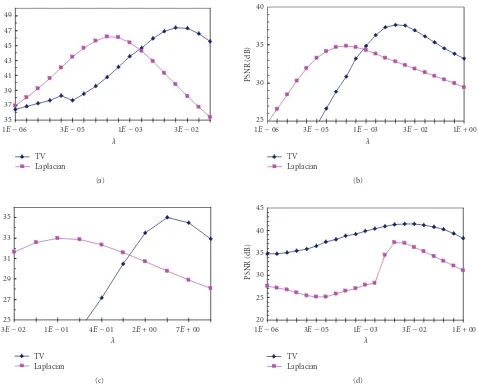
Figure4: PSNR values versus the regularization parameter in the synthetic “Foreman” experiments: (a) the “motion only” case, (b) the “blurring” case, (c) the “noise” case, and (d) the “missing” case.
Figure 3(b). The following peak signal-to-noise ratio (PSNR) was employed as the quantitative measure:
PSNR=10 log10
2552∗L
1N1L2N2
z−z2
, (26)
whereL1N1L2N2is the total number of pixels in the HR
im-age, andzandzrepresent the reconstructed HR image and the original image, respectively.
5.1.1. Synthetic simulations
To show the feature and advantage of the TV-based recon-struction algorithm more sufficiently, we first implemented the synthetic experiments in which the LR images are simu-lated from a single frame of the “Foreman” sequence, frame 24 (the extracted 320 ×256 version). Using observation model (2), we simulated the LR frames in four different ways: (1) the “motion only” case, in which the original frame
was first warped and then the warped versions were down-sampled to obtain the LR frames; (2) the “blurring” case, in which the original frame was first blurred with a 5×5 Gaussian kernel before the warping; (3) the “noise” case, in which the LR frames obtained in the “motion only” case were then contaminated by Gaussian noise with 65.025 variance; and (4) the “missing” case, in which some missing regions were assumed to exist at the same positions of all the LR frames. For each case, the down-sampling factor was two, and four LR images were simulated using global translational motion model. PSNR values against the regularization pa-rameter λ2 in the four cases are demonstrated in Figures 4(a)–4(d), respectively. The SR reconstruction results are re-spectively shown in Figures5–8.
In the “motion only” case, the best PSNR result using Laplacian regularization is 46.162 dB withλ2=0.000256 and
that of TV is 47.360 dB withλ2=0.016384 (seeFigure 4(a)).
(a) (b) (c)
Figure5: Experimental results in the synthetic “motion only” case. (a) LR frame, (b) Laplacian SR result withλ2=0.000256 and (c) TV SR
result withλ2=0.016384.
(a) (b) (c)
Figure6: Experimental results in the synthetic “blurring” case. (a) LR frame, (b) Laplacian SR result withλ2=0.0001 and (c) TV SR result
withλ2=0.008192.
known and there is no noise, blurring, or missing pixel in the image, the result using Laplacian regularization also has high quality. As a result, Figures5(b)and5(c)are almost in-distinguishable visually.
From Figures4(b)and6, we can see the advantage of the TV-based reconstruction algorithm is much more obvious in the “blurring” case.Figure 6(b) is the Laplacian result with the best PSNR of 34.845 dB (λ2 =0.00256), andFigure 6(c)
shows the TV result with the best PSNR of 37.663 dB (λ2 =
0.008192). Visually, the use of Laplacian regularization leads to some artifacts in the reconstructed image. TV regulariza-tion, however, does well.
In the “noise” case, the best PSNR value for the Laplacian regularization is 32.968 dB with the regularization parameter being 0.1024. Using TV regularization, however, we obtained a best PSNR value of 34.987 dB when the regularization pa-rameter is equal to 3.2768. The images corresponding to the best PSNR values are shown in Figures7(b)and7(c), respec-tively. Both images are still noisy to some extent although they have the highest PSNR values, andFigure 7(b)is more obvious. To further smooth the noise, larger regularization parameters should be chosen.Figure 7(d)is the Laplacian re-sult withλ2 =3.2768, andFigure 7(e)is the TV result with λ2 =6.5536. The PSNRs of these two images are 29.797 dB
(Laplacian) versus 34.459 dB (TV). The TV-based algorithm
is preferable again because it can provide simultaneous de-noising and edge preservation.
Figures 4(d) and 8 show the “missing” case. This is a typical example of the simultaneous image inpainting and SR. The best PSNR values for Laplacian and TV are, re-spectively, 37.315 dB (λ2 = 0.008192) and 41.400 dB (λ2 =
0.016384). The corresponding results are shown in Figures 8(b) and 8(c), respectively. We also give the results using larger regularization parameters in Figure 8(d) (Laplacian, λ2 = 0.065536, PSNR = 35.282 dB) and Figure 8(e) (TV, λ2 = 0.26214, PSNR =40.176 dB), respectively. These two
images have better visual quality in the missing regions than their counterparts, Figures8(b)and8(c). We can clearly see that the missing regions can be desirably inpainted using the TV-based algorithm. However, the Laplacian regularization does not work well.Figure 8(f)shows the reconstruction re-sult using TV regularization (λ2 = 0.26214) by conducting
image inpainting and SR separately. The missing regions can-not be inpainted as good as that in the simultaneous process case. The PSNR ofFigure 8(f)is 35.003.
5.1.2. Nonsynthetic simulations
(a) (b)
(c) (d) (e)
Figure7: Experimental results in the synthetic “noise” case. (a) LR frame, (b) Laplacian SR result withλ2=0.1024, (c) TV SR result with λ2=3.2768, (d) Laplacian SR result withλ2=3.2768 and (e) TV SR result withλ2=6.5536.
(a) (b) (c)
(d) (e) (f)
Figure8: Experimental results in the synthetic “missing” case. (a) LR frame, (b) Laplacian simultaneous inpainting and SR result with
λ2=0.008192, (c) TV simultaneous inpainting and SR result withλ2=0.016384, (d) Laplacian simultaneous inpainting and SR result with λ2=0.065536, (e) TV simultaneous inpainting and SR result withλ2=0.26214, and (f) TV result conducting inpainting and SR separately
(a) (b)
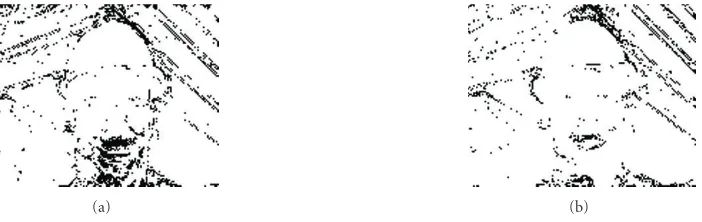
Figure9: Motion estimates of frame 22 (a) and frame 25 (b) in the nonsynthetic “Foreman” experiment.
(a) (b)
Figure10: The unobservable pixels of frame 22 (a) and frame 25 (b) in the nonsynthetic “Foreman” experiment.
frames in the video with a downsampling factor of two. Here, we again demonstrate the reconstruction results of frame 24. Frames 22, 23, 25, and 26 were used as the unreferenced ones. We first tested the “motion only” case. It is noted that the mo-tions are unknown and should be estimated in the nonsyn-thetic cases. We employed the motion estimation method in-troduced inSection 3.2, withλ1=10000 andα=10−6. The
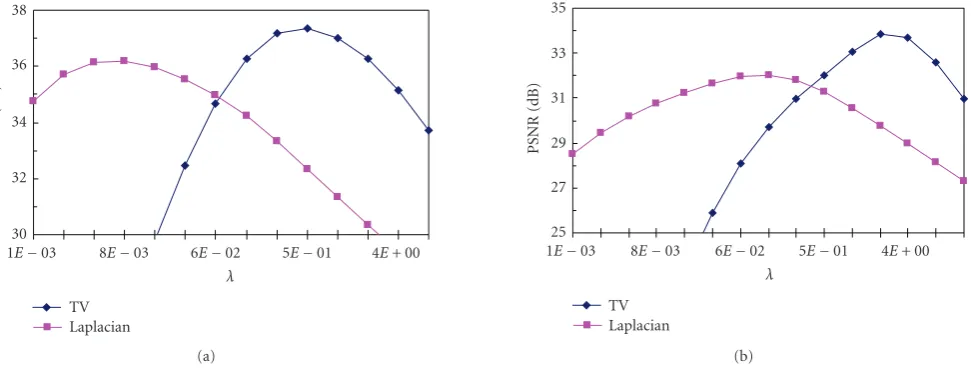
motion estimates of frames 22 and 25 are shown inFigure 9 as illustrations. After the motion estimation, (11) was used to determine the unobservable pixels, and the thresholdd was chosen to be 6. Figures10(a) and10(b) illustrate the unobservable pixels of frame 22 and 25, respectively. Recon-struction methods using Laplacian regularization and TV regularization were respectively implemented. PSNR value against the regularization parameterλ2 is demonstrated in Figure 11(a). The best PSNR result with Laplacian regular-ization is 36.185 dB with λ2 = 0.008, and that of TV is
37.336 dB withλ2 = 0.512. Again, the TV performs better
than Laplacian quantitatively. Furthermore, unlike the syn-thetic “motion only” case, the advantage of the TV-based re-construction is also visually obvious. The Laplacian result is shown inFigure 12(b), from which we can find that the sharp edges are obviously damaged due to the inevitable motion es-timation errors. In the TV result shown inFigure 12(c), how-ever, these edges are effectively preserved.
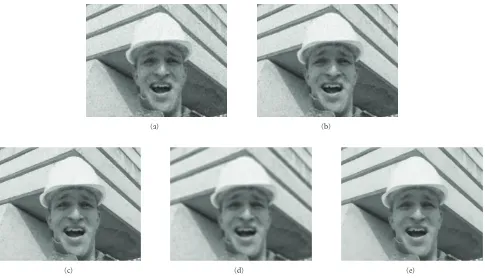
We also show the nonsynthetic “noise” case in which random Gaussian noise with 32.5125 variance was added to the down-sampled images. One of the noisy LR frames is shown inFigure 13(a).Figure 11(b)shows the curves of the PSNR value versus the regularization parameter. The best
PSNR values are, respectively, 32.040 dB and 33.851 dB for the Laplacian and TV. The corresponding reconstructed im-ages are illustrated in Figures13(b)and13(c), and the results with larger regularization parameters which have better vi-sual quality regarding the noise are shown in Figures13(d) and13(e), respectively. By comparisons, we see that the TV-based reconstruction algorithm outperforms the Laplacian-based algorithm in terms of both the visual evaluation and quantitative assessment again.
In order to demonstrate the efficacy of the proposed algorithm, we reconstructed the first 60 frames in the “Foreman” sequence and then combined them together to video format. The regularization parameters for all frames were the same, and the parameters used can pro-vide almost the best visual equality in each case. The SR videos with WMV format can be found at the website http://www.math.hkbu.edu.hk/mng/SR/VideoSR.htm. It is noted that the original frames with size of 352×288 were used now. We also tried to deal with the missing and labeled re-gions in the original video frames in the “motion only” case. Actually, it is impossible to perfectly inpaint these regions because their areas are too large and they are located at the boundaries of the image. However, our experiment indicates that the TV-based reconstruction algorithm has the efficacy to provide a more desirable result as seen inFigure 14.
5.1.3. Comparison to other TV methods
1E−03 8E−03 6E−02 5E−01 4E+ 00
λ
30 32 34 36 38
PSNR
(dB)
TV Laplacian
(a)
1E−03 8E−03 6E−02 5E−01 4E+ 00
λ
25 27 29 31 33 35
PSNR
(dB)
TV Laplacian
(b)
Figure11: PSNR values versus the regularization parameter in the nonsynthetic “Foreman” experiments: (a) the “motion only” case, and (b) the “noise” case.
(a) (b) (c)
Figure12: Experimental results in the nonsynthetic “motion only” case. (a) LR frame, (b) Laplacian SR result withλ=0.008 and (c) TV SR result withλ=0.512.
Laplacian regularization-based algorithm from the reliabil-ity perspective. In this subsection, we compare it to other TV-based algorithms which employ gradient descent (GD) method in terms of both efficiency and reliability. In the ex-periments, the iteration was terminated when the relative gradient normd = ∇E(zn)/∇E(z0)was smaller or
it-eration numberNwas larger than some thresholds. We have mentioned that the drawback of the GD method is that it is difficult to choose time stepdtfor both efficiency and relia-bility. Therefore, we repeated several parameters in each case of the experiments. Here we show the reconstruction results using almost the optimal step parameters. We also tested the effect of parameterβin (14).
Table 1 shows the synthetic “noise-free” case with the full 4 frames being used. Since the problem is almost over-determined in this case, we believe most algorithms can be employed from the reliability perspective. FromTable 1, we can see the PSNR value of the result using FBIP TV algorithm is even lower than that of the GD TV algorithm. But the GD TV algorithm is not stable whendtincreases to 1.0. From the efficiency perspective, the FBIP TV algorithm is faster than
the GD TV and GD BTV algorithms. We also can see that a relatively larger parameterβleads to much faster conver-gence speed for the FBIP TV algorithm, but the efficiency ef-fect ofβto the GD TV algorithm is negligible. The reliability of both FBIP TV and GD TV algorithms is not sensitive to the choice ofβ.
Table 2shows the synthetic “noise-free” case with only 2 frames being used. In this case, the problem is strongly under-determined. We can see that the efficiency advantage of the FBIP TV algorithm is very obvious. The FBIP TV algo-rithm also leads to higher PSNR values than the GD TV and BTV algorithms.
Table 3shows the synthetic “missing” case. The FBIP TV algorithm is still very efficient when there are missing regions in the image. However, the convergence speed of the GD TV and GD BTV are extremely slow. Larger regularization or larger parameter P (in BTV) can speed up the processing, but cannot ensure the optimal solution.
(a) (b)
(c) (d) (e)
Figure13: Experimental results in the nonsynthetic “noise” case. (a) LR frame, (b) Laplacian SR result withλ=0.128, (c) TV SR result with
λ=2.048, (d) Laplacian SR result withλ=2.048, and (e) TV SR result withλ=4.096.
(a) (b)
Figure14: Reconstruction results of the “Foreman” with the original size. (a) Laplacian regularization and (b) TV regularization.
∇E(zn)/∇E(z0) against the computational time, and Figure 15(b) is the demonstration of PSNR value versus the computational time. From both the gradient norm and PSNR convergence criteria, the FBIP TV algorithm greatly outperforms the GD TV algorithm and GD BTV algorithm. It is not only very efficient, but also very stable. In all the pre-vious experiments, the differential operator in (19) was ap-proximated by central difference for both GD TV and FBIP TV algorithms. In this case, we also tested the backward dif-ference approximation for the GD TV algorithm (not that backward difference cannot be used for the FBIP TV algo-rithm because the corresponding system matrix is not sym-metric and positive). Thel1 regularization was also tested. Table 4shows the PSNR values of different algorithms. Here we note that the selected termination conditions can ensure
the optimal results for all the regularizations with the cur-rent parameter settings. It is seen that the proposed FBIP TV algorithm outperforms all other algorithms.
5.2. The “bulletin” sequence
In this experiment, we show the SR reconstruction of a “bul-letin” sequence which was obtained from a consumer-level digital video camera. One frame of this sequence is shown in Figure 16. Although the original frame size is 640×480 pixels, our processing was restricted to a typical 450×80 pixel, as shown in (boxed in dashed) inFigure 16.
Table1: Comparison with GD TV and BTV algorithms in the synthetic “noise-free” case (4 frames).
λ dt β Termination Time (s) PSNR (dB)
FBIP TV 0.016 — 10−5 d=5×10⁻⁴ 16.063 47.360 — 10−1 d=5×10⁻⁴ 11.422 47.426
GD TV 0.016
0.2 10−5 d=5×10⁻⁴ 73.031 47.707 10−1 d=5×10⁻⁴ 70.312 47.709
0.6 10
−5 d=5×10⁻⁴ 24.531 47.722
10−1 d=5×10⁻⁴ 23.141 47.709
1.0
10−5 d=5×10⁻⁴ 15.063 47.733
10−1 d=5×10⁻⁴ 14.530 47.712
10−5 N=2000 303.406 47.274
GD BTV (P=1) 0.007 0.6 — d=5×10
−4 41.828 47.385
1.0 — d=5×10⁻⁴ 34.140 47.265
Table2: Comparison with GD TV and BTV algorithms in the synthetic “noise-free” case (2 frames).
λ dt β Termination Time (s) PSNR (dB)
FBIP TV 0.016 — 10−5 d=1×10⁻³ 18.140 40.201 — 10−1 d=1×10⁻³ 13.718 40.166
GD TV 0.016 0.5 10−5 d=2×10⁻³ 93.734 39.038
GD BTV (P=1) 0.007 0.5 — d=2×10⁻³ 179.093 38.623
Table3: Comparison with GD TV and BTV algorithms in the synthetic “missing” case (4 frames).
λ dt β Termination Time (s) PSNR (dB)
FBIP TV 0.016 — 10−5 d=1×10⁻⁵ 33.875 41.373 — 10−1 d=1×10⁻⁵ 20.062 41.239
GD TV
0.016 1.0 10−5 N=3000 380.087 17.410
0.1 1.0
10−5 N=3000 384.890 23.968
10−5 N=6000 762.343 28.324
10−5 N=9000 1139.56 32.577
BTV (P=1) 0.1 1.0 —
N=3000 335.187 26.883
N=6000 670.343 33.925
N=9000 1018.43 39.460
N=10000 1135.72 39.460
GD BTV (P=3) 0.1 1.0 —
N=1000 376.047 30.170
N=2000 749.141 38.839
N=3000 1191.70 38.861
Table4: Comparison with GD TV and BTV algorithms in the nonsynthetic “noise-free” case (5 frames).
λ dt β Termination PSNR (dB)
FBIP TV(Central) 0.512 — 10−5 d=1×10⁻³ 37.336
GD TV (Central) 0.512 0.05 10−5 N=1000 37.206
GD TV (Backward) 0.512 0.05 10−5 N=1000 37.084
GD L1 0.2 0.05 — N=1000 36.576
GD BTV (P=1) 0.2 0.05 — N=1000 36.854
GD BTV (P=2) 0.2 0.05 — N=1000 36.875
0 20 40 60 80 100 120 140 160 180 Time (s)
10−4
10−3
∇
E
(
z
FBIP TV (β=0.1) GD TV (dt=0.05)
GD BTV (dt=0.05) GD BTV (dt=0.1) (a)
0 20 40 60 80 100 120 140 160 180
Time (s) 31
32 33
PSNR
FBIP TV (β=0.1) GD TV (dt=0.05)
GD BTV (dt=0.05) GD BTV (dt=0.1) (b)
Figure15: Convergence performance of different algorithms, (a) measured by gradient norm, (b) measured by PSNR value.
Figure16: One 640×480 frame in the “bulletin” video. The region boxed in dashed is the interest.
moving object in the scene, the motions between the refer-enced image and the unreferrefer-enced images can be estimated by the affine parameter model introduced in Section 3.1. Figure 17(a)shows one of the extracted images. It is observed that there are obvious artifacts in most parts of this image. These artifacts mainly come from the compression process of the MPEG video.Figure 17(b)is the SR reconstruction result using Laplacian regularization with a relatively smaller regu-larization parameter 0.001. The characters in the image look clearer, but the compression artifact is aggravated. To solve this problem, higher regularization parameter should be cho-sen. In our experiment, we found the artifact problem could not be solved until we increase the regularization parame-ter to 0.5. The reconstructed image is shown inFigure 17(c). Although the artifacts are suppressed, the characters are too
smooth. However, the TV-based reconstruction algorithm can effectively solve this tradeoff.Figure 17(d)shows the TV reconstruction result withλ2 = 5.0. Its overall visual
qual-ity is much better than that of Figures17(a)–17(c). Detailed cropped regions from Figures17(a)–17(d)are, respectively, demonstrated in Figures18(a)–18(d), from which we can see the advantage of the TV-based SR reconstruction more easily. It is noted that we did not consider the compression and decompression processes in the reconstruction model although the inputs of this experiment are the decoded frames from the MPEG video. But even in this case, we ob-tained desirable super-resolved result using the TV-based SR algorithm. If the compression and decompression processes also were included in the SR model such as the methods in [26,27], the result should be better.
6. CONCLUSIONS
(a) (b)
(c) (d)
Figure17: SR reconstruction results of the “bulletin” sequence. (a) LR frame, (b) Laplacian SR result withλ2 =0.001, (c) Laplacian SR
result withλ2=0.5, and (d) TV SR result withλ2=5.0.
(a) (b) (c) (d)
Figure18: (a)–(d) Detail regions cropped from Figures17(a)–17(d).
ACKNOWLEDGMENTS
Research supported in part by RGC 7035/04P and 7035/05P, and HKBU FRGs. H. Shen would like to thank M. K. Ng for his hospitality during his visit to Centre for Mathemati-cal Imaging and Vision, Hong Kong Baptist University, from March 2006 to March 2007. This work was done during H. Shen visit to Hong Kong Baptist University. Research sup-ported in part by RGC Grant HKU 7143/05E.
REFERENCES
[1] R. Y. Tsai and T. S. Huang, “Multi-frame image restoration and registration,”Advances in Computer Vision and Image Process-ing, vol. 1, no. 2, pp. 317–339, 1984.
[2] S. P. Kim, N. K. Bose, and H. M. Valenzuela, “Recursive recon-struction of high resolution image from noisy undersampled multiframes,”IEEE Transactions on Acoustics, Speech, and Sig-nal Processing, vol. 38, no. 6, pp. 1013–1027, 1990.
[3] S. P. Kim and W.-Y. Su, “Recursive high-resolution reconstruc-tion of blurred multiframe images,”IEEE Transactions on Im-age Processing, vol. 2, no. 4, pp. 534–539, 1993.
[4] S. Rhee and M. G. Kang, “Discrete cosine transform based regularized high-resolution image reconstruction algorithm,”
Optical Engineering, vol. 38, no. 8, pp. 1348–1356, 1999. [5] R. H. Chan, T. F. Chan, L. Shen, and Z. Shen, “Wavelet
algo-rithms for high-resolution image reconstruction,”SIAM Jour-nal of Scientific Computing, vol. 24, no. 4, pp. 1408–1432, 2003.
[6] M. K. Ng, C. K. Sze, and S. P. Yung, “Wavelet algorithms for deblurring models,”International Journal of Imaging Systems and Technology, vol. 14, no. 3, pp. 113–121, 2004.
[7] N. Nguyen and P. Milanfar, “A wavelet-based interpolation-restoration method for superresolution (wavelet superresolu-tion),”Circuits, Systems, and Signal Processing, vol. 19, no. 4, pp. 321–338, 2000.
[8] H. Ur and D. Gross, “Improved resolution from subpixel shifted pictures,”CVGIP: Graphical Models and Image Process-ing, vol. 54, no. 2, pp. 181–186, 1992.
[9] M. Irani and S. Peleg, “Improving resolution by image reg-istration,” CVGIP: Graphical Models and Image Processing, vol. 53, no. 3, pp. 231–239, 1991.
[10] H. Stark and P. Oskoui, “High-resolution image recovery from image-plane arrays, using convex projections,”Journal of the Optical Society of America A: Optics and Image Science, and Vi-sion, vol. 6, no. 11, pp. 1715–1726, 1989.
[11] A. M. Tekalp, M. K. Ozkan, and M. I. Sezan, “High-resolution image reconstruction from lower-resolution image sequences and space-varying image restoration,” inProceedings of IEEE International Conference on Acoustics, Speech, and Signal Pro-cessing (ICASSP ’92), vol. 3, pp. 169–172, San Francisco, Calif, USA, March 1992.
Ill, USA, September 1994.
[15] R. R. Schultz and R. L. Stevenson, “Extraction of high-resolution frames from video sequences,”IEEE Transactions on Image Processing, vol. 5, no. 6, pp. 996–1011, 1996.
[16] R. C. Hardie, T. R. Tuinstra, J. Bognar, K. J. Barnard, and E. E. Armstrong, “High resolution image reconstruction from dig-ital video with global and non-global scene motion,” in Pro-ceedings of IEEE International Conference on Image Processing (ICIP ’97), vol. 1, pp. 153–156, Santa Barbara, Calif, USA, Oc-tober 1997.
[17] M. Elad and A. Feuer, “Restoration of a single superresolution image from several blurred, noisy, and undersampled mea-sured images,”IEEE Transactions on Image Processing, vol. 6, no. 12, pp. 1646–1658, 1997.
[18] M. Elad and A. Feuer, “Superresolution restoration of an im-age sequence: adaptive filtering approach,”IEEE Transactions on Image Processing, vol. 8, no. 3, pp. 387–395, 1999.
[19] J. Chung, E. Haber, and J. Nagy, “Numerical methods for cou-pled super-resolution,” Inverse Problems, vol. 22, no. 4, pp. 1261–1272, 2006.
[20] R. C. Hardie, K. J. Barnard, and E. E. Armstrong, “Joint MAP registration and high-resolution image estimation using a se-quence of undersampled images,”IEEE Transactions on Image Processing, vol. 6, no. 12, pp. 1621–1633, 1997.
[21] N. A. Woods, N. P. Galatsanos, and A. K. Katsaggelos, “Stochastic methods for joint registration, restoration, and in-terpolation of multiple undersampled images,”IEEE Transac-tions on Image Processing, vol. 15, no. 1, pp. 201–213, 2006. [22] H. Shen, L. Zhang, B. Huang, and P. Li, “A MAP approach for
joint motion estimation, segmentation, and super resolution,”
IEEE Transactions on Image Processing, vol. 16, no. 2, pp. 479– 490, 2007.
[23] R. Sasahara, H. Hasegawa, I. Yamada, and K. Sakaniwa, “A color super-resolution with multiple nonsmooth constraints by hybrid steepest descent method,” in Proceedings of IEEE International Conference on Image Processing (ICIP ’05), vol. 1, pp. 857–860, Genova, Italy, September 2005.
[24] S. Farsiu, M. Elad, and P. Milanfar, “Multiframe demosaicing and super-resolution of color images,”IEEE Transactions on Image Processing, vol. 15, no. 1, pp. 141–159, 2006.
[25] T. Akgun, Y. Altunbasak, and R. M. Mersereau, “Super-resolution reconstruction of hyperspectral images,” IEEE Transactions on Image Processing, vol. 14, no. 11, pp. 1860– 1875, 2005.
[26] C. A. Segall, A. K. Katsaggelos, R. Molina, and J. Mateos, “Bayesian resolution enhancement of compressed video,”IEEE Transactions on Image Processing, vol. 13, no. 7, pp. 898–910, 2004.
[27] C. A. Segall, R. Molina, and A. K. Katsaggelos, “High-resolution images from low-“High-resolution compressed video,”
IEEE Signal Processing Magazine, vol. 20, no. 3, pp. 37–48, 2003.
[28] D. Capel and A. Zisserman, “Super-resolution enhancement of text image sequences,” inProceedings of the 15th International Conference on Pattern Recognition (ICPR ’00), vol. 1, pp. 600– 605, Barcelona, Spain, September 2000.
ing (ICIP ’04), vol. 3, pp. 1767–1770, Singapore, October 2004. [31] S. Farsiu, M. D. Robinson, M. Elad, and P. Milanfar, “Fast and robust multiframe super resolution,”IEEE Transactions on Im-age Processing, vol. 13, no. 10, pp. 1327–1344, 2004.
[32] T. F. Chan and J. Shen, “Mathematical models for local non-texture inpaintings,” SIAM Journal on Applied Mathematics, vol. 62, no. 3, pp. 1019–1043, 2002.
[33] S. Borman and R. L. Stevenson, “Spatial resolution enhance-ment of low-resolution image sequences: a comprehensive re-view with directions for future research,” Tech. Rep., Labora-tory for Image and Signal Analysis (LISA), University of Notre Dame, Notre Dame, Ind, USA, July 1998.
[34] S. C. Park, M. K. Park, and M. G. Kang, “Super-resolution im-age reconstruction: a technical overview,”IEEE Signal Process-ing Magazine, vol. 20, no. 3, pp. 21–36, 2003.
[35] N. Nguyen, P. Milanfar, and G. Golub, “Efficient general-ized cross-validation with applications to parametric image restoration and resolution enhancement,”IEEE Transactions on Image Processing, vol. 10, no. 9, pp. 1299–1308, 2001. [36] D. Capel and A. Zisserman, “Computer vision applied to super
resolution,”IEEE Signal Processing Magazine, vol. 20, no. 3, pp. 75–86, 2003.
[37] R. R. Schultz, L. Meng, and R. L. Stevenson, “Subpixel mo-tion estimamo-tion for super-resolumo-tion image sequence enhance-ment,”Journal of Visual Communication and Image Represen-tation, vol. 9, no. 1, pp. 38–50, 1998.
[38] A. M. Tekalp,Digital Video Processing, Prentice-Hall, Engle-wood Clliffs, NJ, USA, 1995.
[39] S. Farsiu, D. Robinson, M. Elad, and P. Milanfar, “Advances and challenges in super-resolution,”International Journal of Imaging Systems and Technology, vol. 14, no. 2, pp. 47–57, 2004.
[40] L. Rudin, S. Osher, and E. Fatemi, “Nonlinear total variation based noise removal algorithms,”Physica D, vol. 60, no. 1–4, pp. 259–268, 1992.
[41] C. R. Vogel and M. E. Oman, “Fast, robust total variation-based reconstruction of noisy, blurred images,”IEEE Transac-tions on Image Processing, vol. 7, no. 6, pp. 813–824, 1998. [42] A. Chambolle, “An algorithm for total variation minimization
and applications,”Journal of Mathematical Imaging and Vision, vol. 20, no. 1-2, pp. 89–97, 2004.
[43] Y. Li and F. Santosa, “A computational algorithm for minimiz-ing total variation in image restoration,”IEEE Transactions on Image Processing, vol. 5, no. 6, pp. 987–995, 1996.
[44] J. M. Bioucas-Dias, M. A. T. Figueiredo, and J. P. Oliveira, “Total variation-based image deconvolution: a majorization-minimization approach,” inProceedings of IEEE International Conference on Acoustics, Speech, and Signal Processing (ICASSP ’06), vol. 2, pp. 861–864, Toulouse, France, May 2006. [45] C. R. Vogel and M. E. Oman, “Iterative methods for total
vari-ation denoising,”SIAM Journal of Scientific Computing, vol. 17, no. 1, pp. 227–238, 1996.
[47] F.-R. Lin, M. K. Ng, and W.-K. Ching, “Factorized banded inverse preconditioners for matrices with Toeplitz structure,”
SIAM Journal of Scientific Computing, vol. 26, no. 6, pp. 1852– 1870, 2005.
[48] R. H. Chan, T. F. Chan, and C.-K. Wong, “Cosine transform based preconditioners for total variation deblurring,” IEEE Transactions on Image Processing, vol. 8, no. 10, pp. 1472–1478, 1999.
[49] M. K. Ng, R. H. Chan, T. F. Chan, and A. M. Yip, “Cosine transform preconditioners for high resolution image recon-struction,”Linear Algebra and Its Applications, vol. 316, no. 1– 3, pp. 89–104, 2000.
[50] L. Y. Kolotilina and A. Y. Yeremin, “Factorized sparse approxi-mate inverse preconditionings I: theory,”SIAM Journal on Ma-trix Analysis and Applications, vol. 14, no. 1, pp. 45–58, 1993. [51] N. Nguyen, P. Milanfar, and G. Golub, “A computationally
ef-ficient superresolution image reconstruction algorithm,”IEEE Transactions on Image Processing, vol. 10, no. 4, pp. 573–583, 2001.
Michael K. Ng is a Professor in the De-partment of Mathematics at the Hong Kong Baptist University. He obtained his B.S. degree in 1990 and M.Phil. degree in 1992 at the University of Hong Kong, and Ph.D. degree in 1995 at Chinese Univer-sity of Hong Kong. Michael won the Hon-ourable Mention of Householder Award IX, in 1996, at Switzerland, an excellent young researcher’s presentation at Nanjing
International Conference on Optimization and Numerical Alge-bra, 1999, and the Outstanding Young Researcher Award of the University of Hong Kong. He supervised more than 20 gradu-ate students. As an Applied Mathematician, Michael’s main search areas include bioinformatics, data mining, operations re-search, and scientific computing. Michael has published and edited 5 books, published more than 140 journal papers. He has re-viewed papers for more than 40 international journals. He cur-rently serves on the editorial boards of Journal of Computa-tional and Applied Mathematics (Principal Editor); SIAM Jour-nal on Scientific Computing; Numerical Linear Algebra with Applications; International Journal of Data Mining and Bioin-formatics; Multidimensional Systems and Signal Processing; In-ternational Journal of Computational Science and Engineering, and was guest editor of several special issues of the inter-national journals (Journal of Computational Mathematics, In-ternational Journal of Applied Mathematics, Applied Mathe-matics and Computation, EURASIP Journal on Applied Sig-nal Processing, InternatioSig-nal JourSig-nal of Imaging Systems and Technology).
Huanfeng Shen received the B.S. degree in surveying and mapping engineering from Wuhan University, Wuhan, China, in 2002. He is currently pursuing the Ph.D. degree in the State Key Labora-tory of Information Engineering in Sur-veying, Mapping and Remote Sensing, Wuhan University, Wuhan. His current re-search interests focus on image reconstruc-tion, remote sensing, image processing and application.
Edmund Y. Lamreceived the B.S. degree (with distinction) in 1995, the M.S. de-gree in 1996, and the Ph.D. dede-gree in 2000, all in electrical engineering from Stanford University, Stanford, Calif. At Stanford, he developed image processing algorithms for the Programmable Digital Camera project. He also consulted for industry in the ar-eas of digital camera systems design and al-gorithms development. Before returning to
academia, he was affiliated with the Reticle and Photomask Inspec-tion Division (RAPID) of KLA-Tencor CorporaInspec-tion in San Jose, Calif, as a Senior Engineer, working in the design of defect detec-tion tools for the core die-to-die and die-to-database inspecdetec-tions. He is currently an Assistant Professor of electrical and electronic engineering at the University of Hong Kong, as well as the Direc-tor of its Imaging Systems LaboraDirec-tory. His research interests include electronic and computational imaging, and image processing appli-cations in semiconductor manufacturing, biomedical engineering, and sensor networks. He is a Senior Member of IEEE and a Member of SPIE.
Liangpei Zhang received the B.S. degree in physics from Hunan Normal University, ChangSha, China, in 1982, the M.S. de-gree in optics from the Xi’an Institute of Optics and Precision Mechanics of Chinese Academy of Sciences, Xi’an, China, in 1988, and the Ph.D. degree in photogrammetry and remote sensing from Wuhan Univer-sity, Wuhan, China, in 1998. From 1997 to 2000, he was a Professor of School of