Volume 2007, Article ID 89354,11pages doi:10.1155/2007/89354
Research Article
A MAP Estimator for Simultaneous Superresolution and
Detector Nonunifomity Correction
Russell C. Hardie1and Douglas R. Droege2
1Department of Electrical and Computer Engineering, University of Dayton, 300 College Park, Dayton, OH 45469-0226, USA 2L-3 Communications Cincinnati Electronics, 7500 Innovation Way, Mason, OH 45040, USA
Received 31 August 2006; Accepted 9 April 2007
Recommended by Richard R. Schultz
During digital video acquisition, imagery may be degraded by a number of phenomena including undersampling, blur, and noise. Many systems, particularly those containing infrared focal plane array (FPA) sensors, are also subject to detector nonuniformity. Nonuniformity, or fixed pattern noise, results from nonuniform responsivity of the photodetectors that make up the FPA. Here we propose a maximum a posteriori (MAP) estimation framework for simultaneously addressing undersampling, linear blur, additive noise, and bias nonuniformity. In particular, we jointly estimate a superresolution (SR) image and detector bias nonuniformity parameters from a sequence of observed frames. This algorithm can be applied to video in a variety of ways including using a mov-ing temporal window of frames to process successive groups of frames. By combinmov-ing SR and nonuniformity correction (NUC) in this fashion, we demonstrate that superior results are possible compared with the more conventional approach of performing scene-based NUC followed by independent SR. The proposed MAP algorithm can be applied with or without SR, depending on the application and computational resources available. Even without SR, we believe that the proposed algorithm represents a novel and promising scene-based NUC technique. We present a number of experimental results to demonstrate the efficacy of the pro-posed algorithm. These include simulated imagery for quantitative analysis and real infrared video for qualitative analysis.
Copyright © 2007 R. C. Hardie and D. R. Droege. This is an open access article distributed under the Creative Commons Attribution License, which permits unrestricted use, distribution, and reproduction in any medium, provided the original work is properly cited.
1. INTRODUCTION
During digital video acquisition, imagery may be degraded by a number of phenomena including undersampling, blur, and noise. Many systems, particularly those containing infrared focal plane array (FPA) sensors, are also subject to detector nonuniformity [1–4]. Nonuniformity, or fixed pat-tern noise, results from nonuniform responsivity of the pho-todetectors that make up the FPA. This nonuniformity tends to drift over time, precluding a simple one-time factory cor-rection from completely eradicating the problem. Traditional methods of reducing fixed pattern noise, such as correlated double sampling [5], are often ineffective because the pro-cessing technology and operating temperatures of infrared sensor materials result in the dominance of different sources of nonuniformity. Periodic calibration techniques can be em-ployed to address the problem in the field. These, however, require halting normal operation while the imager is aimed at calibration targets. Furthermore, these methods may only be effective for a scene with a dynamic range close to that
of the calibration targets. Many scene-based techniques have been proposed to perform nonuniformity correction (NUC) using only the available scene imagery (without calibration targets).
that exploits the constant range assumption has been pro-posed in [15]. A nonlinear filter-based method is described in [16]. As a group, these methods are often referred to as constant statistics techniques. Constant statistics techniques work well when motion in a relatively large number of frames distributes diverse scene intensities across the FPA.
Another set of proposed scene-based NUC techniques utilizes motion estimation or specific knowledge of the relative motion between the scene and the FPA [17–23]. A motion-compensated temporal average approach is pre-sented in [19]. Algebraic scene-based NUC techniques are developed in [20–22]. A regularized least-squares method, closely related to this work, is presented in [23]. These motion-compensated techniques are generally able to op-erate successfully with fewer frames than constant statis-tics techniques. Note that many motion-compensated tech-niques utilize interpolation to treat subpixel motion. If the observed imagery is undersampled, the ability to perform ac-curate interpolation is compromised, and these NUC tech-niques can be adversely affected.
When aliasing from undersampling is the primary form of degradation, a variety of superresolution (SR) algorithms can be employed to exploit motion in digital video frames. A good survey of the field can be found in [24,25]. Statistical SR estimation methods derived using a Bayesian framework, similar to that used here, include [26–30]. When significant levels of both nonuniformity and aliasing are present, most approaches treat the nonuniformity and undersampling sep-arately. In particular, some type of calibration or scene-based NUC is employed initially. This is followed by applying an SR algorithm to the corrected imager [31,32]. One pioneering paper developed a maximum-likelihood estimator to jointly estimate a high-resolution (HR) image, shift parameters, and nonuniformity parameters [33].
Here we combine scene-based NUC with SR using a max-imum a posteriori (MAP) estimation framework to jointly estimate an SR image and detector nonuniformity param-eters from a sequence of observed frames (MAP SR-NUC algorithm). We use Gaussian priors for the HR image, bi-ases, and noise. We employ a gradient descent optimization and estimate the motion parameters prior to the MAP algo-rithm. Here we focus on translational and rotational motion. The joint MAP SR-NUC algorithm can be applied to video in a variety of ways including processing successive groups of frames spanned by a moving temporal window of frames. By combining SR and NUC in this fashion, we demonstrate that superior results are possible compared with the more conventional approach of performing scene-based NUC fol-lowed by independent SR. This is because access to an SR image can make interpolation more accurate, leading to im-proved nonuniformity parameter estimation. Similarly, HR image estimation requires accurate knowledge of the detector nonuniformity parameters. The proposed MAP algorithm can be applied with or without SR, depending on the ap-plication and computational resources available. Even with-out SR, we believe that the proposed algorithm represents a novel and promising scene-based NUC technique (MAP NUC algorithm).
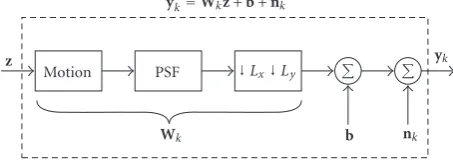
yk=Wkz+b+nk
z yk
Wk b nk
Motion PSF ↓Lx↓Ly
Figure1: Observation model for simultaneous image superresolu-tion and nonuniformity correcsuperresolu-tion.
The rest of this paper is organized as follows. InSection 2, we present the observation model. The joint MAP estimator and corresponding optimization are presented inSection 3. Experimental results are presented in Section 4to demon-strate the efficacy of the proposed algorithm. These include results produced using simulated imagery for quantitative analysis and real infrared video for qualitative analysis. Con-clusions are presented inSection 5.
2. OBSERVATION MODEL
Figure 1illustrates the observation model that relates a set of observed low-resolution (LR) frames with a correspond-ing desired HR image. Samplcorrespond-ing the scene at or above the Nyquist rate gives rise to the desired HR image, denoted us-ing lexicographical notation as anN ×1 vector z. Next, a geometric transformation is applied to model the relative motion between the camera and the scene. Here we con-sider rigid translational and rotational motion. This requires only three motion parameters per frame and is a reason-ably good model for video of static scenes imaged at long range from a nonstationary platform. We next incorporate the point spread function (PSF) of the imaging system using a 2D linear convolution operation. The PSF can be modi-fied to include other degradations as well. In the model, the image is then downsampled by factors ofLx andLy in the
horizontal and vertical directions, respectively.
We now introduce the nonuniformity by adding anM×1 array of biases,b, whereM=N/(LxLy). Detector
nonunifor-mity is frequently modeled using a gain parameter and bias parameter for each detector, allowing for a linear correction. However, in many systems, the nonuniformity in the gain term tends to be less variable and good results can be ob-tained from a bias-only correction. Since a model containing only biases simplifies the resulting algorithms and provides good results on the imagery tested here, we focus here on a bias-only nonuniformity model. Finally, anM×1 Gaussian noise vectornkis added. This forms thekth observed frame
represented by anM×1 vectoryk. Let us assume that we have
observedP frames,y1,y2,. . .,yP. The complete observation
model can be expressed as
yk=Wkz+b+nk, (1)
fork=1, 2,. . .,P, whereWkis anM×Nmatrix that
blur, and the subsampling shown inFigure 1. Note that this model can accommodate downsampling (i.e.,Lx,Ly>1) for
SR or can perform NUC only forLx=Ly=1. Also note that
the operationWkzimplements subpixel motion for anyLx
andLyby performing bilinear interpolation.
We model the additive noise as a zero-mean Gaussian random vector with the following multivariate PDF:
Prnk
= 1
(2π)M/2σM n
exp
− 1 2σ2
n nT
knk
, (2)
fork=1, 2,. . .,P, whereσ2
nis the noise variance. We also
as-sume that these random vectors are independent from frame to frame (temporal noise).
We model the biases (fixed pattern noise) as a zero-mean Gaussian random vector with the following PDF:
Prb= 1
(2πM/2σbM
exp
− 1 2σ2
b bTb
, (3)
whereσ2
b is the variance of the bias parameters. This
Gaus-sian model is chosen for analytical convenience but has been shown to produce useful results.
We model the HR image using a Gaussian PDF given by
Pr(z= 1
(2π)N/2Cz1/2exp
−1 2z
TC−1 z z
, (4)
whereCz is theN×N covariance matrix. The exponential
term in (4) can be factored into a sum of products yielding
Pr(z)= 1
(2π)N/2Cz1/2exp
− 1 2σ2
z N
i=1 zTd
idTiz
, (5)
wheredi =[di,1,di,2,. . .,di,N]T is a coefficient vector. Thus,
the prior can be rewritten as
Pr(z)= 1
(2π)N/2Cz1/2exp −
1 2σ2
z N
i=1 N
j=1
di,jzj 2
.
(6)
The coefficient vectorsdifori = 1, 2,. . .,N are selected to
provide a higher probability for smooth random fields. Here we have selected the following values for the coefficient vec-tors:
di,j= ⎧ ⎪ ⎨ ⎪ ⎩
1 fori=j, −1
4 forj:zjis a cardinal neighbor ofzi. (7)
This model implies that every pixel value in the desired image can be modeled as the average of its four cardinal neighbors plus a Gaussian random variable of varianceσ2
z. Note that
the prior in (6) can also be viewed as a Gibbs distribution where the exponential term is a sum of clique potential func-tions [34] derived from a third-order neighborhood system [35,36].
3. JOINT SUPERRESOLUTION AND NONUNIFORMITY CORRECTION
Given that we observe P frames, denoted by y =
[yT
1,yT2,. . .,yTP]T, we wish to jointly estimate the HR image zand the nonuniformity parametersb. InSection 4, we will demonstrate that it is advantageous to estimate these simul-taneously versus independently.
3.1. MAP estimation
The joint MAP estimation is given by
z,b=arg max z,b
Pr(z,b|y). (8)
Using Bayes rule, this can be equivalently be expressed as
z,b=arg max z,b
Pr(y|z,b) Pr(z,b)
Pr(y) . (9)
Assuming that the biases and the HR image are independent, and noting that the denominator in (9) is not a function ofz
orb, we obtain
z,b=arg max z,b
Pr(y|z,b) Pr(z) Pr(b). (10)
We can express the MAP estimation in terms of a minimiza-tion of a cost funcminimiza-tion as follows:
z,b=arg min z,b
L(z,b), (11)
where
L(z,b)= −logPr(y|z,b)−logPr(z)−logPr(b). (12)
Note that when givenzandb,ykis essentially the noise
with the mean shifted toWkz+b. This gives rise to the
fol-lowing PDF:
Pr(y|z,b)
= P
k=1
1 (2π)M/2σM
n
×exp
− 1 2σ2
n
yk−Wkz−b T
yk−Wkz−b
.
(13)
This can be expressed equivalently as follows:
Pr(y|z,b)
= 1
(2π)PM/2σPM n
×exp − P
k=1
1 2σ2
n
yk−Wkz−b T
yk−Wkz−b
.
300 250 200 150 100 50 300 250 200 150 100 50
(a)
80 70 60 50 40 30 20 10 80 70 60 50 40 30 20 10
(b)
80 70 60 50 40 30 20 10 80 70 60 50 40 30 20 10
(c)
300 250 200 150 100 50 300 250 200 150 100 50
(d)
Figure2: Simulated images: (a) true high-resolution image; (b) simulated frame-one resolution image; (c) observed frame-one low-resolution image withσ2
n=4 andσb2=400; (d) restored frame-one using the MAP SR-NUC algorithm forP=30 frames.
Substituting (14), (4), and (3) into (12) and removing scalars that are not functions ofzorb, we obtain the final cost func-tion for simultaneous SR and NUC. This is given by
L(z,b)= 1 2σ2
n P
k=1
yk−Wkz−b T
yk−Wkz−b
+1 2z
TC−1 z z+
1 2σ2
b bTb.
(15)
The cost function in (15) balances three terms. The first term on the right-hand side is minimized when a candidate
z, projected through the observation model, matches the ob-served data in each frame. The second term is minimized with a smooth HR imagez, and the third term is minimized when the individual biases are near zero. The variancesσ2
n,
σ2
z, andσb2control the relative weights of these three terms,
where the varianceσ2
z is contained in the covariance matrix
Czas shown by (4) and (5). It should be noted that the cost
function in (15) is essentially the same as that used in the reg-ularized least-squares method in [23]. The difference is that here we allow the observation model matrixWkto include
PSF blurring and downsampling, making this more general and appropriate for SR.
30 25 20 15 10 5 0
Number of frames 0 5 10 15 20 25 30 35 MAE Registration-based NUC MAP NUC MAP SR-NUC
Figure3: Mean absolute error for the estimated biases as a function ofP(the number of input frames).
3.2. Gradient descent optimization
The key to the optimization is to obtain the gradient of the cost in (15) with respect to the HR imagezand the bias vec-torb. It can be shown that the gradient of the cost function in (15) with respect to the HR imagezis given by
∇zL(z,b)= 1
σ2 n
P
k=1
WTkWkz+b−yk
+C−1
z z. (16)
Note that the termC−1
z zcan be expressed as
Cz−1z=
z1,z2,. . .,zN T
, (17)
where
zk=
1 σ2
z N
i=1
di,k N
j=1
di,jzj
. (18)
The gradient of the cost function in (15) with respect to the bias vectorbis given by
∇bL(z,b)= 1
σ2 n
P
k=1
Wkz+b−yk
+ 1
σb2
b. (19)
We begin the gradient descent updates using an initial estimate of the HR image and bias vector. Here we lowpass filter and interpolate the first observed frame to obtain an initial HR image estimate z(0). The initial bias estimate is given byb(0)=0, where0is anM×1 vector of zeros. The gradient descent updates are computed as
z(m+ 1)=z(m)−ε(m)gz(m),
b(m+ 1)=b(m)−ε(m)gb(m),
(20) 30 25 20 15 10 5 0
Number of frames 10 12 14 16 18 20 22 24 26 28 30 MAE
Registration NUC→bilinear interpolation MAP NUC→bilinear interpolation MAP NUC→MAP SR
MAP SR-NUC
Figure4: Mean absolute error for the HR image estimate as a func-tion ofP(the number of input frames).
wherem=0, 1, 2,. . . is the iteration number and
gz(m)= ∇zL(z,b)|z=z(m),b=b(m),
gb(m)= ∇bL(z,b)|z=z(m),b=b(m).
(21)
Note thatε(m) is the step size for iterationm. The optimum step size can be found by minimizing
Lz(m+ 1),b(m+ 1)
=Lz(m)−ε(m)gz(m),b(m)−ε(m)gb(m)
(22)
as a function ofε(m). Taking the derivative of (22) with re-spect toε(m) and setting it to zero yields
ε(m)= 1 σ2 n P
k=1
Wkgz(m) +gb(m)
T
Wkz(m)+b(m)−yk
+gT
z(m)C−z1z(m) +
1 σ2
b gT
b(m)b(m)
1 σ2 n P
k=1
Wkgz(m) +gb(m)
T
Wkgz(m) +gb(m)
+gTz(m)C−z1gz(m) + 1 σb2
gTb(m)gb(m)
.
(23)
We continue the iterations until the percentage change in cost falls below a pre-determined value (or a maximum number of iterations are reached).
4. EXPERIMENTAL RESULTS
300 250 200 150 100 50 300 250 200 150 100 50
(a)
300 250 200 150 100 50 300
250 200 150 100 50
(b)
300 250 200 150 100 50 300
250 200 150 100 50
(c)
300 250 200 150 100 50 300 250 200 150 100 50
(d)
Figure5: Simulated output HR image estimates forP=5: (a) joint MAP SR-NUC; (b) MAP NUC followed by MAP SR; (c) MAP NUC followed by bilinear interpolation; (d) registration-based NUC followed by bilinear interpolation.
This first set of results is obtained using simulated imagery to allow for quantitative analysis. The second set uses real data from a forward-looking infrared (FLIR) imager to allow for qualitative analysis.
4.1. Simulated data
The original true HR image is shown inFigure 2(a). This is a single 8-bit grayscale aerial image to which we apply random translational motion using the model described inSection 2, downsample by Lx = Ly = 4, introduce bias
nonunifor-mity with varianceσ2
b = 40, and add Gaussian noise with
varianceσ2
n = 1 to simulate a sequence of 30 LR observed
frames. The first simulated LR frame with Lx = Ly = 4,
slight translation and rotation, but no noise or nonunifor-mity, is shown inFigure 2(b). The first simulated observed frame with noise and nonuniformity applied is shown in
Figure 2(c). The output of the joint MAP SR-NUC algorithm is shown inFigure 2(d)forP=30 observed frames contain-ing noise and nonuniformity. Here we used the exact motion parameters in the algorithm in order to assess the estima-tor independently from the motion estimation. An analysis of motion estimation in the presence of nonuniformity can be found in [19,32,37]. Note that for all the results shown here, we iterate the gradient descent algorithm until the cost decreases by less than 0.001% (typically 20–100 iterations).
The mean absolute error (MAE) for the bias estimates are shown inFigure 3as a function of the number of input frames. We compare the joint MAP SR-NUC estimator with the MAP NUC algorithm (without SR, but equivalent to the MAP SR-NUC estimator with Lx = Ly = 1) and the
registration-based NUC proposed in [19]. Note that the joint MAP SR-NUC algorithm (withLx = Ly = 4) outperforms
80 70 60 50 40 30 20 10 80 70 60 50 40 30 20 10
(a)
80 70 60 50 40 30 20 10 80 70 60 50 40 30 20 10
(b)
80 70 60 50 40 30 20 10 80 70 60 50 40 30 20 10
(c)
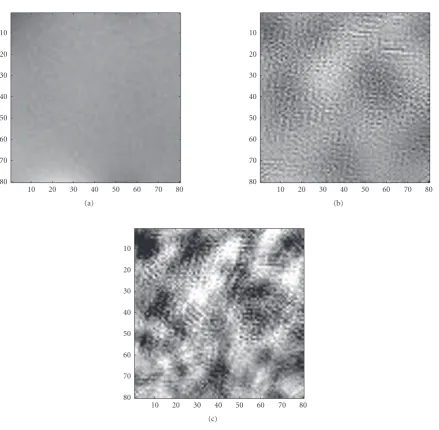
Figure6: Bias error image forP =30: (a) Joint MAP SR-NUC bias error image; (b) MAP NUC bias error image; (c) registration-based NUC bias error image.
MAP algorithms outperform the simple registration-based NUC method.
A plot of the MAE for the HR image estimates, versus the number of input frames, is shown inFigure 4. Here we com-pare the MAP SR-NUC algorithm to several two-step algo-rithms. Two of the benchmark approaches use the proposed MAP NUC (Lx = Ly = 1) algorithm to obtain bias
esti-mates and these biases are used to correct the input frames. We consider processing these corrected frames using bilin-ear interpolation as one benchmark and using a MAP SR algorithm without NUC as the other. The pure SR algo-rithm is obtained using the MAP estimator presented here without the bias terms. This pure SR method is essentially the same as that in [29,38]. We also present MAEs for the registration-based NUC algorithm followed by bilinear in-terpolation. The error plot shows that for a small number of frames, the joint MAP SR-NUC estimator outperforms the
two-step methods. For a larger number of frames, the error for the joint MAP SR-NUC and the independent MAP esti-mators is approximately the same. This is true even though
Figure 3shows that the bias estimates are more accurate us-ing the joint estimator. This suggests that the MAP SR al-gorithm offers some robustness to the small nonuniformity errors when a larger number of frames are used (e.g., more than 30).
600 500 400 300 200 100 500
400 300 200 100
(a)
125 100 75
50 25 125
100 75 50 25
(b)
500 400 300 200 100 500
400 300 200 100
(c)
125 100 75
50 25 125
100 75 50 25
(d)
500 400 300 200 100 500
400 300 200 100
(e)
evident in Figure 5(b)compared with those inFigure 5(a). The SR processed frames (Figures5(a)and5(b)) appear to have much greater details than those obtained with bilinear interpolation (Figures5(c)and5(d)), even with only five in-put frames. Additionally, the MAP NUC (Figure 5(c)) out-performs the registration-based NUC (Figure 5(d)).
To better illustrate the nature of the errors in the bias nonuniformity parameters, these errors are shown in
Figure 6as grayscale images. All of the bias error images are shown with the same colormap to allow for direct compar-ison. The middle grayscale value corresponds to no error. Bright pixels correspond to positive error and dark pixels cor-respond to negative error. The errors shown are forP =30 frames. The bias error for the joint MAP SR-NUC algorithm (Lx=Ly=4) is shown inFigure 6(a). The error for the MAP
NUC algorithm (Lx =Ly =1) is shown inFigure 6(b).
Fi-nally, the bias error image for the registration-based method is shown inFigure 6(c). Note that with the joint MAP SR-NUC algorithm, the bias errors have primarily low-frequency nature and their magnitudes are relatively small. The MAP NUC algorithm shows some high-frequency errors, possi-bly resulting from interpolation errors in the motion model. Such errors are reduced for the joint MAP SR-NUC method because the interpolation is done on the HR grid. The errors for the registration-based method include significant low-and high-frequency components.
4.2. Infrared video
In this section, we present the results obtained by ap-plying the proposed algorithms to a real FLIR video se-quence created by panning the camera. The FLIR imager contains a 640×512 infrared FPA produced by L-3 Com-munications Cincinnati Electronics. The FPA is composed of Indium-Antimonide (InSb) detectors with a wavelength spectral response of 3μm–5μm and it produces 14-bit data. The individual detectors are set on a 0.028 mm pitch, yield-ing a samplyield-ing frequency of 35.7 cycles/mm. The system is equipped with an f /4 lens, yielding a cutofffrequency of 62.5 cycles/mm (undersampled by a factor of 3.5×).
The full first raw frame is shown inFigure 7(a)and a cen-ter 128×128 region of interest is shown inFigure 7(b). The output of the joint MAP SR-NUC algorithm forLx=Ly=4
andP = 20 frames is shown inFigure 7(c). Here we use σn=5, the typical level of temporal noise;σz=300, the
stan-dard deviation of the first observed LR frame; andσb=100,
the standard deviation of the biases from a prior factory cor-rection. We have observed that the MAP algorithm is not highly sensitive to these parameters and their relative values are all that impact the result. Here the motion parameters are estimated from the observed imagery using the registra-tion technique detailed in [38,39] with a lowpass prefilter to reduce the effects of the nonuniformity on the registration accuracy [19,32,37].
The first LR frame corrected with the estimated biases is shown inFigure 7(d). The first LR frame corrected using the estimated bias followed by bilinear interpolation is shown inFigure 7(e). Note that the MAP SR-NUC image provides
more details, including sufficient details to read the lettering on the side of the truck, than the image obtained using bilin-ear interpolation.
5. CONCLUSIONS
In this paper, we have developed a MAP estimation frame-work to jointly estimate an SR image and bias nonunifor-mity parameters from a sequence of observed frames. We use Gaussian priors for the HR image, biases, and noise. We em-ploy a gradient descent optimization and estimate the mo-tion parameters prior to the MAP algorithm. Here we esti-mate translation and rotation parameters using the method described in [38,39].
We have demonstrated that superior results are possible with the joint method compared with comparable processing using independent NUC and SR. The bias errors were con-sistently lower for the joint MAP estimator with any number of input frames tested. The HR image errors were lower in our simulated image results using the joint MAP estimator when fewer than 30 frames were used. Our results suggest that a synergy exists between the SR and NUC estimation algorithms. In particular, the interpolation used for NUC is enhanced by the SR and the SR is enhanced by the NUC. The proposed MAP algorithm can be applied with or without SR, depending on the application and computational resources available. Even without SR, we believe that the proposed al-gorithm represents a novel and promising scene-based NUC technique. We are currently exploring nonuniformity mod-els with gains and biases, more sophisticated prior modmod-els, alternative optimization strategies to enhance performance, and retime implementation architectures based on this al-gorithm.
REFERENCES
[1] A. F. Milton, F. R. Barone, and M. R. Kruer, “Influence of nonuniformity on infrared focal plane array performance,” Optical Engineering, vol. 24, no. 5, pp. 855–862, 1985. [2] W. Gross, T. Hierl, and M. Schultz, “Correctability and
long-term stability of infrared focal plane arrays,”Optical Engineer-ing, vol. 38, no. 5, pp. 862–869, 1999.
[3] D. L. Perry and E. L. Dereniak, “Linear theory of nounifor-mity correction in infrared staring sensors,”Optical Engineer-ing, vol. 32, no. 8, pp. 1854–1859, 1993.
[4] M. D. Nelson, J. F. Johnson, and T. S. Lomheim, “General noise processes in hybrid infrared focal plane arrays,”Optical Engi-neering, vol. 30, no. 11, pp. 1682–1700, 1991.
[5] A. El Gamal and H. Eltoukhy, “CMOS image sensors,”IEEE Circuits and Devices Magazine, vol. 21, no. 3, pp. 6–20, 2005. [6] P. M. Narendra and N. A. Foss, “Shutterless fixed pattern noise
correction for infrared imaging arrays,” inTechnical Issues in Focal Plane Development, vol. 282 ofProceedings of SPIE, pp. 44–51, Washington, DC, USA, April 1981.
[7] J. G. Harris, “Continuous-time calibration of VLSI sensors for gain and offset variations,” inSmart Focal Plane Arrays and Focal Plane Array Testing, M. Wigdor and M. A. Massie, Eds., vol. 2474 ofProceedings of SPIE, pp. 23–33, Orlando, Fla, USA, April 1995.
implementations,” in Infrared Technology and Applications XXIII, B. F. Andresen and M. Strojnik, Eds., vol. 3061 of Pro-ceedings of SPIE, pp. 895–905, Orlando, Fla, USA, April 1997. [9] Y.-M. Chiang and J. G. Harris, “An analog integrated circuit for
continuous-time gain and offset calibration of sensor arrays,” Analog Integrated Circuits and Signal Processing, vol. 12, no. 3, pp. 231–238, 1997.
[10] D. A. Scribner, K. A. Sarkady, J. T. Caulfield, et al., “Nonunifor-mity correction for staring IR focal plane arrays using scene-based techniques,” inInfrared Detectors and Focal Plane Arrays, E. L. Dereniak and R. E. Sampson, Eds., vol. 1308 of Proceed-ings of SPIE, pp. 224–233, Orlando, Fla, USA, April 1990. [11] D. A. Scribner, K. A. Sarkady, M. R. Kruer, J. T. Caulfield, J.
D. Hunt, and C. Herman, “Adaptive nonuniformity correc-tion for IR focal-plane arrays using neural networks,” in In-frared Sensors: Detectors, Electronics, and Signal Processing, T. S. Jayadev, Ed., vol. 1541 ofProceedings of SPIE, pp. 100–109, San Diego, Calif, USA, July 1991.
[12] D. A. Scribner, K. A. Sarkady, M. R. Kruer, et al., “Adaptive retina-like preprocessing for imaging detector arrays,” in Pro-ceedings of IEEE International Conference on Neural Networks, vol. 3, pp. 1955–1960, San Francisco, Calif, USA, March-April 1993.
[13] B. Narayanan, R. C. Hardie, and R. A. Muse, “Scene-based nonuniformity correction technique that exploits knowledge of the focal-plane array readout architecture,”Applied Optics, vol. 44, no. 17, pp. 3482–3491, 2005.
[14] M. M. Hayat, S. N. Torres, E. E. Armstrong, S. C. Cain, and B. Yasuda, “Statistical algorithm for nonuniformity correction in focal-plane arrays,”Applied Optics, vol. 38, no. 5, pp. 772–780, 1999.
[15] S. N. Torres and M. M. Hayat, “Kalman filtering for adaptive nonuniformity correction in infrared focal-plane arrays,” Jour-nal of the Optical Society of America A, vol. 20, no. 3, pp. 470– 480, 2003.
[16] R. C. Hardie and M. M. Hayat, “A nonlinear-filter based ap-proach to detector nonuniformity correction,” inProceedings of IEEE-EURASIP Workshop on Nonlinear Signal and Image Processing, pp. 66–85, Baltimore, Md, USA, June 2001. [17] W. F. O’Neil, “Dithered scan detector compensation,” in
Pro-ceedings of the Infrared Information Symposium (IRIS) Specialty Group on Passive Sensors, Ann Arbor, Mich, USA, 1993. [18] W. F. O’Neil, “Experimental verification of dither scan
non-uniformity correction,” in Proceedings of the Infrared Infor-mation Symposium (IRIS) Specialty Group on Passive Sensors, vol. 1, pp. 329–339, Monterey, Calif, USA, 1997.
[19] R. C. Hardie, M. M. Hayat, E. E. Armstrong, and B. Yasuda, “Scene-based nonuniformity correction with video sequences and registration,”Applied Optics, vol. 39, no. 8, pp. 1241–1250, 2000.
[20] B. M. Ratliff, M. M. Hayat, and R. C. Hardie, “An algebraic algorithm for nonuniformity correction in focal-plane arrays,” Journal of the Optical Society of America A, vol. 19, no. 9, pp. 1737–1747, 2002.
[21] B. M. Ratliff, M. M. Hayat, and J. S. Tyo, “Radiometrically accurate scene-based nonuniformity correction for array sen-sors,”Journal of the Optical Society of America A, vol. 20, no. 10, pp. 1890–1899, 2003.
[22] B. M. Ratliff, M. M. Hayat, and J. S. Tyo, “Generalized alge-braic scene-based nonuniformity correction algorithm,” Jour-nal of the Optical Society of America A, vol. 22, no. 2, pp. 239– 249, 2005.
[23] U. Sakoglu, R. C. Hardie, M. M. Hayat, B. M. Ratliff, and J. S. Tyo, “An algebraic restoration method for estimating
fixed-pattern noise in infrared imagery from a video se-quence,” in Applications of Digital Image Processing XXVII, vol. 5558 ofProceedings of SPIE, pp. 69–79, Denver, Colo, USA, August 2004.
[24] S. C. Park, M. K. Park, and M. G. Kang, “Super-resolution im-age reconstruction: a technical overview,”IEEE Signal Process-ing Magazine, vol. 20, no. 3, pp. 21–36, 2003.
[25] S. Borman, “Topics in multiframe superresolution restora-tion,” Ph.D. dissertation, University of Notre Dame, Notre Dame, Ind, USA, April 2004.
[26] R. R. Schultz and R. L. Stevenson, “A Bayesian approach to image expansion for improved definition,”IEEE Transactions on Image Processing, vol. 3, no. 3, pp. 233–242, 1994.
[27] P. Cheeseman, B. Kanefsky, R. Kraft, J. Stutz, and R. Han-son, “Super-resolved surface reconstruction from multiple im-ages,” Tech. Rep. FIA-94-12, NASA, Moffett Field, Calif, USA, December 1994.
[28] S. C. Cain, R. C. Hardie, and E. E. Armstrong, “Restoration of aliased video sequences via a maximum-likelihood approach,” in Proceedings of National Infrared Information Symposium (IRIS) on Passive Sensors, pp. 230–251, Monterey, Calif, USA, March 1996.
[29] R. C. Hardie, K. J. Barnard, and E. E. Armstrong, “Joint MAP registration and high-resolution image estimation using a se-quence of undersampled images,”IEEE Transactions on Image Processing, vol. 6, no. 12, pp. 1621–1633, 1997.
[30] C. A. Segall, A. K. Katsaggelos, R. Molina, and J. Mateos, “Bayesian resolution enhancement of compressed video,”IEEE Transactions on Image Processing, vol. 13, no. 7, pp. 898–910, 2004.
[31] E. E. Armstrong, M. M. Hayat, R. C. Hardie, S. N. Torres, and B. J. Yasuda, “Nonuniformity correction for improved regis-tration and high-resolution image reconstruction in IR im-agery,” inApplications of Digital Image Processing XXII, A. G. Tescher, Ed., vol. 3808 ofProceedings of SPIE, pp. 150–161, Denver, Colo, USA, July 1999.
[32] E. E. Armstrong, M. M. Hayat, R. C. Hardie, S. N. Torres, and B. Yasuda, “The advantage of non-uniformity correction pre-processing on infrared image registration,” inApplication of Digital Image Processing XXII, vol. 3808 ofProceedings of SPIE, Denver, Colo, USA, July 1999.
[33] S. Cain, E. E. Armstrong, and B. Yasuda, “Joint estimation of image, shifts, and nonuniformities from IR images,” in frared Information Symposium (IRIS) on Passive Sensors, In-frared Information Analysis Center, ERIM International, Ann Arbor, Mich, USA, 1997.
[34] S. Geman and D. Geman, “Stochastic relaxation, Gibbs distri-butions, and the Bayesian restoration of images,”IEEE Trans-actions on Pattern Analysis and Machine Intelligence, vol. 6, no. 6, pp. 721–741, 1984.
[35] J. Besag, “Spatial interaction and the statistical analysis of lat-tice systems,”Journal of the Royal Statistical Society B, vol. 36, no. 2, pp. 192–236, 1974.
[36] H. Derin and E. Elliott, “Modeling and segmentation of noisy and textured images using Gibbs random fields,”IEEE Trans-actions on Pattern Analysis and Machine Intelligence, vol. 9, no. 1, pp. 39–55, 1987.
[37] S. C. Cain, M. M. Hayat, and E. E. Armstrong, “Projection-based image registration in the presence of fixed-pattern noise,”IEEE Transactions on Image Processing, vol. 10, no. 12, pp. 1860–1872, 2001.
to an infrared imaging system,”Optical Engineering, vol. 37, no. 1, pp. 247–260, 1998.
[39] M. Irani and S. Peleg, “Improving resolution by image reg-istration,” CVGIP: Graphical Models and Image Processing, vol. 53, no. 3, pp. 231–239, 1991.
Russell C. Hardiegraduated (magna cum laude) from Loyola College in Maryland in 1988 with the B.S. degree in engineering sci-ence. He obtained his M.S. and Ph.D. de-grees in electrical engineering from the Uni-versity of Delaware in 1990 and 1992, re-spectively. He served as a Senior Scientist at Earth Satellite Corporation in Maryland prior to his appointment at the University of Dayton in 1993. He is currently a Full
Professor in the Department of Electrical and Computer Engi-neering and holds a joint appointment with the Electro-Optics Program. Along with several collaborators, he received the Rudolf Kingslake Medal and Prize from SPIE in 1998 for work on multi-frame image resolution enhancement algorithms. He recently re-ceived the University of Dayton’s Top University-Wide Teaching Award, the 2006 Alumni Award in Teaching. In 1999, he received the School of Engineering Award of Excellence in Teaching at the University of Dayton and was the recipient of the first annual Pro-fessor of the Year Award in 2002 from the Student Chapter of the IEEE at the University of Dayton. His research interests include a wide variety of topics in the area of digital signal and image pro-cessing. His research work has focused on image enhancement and restoration, pattern recognition, and medical image processing.
Douglas R. Droegereceived both the B.S. degree in electrical engineering and the B.S. degree in computer science from the Uni-versity of Dayton in 1999. In 2004, he ob-tained his M.S. degree in electrical engineer-ing from the University of Dayton. He plans to graduate from the University of Dayton in 2008 with the Ph.D. degree in electrical engineering. He has spent seven years at L-3 Communications Cincinnati Electronics