13
402 BOOLEAN ALGEBRA
This chapter assumes a knowledge of basic set ideas. If necessary these should be reviewed before continuing.
We shall denote sets by A, B, C ...
t denotes the Universal set and <f, denotes the Null set. Set operations are denoted as follows:
union (U)
complement (A) where A= t intersection ( n) "A
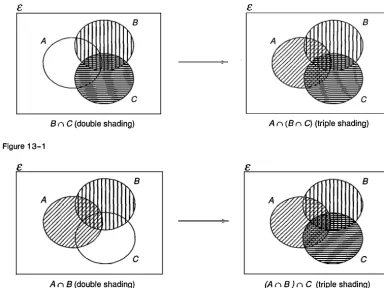
We shall illustrate properties by drawing Venn diagrams. For example, to demonstrate that A n (B n C) = (A n B) n C we proceed as follows:
e
B
B ri C (double shading) Figure 13-1
e
B
An B (double shading)
Figure 13-2
The areas with triple shading are the same in both cases. So: A n (B n C) = (A n B) n C.
Note:
e
B
An (8 n C) (triple shading)
B
(A ri B) ri C (triple shading)
This property has been illustrated rather than proved, because we have used a particular diagram. Show that the result also applies if two of the sets (say A and B) intersect but C is disjoint from them.
In the material which follows, we shall usually just present the final diagram - the readers should build it for themselves in the manner shown above.
It is understood that the properties we shall illustrate require a more formal treatment if a complete proof is sought.
13.1 Laws of set algebra
1 Closure
If A and B are sets belonging to the universal set, t, then A U B, A
n
B, and A = t '- A belong to t.2 Associativity
Figure 13-3
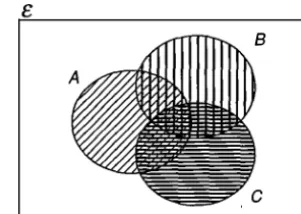
By considering the shaded areas in two ways, show that: a A U (B U C) = (A U B) U C
b An (B
n
C) =(An B)n
C(see above).3 Commutativity
Figure 13-4
From the diagram, it is obvious that: a AUB=BUA
bAnB=BnA
4 Identity elements
Figure 13-5
From the diagram, we see that:
a A U cf, = A = cf, U A (cf, is the null set) btnA=A=Ant.
404 BOOLEAN ALGEBRA
5 Complements
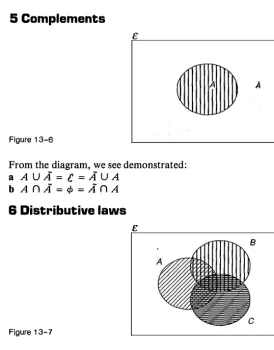
Figure 13-6
From the diagram, we see demonstrated:
a AUA=l'=AUA
bAnA=¢=AnA
6 Distributive laws
e
Figure 13-7
By considering the shaded areas in two ways show that: a A
n
(Bu
C) = (An
B)u
(An
C)b A u (B n C) = (A u B) n (A u C)
13.2 Boolean algebra
A
B
The laws we have illustrated for sets form the basis of Boolean algebra - an algebra named after the English mathematician George Boole (1815-1864).
In this algebra, A, B, C ... are the objects with which we work (not necessarily sets, although the laws are true for sets, as seen above).
To simplify the notation, we shall rtplace union ( U) by an addition symbol ( +) and intersection (n) by a full stop(.). Y
The universal set, l', is replaced by I and the null set, ¢, is replaced by 0, which look more like the identity elements of familiar algebra. The complement of A (A) is replaced by A'. Remember that our symbols now just stand for operations and elements of an algebra and have no necessary connection with the algebra of sets.
We rewrite the above laws for a set, S, containing elements A, B, C ... and the operations + and . (A . B will often be written as AB).
CL Closure laws
IfA andBeSthen 1 A+ BeS 2 ABeS •
A Associative laws
1 A+
(B+
C)=
(A+
B)+
C 2 A (BC) = (AB)CC Commutative laws
1A+B=B+A2 AB= BA
I Identity laws
1A+O=A=O+A 2 Al= A= IACP Complement laws
1 A
+
A'= I =A' + A } where, for each A,the 2 AA'= 0 = A' A complement A' is unique.D Distributive laws
1 A(B
+
C) = AB+
AC • 2 A+
BC=
(A+
B)(A+
C) • Notes:(i) The closure, associative, commutative and identity laws behave the same as for real numbers.
(ii) There are two distributive laws.
{iii) The complement laws are quite different from the inverse laws for real numbers - in fact they are the other way around!
These 13 laws can be used to define a Boolean algebra. (In fact we have included more laws than is strictly necessary to provide a minimum set of axioms. However, it is convenient to work with this set because of the analogy they present with the field laws for real numbers).
Assuming these laws to be true, we now proceed to deduce further properties of a Boolean algebra in just the same way that properties of real numbers can be deduced from the field laws. However, we must resist the temptation to write results familiar from past work that are not, yet, justified within our present system.
13.3 Principle of Duality
If we exchange + and . and also exchange O and I throughout our definitions, we end up with exactly the same set of 13 laws that we began with. For example, Associative Law 1 becomes Associative Law 2, and vice versa. Complement Law 1 becomes Complement Law 2, and vice versa, etc.
-Such expressions are said to be duals of each other.
Whenever we prove a theorem in Boolean algebra we immediately achieve a proof of the dual theorem, i.e. we get two results for one piece of thinking. All that is required for the dual theorem is t� make the necessary exchanges in the original.
13.4 Theorems in Boolean algebra
406 BOOLEAN ALGEBRA
Example 1
Prove that:
a A+l=l
b A.0=0
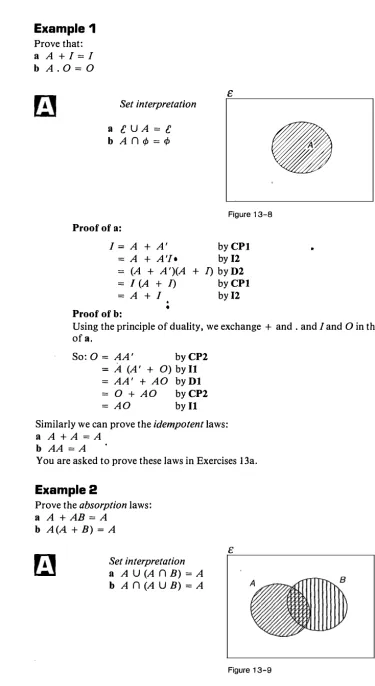
Set interpretation
a l'UA=l' bAn<t>=<I>
Proof of a:
I= A + A'
=
A + A'l••
Figure 13-8byCPl
by 12
=
(A + A')(A=
I (A + I) = A + I+ /) by D2 byCPt byl2
.
•
Proof of b:Using the principle of duality, we exchange + and . and/ and O in the proof ofa.
So: 0
=
AA' byCP2=
A (A' + 0) by 11=
AA' + AO byDl=
0 + AO byCP2=
AO bylt Similarly we can prove the idempotent laws:a A+A=A
b AA =A
You are asked to prove these laws in Exercises 13a.
Example 2
Prove the absorption laws: a A+ AB= A
b A(A + B) = A
Set interpretation a Au (An B)
=
A b An (AU B)=
A£
Proof of a:
A
+
AB=
AI+
AB by 12=
A (I+
B) by D1=
AI by Example la=
A byl2Similarly-prove b, or use duality as follows:
A (A
+ B)
=
(A+
O)(A+ B) by 11
=
A+
OB byD2=
A+
0 by Example lb=
A byll13.5 De Morgan's laws
These very important laws have to do with complements.
Example 3
Prove the de Morgan laws (note duality):
a (A
+
B)'=
A' B'..
b (AB)'=
A'+
B'Set interpretation
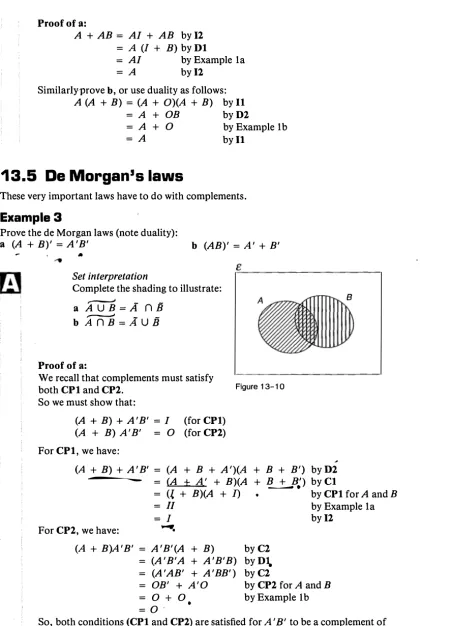
Complete the shading to illustrate:
�
-a AUB=A nB b AnB=AUB
Proof of a:
We recall that complements must satisfy both CPl and CP2.
So we must show that:
(A
+
B)+
A'B'=
I (for CPl) (A+
B) A'B'=
0 (for CP2)For CPl, we have:
Figure 1 3-1 0
J (A
+
B)+
A' B'=
(A+
B+
A ')(A+
B+
B') by D2B
---. =
(A+
,1.' +
B)(A+
JL±Y:) by Cl= ({
+
B)(A+ /) •
by CPl for A and B=
II by Example la=
I byl2For CP2, we have: -.
(A
+
B)A'B'=
A'B'(A+
B)=
(A'B'A+
A'B'B)=
(A'AB'+
A'BB')=
OB'+
A'O=
0 + 0 •=
0 .byC2 byD\ byC2
by CP2 for A and B
by Example 1 b
So, both conditions (CPl and CP2) are satisfied for A' B' to be a complement of
A
+
B. Since complements are unique, (A+
B)'=
A' B'408 BOOLEAN ALGEBRA
Example 4
Prove the following identities:
a A+A'B=A+B b (A +AB+ A'B)'
=
A'B'c ABC + BDAB' + ABECD = ABC d AB + A IC = (A + C)(A I + B)
a
b
C
A+ A'B =(A+ A')(A + B) byD2
=
I (A + B) by CPI= A + B byl2
(A + AB + A' B)'
=
(A + A' B)' by Example 2a (absorption)= (A + B)' by a above = A' B' by de Morgan a
ABC + BDAB' + ABECD
=
ABC + (BB')(DA) + (ABC)(ED)=
ABC + 0 (DA) + (ABC)(ED)= ABC + 0 + (ABC)(ED)
= (ABC) + (ABC)(ED)
= ABC by Example 2a (absorption)
d Noting that we can write AB= A(A' + B) andA'C
=
A'(A + C)by CP2 and Dl, we obtain:
AB+ A'C = A(A' + B) + A'(A + C)
"
byC2
byCP2
by Example I by 11
=
[A(A' + B) + A'] [A(A' + B) + (A=
(AB + A ')(AB + A + C) + C)]byD2 byDl
and CP2
Now: AB + A'
=
A' + AB= (A' + A)(A' + B)
= I (A' + B) = A' + B AB + A + C = A + C
So: AB + A'C =(A'+ B)(A + C)
=
(A + C)(A I + B)Can you find a simpler proof?
Exercises 13a
1 Using only the 13 axioms, prove the following:
a A(IB)
=
ABb (A+ 0) + 0
=
Ac A + (OJ)
=
(A + O)(A -I'- I) d (A+ A)A=
Aby Cl byD2 byCPl
by 12
by absorption law (Example 2)
byC2
In the questions that follow you may assume the 13 axioms and the results proved in Examples I, 2 and 3.
2 a Prove (A + B)(A + B')
=
Ab Write the dual statement and prove it. 3 a Prove the idempotent laws:
(i) A+ A
=
A (ii) AA ""Ab If you are familiar with proof by induction generalise these results by proving: (i) A + A + ... n times
=
A4 a Prove that A + A' B = A + B and prove that 0' = I.
b Write, and prove, the dual of the identity in Question 4a. Prove that/'
=
0. 5 Simplify:a XY(X
+
Z)C [ (A + B)' + A] I + B e PQS + QTPQ' + PQRST 6 Prove the following:
a (A
+
B)A 'B'=
0b ABC + (A I + B' + C')
= /
C AB + C(A I + B')=
AB + C d (A+
A I B)(B+
BC) = B e [(A'B')' + C] (A+ B')'=
A'B f (A + B')(A' + B)(A' + B')=
A'B'b P
+
PQ+
P'Qd PQRS' + P'R + Q'R + RS f [A+ (A' + B)'][A + ( B'C')']
g (A + B)(C + B') + B(A' + C')
=
A + B h (A + C)(A I + B)(B + C)=
AB + A ICi AC+A'B+BC=AC+A'B
7 Write dual statements for the identities in Question 6 and give their proofs.
D
13.6 Boolean algebra investigation
1 The Boolean algebra (<j,, 1)
(This part should be completed by all students.)
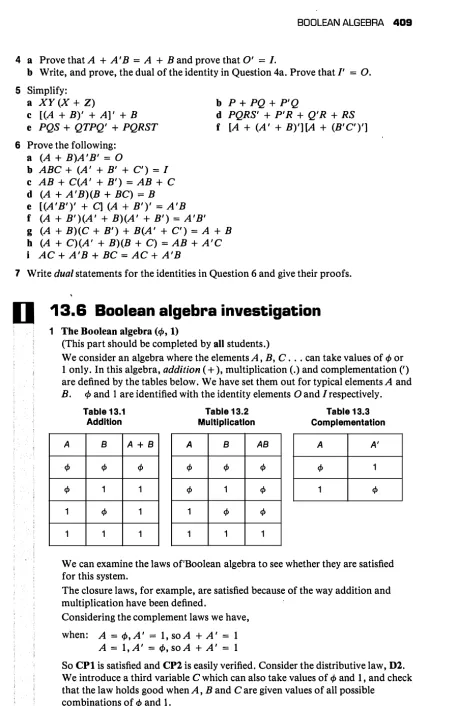
We consider an algebra where the elements A, B, C ... can take values of <j, or 1 only. In this algebra, addition (+),multiplication(.) and complementation(') are defined by the tables below. We have set them out for typical elements A and B. <j, and 1 are identified with the identity elements 0 and /respectively.
A <f, <f, 1 1 Table 13.1 Addition B <f, 1 <f, 1
A+B A
<f, <f,
1 <f,
1 1
1 1
Table 13.2 Multiplicatlon B <f, 1 <f, 1 AB <f, <f, <f, 1 Table 13.3 Complementation
A A'
<f, 1
1 <f,
We can examine the laws of'Boolean algebra to see whether they are satisfied for this system.
The closure laws, for example, are satisfied because of the way addition and multiplication have been defined.
Considering the complement laws we have, when: A
=
<j,, A'=
1, so A + A'=
1A
=
1, A'=
<f,, so A + A'=
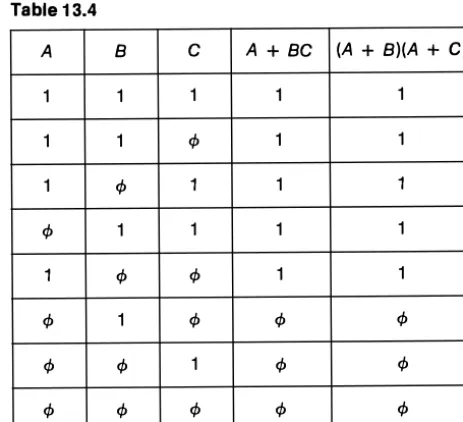
1So CPl is satisfied and CP2 is easily verified. Consider the distributive law, D2. We introduce a third variable C which can also take values of <j, and 1, and check that the law holds good when A, B and Care given values of all possible
410 BOOLEAN ALGEBRA
Table 13.4
A B C A+ BC (A+ B)(A + C)
1 1 1 1 1
1 1 </> 1 1
1 </> 1 1 1
</> 1 1 1 1
1 </> </> 1 1
</> 1 </> </> </> </> </> 1 </> </> </> </> </> </> </>
The first three columns contain all possible combinations of</> and 1 for A, B
andC.
For each row, Columns 4 and 5 are obtained by combining A, B and C as indicated.
Since Columns 4 and 5 are identical and, therefore, interchangeable, we obtain
A +BC= (A + B)(A + C ).
By checking all the laws in a similar manner, verify that this system is a Boolean algebra.
2 Consider the setS
=
{1, 2, 3, 5, 6, 10, 15, 30}Let the operations of ( + ) and (.) be defined for elements A, B and C . .. in this set as follows.
A + B
=
least common multiple of A and B.AB
=
greatest common divisor of A and B. So: 3 + 6=
6 and 3 . 6=
36 + 5
=
30 and 6 . 5=
1, etc.a Draw up the addition and multiplication tables for (S, +, .). b Identify elements that act as the identities corresponding to O and/. c Find the complement of each element in the set.
d Verify that S and its defined operations is a Boolean algebra.
(For some of the laws the amount of checking required is excessive and, for these, a limited amount of checking supported by a brief verbal argument will be sufficient.)
13. 7 Examples of Boolean algebras
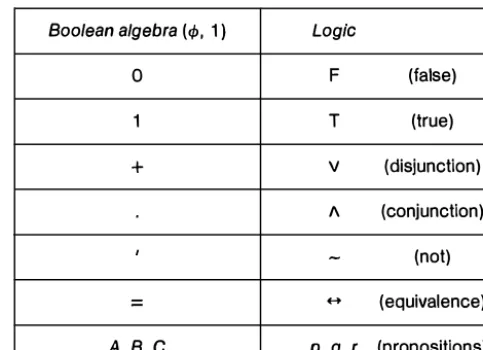
This section is appropriate if Chapter 11 has been previously studied.Recalling the symbolism of propositions and truth tables we make the following correspondences:
Boolean algebra (ct,, 1) Logic
0 F (false)
1 T (true)
+ V (disjunction)
I\ (conjunction)
(not)
=
....
(equivalence)A,B,C P, q, r (propositions)
The tables in Question 1 of the investigation then become:
Table 13.5 Table 13.6 Table 13.7
p q pVq p q p /\q p
F F F F F F F
F T T F T F T
T F T T F F
T T T T T T
-p
T
F
These are precisely the truth tables for disjunction, conjunction and negation presented as Tables 13.1, 13.2 and 13.3.
The table: corresponds to:
B A' + B p q -pvq
0 0 1 F F T
0 1 1 F T T
1 0 0 T F F
1 1 1 T T T
This is the truth table for p--+ q, and we recall thatp--+ q is equivalent to -p V q. There is a one-one correspondence between the system of logic and the Boolean algebra
(<J,, 1), i.e. every result in the Boolean algebra can be turned into an equivalent result in
logic.
For example, the distributive law, D2, A
+
BC = (A+
B)(A+
C) corresponds to the logical equivalence p V (q /\ r) B (p V q) /\ (p V r).412 BOOLEAN ALGEBRA
Example 5
Write logical statements equivalent to the following Boolean Identities:
a A +AB=A b (A +B)' =A'B'
c A +AB+A'B=A +B d AC+A'B+BC=AC+A'B
We replace A, B, C ... by p, q, r . .. , replace' by - , replace + by v, replace . by /\, and replace = by +-+.
For: a we getp v pq +-+ p
b we get -(p V q) +-+ -p I\ -q (de Morgan)
C we get p V (p I\ q) V ( -p I\ q) +-+ p V q
d (p I\ r) V ( -p I\ q) V (q I\ r) +-+ (p I\ r) V ( -p I\ q)
13.8 Electrical circuits
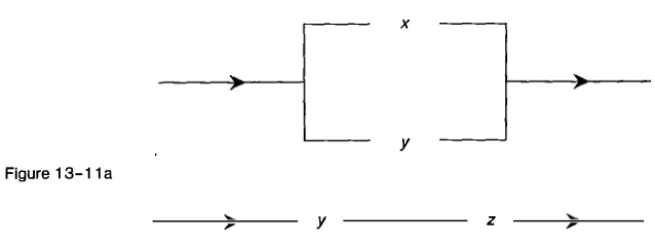
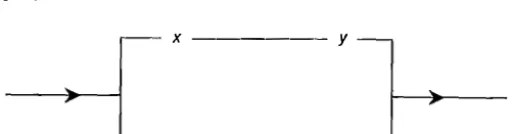
Consider the parallel and series connection of switches x and y shown in Figures 13-1 la and 13-llb.
X
y
Figure 13-11 a
y
Figure 13-11 b
If a switch is on (closed), we assign it the value 1. If a switch is off (open), we assign it the value 0.
z
The combined effect of the switches is given by the circuit value Y. Y = 1, if current flows
Y = 0, if current does not flow.
y
y
For the circuit shown in Figure 13-11 a, current flows provided either x or y is on. This is depicted in Table 13.8 below.
For the circuit shown in Figure 13-11 b, current flows provided both x and y are on. This is depicted in Table 13. 9 below.
Table 13.8 Table 13.9
X y y X y y
0 0 0 0 0 0
1 0 1 1 0 0
0 1 1 0 1 0
Using the Boolean definition of addition, the relationship in Table 13.8 is given by
y
=
X +y,Similarly, the relationship in Table 13.9 is given by Y = xy.
The combined effect, Y, is sometimes written in function notation, e.g. Y
=
f(x, y) orF (x, y) to indicate that it is a function of two variables (switches in the above cases). The laws of Boolean algebra can· now be given concrete meanings in terms of networks involving parallel (+) and series(.) connections of switches.
For example the distributive law D2, i.e. x + yz
=
(x + y)(x + z), may be represented as follows:X
y
y -- z
Figure 13-12: x + yz
X X
y z
Figure 13-13: (x + y)(x + z)
The two circuits are equivalent.
Similarly, circuits can be derived for all the laws of Boolean algebra (see Exercises 13b).
13.9 Simplification of circuits
When switches are connected so that they open and close together, we define them by the same letter, e;g, x in the circuit in Figure 13-13 above.
It is assumed such switches open and close simultaneously, even though they may be physically separated. It may also happen that the closing (opening) of one switch will open (close) others. In this case, we would denote some one switch by y (say) and the others by
y', where y'
=
0 when y=
1, and vice versa.Example 6
Describe and simplify the circuit below:
x---y
x' --- y
414 BOOLEAN ALGEBRA
Here the switches (y) are on or off together, while x' is off whenever xis on, and vice versa. If x and y are on, current flows in the top branch. If x' and y are on (xis off), current flows in the lower branch.
The circuit is defined by: Y
=
xy + x'y=
(x + x')y= Iy =y
An equivalent circuit has a single switch (y), i.e. x and x' serve no useful purpose.
Example 7
Simplify the circuit shown below:
Figure 13-15
The circuit is defined by Y
=
xy + (x + z') z (zx' + y') i.e. Y=
xy + (xz + z'z)(zx' + y')= xy + (xz + O)(zx' + y'), since zz' = 0
=
xy + xzzx' + xzy'= xy + xzy', since xx' = 0 = x(y + zy')
=
x(y + z)(y + y')=
x(y + z)l= x(y + z) So an equivalent circuit is:
Figure 13-1 6
y
z
J-y
X y
Similarly the equivalent expressions in Example 4 and in Exercises 13a, Questions 5 and 6, can be associated with equivalent circuits.
Designing circuits
13.10 Boolean functions
We have seen that Y = x
+
y and Y = xy are functions describing the circuits in Figures 13-1 la and 13-1 lb. We seek a method for finding a function describing any circuit with given properties.If A, B, C ... are elements of a Boolean algebra, an expression consisting of combinations of the elements and/ or their complements is a Boolean Function, e.g. F(A, B)
=
AB+
B', F(A,B, C) =ABC+ A'B'.We consider the Boolean algebra (0, 1), i.e. where every element takes on values of 0 and 1.
13.11 Disjunctive form
Since our work with circuits uses lower case symbols we shall work in terms of x andy rather than A and B, etc.
If Y
=
f(x, y) represents a function in which x, y and Ybelong to the Boolean algebra (0, 1), then the function is completely defined by the table below (Table 13.10).Table 13.10
X y f(x, y)
1 1 ((1, 1)
1 0 ((1, 0)
0 1 ((0, 1)
0 0 ((0, 0)
The numbers in the third column depend upon our purpose - for example, to design a parallel circuit with switches x and y, the respective entries aref(l, 1)
=
f(l, 0)=
f(0, 1)=
1, andf(0, 0)=
0 which lead to the familiar result Y=
f(x, y)=
x+
y.In the general case it is true that:
f(x,y)
=
f(l, l)xy+
f(l, 0)xy'+
f(0, l)x'y+
f(0, 0)x'y'Notice the pattern on the RHS, in which 1 goes with the variable x, and 0 goes with the complement x'. This makes the formula easier to remember.
(1)
The right-hand side of (1) consists of a 'sum' of 'product' terms. Recalling that +
416 BOOLEAN ALGEBRA
Verification of (1)
x and y take the values 0 and 1 respectively.
Ifx = y = 0, we havex' = y' = 1
andRHSof(l) =/(1, 1) x 0 +/(1,0) x 0 +f(0, 1) x 0 +/(0,0) x 1
i.e. LHS
=
RHSIf x = 1 and y = 0, we have x' = 0, y' = 1
andRHSof(l) = /(1, 1) x 0 +/(1,0) x 1 +/(0, 1) x 0 +/(0,0) x 0
i.e. LHS
=
RHSSimilarly, whenx = 0 andy = 1, we get LHS = RHS and, whenx = 1 andy = 1, we
get LHS
=
RHS.So LHS
=
RHS for all possible values of x and y and the formula is verified.Example&
The home of one of the authors of this book has a passage with a light that is controlled by two switches - one at each end of the passage. When both switches are down (on) or up (off) the light is on. If one switch is down and the other up the light is off. Find a circuit design for this system.
Denoting the switches at the top and bottom of the passage by
t
and b, the system is described in the following table.Table 13.11
t b
1 1 1 0
0 1
0 0
f(t, b)
1
0
0
1
/(1, 1) = 1 (both down) /(1, 0)
=
0 (one up, one down) /(0, 1)=
0 (one up, one down)f(0, 0)
=
1 (both up)Notice that the first two columns contain the 'domain' of the function, i.e. all possible combinations of 0 and 1. The third column contains the circuit requirements.
Using formula (1) we have:
f(t, b)
=
f(l, l )tb + /(1, 0)tb' + f(0, l )t'b + f(0, 0)t'b'=
l(tb) + 0(tb') + 0(t' b) + l(t' b')=
tb+
t'b'i.e. Y = f(t, b) = tb + t'b'
---b
t'---b'
Physically, this can be achieved by wiring similar to that shown below: b
>, a. a. :::, VI ai �
Figure 1 3-1 8
t'
13.12 Conjunctive form
b'
/
,.
Alternatively,f(x, y) can be expressed as a product (conjunction) of factors. Verify that:
f(x, y)
=
(/(1, 1)+
x'+
y')(/(1, 0)+
x'+
y)(f(0, 1)+
x+
y') (f(0, 0)+
x+
y)and show that it leads to an alternative wiring for the passage light in Example 8. i.e. Y
=
f(t, b)=
(t+
b')(t'+
b). Draw this circuit.Since: (t + b')(t' + b)
=
tt'+
tb+
b't'+
b'b=
0+
tb+
t' b'+
0=
tb+
t'b'Either function can be used to derive the other.
13.13 Functions of three variables
For y
=
f(x, y, z) there are 23=
8 combinations for the domain off, i.e. (0, 0, 0), etc.In this case the disjunctive form is:
f(x,y,z) =f(l, 1, l)xyz +J(l, 1,0)xyz' +f(l,0, l)xy'z +f(l,0,0)xy'z' + f(0, 1, l)x'yz
+
f(0, 1, 0)x'yz'+
f(0, 0, l)x'y'z+
f(0, 0, 0)x'y'z'.Example 9
Three judges at a weightlifting contest vote electronically, using the following method. If
418 BOOLEAN ALGEBRA
Current will flow in the circuit provided at least two of the three switches (x, y, z)
are on.
So the function table for the circuit is as follows (Table 13.12).
Table 13.12
X y z f(x, y, z)
1 1 1 1
1 1 0 1
1 0 1 1
0 1 1 1
1 0 0 0
0 1 0 0 0 0 1 0 0 0 0 0
Then, using the formula for f(x, y, z) given above, we obtain:
f(x,y, z)
=
l(xyz) + l(xyz') + l(xy'z) + l(x'yz) + O(xy'z') + O(x'yz')+
O(x'y'z)+
O(x'y'z')=
xyz + xyz' + xy'z + x'yzNote that this can be further simplified:
e.g.f(x,y, z)
=
(xyz + x'yz) + (xyz' + xy'z)=
(x + x')yz + x(yz' + y'z)= yz + x(yz' + y'z)
--- z ----�
Y -- z'
y' -- z
Figure 1 3-1 9
Exercises 13b
1 Draw circuits to illustrate the following laws used to define Boolean algebra:
a x
+
(y+
z)=
(x+
y)+
z b x(yz)=
(xy)z c x + 0=
x (0 is a switch that is always open)d x.1 = x (1 is a switch that is always closed)
e x
+
x' = 1 f x.x'=
0g x(y
+
z)=
xy+
xz h x+
yz=
(x+
y)(x+
z)2 Draw circuits to illustrate the given identities:
a x + 1 = 1 b x.O = 0
C X
+
X=
X d X.X=
Xe x + xy = x f x(x + y) = x
g X
+
x' y=
X+
y h X+
xy+
x' y=
X+
y(x
+
y)(x+
y')=
x j (x+
y)(x'+
y)(y+
z)=
(x+
z)(x'+
y) 3 Draw circuits that represent the expressions given in Exercises 13a Question 5, and theirsimplifications.
4 (For those who have studied Chapter 11, 'Logic and reasoning'.)
Write logical expressions in terms of propositions, disjunction, conjunction, etc. that are equivalent to the Boolean statements given in:
a Question 1 above b Question 2 above.
5 Write the Boolean equation for each of the following circuits and prove them to be equivalent.
a
and � y �
d Y----z
�--x--�
�--X----,
420 BOOLEAN ALGEBRA
6 Draw the simplest network that is equivalent to each of the following circuits:
�:
c:·
b X y
C
t
x
x
- y'---,
---- z
----t----l>--y ________ _,
a' ---- b' - � - c' --- a --- b
-� I
C - b' �7_
a- --- b�1- --
+
-- c --- a'---'
e
a----<[:
C
---1[ :
:J-C:
f u V
w - v'
7 Given the following table that defines a Boolean function,f(x, y, z), of three variables on (0, 1), answer the questions below:
X y z /1 /2 /3
1 1 1 1 0 1
1 1 0 0 1 0
1 0 1 1 0 1
0 1 1 1 0 1
1 0 0 0 1 0
0 1 0 1 0 1
0 0 1 1 0 1
0 0 0 1 1 0
a Verify that:
f(x,y,z) =f(l, 1, l)xyz +f(l, l,0)xyz' +f(l,0, l)xy'z +f(l,0,0)xy'z'
+
f(0, 1, 1) x'yz+
f(0, 1, 0) x'yz'+
f(0, 0, 1) x'y'z+
f(0, 0, 0) x'y'z'. b Find the particular function! 1 (x, y, z) from the defined values in thef1 column.If it is possible, simplify this expression and draw the simplest equivalent circuit. c Repeat for fz
d Repeat for f 3 (Refer to Example 9).
8 Two adjudicators (each having a switch) award points in a music festival. When an item is finished each turns on his/her switch and a red light shows. When each has finished making notes he/she turns off the switch and, when both are off, the light goes out signalling that the next item can proceed. Design a circuit for this arrangement. 9 Players are being selected for the training squad of a team. A player is selected if the
chair of selectors and any one of his/ her two co-selectors vote in favour. Voting is conducted privately by pressing switches to avoid possible bias and influence. A light
shows if a player is selected.
a Design a suitable circuit to support this voting process.
b Repeat for a situation involving three co-selectors, where a majority is required from the four selectors.
10 The function room of a house adjoins two other rooms. Design a circuit to enable the function room light to be turned on or off from either the function room itself or either of the two adjoining rooms.
11 A political party meeting is attended by four persons representing various factional party interests. These persons carry with them the votes of members of their faction. A has 20 votes, B has 35 votes, Chas 10 votes and D has 15 votes. Each representative
submits his/ her votes in a block by pressing a switch. Construct a circuit that will sound a bell if there is a majority vote in favour of an issue.