Volume 2008, Article ID 283483,8pages doi:10.1155/2008/283483
Research Article
Multitarget Identification and Localization Using
Bistatic MIMO Radar Systems
Haidong Yan, Jun Li, and Guisheng Liao
National Lab of Radar Signal Processing, Xidian University, Xi’an 710071, China
Correspondence should be addressed to Jun Li,[email protected]
Received 19 April 2007; Revised 19 September 2007; Accepted 12 November 2007
Recommended by Arden Huang
A scheme for multitarget identification and localization using bistatic MIMO radar systems is proposed. Multitarget can be dis-tinguished by Capon method, as well as the targets angles with respect to transmitter and receiver can be synthesized using the received signals. Thus, the locations of the multiple targets are obtained and spatial synchronization problem in traditional bistatic radars is avoided. The maximum number of targets that can be uniquely identified by proposed method is also analyzed. It is indicated that the product of the numbers of receive and transmit elements minus-one targets can be identified by exploiting the fluctuating of the radar cross section (RCS) of the targets. Cramer-Rao bounds (CRB) are derived to obtain more insights of this scheme. Simulation results demonstrate the performances of the proposed method using Swerling II target model in various sce-narios.
Copyright © 2008 Haidong Yan et al. This is an open access article distributed under the Creative Commons Attribution License, which permits unrestricted use, distribution, and reproduction in any medium, provided the original work is properly cited.
1. INTRODUCTION
Multiple-input multiple-output (MIMO) radar has been re-cently become a hot research area for its potential advan-tages. MIMO radar uses multiple antennas to simultaneously transmit several independent waveforms and exploit multi-ple antennas to receive the reflected signals. The echo signals are independent of each other [1–7]. Unlike conventional phased-array radar, MIMO radar systems transmit different signals from different transmit elements. Thus, the whole space can be covered by the electromagnetic waves which are transmitted by the transmit array. Recently, many MIMO radar schemes have been proposed to resist the fluctuations of the target radar cross section (RCS) with the spatial sity of target scatters to get superiority with waveform diver-sity in MIMO radar [1], to improve detection performance [2], to create spatial beampatterns ranging from the high di-rectionality of phased-array system to the omnidirectional-lity of MIMO system with orthogonal signals through the choice of a signal cross-correlation matrix [3], or to achieve high resolution and excellent interference rejection capability with the direct application of many adaptive techniques [4]. In [5,6], additional array freedom and super-resolution pro-cessing have been achieved by exploiting virtual array sensors in monostatic MIMO radar system. The synthetic impulse
and aperture radar (SIAR) is also a monostatic MIMO radar scheme [8]. In conventional bistatic radar, it is required that the transmitting beam and the receiving beam illuminate to the same target simultaneously to solve space synchroniza-tion problem [9]. A bistatic MIMO radar scheme of transmit spatial diversity had been proposed in [7], and the estima-tion performance is analyzed. However, only the angles with respect to the receiver can be determined in this scheme.
A bistatic MIMO radar scheme is proposed to identify and locate multiple targets in this paper. Two-dimensional spatial spectrum estimation is carried out at the receiver. Spe-cially, the method proposed in this paper can parry auto-matically the spatial 2D angles of targets, which solves the space synchronization problem in conventional bistatic radar system. Maximum number of targets that can be uniquely identified by proposed method is also analyzed in this pa-per. It is indicated that the product of the number of receive and transmit elements minus-one targets can be identified in the case of independently distributed targets by exploiting the uncorrelation of the reflection coefficients of the targets. Our scheme can be viewed as an extension of the scheme in [5,10].
1
2
3
M
T
ransmit
ar
ra
ys
Target
θt
θr
1 2 3 N
· · ·
. . .
Receive arrays
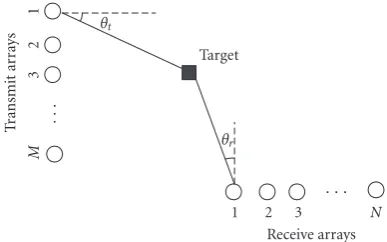
Figure1: Bistatic MIMO radar scenario.
and location are proposed. The maximum number of iden-tified targets and Cramer-Rao bounds (CRB) for target lo-cation are analyzed inSection 4to obtain more insights of the proposed scheme. The proposed scheme is tested via a few cases and simulations, which appear inSection 5. Finally,
Section 6concludes the paper.
2. BISTATIC MIMO RADAR SIGNAL MODEL
The array structure used in this paper is illustrated in
Figure 1. For clarity and mathematical tractability, we use a
simple model that ignores Doppler effects and clutters, and the range of the target is assumed much larger than the aper-ture of transmit array and receive array. Considering the RCS which is constant during a pulse period and varying inde-pendently pulse to pulse, our target model is a classical Swer-ling Case II [11]. The transmit and receive arrays are uni-form linear arrays (ULA) withMelements at the transmitter andNelements at the receiver. The elements at the transmit-ter are omnidirectional. dt is the interelement space at the
transmitter anddr is the interelement space at the receiver.
Assume that the target is at angles (θt,θr), whereθtis the
an-gle of the target with respect to the transmit array andθr is
the angle with respect to the receive array.λdenotes the car-rier wavelength.si=[si(1),. . .,si(L)]T,i=1· · ·M, denotes
the coded pulse of theith transmitter, whereLrepresents the number of codes in one pulse period. In the case of a sin-gle target at location (θt,θr), the received signal vector of one
pulse period is given by
r(n)=αaθr
bTθt
S(n) +w(n), (1)
where (·)T denotes the vector/matrix transpose. r(n) =
[r1(n) r2(n)· · · r2(n)]T,S(n)=[s1(n)s2(n)· · · sM(n)]T
with n = 1· · ·L. α denotes the coefficient involving the reflection coefficients and path loses of the target and we call it reflection coefficient for short in this paper.a(θr) =
[1 ej(2π/λ)drsinθr ej(2π/λ)2drsinθr · · · ej(2π/λ)(N−1)drsinθr]T is an
N×1 vector, usually referred to as the receiver steering vector.
b(θr)=[1 ej(2π/λ)dtsinθt ej(2π/λ)2dtsinθt· · ·ej(2π/λ)(M−1)dtsinθt]T
is anM×1 vector, which is usually described as the trans-mitter steering vector. The noise vectors{w(n)}N
n=1 are
as-sumed to be independent, zero-mean complex Gaussian dis-tribution withw∼Nc(0,σ2
wIN).
In the case ofPtargets, (1) is modified to
r(n)=Aθr
diag(α)BTθt
S(n) +w(n), (2)
where A(θr) = [a(θr1) a(θr2) · · · a(θrp)] is the
re-ceive steering matrix, and θr1· · ·θrp denote the
an-gles of the targets with respect to the receive array.
B(θt)=[b(θt1)b(θt2) · · · b(θtp)] is the transmit steering
matrix, andθt1· · ·θtpdenote the angles of the targets with
respect to the transmit array. diag(v) denotes a diagonal ma-trix constructed by the vector v. α = [α1· · ·αp]T, where
α1· · ·αpare the reflection coefficients of each target.
3. CAPON-BASED TARGETS IDENTIFICATION
AND LOCATION
For simplicity, we assume first that there is only one target in the space and the signal of one pulse period is transmit-ted from each transmit element. For orthogonal-transmittransmit-ted waveforms such thatsis∗j =0,sisi = |si|2i /=j =1· · ·M,
where si,sj stand for the signals transmitted from the ith
and jth transmit elements. The received signal r(n) can be matched by the transmitted waveform to yield a sufficient static matrix as follows:
Y=1
L
L
n=1
r(n)S(n)H, (3)
where (·)Hdenotes the Hermitian operation.
Substitution of (1) into (3), the independent sufficient
statistic vector can be expressed as
η=row(Y)=row
1 L
L
n=1
r(n)S(n)H
=row
1 L
L
n=1
αaθr
bTθt
S(n)SH(n) +w(n)SH(n)
=row
α
L
n=1
aθr
bTθt 1
LS(n)S
H(n) +1
L
L
n=1
w(n)SH(n)
=rowαaθr
bTθt
Rs
+ row
1 L
L
n=1w(n)S
H(n)
=ακθr,θt
+v,
(4)
whereRs=(1/L) L
n=1S(n)SH(n), andRsis the identify
ma-trix when transmitted signals are orthogonal. κ(θr,θt) =
row(a(θr)bT(θt)Rs)=row(a(θr)bT(θt)) is a vector with the
size ofMN×1 andv=row((1/L)Ln=1w(n)SH(n)) is
zero-mean complex Gaussian withv∼Nc(0,σ2
wINM). row(·)
de-notes the operator that stacks the rows of a matrix in a col-umn vector.
When the number of the targets isPand the signals ofQ pulses period are transmitted, (4) can be expressed as follows:
Yη=K
θr,θt
r1 r2 · · · rN
s∗1 s∗2 s∗M s∗1 s∗2 s∗M s∗1 s∗2 s∗M
· · · · · · · · · · · ·
Yη=[η1· · ·ηQ]
Identification & location algorithms
Figure2: Sufficient statistic extraction and identification and local-ization algorithms.
where Yη = [η1· · ·ηQ], and η1· · ·ηQ are the
suffi-cient statistic vectors obtained fromQtransmitting pulses.
K(θr,θt) = [κ(θr1,θt1)· · ·κ(θrp,θtp)] is a matrix of size
MN×P,
H=
⎡ ⎢ ⎢ ⎢ ⎢ ⎣
α11 α12 · · · α1Q
α21 α22 · · · α2Q
..
. ... . .. ... αP1 αP2 · · · αPQ
⎤ ⎥ ⎥ ⎥ ⎥
⎦P×Q (6)
whereαi j,i = 1· · ·P, j =1· · ·Qis the reflection
coeffi-cient of theith target in the jth transmit pulse period. The configuration for obtaining the sufficient static from the data is described inFigure 2.
In practice, different targets have different reflections and path losses. Considering Swerling Case II target model [11], we assume thatαiobeys the complex Gaussian distribution
with zero mean and varianceσ2
αi, namelyαi∼
c(0,σ2
αi),i =
1· · ·P. The Capon estimator [12] ofθt,θrcan be written in
the form
PCaponθt,θr
= 1
κHθr,θtR−1
η κ
θr,θt
, (7)
whereRη=(1/Q)YηYHη.
The true targets locations will result in the peaks at the Capon estimator outputs.
4. PROPERTY ANALYSIS
4.1. Maximum number of target analysis
From (5), the coherence matrixRηcan be expressed as
Rη= 1
QYηY
H
η =K
θr,θt
RHKH
θr,θt
+σ2
wINM, (8)
whereRH = (1/Q)HHH. We can configure the array
struc-ture to ensure the column full rank ofK(θr,θt). IfK(θr,θt) is
column full rank, the maximum number of targets that can be identified depends on the rank ofRη. It is clear that the
maximum rank ofRη isNM. So the maximum number of
the targets that can be identified by this scheme is (NM−1).
To ensure the maximum number of targets identification, the matrixRHshould be full rank. The uncorrelation of the
tar-gets reflection coefficients may guarantee the full rank ofRH.
Accordingly, the maximum number of identification should be achieved by making use of the uncorrelation of the re-flection coefficients of the targets. Our target model in the simulations of the next section is a classical Swerling case II with RCS fluctuations fixing during a transmitting pulse and varying independently pulse to pulse. The targets which are assumed independent of each other in the space and the reflection coefficients of different targets are independent in one pulse period.
4.2. Cramer-Rao bound
Following the approach in [13, Chapter 3] and [14], the stochastic CRB for location parameters of multiple targets is calculated here to obtain more insights of the proposed scheme. The Fisher information matrix (FIM) can be calcu-lated as follows:
J(ξ)=1
2tr
R−η1(ξ)
∂Rη(ξ)
∂ξ R −1
η (ξ)
∂Rη(ξ)
∂ξ
=
⎡ ⎢ ⎢ ⎢ ⎢ ⎢ ⎢ ⎣
Jθrθr Jθrθt Jθrσα Jθrσw JT
θrθt Jθtθt Jθtσα Jθtσw
JTθrσα JTθtσα Jσασα Jσασw JTθrσw JTθtσw JTσασw Jσwσw
⎤ ⎥ ⎥ ⎥ ⎥ ⎥ ⎥ ⎦ ,
(9)
where ξ = [θTrθTtσασw] T
and σα = [σα1· · ·σαp]
T
. The derivation of the submatrices of FIM in (9) is given in the appendix. We can calculate the variance of an individual es-timated parameter by inverting the FIM, namely,
CRB(ξ)=diagJ−1ξ, (10)
where diag(·) denotes a vector constructed by the diagonal elements of the matrix (·).
In (10), the first P elements of CRB(ξ) are the CRB forθr1· · ·θrp and the secondP elements are the ones for
θt1· · ·θtp.
4.3. Analysis of the CRB
The transmit signals used in this subsection are as follows. Hadamard code pulse signals (HCP): each transmitter transmits the different Hadamard code with the same carrier frequency.
The step-frequency Hadamard code pulse signals (FHCP): each transmitter transmits different Hadamard code with different carrier frequency.
Random Binary-phased Code Pulse signals (RBCP)—the transmit signals are pseudorandom binary code with same carrier frequency.
10−4
10−3
10−2
10−1
100
(CRB)
Transmit ang
le oftarget
Receive angle of target
100 0
−100 −50 0
50 100
(a)
10−4
10−3
10−2
10−1
100
(CRB)
Transmit ang
le of target Receiveang le of ta
rget
100 50
0
−50
−100
−50 0
50 100
(b)
Figure3: The CRB for bistatic MIMO radar,M=N=3,L=256, SNR=8 dB,σ2
α=0.1. (a) The CRB for receive angle of range [−80◦, 80◦]
with transmit angle varying from−80◦to 80◦; (b) the CRB for transmit angle of range [−80◦, 80◦] with receive angle varying from−80◦to 80◦.
10−3
10−2
10−1
100
CRB for receive angle of target
CRB
0 2 4 6 8 10
SNR HCP RBCP FHCP (a)
10−3
10−2
10−1
100
CRB for transmit angle of target
CRB
0 2 4 6 8 10
SNR HCP RBCP FHCP (b)
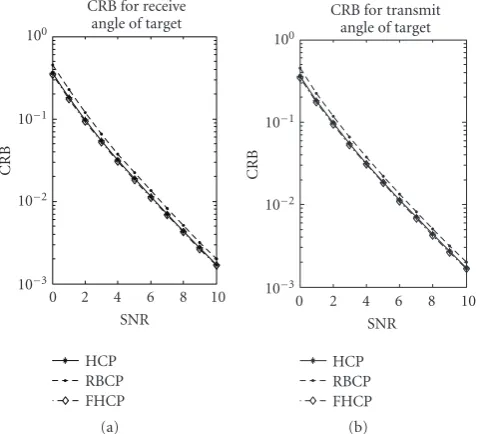
Figure4: The CRB for MIMO radar of a single target with different signals;θt=0◦,θr=0◦,σ2α=0.1.
is the half-wavelength of the maximum carrier frequency).
Figure 3shows respectively the variation of CRB of the
trans-mit angle and receive angle with the location of one target. The transmit signal is selected as RBCP. InFigure 3(a), we can observe that the far the target angles depart from norm of receiver, the worse the estimation performance of receive angle is. While the CRB of receive angle is kept constant with varying transmit angles. It means that the performance of re-ceive angle is not related to transmit angle of the target. The similar conclusion for the CRB of transmit angle can also be obtained fromFigure 3(b).
We compare the CRBs of location parameters for single target with different transmit signals inFigure 4. The FHCP
10−4
10−2
100
102
104
106
108
CRB
1 2 3 4 5 6 7 8 9
P
Receive angle of the first target Transmit angle of the first target
Figure5: CRB of the first target located atθr1=0◦,θt1=0◦versus the number of targetP, SNR=8 dB.
signals, RBCP signals, and HCP signals are used, respectively. Although the correlation matrix of both FHCP signals and HCP signals is the identify matrix, it can be observed that the CRB of the former is lower than the latter. The reason is that they have different array manifolds. As the cross correlation of RBCP signals is not zero, its CRB is the worst among three transmit signals.
Table1: Locations of the nine targets.
Targets 1 2 3 4 5 6 7 8 9
θr 0 −40 −50 10 −20 40 20 50 −30 θt 0 −20 50 −10 −50 −40 60 30 30 σ2
α 0.1 0.15 0.2 0.25 0.3 0.35 0.4 0.45 0.5
10−3
10−2
10−1
100
101
CRB
1 2 3 4 5 6
Receive angle of target2 Receive angle of target1 Receive angle of target3
(a)
10−3
10−2
10−1
100
101
CRB
1 2 3 4 5 6
Transmit angle of target2 Transmit angle of target1 Transmit angle of target3
(b)
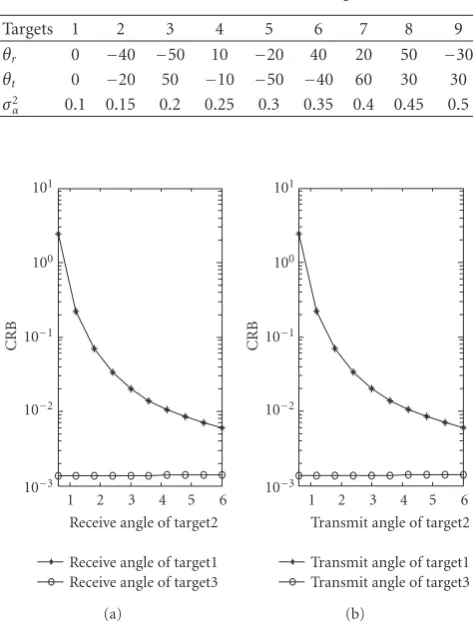
Figure6: CRB of Target 1 and Target 3 as a function of Target 2’s angles, where Target 1 locates atθt1=0◦,θr1=0◦, Target 3 locates
atθt3=50◦,θr3=50◦,σ2α1=0.7,σ
2
α2=0.75,σ
2
α3=0.8 SNR=8 dB.
the value of CRB is infinite. It is consistent with the result discussed previously inSection 4.1.
Figure 6 shows the interaction of the adjacent targets.
Two targets are fixed at [θt1,θr1] = [0◦, 0◦] (Target 1) and
[θt3,θr3] =[50◦, 50◦] (Target 3) withσ2α1 = 0.7,σ
2
α3 = 0.8.
The location of another target (Target 2) is varying from [θt2,θr2] = [0.6◦, 0.6◦] to [6◦, 6◦] with σ2α2 = 0.75, which is very close to Target 1 and far from Target 3. It is shown that the CRB of Target 1 increases when the angles of Target 2 are close to Target 1. However, the adjacency of Target 1 and Target 2 does not almost influence the performance of Target 3.
5. SIMULATION RESULTS
In this section, we demonstrate via simulations the identifi-cation and localization performance of the scheme proposed in this paper. Three transmit antennas and three receive an-tennas are considered, that is,M =N =3. The array struc-ture is the same asFigure 1, and with half-wavelength space between adjacent elements used both for transmitter and re-ceiver. Signal-to-noise ratio (SNR) is 8 dB andL=256 is the number of code in one pulse period. The number of trans-mitted pulses isQ=500.
Table2: Locations of the six targets.
Targets 1 2 3 4 5 6
θt 40 −20 0 25 −50 10
θr −45 −35 0 20 30 40
σ2
α 0.6 0.65 0.7 0.75 0.8 0.85
Table3: Locations of the eight targets.
Targets 1 2 3 4 5 6 7 8
θt 50 −20 −50 −10 −40 60 30 10 θr −50 −40 −20 10 40 20 50 −10 σ2
α 0.5 0.55 0.6 0.65 0.7 0.75 0.8 0.85
5.1. The influence of the transmitted signals
We demonstrate the influence of the transmitted signals with three transmitted signal cases: HCP signals, FHCP signals, and RBCP signals. The performances of these three different transmitted signal cases are plotted in Figures7(a),7(b), and
7(c). The target locates atθt =0◦,θr=0◦withσ2α=0.8. It
is shown that the identification performance with HCP sig-nals and FHCP sigsig-nals is superior to the performance ob-tained with RBCP signals. The correlation of transmit wave-form would degrade the perwave-formance.
The cases of multitarget are plotted in Figures8(a),8(b), and8(c). Six targets are identified and localized effectively. It is shown that all the three signals cases can identify and locate the targets. However, HCP signals and FHCP signals have better identifibility than RBCP signals.
InFigure 9, localization and identification of eight
dif-ferent targets (maximum target number) are plotted in the case of three different transmitted signals. The locations of the targets are given inTable 3. It is shown that eight
differ-ent targets can be iddiffer-entified and located in the three cases. We can see that the performance of identification in HCP signals and FHCP signals is much better than that of the case in RBCP signals. It can be observed from Figures9(a)and
9(b)that when the target number reach the maximum iden-tifiable number, the peak sidelobes level is much higher (ap-proximately 10 dB) than that of the one inFigure 9(c). It can be concluded that the identification performance of FHCP signals is superior to the performance obtained by HCP sig-nals and RBCP sigsig-nals. Accordingly, the performance of tar-get identification and location is closely related to the trans-mitted signals.
From Figures7,8, and9, we can also observe that the tar-gets’ 2D angles can be paired automatically in our scheme. And the maximum number of targets can be identified is (NM−1)=(3×3−1)= 8, which is consistent with the conclusion inSection 4.
5.2. Identifiability of adjacent targets
−50
−40
−30
−20
−10 0
(dB)
10050 0
−50
−100
100
−100−50 0 50
Transmit ang
les
of target Receive angles of target
(a) RBCP signals case
−50
−40
−30
−20
−10 0
(dB)
100 50
0
−50
−100
100
−100−50 0 50
Transmit ang
les
of target Receiveanglesof targ et
(b) HCP signals case
−50
−40
−30
−20
−10 0
(dB)
100 50
0
−50
−100
100
−100−50 0 50
Transmit ang
les
of target Receiveanglesof targ et
(c) FHCP signals case
Figure7: Performance of one target locates atθt=0◦,θr=0◦,σ2α=0.8.
−30
−25
−20
−15
−−10 5 0
(dB)
100 50
0
−50
−100
100
−50 0 50
Transmit ang
les of
targe
t Receive angles of targ et
(a) RBCP signals case
−40
−30
−20
−10 0
(dB)
100 50
0
−50
−100
100
−100−50
50 0
Transmit ang
les of
targe
t Receive angles of targ
et
(b) HCP signals case
−40
−30
−20
−10 0
(dB)
100 50
0
−50
−100
100
−100 −50 0 50
Transmit ang
les of
targe
t Receive angles of targ et
(c) FHCP signals case
Figure8: Identification and localization for six targets, SNR=8 dB.
−25
−20
−15
−10
−5 0
(dB)
100 50
0
−50
−100
100
−50 0 50
Transmit ang
les of
targe
t Receive angles of targ et
(a) RBCP signals case
−40
−30
−20
−10 0
(dB)
100 0
−100−100
100
−50 0 50
Transmit
ang les of
targe
t Receive angles of targ et
(b) HCP signals case
−40
−30
−20
−10 0
(dB)
100 0
−100−100
100
−50 0 50
Transmit
ang les of
targe
t Receive anglesof target
(c) FHCP signals case
Figure9: Identification and localization for six targets, SNR=8 dB.
at [0◦, 0◦] withσ2
α1 = 0.7 and Target 2 is located at [2 ◦, 2◦] withσ2
α2 =0.75. It is shown that they are too close to sep-arate. But they do not affect the location and identification performance of Target 3 which is located at [50◦, 50◦] with σ2
α3 = 0.8. InFigure 10(b), the Target 2 is moved to be lo-cated at [6◦, 6◦]. Now it is far enough to separate Target 1 and Target 2. These simulation results are consistent with the results from the analysis of CRB inSection 4.3.
6. CONCLUSIONS
In this paper, anew scheme of multitarget resolution and lo-calization using bistatic MIMO radar systems is presented.
Multitarget can be distinguished, as well as the targets an-gles with respect to transmitter and receiver can be synthe-sized using the received signals. Accordingly, the locations of the multiple targets are obtained and spatial synchroniza-tion problem in tradisynchroniza-tional bistatic radars is avoided. The maximum number of targets that can be uniquely identi-fied by proposed method is also analyzed. It is indicated that the product of the number of receive and transmit elements minus-one targets can be identified in the case of indepen-dently distributed targets by exploiting the spatial and tem-poral uncorrelation of the reflection coefficient of the targets.
FromSection 5, it is seen that the performance of the targets
−50
−40
−30
−20
−10 0
(dB)
Transmit
ang les
of target
Receive angles of target
100 0
−100
−50 −50 0 50
100
(a) Target 2 is located at [2◦, 2◦]
−40
−30
−20
−10 0
(dB)
Transmit
ang les
of target
Receive angles of target
100 0
−100 −50 0 50
100
(b) Target 2 is located at [6◦, 6◦]
Figure10: Identifiability of the adjacent targets (Target 1 [0◦, 0◦]; Target 3 [50◦, 50◦]; SNR=8 dB,σ2
α1=0.7,σ
2
α2=0.75,σ
2 α3=0.8).
of the transmit signal. How to design good transmit signals for bistatic MIMO radar is the focus of our future work.
APPENDIX
A. FISHER INFORMATION MATRIX DERIVATION
In this appendix, we derive the elements of the submatrices in (9).
From (5) we can see that the observations satisfy the stochastic model Y∼Nc(0,R
η) (see [15]), where Rη =
E{YYH} ≈ (1/Q)Y
ηYHη = K(θr,θt)RHKH(θr,θt) +σ2wINM
is theNM×NMarray data covariance matrix. Let us consider the following matrix:
RH
σα
=
⎡ ⎢ ⎢ ⎣
σ2
α1
. .. σ2
αp
⎤ ⎥ ⎥
⎦, (A.1)
whereσα=[σα1· · ·σαp]
T
is the vector of the unknown pa-rameters which are used to parameterize the reflection coef-ficients covariance matrix. Thus, the (3P+1)×1 vector of un-known parameters can be written asξ=[θTr θTt σαT σw]
T
. Under the previous assumptions, the Fisher information matrix (FIM) [13, Chapter 3] for the parameter vectorξis given by
J(ξ)=1 2tr
R−η1(ξ)
∂Rη(ξ)
∂ξ R −1
η (ξ)
∂Rη(ξ)
∂ξ
. (A.2)
And here we rewrite the expression of the submatrices with their elements asJθrθr = {Jθrlθrk}P×P,Jθrθt= {Jθrlθtk}P×P, Jθtθt = {Jθtlθtk}P×P,Jθrσα = {Jθrlσαk}P×P,Jθtσα = {Jθtlσαk}P×P, Jσασα = {Jσαlσαk}P×P,Jθrσw = {Jθrlσw}P×1,Jθtσw = {Jθtlσw}P×1, Jσασw= {Jσαlσw}P×1,Jσwσw= {Jσwσw}1×1, forl,k=1· · ·P.
The following derivatives are calculated firstly:
∂Kθr,θt
∂θrl
=
0· · ·∂k
θrl,θtl
∂θrl
· · ·0
NM×P
,
∂RH
∂σαl
=2 ⎡ ⎢ ⎢ ⎢ ⎢ ⎢ ⎢ ⎢ ⎢ ⎣ 0
. .. σαl
. .. 0
⎤ ⎥ ⎥ ⎥ ⎥ ⎥ ⎥ ⎥ ⎥ ⎦
P×P
,
∂σ2
wINM
∂σw =2σw INM
(A.3)
forl=1· · ·P.
For succinctness, we only give the detail derivation of Jθrlθrk here:
Jθrlθrk =
1 2tr
R−η1(ξ)
∂Rη(ξ)
∂θrl
R−η1(ξ)
∂Rη(ξ)
∂θrk
= 1
2tr
R−η1(ξ)∂
Kθr,θt
RHKH
θr,θt
+σ2
wINM
∂θrl
×R−η1(ξ)
∂Kθr,θt
RHKH
θr,θt
+σ2
wINM
∂θrk
= 1
2tr
R−η1(ξ)
∂Kθr,θt
∂θrl
RHKH
θr,θt
+Kθr,θt
RH∂
KHθr,θt
∂θrl
×R−1
η (ξ)
∂
Kθr,θt
∂θrk
RHKH
θr,θt
+Kθr,θt
RH∂
KHθr,θt
∂θrk
= 1
2σ
2
αlσ
2
αktr
R−η1(ξ)
∂kθrl,θtl
∂θrl
kHθrl,θtl
+kθrl,θtl
∂kHθrl,θtl
∂θrl
×R−1
η (ξ)
∂
kθrk,θtk
∂θrk
kHθrk,θtk
+kθrk,θtk
∂kHθrk,θtk
∂θrk
= 1
2σ
2
αlσ
2
αktr
R−η1(ξ)
∂kθrl,θtl
kHθrl,θtl
∂θrl
×R−1
η (ξ)
∂kθrk,θtk
kHθrk,θtk
∂θrk
.
(A.4)
Making use of the derivation approach of (A.4) along with (A.2) and (A.3), we can also derive the other elements of the FIM as follows:
Jθrlθtk =1
2σ
2
αlσ
2
αktr
R−1
η (ξ)
∂kθrl,θtl
kHθrl,θtl
∂θrl
×R−η1(ξ)
∂kθrk,θtk
kHθrk,θtk
∂θtk
,
Jθtlθtk =
1 2σ
2
αlσ
2
αktr
R−η1(ξ)
∂kθrl,θtl
kHθrl,θtl
∂θtl
×R−1
η (ξ)
∂kθrk,θtk
kHθrk,θtk
∂θtk
,
Jθrlσαk =σ2αlσαktr
R−η1(ξ)
∂kθrl,θtl
kHθrl,θtl
∂θrl
×R−1
η (ξ)k
θrk,θtk
kHθrk,θtk
,
Jθtlσαk =σ2αlσαktr
R−1
η (ξ)
∂kθrl,θtl
kHθrl,θtl
∂θtl
×R−1
η (ξ)k
θrk,θtk
kHθrk,θtk
,
Jσαlσαk =2σαlσαktr
R−1
η (ξ)k
θrl,θtl
kHθrl,θtl
×R−1
η (ξ)k
θrk,θtk
kHθrk,θtk
,
Jθrlσw=σ 2
αlσwtr
R−η1(ξ)
∂kθrl,θtl
kHθrl,θtl
∂θrl
Rη−1(ξ)
,
Jθtlσw=σ 2
αlσwtr
R−1
η (ξ)
∂kθrl,θtl
kHθrl,θtl
∂θtl
R−1
η (ξ)
,
Jσαlσw=2σαlσwtr
R−1
η (ξ)k
θrl,θtl
kHθrl,θtl
R−1
η (ξ)
,
Jσwσw=2σ 2
wtr
Rη−1(ξ)R−η1(ξ)
.
(A.5)
ACKNOWLEDGMENTS
This research is supported by Key Project of Ministry of Ed-ucation of China under Contract no. 107102. The authors are grateful to the anonymous referees for their constructive
comments and suggestions in improving the quality of this paper.
REFERENCES
[1] J. Li and P. Stoic, “MIMO radar—diversity means superior-ity,” inProceedings of the 14th Adaptive Sensor Array Process-ing Workshop (ASAP ’06), Lincoln Lab, Mass, USA, December 2006.
[2] E. Fishler, A. Haimovich, R. S. Blum, L. J. Cimini Jr., D. Chizhik, and R. A. Valenzuela, “Spatial diversity in radars-models and detection performance,”IEEE Transactions on Sig-nal Processing, vol. 54, no. 3, pp. 823–838, 2006.
[3] D. R. Fuhrmann and G. S. Antonio, “Transmit beamforming for MIMO radar systems using partial signal correlation,” in Proceedings of the 38th Asilomar Conference on Signals, Systems and Computers (ACSSC ’04), vol. 1, pp. 295–299, Pacific Grove, Calif, USA, November 2004.
[4] L. Xu, J. Li, and P. Stoica, “Adaptive techniques for mimo radar,” in Proceedings of the 4th Workshop on Sensor Array and Multichannel Signal Processing (SAM ’06), pp. 258–262, Waltham, Mass, USA, July 2006.
[5] I. Bekkerman and J. Tabrikian, “Target detection and local-ization using MIMO radars and sonars,”IEEE Transactions on Signal Processing, vol. 54, no. 10, pp. 3873–3883, 2006. [6] F. C. Robey, S. Coutts, D. D. Weikle, J. C. McHarg, and K.
Cuomo, “MIMO radar theory and exprimental results,” in Proceedings of the 38th Asilomar Conference on Signals, Systems and Computers (ACSSC ’04), vol. 1, pp. 300–304, Pacific Grove, Calif, USA, November 2004.
[7] E. Fishler, A. Haimovich, R. S. Blum, L. J. Cimini, D. Chizhik, and R. A. Valenzuela, “MIMO radar: an idea whose time has come,” inProceedings of the IEEE Radar Conference, pp. 71–78, Philadelphia, Pa, USA, April 2004.
[8] C. Baixiao, Z. Hongliang, W. Yajun, and W. Jun, “Analysis and experimental results on sparse array synthetic impulse and aperture radar,” inProceeding of CIE International Conference Radar, pp. 76–80, Beijing, China, October 2001.
[9] M. I. Skolnik,Radar Handbook, McGraw-Hill, New York, NY, USA, 1990.
[10] I. Bekkerman and J. Tabrikian, “Spatially coded signal model for active arrays,” inProceedings of IEEE International Confer-ence on Acoustics, Speech, and Signal Processing (ICASSP ’04), vol. 2, pp. 209–212, Montreal, Quebec, Canada, May 2004. [11] M. I. Skolnik,Introduction to Radar System 3E, McGraw-Hill,
New York, NY, USA, 2001.
[12] L. Deshu,Spatial Spectrum Estimation and Application, Uni-versity of Science and Technology of China Press, BeiJing, China, 1997.
[13] S. M. Kay,Fundamentals of Statistical Signal Processing: Estima-tion Theory, Prentice-Hall, Englewood Cliffs, NJ, USA, 1998. [14] P. Stoica and A. Nehorai, “Performance study of
condi-tional and uncondicondi-tional direction-of-arrival estimation,” IEEE Transactions on Acoustics, Speech, and Signal Processing, vol. 38, no. 10, pp. 1783–1795, 1990.