The use of learning styles in adult
learning
Evaluating the use of adult learning styles in two
courses of a Masters program at the University of South
Australia, unit Systems Engineering & Evaluation
Centre
By: Chantal Scholten
University of Twente
Faculty of Behavioural Sciences
Educational Science and Technology
The use of learning styles in adult
learning
Evaluating the use of adult learning styles in two
courses of a Masters program at the University of South
Australia, unit Systems Engineering & Evaluation
Centre
By: Chantal Scholten
University of Twente, Faculty of Behavioural Sciences
Educational Science and Technology, master track Human Resource
Development
Holten, January 2006
Supervisors:
Dr. Irene Visscher-Voerman (University of Twente)
Executive summary
Formative evaluation of the OTE course
The University of South Australia, unit Systems Engineering & Evaluation Centre in Adelaide liked to have proof that the Learning for Masters of Engineering For DSTO staff (Defence Science and Technology Organisation) (LMEF) program was
representative of best teaching practice in postgraduate education, and that the program was meeting the needs of the students. From this perspective, they have asked for an evaluation of two of the LMEF courses. One of these courses is ‘Operational Test and Evaluation’ (OTE).
When conducting an evaluation study, one can focus on several perspectives. The research of this masters project was aimed at writing recommendations to improve and guarantee the degree in which the OTE course of the LMEF Masters could serve adults with several learning styles now and in the future. The main question of this research project was ‘How can the ‘Operational Test and Evaluation’ (OTE) course of the LMEF Masters program ensure best teaching practice, so that several adult learning styles are addressed?’.
With ‘best teaching practice’ the focus in this research project was on adult learning styles and not on, for example how good the lecturer is grounded didactically. This main question could be answered by looking at the two following sub-questions: 1. What is the quality of the OTE courses of the LMEF Masters program by looking at
the degree in which the courses can serve adults with several learning styles?
Ch. 1
2. How can the quality of the OTE courses of the LMEF Masters program be improved, by looking at the degree in which the courses can serve adults with several learning styles?
There were two phases in this research project. In each phase a research question was answered by conducting several activities:
Ch. 3
Figure 1. Phases of this research project
Theoretical framework
Ch. 2
Before giving a summary of the most important results related to these research
questions, it is important to know something about the used theoretical framework of this research project. A list of characteristics of adult learners was made, based on three adult learning theories. Each of these characteristics resulted in evaluation criteria which were used while evaluating the two courses. Also David Kolb’s learning style model was used, because it offered a way to understand individual people's different learning styles.
Leads to 2. Recommendations for improvement: - formative evaluation recommendations
24 recommendations: - 3 interaction
- 13 interaction (teaching) methods - 2 assignments - 6 general
1. Evaluation of program quality: - analysis course website
Characteristics of adult learners
Based on Malcolm Knowles’ theory of Andragogy, Carl Rogers’ Experiential Learning and Patricia Cross’ Characteristics of Adults as Learners model, the following list of characteristics of adult learners was used in this research project:
1. Control of their learning 2. Immediate utility
3. Focus on issues that concern them 4. Test their learning as they go 5. Expect performance improvement 6. Maximise available resources
7. Require collaborative, respectful, mutual and informal climate 8. Rely on information that is appropriate and developmentally paced
Learning styles
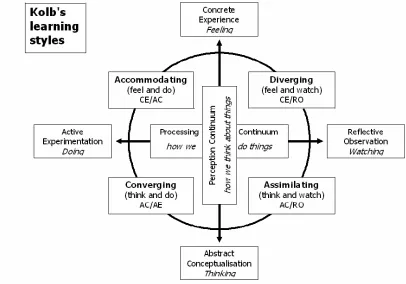
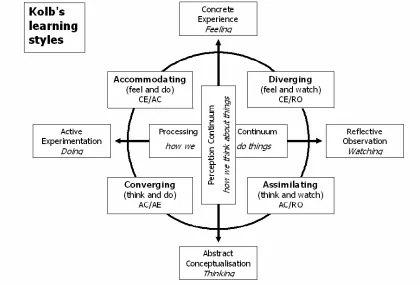
In this research project Kolb’s Learning Style Model was used. The learning styles taken from this model are: diverging, assimilating, converging and accommodating.
Figure 2. Kolb’s learning style model (Figure from Chapman, 1995-2005)
in an (online) class (Palloff & Pratt, 2003; Moran, 1997).
This executive summary will give a summary of the most important results related to the evaluation of the OTE course.
Results research question 1
Ch. 5
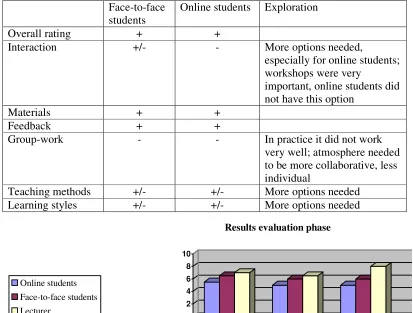
The results of the evaluation phase answered the question: ‘What is the quality of the OTE course of the LMEF Masters program by looking at the degree in which the course can serve adults with several learning styles?’. There were three categories analysed: adult learning characteristics, learning styles and teaching methods.
Table 1.
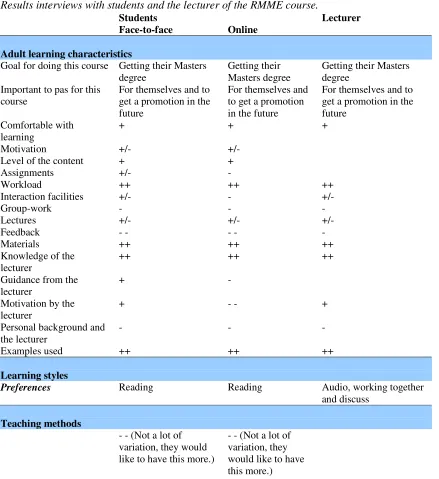
Results according to the respondents
Face-to-face
students Online students Exploration
Overall rating + +
Interaction +/- - More options needed,
especially for online students; workshops were very
important, online students did not have this option
Materials + +
Feedback + +
Group-work - - In practice it did not work very well; atmosphere needed to be more collaborative, less individual
Teaching methods +/- +/- More options needed Learning styles +/- +/- More options needed
0 2 4 6 8 10
Adult learning characteristics
Learning styles Teaching methods
Results evaluation phase
Online students Face-to-face students Lecturer
Figure 3. Degree of satisfaction research question 1
These results showed that especially the online students were not satisfied with some aspects of the OTE course; they were more negative than the face-to-face students.
Results research question 2
Ch. 6
The recommendations were discussed with lecturers and students in a formative evaluation of the recommendations. It was examined if they thought the
were usable for the lecturers. As a result of the formative evaluation of the
recommendations, some recommendations could stay the same, some had to be adjusted and some recommendations had to be removed, because they were not going to improve the quality of the course. After that, final conclusions and recommendations were written about implementing adult learning styles, to improve the quality of the OTE course of the LMEF Masters program. No new recommendations were added compared to the formative evaluation of the recommendations. Research question two ‘How can the quality of the OTE course of the LMEF Masters program be improved, by looking at the degree in which the courses can serve adults with several learning styles?’ can be
answered by implementing these adjusted recommendations. They were all written down in an implementation plan.
Main question: Implementation plan
Ch. 7
App. 9
The implementation plan was the answer to the main research question ‘How can the ‘Operational Test and Evaluation’ (OTE) course of the LMEF Masters program ensure best teaching practice, so that several adult learning styles are addressed?’. The
implementation plan is written that way, that the lecturers can use the plan individually. Every step that is advised to take, is explained in the implementation plan.
There were two major findings for the improvement of the OTE course, they will be explained in short in this executive summary: recommendations related to improvement of interaction and the recommendations to improve the group-work. These are the ten most important recommendations, they are mentioned and explained first. After that, the other recommendations are only mentioned. They are also important, but they are mainly recommendations to improve the use of teaching methods and thus the use of learning styles in the OTE course.
Group-work can be a key factor in making distance courses as good as or better than face-to-face courses (Hiltz & Wellman, 1997, In Turoff et al., 2004). The interaction needed to be improved for especially the online students.
Recommendations in implementation plan
Recommendations with respect to interaction
- It is advised that the lecturer calls the online students at least one time during the course.
This way the online students have real-human interaction, they can ask questions and get instant feedback. This motivates them.
Recommendations with respect to interaction (teaching) methods
- It is advised that the lecturer stimulates the students more to use the discussion board:
Submitting general feedback on the discussion board.
Submitting relevant questions asked by one student on the discussion board. When a student asks a question on the discussion board, it is advised that the lecturer also gives the other students opportunities to answer that question. This way the lecturer lets the students think for them selves.
It is advised that the lecturer responds after a couple of days (for example at the end of the week) to the answers given by the student.
When the lecturer also gives the other students opportunities to answer a question, the lecturer lets the students think for them selves, and not give them all answers straight away without letting them think about the subject.
The lecturer should respond to the answers given by the students, because this way the students know what answers are good and what not.
The lecturer can stimulate the students to make more and better use of the discussion board, by making it clear to them at the beginning of the course that they can improve their grade by participating active on the discussion board. When they submit good and relevant questions and also give good comments on other questions, this will be 2% of their grade. By giving the students a grade for their participation they are more willing and motivated to do it.
- It is advised to make use of a live virtual classroom.
The students and the literature results all found a recommendation about the use of a live virtual classroom important. The lecturer of the OTE course did not like the use of a live virtual classroom. It is still advised to make use of a live virtual classroom for at least two sessions, because for the online students the use of a live virtual classroom is very important. They miss the live interaction and live questioning. For them it is not possible to attend to the classroom session, so to use of the live virtual classroom for at least two times is a good alternative. As a result of this, it is advised to make use of a live virtual classroom.
- It is advised to make use of classroom discussions.
Barton, Heilker & Rutkowski (2005) are saying that classroom discussions function best when students are talking to students. The goal is to get as many students involved in talking to one another as possible and for the teacher to fade into the background. Students are well practiced in how to talk to and listen to teachers, and in how to address and look to authority figures for answers. But they are not well versed in how to talk to and listen to each other, in how to navigate and negotiate and discuss issues of serious consequence and work toward answers among equals.
Students learn through discussions to explore subjects/matters and to deal with people of different backgrounds (Dreikers, Grumwald & Pepper, 1971, In Dempster & Raff, 1992). - It is advised that at the beginning of each course some time is spent on how to work
effectively in groups.
The students should encourage and stimulate each other in the group to have meaningful discussion. The atmosphere should be one in which the students want to learn from each other and share experiences, not to keep everything for themselves. Students should be made aware of the fact they are expected to have a pro-active attitude and contact each other to discuss topics. They should not wait until the lecturer tells them.
- It is advised to submit a document in the e-learning environment of how to work effectively in groups.
Every student should have access to this document. To make sure every student reads this, the lecturer can say in the meetings and write on the website in the schedule ‘To improve your grade – download these papers and read them.’ This gives the students a reason to read the documents.
- It is advised that the lecturer stimulates group-work, by showing interest in how the group-work is progressing.
same person, the lecturer gets a good idea how the group-work is really going.
- It is advised that halfway trough working in groups in the course, the students fill in a questionnaire about collaboration.
When using this questionnaire, students have to think about how the group-work is going and what their own role is in the process. When necessary they can change things for the rest of the course to make the group-work, work better.
The lecturer can stimulate the students to reflect on the group-work, by making it clear to them at the beginning of the course that they can improve their grade by participating active in group-work and when they fill in the collaboration questionnaire. When they submit a filled in questionnaire in which it is clear that they have really done their best to reflect on how the group-work is going, this will be 2% of their grade. By giving the students a grade for filling in the collaboration questionnaire, they are more willing and motivated to do it. It is recommended that the collaboration questionnaire will not be marked, but that it is compulsory.
General recommendations
- It is advised to have more face-to-face meetings for the OTE course.
Students can meet and interact with each other in face-to-face meetings. They think that is very important. Now the OTE course is offered as an online course, but students would really like to have face-to-face meetings. The OTE lecturer offered a couple of
workshops in his own time, this is really helping the students; they would like to have them even more.
The other recommendations are:
Recommendations with respect to interaction
- It is advised that the lecturer makes a place on the discussion board where students have to submit in short their personal background information.
It is advised that the lecturer uses the students’ background information in the material, so that especially the online students can relate to it.
Recommendations with respect to interaction (teaching) methods
It is advised:
- to structure the discussion board by lesson.
- that all students and the lecturer receive an e-mail when something has been submitted on the discussion board.
- to make use of online practice exercises
- to make use of hyperlinks in an e-learning environment.
- to make use of simulations, especially role-play and case studies. to make use of recorded lectures in an e-learning environment.
It is advised:
- that the written material is more explicit as to what steps need to be taken to complete the assignments.
- that the lecturer submits extra information concerning the assignments on the discussion board.
General recommendations
It is advised:
- to use the same format for the course outline.
- that the lecturer sends all the students an e-mail at the beginning of the course to check if the students can log-in and if they have problems with this, who they can contact. Students should all respond to this e-mail.
- to deliver the learning material two lessons ahead.
Abstract
The University of South Australia, unit Systems Engineering & Evaluation Centre in Adelaide liked to have proof that the Learning for Masters of Engineering For DSTO staff (LMEF) program was representative of best teaching practice in post graduate education, and that the program was meeting the needs of the students.
The research of this masters project was aimed at writing recommendations to improve and guarantee the degree in which the courses ‘Research Methods in a Multidisciplinary
Environment’ and ‘Operational Test and Evaluation’ of the LMEF Masters could serve adults with several learning styles now and in the future. The main question of this research project was ‘How can the ‘Research Methods in a Multidisciplinary Environment’ (RMME) and ‘Operational Test and Evaluation’ (OTE) courses of the LMEF Masters program ensure best teaching practice, so that several adult learning styles are addressed?’
This main question could be answered by looking at the two following sub-questions: 1. What is the quality of the RMME and OTE courses of the LMEF Masters program by
looking at the degree in which the courses can serve adults with several learning styles? 2. How can the quality of the RMME and OTE courses of the LMEF Masters program be
improved, by looking at the degree in which the courses can serve adults with several learning styles?
There were two phases in this research project: the first phase was an evaluation phase in which sub-question one was answered. To do this, the two courses ‘Research Methods in a Multidisciplinary Environment’ and ‘Operational Test and Evaluation’ given in this master program were explored, a document analysis was made, the curriculum was looked at carefully with a focus on adult learning styles, an interview with the contact person of Defence Science and Technology Organisation, an interview with the coordinator of AITEC, interviews with lecturers and with students were conducted and a questionnaire was
developed and sent to the students.
The second phase of this research project was a phase towards the recommendations in which sub-question two was answered. Based on the results of all the activities in the evaluation phase, conclusions and recommendations were written about adult learning styles to improve the two courses. In total there were 34 recommendations. That were three recommendations about interaction, eighteen recommendations about interaction (teaching) methods, five recommendations about feedback, two recommendations about assignments and six general recommendations. The recommendations were discussed with lecturers and students. This way it could be made sure that the recommendations fit with the needs of the students and that they were usable for the lecturers. After that, final conclusions and recommendations were made about implementing adult learning styles, to improve the quality of the courses ‘Research Methods in a Multidisciplinary Environment’ and ‘Operational Test and
Table of content
Executive summary ...3
Abstract...10
Foreword...14
1 Introduction ...15
1.1 Context ...15
1.1.1 Defence Science and Technology Organisation ...16
1.1.2 AITEC ...16
1.1.3 Systems Engineering and Evaluation Centre...16
1.1.4 Learning for Masters of Engineering For DSTO staff ...17
1.1.5 Course one to be evaluated: Research Methods in a Multidisciplinary Environment...18
1.1.6 Course two to be evaluated: Operational Test and Evaluation...19
1.2 Intended curriculum ...20
1.3 Relevance of the study ...20
1.4 Reading guide ...21
2 Theoretical background ...22
2.1 Main adult learning theories...22
2.1.1 Andragogy ...23
2.1.2 Experiential learning ...24
2.1.3 Characteristics of Adults as Learners model ...25
2.1.4 Combination of theories: characteristics of adult learners ...26
2.2 Learning styles...29
2.2.2 Concept of learning style...29
2.2.2 Learning style models...30
2.2.2 Addressing different learning styles in a course ...33
2.3 Teaching methods ...34
2.2.2 Teaching methods that fit with Kolb’s Learning Style model...34
2.2.2 Teaching methods to address adult learning styles ...35
2.4 Conclusion...36
3 Research design...38
3.1 Phase 1: Evaluation...38
3.1.1 Research questions 1 ...39
3.2.2 Activities...40
3.2 Phase 2: Towards recommendations...43
3.2.1 Research question 2...44
3.2.2 Activities...44
4 Results research question 1 RMME...47
4.1 Results from the analysis of the course website ...47
4.2 Results from the AITEC questionnaire ...48
4.2.1 Summary of the results from the AITEC questionnaire RMME 2003...48
4.2.2 Summary of the results of the AITEC questionnaire RMME 2004...49
4.3 Results of the questionnaire developed by the researchers ...49
4.4 Results from the interviews with students and the lecturer of the RMME course ...50
4.5.1 Positive aspects of the RMME course...52
4.5.2 Aspects that can be improved in the RMME course...53
4.5.3 Learning style preferences...54
4.6 Overall conclusion ...55
5 Results research question 1 OTE ...56
5.1 Results from the analysis of the course website ...56
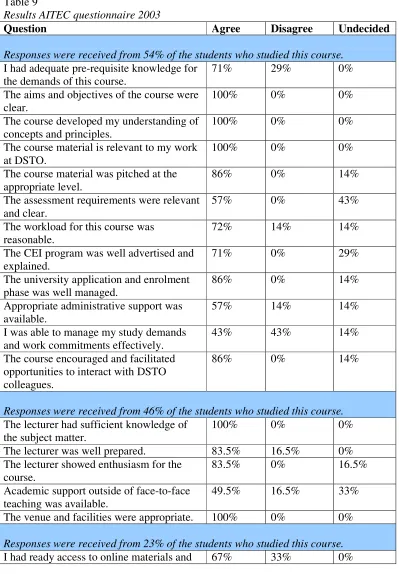
5.2 Results from the AITEC questionnaire ...57
5.2.1 Summary of the results from the AITEC questionnaire 2003 ...57
5.2.2 Summary of the results of the AITEC questionnaire 2004...58
5.3 Results of the questionnaire developed by the researchers ...58
5.4 Results from the interviews with students and the lecturer of the OTE course...59
5.5 Conclusions OTE...60
5.5.1 Positive aspects of the OTE course ...61
5.5.2 Aspects that can be improved in the OTE course ...62
5.5.3 Learning style preferences...63
5.6 Overall conclusion ...64
6 Results research question 2 RMME and OTE...65
6.1 Results formative evaluation of the recommendations ...66
6.1.1 Results of the students ...66
6.1.2 Results of the lecturers ...68
6.1.3 Differences between students and the lecturer...68
6.2 Conclusion...69
6.2.1 Recommendations that can stay the same ...69
6.2.2 Recommendations that need to be adjusted...70
6.2.3 The recommendation that needed to be removed ...72
6.3 Overall conclusion ...72
7 Implementation plan...73
7.1 Structure implementation plan...73
7.2 Recommendations with respect to interaction...74
7.3 Recommendations with respect to interaction (teaching) methods ...75
7.3.1 Discussion board in an e-learning environment...76
7.3.2 Notice board in an e-learning environment ...77
7.3.3 Online practice exercises ...78
7.3.4 Hyperlinks...78
7.3.5 Interactive animations and media...79
7.3.6 Simulations: Role-play & Case-study ...79
7.3.7 Recorded lectures ...80
7.3.8 Live virtual classroom ...80
7.3.9 PowerPoint slides with pictures, graphics and diagrams...81
7.3.10 Classroom Discussions...82
7.3.11 Group-work...82
7.4 Recommendations with respect to feedback ...84
7.5 Recommendations with respect to the assignments...85
7.6 General recommendations...86
7.6.1 Course explanation...86
7.6.2 Course website (e-learning environment)...86
7.6.4 Access e-learning environment...87
7.6.5 Delivery of learning material...87
8 Discussion...88
8.1 Discussion research methods...88
8.1.1 Validity ...88
8.2 Discussion results...89
8.2.1 Reliability / Validity...89
8.2.2 Implementation of the recommendations ...90
8.3 Follow-up studies...91
8.3.1 Improvement of this research project...91
8.3.2 Take the extend to which adults with several learning styles are ... served along in evaluation ...92
8.4 Main question ...92
9 References ...93
Appendix 1: Interview questions lecturers...96
Appendix 2: Interview questions students...97
Appendix 3: Developed questionnaire ...100
Appendix 4: Results research question 1 RMME ...103
Appendix 5: Results research question 1 OTE...114
Appendix 6: Recommendations ...126
Appendix 7: Results research question 2 RMME ...129
Appendix 8: Results research question 2 OTE...137
Foreword
In this report a description is given of a research project that was carried out for the round-off of the master Human Resource Development at the University of Twente, Enschede, the Netherlands. The past months I have been struggling with adult learners and learning styles, which were evaluated in two courses of a Masters program at the University of South Australia.
There are a lot of people who I owe a big thank you. First of all, my supervisor Irene Visscher-Voerman. I really learned a lot from her, not only during this research project, but during my whole study period at the University of Twente. I also want to thank David Cropley for giving me the chance to do my final project at unit SEEC. Although he was very busy, he always found the time to read the reports and findings and provided me with useful tips.
Next to these people, I owe a big thanks to all the other staff members at SEEC, who helped me where possible and who made my stay in Adelaide a really pleasant time. A special thanks to Michael Harris, Paul Bunnik, Melissa Madix and Ian Price for all their help, professionally and personally. Also a big thanks to Lynn Busschenschut. Thanks to her, al the administration before and during my arrival in Adelaide was organized. I also want to thank the people who let me interview them and who filled in the questionnaires. Even though they were really busy with their work, they found the time to help me by giving their opinion, thank you very much! In the Netherlands, there are also a lot of people I want to thank. My family, especially my parents, my friends, my (ex-) house members and my fellow students at the University of Twente.
Last but not least, I want to thank Marieke Klink for joining me on this big adventure to Australia. I really learned a lot from you and even though sometimes it was hard being together all that time, I really enjoyed our time there together!
1
Introduction
In this research two master courses for the department of Systems Engineering & Evaluation centre (SEEC) of the University of South Australia (UniSA) were evaluated and
recommendations for improvement were made. When conducting an evaluation study, one can focus on several perspectives. Because the length of this research project was only a few months and the students attending the two evaluated courses were all adult learners with several learning styles (see for an explanation, chapter 2), this research project was aiming at an evaluation of the degree in which the courses are serving adults with several learning styles in the RMME and OTE course of the LMEF Masters program.
This chapter is an introduction to this research project. In this chapter the context of this research project will be explained in section 1.1. In section 1.2 the intended curriculum will be explained and in section 1.3 the relevance will be discussed. Finally, in section 1.4 the reading guide for this whole report will be given.
1.1
Context
The department of SEEC is a department of UniSA. It runs a master program for the staff of the Defence Science and Technology Organisation (DSTO). SEEC wants to be sure that the Learning for Masters of Engineering For DSTO staff (LMEF) program is representative of best teaching practice in postgraduate education, and, that the program is meeting the needs of the client. From this perspective, they have asked for an evaluation of two of the LMEF courses. The courses to be evaluated were ‘Research Methods in a Multidisciplinary Environment’ (RMME) and ‘Operational Test and Evaluation’ (OTE).
Below, in figure 1, a structure of the several stakeholders involved is presented. This is done to make clear what the relationships between the stakeholders involved are.
Figure 1. Structure of the organisation
University of Adelaide University of
South Australia
Flinders University
DSTO
AITEC
Other providers
SEEC
In the following sections the several stakeholders in this research project that are presented in figure 1 are explained. In section 1.1.1 the organisation DSTO will be explained. In section 1.1.2 the organisation AITEC will be explained and in section 1.1.3 the organisation SEEC will be explained. After these organisations are explained, section 1.1.4 will focus on the LMEF Masters Program. In the last two sub-sections the content and the aim/learning objective of the RMME (sub-section 1.1.5) and OTE (sub-section 1.1.6) course will be discussed.
1.1.1 Defence Science and Technology Organisation
The Defence Science and Technology Organisation (DSTO) is part of Australia's Department of Defence. DSTO's role is to ensure the expert, impartial and innovative application of science and technology to the defence of Australia and its national interests.
DSTO has a yearly budget of approximately $300 million and employs about 2300 staff, predominantly scientists, engineers, IT specialists and technicians.
DSTO has a presence in nearly every state and territory in Australia. It has its corporate office at Defence headquarters in Canberra with research facilities in Melbourne, Edinburgh (near Adelaide), Canberra, Sydney, HMAS Stirling at Rockingham (near Perth), Scottsdale in Tasmania, and Innisfail in northern Queensland.
At all times, DSTO works closely with the industry, science and technology community to enhance its ability to support Australia's defence capabilities and to contribute to national wealth.
1.1.2 AITEC
The Department of Defence has contracted an external organisation, AITEC. AITEC is the organization that provides the liaison and administration between DSTO and UniSA. AITEC is responsible for all aspects of the university enrolment, including payment of fees and graduations, and evaluating the courses and programs.
1.1.3 Systems Engineering and Evaluation Centre
The Systems Engineering and Evaluation Centre (SEEC) is an official research centre within the University of South Australia. The centre was established in 1999 as the successor of the Australian Centre for Test and Evaluation (ACTE). ACTE was founded in 1992 to provide a focus for Test and Evaluation in the Asia-Pacific region.
The centre uses specialised facilities for research and technical staff to work with clients to help them understand their complex systems and improve their practices.
SEEC staff members are experts in understanding and resolving complex problems. SEEC staff represents four key centres of expertise:
- Systems Engineering - Test and Evaluation
- Capability Development and Acquisition - Aviation Systems Safety
SEEC offers the following programs:
- Systems Engineering (SE) and Test and Evaluation (T&E) coursework and research degree programs ranging from Graduate Certificate to Doctor of Philosophy (PhD). - Professional Training Programs, to allow participation in courses without enrolling in a
University of South Australia Program.
part of the program at UniSA is called the LMEF Masters program (a Masters of Engineering).
In total, there are 27 people working at SEEC, including 4 support staff members. Most of these staff members teach and do research. In total 6 staff members of the SEEC staff teach in the LMEF program. Two of them are involved in the courses to be evaluated.
1.1.4 Learning for Masters of Engineering For DSTO staff
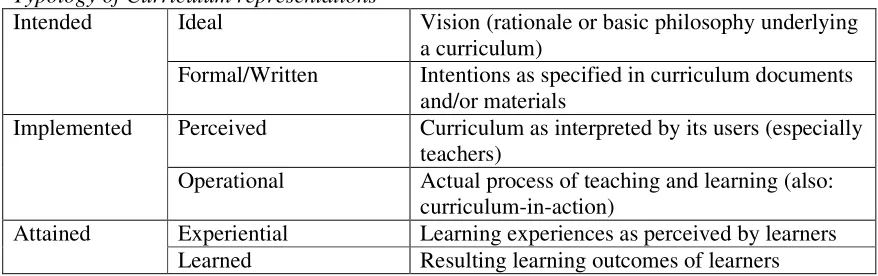
To understand the research project, it is important to understand the context. To understand the context one can look at the curriculum. A curriculum can be looked at in different ways. A general distinction can be made between the three levels ‘intended’, ‘implemented’ and ‘attained’ (Van den Akker, 2004). A more detailed overview is given in table 1 (Van den Akker, 2004).
It is important to look at the levels ‘intended’, ‘implemented’ and ‘attained’, because together they can give a clear image of the education offered to the students of the RMME and OTE courses. When looking at these three levels, it can be analysed if the vision, the way the lecturers think and the way the students think are the same about the curriculum.
Table 1
Typology of Curriculum representations
Ideal Vision (rationale or basic philosophy underlying a curriculum)
Intended
Formal/Written Intentions as specified in curriculum documents and/or materials
Perceived Curriculum as interpreted by its users (especially teachers)
Implemented
Operational Actual process of teaching and learning (also: curriculum-in-action)
Experiential Learning experiences as perceived by learners Attained
Learned Resulting learning outcomes of learners
One of the big challenges for curriculum improvement in general and for this formative evaluation research in particular, is creating consistency between the different parts of the curriculum. One way to look at a curriculum is by dividing the curriculum in components. In this research the ten curriculum components of table 2 (Van den Akker, 2004) were used to describe the two courses RMME and OTE of the LMEF Masters program. Each of the components can be subdivided in one of the three levels of the typology of curriculum representations: intended,
implemented and attained. The intended curriculum is explained in section 1.2. The implemented and attained curriculum will be presented in chapter 4 and 5.
Table 2
Curriculum components
Component: Description:
Rationale Why are they learning?
Aims & Objectives Toward which goals are they learning?
Content What are they learning?
Learning activities How are they learning?
Grouping With whom are they learning?
Location Where are they learning?
Time When are they learning?
Assessment How far has learning progressed?
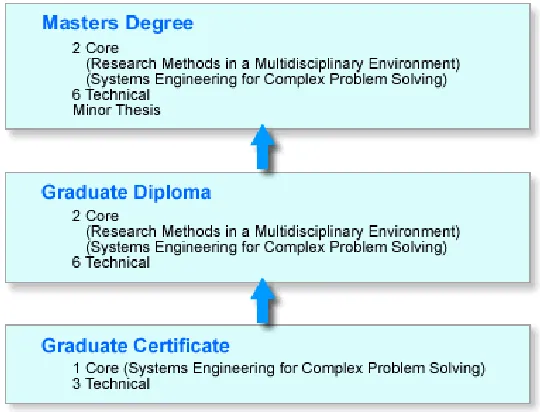
The three organisations discussed above played a role in the LMEF Masters program. In this subsection the focus will be on this LMEF Masters program. In figure 2 the streams of the LMEF program are presented. The LMEF Masters includes two compulsory core courses, Systems Engineering for Complex Problem Solving and Research Methods in a
Multidisciplinary Environment (RMME), and six elective technical courses. Operational Test and Evaluation (OTE) is one of those elective technical courses. The LMEF Masters program is mainly offered via online learning. There are also some face-to-face sessions. This
combination is also called ‘blended learning’ (Driscoll & Carliner, 2005).
Figure 2. Streams of LMEF Masters program
The two evaluated courses RMME and OTE will be described in the following sub-sections. In this description the curriculum components of Van den Akker (2004) are used.
1.1.5 Course one to be evaluated: Research Methods in a Multidisciplinary Environment
One of the courses that has been evaluated was the RMME course. The content of the RMME course covers:
- The nature of inquiry and the selection of appropriate methods to suit the types of problems encountered by DSTO and the defence sector.
- Research techniques, for example the design of experiments, data validation and interpretation.
- Research design, qualitative and quantitative research, sources of data, data collection procedures, measurement strategies, questionnaire design, interviewing techniques, content analysis, literature surveys, information databases, statistical techniques and evaluation.
The aim/learning objective for the RMME course is:
- To provide the student with the fundamental concepts and practice of engineering research in a multidisciplinary environment where no-engineering functions may be present.
On completion of the RMME course, students should be able to: - describe the key elements in the design of research programs;
- appreciate the fundamental concepts of qualitative and quantitative research; - understand the fundamentals of data collection and research methodology; - apply skills in gathering and analysing information; and
- apply skills and knowledge of the methods for writing effectively for research degrees.
The lecturer of the RMME course provided six traditional classroom meetings and made use of an e-learning environment. Each classroom meeting took a whole day. The RMME course used a text book. Other readings and materials were provided online. The students were learning mainly individual. During the classroom meetings, the course made use of 7 tutorials (not marked group-work).
1.1.6 Course two to be evaluated: Operational Test and Evaluation
The other course that has been evaluated was the OTE course. The content of the OTE course covers:
- The definition of Operational Test and Evaluation
- Differences from Development and Acceptance Test and Evaluation - Human factors
- Methods of reporting - Critical issues
- Statistical confidence levels - Operational test plans - Safety and suitability testing - Operational test reports
The aim/learning objective for the OTE course is:
- To introduce the principles of the specialist discipline of Operational Test and Evaluation.
On completion of this course students should be able to:
- appreciate the elemental components of an Operational Test and Evaluation program; - appreciate the thrust of Operational Test and Evaluation is a systems-level approach to
demonstrating usefulness in achieving users' requirements;
- understand the relationships between the elements of Operational Test and Evaluation; - understand the differences between Operational Test and Evaluation and other types of
Test and Evaluation; and
- understand the human factors affecting Operational Test and Evaluation.
1.2
Intended curriculum
A part of the ideal curriculum of the LMEF Masters program is ‘to give independent, expert, professional advice on the application of science and technology to the defence of Australia, DSTO provides DSTO-specific postgraduate education programs for staff.’ (Defence Science and Technology Organisation, 2005).
The intended curriculum is specified in the official documents Continuing education
initiative, Policy statement DSTO (2005) and Procedures and guidelines (2005). The LMEF Masters program is aiming specifically at maintaining and enhancing DSTO’s scientific and technology knowledge base and research capability. This is the rationale according to the interview with the contact person of DSTO, the contact person of AITEC (an external organisation, contracted by the Department of Defence) and the interviews with the students. The LMEF Masters program is a program of part-time postgraduate study in a selected range of scientific and technological disciplines that lead to the award of Graduate Certificate, Graduate Diploma or Masters Degree, or DSTO staff may choose for individual courses. DSTO supports the career development of its entire staff, and recognises continuing education and lifelong learning. These are key ingredients for a successful career in DSTO.
DSTO pays the relevant university fees and charges for staff approved to undertake the LMEF Masters program.
1.3
Relevance of the study
DSTO is a very important client of SEEC. SEEC does a lot of work with them, both teaching and research. DSTO invests a lot of money in the unit SEEC, so it is important to keep them satisfied by delivering high quality courses. Another important reason for this research was that the lecturers and the staff know they are giving effective and efficient education; they know that they are doing a good job. By taking part in this research they can get the proof to show this to other people and organisations.
There has never been a research about the way of teaching and cope of the lecturers with the different learning styles of adults, the lecturers do not have the proof that they are doing a good job. Through this research they can demonstrate to other people and organisations that they are serving adults with several learning styles in the best possible way.
The use of learning styles in adult learning
Because in this research project special attention was given to the use of learning styles in adult learning, the first question one can ask him-/herself is: Why is the use of learning styles important in adult learning?
instructional methods are used (Caffarella, 2002). That is why it is important to know more about the students following these courses.
Because ‘different methods of instruction work best for different styles of thought’ (Sternberg 1997, p. 115, In Brennan, McFadden & Law, 2001), differences in learning styles need to be accepted and accommodated in every part - also the teaching methods - of the delivery of education and training of the RMME and OTE courses.
It is relevant to know to what extent learning styles in adult learning were used in the courses RMME and OTE. This way the use of adult learning styles in the two courses can ensure best teaching practice. In this research project it was examined how the learning styles in adult learning of the courses RMME and OTE were already implemented and how the learning styles in adult learning of the courses RMME and OTE could be improved. This was done by a formative evaluation.
So, the main question that was answered in this research project is as follows:
How can the ‘Research Methods in a Multidisciplinary Environment’ (RMME) and ‘Operational Test and Evaluation’ (OTE) courses of the LMEF Masters program ensure best teaching practice, so that several adult learning styles are addressed?
With ‘best teaching practice’ the focus will be on adult learning styles and not on, for example how good the lecturer is grounded didactically.
The main question can be answered by looking at the two following sub-questions: 1. What is the quality of the RMME and OTE courses of the LMEF Masters program by
looking at the degree in which the courses can serve adults with several learning styles? 2. How can the quality of the RMME and OTE courses of the LMEF Masters program be
improved, by looking at the degree in which the courses can serve adults with several learning styles?
This research project is combined with the research project of Klink (2006). She focused on the use of interaction methods in a blended learning environment. Both research project evaluated the courses RMME and OTE of the LMEF Masters program. Each researcher focused on one perspective and at the end of the research project, these perspectives were combined in writing the recommendations.
1.4
Reading guide
2
Theoretical background
In the previous chapter the main question of this research project has been formulated: How can the ‘Research Methods in a Multidisciplinary Environment’ (RMME) and
‘Operational Test and Evaluation’ (OTE) courses of the LMEF Masters program ensure best teaching practice, so that several adult learning styles are addressed?
In this chapter a theoretical background will be developed that helps answering this main question. Also when writing the recommendations to improve the two courses RMME and OTE of the LMEF Masters program, it is important to have more theoretical background. By defining the conceptual framework, the quality of the LMEF Masters program can be
determined. To do that, this literature research will help to answer the following questions: - Which learning theories belong to adult learning?
- Which of the learning style-models is best suited for the two courses RMME and OTE of the LMEF program?
- Which teaching methods are available in adult learning?
- What are the best teaching methods to use in the RMME and OTE courses of the LMEF Masters program according to adults?
The questions mentioned above help to answer sub-question 1: ‘What is the quality of the RMME and OTE courses of the LMEF Masters program by looking at the degree in which the courses can serve adults with several learning styles?’.
In this chapter the core terms are explained. These core terms are explained, because these terms are used in this research project. Therefore, in section 2.1 different adult learning theories will be discussed. In section 2.2 learning styles, learning style models and how one should address these in the RMME and OTE courses will be discussed. Students differ widely in their preferred learning environments and styles of learning. There may be advantages for some students in presenting material via programs that match their preferred learning style. Section 2.3 discusses several ways of presenting material by discussing teaching methods and what the best teaching methods to use in the RMME and OTE courses are, according to adult learning.
2.1
Main adult learning theories
The students who were doing the RMME and OTE course are adults. Education offered to adults should be different from education offered to children or adolescents, because adults have special needs and requirements as learners. The University of South Australia, unit SEEC should adjust their education to adults. Therefore the main adult learning theories will be discussed in this chapter.
learning focuses on describing the adult development process and the learning challenges it poses (Kolb, 1984). Cross’ Characteristics of Adult as Learners model focuses on the development of lifelong learning for adults. Based on these three theories, a list of adult learning characteristics is made, on which the focus will be in the rest of this research project.
2.1.1 Andragogy
As Kearsly (1994-2005) indicated, Knowles' theory of andragogy is an attempt to develop a theory specifically for adult learning. Knowles emphasizes that adults are self-directed and want to take responsibility for decisions. Adult learning programs must accommodate this fundamental aspect. According to Kearsly (1994-2005), andragogy makes the following assumptions about the design of learning: (1) adults need to know why they need to learn something, (2) adults need to learn experientially, (3) adults approach learning as problem-solving, and (4) adults learn best when the topic is of immediate value.
Principles of Andragogy
According to Fogarty and Pete (2004), Knowles believes that andragogy is process-oriented rather than content-based (pedagogy). Fogarty and Pete (2004) have their own ideas about adult learning, but some of their work refers to Knowles’ theory of Andragogy. Some of their principles are the same as Knowles’ principles. Zemke and Zemke (1995) used the same principles for adult learning as Knowles did. The other sources used in this section, made a reference to the work of Knowles in their own work.
The andragogy theory is anchored on the five following principles:
1. Self concept: As Fogarty and Pete (2004), DeSimone, Werner and Harris (2002) and Kearsly (1994-2005) indicated, and Knowles (1980) mentioned, adult learners are directing their own plan. So, they are in control of their own learning process. Although adult learners, naturally, have varying degrees of self-efficacy, for the most part they demonstrate a strong sense of self in their learning. Even so, some feel embarrassed about returning to school or joining classes of younger students. Some may hold negative impressions of their own abilities, or they may hold negative impressions of schools, teachers, and educational experiences in general. They may have varying level of awareness about their own learning styles. Yet, the adult learner’s sense of self greatly influences their learning experiences (Dirkx, Lavin & Pelavin, 1995, In Fogarty & Pete, 2004).
2. Experience: The adult learner has collected a personal growing reservoir of experiences (Fogarty & Pete, 2004; DeSimone et al., 2002; Knowles, 1980). As Dirkx et al. (1995, In Fogarty & Pete, 2004) and Kearsly (1994-2005) indicated, adult learners are diverse learners; they bring a wealth of life experiences to their learning activity and they vary widely in age, abilities, level of schooling, job experiences, cultural background, and personal goals.
4. Orientation to learning: The adult learner is problem-centred and aware of the immediacy of application (Fogarty & Pete, 2004; DeSimone et al., 2002; Knowles, 1980). Adult learners want to relate their learning to specific contexts in their lives, ones that usually involve work, their homes and families. Dirkx et al. (1995, In Fogarty & Pete, 2004) add to that, that because adults are busy people, they expect that their course will help them with existing problem areas.
5. Motivation: According to Knowles (1980) adult learners harbour internal motivation. Adult learners are learning for a reason, and they push themselves from within (Fogarty & Pete, 2004). Zemke and Zemke (1995) add to that, that there are three elements one should take into account when motivating adults: (1) as said, they have a preference for real-world, problem-based approaches, so this should be available; (2) they are more motivated when they have the opportunity for personal growth or gain; and (3) they are more motivated when they can participate.
2.1.2 Experiential learning
The second theory discussed in this chapter is Carl Rogers’ Experiential learning. Rogers distinguishes two types of learning: cognitive (meaningless) and experiential (significant). The difference between them is that experiential learning addresses the needs and wants of the learner where cognitive learning does not do that. As Kearsly (1994-2005) indicated, Rogers lists the following qualities of experiential learning: personal involvement, self-initiated, evaluated by learner, and pervasive effects on learner.
According to Rogers, learning is facilitated when: (1) the student participates completely in the learning process and has control over its nature and direction, (2) it is primarily based upon direct confrontation with practical, social, personal or research problems, and (3) self-evaluation is the principal method of assessing progress or success. Kearsly (1994-2005) indicated that Rogers also emphasizes the importance of learning to learn and an openness to change.
Kearsly (1994-2005) mentions that, to Rogers, experiential learning is equal to personal change and growth. Rogers feels that all human beings have a natural tendency to learn; the role of the teacher is to facilitate such learning. This includes: (1) setting a positive climate for learning, (2) clarifying the purposes of the learner(s), (3) organizing and making available learning resources, (4) balancing intellectual and emotional components of learning, and (5) sharing feelings and thoughts with learners but not dominating (Kearsly, 1994-2005). The teacher and the learner engage in a process which is concerned with facilitating an active process of learning in the student. The student becomes responsible for his or her own learning. Hobbs (1992) says that the teacher is a resource and a provider of structure, but learning is seen as taking place when the learner is trying actively to incorporate external knowledge into his or her own internal frame of reference.
Principles of Experiential Learning
Experiential learning is based on four principles:
1. Relevancy: According to Hobbs (1992) and Rogers (as Kearsly, 1994-2005 indicated), significant learning takes place when the subject matter is relevant to the personal interests of the student: what is being learned and how it is being learned hold a special importance for that person.
3. Self-initiated learning. Self-initiated learning is the most lasting and pervasive (Kearsly, 1994-2005). There is an involvement of the whole self – body, thoughts, feelings, and actions, not just the mind (Hobbs, 1992); in other words, the learner is engaged as a whole person.
4. Participation and experience. As Kearsly (1004-2005) indicated, experiential learning is concerned with the experience of individuals, not just with their participation. The students are asked to consider and utilise their own experience as a basis for
self-understanding and assessment of their own needs, resources and objectives (Hobbs, 1992). The learner is involved in a reflective experience which enables the person to relate current learning to past, present and future, even if these time relationships are felt rather than thought (Hobbs, 1992).
2.1.3 Characteristics of Adults as Learners model
The third theory discussed in this chapter is Cross’ Characteristics of Adults as Learners (CAL) model. Cross (1981) presents the CAL model in the context of her analysis of lifelong learning programs. The model attempts to integrate other theoretical frameworks for adult learning such as Knowles’ Andragogy, Rogers’ Experiential Learning, and Lifespan Psychology.
Figure 3. CAL model
As Kearsly (1994-2005) indicated, the CAL model consists of two classes of variables: (1) personal characteristics and (2) situational characteristics. Personal characteristics include: physiological/aging, socio-cultural/life phases, and psychological/developmental stages. These three dimensions have different characteristics as far as lifelong learning is concerned. Aging results in the declining of certain sensory-motor abilities (for example eyesight, hearing, reaction time) while intelligence abilities (for example decision-making skills, reasoning, vocabulary) tend to improve. Life phases and developmental stages (for example marriage, job changes, retirement) involve a series of plateaus and transitions which may or may not be directly related to age (Kearsly, 1994-2005; Cross, 1981).
As Kearsly (1994-2005) indicated, situational characteristics consist of part-time versus full-time learning, and voluntary versus compulsory learning. The administration of learning (for example schedules, locations, procedures) is strongly affected by the first variable part-time versus full-time learning. This means for example that it is more difficult for part-time learners to make a schedule for learning and to find a good, suitable location. The second variable, voluntary versus compulsory learning, belongs to the self-directed, problem-centred nature of most adult learning (Kearsly, 1994-2005).
Personal Characteristics
Physiological / Aging Sociocultural / Life Phases
Psychological / Developmental Stages
Situational Characteristics
Principles of Adult Learning Theory
The Adult Learning Theory is based on 4 principles (Kearsly, 1994-2005; Cross, 1981): 1. Experience. Adult learning programs should capitalize on the experience of participants. 2. Limitations. Adult learning programs should adapt to the aging limitations of the
participants.
3. Personal development. Adults should be challenged to move to increasingly advanced stages of personal development.
4. Choice. Adults should have as much choice as possible in the availability and organization of learning programs.
2.1.4 Combination of theories: characteristics of adult learners
Based on Knowles’ chart of nine findings as the prominent issues and concerns of the adult learner (Knowles, 1973, In Fogarty & Pete, 2004) and the above adult learning theories, one could say that adult learners have the following characteristics:
9. Control of their learning 10.Immediate utility
11.Focus on issues that concern them 12.Test their learning as they go 13.Expect performance improvement 14.Maximise available resources
15.Require collaborative, respectful, mutual and informal climate 16.Rely on information that is appropriate and developmentally paced
Each characteristic will be explained and after each explanation a focus of this research will be given.
1. Control of their learning. Buford and Lindner (2002, In Richards, Dooley & Lindner, 2004) are saying that adult learners want control; they want to decide what, where, and how they will learn whatever it is they have targeted for themselves (Caffarella, 2002). According to Fogarty and Pete (2004) they frequently want to continue the formal lesson on their own, through research either online or through sources such as books or journals. In this research project it was analysed if the adult learning characteristic ‘control of their learning’ was used in the RMME and OTE course. The students want to have control over the material. They want to access it anytime, anywhere. When they need support of the lecturer in their learning process, they should get this. Students have a goal for doing this course and they have expectations of the course. These goals and expectations play a role in the way they want to control their learning. If one of the goals was that they found it very important to pass for this course, lecturers could use this in the teaching materials.
Therefore, the following evaluation criteria of this research project could be determined when analysing the RMME and OTE course of the LMEF Masters program:
- Students should have access to all materials without technical support. - The lecturer should provide suitable support to the students.
- The course should meet the expectations of the students. - The course should be important for the students to pass for.
- The course should help the students to reach their goal for doing the course.
immediate, perceived or ‘recognized’ need (Fogarty & Pete, 2004). They want something that helps them do their job or do their job better.
In this research project it was analysed if the adult learning characteristic ‘immediate utility’ was used in the RMME and OTE course. The lecturer should be well prepared, and make sure that the lectures contain topics and examples that can be used immediately by the students. The workload of the course should not be too high, and not too low. Therefore, the following evaluation criteria of this research project could be determined when analysing the RMME and OTE course of the LMEF Masters program:
- The workload for the course is reasonable. Yes/No - The lecturer is prepared. Yes/No
- The lectures should be organized and of meaning for the students.
3. Focus on issues that concern them. Adult learners are focused learners with specific goals in mind that relate to their specific situations. They question the relevance first and the application second (Buford & Lindner, 2002, In Richards et al., 2004). The adult learner is making personal connections to the information and is focusing on related issues of concern. These adult learners are making meaning through their personally relevant examples, and they expect the expert to explicitly connect with their concerns.
In this research project it was analysed if the adult learning characteristic ‘Focus on issues that concern them’ was used in the RMME and OTE course. The LMEF Masters program and the aims and objectives of the course should be clear to all (future) students. This way they know if the program and the courses are relevant for them, if they fit with their interests. All the material used in the course, should fit with these interests; it should be relevant for them. Even the examples, used in classroom sessions or in instruction, should be relevant.
Therefore, the following evaluation criteria of this research project could be determined when analysing the RMME and OTE course of the LMEF Masters program:
- The LMEF program is well advertised. Yes/No
- The aims and objectives of the course should be clear to the students. - The material should have relevance to the students.
- It should be possible for the students to combine the their work with studying. - The course should be relevant to the work of the students.
- The examples used in the course should be relevant and fit with the knowledge the students already have.
4. Test their learning as they go. Adult learners want to know how they are doing as they proceed through the learning experience. They want to keep their eye on the little steps, the various phases on their way to the final accomplishment. Adults want to leave the learning activity knowing how to do it on their own. Adult learners want periodic feedback, just to know how it is going.
In this research project it was analysed if the adult learning characteristic ‘test their learning as they go’ was used in the RMME and OTE course. Therefore, the following evaluation criterion of this research project can be determined when analysing the RMME and OTE course of the LMEF Masters program:
- The students should receive timely and personalized feedback from the lecturer.
5. Expect performance improvement. Adult learners expect to see their performance improved as a result of their classes or lessons. Adults bring varying levels of skill and expertise to the learning, and they are continually self-appraising as they learn.
skills and expertise, the course should offer the material in such a way that every students can enhance his/her understanding of the subject. Every student has to learn something. That is why it is important to make sure that every student has the right pre-requisite knowledge, so at least every student has the same beginning level. The material should have an appropriate level that fits with the required knowledge for the course.
The following evaluation criteria of this research project could be determined when analysing the RMME and OTE course of the LMEF Masters program:
- The course should improve the students´ understanding of the subjects discussed in the course.
- The material should have an appropriate level that fits with the pre-requisite knowledge
students already have.
6. Maximise available resources. Adult learners bring a lot of experience and resources to the learning environment. These should be used to maximise available resources. Fogarty and Pete (2004) are saying that adult learners want to know that the adult teaching them knows more than they themselves know about the topic. They want a certain level of expertise.
In this research project it was analysed if the adult learning characteristic ‘maximise available resources.’ was used in the RMME and OTE course. To use the experience of the individual students, there should be several ways to interact with each other. Students should also have possibilities to interact with the lecturer. The lecturers should make sure that he is
knowledgeable about the topics discussed in the course, to make sure that the adult students respect him.
Therefore, the following evaluation criteria of this research project could be determined when analysing the RMME and OTE course of the LMEF Masters program:
- The course provides interaction facilities. Yes/No
- The course provides possibilities to have interaction with a group. Yes/No - The lecturer is knowledgeable about the topics discussed in the course. Yes/No
7. Require collaborative, respectful, mutual, and informal climate. Adult learners want to collaborate and share. Adult learners seek social settings and are stimulated through discussion and articulation of ideas. Often, they enter into a learning setting in pairs or as a team. When adult learners collaborate, their confidence is boosted and their commitment to using new information is stronger (Fogarty & Pete, 2004).
In this research project it was analysed if the adult learning characteristic ‘require
collaborative, respectful, mutual, and informal climate’ was used in the RMME and OTE course. To get this climate, students do not want to spend their time on application and enrolment, or other administrative problems. If they have an administrative problem, appropriate support should be available, so students can spend their time on their learning process. The facilities used in the course can contribute to an attractive learning climate as well. The lecturer plays an important role in creating a good climate. If he is enthusiastic, students will be stimulated and motivated more by him. The lecturer should make the students feel comfortable with learning by looking at the students’ personal background and use these backgrounds in the learning environment.
Therefore, the following evaluation criteria of this research project could be determined when analysing the RMME and OTE course of the LMEF Masters program:
- The application and enrolment for the course is easy and not time-consuming. Yes/No - The students know who to turn to for administrative support. Yes/No
- The lecturer should be able to motivate the students.
- The lecturer should make the students feel comfortable with learning.
- The lecturer should use the students’ personal background in the learning environment.
8. Rely on information that is appropriate and developmentally paced. Adult learners want the learning paced developmentally, without great gaps or giant leaps to remotely connected information or information that goes beyond their comfort zones (Fogarty & Pete, 2004). Adult learners are curious about theories or research that support a given idea. According to Fogarty & Pete (2004) they do not desire voluminous supporting research, but they do want some evidence of expert support that gives them understanding of the ‘why’ behind the practice.
In this research project it was analysed if the adult learning characteristic ‘rely on information that is appropriate and developmentally paced’ was used in the RMME and OTE course. Assignments should be clear, and it should be clear what is expected from the students while making the assignments. This is very important to especially students who have to rely mostly on the written material. The content should be presented in steps and fit with the level of experience and knowledge that the students have, to make sure that the learning process will be optimal.
Therefore, the following evaluation criteria of this research project could be determined when analysing the RMME and OTE course of the LMEF Masters program:
- Assignments are clear and univocal. Yes/No
- The assessment requirements should be clear to all students.
- The content are presented in steps and fit with the level of experience and knowledge that the students have. Yes/No
The eight provided characteristics of adult learners should be taken into account. During this research project there was analysed how these characteristics were used at that moment, but also how they could be improved. This was done by using the evaluation criteria.
2.2
Learning styles
In the previous section (chapter 2.1) the characteristics of the adult students were discussed. When one is taking these specific adult learning characteristics into account, then one should also take into account teaching styles and attempts to make the best match possible between what the lecturer can offer and what the individual adult student needs (Dunn & Dunn, 1979, In McInerney & McInerney, 2002). When there is a match between the learning style needs of the student and what the lecturer provides in his course, learning will be enhanced.
This sub-section will explain the concept of a learning style. To analyse the way the two courses RMME and OTE use different learning styles, David Kolb’s Learning Style model will be used. This model will be explained and finally it will be showed how different learning styles can be addressed in one course.
2.2.2 Concept of learning style
As the research on learning styles shows (Kolb, 1984; Gardner, 1993; Sanchez and
Gunawardena, 1998, In Hanna, Glowacki-Dudka & Conceição-Runlee, 2000), people learn in multiple ways and through multiple senses.
constructed filters people use to orient their relationships with the world (O’Connor, 1997, In Palloff & Pratt, 2003). These filters are influenced by factors such as age, maturity, and experience (Palloff & Pratt, 2003), but also by the following factors (Willing, 1988): - The individual’s natural psychological and cognitive being
- Particular education and socio-cultural background - Schooling in general
- The person’s perceptions of his/her own weak points, as well as strengths Because of various factors contributing to a learning style, some aspects of a given
individual’s style may change over time, while others may not (Willing, 1988; Palloff & Pratt, 2003).
Research shows that an effort to accommodate learning styles by choosing suitable teaching styles, methodologies and course organization can result in improved learner satisfaction and attainment (Willing, 1988; Brennan, McFadden & Law, 2001). ‘The key principle is that in order for students to benefit maximally from instruction and assessment, at least some of each should match their styles of thinking. Different methods of instruction work best for different styles of thought’ (Sternberg 1997, p. 115, In Brennan et al., 2001).
2.2.2 Learning style models
After knowing what a learning style is, it is important to use a model for analysing the use of learning styles in the courses. This model will give support. The study of learning styles has provided several categories or groupings of filters. For example, filters may be categorized by the sense – auditory, visual, or kinaesthetic. Some people may respond to auditory
information more readily than information presented visually, for example. Other studies of learning styles have focussed on a combination sensory and cognitive approach to examine how students process information (Palloff & Pratt, 2003). In this research project David Kolbs’ Learning Style model will be used, because this model fits with the characteristics of adult learning, like testing their learning as they go and immediate utility. Adult learners tend to be goal-oriented and experience-based. Adults often see learning as obtaining as much knowledge as possible that can be used in practice or for career advancement. The more directly an adult can employ the material being studied, the more likely he or she will keep hold of the knowledge. Consequently, according to Schroeder (1993, In Palloff & Pratt, 2003), beginning with concrete learning experiences and then building toward abstract
understanding is an appropriate strategy that engages the learning styles of adult learners. This are key-words of Kolb’s Learning style Model. They will be discussed below. The model also gave rise to related terms such as experiential learning. This is an important adult learning theory, explained in sub-section 2.1.2.
Kolb’s Learning Style Model
Kolb's learning theory sets out four distinct learning styles (or preferences), which are based on a four-stage learning cycle. Kolb's model (figure 2) offers a way to understand individual people's different learning styles, and also an explanation of a cycle of experiential learning that can be applied to everybody (Chapman, 1995-2005). The 'cycle of learning' is expressed as a four-stage cycle of learning. These four stages are dependant on each other and can be described in terms of the skills which belong to those stages (Kolb, 1985; Chapman, 1995-2005; Thesis, n.d.; Blackmore, 1996):
1. Concrete experience (Feeling) - (CE): being involved in a new experience
3. Abstract conceptualization (Thinking) - (AC): creating theories to explain observations
4. Active experimentation (Doing) - (AE): using theories to solve problems, make decisions
Figure 4. Kolb’s learning style model (Figure from Chapman, 1995-2005)
Kolb says that ideally this process represents a learning cycle or spiral where the learner 'touches all the bases' (Kolb, 1985; Chapman, 1995-2005). When you experience something this leads to observations and reflections. These reflections are then assimilated (absorbed and translated) into abstract concepts. The person can actively test and experiment with these, which in turn enables the creation of new experiences (Kolb, 1985; Chapman, 1995-2005; Thesis, n.d.). It is possible to go through the stages in a different order, or to skip a stage. But when a stage is skipped or too rapidly passed through the learning outcomes decrease (Thesis, n.d.)
In the previous it was said that Kolb’s model works on a four stage