R E S E A R C H
Open Access
Joint DOA and multi-pitch estimation based on
subspace techniques
Johan Xi Zhang
1*, Mads Græsbøll Christensen
2, Søren Holdt Jensen
1and Marc Moonen
3Abstract
In this article, we present a novel method for high-resolution joint direction-of-arrivals (DOA) and multi-pitch estimation based on subspaces decomposed from a spatio-temporal data model. The resulting estimator is termed multi-channel harmonic MUSIC (MC-HMUSIC). It is capable of resolving sources under adverse conditions, unlike traditional methods, for example when multiple sources are impinging on the array from approximately the same angle or similar pitches. The effectiveness of the method is demonstrated on a simulated an-echoic array
recordings with source signals from real recorded speech and clarinet. Furthermore, statistical evaluation with synthetic signals shows the increased robustness in DOA and fundamental frequency estimation, as compared with to a state-of-the-art reference method.
Keywords:multi-pitch estimation, direction-of-arrival estimation, subspace orthogonality, array processing
1. Introduction
The problem of estimating the fundamental frequency, or pitch, of a period waveform has been of interest to the signal processing community for many years. Funda-mental frequency estimators are important for many practical applications such as automatic note transcrip-tion in music, audio and speech coding, classificatranscrip-tion of music, and speech analysis. Numerous algorithms have been proposed for both the single- and multi-pitch sce-narios [1-5]. The problem for single-pitch scesce-narios is considered as well-posed. However, in real-world sig-nals, the multi-pitch scenario occurs quite frequently [2,6]. The multi-pitch estimation algorithms are often based on, i.e., various modification of the auto-correla-tion funcauto-correla-tion [1,7], maximum likelihood, optimal filter-ing, and subspace techniques [2,3,8]. In real-life recordings, problems such as frequency overlap of sources, reverberation, and colored noise will strongly limit the performance of multi-pitch estimator and esti-mator designed for single channel recordings often use simplified signal models. One widely used signal simpli-fication in multi-pitch estimators, for example, is the sparseness of the signal, where the frequency spectrum
of sources are assumed to not overlap [2]. This assump-tion may be appropriate when sources consist of mix-ture of several speech signals having different pitches [9]. However, for audio signals it is less likely to be true. This is especially so in western music, where instru-ments are most often played in accord, something that causes the harmonics to overlap or even coincide. With only single-channel recording it is, therefore, hard, or perhaps even impossible, to estimate pitches with over-lapping harmonics, unless additional information, such as a temporal or spectral model, is included.
Recently, multi-channel approaches have attracted considerable attention both in single- and multi-pitch scenarios. By exploring the spatial information of the sources, more robust pitch estimators have been pro-posed [10-14]. Most of those multi-channel methods are still mainly based on auto-correlation function-related approaches, however, although a few exceptions can be found in [15-18]. In direction-of-arrival (DOA) estima-tors, audio and speech signals are often modeled as broadband signal, and standard subspace methods such as MUSIC and ESPRIT are only defined for narrow-band signal model, which then fail to directly operate on broadband signals [19]. One often used concept is band-pass filtering of broadband signals into subbands, where narrow-band estimators can be applied to each subband [20]. In the narrow-band case, a delay in the * Correspondence: [email protected]
1
Department of Electronic Systems (ES-MISP), Aalborg University, Aalborg, Denmark
Full list of author information is available at the end of the article
signal is equivalent to a phase shifts according to the frequencies of complex exponentials. An alternative method is, however, as follows: since harmonic signals consist of sinusoidal components, we can model each source as multiple narrow-band signal with distinct fre-quencies arriving at the same DOA.
In this article, we propose a parametric method for sol-ving the problem of joint fundamental frequency and DOA estimation based on subspace techniques where the quantities of interest are jointly estimated using a MUSIC-like approach. We term the proposed estimator Multi-channel multi-pitch Harmonic MUSIC (HMUSIC). The spatio-temporal data model used in MC-HMUSIC is based on the JAFE data model [21,22]. Ori-ginally, the JAFE data model was used for estimating joint unconstrained frequencies and DOAs estimates of complex exponential using ESPRIT, which is referred as joint angle-frequency estimation (JAFE) algorithm. Other-related work with joint frequency-DOA methods includes [23-25]. In this article, we have parametrized the harmonic structure of periodic signals in the signal model to model the fundamental frequency and the DOA of individual sources. An estimator is constructed for jointly estimating the parameters of interest. Incor-porating the DOA parameter in finding the fundamental frequency may give better robustness against a signal with overlapping harmonics. Similarly, it can be expected that the DOA can be found more accurately when the nature of the signal of interest is taken into account.
The remainder of this article is comprised four sec-tions: Section 2, in which we will introduce some nota-tion, the spatio-temporal signal model, for which we also derive the associated Cramér-Rao lower bound, along with the JAFE data mode; Section 3, where we then present the proposed method; Section 4, in which we present the experimental results obtained using the proposed method; and, finally, Section 5, where we con-clude on our work.
2. Fundamentals
2.1. Spatio-temporal signal model
Next, the signal model employed throughout the article will be presented. Without multi-path propagation of sources, it is given as follows: the signal xi received by
microphone element i arranged in a uniform linear
array (ULA) configuration,i= 1,...,M, is given by
xi(n) = K
k=1
Lk
l=1
βl,kej(ωkln+φkl(i−1))+ei(n),
βl,k = Al,kejγl,k,
(1)
for sample index n = 0,..., N - 1, where subscript k
denotes the kth source and l the lth harmonic.
Moreover, Al,k is the real-valued positive amplitude of
the complex exponential, Lk is the number of
harmo-nics, K is number of sources, gl,kis the phase of the
individual harmonics, jk is the phase shift caused by
the DOA, and ei(n) is complex symmetric white
Gaus-sian noise. The phase shift between array elements is given as φk=ωkfsdcsin(θk), where d is the spacing
between the elements measured in wavelengths, c is
the speed of propagation in unit [m/s], θk is the DOA
defined for θk Î [-90°, 90°], fs is the signal sampling
frequency. The problem of interest is to estimate ωk
and θk. We in the following assume that the number
of sources Kis known and the number of harmonics
Lk of individual sources is known or found in some
other, possibly joint, way. We note that a number of ways of doing this has been proposed in the past [26-28,2].
2.2. Cramér-Rao lower bound
We will now proceed to derive the exact Cramér-Rao lower bound (CRLB) for the problem of estimating the parameters of interest. First, we define the M× 1
deter-ministic signal model vector s(n, μ) with column
ele-ment as
si(n, μ) = K
k=1
Lk
l=1
βl,kej(ωkln+φkl(i−1)), βl,k=Al,kejγl,k,(2)
where s(n, μ) = [s1(n, μ) ...sM(n, μ)]T. Furthermore, the parameter vectorμis given by
μ = [ω1 · · · ωKθ1 · · · θK
A1,1 γ1,1 · · · ALK,K γLK,K].
(3)
Recall that the observed signal vector with additive white noise is given by
x(n) =s(n, μ) +e(n) = ⎡ ⎢ ⎣
s1(n,μ)
.. . sM(n,μ)
⎤ ⎥
⎦+e(n), (4)
withe(n) being the noise column vector. The CRLB is
defined as the variance of an unbiased estimate of the pth element ofμ, which is lower bounded as
var(μp)≥[C−1]pp, (5)
where C is the so-called Fisher information matrix
given by
C= 2
σ2Re
N−1
n=0
∂s(n,μ)H
∂μ
∂s(n,μ)
∂μT
The partial derivative matrix is denoted as
∂s(n,μ)
∂μ =
∂s1(n,μ)
∂μ · · · ∂sM∂(μn,μ)
, (7)
where vector ∂si(n,μ)
∂μ is the partial derivatives with
respect to the entries in the vector μ. The expression
for the columns in ∂s(∂nμ,μ) is given as
∂si(n,μ) ∂μ = ⎡ ⎢ ⎢ ⎢ ⎢ ⎢ ⎢ ⎢ ⎢ ⎢ ⎢ ⎢ ⎢ ⎢ ⎢ ⎢ ⎢ ⎢ ⎢ ⎢ ⎢ ⎢ ⎢ ⎢ ⎢ ⎢ ⎢ ⎢ ⎢ ⎢ ⎢ ⎢ ⎢ ⎢ ⎢ ⎢ ⎢ ⎢ ⎢ ⎢ ⎢ ⎣ L1 l=1
jln+ (i−1)fsdcsin(θ1)
βl,1ej(ω1ln+φ1l(i−1))
.. . LK
l=1
jln+ (i−1)fsdcsin(θK)
βl,Kej(ωKln+φKl(i−1))
L1
l=1
jl(i−1)ω1fsdccos(θ1)
βl,1ej(ω1ln+φ1l(i−1))
.. . LK l=1
jl(i−1)ωKfsdccos(θK)
βl,Kej(ωKln+φKl(i−1))
ejγ1,1ej(ω1n+φ1(i−1))
jA1,1ejγ1,1ej(ω1n+φ1(i−1))
.. .
ejγLK,Kej(ωKLKn+φKLK(i−1))
jALK,KejγLK,Kej(ωKLKn+φKLK(i−1))
⎤ ⎥ ⎥ ⎥ ⎥ ⎥ ⎥ ⎥ ⎥ ⎥ ⎥ ⎥ ⎥ ⎥ ⎥ ⎥ ⎥ ⎥ ⎥ ⎥ ⎥ ⎥ ⎥ ⎥ ⎥ ⎥ ⎥ ⎥ ⎥ ⎥ ⎥ ⎥ ⎥ ⎥ ⎥ ⎥ ⎥ ⎥ ⎥ ⎥ ⎥ ⎦ . (8)
2.3. The JAFE data model
Next, we will introduce the specifics of the JAFE data model [22,29] that our method is based on. At a time
instantnthe received signal from the M array elements
arex(n) = [x1(n)x2(n) ...xM(n)]T, which can be written as
x(n) =Ab+e(n), (9)
wheree(n)ÎℂM×1is the noise vector, andA= [A1...
AK] is a Vandermonde matrix containing parameters ωk
andθkfor sourcesk= 1, . . . ,K, i.e.,
Ak=
a(θk, ωk1) · · · a(θk, ωkLk), (10)
witha(θ,ω) being the array steering vector given by
a(θ,ω) =
1 · · · ejωfsdc(M−1) sin(θ)
T
. (11)
Here, (·)T denotes the vector transpose. Unlike the
steering vector defined in [22,21], where only the DOA is parametrized, here, a general definition of the vector
(11) is used, in which it depends on both θandω [29].
The frequency components are expressed in
n= diag n
1 · · · nK
where the matrix for each
source is given by
k= diag
ejωk · · · ejωkLk. (12)
The complex amplitudes for involving components are represented by the following vector:
b=β1,1 · · · βL1,1 · · · β1,K · · · βLK,K
T . (13)
To capture the temporal behavior, N time-domain
data samples of the array output x(n) are collected to
form theM×Ndata matrixX, which is defined as
X=x(n) · · · x(N). (14)
Due to the structure of the harmonic components, the data matrix is given by
X=Ab b · · · N−1b+E, (15)
whereE Î ℂM×Nis a matrix containing Nsample of
the noise vectore(n).
In speech and audio signal processing, it is common to model each source as a set of multiple harmonics
with model order Lk >1. Due to the narrow-band
approximation of the steering vector, the multiple com-plex components with distinct frequencies impinge on the array with identical DOA will result in a non-unique spatial frequencies which cause a harmonic structure in
the spatial frequencies jkl ∀l as well. The multiple
sources impinge on the array with different DOAs con-sisting of various frequency components may, for certain frequency combinations, give the same array steering
vector, which cause the matrixAto be rank deficient.
Normally, this ambiguous mapping of the steering vec-tor is mitigated by band-pass filtering the signal into its subbands, where the DOA of the signal is uniquely modeled by the narrow-band steering vector [20, Chap. 9].
Here, the ambiguities and the rank-deficiency are avoided by introducing temporal smoothness in order to
restore the rank of A. The temporally smoothed data
matrix is obtained by stackingttimes temporally shifted versions of the original data matrix [22,21,29], given as
Xt= ⎡ ⎢ ⎢ ⎢ ⎢ ⎢ ⎣
A[b b · · · N−tb]
A[b b · · · N−tb] ..
.
At−1[b b · · · N−tb] ⎤ ⎥ ⎥ ⎥ ⎥ ⎥ ⎦
+Et, (16)
whereXtÎℂtM×N-t+1is the temporally smoothed data matrix, andEtis the noise term constructed fromEin a
similar way as Xt. In using the signal model where the
Xtcan be factorized as
Xt= ⎡ ⎢ ⎢ ⎢ ⎣
A A
.. .
At−1
⎤ ⎥ ⎥ ⎥ ⎦
b b · · · N−tb+Et. (17)
With some additional definitions, we can also write this expression more compactly as
Xt =A¯tBt+Et, (18)
where Āt= [A AF ...AFt-1]TandBt= [b Fb... FN-t
b]. The temporally smoothed data matrix Xtcan
maxi-mally resole up to tM≥Kk=1Lk complex exponentials, whereĀtis linearly independent for any distinctθ and
ω[30].
When multiple sources with distinct DOA with the same fundamental frequency impinge on the array, it will result in correlation between the underlying sig-nals, which will make it harder to separate the corre-sponding components into its eigenvectors [22,31]. To mitigate this problem, spatial smoothing is
intro-duced, which works as follows. An array ofM sensors
is subdivided into S subarrays. In this article, the sub-arrays are spatially shifted with one element in each subarrays, the number of elements in each subarray
being MS = M - S + 1. For s = 1, . . . , S, let
Js∈CtMs×tM be the selection matrix corresponding to thesth subarray for the data matrixXt. Then, the
spa-tio-temporally smoothed data matrix
Xt,S∈CtMs×S(N−t+1) is given by
Xt,s=[J1Xt · · · JSXt]. (19)
Furthermore,Xt,scan be factorized as
Xt,s=
J1A¯t · · · JSA¯t
⎡ ⎢ ⎣
Bt . ..
Bt ⎤ ⎥
⎦+Et,s, (20)
where Et,s is the noise term constructed fromEin a
similar way asXt,s. Using the shift invariance structure inAm, the term JsAmfors= 1, . . . , Sis given by
JsA¯t=J1A¯ts−1, (21)
where
= diagejφ11· · ·ejφ1L1 · · · ejφK1· · ·ejφKLK,(22)
which is simply the phase difference between array elements. With (21), the matrix Xt,s can be written in a compact form as
Xt,s=J1A¯t
Bt Bt · · · S−1Bt
+Et,s, (23)
with selection matrix expressed as
J1=It⊗[IMs 0], (24)
where It Î ℝt×t and IMs ∈R
Ms×Ms are the identity
matrices,⊗is the Kroneker product as defined in [22]. It is interesting to note that the noise term Et,s is no longer white due to the spatio-temporal smoothing pro-cedure, as correlation between the different rows of (23) is obtained. A pre-whitening step can be implemented in (23) to mitigate this. We note, however, that accord-ing to results reported in [22], pre-whitenaccord-ing step is only interesting for signals with low SNR where minor estimation improvement can be achieved. In this article, the main interest is to propose a multi-channel joint DOA and multi-pitch estimator, for which reason the whitening process is left without further description, but we refer the interested reader to [22]. We also note that aside from spatial smoothing, forward-backward aver-aging could also be implemented to reduce the influence of the correlated sources [22,31,19].
3. The proposed method 3.1. Coarse estimates
From the final spatio-temporally smoothed data matrix, a basis for the signal and noise subspaces can be obtained as follows. The singular value decomposition (SVD) of the data matrix (23) is given by
Xt,s=UVH, (25)
where the columns ofUare the singular vectors, i.e.,
U=u1 · · · utMS
. (26)
A basis of the orthogonal complement of the signal subspace, also called the noise subspace, is formed from singular vector associated with themMS -Qleast signif-icant singular values, i.e.,
G=uQ+1 · · · umMS
, (27)
with Q=K
k=1Lkbeing the total number of complex
exponentials in the signal. Similarly, the signal subspace is spanned by theQlargest singular values, i.e.,
S=u1 · · · uQ
. (28)
principle used in MUSIC [19,32,27,26,4]. According to the signal noise subspace orthogonality principle, the following relationship holds:
J1A¯tG=0, (29)
where we, for notational simplicity, have introduced
J1Āt=Ats. The matrixAts is comprised Vandermonde
matrices for sources k= 1, . . . ,K. The matrix for each individual source is given by
Ats,k= ⎡ ⎢ ⎢ ⎢ ⎢ ⎢ ⎢ ⎢ ⎢ ⎢ ⎢ ⎢ ⎢ ⎢ ⎢ ⎢ ⎢ ⎣
1 · · · 1
ejφk ejφkLk
..
. ...
ejφkS · · · ejφkLkS
..
. ...
ejωk(t−1) · · · ejωkLk(t−1)
ejφkejωk(t−1) ejφkLkejωkLk(t−1)
..
. ...
ejφkSejωk(t−1)· · · ejφkLkSejωkLk(t−1)
⎤ ⎥ ⎥ ⎥ ⎥ ⎥ ⎥ ⎥ ⎥ ⎥ ⎥ ⎥ ⎥ ⎥ ⎥ ⎥ ⎥ ⎦
. (30)
The cost function of the proposed joint DOA and multi-pitch estimator is then
J(ωk, θk) =AtsH,kG2F, (31)
where ||·||F is the Frobenius Norm. Note that this
measure is closely related to the angles between the sub-spaces as explained in [33] and can hence be used as a measure of the extent to which (29) holds for a candi-date fundamental frequency and DOA. The pair of fun-damental frequency and DOA can, therefore, be found as the combination that is the closest to being orthogo-nal toG, i.e.,
{ωk, θk}Kk=1= arg min {θk}K1,{ωk}K1
AHts,kG2F. (32)
The multi-channel estimators will have a cost function which is more well-behaved compared to those of single channel multi-pitch estimators (see, e.g., [26,32,28] for some examples of such).
3.2. Refined estimates
For many applications, only a coarse estimate of involved fundamental frequencies and DOAs are needed, in which case the cost function in (32) is evalu-ated on pre-defined search region with some specified granularity. If, however, very accurate estimates are desired, a refined estimate can be found as described next. For a rough estimate of the parameter of interests, refined estimates are obtained by minimizing the cost function in (32) using a cyclic minimization approach.
The gradient of the cost function (32) for fundamental frequency and DOA are given as
∂ ∂ωk
J(ωk, θk) = 2Re
Tr
AHts,kGGH ∂ ∂ωk
Ats,k
, (33)
∂ ∂θk
J(ωk, θk) = 2Re
Tr
AHts,kGGH ∂ ∂θk
Ats,k
, (34)
with Re (·) denoting the real value. The gradient can be used for finding refined estimate using standard methods.
Here, we iteratively find a refined estimate using a cyclic approach. During an iteration,ωkis first estimated with
ˆ
ωi+1
k =ωˆki−δ
∂ ∂ωk
J(ωˆik,θˆki), (35)
wherei is the iteration index andδis a small positive constant that is found using line search. The estimated
ˆ
ωi+1
k is then used to initialize the minimization function for DOA, which is then found as
ˆ
θi+1
k =θˆ i k−δ
∂ ∂θk
J(ωˆik+1,θˆki). (36)
The method is initialized for i = 0 using the coarse
estimates obtained from (32).
4. Experimental results 4.1. Signal examples
We start the experimental part of this article by illus-trating the application of the proposed method to ana-lyzing a mixed signal consisting of speech and clarinet signals, sampled atfs= 8000 Hz. The single-channel sig-nals are converted into a multi-channel signal by intro-ducing different delays according to two pre-determined
DOA to simulate a microphone array with M= 8
chan-nels. The simulated DOAs of the speech and the clarinet signals are, respectively, θ1 = -45° and θ2 = 45°. The
spectrogram of the mixed signal of the first channel is illustrated in Figure 1. To avoid spatial ambiguities, the distance between two sensor is half the wavelength of
the highest frequency in the observed signal, here d=
0.0425 m. The mixed signal is segmented into 50%
over-lapped signal segments withN = 128. The user
para-meter selected in this experiment is t=23N and
s=M2. The cost function is evaluated with a
Vander-monde matrix withL= 5 complex exponentials, and the
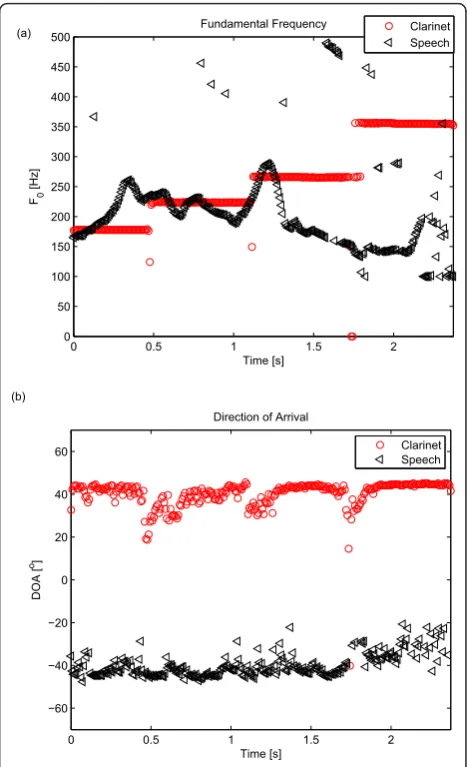
overestimation technique is usually used when the true order of the signal subspace is unknown, the signal sub-space is assumed to be larger than the true one which can minimize the signal subspace components in the noise subspace. An added benefit of posing the problem as a joint estimation problem is that the multi-pitch estimation problem can be seen as several single-pitch problems for a distinct set of DOAs, one per source. Therefore, it is less important to select an exact signal model order than single-channel multi-pitch estimators would need [28]. The cost function is evaluated for fre-quencies from 100 to 500 with granularity of 0.52 Hz. The evaluated results are illustrated in Figure 2 where the upper panel contains the fundamental frequency estimates and lower panel the DOA estimates. It can be seen that the proposed algorithm can track the funda-mental frequency and the DOA of the speech signal well, with only a few observed errors on regions with low signal energy. The clarinet signal’s DOA and funda-mental frequencies have also been estimated well for all segments.
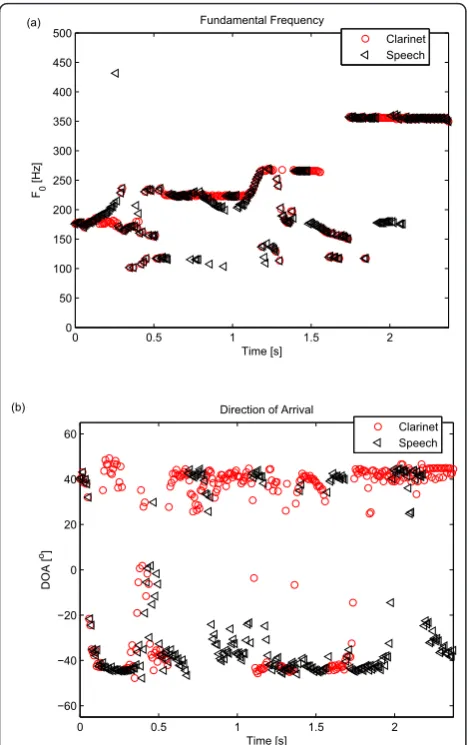
For the purpose of further comparison, the same signal will be analyzed using a standard time delay-and-sum beamformer [34] for DOA estimates and a single-channel maximum-likelihood based pitch esti-mator applied on the beamformed output signals [2]. The results are shown in Figure 3. The figure clearly shows that the delay-sum beamformer cannot
satisfac-tory resolve the DOAs with M = 8 array elements
which will further affect the performance of the sin-gle-channel pitch estimator, as shown in the upper panel. In this example, the proposed algorithm shown in Figure 2 is superior compared to reference method shown in Figure 3. The low resolution performance of the reference method will make the statistical
evaluation of this method uninteresting, and we, therefore, will not be using it any further in the experiments to follow.
4.2. Statistical evaluation
Next, we use Monte Carlo simulations evaluated on syn-thetic signals embedded in noise in assessing the statisti-cal properties of the proposed method and compare it with the exact CRLB. As a reference method for pitch and DOA estimation, we use the JAFE algorithm pro-posed in [22] for jointly estimating unconstrained
fre-quencies and DOAs. Next, the unconstrained
frequencies are grouped according to their correspond-ing DOAs where closely related directions are grouped together. A fundamental frequency is formed from these grouped frequencies in a weighted way as proposed in [35]. We refer this as the WLS estimator. In order to
Figure 1The mixed spectrogram of the real recorded speech and clarinet signal.
0 0.5 1 1.5 2
0 50 100 150 200 250 300 350 400 450 500
Time [s]
F0
[Hz]
Fundamental Frequency Clarinet
Speech
0 0.5 1 1.5 2
í60
í40
í20 0 20 40 60
Time [s]
DOA [
o]
Direction of Arrival
Clarinet Speech (a)
(b)
remove the errors due to the erroneous estimate of amplitudes, we assume WLS having the exact signal amplitude given. The WLS estimator is a computation-ally efficient pitch estimation method with good statisti-cal properties. The reference DOA estimate is easily obtained in a similar way from the mean value of these grouped DOAs according to [22].
Here, we consider aM = 8 element ULA with sensor
distance d = 0.0425 with a sampling frequency of fs=
8000. The estimators are evaluated for two signal setups,
first with two sources having ω1 = 252.123 and ω2 =
300.321 with L1,2 = 3, and second with one harmonic
source of ω1 = 252.123 and L1 = 3. All amplitudes on
individual harmonics are set to unityAk,l = 1 for tract-ability. Both sources are assumed to be far-field sources
impinging on the array with DOAs at θ1 = -43.23° and
θ2 = 70°, respectively, and for one source having a DOA
of θ1 = -43.23°. All simulation results are based on 100
Monte Carlo runs. The performance is measured using the root mean squared estimation error (RMSE) as defined in [28,32,26,27]. The user parameter for JAFE data model is selected to the optimal values as proposed in [22] with temporal and spatial smoothness para-meters, t=23N and s=M2, respectively. We note that in practical applications, the computational com-plexity has to also be considered in selecting the
appro-priate parameters t and s. An example of the
2-dimensional (2D) cost function of our proposed method evaluated on two mixed signal is illustrated in Figure 4, where a coarser estimate of the DOA and fundamental estimates can be identified from the two peaks in the 2D cost function.
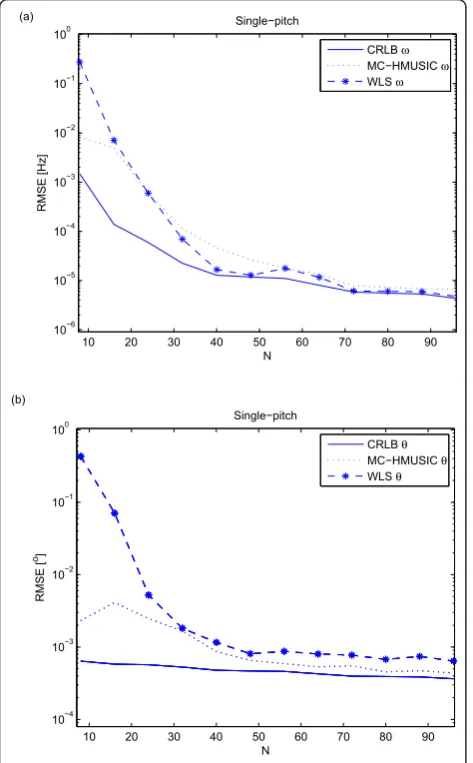
In the first simulation, we evaluate the proposed method’s statistical properties in a single source scenario for varying sample lengths and SNRs. The RMSEs on
signal with varyingNare shown in Figure 5, and with
varying SNR in Figure 6. It can be seen from these fig-ures that both estimators perform well for all SNR above 0 dB with WLS being slightly better for funda-mental frequency estimation while the proposed estima-tor is better in DOA estimation. Both methods are also
able to follow CRLB closely for around sample lengthN
>60. The better DOA estimation capabilities of the pro-posed method can be explained by the joint estimation of the fundamental frequency and DOA, which leads to increased robustness under adverse conditions. Both estimators can be considered as consistent in the single-pitch scenario.
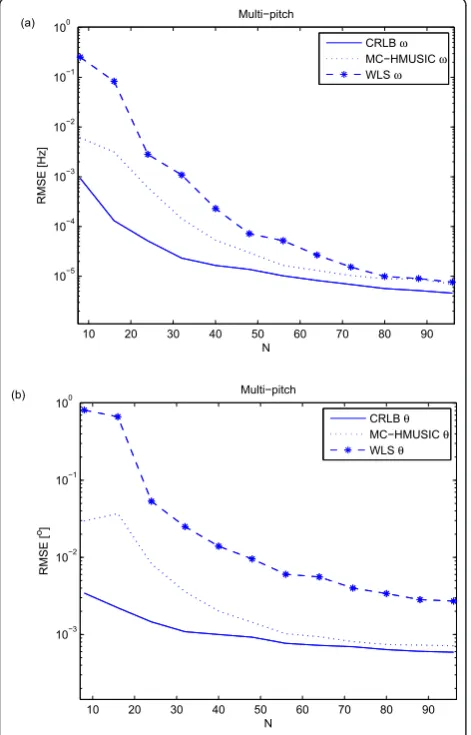
Next, we evaluate our method for the multi-pitch scenario. The so-obtained RMSEs for varying N and
0 0.5 1 1.5 2
0 50 100 150 200 250 300 350 400 450 500
Time [s]
F0
[Hz]
Fundamental Frequency
Clarinet Speech
0 0.5 1 1.5 2
í60 í40 í20 0 20 40 60
Time [s]
DOA [
o]
Direction of Arrival
Clarinet Speech (a)
(b)
Figure 3The estimates of (a) the fundamental frequency using maximum-likelihood estimator at the output of the
beamformer, (b) the DOA using a delay-sum beamformer.
Figure 4Example of cost functions for two synthetic sources
having three harmonic each,N= 64 andM= 8. The true
fundamental frequency ofω1= 252.123 andω2= 300.321 having
SNR are depicted in Figures 7 and 8. In Figure 7, it clearly shows that the proposed method is better than the WLS estimator for short sample lengths. The WLS
estimator is not following CRLB until N >80 samples
while the proposed estimator is for N >64. The
remaining gap between CRLB and both evaluated
esti-mators for N >80 are due to the mutual interference
between the harmonic sources. The slowly converging performance of WLS is mainly due to the bad estimate of the unconstrained frequency estimate using the JAFE method. With our selected simulation setup, the JAFE estimator is not giving consistent estimates for all harmonic components, which, in turn, results in poor performance in the WLS estimates. In general, the WLS estimator is sensitive to spurious estimate of the unconstrained frequencies. Moreover, the proposed
estimator, which is jointly estimating both the DOA and the fundamental frequency, yields better estimates
for smaller sample length N. The results in terms of
RMSEs for varying SNRs are shown in Figure 8. This figure shows that the proposed estimator is again more robust than the WLS estimator for both DOA and fun-damental frequency estimation.
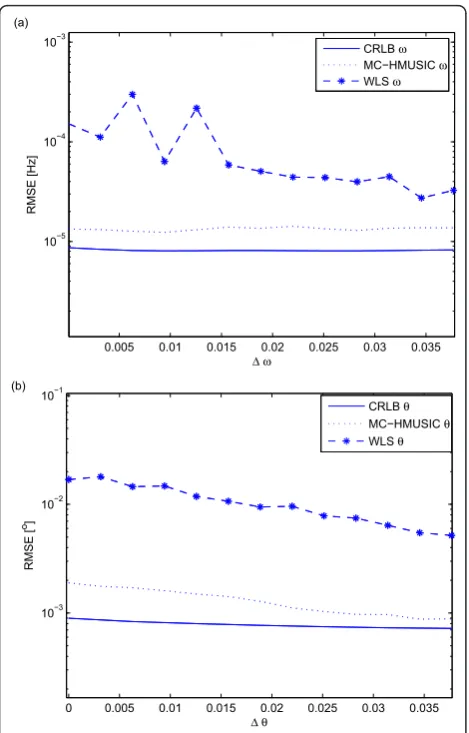
In next two experiments, we will study the perfor-mance as a function of the difference in fundamental frequencies and DOAs for multiple sources. We start with studying the RMSE as a function of the difference between the fundamental frequencies of two harmonic sources, i.e., Δω = |ω1 - ω2|, withθ1 = -43.321° andθ2
= 70°. Here, we use an SNR set to 40 dB, and a sample
length N= 64 with M= 8 array elements. The obtained
RMSEs are shown in Figure 9. The figure clearly shows
10 20 30 40 50 60 70 80 90
10í6 10í5 10í4 10í3 10í2 10í1 100
N
RMSE [Hz]
Singleípitch
CRLB ω MCíHMUSIC ω WLS ω
10 20 30 40 50 60 70 80 90
10í4 10í3 10í2 10í1 100
N
RMSE [
o]
Singleípitch
CRLB θ MCíHMUSIC θ WLS θ (a)
(b)
Figure 5RMSE as a function ofNfor SNR = 40 dB evaluated on single-pitch signal with unit amplitude: (a) fundamental frequency estimates; (b) DOA estimates.
í20 í10 0 10 20 30 40
10í6 10í5
10í4 10í3 10í2
10í1 100 101
SNR
RMSE [Hz]
Singleípitch
CRLB ω MCíHMUSIC ω WLS ω
í20 í10 0 10 20 30 40
10í4 10í3
10í2 10í1 100 101
SNR
RMSE [
o]
Singleípitch
CRLB θ MCíHMUSIC θ WLS θ (a)
(b)
that both methods can successfully estimate the funda-mental frequencies and DOAs. Once again the proposed estimator gives more robust estimates, close to the CRLB. Additionally, it should be noted that both meth-ods are correctly estimating the DOA even when the
both fundamental frequencies are identical ω1 = ω2,
something that would not be possible with only a single channel. MC-HMUSIC has the ability to estimate the fundamental frequencies when both harmonics are iden-tical provided that the DOAs are distinct and vice versa. Estimation of the parameters of signals with overlapping harmonics is a crucial limitation in multi-pitch estima-tion using only single-channel recordings. In the final experiment, the RMSE as a function of the difference
between the DOAs of two harmonic sourcesΔθ = |θ1
-θ2| is analyzed for an SNR set to 40 dB and a sample
length ofN= 64 withM= 8 array elements. The
funda-mental frequencies areω1= 252.123 andω2 = 300.321,
respectively. The observations and conclusions are basi-cally the same as before, with the proposed method out-performing the reference method so far.
5. Conclusion
In this article, we have generalized the single-channel multi-pitch problem into a multi-channel multi-pitch estimation problem. To solve this new problem, we pro-pose an estimator for joint estimation of fundamental frequencies and DOAs of multiple sources. The pro-posed estimator is based on subspace analysis using a time-space data model. The method is shown to have potential in applications to real signals with simulated anechoic array recording, and a statistical evaluation demonstrates its robustness in DOA and fundamental frequency estimation as compared to a state-of-the-art reference method. Furthermore, the proposed method is shown to have good statistical performance under
10 20 30 40 50 60 70 80 90
10í5
10í4 10í3 10í2 10í1 100
N
RMSE [Hz]
Multiípitch
CRLB ω
MCíHMUSIC ω
WLS ω
10 20 30 40 50 60 70 80 90
10í3
10í2
10í1
100
N
RMSE [
o]
Multiípitch
CRLB θ
MCíHMUSIC θ
WLS θ
(a)
(b)
Figure 7RMSE as a function ofNfor SNR = 40 dB evaluated on multi-pitch signal with unit amplitudes: (a) joint
fundamental frequency estimates; (b) joint DOA estimates.
í20 í10 0 10 20 30 40 10í6
10í5 10í4
10í3
10í2
10í1 100 101
SNR
RMSE [Hz]
Multiípitch
CRLB ω
MCíHMUSIC ω
WLS ω
í20 í10 0 10 20 30 40 10í4
10í3
10í2 10í1 100
101
SNR
RMSE [
o]
Multiípitch
CRLB θ
MCíHMUSIC θ WLS θ (a)
(b)
adverse conditions, for example for sources with similar DOA or fundamental frequency.
Acknowledgements
The study of Zhang was supported by the Marie Curie EST-SIGNAL Fellowship, Contract No. MEST-CT-2005-021175.
Author details
1Department of Electronic Systems (ES-MISP), Aalborg University, Aalborg,
Denmark2Department of Architecture, Design and Media Technology,
Aalborg University, Denmark3Department of Electrical Engineering (ESAT-SCD), Katholieke Universiteit Leuven, Leuven, Belgium
Competing interests
The authors declare that they have no competing interests.
Received: 26 March 2011 Accepted: 2 January 2012 Published: 2 January 2012
References
1. A Klapuri, Automatic music transcription as we know it today. J New Music Res.33, 269–282 (2004)
2. MG Christensen, A Jakobsson,Multi-Pitch Estimation. Synthesis Lectures on Speech and Audio Processing (2009)
3. L Rabiner, On the use of autocorrelation analysis for pitch detection. IEEE Trans Signal Process.44, 2229–2244 (1996)
4. JX Zhang, MG Christensen, SH Jensen, M Moonen, A robust and computationally efficient subspace-based fundamental frequency estimator. IEEE Trans Acoust Speech Language Process.18(3), 487–497 (2010) 5. A de Cheveigne, H Kawahara, YIN, a fundamental frequency estimator for
speech and music. J Acoust Soc Am.111(4), 1917–1930 (2002) 6. DL Wang, GJ Brown,Computational Auditory Scene Analysis: Principle,
Algorithm, and Applications, (Wiley, IEEE Press, New York, 2006)
7. A Klapuri, Multiple fundamental frequency estimation based on harmonicity and spectral smoothness. IEEE Trans Speech Audio Process.11, 804–816 (2003)
8. V Emiya, D Bertrand, R Badeau, A parametric method for pitch estimation of piano tones. inIEEE International Conference on Acoustics, Speech, and Signal Processing.1, 249–252 (2007)
9. S Rickard, O Yilmaz, Blind separation of speech mixtures via time-frequency masking. IEEE Trans Signal Process.52, 1830–1847 (2004)
10. M Wohmayr, M Kepsi, Joint position-pitch extraction from multichannel audio. inProceedings of the Interspeech(2007)
11. X Qian, R Kumaresan, Joint estimation of time delay and pitch of voiced speech signals. inRecord of the Asilomar Conference on Signals, Systems, and Computers.2(1996)
12. SN Wrigley, GJ Brown, Recurrent timing neural networks for joint F0-localisation based speech separation. inIEEE International Conference on Acoustics, Speech and Signal Processing(2007)
13. F Flego, M Omologo, Robust F0 estimation based on a multi-microphone periodicity function for distant-talking speech. inEUSIPCO(2006) 14. L Armani, M Omologo, Weighted auto-correlation-based F0 estimation for
distant-talking interaction with a distributed microphone network. inIEEE International Conference on Acoustics, Speech and Signal Processing.1, 113–116 (2004)
15. D Chazan, Y Stettiner, D Malah, Optimal multi-pitch estimation using the em algorithm for co-channel speech separation. inProceedings of the IEEE International Conference on Acoustics, Speech, and Signal Processing(1993) 16. G Liao, HC So, PC Ching, Joint time delay and frequency estimation of
multiple sinusoids. inIEEE International Conference on Acoustics, Speech and Signal Processing.5, 3121–3124 (2001)
17. Y Wu, HC So, Y Tan, Joint time-delay and frequency estimation using parallel factor analysis. Elsevier Signal Process.89, 1667–1670 (2009) 18. LY Ngan, Y Wu, HC So, PC Ching, SW Lee, Joint time delay and pitch
estimation for speaker localization. inProceedings of the IEEE International Symposium on Circuits and Systems722–725 (2003)
19. P Stoica, R Moses,Spectral Analysis of Signals, (Prentice-Hall, Upper Saddle River, 2005)
20. M Brandstein, D Ward,Microphone Arrays, (Springer, Berlin, 2001)
21. AJ van der Veen, M Vanderveen, A Paulraj, Joint angle and delay estimation using shift invariance techniques. IEEE Trans Signal Process.46, 405–418 (1998)
22. AN Lemma, AJ van der Veen, EF Deprettere, Analysis of joint angle-frequency estimation using ESPRIT. IEEE Trans Signal Process.51, 1264–1283 (2003)
23. M Viberg, P Stoica, A computationally efficient method for joint direction finding and frequency estimation in colored noise. inRecord of the Asilomar Conference on Signals, Systems, and Computers.2, 1547–1551 (1998) 24. JD Lin, WH Fang, YY Wang, JT Chen, FSF MUSIC for joint DOA and frequency estimation and its performance analysis. IEEE Trans Signal Process.54, 4529–4542 (2006)
25. S Wang, J Caffery, X Zhou, Analysis of a joint space-time doa/foa estimator using MUSIC. inIEEE International Symposium on Personal, Indoor and Mobile Radio CommunicationsB138–B142 (2001)
26. MG Christensen, P Stoica, A Jakobsson, SH Jensen, Multi-pitch estimation. Elsevier Signal Process.88(4), 972–983 (2008)
27. MG Christensen, A Jakobsson, SH Jensen, Joint high-resolution fundamental frequency and order estimation. IEEE Trans. Acoust Speech Signal Process. 15(5), 1635–1644 (2007)
28. JX Zhang, MG Christensen, SH Jensen, M Moonen, An iterative subspace-based multi-pitch estimation algorithm. Elsevier Signal Process.91, 150–154 (2011)
29. AN Lemma, ESPRIT based joint angle-frequency estimation algorithms and simulations. PhD Thesis Delft University (1999)
0.005 0.01 0.015 0.02 0.025 0.03 0.035 10í5
10í4 10í3
Δω
RMSE [Hz]
CRLB ω
MCíHMUSIC ω
WLS ω
0 0.005 0.01 0.015 0.02 0.025 0.03 0.035 10í3
10í2 10í1
Δθ
RMSE [
o]
CRLB θ
MCíHMUSIC θ
WLS θ
(a)
(b)
30. T Shu, XZ Liu, Robust and computationally efficient signal-dependent method for joint DOA and frequency estimation. EURASIP J Adv Signal Process.2008(2008). Article ID 10.1155/2008/134853
31. H Krim, M Viberg, Two decades of array processing research-the parametric approach. IEEE SP Mag (1996)
32. MG Christensen, A Jakobsson, SH Jensen, Multi-pitch estimation using Harmonic MUSIC. inRecord of the Asilomar Conference on Signals, Systems, and Computers521–525 (2006)
33. MG Christensen, A Jakobsson, SH Jensen, Sinusoidal order estimation using angles between subspaces. EURASIP J Adv Signal Process 1–11 (2009). Article ID 948756
34. BDV Veen, KM Buckley, Beamforming: a versatile approach to spatial filtering. IEEE ASSP Mag.5, 4–24 (1988)
35. H Li, P Stoica, J Li, Computationally efficient parameter estimation for harmonic sinusoidal signals. Elsevier Signal Process 1937–1944 (2000)
doi:10.1186/1687-6180-2012-1
Cite this article as:Zhanget al.:Joint DOA and multi-pitch estimation
based on subspace techniques.EURASIP Journal on Advances in Signal
Processing20122012:1.
Submit your manuscript to a
journal and benefi t from:
7 Convenient online submission
7 Rigorous peer review
7 Immediate publication on acceptance
7 Open access: articles freely available online
7 High visibility within the fi eld
7 Retaining the copyright to your article