R E S E A R C H
Open Access
Modeling bee swarming behavior through
diffusion adaptation with asymmetric
information sharing
Jinchao Li
*and Ali H Sayed
Abstract
Honeybees swarm when they move to a new site for their hive. During the process of swarming, their behavior can be analyzed by classifying them as informed bees or uninformed bees, where the informed bees have some information about the destination while the uninformed bees follow the informed bees. The swarm’s movement can be viewed as a network of mobile nodes with asymmetric information exchange about their destination. In these networks, adaptive and mobile agents share information on the fly and adapt their estimates in response to local measurements and data shared with neighbors. Diffusion adaptation is used to model the adaptation process in the presence of asymmetric nodes and noisy data. The simulations indicate that the models are able to emulate the swarming behavior of bees under varied conditions such as a small number of informed bees, sharing of target location, sharing of target direction, and noisy measurements.
I. Introduction
Animal species move in groups, such as schools of fish, flocks of birds, and swarms of honeybees, when they perform seasonal migrations, travel to food sources, or to new sites [1]. For some species, the majority of the individuals in the group process the information about the propensity to travel in a certain direction; but for other species, only some of the group members share information about the destination, while the other unin-formed members are guided by inunin-formed individuals. For example, for honey bees, when they have made a decision about the new site and begin traveling, the location of the new nest site is only known to a small fraction of the swarm [2,3].
A curious feature in the home-site selection procedure by bees is that only 3-5% of the bees [4] in the swarm have been to the new site and are called scout bees. So, how can these fewer bees lead the entire swarm toward the new site? After falsifying the “assembly pheromone” assumption [5], there have been at least two likely hypotheses, both of which show that the informed bees provide guidance information to the other bees [6]. One hypothesis is the “subtle bee”hypothesis and the other
one is the “streaker bee” hypothesis. The “subtle bee” hypothesis suggests that informed bees do not conspicu-ously signal the correct travel direction but steer the whole swarm by moving toward the right direction. The
“streaker bee”hypothesis states that the informed bees will conspicuously signal the correct travel direction by making high-speed flights. The major difference is that in the “streaker bee” hypothesis, the uninformed bees will pay more attention to the action of those high-speed bees, i.e., they favor the information transmitted from fast flying bees. In simulations, it was shown in [7] that in a group of both informed individuals and unin-formed individuals, if each individual attempts to align with neighbors and tries to keep a certain distance from others, then the whole group can fly correctly to the destination. This policy can be used to explain the
“subtle bee” hypothesis. On the other hand, it was shown in [8] that the“streaker bee”hypothesis is a plau-sible mechanism by simulating the case that uninformed individuals can recognize informed bees and favor align-ment to these bees. Later, through photographic analy-sis, the work [9] showed that there are some fast flying bees in the swarm, especially in the upper half of the cloud of bees. And the experiments in [9,10] showed that those high-speed bees have greater directionality oriented toward the new nest site. Thus, though it is still uncertain
* Correspondence: [email protected]
Department of Electrical Engineering University of California, Los Angeles
Li and SayedEURASIP Journal on Advances in Signal Processing2012,2012:18 http://asp.eurasipjournals.com/content/2012/1/18
whether uninformed bees follow streaker bees, it appears that uninformed bees follow fast flying bees.
In this article, we construct a model to explain the bee swarming behavior under conditions not considered before including the type of information that is shared about the bees, the fact that measurements are subject to noise, and the fact that the location of the destination is not known precisely but needs to be estimated on the fly from noisy data. When information is subjected to noise, improved performance can be obtained if the shared information is processed locally as well. Rather than rely solely on, for example, averaging information from nearby neighbors, the diffusion model that is adopted in this article allows each individual bee to further filter the received information based on its local measurements. The model is based on the assumption that streaker bees lead uninformed bees by flying fast, and that if they slow down to the speed of the unin-formed bees, they are not recognized as streaker bees by the rest of the swarm.
The swarming behavior of honeybees provides a useful and interesting example of one kind of mobile networks that consists of two types of nodes: informed agents and followers. In these networks, there is a limited number of informed nodes, which possess relatively accurate information about the overall objective of the network (such as moving toward a target location). In contrast, the remaining nodes (which constitute the majority) do not have information about the target location but rather interact with their neighboring nodes in order to infer useful information about the overall objective. Information diffuses through this hierarchical network structure and the motion of the uniformed agents is ultimately influenced by the measurements from the informed agents. Some earlier works in the literature, such as [11-13], used bio-inspired ideas to suggest meth-ods for distributed detection and resource allocation in communication systems. In this article, we are instead interesting in proposing a distributed algorithm that emulates the bee swarming behavior. We do so by employing a diffusion adaptation strategy, and con-structing a mobile network model to represent the swarm, with each node corresponding to a bee in the swarm. By using diffusion adaptation [14-16], each bee makes its own estimation about the target location and shares information with its neighbors. The type of infor-mation shared among neighbors affects the efficiency of the swarming behavior. We consider two types of infor-mation sharing. In one case, we assume the agents share noisy information about the general location of the tar-get, and in the other case we assume the agents share noisy information about the general direction of the tar-get. Our model extends the earlier study done in [8], which focused on ensuring that the bees align their
individual velocities to the average velocity of their neighbors through a consensus procedure. In contrast, we incorporate diffusion adaptation and allow the bees to adjust their velocities by taking into account several additional effects such as: (a) the velocities of their neighbors as in [8]; (b) the velocities of the informed agents; (c) the agents’estimation of the target location; and (d) the type of information that is being shared (such as information about the location of the target or about its direction). Simulation results further ahead (e. g., Figures nine and ten) illustrate how these additional factors improve the accuracy of the model. Furthermore, since it is reasonable to assume that each bee generally assesses information relative to its own location, the model that is developed in the body of the article is translated into a local coordinate system in the Appen-dix. We derive the equation models relative to a global coordinate system in the following sections because it is easier to convey the main ideas without overburdening the notation with subscripts and superscripts that refer to different local coordinate systems (one for each bee).
A. Relation to network processing algorithms
In prior studies on network adaptation and processing [17,18], the emphasis has largely been on the case of homogeneous networks, where nodes have similar pro-cessing capabilities and similar information levels about the state of the environment. The swarm of bees provides a useful example of a heterogeneous network consisting of two types of nodes: some nodes (about 5% of them) are more informed than the remaining nodes. In addi-tion, the nodes are mobile and the informed nodes are faster than the uninformed nodes. From a signal (or information) processing perspective, it is an interesting challenge to show how to organize the sharing of infor-mation in a manner that benefits the overall performance across the network. To do so, we consider two subnet-works: one for informed bees and the other for unin-formed bees; the agents within each subnetwork share information with the neighbors in the same subnetwork. In addition, in order to allow passing of information from informed nodes to uninformed nodes, the informed needs perform a strategy for information sharing by mov-ing back and forth to become part of the neighborhoods of the uninformed nodes. In this article, we describe one way of developing adaptation algorithms that handle such heterogeneous behavior and examine the perfor-mance of the network in the presence of adaptation noise and dynamically changing neighborhoods.
II. Diffusing position information
used to allow the nodes to adapt their motion toward the common target (hive) location.
A. Informed bees
Informed bees have been to the destination site before. However, while traveling with the swarm toward the site, their estimation of the distance to the new site is not accurate due to noisy disturbances. For each itera-tion step, the informed bees sense the approximate dis-tance to the site in the presence of noise, communicate with the informed bees in their neighborhood, and use this process of information sharing to refine their esti-mation of the location of the site. Based on the number of neighboring bees, the informed bees decide on whether to trust the refined information and move in the direction of the estimated location. To describe the algorithm in more mathematical terms, let us introduce a couple of parameters:
⎧ ⎪ ⎪ ⎪ ⎪ ⎪ ⎪ ⎪ ⎪ ⎪ ⎪ ⎪ ⎪ ⎪ ⎪ ⎪ ⎪ ⎪ ⎪ ⎪ ⎪ ⎪ ⎪ ⎨ ⎪ ⎪ ⎪ ⎪ ⎪ ⎪ ⎪ ⎪ ⎪ ⎪ ⎪ ⎪ ⎪ ⎪ ⎪ ⎪ ⎪ ⎪ ⎪ ⎪ ⎪ ⎪ ⎩
ωo: Actual location of the new hive site.
xk,i: Actual position of informed beekat timei.
uk,i:
Noisy unit - norm direction vector from informedkbee at timeitowards the target locationwo. The exact direction vector, say
uo
k,i, is equal to the unit - norm vector that points fromxk,itowardswo. The vectoruk,i is a noisy version ofuo
k,i.
do
k(i) : Actual distance to the new site from informed beekat timei.
dk(i) :
Measured distance to the new site by informed beekat timei. This distance is affected by random noise.
(1)
In our notation we use boldface letters, such as dk(i)
anduk,i, to denote stochastic variables and use normal
font, such as dk(i) and uk,i, to denote realizations or
observations for these random variables.
As the informed bees approach the target, they are able to make better estimation of their distance to the target. Therefore, we shall assume that the measured distance dk(i) is the true distance plus additive noise,
with the variance of the noise changing in proportion to the distance to the target, namely, we assume that
dk(i) =dok(i) +β·ω o−x
k,i·nk(i) (2) where nk(i) is a normalized unit-variance zero-mean
Gaussian variable, and b is a positive parameter. The term∥w° - xk,i∥ is a measure of the Euclidean distance
from beekto the target.
We assume that the swarm contains a total of K
informed bees and N - K uninformed bees (with K
usually much smaller thanN). Now given the noisy dis-tance measurements (2) by the informed bees, we con-sider the following cost function:
min
w K
k=1
Edk(i)−uk,i(ωo−xk,i)2 (3)
where Edenotes the expectation operator. This cost function attempts to determine the optimal location w° that best matches the measured data {dk(i),uk,i} in the
least-mean-squares sense. Once determined, the esti-mate of w° will be subsequently used by the bees to adjust their velocity vectors and update their locations. We are interested in a distributed solution to (3) where the estimation problem can be solved in a decentralized manner where each bee would only need to share infor-mation with its immediate (local) neighbors and not with all other bees. To arrive at such a distributed solu-tion, we call upon the adapt-then-combine (ATC) diffu-sion algorithm, which was developed in [15,16] to solve similar problems. The algorithm consists of two steps: an adaptation (processing) step followed by a consulta-tion (combinaconsulta-tion) step. Letψk,i-1denote the estimate of w° by bee kat time i - 1. Given the data {dk(i), uk,i} at
timei, the following steps are performed (In analysis of the following part, it is presumed that the bees are not in the position of the destination. Otherwise, those bees stop the process of estimation and velocity control):
(1) Adaptation step. Each informed bee performs an adaptation step by incorporating the local data {dk(i),uk,
i, xk,i} in order to update its estimate ψk,i-1 into an
improved intermediate estimatejk,i:
φk,i=ψk,i−1+μku∗k,i dk(i)−uk,i(ψk,i−1−xk,i)
(4)
(2) Combination step. Subsequently, each informed bee averages the intermediate estimates of its immediate neighbors to obtain the final updated estimateψk,i. This
sequence of adaptation and combination steps updates the estimate ofw° fromψk,i-1toψk,i:
ψk,i=
t∈N(i)
k,s ask,lφl,i
(5)
In (5), the symbol Nk(,is) represents the set of informed bees in the neighborhood of informed bee kat timei; the neighborhood may be defined as the set of informed bees that are within distance r from bee k. The coeffi-cients as
k,l are scaling factors that add up to one. For simplicity, the coefficients can be assigned uniformly or assigned according to the distance between the bee and its neighbors:
l∈Nk(,is)
ask,l= 1
(6)
Expressions (4) and (5) indicate that the informed bees first estimate the position of the new site (adaptation step), and then communicate with their neighbors and obtain a new estimate (combination step). Observe that in this diffusion model, the bee does not rely solely on
Li and SayedEURASIP Journal on Advances in Signal Processing2012,2012:18 http://asp.eurasipjournals.com/content/2012/1/18
combining the information received from its neighbors [as in (5)]. The bee also processes this combined esti-mate according to (4) by evaluating an error term that measures how well the combined estimate explains the local data {dk(i),uk,i} measured by beek.
(3) Velocity control step. After each informed bee has updated its estimate to ψk,i, the group of informed
bees needs to decide where they should move to in the next step. We call this step the control step, since the result of the estimation result is used for controlling the bees’motion. For the control step, each informed bee checks the number of bees in its neighborhood. If the number exceeds a certain threshold, then the informed bee will move toward the direction of the nest site as described below. The velocity vector will be set as a weighted combination of the previous and current velo-city vectors. To describe the mechanism of velovelo-city con-trol, we define the maximum speed asgsmax, wheregis a number between 2 and 3, and smax is the maximum speed of motion of the uninformed bees. If the number of informed bees is less than a threshold, then the informed bee will go back to the rear of the swarm. In fact, whether these informed bees move toward the rear or linger around until the rest of the swarm go past them is still not known. In this study, we use the former assumption and assume that the informed bee first moves toward the center of the swarm, and when it passes the center, it goes toward the opposite direction of the new site. During this process, the speed becomes
smax the same as that of the uninformed bees, so that other bees cannot recognize it as an informed bee. This procedure can be modeled mathematically as follows:
If Nk(,is) ≥threshold, then informed bee ksets its velo-city vector as a combination of the previous velovelo-city vector and an estimate of the direction vector toward the location of the new site:
vk,i= (1−λ)vk,i−1+λγsmax
(ψk,i−xk,i)
ψk,i−xk,i
(7)
else if Nk(,is) < threshold, then informed bee k moves back toward the rear of the swarm. Initially, the bee turns around with velocity
vk,i=−smax ψk,i− xk,i
ψk,i−xk,i (8)
Subsequently, the informed bee detects the bees that are in front of it and moves toward the center of this group until it reaches the rear of the swarm. Bee l is considered to be in front of informed beekwhen
xl,i−xk,i<rr (9)
(xl,i−xk,i)vTk,i>0 (10) whererris the range of the perception area (the same
value as the repulsion region for uninformed bees described further ahead in (19)). Then the velocity at timeifor informed beekis set as
vk,i=smax
l∈Nk(,if)(xl,i−xk,i)
l∈Nk(,if)(xl,i−xk,i)
(11)
where Nk(,if) is the set of bees in front of beekat time
i. This velocity selection makes the informed bee move toward the center of the surrounding bees that are in front of it while it is moving toward the back of the swarm.
After setting the velocity vector, each informed bee then updates its position according to the rule:
xk,i+1=xk,i+vk,it (12)
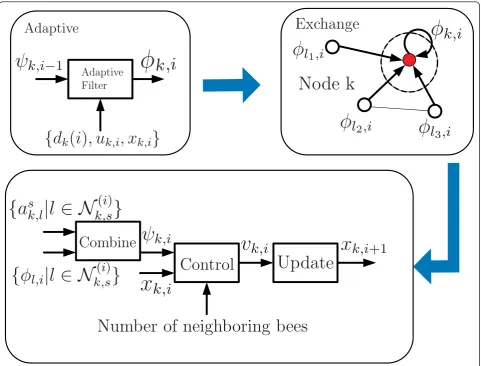
The procedure is summarized in Figure 1. In (7) and (8), we assume that the term in the denominator is not zero; otherwise, we set the velocityvk,i to zero (sinceψk,i
=xk,i indicates that the informed bee is close to or has
likely arrived at the destination).
B. Uninformed bees
The uninformed bees have not been to the destination site before and they cannot sense the position of the destination. They collect information about the site by first checking whether there are informed bees in their neighborhood. If so, they benefit from the estimation results of these neighbors; if not, they use the result of their previous estimation step. Specifically, we consider the following cost function for the uninformed bees:
min
w N−K
k=1 E
l∈N(i)
k,s
ck,lψl,i−ωo
2
(13)
where the coefficientsck,lare scaling factors that add
up to one (for simplicity, the factors can be assigned uniformly):
l∈Nk(,is)
ck,l= 1
(14)
minimizing the mean-square error (MSE). Once deter-mined, the estimate of w° is subsequently used by the uninformed bees to adjust their velocity vectors and update their locations. Again, we are interested in a dis-tributed solution to (13), whereby each bee would only need to share information with its immediate (local) neighbors. To do so, we again appeal to the ATC diffu-sion algorithm. The algorithm consists of two steps: an adaptation (processing) step followed by a consultation (combination) step. As before, we let ψk,i-1denote the
estimate of w° at uninformed beekat timei- 1. Given the estimates {ψl,i-i} from the informed bees in the
neighborhood, each uninformed bee would perform the following three steps:
(1) Adaptation step. Each uninformed bee combines the current estimates at timei from its informed neigh-bors and uses this information to update its estimateψk,
i-1 to the intermediate valuejk,i:
φk,i=ψk,i−1+μk
⎛ ⎜
⎝
l∈Nk(,is)
ck,lψl,i−ψk,i−1
⎞ ⎟
⎠ (15)
(2)Combination step. Subsequently, each uninformed bee combines the intermediate estimates of its neighbors (now consisting of both informed and uninformed bees) and ends up with the updated estimateψk,i. The factors
can be assigned uniformly for simplicity:
ψk,i=
l∈N(i)
k ak,lφl,i
(16)
where Nk(i) denotes the set of bees (both informed and uninformed) within the neighborhood of beekat timei. Observe that the neighborhood of beekis divided into two sets: one is the entire neighborhood Nk(i) consisting Figure 1A diffusion adaptation model for the motion of informed bees involving three components: adaptation, consultation, and velocity control.
Li and SayedEURASIP Journal on Advances in Signal Processing2012,2012:18 http://asp.eurasipjournals.com/content/2012/1/18
of all bees within a certain radiusr, and the other setNk(,is) is a subset of the first and consists only of the informed bees within the neighborhood. After the diffusion step (15), the uninformed bees use the location estimatesψk,i
to update their velocity vectors in order to meet at least two objectives: (a) to move toward the target locationw° and (b) to move coherently with the other bees as a group by ensuring that the bees do not get too close to each other or too far from each other, as we now explain.
(3) Velocity control step. The first objective is assisted by computing a velocity component, denoted by
vk,m,i, through a combination of the current velocity and
a vector pointing approximately towardw°, namely,
vk,m,i= (1−λ)vk,i−1+λsmax
(ψk,i−xk,i)
ψk,i−xk,i
(17)
The second objective of moving in a group can be implemented by defining an attraction and repulsion area around each bee. For attraction, the velocity vector is selected as the average of all vectors pointing from the current position of the bee to all of its neighbors [8]:
If Nk(,ia)= 0,
vk,a,i=
smax ra
1
N(i)
k,a
l∈Nk(,ia)
(xl,i−xk,i) (18)
else if Nk(,ia)= 0,
vk,a,i=vk,m,i (19)
where Nk(,ia) is the set of bees within the attraction area
of bee kat time i. The factor r1
a is used to bound the
length of the vector to at most one, so that the value of
vk,a,idoes not exceedsmax. In Equation (18), when bee l
moves away from beek, the weight for beel toward the final attraction velocity of beekwould be larger. In this way, within the attraction region, when the neighboring bees of bee kmove away, bee k would be attracted by these bees.
For repulsion, the velocity vector is selected as the average of all vectors pointing from all neighbors within a given distancerrto the bee [8]:
If Nk(,ir)= 0,
vk,r,i=
smax rr
1
N(i)
k,r
·
l∈N(i)
k,r
(xk,i−xl,i)
rr
xk,i−xl,i
−1
(20)
else if Nk(,ir)= 0,
vk,r,i=vk,m,i (21)
where Nk(,ir) is the set of bees within the repulsion area
of bee kat time i. The factor r1r is used to bound the length of the vector to at most one, so that the value of
vk,r,idoes not exceedsmax. In Equation (20), when
neigh-boring bee lmoves away from beek, the weight for bee
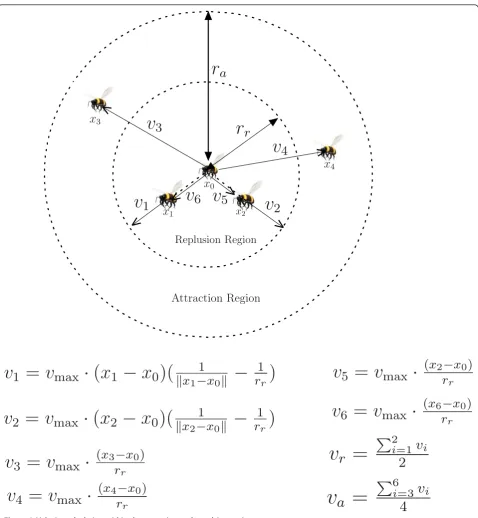
Itoward the final repulsion velocity of beekwould be smaller. In this way, within the repulsion region, when the neighboring bees of bee kmove closer, bee kwould be repelled by these bees. Figure 2 shows an example of how attraction and repulsion work. The three velocity components are combined to yield the bee’s velocity as:
vk,i=αmvk,m,i+ (1−αm)(ρavk,a,i+ρrvk,r,i) (22) whereraandrrare positive weighting scalars, andam
is a factor between 0 and 1.
After setting the velocity vector, each uninformed bee then updates its position vector according to the same rule:
xk,i+1=xk,i+vk,it (23)
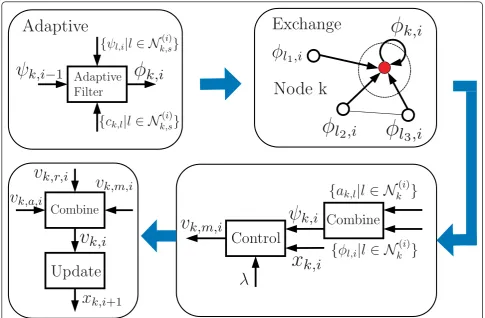
In conclusion, the behavior of uninformed bees is summarized in Figure 3.
C. Simulation results
We set the simulation parameters as in Table 1 to ensure the density of bees is the same as the density of bees in the real world.
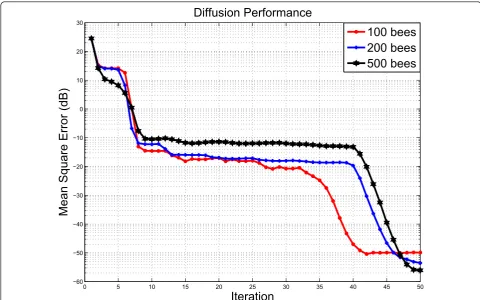
Figure 4 shows that the swarm can reach the destina-tion even if the percentage of informed bees is small (5%). In fact, simulations indicate that the swarm is able to reach the destination even with a smaller fraction of informed bees. Figure 5 shows the convergence speed and mean square error of the estimated target position and the true position for different percentages of informed bees in the swarm.
with the observation in [7] that the larger the swarm is, the less leaders the swarm needs. Moreover, Figure 5 exhibits a staircase shape. The horizontal steps arise when informed bees move back to the rear of the swarm. When they do so, they fly at low speeds and are not recognized as informed bees by the other formed bees. When this situation occurs, the unin-formed bees are not able to update their estimate of the
target location and instead maintain their previous estimates.
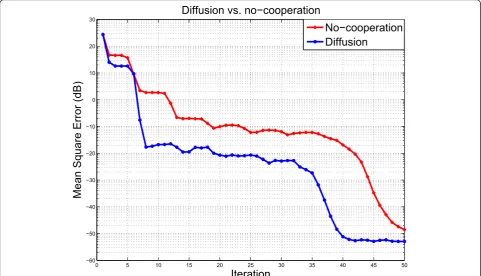
Figure 7 shows the result of diffusion adaptation com-pared with the situation where the bees do not coop-erate with each other to estimate the target location (the combination steps are not used). It is seen that the dif-fusion adaptation model leads to better estimation results.
Figure 2Velocity calculation within the attraction and repulsion regions. Li and SayedEURASIP Journal on Advances in Signal Processing2012,2012:18 http://asp.eurasipjournals.com/content/2012/1/18
D. Comments on model
The informed and uninformed bees perform adaptation diffusion independently. The relation between both pro-cesses is that the observations of the uninformed bees arise from the informed bees. For the informed bees, they share information about the destination location to perform diffusion adaptation, and communicate with the surrounding informed bees. For the uninformed bees, they gather information from the informed bees in their neighborhood, and use these bees’estimation results as their own observation. Afterward, they communicate with all surrounding bees. By examining the information propagation mechanism among uninformed bees, it can be seen that after a few steps, an accurate estimate
about the target position will be shared among the bees in the whole swarm.
III. Diffusing direction information
So far in our discussions we examined one mode of infor-mation sharing where the nodes (bees) shared informa-tion about the locainforma-tion of the target destinainforma-tion. We now discuss another possibility for information sharing, which is less demanding than sharing the location estimates. Bees may instead share information about the direction (rather than location) of the destination.
A. Informed bees
We first model the dynamics of the informed bees. These bees estimate the position of the new site, set their velocity vectors, and then communicate the infor-mation about the direction that agrees with their velo-city vectors to the surrounding informed bees. We again use a diffusion adaptation model. Now, however, the combination step will be applied to the velocity vectors rather than the location vectors. Three steps are involved: adaptation, velocity control, and combination. Figure 3A diffusion adaptation model for the motion of uninformed bees involving three components: adaptation, consultation, and velocity control. In this case, the velocity control block does not only ensure motion toward the desired target, but also helps enforce regions of repulsion and attraction around the bees to guarantee group motion.
Table 1 Simulation parameters
N K ra rr σv2 rr ra Smax μ
100 5 0.5 0.5 0.5 0.8 1.5 0.1 0.2
N, the number of bees in the swarm K, the number of informed bees in the swarm
σ2
(1)Adaptation step. Each informed bee uses its local data to update its estimate of the location from ψk,i-1to
ψk,i. Contrary to the adaptation step in Section 2.1, the
location estimate is updated directly toψk,i rather than
to an intermediate quantity:
ψk,i=ψk,i−1+μku∗k,i[dk(i)−uk,i(ψk,i−1−xk,i)] (24) (2) Velocity control. Each informed bee uses its updated location estimate to compute an intermediate velocity vector based on a threshold computation.
If Nk(,is) ≥ threshold, set the intermediate velocity vec-tor as:
ηk,i= (1−λ)vk,i−1+λγsmax
(ψk,i−xk,i)
ψk,i−xk,i
(25)
else if Nk(,is) < threshold, informed beekinitially turns around with velocity
vk,i=−smax ψk,i− xk,i
ψk,i−xk,i (26)
then moves with velocity:
vk,i=smax
l∈Nk(,if)(xl,i−xk,i)
l∈Nk(,if)(xl,i−xk,i)
(27)
where the position of beelshould satisfy:
xl,i−xk,i<rr (28)
(xl,i−xk,i)vTk,i>0 (29) In (26) and (27), we assume that the term in the denominator is not zero; otherwise, we set the velocity termshk,iandvk,ito zero (sinceψk,i=xk,iindicates that
Figure 4Simulated distribution of a swarm of honeybees as they move toward the destination. Li and SayedEURASIP Journal on Advances in Signal Processing2012,2012:18
http://asp.eurasipjournals.com/content/2012/1/18
the informed bee is close to or has likely arrived at the destination).
(3) Combination step. If the number of informed bees in the neighborhood of bee k is larger than a threshold, the intermediate velocity vectors in the neigh-borhood are combined in a convex manner. Specifically,
If Nk(,is) ≥threshold, set:
vk,i=
l∈Nk(,is) ask,lηl,i
(30)
else if Nk(,is) < threshold, set
vk,i=ηk,i (31)
(4)Update location:
xk,i+1=xk,i+vk,it (32)
Compared with the diffusion model we adopted in Section 2.1, the difference is that the diffusion step of Equation (4) was performed on the estimates of the tar-get location, while now diffusion is performed on the intermediate velocity vectors as in (43).
B. Uninformed bees
In the previous model, the uninformed bees shared information about the position of the new site, and each bee determined its own velocity vector after diffusing the position vectors. In contrast, in the current model, the uninformed bees can only receive information about the velocity vectors of their neighboring bees, so that the diffusion step is performed over the intermediate velocities.
1) Adaptation step. Each uninformed bee k com-bines the velocity vectors of the informed bees in its neighbor hood, and updates its velocity vectorvk,i-1
to an intermediate valuehk,i:
ηk,i=vk,i−1+μk
⎛ ⎜
⎝
l∈Nk(,is)
ck,lvl,i−vk,i−1
⎞ ⎟
⎠ (33)
2)Combination step. Each uninformed bee uses the intermediate velocity vectors to update its velocity in
0 5 10 15 20 25 30 35 40 45 50
−60
−50
−40
−30
−20
−10 0 10 20 30
Iteration
Mean Square Error (dB)
Diffusion Performance
1% informed bees
5% informed bees
10% informed bees
order to satisfy the same two objectives as before: (a) to move toward the target direction and (b) to move coherently with the other bees as a group by ensur-ing that the bees do not get too close to each other or too far from each other.
The first objective is assisted by computing a velocity component, denoted by vk,m,i, through a combination of
the intermediate velocity vectors of other uninformed bees and the velocity vectors of informed bees. The sec-ond objective is assisted by combiningvk,m,iwith a term
that enforces regions of attraction and repulsion around each bee as before:
vk,m,i=
l∈N(i)
k,u auk,lηl,i+
l∈N(i)
k,s ask,lvl,i
(34)
vk,i=αmvk,m,i+ (1−αm)(ρavk,a,i+ρrvk,r,i) (35)
3)Location control step:
xk,i+1=xk,i+vk,it (36)
C. Simulation results
In the simulations, we use the same parameters from Table 1. We observed that the bees are able to reach the destination under this alternative model where the bees share information about the direction of the target (the observed result is similar to Figure 4).
It is also observed that during flight if the bees travel a long distance toward the destination, then the swarm may break up into two subgroups. This situation appar-ently happens when the informed bees fly in front of the swarm and bees at the rear of the swarm are less influenced by them and split away from the group. However in most cases, the two groups of bees will join together again; this behavior is observed in nature.
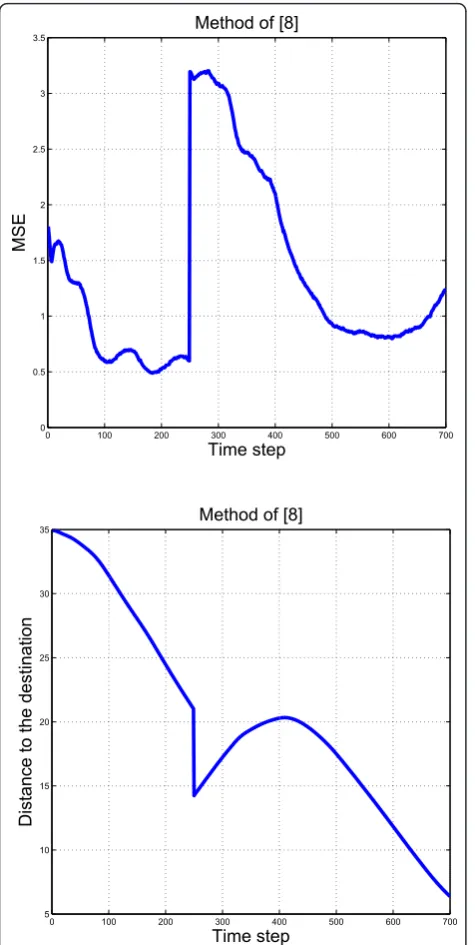
It is useful to compare our results with the model devel-oped in [8]. The model in [8] assumes that the uninformed bees average the velocities of their surrounding bees. In our model, the uninformed bees first check the velocities of the informed bees, set their own velocities, and then communicate with other bees. By doing so, uninformed bees pay more attention to the informed bees. The result indicates that this policy works well in leading uninformed bees to the destination and the uninformed bees would follow the informed bees’behavior more closely. In order to illustrate this difference, we set up two simulations, one
0 5 10 15 20 25 30 35 40 45 50
−60
−50
−40
−30
−20
−10 0 10 20 30
Iteration
Mean Square Error (dB)
Diffusion Performance
100 bees
200 bees
500 bees
Figure 6MSE performance for target location estimation based on a different number of total bees and the same proportion of informed bees (set at 5%).
Li and SayedEURASIP Journal on Advances in Signal Processing2012,2012:18 http://asp.eurasipjournals.com/content/2012/1/18
for the method of [8] and one for our method. The same parameters are used in both simulations, and for the first 250 steps, the destination is set to [20,20,20], and after that, the destination is changed to [0,0,0]. One factor that we measure is the difference between the actual direction toward the target and the estimated direction for each uninformed bee, and we use the MSE to assess this mea-sure. Averaging over 50 experiments, Figures 8 and 9 show how MSE and the distance to the destination vary with time for the method of [8] and for the proposed dif-fusion adaptation models. The results suggest that it takes a longer time for the uninformed bees in model [8] to re-orient themselves to the new destination. Roughly, from the figures, it takes about 350 steps for the bees to gather sufficient information about the new direction using the model in [8], while diffusion adaptation needs only about 10 steps. Note that in the method of Figure 9, when informed bees go back to the rear of the group, it is possi-ble that the swarm may slow down to a small velocity, and this velocity is mostly determined by the attraction and repulsion effects.
IV. Conclusion
This article studied the modeling capabilities of diffusion adaptation mechanisms in the context of bee swarming. Bee swarms provide an example of mobile networks
with asymmetric flow of information where some agents are more informed than others. Two kinds of informa-tion sharing were considered: locainforma-tion of the target and direction of the target. Using the parameters given in the model, in the location sharing model, the swarm can reach the target with as little as 1% of informed bees, while in the direction sharing model, the percentage of informed bees needs to be higher (3% in our simula-tions). Both models support the experimental evidence [7] that there are about 5% streaker bees in a swarm. The diffusion model does not rely only on having the bees follow the average velocity of their neighbors, as in traditional consensus models. Instead, information from the informed bees and estimates of the target location and its direction are diffused to influence the direction of motion as well.
Appendix 1: Diffusing position information using local coordinate systems
The description of the models in the body of the article assumes that the location dataxk,iare measured relative
to a global coordinate system. However, it is reasonable to assume that bees can only observe the positions and velocities of surrounding bees relative to themselves. For this reason, it is more practical to associate with each bee a local coordinate system whose origin is set at the
0 5 10 15 20 25 30 35 40 45 50
−60
−50
−40
−30
−20
−10 0 10 20 30
Iteration
Mean Square Error (dB)
Diffusion vs. no
−
cooperation
No
−
cooperation
Diffusion
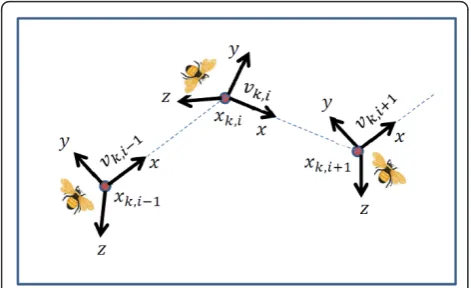
current location of the bee and whose xaxis points in the direction of motion of the bee (this coordinate sys-tem moves with the bee). Note that in view of the updates (12), (23), (32), and (36), the origin of the local coordinate system at timeiis atxk,iand the direction of
thex-axis is the same asvk,i(see Figure 10). In this
sec-tion, we show how to transform the diffusion models from relying on data relative to the global coordinate system to data relative to localized coordinate systems. To uniquely determine the y andz-axes of the local
coordinate systems, we select they-axis to lie perpendi-cular to thex-axis, and select the direction of thez-axis to be according to the vector product rule. When the local coordinate system is selected in this manner, we can move back and forth between global and local coor-dinates as follows:
wl=Gk(w−xk) (37)
whereω represents a vector in the global coordinate system and ωldenotes its representation relative to the local coordinate system attached to beek. Moreover, the term xkdenotes the location of the bee in relation to
0 100 200 300 400 500 600 700
0 0.5 1 1.5 2 2.5 3 3.5
Method of [8]
Time step
MSE
0 100 200 300 400 500 600 700
5 10 15 20 25 30
35 Method of [8]
Time step
Distance to the destination
Figure 8 Method of [8]: MSE (top) versus distance to the destination (bottom).
0 100 200 300 400
0 0.5 1 1.5 2 2.5 3 3.5
4 Our method
Time step
M
S
E
0 100 200 300 400
5 10 15 20 25 30 35
Our method
Time step
Distance to the destination
Figure 9Our method: MSE (top) versus distance to the destination (bottom).
Li and SayedEURASIP Journal on Advances in Signal Processing2012,2012:18 http://asp.eurasipjournals.com/content/2012/1/18
the global coordinates. The columns of the rotation matrix GTk consist of the orthonormal basis vectors of the local coordinate system relative to the global coordi-nate. The matrixGkis unitary.
1.1 Informed bees
We first show how to transform the intermediate esti-matesjk,i and the updated estimates ψk,i to the local
coordinates. To begin with, the rotation matrix that transforms a representation relative to the local coordi-nates at time i - 1 to a representation relative to the local coordinates at timeiis given by:
Glk,i=Gk,iGTk,i−1 (38)
Now let ψl
k,i−1 denote the local representation ofψk,i-1
relative to the coordinate system at timei- 1. It is given by
ψl
k,i−1=Gk,i−1(ψk,i−1−xk,i−1) (39)
Similarly, let ψ¯kl,i−1 denote the representation of the same ψk,i-1 relative to the local coordinate system at
timei, namely,
¯ ψl
k,i−1=Gk,i(ψk,i−1−xk,i)
=Gk,i((ψk,i−1−xk,i−1)−(xk,i−xk,i−1))
=Glk,iψkl,i−1− ¯vlk,i−1t
(40)
where
vlk,i=Gk,ivk,i (41)
¯
vlk,i−1=Gk,ivk,i−1 (42)
Then, using Equation (4), we get
φl
k,i=Gk,i(φk,i−xk,i)
=Gk,i(φk,i−ψk,i−1+ψk,i−1−xk,i)
=μGk,iuk∗,i[dk(i)−uk,i(ψk,i−1−xk,i)]
+Gk,i(ψk,i−1−xk,i)
=ψ¯kl,i−1+μ(uk,iGTk,i)∗[dk(i)−(uk,iGTk,i)ψ¯kl,i−1]
(43)
Similarly, for the combination step we have
ψl
k,i=Gk,i(ψk,i−xk,i)
=Gk,i
⎛ ⎜
⎝
m∈N(i) k,s
ask,mφm,i−xk,i
⎞ ⎟ ⎠
=
m∈N(i) k,s
ask,mφlm,k,i
(44)
where
m∈N(i)
k,s
ask,m= 1
(45)
and we introduce
φl
m,k,i=Gk,i(φm,i−xk,i) (46) This quantity denotes the estimate result of beemat timeiin the local coordinate system of beek. Therefore, the behavior of the informed bees can be described as follows in the local coordinate systems:
(1)Measurement data
dk(i): distance to the destination.
ul
k,i=uk,iGTk,i: direction in the local coordinate system. (2)Adaptation step
¯ ψl
k,i−1=Glk,iψkl,i−1− ¯vlk,i−1t φl
k,i=ψ¯ l k,i−1+μu
l∗
k,i
dk(i)−ulk,iψ¯ l k,i−1
(47)
(3)Combination step
φl
m,k,i=Gk,i(φm,i−xk,i)
ψl k,i=
m∈Nk(,is)
ask,mφlm,k,i (48)
(4)Velocity control step
When ψkl,i= 0, we set the bee velocity to be zero. Otherwise:
If N(i)
k,s ≥threshold, set the velocity vector as
vlk,i= (1−λ)v¯lk,i−1+λγsmax ψl
k,i
ψl
k,i
(49) Figure 10Local coordinates systems that move with the bee.
else if Nk(,is) < threshold:
For the first step, informed bees turn around with velocity
vlk,i=−smax ψl
k,i
ψl
k,i
(50)
For the subsequent steps, the informed bees move with velocity
vlk,i=smax
m∈N(i) k,fx
l m,k,i
m∈N(i)
k,fx
l m,k,i
(51)
where the position of beemshould satisfy
xlm,k,i<rr (52)
xlm,k,i(vlk,i)T >0 (53)
(5)Update location
xlk,i+1=vlk,it (54)
1.2 Uninformed bees
We use a similar derivation for the uninformed bees and obtain that
(1)Measurement data
m∈Nk(,is)
ck,mψml,k,i (55)
where ψml,k,i denotes the estimate of beemat time i
using the local coordinate system of beek. (2)Adaptation step
¯ ψl
k,i−1=G
l k,iψ
l k,i−1− ¯v
l
k,i−1t (56)
φl
k,i=ψ¯kl,i−1+μk
⎛ ⎜
⎝
m∈Nk(,is)
ck,mψml,k,i− ¯ψkl,i−1
⎞ ⎟
⎠ (57)
(3)Combination step
ψl k,i=
m∈N(i)
k,s
ask,mφml,k,i
(58)
(4)Velocity control step
⎧ ⎨ ⎩
vlk,m,i= (1−λ)v¯lk,i−1+λsmax ψ l k,i
ψl
k,i ψl
k,i= 0
vlk,m,i=¯vkl,i−1, ψkl,i= 0
(59) ⎧ ⎪ ⎨ ⎪ ⎩
vlk,a,i= smax ra
1 N(i)
k,a
m∈N(i)
k,ax
l
m,k,i−1N (i)
k,a= 0
vlk,a,i=v¯lk,i−1, Nk(,ia)= 0
(60) ⎧ ⎪ ⎪ ⎪ ⎪ ⎪ ⎪ ⎨ ⎪ ⎪ ⎪ ⎪ ⎪ ⎪ ⎩
vlk,r,i=smax
rr 1 N(i) k,r
m∈N(i) k,r x
l m,k,i−1
⎛
⎝ rr
xlm,k,i−1−
1
⎞ ⎠
N(i)
k,r= 0
vlk,r,i=¯vlk,i−1, Nk(,ir)= 0
(61)
vlk,i=αmvkl,m,i+ (1−αm)
ρavlk,a,i+ρrvlk,r,i
(62)
(5)Update location
xlk,i+1=vlk,it (63)
Appendix 2: diffusing direction information using local coordinate systems
We can follow the same procedure as in Appendix 1 to express the direction information model in the local coordinate systems.
2.1 Informed bees (1)Measurement data
dk(i): distance to the destination.
ulk,i=uk,iGTk,i direction in the local coordinate system. (2)Adaptation step
¯ ψl
k,i−1=G
l k,iψ
l k,i−1− ¯v
l k,i−1t φl
k,i=ψ¯kl,i−1+μulk∗,i
dk(i)−ulk,iψ¯kl,i−1
(64)
(3)Velocity control step
When ψkl,i= 0, we set the velocity to zero. Otherwise: If Nk(,is) ≥threshold, evaluate the intermediate velocity vector as
ηl
k,i= (1−λ)¯v l
k,i−1+λγsmax ψl
k,i
ψl
k,i
(65)
else if Nk(,is) < threshold:
For the first step, informed bees turn around with velocity
vk,i=−smax ψl
k,i
ψl
k,i
(66)
Li and SayedEURASIP Journal on Advances in Signal Processing2012,2012:18 http://asp.eurasipjournals.com/content/2012/1/18
For the following steps, informed bees move with velocity
vk,i=smax
m∈Nk(,if)x
l m,k,i
m∈N(i)
k,f x
l m,k,i
(67)
where the position of bee m should satisfy
xlm,k,i<rr (68)
xlm,k,i(vlk,i)T >0 (69)
(4)Combination step If Nk(,is) ≥threshold, set
vlk,i=
m∈Nk(,is)
ask,mηllm,k,i
(70)
else if Nk(,is) < threshold
vlk,i=ηkl,i (71)
(5)Update the location vector:
xlk,i+1=vlk,it (72)
2.2 Uninformed bees
For the uninformed bees, using similar derivations, we have
φl
k,i=Gk,i(φk,i−xk,i)
=ψ¯kl,i−1+μk
⎛ ⎜
⎝
m∈N(i)
k,s
ck,lφml,k,i− ¯ψ l k,i−1
⎞ ⎟ ⎠ (73) where ¯ ψl
k,i−1=G
l k,iψ
l k,i−1− ¯v
l
k,i−1t (74)
We arrive at the following steps: (1)Measurement data:
m∈N(i)
k,s
ck,mvlm,k,i (75)
(2)Adaptation step:
ηl
k,i=v¯lk,i−1+μk
⎛ ⎜
⎝
m∈Nk(,is)
ck,mvlm,k,i− ¯vlk,i−1
⎞ ⎟
⎠ (76)
(3)Combination step:
vlk,m,i=
m∈N(i)
k,u
auk,mηlm,k,i+
m∈N(i)
k,s
ask,mvlm,k,i
vlk,i=αmvkl,m,i+ (1−αm)
ρavlk,a,i+ρrvlk,r,i
(77)
(4)Update location:
xlk,i+1=vlk,it (78)
Acknowledgements
This study was supported in part by NSF awards CCF-0949236, NSF EECS-0725441, and CCF-1011918. A short version of this study was presented in [19].
Competing interests
The authors declare that they have no competing interests.
Received: 25 September 2010 Accepted: 23 January 2012 Published: 23 January 2012
References
1. ID Couzin, Collective cognition in animal groups. Trends Cogn Sci.13, 36–43 (2009). doi:10.1016/j.tics.2008.10.002
2. TD Seeley, SC Buhrman, Nest-site selection in honey bees: how well do swarms implement the best-of-N decision rule? Behav. Ecol Sociobiol.49, 416–427 (2001). doi:10.1007/s002650000299
3. KM Passino, TD Seeley, PK Visscher, Swarm cognition in honey bees. Behav Ecol Sociobiol.62, 401–414 (2008). doi:10.1007/s00265-007-0468-1 4. TD Seeley, RA Morse, PK Visscher, The natural history of the flight of honey
bee swarms. Psyche.86, 103–114 (1979). doi:10.1155/1979/80869 5. A Avitabile, RA Morse, R Boch, Swarming honey bees guided by
pheromones. Ann Entomol Soc Am.68, 1079–1082 (1975)
6. KM Schultz, KM Passino, TD Seeley, The mechanism of flight guidance in honeybee swarms: subtle guides or informed bees? j. Exp Biol.211, 3287–3295 (2008). doi:10.1242/jeb.018994
7. ID Couzin, J Krause, NR Franks, SA Levin, Effective leadership and decision-making in animal groups in the move. Nature.433, 513–516 (2005). doi:10.1038/nature03236
8. S Janson, M Middendorf, M Beekman, Honeybee swarms: how do scouts guide a swarm of uninformed bees? Anim Behav.70, 349–358 (2005). doi:10.1016/j.anbehav.2004.10.018
9. M Beekman, RL Fathke, TD Seeley, How does an informed minority of scouts guide a honey bee swarm as it flies to its new home? Anim Behav. 71, 161–171 (2006). doi:10.1016/j.anbehav.2005.04.009
10. T Latty, M Duncan, M Beekman, High bee traffic disrupts transfer of directional information in flying honeybee swarms. Anim Behav.78, 117–121 (2009). doi:10.1016/j.anbehav.2009.04.007
11. S Barbarossa, G Scutari, Bio-inspired sensor network design: distributed decision through self-synchronization. IEEE Signal Process Mag.24(3), 26–35 (2007)
12. R Pagliari, YW Hong, A Scaglione, Bio-inspired algorithms for decentralized round-robin and proportional fair scheduling. IEEE J Sel Areas Commun. 28(4), 564–575 (2010)
13. M Maskery, V Krishnamurthy, Q Zhao, Decentralized dynamic spectrum access for cognitive radios: cooperative design of a non-cooperative game. IEEE Trans Commun.57(2), 459–469 (2009)
14. AH Sayed,Adaptive Filters(Wiley, NJ, 2008)
15. CG Lopes, AH Sayed, Diffusion least-mean squares over adaptive networks: formulation and performance analysis. IEEE Trans Signal Process.56(7), 3122–3136 (2008)
16. FS Cattivelli, AH Sayed, Diffusion lms strategies for distributed estimation. IEEE Trans Signal Process.58, 1035–1048 (2010)
18. F Cattivelli, AH Sayed, Modeling bird flight formations using diffusion adaptation. IEEE Trans Signal Process.59, 2038–2051 (2011) 19. J Li, S-Y Tu, AH Sayed, Honeybee swarming behavior using diffusion
adaptation, inProc IEEE Digital Signal Processing Workshop, Sedona, AZ, 294–254 (2011)
doi:10.1186/1687-6180-2012-18
Cite this article as:Li and Sayed:Modeling bee swarming behavior through diffusion adaptation with asymmetric information sharing.
EURASIP Journal on Advances in Signal Processing20122012:18.
Submit your manuscript to a
journal and benefi t from:
7Convenient online submission
7Rigorous peer review
7Immediate publication on acceptance
7Open access: articles freely available online
7High visibility within the fi eld
7Retaining the copyright to your article
Submit your next manuscript at 7 springeropen.com Li and SayedEURASIP Journal on Advances in Signal Processing2012,2012:18
http://asp.eurasipjournals.com/content/2012/1/18