Write-intensive applications with LDAP
Data Data Data Data Data Data DataBtree Index sca n < = Key > < = Key > < = Key > < Key > < = Key > < = Key > Global cache Global cache structure Abstract Entry Abstract Entry Abstract Entry Private Private (concrete) e ntry (concrete) e (concrete) e Abstract Entry Abstract Entry Private (concrete) e ntry Abstract Entry Abstract Entry Abstract Entry Private Private Private (concrete) e ntry < Next Next Key Key Prev Prev Key Director y entry Director y entry T1 directory T1 directory T1 directory Head Director y entry Directory entry Directory entry Directory entry Directory entry Tail Key Key Next Next Next Next Prev Prev Prev Key Directory entry Directory entry Directory entryKeyKey
B1 directory B1 directory B1 directory> B1 directory B1 directory Head Directory entry Directory entry Directory entry Directory entry Directory entry Directory entry Tail Tail Dat Dat > T2 directory T2 directory T2 directory T2 directory T2 directory T2 directory similar to T1 similar to T1 similar to T1 similar to T1 similar to T1
Dat Dat Dat Dat Dat B2 directory B2 directory B2 directory Similar to B1 Similar to B1
Dat
DatSimilar to B1aa
Dat Dat Dat Key Key Key Modifications Directory entry Directory entry Directory entry Directory entry Directory entry Directory entry Directory entry Directory entry Directory entry Key Key Key
Directory entryKey Directory entry Directory entry Directory entry Directory entry Directory entry Key Key Key y entry y entry y entry LDAP Dat Dat Dat Key Key Key Key Key Data Abstract Entry (concrete) e Order table Order table Order table
Order 1 reselle r 1
Order 1 reselle
Order1 resell er 2 Order1 resell Order1 resell er 2 Order1 resell er 3
Order1 resell==
Order1 resell > >
Order 2 reselle r 1
Order 2 reselle Order 2 reselle r 1
Order 2 reselle
ntry Private (concrete) e (concrete) e ntry Additional inf o Additional inf Additional info Additional info Additional info Order items Additional info Relational da tabase Reseller Reseller = = nr 1 nr 1 Reseller
Reseller<<
Reseller<< Reseller nr 2 nr 2 nr 2 nr 2 B1 directory B1 directory Order Order Order Order Order Order Order Order Order B1 directory Order Order Order Order Head Order Order Order Directory entry Directory entry Directory entry Cache direc tory element Cache page Cache direc tory element Cache page Cache direc tory element Cache page More Cache elements
Tail / LRU i tems Head / MRU items
T1 and T2, maintained as LRU queue Cache direc tory element Cache direc tory element Cache direc tory element More Cache elements
Write-intensive applications with LDAP
Cuong Bui
22nd September 2004
Under supervision of Ling Feng, Djoerd Hiemstra, Rick van Rein
Database group, Department of Computer Science, University of Twente
Abstract
CONTENTS 3
Contents
1 Introduction 5
1.1 Problem description . . . 6
1.1.1 The problem . . . 6
1.1.2 Related work . . . 6
1.1.3 Thesis contribution . . . 6
1.2 What is LDAP . . . 6
1.3 What is OpenLDAP . . . 7
1.4 Data stored in OpenLDAP . . . 7
1.5 OpenLDAP back-ends . . . 9
2 Choosing LDAP over a relational database 11 2.1 Type of application . . . 11
2.2 Lightweight . . . 12
2.3 Access control . . . 12
2.4 Authentication . . . 13
2.5 Flexibility . . . 14
2.6 Storage of data . . . 14
2.7 Data safety . . . 15
2.8 Transactions . . . 15
2.9 Write ahead logging . . . 17
2.10 Scalability and reliability . . . 17
2.11 Maintenance . . . 17
2.12 Extending server functionality . . . 18
2.13 Documentation . . . 18
2.14 Summary . . . 18
3 Approach to test OpenLDAP 20 3.1 Test setup . . . 21
3.2 Hardware and software used . . . 21
3.2.1 Server . . . 22
3.2.2 Client . . . 22
3.3 Test results . . . 23
3.3.1 OpenLDAP configuration . . . 23
3.3.2 Evaluation of preliminary results . . . 25
4 Proposed solutions 27 4.1 OpenLDAP query processing . . . 27
4.2 Add back-off mechanism . . . 28
4.3 Buffer management . . . 29
4.3.1 Access patterns . . . 30
4.3.2 LRU: Least Recently Used . . . 30
4.3.3 LRU-K/LRU-2 . . . 32
4.3.4 2Q . . . 32
4 CONTENTS
4.3.6 ARC . . . 34
4.4 Choosing a cache replacement policy for OpenLDAP . . . 36
4.4.1 Experience with substitution of LRU with ARC in Post-greSQL . . . 37
4.5 Substituting LRU with ARC in OpenLDAP . . . 39
4.5.1 LRU in OpenLDAP . . . 39
4.5.2 Modify LRU structure to support ARC in OpenLDAP . . 40
4.5.3 Modify code to support ARC in OpenLDAP . . . 41
4.5.4 Problems encountered during implementation . . . 42
4.6 Performance test . . . 43
4.6.1 Test setup . . . 43
4.6.2 Definition of recorded data . . . 44
4.6.3 Patterns . . . 45
4.6.4 Pattern motivation . . . 46
4.7 Statistical analysis of the data . . . 47
4.7.1 Overview of the used theory . . . 47
4.7.2 Analysis of the data . . . 48
4.8 Evaluation of results . . . 50
4.8.1 Optimal concurrent connections . . . 51
4.8.2 Evaluation of pattern S1 . . . 52
4.8.3 Evaluation of pattern S2 . . . 56
4.8.4 Evaluation of pattern S3 . . . 58
4.8.5 Evaluation of pattern L1 . . . 62
4.8.6 Evaluation of pattern C1 . . . 64
4.8.7 Evaluation summary . . . 67
5 Evaluation of OpenLDAP documentation 68 5.1 User documentation . . . 68
5.2 Developer documentation . . . 69
5.3 Summary . . . 70
5
1
Introduction
The Lightweight Directory Access Protocol (LDAP) is being used for a variety of applications. The nature of these applications tend to be read-intensive. However this is not a restriction of the LDAP specification [4]. Although LDAP often is optimized for read operations, it is capable of handling write operations as well.
OpenFortress, a technology provider specialized in applications of digital signatures, has implemented a workflow reseller system that stores its informa-tion in OpenLDAP [3]. Workflow systems often require more write operainforma-tions than typical LDAP applications and are usually implemented on top of a Re-lational Database Management System (RDBMS). RDBMS are optimized for reading, writing, concurrency and they often have mechanism for distributing load, which makes them highly scalable. A RDBMS is often chosen for such sys-tem because of these factors. OpenFortress has chosen to deploy OpenLDAP because OpenLDAP is lightweight, can store complicated data structures, has fast data retrieval and replication.
This thesis will use a case provided by OpenFortress to ensure whether Open-LDAP is suitable for a write-intensive application such as a workflow reseller system.
6 1 INTRODUCTION
1.1
Problem description
1.1.1 The problem
Write-intensive applications have different requirements than read-intensive ap-plications. It is reasonable to assume that write-intensive applications will access the disk for a longer period of time with exclusive locking than read-intensive applications. Applications, which are optimized for reading such as OpenLDAP are designed for fast read actions and write-intensive applications may fail to achieve a reasonable speed with that design. This thesis will explore the possibil-ities to deploy write-intensive applications with OpenLDAP which is by design optimized for read actions.
The main focus will be on performance measurements with read and write-intensive applications. Typical performance simulations are being created to represent the OpenFortress reseller system (a write-intensive application). Sev-eral other aspects such as maintenance and documentation will also be explored. These parts are also essential to deploy any kind (read or write-intensive) of ap-plications.
1.1.2 Related work
Performance with read-intensive applications using OpenLDAP has been mea-sured and the results are presented in [1]. Improvements in this area have been proposed and accepted in the development version of OpenLDAP. Examples of such an improvement is a proxy cache mechanism to cache queries. Caching queries yields a reduced client latency and a better scalability (shown in [18]). Deploying caches can reduce frequent disk access. The commonly used replace-ment policy is Least Recently Used (LRU, explained in subsection 4.3.2). This algorithm is relatively easy but it have some drawbacks. Solutions for these drawbacks have been presented in [13, 10, 14, 12, 11].
1.1.3 Thesis contribution
This thesis will explore practical implementation of write-intensive applications with OpenLDAP. OpenLDAP uses the cache system extensively and an im-provement in this part of the system will improve the OpenLDAP performance. The OpenLDAP LRU implementation will be substituted with ARC and the results will be studied. Also this thesis will try to motivate why in some cases OpenLDAP is a better solution than a traditional relational database.
1.2
What is LDAP
1.3 What is OpenLDAP 7
thesis, there have been three revisions [8, 9, 4] of LDAP. The LDAP definitions specifies how one can access a specialized database (a directory).
A directory can be compared by a phone book. One can lookup information. For example a phone book is being used to lookup phone numbers or addresses using a key (such as the last name). A phone book is printed once over a period of time, but lookups of phone numbers occur frequently. A common usage of a directory is storage of centralized user account information. Account information can consist of user name, password and other credentials. Read access (for example a login action of a user) to this directory occurs frequently compared to write access (for example addition of a new user). Generally more reading than writing is being done on a directory.
1.3
What is OpenLDAP
OpenLDAP [3] is an open source implementation of the LDAP specification and the source code freely distributed under the OpenLDAP public license which has similarities with the BSD style license. One can use this software freely and make modifications to it.
The OpenLDAP suite consists of:
• slapd - stand-alone LDAP server
• slurpd - stand-alone LDAP replication server
• libraries implementing the standardized Application Programmers
Inter-face (API) and utilities for managing the OpenLDAP environment.
The slapd daemon is the actual LDAP server. This server consist a front-end that handles incoming connections and a back-end which manages the actual storage and retrieval of the data.
The slurpd daemon (a service program) is used to propagate updates from one slapd to another slapd deamon. Slapd must be configured to maintain the replication log, which will be used for replication. A slapd deamon can send updates to one or more slapd slaves. OpenLDAP uses a single master / multiple slaves model for replication. Also temporary inconsistency between replica are allowed, as long as they are synchronized eventually.
To complete the suite a set of utilities and libraries is also provided. Develop-ers can use the libraries to create own software applications which can interact with OpenLDAP. The set of utilities can be used to perform maintenance tasks such as backup and restoring data. There are also command line utilities for adding entries, searching entries and modifying entries.
1.4
Data stored in OpenLDAP
8 1 INTRODUCTION
defined as strings (sequence of characters) such ascn for Common Name orou
for Organizational Unit. Values are dependant of their types. For example an
ou can contain the string “Helpdesk” where as a jpegPhoto can contain binary
data.
The data organization is being represented as a hierarchical tree-like
struc-ture. The DN for R van Rein in figure 1 is “cn=R van Rein, ou=helpdesk,
o=OpenFortress, C=NL ”. The DN for J doe is “cn=J Doe, ou=help desk, o=Company, st=California, C=US ”. Notice the inconsistency between a help desk person located in the Netherlands and one in the USA. The state is missing in the Dutch DN.
C = US C = NL
ST = California
O = OpenFortress
OU = Helpdesk OU = Financial
CN = R van Rein Country
State
Organization
Organizational Unit
Person (Common Name) O = Company
OU = Helpdesk OU = Financial
CN = J Doe Organization
Organizational Unit
Person (Common Name)
Figure 1: Example data representation
1.5 OpenLDAP back-ends 9
1.5
OpenLDAP back-ends
As stated before OpenLDAP can store its data in several back-ends. Each has its advantages and disadvantages. This thesis will only use the two commonly used back-ends. These are:
• Back-LDBM (using Berkeley DB version 3)
• Back-BDB (using Berkeley DB version 4)
LDBM is the default back-end for OpenLDAP 2.0.x and uses Berkeley DB version 3.x for storage and retrieval. BDB is the default back-end for OpenLDAP 2.1.x and uses Berkeley DB version 4.x for storage and retrieval of data. LDBM is a generic Application Programmers Interface (API) that can be plugged on top of several other storage engines such as GDBM, MDBM, Berkeley DB (version 3 or 4). Back-bdb uses the full BDB 4 API. Table 1 shows the main difference between back-bdb (bdb v4) and back-ldbm (bdb v3).
Features back-ldbm back-bdb
Record lock no yes
Write ahead logging no yes
Transaction support no yes
On-line backup no yes
Two phase locking no yes
Table 1: Difference between back-ldbm and back-bdb
Back-ldbm has no fine-grained mechanism to perform record locking. When locking is required, back-ldbm will lock the entire database. This behavior is not desirable for an application with high concurrency requirements. Back-bdb stores one record in a page. BDB supports storage of multiple records on a page but OpenLDAP has chosen to store only one record in a page. BDB v4 can only lock pages. By storing one record in a page at a time OpenLDAP 2.1 using back-bdb can support single record locking.
Write Ahead Logging (WAL) is a mechanism to recover the data to a consis-tent state from crashes or power outage. Modifications are first written to a log file before the actual modification is committed. If a disaster does occur, one can use the WAL log to recover to a consistent state of the data by replaying the log file. WAL feature is desirable for applications processing data, which may not be corrupted.
10 1 INTRODUCTION
are also isolated, meaning no other transactions or operations can interfere with a transaction once it has started. The durability property requires the system to maintain its changes when a transaction completes, even if the system crashes. The back-bdb supports transactions. LDAP can use the transactional back-end to ensure data safety of the stored data.
The features offered by back-bdb are valuable to applications handling im-portant data. Back-bdb can recover from crashes and guarantees consistent data. This is essential to administrative applications such as a reseller workflow system. These features are coming with a certain overhead. The WAL and transaction support requires more system resources (slow disk IO, disk space needed for log file storage).
Administrative systems may need to run 24 hours a day. They may never be shutdown. Back-ldbm cannot support on-line backup because it doesn’t support record locks. When a backup is being performed the backup application has to read the database files. Because slapd is running (it will access the database file, and thus it will lock the file for other applications), the backup application cannot read the database files and therefore cannot perform on-line/hot backups (An on-line/hot backup is a consistent backup performed while the system is operating). This behavior is undesirable. This problem does not exist with OpenLDAP with the back-bdb back-end.
11
2
Choosing LDAP over a relational database
The workflow reseller system can be classified as an administrative system where stored data is important and may not be lost. This administrative system has a high percentage of write operations compared to common use of LDAP sys-tems. The common LDAP systems can be classified as read-intensive applica-tion (e.g. a phone book where one can lookup informaapplica-tion relatively fast and where changes don’t appear frequently). An important question is why one would choose to implement such a system using LDAP instead of a relational database. The motivation for the choice has been based on several aspects. The aspects will be discussed for OpenLDAP and for a relational database. Before each aspect is discussed, specific order information shall be given. An order exists of two parts. Figure 2 is the decomposition of an order.
Order Order items
1
has is part of
1..N
Figure 2: Entity relation diagram of the order part
The entity relation diagram (ERD) shows an order can have multiple order items. An order item is part of an order. An order can have fields like dates and order numbers. Order items can have an amount of purchased product and the description for the product itself. This is a highly simplified representation of the data. Orders can are to resellers and have a certain workflow status. This sim-plified representation will be used to motivate the choice between OpenLDAP and a relational database. The motivation consist of several aspects which are discussed in the following sections.
2.1
Type of application
12 2 CHOOSING LDAP OVER A RELATIONAL DATABASE
2.2
Lightweight
OpenLDAP is a lightweight implementation of the LDAP specification (part of the DAP specification). OpenLDAP is smaller and less complex compared to a database (such as PostgreSQL [7]). A relational database does have more overhead. It has logic to process procedural languages, manage multiple types of indexes (such as full text index and clustered index), load balancing func-tionality (fail over, fail safe, replication), manage triggers, support foreign key enforcement and so on. This list of extra functionality, which is not in LDAP is not complete. This ’overhead’ (it’s called overhead here, but it’s an important part of a relational database) is not all present in OpenLDAP. Having less over-head helps to keep the application relatively simple and requires less resources (in term of memory footprint and disk space ). Transactions are a major cause of overhead and complexity for the purposes of the workflow reseller system.
2.3
Access control
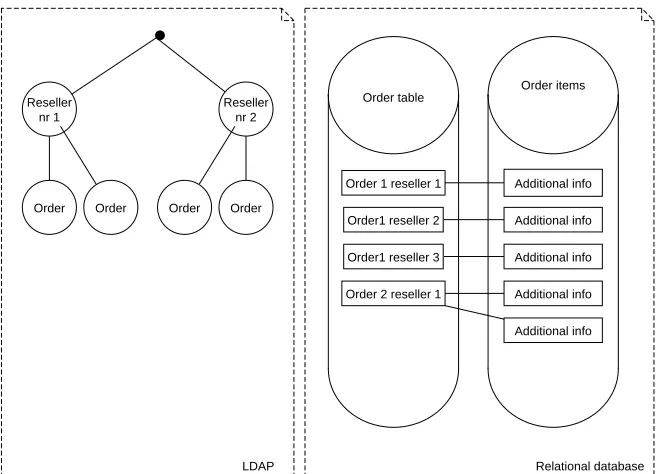
The OpenLDAP hierarchical storage structure can allow an elegant representa-tion of data. Figure 3 depicts a decomposirepresenta-tion of storage of order informarepresenta-tion from several resellers.
LDAP
Order table
Order 1 reseller 1
Order1 reseller 2
Order1 reseller 3
Order 2 reseller 1
Additional info
Additional info
Additional info
Additional info Order items
Additional info
Relational database Reseller
nr 1
Reseller nr 2
Order Order Order Order
Figure 3: Decomposition of order data
2.4 Authentication 13
access this particular information. A reseller can store multiple orders and an order has one or more order items. With a relational database two tables are required to represent this order structure. This first table is a table where global order information is stored (such as issue date and payment). The second table stores order items (what has been ordered for an order). These two tables are linked together. Using this construction it’s hard to enforce access at database level to certain orders for a particular reseller. Enforcement at the application level is possible but is not safe. Access cannot be regulated at row level in a relational database (such as PostgreSQL). Any reseller with access to the order table will be able to access all the rows and therefore he or she is able to access information from other resellers. A database view can be defined to overcome this problem at application level. The user can always log on to the database manually using his or her credentials and access/modify the records with SQL queries.
Another solution with a relational database is to store each order information for a certain reseller in a distinct database. Access can now be granted to certain reseller for a certain database. However this solution is not practical. If a reseller is added, an extra database has to be created. The number of databases grows instead of the number of records.
With stored procedures it is possible to solve this problem. One can use a stored procedure, which will return a data set (order items) for a certain reseller. An user table is also required where reseller credentials are stored. The stored procedure can use this user table to determine what kind of records needs to be returned for a user. These solutions will only work if the database has extensive user rights management. The stored procedure needs complete access to the order tables, but the user (reseller) who is calling/invoking the stored procedure may not have access to these tables. Not all databases support this and it is therefore no common solution for all databases.
2.4
Authentication
14 2 CHOOSING LDAP OVER A RELATIONAL DATABASE
relational database.
2.5
Flexibility
OpenLDAP has advantages over a relational database with respect to the data structures. There are more pre-defined types in OpenLDAP (such as jpegPhoto) that are not present in relational databases. Having more pre-defined types help to prevent one from creating their own types. However, there are some relational databases (such as [7]) who can define their own data types. This behavior is however not standard and is different for each database, this will make exchange of data and schemes (with user defined types) difficult among databases.
The OpenLDAP scheme can also be more flexible than a relational database scheme. The tree structures are more easily dividable given user more flexibility. A user can for example host different trees on different servers. Also sub-trees can be assigned to a certain person (such as a reseller).
The user rights management with OpenLDAP is also more flexible than the user rights management of a relational database. Access can be restricted at tree/record level whereas a relational database only has rights management for tables.
With OpenLDAP there is also more control on how certain data is stored. Blobs (binary large objects) can grouped (stored) together, this will make some tasks (maintenance) easier. Relational databases can have table spaces. A table space is a mechanism, where one can have more control on how a database will store the data. Indexes for example can be stored on fast drives and ’normal’ data can be stored on slower drives. Indexes are more often accessed than ’normal’ data and will benefit from the storage on the fast drives. Table spaces do give a relational database more flexibility on how data will be stored, but it is again not standard and not all databases support this feature.
2.6
Storage of data
2.7 Data safety 15
Relational DB
Storage manager LDAP
File system
Figure 4: Level of storage
OpenLDAP also uses a storage manager to manage its data. A possible storage manager is supplied by the Berkeley DB layer. The difference between OpenLDAP and a relational database is the extra functionality that is supplied by the relational database. Examples of this extra functionality are stored procedures and foreign keys constraints, which are not present in OpenLDAP. Having this extra functionality is an advantage but also makes the relational database system larger and more complex than OpenLDAP.
2.7
Data safety
OpenLDAP can use several back-ends to store the data. All Berkeley DB ver-sions with version numbers less than 4.2.x are not ACID compliant. A non-ACID compliant back-end has several disadvantages as was described in subsection 1.5. Non ACID systems cannot guarantee the safeness of the data. A power failure or a crash might corrupt the data and there might be no way to recover from it (beside from using a backup). Order / workflow information is the kind of information that can change often and where a loss of a single record can have a financial consequence. For example if some reseller ordered 5000 items and the system crashes, the valuable information lost by the system causes a potentially large amount of money. The data can also be corrupted and all order infor-mation since the last backup could be lost. A system with ACID capabilities might have prevented this disaster. And if disaster happens (for example power failure over a long period of time) ACID compliant systems guarantee they can recover the data in a consistent state (This guarantee is more or less theoretical, there are situations where even an ACID compliant system may not recover to a consistent state. Such example situation is a physically damaged hard disk). LDAP and a relational database can also replicate data to a slave to ensure a higher degree of data safety.
2.8
Transactions
16 2 CHOOSING LDAP OVER A RELATIONAL DATABASE
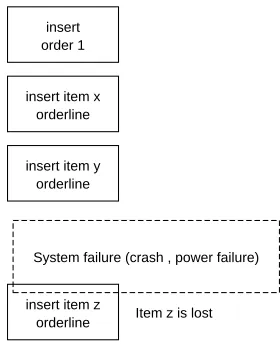
required for example with the insertion of order information. Order information consist of one global order information block and one more items, which have been ordered for that order. If the system doesn’t support transactions a crash or power failure during the insertion of an order can result in loss of information as shown in Figure 5.
insert item x orderline
insert item y orderline
insert item z orderline
insert order 1
Example insert of an order with items System failure (crash , power failure)
Item z is lost
Figure 5: Example sequence of operations with failure
First the global order is inserted followed by two orderline items. Before item z can be inserted or during the insertion of item z, a system failure occurs. Non-transactional systems may now have lost item z. The system only has the order information with item x and item y (and is not correct, item z is missing). If this system was transactional all of the insert operations are aborted and the data remains consistent. The order information is not stored in this case. If the system also uses WAL (explained in subsection 2.9) the system can replay the log and still insert the order with item x,y and z. With a non transactional system one has to manually remove the inserted order and order items. A relational database such as PostgreSQL is transactional and ACID complaint. OpenLDAP with BDB greater than 4.1.x can also be transactional and ACID compliant at object level. There still will be a potential loss of data as illustrated by figure 5. OpenFortress solves this problem by storing global and order items in one object.
2.9 Write ahead logging 17
2.9
Write ahead logging
WAL allows data recovery in case of a system failure. A history of operations is replayed to recover data. This is possible because WAL writes a log entry before it actually executes a certain operation. WAL can be used to implement the Durability property of ACID. Both OpenLDAP with BDB greater than 4.0.x and a relational database has WAL.
2.10
Scalability and reliability
OpenLDAP is lightweight but it has a mechanism to scale. For this purpose OpenLDAP has a replication mechanism. The content of one OpenLDAP server can be distributed (replicated) to multiple servers. A reseller can even run their own sub tree on the their own server. The replication mechanism isn’t transparent as with a relational database where mechanism like fail over and fail safe are implemented. Using this mechanism one can deploy several database servers as one database server (database cluster). If one of the database servers fails, the other servers will take the tasks of the failed server and process them. If the loads to the system is high, a cluster of databases can divide workload to maintain acceptable performance. OpenLDAP doesn’t have this mechanism. It only has replication and backups. OpenLDAP does have a similar structure as the Domain Name System (DNS). Partial trees can be stored on different locations. One could use this to spread the load of a tree if the load gets too high. This particular workflow system will not require this functionality at this point. If the system will get large and heavily used scalability can be solved by spreading sub trees to multiple locations.
2.11
Maintenance
Server maintenance consists of several tasks. Only the backup procedure will be discussed in detail for both back-ldbm and back-bdb. In order to perform a backup of a running OpenLDAP directory the server has to be shutdown with back-ldbm. Only one process can access the database files at a time. The OpenLDAP server has to be shutdown to release the database files to the backup utilities. The database files can now be copied to another location. The preferred method to perform a backup is to dump the data in a so-called LDIF format file. This format is interchangeable. To restore a backup one can copy the backup database files to the right location. The preferred method is to use the LDIF file to restore the data.
With the BDB back-end the OpenLDAP server doesn’t have to be shutdown to perform the backup. The LDIF backup file can be created and restored with the server running. For systems with the requirement of running 24 hours a day, back-bdb is the most suitable solution when using OpenLDAP.
18 2 CHOOSING LDAP OVER A RELATIONAL DATABASE
MySQL with standard table type). Restoring data with databases can also be done while the system is still on-line.
2.12
Extending server functionality
A relational database provides a standard set of extra functionalities such as aggregations, date/time and conversion functions. Using these functionalities one can save significant amount of time. For report purposes the aggregation functions are very useful. The maximum, minimum and average can be easily calculated. For example to calculate the average of the orders the user has to query all orders and process them manually (or write a script/program to do so) with OpenLDAP. With a RDBMS a query is formulated and executed. The RDBMS will do all the work outlined by the query and the result will be returned.
Relational databases also offer functionality to write user-defined functions to extend the server with functionality. A user defined function is a function declared in a certain (often called procedural language) language to perform operations on the dataset. Relational databases work with datasets and there-fore it’s practical to implement extra functionality with user defined functions. OpenLDAP implements the LDAP specification and this specification has no user defined function requirement. OpenLDAP is open source and the source code is freely available for download. One can modify this code to add extra functionality.
Events can be useful if the system needs to perform certain checks before an order is inserted. These checks can be implemented with triggers. A trigger is an event that can be executed in case a record gets deleted, modified or inserted. Implementing such functionality with OpenLDAP requires one modify the OpenLDAP source code or to manage these checks at (client) application level.
2.13
Documentation
The documentation of OpenLDAP consist of a few marginal manuals. For ex-tensive understanding of the system one has to read the LDAP RFC [4, 8, 9]. There is also a frequently asked question list but it is too marginal and some-times the information is incomplete. In contrast to a relational database (such as PostgreSQL, Oracle) there are many books and good extensive on-line doc-umentation. Good documentation and on-line resources are important for fast and good deployment of a product. With regard to this aspect a relational database has a significant advantage over OpenLDAP.
2.14
Summary
2.14 Summary 19
being lightweight but a relational database can use the extra functionality to provide more ease (provided aggregation functions for example) of use to the user.
There is very little known about the write performance of OpenLDAP. Re-search [1] has shown OpenLDAP is capable of handling read-intensive opera-tions. The performance of write-intensive applications need further exploration. The documentation can be an obstacle. There are very few design docu-ments on OpenLDAP (the developers even suggest the design is in the source code). Good documentation is also required to do maintenance and other ad-ministrative tasks (configuration and tuning the server for instance).
OpenLDAP has a hierarchical structure that is elegant to implement the reseller system. Access can be regulated elegantly. OpenLDAP has an advantage over a relational database with respect to this point. Also OpenLDAP offers more standardized authentication options than a relational database.
20 3 APPROACH TO TEST OPENLDAP
3
Approach to test OpenLDAP
Before this thesis work, there is very little is known about using OpenLDAP with write-intensive applications. A top down approach is selected to explore possible problems. The system is considered as a black box and tests are performed on this system. The black box approach is chosen because it is not known where potential problems may exists. Observations such as running time and system load will be recorded and analyzed.
3.1 Test setup 21
3.1
Test setup
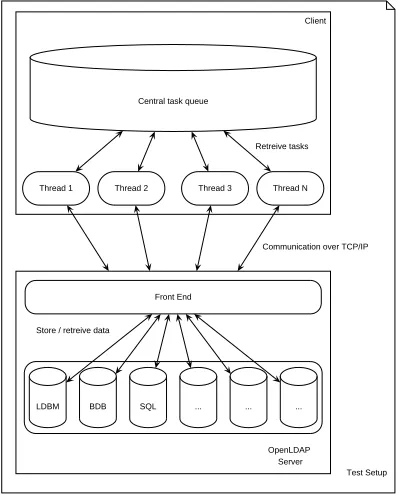
This section describes how the benchmarks are performed and what kind of hardware and software has been used. Figure 6 presents a schematic overview of the test environment.
Central task queue
Thread 1 Thread 2 Thread 3 Thread N
Communication over TCP/IP
Test Setup Client
OpenLDAP Server Front End
LDBM BDB SQL ... ... ...
Retreive tasks
Store / retreive data
Figure 6: Test setup
There is one client communicating over TCP/IP with the OpenLDAP server. Each client thread has its own connection with the server. A client can have certain number of threads running. The OpenLDAP server was compiled with several back-ends but only back-ldbm and back-bdb was used for these test. Both client and server are connected to a 100 mbit/s switch. No other devices where connected to this switch.
3.2
Hardware and software used
22 3 APPROACH TO TEST OPENLDAP
3.2.1 Server
Table 2 lists what kind of hardware and software was used for the OpenLDAP server. The OpenLDAP server is running on a Intel Pentium 4 system operating on the Gentoo Linux distribution.
OpenLDAP server (hardware) OpenLDAP server (software)
Intel Pentium 4 (northwood) 2,53 Ghz (533 fsb)
configured Linux 1.4rc2
512 MB DDR ram (cas 2) Stock kernel 2.4.20 using ext3 file
sys-tem
ultra dma enabled hard disk g++ 3.2.2 used to compile software
100 Mbit/s network interface card OpenLDAP 2.0.27 / 2.1.17 (compiled
with 02 and i686 optimizations) only cron, syslog and ssh daemon where running
Table 2: Software and hardware used by server
The OpenLDAP server 2.0.27 and 2.1.17 were both tested. OpenLDAP 2.0.27 was configured with back-ldbm. OpenLDAP 2.1.17 was both configured to run with back-ldbm and back-bdb. Communication with OpenLDAP was only allowed with LDAP protocol version 3 [4]. Linux (kernels 2.4.x. and 2.6.x) was chosen because (at the time of writing of this thesis) it has a good thread handling (OpenLDAP is a multi-threaded application).
3.2.2 Client
Client(s) (hardware) Client(s) (software)
Intel Pentium 4 (willamette) 1,8 Ghz Gentoo linux 1.4rc1
512 MB DDR ram (cas 2.5) Stock kernel 2.4.18 (with pre-emptive
patch) using ReiserFS file system
ultra dma enabled hard disk g++ 3.2.2 used to compile software
100 Mbit/s network interface card only cron, syslog and ssh daemon where
running
Table 3: Software and hardware used by client
3.3 Test results 23
task queue is generated before the clients start. The creation of the task queue can be influenced by four parameters. These parameters are:
• Total number of tasks
• Percentage of the total number of task that are read operations
• Percentage of the total number of task that are writing operations
• Percentage of the total number of task that are authentication operations
A simple algorithm is used to ensure the queue will reflect the percentage of each type of operation. The algorithm creates 10 tasks each time for each block. The 10 tasks are being distributed over the percentages of read, write and authen-tication. Figure 7 illustrates a task queue with 60% read (illustrated with the symbol R), 30% write (illustrated with the symbol W) and 10% authentication (illustrated with the symbol A) operations.
R R R R R R W W W A ....
Block 1 Block ...
....
Block ...
Figure 7: Example content of a task queue
Each block following block 1 is arranged the same way as block 1. The arguments and parameters can be different (i.e. update other record, select other record). After the queue has been created, a predefined number of threads will be created. A start signal is sent to the created threads to start the actual test. The threads will perform all the tasks defined in the task queue. Each thread retrieves a task from the tasks queue and tries to execute it. Upon completion of the task, a new task is acquired until there are no tasks left. Time used to complete the tasks will be recorded. Linux was also chosen for the client with the same motivation as the server (the test program is also a multi threaded application).
3.3
Test results
The test is performed with different parameters. This way, one can obtain an indication of the extent to which OpenLDAP is capable of handling write-intensive applications. This subsection will discuss the results of the preliminary test done with OpenLDAP.
3.3.1 OpenLDAP configuration
24 3 APPROACH TO TEST OPENLDAP
3.3 Test results 25
3.3.2 Evaluation of preliminary results
The performance of back-bdb will be less than back-ldbm because of the addi-tional transaction overhead. Each operation needs to be logged (WAL) with the BDB back-end in order to be able recovers from a disaster. This logging is done with log files which are written to the disk. It’s this disc access that causes the slowdown.
The difference in performance between read-intensive simulation and write-intensive simulation should be relatively small. An explanation for this behavior can be found in the storage mechanism used by OpenLDAP and BDB. BDB uses a persistent on-disk cache. This cache resides on the hard disk and is filled upon access of certain elements. A read operation will always yield a write action to the disk cache (the requested element will be first read into the on-disk cache before it becomes available to OpenLDAP). A write action will first cause the elements to be read into the on-disk cache of BDB and later on that element will be modified and the on-disk cache will eventually be synchronized with the actual storage of the data (the *.bdb files). OpenLDAP itself also has a cache in memory. The on-disk BDB cache is required by bdb to ensure consistent and safe data storage (see [20] for more detailed information). BDB stores per-thread and per-process shared information in an environment region. Locks and mutexes are also stored in these regions as well as the on-disk cache.
Response time
Number of operations Degrading execution time after a number of operations
26 3 APPROACH TO TEST OPENLDAP
During the performance test a problem has been discovered after about 10 test runs. The OpenLDAP server seems to do nothing at a certain point. It doesn’t seem to use any computing power at all and new request to the system are significant slower than the previous ones. Additional requests are stalled even longer. The response time seems to decrease exponentially. Graph 8 illus-trates this problem. The reseller system must run 24 hours a day and must not break down after a number of requests. Read operations or write operations or a combination of them all cause this behavior so it’s safe to assume the problem is not related to the operation type. It is triggered after a certain number of requests. The only way to repair this behavior is to increase the BDB cache-size parameter for the on-disk cache or to increase the capacity of the cache in Open-LDAP. Due to this solution it is assumed that the behavior is somehow cache related. An inefficient cache algorithm might be used or perhaps the cache is flushed all the time because the number of requested elements is in essence a large sequence, which exceeds the cache capacity limit. The preliminary bench-mark program will not request an element which have been requested before and therefore renders the cache useless. The cause for the problem was eventually
tracked down to bugs in BDB versions≤4.2.48.
27
4
Proposed solutions
A performance degradation problem has been discovered during several test runs. The response time of a request would collapse after a number of requests. Increasing the cache size will hide/prevent the performance degradation. The cause for this problem is believed to be the ineffective cache replacement policy with a large sequence and large looping access patterns (explained in subsection 4.3.1) in combination with a polling resource claiming mechanism (explained in subsection 4.2). A possible improvement for resource claiming mechanism is presented in subsection 4.2 and a possible solution for the performance degra-dation is presented in 4.3. Subsection 4.1 will first discuss in detail how queries work in OpenLDAP and how they depend on the caching mechanism.
4.1
OpenLDAP query processing
There are basically four types of query (Add, Remove, Modify, Search) which can be sent to an LDAP server. The four types of queries interact similarly with OpenLDAP and its buffer management system. The Modify and Search operations can produce a cache hit. The Add operation can produce a cache hit if the element which will be added is already present in the cache. This is similar to the Remove operation where the element might reside in the cache.
A Search operation is processed as follows:
1. Distinguished Name (DN) to ID (a numerical ID) translation (cache in-teraction)
2. ID to entry number lookup (cache interaction)
3. Retrieve base element and candidates
4. Filter the candidates and return the results
Because BDB can only store pairs of (key,value) a DN has to be translated to an ID (ID will be used as key). This ID needs to be mapped back to an entry. The DN is used to lookup an ID entry in the cache. If the ID is not present a new ID is created and inserted into the cache. With the acquired ID number an entry number lookup is performed. This entry number can be used to retrieve the base element and candidates matching this entry number. A base entry could be the reseller entry and the candidates can be certain order numbers. The candidates are then filtered with a filter criterion (such as order number). The matching results are then returned.
The Modify operation works similar to the search. There is an additional step with the Modify operation. First the entry is retrieved (same mechanism as search operation) and after the retrieval the modifications are made and the results are stored in the cache (and disk).
28 4 PROPOSED SOLUTIONS
There is another type of interaction that causes OpenLDAP to access the cache. The login procedure and credentials check also involves a cache access. The four steps of the Search operation also apply to this interaction. The next subsection will explore and test a possible solution for resource polling mechanism.
4.2
Add back-off mechanism
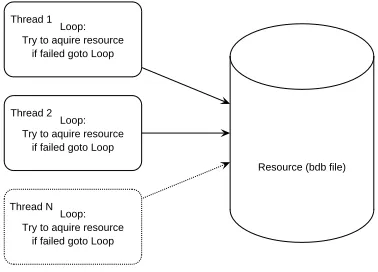
Most requests to back-bdb are done through a construction denoted in figure 9. The figure shows several threads trying to acquire a resource. If a thread fails to acquire the resource it will immediately try again.
Loop: Try to aquire resource
if failed goto Loop
Resource (bdb file) Loop:
Try to aquire resource if failed goto Loop
Loop: Try to aquire resource
if failed goto Loop Thread 1
Thread 2
Thread N
Figure 9: Multiple threads claiming one resource
4.3 Buffer management 29
4.3
Buffer management
A cache system consists of three parts. These parts are:
• A main (cache) memory
• An auxiliary memory
• A replacement policy
The main memory is the memory where the cache items will be stored. This memory is fast but expensive compared to the auxiliary memory. In a cache sys-tem there is a fixed (relative small compared to the auxiliary memory) amount of main memory and a large amount of auxiliary memory. Data from the auxil-iary memory is first read into the main memory before it will be used. Accessing this data from the main memory is faster than accessing it from the auxiliary memory. Data, which has recently been read into the cache is expected to be used again in a short period of time (near future). This future access of data will be read from the fast main memory. Data elements are constantly added in this main memory until the cache capacity is reached. If the cache system is full (capacity has been reached), an element has to be elected to be replaced by a new element. Such a process is called a replacement policy. A replacement pol-icy is an algorithm that determines what element will be swapped out in favor of a new element if the cache system has reached its capacity. There are many different replacement policies described in the literature. A short description of a few algorithms and their characteristics are given in the following subsections. Several commonly used metrics will be to determine the effectiveness and the cost of the replacement policy. Metrics used in this thesis are:
• Cache hit rate (Hr= hits in the main memorytotal request to the cache ∗100%)
• Computational overhead (Number of list-iterations used)
• Space overhead (Additional amount of memory needed)
A replacement policy is effective if the hit rate Hr high. A high Hr indicates
most data items were in the main memory when requested and a lowHrindicates
most items were not in the main memory when requested.
30 4 PROPOSED SOLUTIONS
needed by the replacement policy. It’s desirable to have a low space overhead because the algorithm doesn’t use a large amount of memory in that case. An
ideal replacement policy will have a highHr, low constant overhead and a low
space overhead.
4.3.1 Access patterns
An access pattern is a sequence of defined actions that will be executed. This thesis will define an access pattern as a sequence of OpenLDAP operations. An operation can consist of the following actions:
read A read action is used to simulate a request of an order. The
informa-tion will be fetched from OpenLDAP and returned to the requesting party.
write A write action is used to simulate an insertion and modifications of
an order object. Insertion and modifications causes OpenLDAP to perform write operations.
authentication Authentication is used to simulate authentication/authorization. A reseller for example has to identified/authorized and these actions will occur regularly.
The structure of such a pattern can be classified. The classification of access patterns used in this thesis are shown in table 4.
Pattern Description
Small sequence ordered list of orders. #operations in pattern <cache size
Large sequence ordered list of orders. #operations in pattern >cache size
Small random random list of orders. #operations in pattern <cache size
Large random random list of orders. #operations in pattern >cache size
Small loop repeating block of operations. #operations in pattern<cache size
Large loop repeating block of operations. #operations in pattern>cache size
Changing pattern A combination of two or more different patterns concatenated
Table 4: Classification of access patterns
Classification of access patterns can help to compare the different cache replacement policies with each other. If one replacement policy performs bad with a certain pattern, another replacement policy might be chosen to eliminate this bad performance.
4.3.2 LRU: Least Recently Used
4.3 Buffer management 31
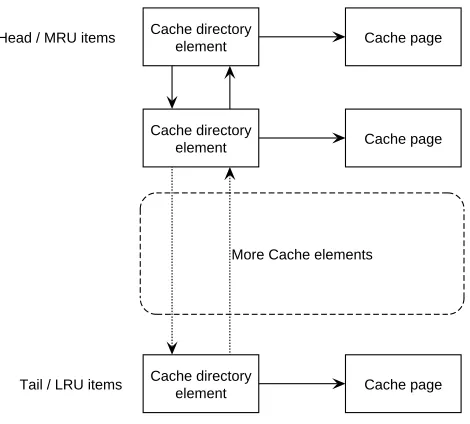
used pages will be used again in the near future. A double linked list is commonly used as data structure for LRU. Items on top of the list represent Most Recently Used (MRU) items. Items at the tail of the list are the items which will be evicted if the maximum capacity has been reached for a certain cache and a page fault (cache miss) has occurred.
Cache directory
element Cache page
Cache directory
element Cache page
Cache directory
element Cache page More Cache elements
Tail / LRU items Head / MRU items
Figure 10: LRU structure
A brief description will be given to illustrate how the algorithm operates. Figure 10 illustrates an example data structure commonly used for LRU. A cache directory entry is an entry with information describing the page it is referring to. Information such as page number and number of processes currently accessing this page is also stored here. The pointer to the actual cache page is also stored here. If some process tries to access a certain page, it will first try to find the desired information in the cache. If that page is located somewhere in the cache, it will be removed from its current position and inserted in the front (at the MRU position) of the cache. Items located at the MRU position represents recently accessed data. A page fault occurs if the requested information is not located somewhere in the cache. In this case a page needs to be read from disk and put on top of the cache (at the MRU position). If the cache has reached its maximum capacity, the entry at the LRU position (least recently used position) of the cache will be removed.
32 4 PROPOSED SOLUTIONS
have been read because the page has a ’long’ period of time before it will be accessed again. This is one disadvantage of LRU.
Another problem for LRU is a large sequence pattern. A sequence pattern is a pattern withN successive different items which will be requested. LetCbe the capacity (number of entries) of a LRU cache. It is clear to that ifNis greater or equal toCall cache pages will travel from the MRU position to the LRU position and are eventually be swapped out. Such access patterns performed against a LRU cache will render the cache useless. No caching mechanism is better in this situation than a LRU cache. It’s evident that LRU will have a problem with looping patterns with a loop size is greater or equal to the cache capacity. Looping patterns can be considered as a number of large sequence patterns executed sequentially (access patterns are explained in subsection 4.3.1)
The changing access pattern can also be a problem for a replacement policy such as LRU. Changing access pattern is a combination of access patterns. The problem explained with LRU and large sequence patterns and large looping patterns also applies here if one of these two patterns is present in one of the combinations of the changing pattern.
4.3.3 LRU-K/LRU-2
The LRU-K algorithm paper[11] introduces an improved LRU algorithm, which also takes frequency information into account. LRU-K keeps track of the num-ber K last references to a popular page. This information is statistically used to determine which page will be used frequently and therefore be given higher priority than less frequently used pages. LRU-2 (K = 2) needs to maintain a pri-ority queue and usage of a pripri-ority queue results in a logarithmic computational overhead. A priority queue is implemented as a heap structure (shown in [22]). Insertions and extractions (deletes) on heap structures require a logarithmic (Log(C)) computational overhead. As shown in [10] aLog(C) implementation complexity is a severe overhead with large cache sizes.
Eviction candidates are selected based on the values of the backward K-distance function. The cache entry with the highest backward K-K-distance value will be evicted. If two or more cache entries have the same largest value a sub-sidiary algorithm is required to determine the eviction candidate. The algorithm performs well for most traces (shown in [10]) and can adapt to changing pat-terns. Large sequence patterns and looping patterns will not flush out popular pages because of their backward K-distance value.
LRU-2 requires an offline parameter that captures the amount of time a page has only been seen once recently and should be kept in the cache. Differ-ent access patterns (workloads) require differDiffer-ent parameter values for optimal algorithm-performance.
4.3.4 2Q
4.3 Buffer management 33
(named Am). The basic idea behind 2Q is to store hot pages in Am. Hot pages are popular pages, which will be accessed frequently in time. The data structure for 2Q is graphically given in figure 11.
Cache directory
element Cache page
Cache directory
element Cache page
Cache directory
element Cache page
More Cache elements
Tail / LRU items Head / MRU items
Am queue, maintained as LRU queue Cache directory
element Cache page
Cache directory
element Cache page
Cache directory
element Cache page
More Cache elements
Tail / First Out Head / First In
A1 queue, maintained as FIFO queue
Figure 11: 2Q data structure
A first reference to a page will always cause the page to be place on top of the A1 buffer. During its resident a page can move from the A1 buffer to the Am buffer if that page is referenced for a second time. This page is considered as a hot (popular) page and will be kept in the main queue (Am). Pages that have not been referenced for a second time are considered cold pages and eventually will travel down to the tail and swapped out of the A1 queue. The Am queue is maintained as a normal LRU queue discussed in subsection 4.3.2. A page in the Am queue will only be swapped out if the capacity of Am has been reached and a hot page has been identified in the A1 queue.
The size of the A1 and Am queue needs to be selected carefully. A small A1 will prevent effective recognition of hot pages. Possible hot pages can be removed from the A1 buffer before they will be referenced again. A large A1 implies a small Am and therefore less capacity to store hot pages. These offline parameters needs to be carefully tuned to get optimal algorithm-performance.
2Q has a constant time computational overhead, which is better than LRU-2. The performance [10] of 2Q and LRU-2 are very similar with carefully selected offline parameters.
2Q can resist a large sequence pattern and large looping pattern. Such patterns will only flush out the A1 queue leaving the Am queue intact. Let
N be number of different references and Ca1be the capacity of A1 queue and
34 4 PROPOSED SOLUTIONS
is when N < Ca1 is true. A sequence pattern with N < Ca1will cause very
little pollution since this pattern is performed only once. However a small Am can cause hot pages to be swapped out. A constant repeat of this pattern is considered as a looping pattern and will eventually flush out all hot pages in Am. This again demonstrates the importance of the two offline parameters.
4.3.5 MQ
Multi queue (MQ) replacement policy was designed for storage controllers (such
as IDE controllers and RAID cards). MQ uses m (for example m = 8) LRU
queues. The queues are namedQ0, ..., Qm−1. A queue Qi contains pages which
have been seen between 2i times and 2i+1−1times recently. Table 5 illustrate
how the queues are organized form= 8.
Queue Q0 Q1 Q2 Q3 Q4 Q5 Q6 Q7
seen #times 1..1 2..3 4..7 8..15 16..31 32..63 65..127 128..255
Table 5: MQ with 8 LRU queues
Q0 holds elements that have been seen only once recently (accessed once
recently),Q2holds elements that have been seen at least two times and at most
three times recently and so on. Cache pages can move from Q0 to Q7 when
referred to frequently. A page is swapped out for a new page of Qi when it
reaches the LRU position of theQi andQi is at max capacity.
MQ has a constant time computational overhead but it is dependant on the number of queues. The lookup functions needs to look into all queues until it finds the requested page. If the number of queues is large, lookups can get expensive.
4.3.6 ARC
4.3 Buffer management 35
Cache directory
element Cache page
Cache directory
element Cache page
Cache directory
element Cache page
More Cache elements
Tail / LRU items Head / MRU items
T1 and T2, maintained as LRU queue Cache directory
element
Cache directory element
Cache directory element
More Cache elements
B1 and B2, ghost caches
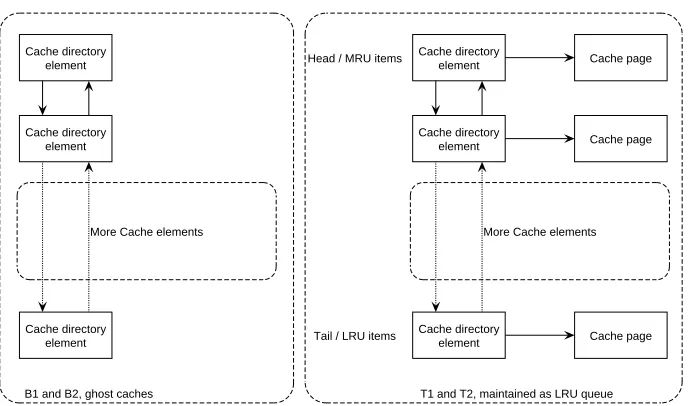
Figure 12: ARC data structure
The four lists are named T1, T2, B1 and B2. T1 holds elements that have been referenced only once and T2 holds elements which have been referenced at least twice. B1 is called the bottom of T1 and hold directory entries from recently evicted pages from T1. B2 is the bottom of T2 and holds recently evicted entries from T2. B1 and B2 will be used to guide a learning variable called Target T1. Intuitively a cache hit in B1 is an indication for a small T1 size and a cache hit in B2 is an indication for a small T2 size. Cache hits in B1 and B2 will adjust Target T1 to reflect the target size of T1.
A first reference to a cache page will cause the page to be placed at the MRU position of T1. This page will move to the top of T2 if it is referenced again before it has been swapped out of T1. If a cache hit occurs in the B1 queue of the cache, the cache directory will be moved to the top of T2 and the actual data from disk will be re-fetched. Cache hits in T2 will cause the page to be removed from its current position and placed on top of T2. If the hit occurs in B2, the cache directory will be moved from B2 to the top of T2 and the actual data from disk will be read into the cache page.
As mentioned before, elements in B1 and B2 don’t have have a valid pointer to a cache page. Elements resident in one of these queues will eventually be removed. The T1, T2, B1 and B2 can also dynamically grow or shrink. The target size for T1 determines the size of T1, T2, B1 and B2. The learning variable Target T1 needs to be updated after each page fault and cache hit. Luckily this book keeping time can be considered as constant time overhead.
36 4 PROPOSED SOLUTIONS
4.4
Choosing a cache replacement policy for OpenLDAP
As explained in subsection 4.3.2, LRU has problems with certain access patterns. With certain access patterns it’s better to have no cache system because those access patterns will flush the cache constantly. LetOsbe the symbol
represent-ing space overhead and Oc the symbol representing computational overhead.
Table 6 denotes the characteristics of the discussed replacement policies.
Replacement policy Overhead Recency Frequency
LRU low constantOc, lowOs yes no
LRU-2 logarithmicOc, lowOs yes yes
2Q low constantOc, lowOs yes yes
MQ constantOc, lowOs yes yes
ARC low constantOc, lowOs yes yes
Replacement policy Adapt to changing patterns Require offline parameters
LRU no no
LRU-2 yes yes
2Q yes yes
MQ yes yes
ARC yes no
Table 6: Characteristics of replacement policies
LRU-2 has a logarithmic computational overhead which make this policy less suitable for large caches. The offline parameter for LRU-2 is also hard to define for all access patterns. The 2Q replacement policy removes the logarith-mic computational complexity but still requires an offline parameter. Several different values are optimal for different access patterns and therefore makes this replacement policy hard to function optimal for all discussed access pat-terns. MQ is not suitable because it also has offline parameters. It has the same weakness where different parameters are optimal for certain access patterns. ARC replacement policy is suitable to replace LRU in OpenLDAP because it doesn’t require an offline parameter. Instead the algorithm is self-tuning and can therefore tune itself to different workloads (access patterns). ARC can also withstand a large sequence access pattern. Such a pattern will only flush the T1 and elements in T2 will be preserved.
4.4 Choosing a cache replacement policy for OpenLDAP 37
weaknesses causing performance problems. An improvement with ARC in Post-greSQL is a good indication that OpenLDAP will also profit since both systems are (cache-wise) similar.
4.4.1 Experience with substitution of LRU with ARC in PostgreSQL
PostgreSQL is a sophisticated open source Relational Database Management System (RDBMS) originally developed at the University of California at Berke-ley. PostgreSQL has evolved into a full-featured database with support for views, stored procedures, triggers, transactions, multi-version concurrency con-trol (MVCC) and more. MVCC is interesting to this discussion because under certain circumstances it can also cause the cache to be flushed. MVCC allows a process to take a snapshot of data currently in the database. This snapshot can then be processed without having to worry about other processes which might alter the current data. Changes from multiple snapshots are automat-ically merged by the system. While MVCC improves concurrency, it also has a disadvantage. Deleted data cannot be removed directly because these pages can be in use by another snapshot, instead they are marked as deleted (in-valid). An RDBMS using MVCC thus requires a periodic background process to reclaim these ’marked for deletion’ data pages on disk. During this reclaim-ing period processes may not access these data and therefore the data is locked. Reclaiming marked for deletion database pages is done in PostgreSQL by a com-mand/program called vacuum. To make matters worse, a vacuum has to check all pages and will flush the carefully populated LRU cache. Another potential problem with vacuum is the disk IO that’s associated with it. If one vacuums too frequently the system is flooded with disk IO operations (from the vacuum itself, but also from write ahead logging).
38 4 PROPOSED SOLUTIONS
Data Data Data Data Data Data Data
Sequential scan
Figure 13: Sequential scan
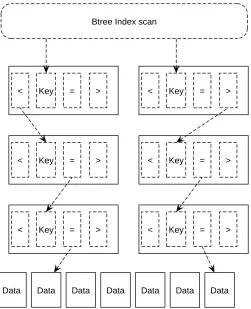
The opposite of a sequential scan is an index scan, where a back-end can use an index to retrieve only certain parts of the data without having to access all the records of a certain table.
Data Data Data Data Data Data Data
Btree Index scan
< Key = >
< Key = >
< Key = > < Key = >
< Key = >
< Key = >
4.5 Substituting LRU with ARC in OpenLDAP 39
Figure 14 is a schematic overview of an index scan (btree index in this case). An index is used to determine the upper bound and lower bound of the data. Only required data is read using this method.
During the release cycle of PostgreSQL 7.4 a vacuum deamon was intro-duced. Using a low vacuum interval, massive disk IO is generated. With this massive disk IO the cache is also flushed. While executing vacuum often helps the optimizer with extra statistical data, it has a negative impact on the disk IO performance. ARC can be used as solution for this problem since it can withstand a sequential scan.
On-line Transaction Processing (OLTP) is a class of transaction-oriented applications typically used for data entry or data retrieval in a number of in-dustries such as banking, airlines, mail order, supermarkets, and manufacturers. Access patterns (often called traces) for these types of applications are used to benchmark databases. During performance tests of PostgreSQL 7.4 with several OLTP traces a few performance problems were encountered. Traces that had a similar effect as a large sequential scan were causing slowdowns. ARC can also be used as solution in this case.
After evaluating 2Q, LRU-2 and ARC, the last cache replacement policy was used to replace the LRU replacing policy inside PostgreSQL. The main reason to choose for ARC was the ability of ARC to withstand sequential scans and the ability to automatically tune the replacement policy. The traces that were causing problems before are now running smoothly [19]. The system is now responsive during these traces. Without ARC the PostgreSQL server was not responsive during the traces. The author of this thesis actively helped the PostgreSQL community to evaluate 2Q, LRU-2 and ARC. The ARC replacement was identified as the most suitable policy and is integrated for the next major release of PostgreSQL (8.0).
4.5
Substituting LRU with ARC in OpenLDAP
ARC in PostgreSQL has been shown to improve performance (especially against cache flush patterns). OpenLDAP is a similar system to PostgreSQL (illustrated in figure 4) and it is reasonable to assume a similar improvement in the cache system of OpenLDAP will also improve performance against a large sequence pattern. The next subsections will describe how LRU is used in OpenLDAP and how ARC will replace it.
4.5.1 LRU in OpenLDAP
OpenLDAP uses the LRU as cache replacement policy. Figure 15 illustrates the structure used to support LRU in OpenLDAP.
40 4 PROPOSED SOLUTIONS
Global cache
structure Abstract Entry
Private (concrete) entry
Abstract Entry Private
(concrete) entry
Abstract Entry Private
(concrete) entry
Next Prev
Head
Tail
Figure 15: LRU structure in OpenLDAP
an entry abstraction layer. Traveling through this layer one can obtain the pri-vate entry data. The pripri-vate entry stores all the back-end specific information. These private entries are organized as a double linked list. All entries except the head and the tail will have a pointer to the next and the previous elements. The head element doesn’t have a pointer to the previous entry and may have a pointer to the next element. This pointer may be absent if there is only one element in the cache. In this case the tail also points to this element. Tail elements may have a previous element.
The LRU implementation in OpenLDAP has been tested for a period of releases and is considered stable. The locking mechanism in OpenLDAP is also considered stable. The strategy is to make a minimal number of adjustments in the code to replace LRU with ARC. Using this strategy one can benefit from the (proved) implementations.
4.5.2 Modify LRU structure to support ARC in OpenLDAP
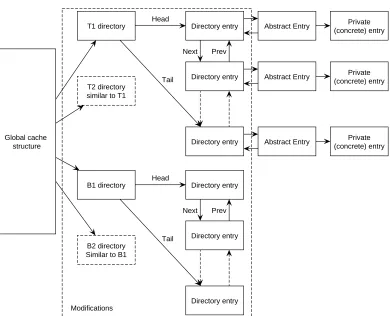
Figure 16 illustrates the changes required in the current LRU implementation in order to replace the LRU replacement policy with ARC. The global cache structure, abstract entry and private entry info are still present. Preserving these structures will result in less modifications to the current OpenLDAP code. The double linked list used to connect private entries has been removed. This is LRU specific and therefore its removal is safe.
4.5 Substituting LRU with ARC in OpenLDAP 41
Global cache structure
Abstract Entry Private (concrete) entry
Abstract Entry Private (concrete) entry
Abstract Entry Private (concrete) entry Next Prev
Directory entry T1 directory
Head
Directory entry
Directory entry Tail
Next Prev Directory entry B1 directory
Head
Directory entry
Directory entry Tail
T2 directory similar to T1
B2 directory Similar to B1
Modifications
Figure 16: ARC structure in OpenLDAP
An extra pointer is added between an abstract entry and a directory entry. Adding this extra pointer will allow fast access from an abstract entry to a directory entry. If this pointer is not present, an access to a directory entry from an abstract entry would result in a linear search through T1 and T2. This linear search time can be large if the caches size is large. A search through B1 and B2 is not required because these list cannot hold actual entries.
4.5.3 Modify code to support ARC in OpenLDAP
42 4 PROPOSED SOLUTIONS
insertion of the newly read information. The implementation of these two cases for ARC is harder. A cache hit can cause an element to switch from list (i.e. element can move from T1 to T2). It also may cause an element to be moved to the phantom cache.
ARC is implemented as two functions. The first function is a process cache hit function, which handles a cache hit. The second function has logic to handle a cache miss. These two functions will be inserted into the current OpenLDAP implementation. The LRU implementation will be removed. Inserting calls to cache hit and cache misses will cause a minimal adjustment to the code and therefore is less likely to introduce new bugs in the current implementation. Another advantage is that the locking mechanism can be reused. The disadvan-tage of this ARC implementation is the longer period of time required to hold an exclusive lock on the cache. If the exclusive lock has been claimed all other threads trying to acquire that mutex will block them self until the current holder of the exclusive lock releases this lock. Less concurrency is possible with this construction. A refinement of the global mutex into four mutexes for T1, T2, B1 and B2 can improve concurrency. Also moving the mutex acquire/release into the cache hit and cache miss function can improve concurrency.
Reimplementing data fetches from disk is also avoided. Manually fetching and decoding this information requires many function calls and error handling. Changing large chunks of code is error prone and therefore avoided. Instead the cache miss call will be inserted after a successful read action from disk. Using this implementation, results about cache hits and cache misses can be measured. These metrics will give a good indication of the cache performance.
4.5.4 Problems encountered during implementation
Several problems were encountered during implementation. The first problem is the lack of a good freely available debugger that can handle multi threaded applications. OpenLDAP can run in a single thread and can therefore be loaded into a debugger like DDD (a graphical front end for gdb). However problems that only occurs with multiple threads cannot be simulated/debugged using this setup. Debugging multi threaded applications is possible but it is very hard due to locking and the fact that each of the running thread (or multiple threads) could be causing a problem. OpenLDAP has fine grained logging mechanism that can be used to output debugging information to syslog. Review of this log can also reveal complex problems but it is time intensive (the log for a full trace is very large, and takes a lot of time to be studied).
4.6 Performance test 43
down to several bugs in the BDB subsystem. These bugs have been fixed in the next major release of BDB (version greater than 4.2.52). All BDB 4.1.x versions still have the bugs and it is not recommended to use this version.
Lack of design and implementation documents also slows down development significantly. It is hard to read code with very limited code comments and its even harder to insert/modify code with limited documentation. Also the code is full with so called “#ifdefs” which makes to code even harder to read and to understand.
4.6
Performance test
4.6.1 Test setup
The test setup for the second series of performance tests are more or less the same as the initial setup. The software used on the server was upgraded due to bugs discovered in BDB 4.1.x. A newer version of BDB (4.2.52) was used for the second series of performance tests. Also OpenLDAP 2.1.25 was used instead of the older version. Version 2.1.25 had several important bdb back-end fixes (crash fixes).
The software for the clients also has been updated. The second series of tests uses predefined access patterns. These patterns will be generated with a pattern generator. The source codes of the pattern generator and benchmark program can be found at http://www.lokishop.nl/verslag/code/. The main benchmark program is also altered to read a pattern at startup in