Do infants learn from isolated words? An ecological study. Tamar Keren-Portnoy1, Marilyn Vihman1 and Robin J. Lindop Fisher2
1University of York and 2Oxleas NHS Foundation Trust
Corresponding author contact details:
Tamar Keren-Portnoy
Language and Linguistic Science University of York
Heslington York YO10 5DD +44 1904 323614
email: [email protected]
[8999 words]
Research highlights
Experimental evidence that infants remember isolated words better than words placed sentence-finally.
Discussion of potential role of isolated words in language acquisition.
Abstract
There is disagreement among researchers as to whether or not words that appear in isolation in input speech play a central role in infant language learning. Such words are often said to occur too infrequently to be of any real significance for early word
learning; the assumption is that such learning instead depends largely on infant ability to segment words from running speech (e.g., Friederici & Wessels, 1993; Johnson & Jusczyk, 2001; Gerken & Aslin, 2005). Alternatively, some researchers have proposed learning models that assign an important role to isolated words (as well as to words at the edges of short utterances) for bootstrapping infants into word-form learning as well as into learning more generally about phonological features of words in the ambient language (e.g., Perruchet & Vinter, 1998; Thiessen, Kronstein, & Hufnagle, 2013). Importantly, Brent and Siskind (2001) provided evidence to support a ‘model in which young children typically acquire a small initial vocabulary from exposure to isolated words’ (p. B42). Nevertheless, statements endorsing the view that only segmentation could give infants a good start on word learning continue to appear: See, for example, Kudo, Nonaka, Mizuno, Mizono & Okanoya (2011): ‘…parents usually do not teach each isolated word one by one to their babies. Therefore, infants must have the ability to segment words from fluent speech for language acquisition’ (p. 1100) and Johnson, Seidl & Tyler (2014):
Researchers interested in investigating whether isolated words are an important source of early word knowledge have tackled the issue from various angles. One approach, as suggested by the quote from Johnson et al., is to assess whether infants hear a sufficient number of words in isolation for this to be a credible factor. Sources measuring naturalistic infant-directed speech (IDS) report that only about 8-10% of utterances consist of a single content word (American English and Japanese: Fernald & Morikawa, 1993; American English: Brent & Siskind, 2001). Counting ‘one-word utterances’ of all kinds in the speech addressed to one infant, however, yielded the considerably higher figure of about 40% (Dutch: van de Weijer, 1998). The same figures have alternatively been seen as significant: ‘viewed through a wide lens, the presence of isolated words seems more impressive’ (Lew-Williams, Pelucchi & Saffran, 2011) or negligible: ‘It seems unlikely that attention to words in isolation is sufficient for infants to parse the input accurately. Most IDS utterances contain more than one word.’ (Johnson & Jusczyk, 2001, p. 549; cf. also Graf-Estes, Evans, Alibali & Saffran, 2007). Note that the facts are not under dispute: Multiword utterances are in the majority, whether they account for 60% of the input, as in the intensive Dutch case study, or 90-92%, as in the other studies mentioned above. However, whether the proportion of isolated words in the input is sufficient to serve as a significant source of learning is not a matter of opinion or interpretation but an empirical question that can be answered only by testing what infants actually learn.
that some mothers produced the words often in isolation, but others never did, even in the context of this somewhat artificial task. They concluded that ‘the strategy of using the target word in isolation to solve the word-segmentation problem cannot be sufficient for all infants’ (p. 119).
presentation has been unequivocally shown to be superior to the other across different tasks and methodologies.
Importantly, the training in these experimental studies has been carried out in a highly constrained situation, under optimal learning conditions: in a quiet sound booth, in the absence of any competing stimuli. In addition, the distinct experimental context (the location, people, voices and test situation) is new to the infant, likely creating the feeling of a ‘special occasion’; this may make the learning episode especially memorable. Finally, the training typically involves only a limited set of items, unlike everyday experience, in which new words, though sometimes repeated, are constantly interspersed with other words. Thus the learning observed in these studies is quite distinct from the type of learning likely to occur in the everyday life of the infant.
frequency in isolation remains a significant predictor, for both comprehension and production (based on the CDI), even once variables such as total frequency, concreteness, duration and word class have been accounted for.1 Interestingly, they found that appearance in isolation in the input was not, as they suspected might be the case, simply a proxy for utterance-final position (which itself proved not to be a significant predictor for word learning).
results seemed to constitute evidence of long-term learning of ‘part words’; the finding was taken to cast doubt on the importance of isolated words. However, most of the 12 high-frequency nonwords presented were actually drawn from short fixed phrases commonly heard either utterance-initially or –finally, with only one- or two-syllable fillers needed to complete the phrases (cf. the following part-words, between slashes, with potential ‘fillers’ in brackets: /sepu /c’est pour [toi] ‘it’s for [you]’; /vaf / va faireʁ ɛʁ [pipi] ‘go make [peepee]’, /tule/ tous les [jours] ‘every [day]’; /kwasa/ [c’est] quoi ça ‘what[’s] that?’, /kɔʁɛ̃/ [en]core un ‘one more’, /naply/ [i(l n’)y en] a plus /iyãnaply/ ‘[there] aren’t any more, all gone’). Although none of these forms are words, and they appear in isolation only very rarely (0.9%, according to Appendix C in Ngon et al., 2013), the full phrases are formulaic and thus, for beginner learners, effectively indistinguishable from words. In addition, these formulaic nonwords are of a kind commonly encountered at edges of utterances (see Appendix C in Ngon et al., 2013), which should make them easier to segment (see Seidl & Johnson, 2006).
The high level of infant (familiarity) response to these nonwords may indeed indicate an ability to segment words from naturalistic input speech. However, segmenting such
Two additional studies have exposed infants to running speech in the home. In both cases the infants demonstrated learning of the words embedded in the running speech, or in other words, succeeded in segmenting words from running speech heard (trained) in the home when tested in the lab. In Jusczyk and Hohne (1997), 8-month-old infants were visited in the home by an experimenter who played recorded stories to them for 30 minutes a day, over 10 days, while leafing through a related picture book. Two weeks after the last story session, at age 9 months, the infants were tested on recognition of the 36 most frequent words from the stories, through word lists. The voice used to record the lab stimuli was one of the voices used in recording the stories. Infants looked longer in response to the lists of words from the story than to the foils, thus showing that they had segmented them and could still remember them two weeks later.
The second study was run with German 9-month-old infants (Schreiner, Altvater-Mackensen & Mani, 2016). Schreiner et al. exposed each infant to a single new nonword over 6 weeks in the home, through an audio-CD with stories, each containing multiple repetitions of that same word. Following the 6-weeks’ exposure, the infants were tested in the lab. The infants recognised the new word when tested in a segmentation task,2 thus showing that they had segmented the words in the course of the home exposure and were now also able to segment it out of new surrounding speech. In this study the voice used for the recording of the CD was different from that used in the lab study. 2This segmentation test was presented as an additional training phase in the lab. The children showed recognition of the words by listening longer to the sentences
Each of these studies was intended to test for segmentation after a simulation of naturalistic exposure in the home. However, both studies had limitations in terms of their ecological validity. In Jusczyk and Hohne the visit of the (unfamiliar) experimenter clearly constituted a ‘special situation’, which could mark the learning itself as ‘special’ and thus support long-term learning. Similarly, in the Schreiner et al. study the voice in which the words were trained was unfamiliar to the infant and heard in no other context. Furthermore, in both of these experiments the trained words are presented in a disembodied voice (presented through recording). None of these characteristics is part of a child’s ordinary learning experience.
The current study investigates the long-term effects of presentation mode on memory for word forms in the ecologically valid situation of a parent repeatedly reading the same book to their child. Note that this is a classic example of joint attention, widely considered the optimal learning situation (Moore & Dunham, 1995; Tomasello, 2003). This contrasts with the conditions employed in either Jusczyk and Hohne or Schreiner et al., where exposure to the new words was embedded in a minimally interactional context, if any.
We supplied parents with picture books to read to their infants over a three-week period; some pictures were labelled with a full sentence followed by an isolated word (e.g., Look at this lovely pet. Pudu.) and others with a full sentence, in which the target word was in final position (e.g., Look at this lovely pudu.). Furthermore, we included not one or two but 16 new words in each book. After this exposure period the infants were brought to the lab for testing, using the Headturn Preference Procedure (HPP). Unlike studies that present words for learning or recognition in the lab, here both presentation modes (isolation or sentence-final) were experienced in the home, under relatively naturalistic learning conditions that are thus far from optimal: We can assume that the reading sometimes took place in the presence of competing stimuli, whether just other talk or other activities (and thus some degree of background noise and possibly also visual distraction), with a lack of consistency in the presentation and no tagging of the learning context as special (i.e., all aspects of the situation were familiar and routine: the place, the caretaker and his or her voice, etc.). The question was whether one of the two types of presentation mode would lead to better memory for the relatively large number of novel word forms the infants were exposed to.
Experiment 1
(a) in isolation or (b) sentence-finally as compared with (c) words not previously encountered.3
Method
Participants
Two groups of infants aged 12 months at test (mean age Group 1 = 0;11.19, SD = 4.4 days, Group 2 = 0;11.21, SD = 4.4 days, N = 16 each; 4 females in each) were read the book in the home and then tested on Isolated vs. Unfamiliar words (Group 1) and Sentential vs. Unfamiliar words (Group 2). Infants were recruited in the area around York, England, through advertisements in local papers, newsletters and word of mouth. Infants had no known developmental or hearing problems. Data from six additional infants were discarded due to crying or parental interference. 4
Picture book materials
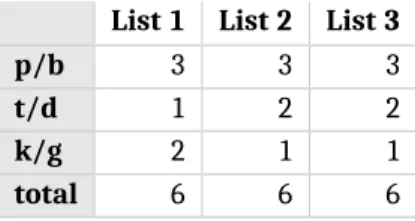
We prepared three parallel lists of eight trochaic (strong-weak) disyllabic words each, all rare animal names, such that each child was exposed to two sets of words in the book-reading, one set presented in isolation (‘Isolated’) and one sentence-finally (‘Sentential’); the third set of words were unseen and unheard prior to the experimental test (‘Unfamiliar’). The lists were balanced as follows: (1) Each included a variety of different animal types (land and sea mammals, birds, etc.), to keep the pictures varied and potentially interesting; (2) no list contained more than one animal sufficiently common that some subjects might have heard the name before (e.g., beaver, dolphin); (3) the lists were balanced in their phonetic segments and phonotactic sequences (Tables 1 and 2).
[Insert Tables 1 and 2 about here]
The book presented one animal picture per page, with the text below. Two types of text were used to present the target words: Isolated words followed a single filler sentence; Sentential words occurred last in a short sentence. We chose to contrast use in isolation with sentence-final presentation as the strongest test of our hypothesis: Parents
commonly place unfamiliar terms sentence-finally in IDS (Aslin et al., 1996; Fernald & Mazzie, 1991). Also, research has shown that words are easier to segment from edges of utterances than utterance-medially (Seidl & Johnson, 2006; Johnson et al., 2014), so we intentionally made the segmentation task as easy as possible, while still maintaining the task requirement that the infants ‘find’ the novel word within the sentence (‘segment it out’) in order to preserve it in memory.
The full set of 32 filler or carrier sentences was constructed in such a way that the animal names could not be fully predicted from the opening words of the sentences. The matching of animal names with pairs of carrier or filler sentences and the order of presentation of animals were pseudo-randomised for each list, with care to avoid sequences of (1) visually similar animals, (2) pairs of sentences with parallel text (e.g.,
Look at this lovely X. and Look at this lovely pet. X.) or (3) overly similar target names. While the Sentential target words were printed on a single line, the Isolated target words were printed below the filler sentence, to increase the chances that parents would pause before producing them.
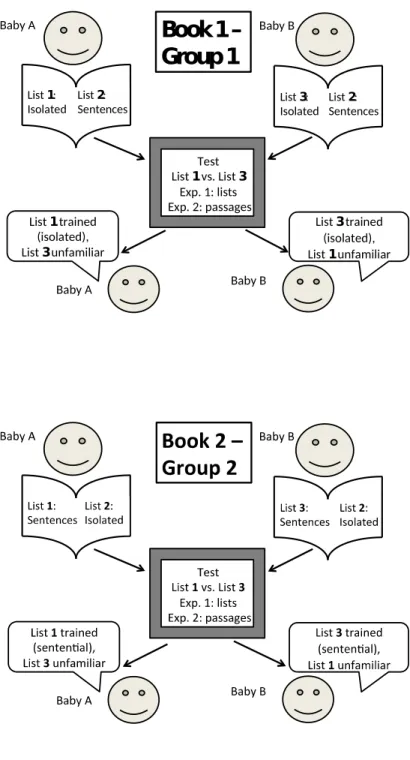
Two versions of Book 1, used with Group 1 (tested on words ‘trained’ in isolation), differed as follows: In one version List 1 words were presented in isolation, List 2 words sentence-finally and List 3 (Unfamiliar at test) was missing (see Baby A book, Figure 1a); in the other version, List 3 words were presented in isolation, List 2 words sentence-finally and List 1 was missing (see Baby B book, Figure 1a). Two versions of Book 2, used with Group 2 (tested on words ‘trained’ in sentences), differed in the same way, but with Sentential instead of Isolated words as the relevant variable (see Baby A and Baby B books in Figure 1b). List 2 words were never included at test, in either experiment.
[Insert Figure 1 about here]
Book reading procedure
the animal name except where it was printed on the page. They were told to read only for as long as the child was still attending, and then to mark their place and continue on from there the next time. Parents were neither asked nor expected to read through the book in its entirety at any one sitting; they were also told that missing some readings would not be a problem. Accordingly, although different children heard the words different numbers of times, each child heard the two lists approximately an equivalent number of times and only while attending to the book.
Parents were asked to log which pages they got through in each reading. They were not told the aim of the study, beyond the fact that we were interested in finding out whether the infants would learn the words in the book. They were given no specific instructions as to how to read the book (i.e., with or without pauses). We did not record the parents reading the book to their infants, as we believed that that would have detracted from the naturalness of the situation. After the three weeks of home reading the child was brought to the lab for testing.
HPP Test Stimuli
Three word lists were prepared as stimuli for the HPP, based on Lists 1-3 presented in Table 1. A Yorkshire speaker recorded the words in a lively child-directed speech style, using a Neumann U87A microphone. A single recorded exemplar was used for each target word, and six versions of each list were prepared, with a randomised order of words in each.
Infants were trained, through book-reading, with two sets of words, one presented in isolation and the other sententially. However, each infant was tested on only one of the word lists s/he had been trained with, contrasted with a list s/he had not heard before (Unfamiliar). All children were tested using the same two lists (List 1 and List 3), which reduced the risk of experimenter bias since the experimenter ran the same condition at test with all infants. Thus, List 1 was Isolated and List 3 was Unfamiliar for half the children in Group 1, and vice versa for the other half. The same was the case for Sentential and Unfamiliar for Group 2 children (see Figure 1 for the relationship between the different versions of each book and the status of the test lists as trained or untrained/unfamiliar for each group).
HPP test procedure
test trials, 6 each of either Isolated and Unfamiliar (for Group 1) or Sentential and Unfamiliar (for Group 2). The familiarisation trials, with two lists of each type, did not differ from the test trials in any way but provided an opportunity for the children to become familiarised with the procedure.
Results
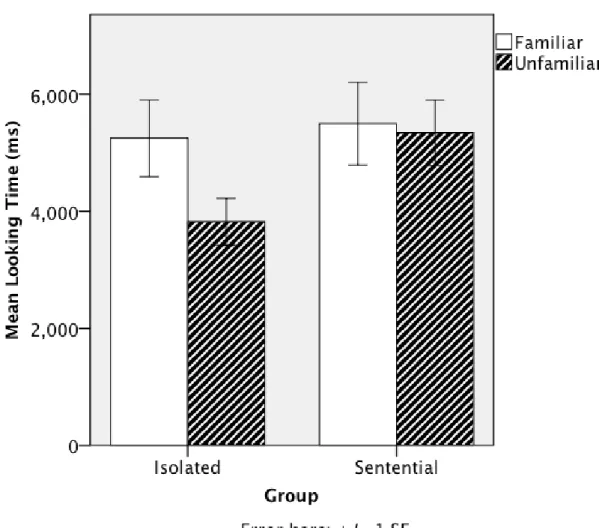
We ran a mixed design ANOVA, with test-item Familiarity (familiar from book vs. unfamiliar) as a within-subject variable and Group (Group 1 vs. Group 2) as a between-subject variable. There was no main effect for Group, F (1, 30) = 1.282, p = .266. There was a significant main effect for Familiarity, F (1, 30) = 7.060, p = . 013 (large effect size: Partial Eta Squared = .19) and a significant interaction of Group with Familiarity: F (1, 30) = 4.545, p = . 041 (large effect size: Partial Eta Squared = .13) (see Figure 2). We followed the ANOVA with t-tests to identify the source of the interaction, using the Bonferroni correction. Group 1 showed significantly longer looking times towards Isolated (Mean = 5249 ms, sd= 2621) than towards Unfamiliar words (Mean = 3822, sd = 1615) (t = 3.49, df = 15, p = .003). Group 2 showed no significant difference between looking times towards Sentential (Mean = 5450, sd = 2822) vs. Unfamiliar words (Mean = 5343, sd = 2235) (t = 0.36, df = 15, p = .72).
[Insert Figure 2 around here]
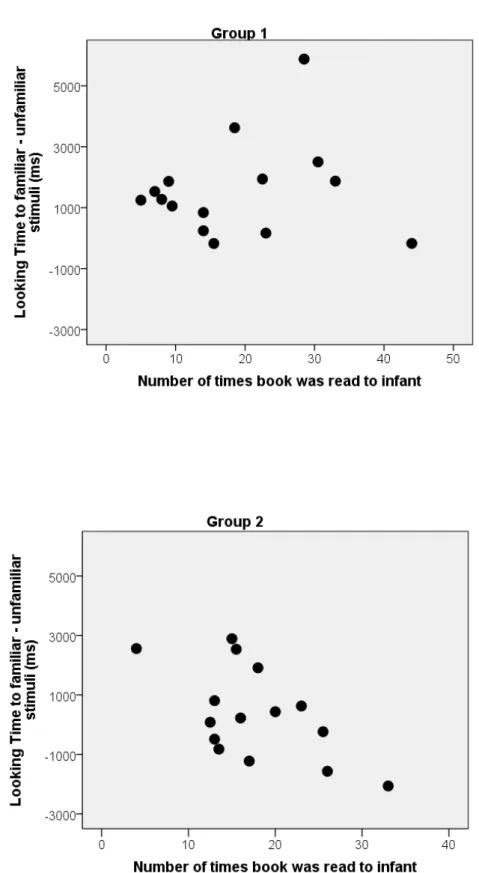
(r(30) = -.099, p = 602, 2-tailed) or Group 1 (r(15) = .135, p = .631, 2-tailed: Figure 3 top panel), but in Group 2 there was a significant negative correlation between the number of repeats and infant preference (r(15) = -.579, p = .024, 2-tailed: Figure 3 bottom panel). As can be seen in the scatterplot in Figure 3 (bottom panel), the seemingly significant relation is actually carried by two data points with relatively extreme values (one low on number of repeats and with a strong preference for Familiar words and one high on number of repeats and with a preference for Unfamiliar words), and indeed, when these are removed, the correlation is no longer significant (r(13) = -.264, p = .383, 2-tailed). In addition, we find it extremely unlikely that infants would show a familiarity response following many readings of the book (i.e. more exposure to the words) but a novelty response following few readings of the book (i.e., less exposure to the words). If anything, easier tasks (e.g., recognising words heard often and well known) are expected to lead to a novelty response and harder tasks (e.g., recognising words heard infrequently and less well remembered) to a familiarity response (see Hunter & Ames, 1988; DePaolis, Keren-Portnoy & Vihman, 2016).
[Insert Figure 3 around here]
Discussion
debate regarding the relative importance of isolated words for word learning. Our results clearly show that when presented as part of natural parent-child interaction, in a joint-attention situation without special tagging of the learning event, words with nearly identical input frequencies are more likely to be remembered when heard in isolation than when heard sentence-finally at age 12 months.
It is possible that one of the things that makes words heard in isolation particularly memorable (beyond the bare fact of their occurrence between pauses) is prosodic salience. That is, it is likely that such words are produced more slowly, more loudly and with more lively pitch modulation. In this study we made no attempt to control for this aspect of the children’s exposure to the words; however, we saw no need to exert such control as the advantage in terms of salience is a natural concomitant of isolated word use.
However, it could be objected that a confounding factor here is the match, or lack of match, of the form of presentation of the words in the ‘training’ phase (i.e., the book reading in the home) to the test phase in the lab: The infants in Experiment 1 were tested on word recognition using lists of isolated words. It is possible that words originally encountered in isolation (in training) are more easily recognised in isolation, but that words originally encountered in connected speech will be better recognised in running speech than in isolation, or at least will be more readily recognised in running speech than words first encountered in isolation.
(i.e., in isolation), or were trained in isolation and then tested in passages. Only very recently has segmentation been tested using passages at both training and test (requiring segmentation from different sentences in each case), using EEG (Junge, Cutler & Hagoort, 2014) or the central fixation procedure (Schreiner et al., 2016). Therefore, the claim that infants are capable of segmenting words has nearly always depended not on ‘matching’ of presentation contexts at training and test but rather on identifying words trained in sentences when tested in isolation, as in our Experiment 1, or vice versa.
Given the results of Experiment 1, then, the question that arises is how robust the learning of words heard in isolation may be. That is, can such words also be recognised when embedded in mid-sentence, a far more difficult task. Accordingly, we ran Experiment 2, in which infants were read the same books as in Experiment 1 but were tested with words requiring segmentation rather than with word lists.
Experiment 2
Our research question was, what type of presentation mode at the training stage (Isolation or Sentential) will lead to recognition of the trained words when these are embedded in passages at test? In other words, which words will be easier to segment from running speech – those encountered in isolation or those encountered in sentences?
Participants
were presented with Isolated vs. Unfamiliar words (Group 1) and Sentential vs. Unfamiliar words (Group 2) embedded in passages, in a segmentation task. Infants were recruited as for Experiment 1 and had no known developmental or hearing problem. Data from fourteen additional infants were discarded due to crying (n = 8), hearing problems (n = 1) and experimenter error (n = 5),
Picture book materials
The books used were identical to those used in Experiment 1 (see Figure 1).
HPP test stimuli
The stimuli were two different passages, each incorporating one of the two word lists used in this experiment (as well as in Experiment 1: Lists 1 and 3). Each word appeared once in the passage (see Appendix 2 for the two passages). Unlike the HPP with isolated word lists, in which the order of words was changed from one list to the next, the passages remained the same across presentations. A Yorkshire speaker recorded the passages in a lively child-directed speech style, using a Neumann U87A microphone. A single recorded exemplar was used for each passage. The passages were constructed with the intention that all non-target content words (nouns, verbs and adjectives) should be unfamiliar to the infants, so that the non-target words would not influence looking times. Each passage was 66 syllables long and consisted of five sentences or clauses, three of which contained two target words and two of which contained one each (see Appendix 2; Passage 1 – with List 1 words embedded – was 16690 ms long, and Passage 2 – with List 2 words – was 16610 ms long).
As in Experiment 1, infants were trained, through book-reading, with two sets of words, one presented in isolation and the other sententially, over a three-week period, and each infant was tested on only one of the word lists s/he had been trained with, contrasted with a list s/he had not heard before (Unfamiliar). All children were tested using the same two lists (List 1 and List 3), embedded in passages (Passage 1 and Passage 3, respectively). For half the children in Group 1, Passage 1 contained words presented in isolation in the book (‘Isolated passage’) and Passage 3 contained Unfamiliar words, and vice versa for the other children (see Baby A and Baby B, respectively, in Figure 1a). Similarly, for half the children in Group 2, Passage 1 contained words presented sentence-finally in the book (‘Sentential passage’) and Passage 3 contained Unfamiliar words, and vice versa for the other children (see Baby A and Baby B, respectively, in Figure 1b). During the HPP each infant heard two passages presented in pseudo-random order (ensuring that no passage was heard more than twice in succession),5 from randomly chosen sides (right or left). Each test involved two familiarisation trials (1 of each passage) and 12 test trials (6 of each passage).
Results
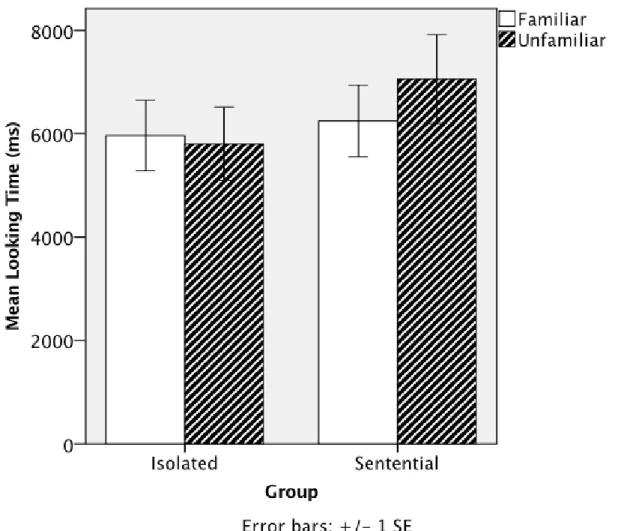
We ran a mixed design ANOVA, with test-item Familiarity (familiar from book vs. unfamiliar) as a within-subject variable and Group (Group 1 vs. Group 2) as a between-subject variable. The mean looking time in Group 1 towards the Familiar (Isolated) passage was M = 5963 ms (sd= 2735) and towards Unfamiliar passage M = 5801 (sd =
2825). In Group 2 the mean looking time towards the Familiar (Sentential) passage was M = 6244 ms (sd = 2768) and towards the Unfamiliar passage M = 7054 ms (sd = 3442). There was no main effect for Group, F (1, 30) = 0.593, p = .447 (small effect size: Partial Eta Squared = .02) or for Familiarity, F (1, 30) = 1.023, p = . 320 (small effect size: Partial Eta Squared = .03) and no significant interaction of Group with Familiarity: F (1, 30) = 2.301, p = . 140 (medium effect size: Partial Eta Squared = .07) (see Figure 4).
The families reported reading the book to their infants a mean of 18 times (Group 1, one missing value, range 7 to 41) and 23 times (Group 2, range 4 to 41) over the three weeks. We found no correlation between number of repeats and infant preference for familiar words (as measured by looking time to the familiar words minus that to the unfamiliar words) in either group (r(15) = -.283, p = .307, 2-tailed in Group 1 and r(16) = .077, p = 0.777, 2-tailed in Group 2) nor in the joint sample of the two groups (r(31) = -.135, p = .469, 2-tailed).
Discussion
isolation over hearing them sentence-finally: The newly learned words do not provide any evident advantage when they are encountered medially in passages.6
General discussion
We carried out two experiments to assess the relative memorability for infants of new words (uncommon animal names) heard in isolation as compared with sentence-finally. The words were presented at home, at comparable frequencies, in a routine book-reading situation; we tested the infants after three weeks of exposure to those names. The results of the first experiment are clear: Isolated words may be infrequent, but when they occur, they are more memorable than words presented in running speech, even when those occur in pre-pausal position. However, the second experiment demonstrated the limits of that learning, in that neither words heard in isolation nor words heard sentence-finally were recognised when tested medially in passages.
presented in a word list. Put simply, whether under natural or experimental conditions, both the learning or training process and the access to recently learned forms are likely to be more successful in the case of isolated words than of words embedded in running speech. Indeed, when tested on recognition of words likely to be familiar from everyday life, without training in the lab, British infants show recognition at 11 months when tested with isolated word lists (Vihman et al., 2004) but only at 12 months when tested on those same words in passages (DePaolis, Vihman & Keren-Portnoy, 2014). We do not have direct evidence to answer the key question as to how words learned in isolation begin to be recognised in running speech. Based on DePaolis et al. (2014), however, we assume that considerably more exposure, with more repeated experiences with any given word, are needed to ensure success in this more difficult task.
We should bear in mind that in real life, unlike experimental situations in the lab, there is no clear distinction between training and testing: Following the first encounter with a word form every new encounter serves as an opportunity for the word to become more familiar; each fresh experience activates previously stored exemplars or memories and leads to better and more solid encoding. At the same time, each such encounter can also serve as a ‘recognition test’, insofar as it reactivates those previous memories, thus potentially creating a feeling of familiarity and a sense of recognition. It is therefore unsurprising that task characteristics (such as presentation mode, in isolation or in running speech) affect the training and the test phases in similar ways.
when tested in the lab, in segmenting words trained in the home using running speech. Let us consider what might account for the divergence between their results and ours, especially given that the infants in these two studies were younger than our participants. Firstly, we note that the Jusczyk & Hohne study was considerably more ambitious than that of Schreiner et al. in several respects – in number of words it set out to teach (36 vs. one), brevity of the training (two vs. six weeks) and delay between hearing the stories and being tested (two weeks vs. none, or none reported). All these aspects made the Juszcyk and Hohne task much more difficult. However, in two respects it was an easier task: In Juszcyk and Hohne the voice used in the stimuli at test was one of the voices used in training, which would have helped to reactivate the children’s memory for the trained words. In addition, as noted earlier, a stranger did the training, which set the word learning experience apart from the infant’s everyday life. What made segmentation of the target words possible in this case may have been the fact that the voice in which these words were encountered was heard again only when the children came to be tested. Contextual cues are known to be critical in reactivating infant memory, even after a delay of some weeks (see Rovee-Collier, 1997). In this case, the voice may well have served as a contextual cue.
‘training’) can have been identical in our study, in which reading was done in real time, whereas in the Schreiner et al. (2016) study there was variability (as there were multiple tokens of the word in each story) but also recurrent tokens (as the same recording was played over several days).
Finally, the voice used in training in our study was highly familiar and the book reading situation was embedded in the family’s daily routine. Nothing makes these book-reading episodes stand out relative to any other episode of joint activity between parent and child. The identity of a voice has been shown to be stored in memory when an infant encounters speech (Houston & Jusczyk, 2000; Houston & Jusczyk, 2003). If the voice is unfamiliar, the speech will be marked off as unique in some way relative to other heard speech. If, in contrast, the voice in which a new word is encountered is a highly familiar one, there is no reason for such a word to be tagged as ‘special’. The fact that the voice in our experiments was, as in the Schreiner et al. study, different from that used in the training merely adds to the difficulty of our task.
reported in American studies, as did another British lab (Floccia et al., 2016); French infants were similarly unable to segment under several different experimental conditions, although not all (Nazzi, Iakimova, Bertoncini, Frédonie & Alcantara, 2006; Nazzi, Mersad, Sundara, Iakimova & Polka, 2014). Taken together, these findings suggest that segmentation, even when tested immediately after training in the lab, is not as easy as is sometimes assumed. Segmenting words from sentences in the much less constrained conditions of the home environment is surely more difficult. This is suggested by the fact that, whereas untrained word recognition is robustly seen for words presented in isolated-word lists at 11 months (Hallé & Boysson-Bardies, 1994, Vihman et al., 2004, Swingley, 2005, Vihman et al., 2007, Vihman & Majorano, 2017), recognition of similar untrained words embedded in passages at test is observed only at 12 months (DePaolis et al., 2014).
To what extent must children segment early word forms in order to make a start on language learning? To what extent does language learning depend on this skill? Our study does not address this question. Clearly segmentation does occur in a naturalistic setting, but further research is needed to establish the age at which this first occurs; that may vary in relation to other factors (e.g., complexity of word form, frequency of use, style of infant-directed speech, and so on). What is needed now is a series of naturalistic studies carried out at increasing child ages to identify the point at which words presented as part of everyday routines are segmented from running speech.
can also support learning to segment speech. However, even ‘non-syntactic’ words (e.g., greetings or onomatopoeia), which may appear to be of no use for segmentation, do provide useful knowledge regarding phonological aspects of the ambient language, such as accentual pattern and common phonotactic sequences. A good deal of previous experimental research has highlighted the value of such knowledge for segmentation (e.g., Johnson & Jusczyk, 2001; Mattys & Jusczyk, 2001).
Two different questions can be asked about infant learning. We can ask what infants are
able to do under ideal conditions (i.e., conditions minimally affected by ‘noise’ or distractions of any kind, and with every effort to highlight the target forms). To answer that question we can both teach and test word learning in the lab. Alternatively, we can ask, given the reality of infants’ everyday experience, what do infants actually learn
under less than ideal conditions? Our findings suggest that, in everyday life, the relatively few units heard in isolation are disproportionately memorable, especially at the earliest stages.
References
Aslin, R. N, Woodward, J. Z., LaMendola, N. P. & Bever, T. (1996). Models of word segmentation in fluent materinal speech to infants. In J. L. Morgan & K. Demuth (eds.), Signal to Syntax: Bootstrapping from speech to grammar in early acquisition
(pp. 117-124). Mahwah, NJ: Lawrence Erlbaum Associates.
Bortfeld, H. & Morgan, J. L. (2010). Is early word-form processing stress-full? How natural variability supports recognition. Cognitive psychology, 60, 241-266.
DePaolis, R. A., Keren-Portnoy, T., & Vihman, M. M., (2016). Making sense of infant familiarity and novelty responses to words at lexical onset. Frontiers in Psychology, 7(715). http://journal.frontiersin.org/article/10.3389/fpsyg.2016.00715
DePaolis, R. A., Vihman, M. M. & Keren-Portnoy, T. (2014). When do infants begin recognizing familiar words in sentences? Journal of Child Language, 41, 226-239. Fenson, L., Dale, P. S., Reznick, J. S., Thal, D., Bates, E., Hartung, J., Pethick, S., & Reilly, J.
(1993). The MacArthur communicative development inventories: User's guide and technical manual. San Diego, CA: Singular.
Fernald, A., & Hurtado, N. (2006). Names in frames: Infants interpret words in sentence frames faster than words in isolation. Developmental Science, 9, F33-F40.
Fernald, A. and Mazzie, C. (1991). Prosody and focus in speech to infants and adults.
Developmental Psychology, 27, 209–221.
Fernald, A., & Morikawa, H. (1993). Common themes and cultural variations in Japanese and American mothers’ speech to infants. Child Development, 64, 637–656.
Floccia, C., Keren-Portnoy, T., DePaolis, R. A., Duffy, H., Delle Luche, C., Durrant, S., White, L., Goslin, J., Vihman, M. M. (2016). British English Infants Segment Words Only with Exaggerated Infant-Directed Speech Stimuli. Cognition, 148, 1-9.
Friederici, A. D. & Wessels, J. M. I. (1993). Phonotactic knowledge of word boundaries and its use in infant speech perception. Perception & Psychophysics, 54, 287-295. Gerken, L. A. & Aslin, R. N. (2005). Thirty years of research on infant speech perception:
the legacy of Peter W. Jusczyk. Language, Learning and Development, 1, 5-21.
Hallé, P. A. & Boysson-Bardies, B. de (1994). Emergence of an early receptive lexicon: infants’ recognition of words. Infant Behavior and Development, 17, 119-129.
Houston, D. M. & Jusczyk, P. W. (2003). The role of talker-specific information in word segmentation by infants. Journal of Experimental Psychology: Human Perception and Performance, 26(5), 1570-1582.
Houston, D. M. & Jusczyk, P. W. (2003). Infants’ long-term memory for the sound patterns of words and voices. Journal of Experimental Psychology: Human Perception and Performance, 29(6), 1143-1154.
Hunter, M. A. & Ames, E. W. (1988). A multifactor model of infant preferences for novel and familiar stimuli. Advances in Infancy Research, 5, 69-95.
Johnson, E. & Jusczyk, P. W. (2001). Word segmentation by 8-month-olds: When speech cues count more than statistics. Journal of Memory and Language, 44, 548-567.
Johnson, E., Seidl, A. & Tyler, M. D. (2014). The edge factor in early word segmentation: Utterance-level prosody enables word form extraction by 6-month-olds. Plos One, 9,
1-14.
Junge, C., Kooijman, V., Hagoort, P. & Cutler, A. (2012). Rapid recognition at 10 months as a predictor of language development. Developmental Science, 15, 463-473.
Junge, C., Cutler, A. & Hagoort, P. (2014). Successful Word Recognition by 10-Month-Olds Given Continuous Speech Both at Initial Exposure and Test. Infancy, 19, 179-193.
Jusczyk, P. W. & Hohne, E. A. (1997). Infants’ memory for spoken words. Science, 277, 1984-1986.
Koenig, M. A., & Cole, C. (2014). Early word learning. In D. Reisberg (ed.), The Oxford Handbook of Cognitive Psychology (pp. 492-503).Oxford: Oxford University Press. Kudo, N., Nonaka, Y., Mizuno, N., Mizuno, K. & Okanoya, K. (2011). On-line statistical
segmentation of a non-speech auditory stream in neonates as demonstrated by even-related brain potentials. Developmental Science, 14, 1100-1106.
Lew-Williams, C., Pelucchi, B. & Saffran, J. R. (2011). Isolated words enhance statistical learning by 9-month-old infants. Developmental Science, 14, 1323-1329.
Mattys, S. L. & Jusczyk, M. (2001). Phonotactic cues for segmentation of fluent speech by infants. Cognition, 78, 91-121.
Moore, C. & Dunham, P. J. (eds.). (1995). Joint Attention: Its origins and role in development. Hillsdale, NJ: Lawrence Erlbaum.
Nazzi, T., Iakimova, G., Bertoncini, J., Frédonie, S., & Alcantara, C. (2006). Early segmentation of fluent speech by infants acquiring French: emerging evidence for crosslinguistic differences. Journal of Memory and Language, 54, 283–299.
Nazzi, T., Mersad, K., Sundara, M., Iakimova, G., & Polka, L. (2014). Early word segmentation in infants acquiring Parisian French: task-dependent and dialect-specific aspects. Journal of Child Language, 41(3), 600-633.
Ngon, C., Martin, A., Dupoux, E., Cabrol, D., Dutat, M. & Pepercamp, S. (2013). (Non)words, (non)words, (non)words: Evidence for a protolexicon during the first year of life. Developmental Science, 16, 24-34.
Perruchet, P., Vinter, A. (1998). PARSER: A model for word segmentation. Journal of Memory and Language, 39, 246-263
Schreiner, M. S., Altvater-Mackensen, N. & Mani, N. (2016). Early word segmentation in naturalistic environments: limited e ects of speech register. ff Infancy, 21(5), 625– 647.
Seidl, A. & Johnson, E. (2006). Infant word segmentation revisited: Edge alignment facilitates target extraction. Developmental Science, 9, 565-573.
Singh, L. (2008). Influences of high and low variability on infant word recognition.
Cognition, 106, 833-870.
Swingley, D. (2005). Eleven-month-olds’ knowledge of how familiar words sound.
Developmental Science, 8, 432-443.
Swingley, D. & Humphrey, C. (2017). Quantitative linguistic predictors of infants’ learning of specific English words. Child Development.
Thiessen, E. D., Kronstein, A. T. & Hufnagle, D. G. (2013). The extraction and integration framework: a two-process account of statistical learning. Psychological Bulletin, 139,
792-814.
Tomasello, M. (2003). Constructing a Language: A usage-based theory of language acquisition. Boston, MA: Harvard University Press.
van de Weijer, J. (1998). Language input for word discovery. (v. 9). Nijmegen: Max Planck Institute for Psycholinguistics.
Vihman, M. M. & Majorano, M. (2017). The role of geminates in infants' early words and word-form recognition. Journal of Child Language, 44, 158-184.
Appendix 1
Sentence-final words Syl.
count
Pair Isolated words Syl.
count
look at this lovely X 5 1 Look at this lovely pet. X 6
look at this other X 5 Look at this other one. X 6
let's look at this (disyllabic adjective: furry/hungry) X
6 2 Let's look at this (fluffy/graceful) pet. X
7
let's look at this even (trisyllabic comparative: furrier/hungrier) X
9 Let's look at this
(fluffy/graceful) animal. X
9
can you see the X? 4 3 Can you see it? X 4
can you see the smaller X? 6 Can you see it (disyllabic present participle: sitting/eating). X
6
I wonder if this is a X? 7 4 I wonder what this is? X 6
I wonder if this is a different X? 9 I wonder what this one is called? X
8
could this perhaps be a X? 6 5 What do you think this could be? X
7
could this perhaps be another X?
8 What do you think this one could be called? X
9
could this be a X? 4 6 What could this thing be? X 5
comparative: older/younger) X? here? X look at the big (monosyllabic
body part: horns/ears) on the X
7 7 Look at those/that big (monosyllabic body part: wings/ears/nose/eyes). X
5
look at the cute (monosyllabic body part: ears/nose) on that X!
7 Look at those/that sharp (monosyllabic body part: beak/horns/nails/nose). X
5
what a pretty pet X 5 8 What a pretty pet/bird. X 5
what an even prettier X 7 What a pretty creature. X 6
101 101
Appendix 2 Passage for list 1:
One summer’s day the pudu and the fennec went for a stroll. They saw a tiny zebra and a smiley beaver playing golf. Along came a condor with a gibbon to join in the game. And of course there was a dunlin too! Then a bongo called them all in for their brunch.
Passage for list 3:
Every Thursday the pika and the ferret go for a run. They visit the chatty vulture and the greedy cavy and go racing. Sometimes they spot a bilby and a dugong out playing. They spy a desman too! But not the panther because he’s too lazy for sport.
List 1 List 2 List 3
[p]V[St]V pudu [pu:du] puku [pu:ku] pika [pi:kə]
[Fr]VCV[St] fennec [fɛnık] civet [sıvıt] ferret [fɛɹıt]
[Fr ]VCCV zebra [zɛbrə] sambar [samba:] vulture [vʊltʃə]
[St]V[Fr]V beaver [bi:və] dassie [dası] cavy [kavı]
[St]VCCV condor [kɒndɔ:] petrel [petɹəɫ] bilby [bılbı]
[St]V[St]V[N] gibbon [gıbən] bettong [bɛtoŋ] dugong [du:goŋ]
[d]VCCV[N] dunlin [dʊnɫın] dolphin [doɫfın] desman [dɛzmən]
[St]V[N+CC]V bongo [boŋgɔ:] gundi [gʊndı] panther [panθə]
Table 2: Initial stop consonant distribution in the three word lists
List
1
List 2 List 3
p/b 3 3 3
t/d 1 2 2
k/g 2 1 1
Figure 1. Alternative versions of books used in training and their relation to stimuli provided at test.
a. Book 1, Group 1 (tested on words heard in isolation in book reading). b. Book 2, Group 2 (tested on words heard in sentences in book reading)
Baby A List1trained
(isolated), List3unfamiliar
Baby B
List3trained (isolated), List1unfamiliar List1:
Isolated List2: Sentences
List3: Isolated
List2: Sentences
Baby A Baby B
Test List1vs. List3
Exp. 1: lists Exp. 2: passages