THE DIFFRACTIVE DISSOCIATION PROCESS TI- p ~TI- (TI-TI+p) AT 14 GeV/c
Thesis by Leo C. Rosenfeld
In Partial Fulfillment of the Requirements for the Degree of
Doctor of Philosophy
California Institute of Technology Pasadena, California
1977
ii
ACKNOWLEDGEMENTS
The experiment which I describe in this thesis depended on the efforts of many people at three institutions. The support personnel of the Caltech High Energy Physics Group built substantial portions of the apparatus. At the Stanford Linear Accelerator Center the major con-tributors were the members of the Experimental Facilities Department, under the leadership of E. Seppi, especially J. Murray; the members of the Accelerator Operations staff; and the members of the Bubble Chamber Operations Group, under the leadership of R. Watt, especially G. Bowden. The scanning and measurement of the bubble chamber film at Lawrence Berkeley Laboratory was in the hands both of the Data Handling Group under the leadership of H. White and the scanning and measuring staff of the Ely Physics Group.
The physicists who played major roles in the work reported here were R. Ely, D. Grether, and P. Oddone of LBL and W. Ford, V. Davidson, F. Nagy, and C. Peck of Caltech. Professor Ely was my host during a long residence in Berkeley, and he generously made available all the resources necessary to carry out the analysis. Professor Peck, the guiding hand and chief stimulus to the entire enterprise, was my thesis adviser. His labor, his leadership, and his friendly counsel were integral to the execution of this. project.
; ; ; ABSTRACT
We describe an experiment in which a 14 GeV/c TI- beam was inci-dent on a hydrogen bubble chamber. Fast forward scattered pions traversed a wire spark chamber spectrometer downstream of the bubble chamber.
Events identified as inelastic by the spectrometer induced a trigger of the bubble chamber camera. The film produced contained a heavy enrich-ment of events of proton diffractive dissociation.
We have studied a sample from this exposure of 4400 events of
- - - - +
the reaction TI p ~ TI N* ~ TI TI TI p. In the two body mass spectra the only noteworthy feature is the 6++(1230). In the N* mass spectrum we observe enhancements at 1.49 GeV, 1.72 GeV, and 2.0 GeV. For the prom-inent 1.72 GeV feature we give estimates of the width and cross section as well as evidence favoring a substantial branching fraction to
TI6(1230). We looked for production of N*(l470) followed by decay to TI6(1230) with negative result. An examination of the 6++(1230) decay distribution suggests that the Deck mechanism is the major contributor to the TI6 subchannel.
iv CONTENTS
Page
ACKNOWLEDGEMENTS . . . • . . . • . . . ii
ABSTRACT CHAPTER
...
,... .
iiiI. INTRODUCTION 1. The Diffraction Picture of Good and Walker ... 1
2. Properties of Diffractive Dissociation ... 6
3. The t-channe1 Viewpoint • . . . • . . . . • . . . 10
4. The Deck Mechanism ... ,... 13
5. Some Published Data at Very High Energy ..•... 16
6. Intent of the Present Experiment... 21
II. EXPERIMENTAL APPARATUS 1 . Ov e rv i ew ••.•....••.•.•••.••••••• , . . • • • • • • • • • . • • . 2 4 2. The Secondary Beam Line . . . • . . . . • . • . . . • . . . 25
3. The Bubble Chamber ...••..••.•.... 27
4. The Spectrometer... 29
5. Triggering and the Role of the Online Computer .. 34
III. PROCESSING l . Overview ... ~ . 43
2. Processing of the Spark Chamber Data .•...•... 43
3. Scanning and Filtering •..•...•.•.•...•.•.••. 46
4. Measuring ...•...•..•.•..••.. 47
5. Geometrical Reconstruction ...•..•.. ,... 48
6. Hybri di zati on ...•.. , 49
7. Kinematic Fitting •...•.•••.••..•••••..••••.•. 58
8. Validation... 61
IV. ANALYSES l . Preamb l e ...•...• , .••.••.•... , . . • • • • • • • • 6 9 2. Estimation and Display of Densities .•...•••••.•• 70
3. Event Selection .•..••.•...•.•...•.••..•••••••• 71
4. Normalization ... .... ...•...•.. 80
5. Acceptance and Weighting ..•.•...•••..•..•..••• ,. 82
6. Survey of the N* Mass Spectra .•.••.•••••..•.•... 85
v
Page 8. Further Discussion of N* Resonance Production.... 111 9. Helicity Conservation . ... ... ... •...•••••. •.. 116 10. Test of the Bia~as-Dabkowski-Van Hove Hypothesis . 128
11. SuIT111ary ••••••••••••••••••••••••••••••••••••••••• 141
APPENDICES
A. Deta i 1 s of the Trigger Program . . • . . • . . • . . • . . . • . • • . • • 142 B. The Kuiper Statistic ...•...•...•..• 145 C. The
x
2 Dependence of Contaminationfrom Lower Constraint Cl asses .•..•.•...•...•...• , . . 149 D. Estimation of the Probability of Track Inversion ... 151
1
I. INTRODUCTION
1. The Diffraction Picture of Good and Walker
In hadron scattering at high energy the preeminent diffractive
process is forward elastic scattering. We call it diffractive because
the dominant features of this process are understandable from the
view-point of optical diffraction. The target acts as a nearly opaque disk,
extinguishing most of the incident wave. The resulting shadow acts, in
the Huygens construction, as the source of secondary waves at small
angles from the incident direction. We refer to certain inelastic hadron
processes as diffractive dissociation. They are similar in their major
properties to elastic scattering, and they may also be a result of
absorption of the incident wave.
The first thorough exposition of the concept of diffractive
dissociation appears in Good and Walker [1960]. They present the following
optical analogue. In the case that a linearly polarized wave impinges
on an opaque disk, the diffracted light has the same polarization as the
incident light. Suppose instead that the disk is a Polaroid and that its
axis is at 45° to the direction of polarization of the incident wave.
The polarization of the diffracted wave is then transverse to the axis of
the Polaroid. If we project the diffracted wave on axes parallel and
perpendicular to the incident polarization, we find components in both
directions. Diffraction by a Polaroid can thus create a new state, one
not present in the incident wave.
2 1.1
AB + A* B (1.1)
in which B is a nucleus, A is a meson or nucleon, and A* is a system of two or more hadrons which are the dissociation products of A. They adopted the viewpoint that a hadron is a composite of more elementary objects. One representation of a free particle state is a superposition of states containing different numbers and kinds of constituents.t
The choice of basis is at our disposal. For representing the incident hadron, A, and the final hadrons, A*, the appropriate basis is the set of states
10.
1>
of one or more free particles. For understanding the propagation of the constituents of A through B, the appropriate basis is the set of states IC;> which the nuclear matter attenuatesexponentially. In general the rate of attenuation would be different for each IC;> , and in general no IC;> would be a free particle state.
We represent the incident hadron A as
101
>=
~
c. IC;> 1 1(1. 2)
The transmitted wave is
IT>
=
I
n· c. IC;> 1 1 1( 1 • 3)
3 I. l
with
In .1
l < 1 We reprojectIT>
into theID; >
basis obtainingI
13;10.>
i > 1 1 1
( 1 . 4)
f3; = <D;
IT>
=
I
n .c. <D.I
c.
>
j J J 1 J ( 1. 5)
The first term on the right of equation (1.4) interferes with the incident
wave to produce elastic scattering. The second term on the right is a
source of secondary waves of one or more free particles distinct from the
incident hadron. It corresponds to the new polarization state which we
found in considering diffraction from a Polaroid.
An elegant example of differential absorption in hadronic
reac-tions is the regeneration of Ks from KL in nuclear targets. The
incident KL is a superposition of equal parts of the strangeness
eigen-states KO and
K° .
The nuclei of an absorber attenuate these statesat different rates, so the emergent state is a superposition of KL and
Ks .
In the foregoing analysis we ignored the phase change of the
hadron wave function as it propagates through a nucleus. This
4 I. l
extent in the beam direction or if all the states jc. > and
,
jD. > were,
energy degenerate. In the general case, however, many of the states
ID;> have appreciably greater mass than the incident hadron. In
particular the mass of the final state of a dissociated nucleon is greater
by at least the pion mass. We can follow the argument of Good and Walker
to understand how nearly degenerate the jc.> and
,
ID;> states mustbe when we treat the nucleus as a three dimensional object. We view
each differential layer of the nucleus as an independent source for the
transmitted wave. At the time of excitation, a layer emits a
superposi-tion of the states ID;> in phase with the incident wave. Each ID.>
,
then propagates with a frequency dependent on its mass to the shadow side
of the nucleus. For masses too far from that of the incident hadron the
layers contribute incoherently to the final state and a significant cross
section can not develop. Diffractive dissociation, in the sense of Good
and Walker, is the relatively large cross section expected when the
initial and final states are so nearly degenerate that the wavelets from
each layer of the nucleus are in phase when they emerge.
We make the above considerations quantitative as follows. The
frequency difference of the A and the A* systems of reaction (1.1)
is proportional to their energy difference.
~w
=
(E* - E)/h (1.6)5 I. 1
( 1 . 7)
rA and r 6 are the radii of A and B, and the factors 1/y account for the Lorentz contraction. The coherence condition is
1::,w flt << 1 . (1.8)
We evaluate E*-E from energy-momentum conservation, and we approximate both rA and r8 by the Compton wavelength of the pion, hc/mn. The general result is
+
J
<< l . ( l . 9)s is the square of the center-of-mass energy, and M* is the mass of
A* • We specialize relation (1.9) for three cases which cover most
situations of practical interest.
Case l. MA<< M8 , B is the target, A has momentum P >>MA
Case 2.
m
7T
6
2MA
• - << 1
s
or with P the beam momentum in the rest frame of either A or B
m p
7T
<< 1 .
I. l
(1. 11)
(1.12)
Case 3. M8 << MA ,
M~
<< s , P is the momentum of B in the A rest frame.2m P
7T
<< 1 (1.13)
Relations (1.10)-(1.13) make clear that the higher the beam momentum,
the higher the M* at which diffractive dissociation may be observable.
2. Properties of Diffractive Dissociation
The connection between quantum number exchange and energy
depen-dence is the feature of hadronic processes which pennits us to distinguish
phenomenologically between diffractive dissociation and other dissociation
processes. Over the domain of presently available energies two-body
7
o{AB ~ A*B) ~ p -r
When A* has the same internal quantum numbers as A,
r S 0.5
whereas when A* has different internal quantum numbers, r ~ 1.5
[Fox and Quigg 1973].
I.2
{2.1)
{2.2)
All proposed models of diffractive dissociation are unanimous in
support of a selection rule requiring A* to have the same quantum
numbers as A. In the absorption model of the preceding section this
rule is an irrrnediate consequence for the additive quantum numbers.t
In the case that A is a meson with definite charge conjugation CA ,
the model does not by itself require that CA*
=
CA . The Pomeranchuktheorem, however, which asserts the equality of particle and antiparticle
cross sections at infinite energy, disfavors a gentle energy dependence
like {2.2) if CA* ~ CA . Although the model of Good and Walker is
relevant to Ks regeneration as we mentioned, the charge conjugation
changes from KL to Ks' and the process does not satisfy relation
(2.2). [Brody et al. 1971]. A corollary of the preservation of the C
quantum number is that pions dissociate only into odd numbers of pions
because the dissociation products must preserve the G parity.
Corresponding rules for K meson diffractive dissociation are obtainable
by invoking SU{3) syrrmetry.
8 I.2
Diffraction scattering characteristically produces an angular
distribution with a sharp forward peak. The Heisenberg uncertainty
principle relates the width of the peak to the size of the diffracting
object.
P ~ h/r
t (2.3)
with Pt the momentum component transverse to the incident direction
and r the radius of a black disk. Elastic scattering of hadrons from
nuclei exemplifies this behavior [Blieden et al. 1975 and Apokin et al.
1976]. Good and Walker [1960] reason that since absorption is
respon-sible for both elastic diffraction and diffractive dissociation, the
production angular distributions should be similar. Differences might
exist, however, because the transparency of the absorbing disk may depend
on impact parameter. Some other models in the same spirit as Good and
Walker yield more detailed predictions for the angular distribution in
dissociation reactions [Chou and Yang 1968, Cheng and Wu 1971].
A selection rule for the internal angular momentum and parity
of A* is a more difficult matter than the selection rule for the
internal quantum numbers, in part because the quantum number accounting
must include the orbital angular momentum of A and A* with respect
to B. Good and Walker suggested that the orbital angular momentum would
not change with.the consequence that JP(A*)
=
Jp(A). In discussionsof Regge exchanges Gribov [1967] and Morrison [1968] proposed the less
9 I.2
P(A*)/P(A) = (2.4)
as a property of Pomeron exchange (see the following section).t Both authors spoke of A* as a resonance, and neither specifically addressed the question of whether the rule should apply to a nonresonant component of A* . Carlitz et al. [1969] proposed yet another rule stating that a resonant A* could belong only to certain SU(6) multiplets. Experi-ments have not clearly established the validity of any of these rules.
A different kind of angular momentum rule concerns the helicity of A*. For zero degree scattering (and assuming no B spin flip) the helicity of A* must be the same as the helicity of A purely to conserve angular momentum. When the scattering angle is nonzero,
statements about the A* helicity must refer to a particular reference frame. Experimental evidence favors helicity "conservation" in the center-of-mass frame for TIP elastic scattering (A = p, A* = p) and for the quasi-elastic process yp +pop (A = y, A*= PO) (references in Section IV.9). This rule does not appear to be valid for meson and baryon dissociation reactions, at least not generally. An alternative rule, helicity conservation in the A* rest frame (t-channel helicity conservation), has some experimental support. As with the Gribov-Morrison
10 I.2
rule the helicity conservation properties of A* may depend on whether or not A* is resonant.
3. The t-channel Viewpoint
Our present understanding of nondiffractive two-body processes at lab momentum ·~ 4 GeV is in tenns of particle exchange in the t-channel. The 11
t-channel11 of the reaction AB+ C 0 is the reaction
AC
+B
0 . We describe both reactions with a single amplitudeanalytically continued in the variables
2
t
,J
(Pc - PA)2 s-channel(PA + PB)
s
-2
·
I
(Pc+ PA)2 t-channel
(PA - P _) B
(3 .1)
11 I.3
and a forward peak in dcr/dt is generally not evident.
The extension of these ideas to account for the combined effect
of all possible t-channel exchanges is the Regge pole phenomenology. In
the Regge analysis the amplitude for the s-channel reaction has the
following integral representation when A, B, C, and D are all spinless
(the Sommerfeld-Watson transfonnation).
M{s,t) = 1 2Tii
f
(2L+l) PL (-z(s,t))
sin TI L A(L,t)dL
c
(3.2)
The function z(s,t) is the cosine of the scattering angle of the
t-channel reaction. Kinematics alone detennines its fonn. The function
PL is the Legendre function of complex order L and degree zero. The
functions obtained by restricting A(L,t) to non-negative integer values
of L are the partial wave amplitudes of the t-channel reaction. The
contour C encloses at least these values of L . In the theory of
scattering from a potential the singularities of the function A(L,t) in
the complex L plane are isolated poles. They are the Regge poles, and
their positions, ai(t), are the Regge trajectories. The rightmost pole,
the one with the largest Re a , dominates the behavior of M(s,t) in
the large s limit.
For relativistic particle scattering the singularities of A(L,t)
may in principle be more complicated than isolated poles. The simple Regge
12 I.3
description of much of two-body scattering data [Fox and Quigg 1973) but also connects it with particle spectroscopy. A value of ,If (t > 0) at which a(t) is a non-negative integer (of proper signature) is the
expected mass of a particle or -resonance, and the usual identificaticm of a trajectory is by the name of the lowest mass state which lies on it, for example the "p trajectory." A special trajectory, however, is the
"Pomeron.11
All of its t-channel quantum numbers are zero, and therefore the lowest mass state on it is the vacuum. From the t-channel viewpoint the Pomeron is the basis for understanding elastic scattering and
inelastic diffractive processes. The Pomeron pole is always to the right of the other Regge poles, so when its exchange is possible, it dominates in the high s regime.
The two chief results of the Regge theory are the s dependence of dcr/dt and factorization. When only Pomeron exchange need be
considered,
do 2a (t)-2
= R(t) s J:
dt (3.3)
with ~(t) the trajectory of the Pomeron. This same s dependence obtains regardless of the identities of the initial and final state particles. The content of factorization is that R(t) is a product of two factors, one depending only on the t-channel initial state, the other depending only·on the t-channel final state.
13 I.3
Experimentally testable corollaries take the fonn
da dt AB + A*B
da/dt AB + AB
=
da/dt AC + A*Cda/dt AC + AC (3.5)
Beyond factorization Regge theory leaves considerable freedom in the fonn of the functions R(t).
For the understanding of reactions in which the quantum numbers forbid Pomeron exchange, the Regge phenomenology has no peer. The Pomeron, however, has been an object of substantial controversy. If the absorp-tion mechanism described in Secabsorp-tion I.l is a correct view of diffractive reactions, then it is not clear why the Pomeron singularity should have the simplicity of a Regge pole. The predictive powers of the two view-points do not have much overlap, so experiment does not easily discrimi-nate between them. A recent review of hadron diffraction theory empha-sizing the t-channel viewpoint is available in Abarbanel [1976].
4. The Deck Mechanism
Drell and Hiida [1961] and Deck [1964] proposed the following mechanism as a contributor, at least, to diffractive dissociation. One of the incident particles dissociates virtually into two pieces, for
example TI + pTI or p + TIP • One of the pieces then scatters elastically
14 I.4
B
---
B'D propagator •---DB elastic scattering
r - - - o
A
c
FIG. 1. Diagram representing the Deck mechanism.
Since the fraction of A's time which it spends as a virtual state of C
and D is independent of beam energy, the energy dependence of the
process is like the energy dependence of DB elastic scattering and is
therefore diffractive.
A characteristic of the Deck mechanism is that it produces a
broad enhancement near threshold in do/dM(CD) without the need for
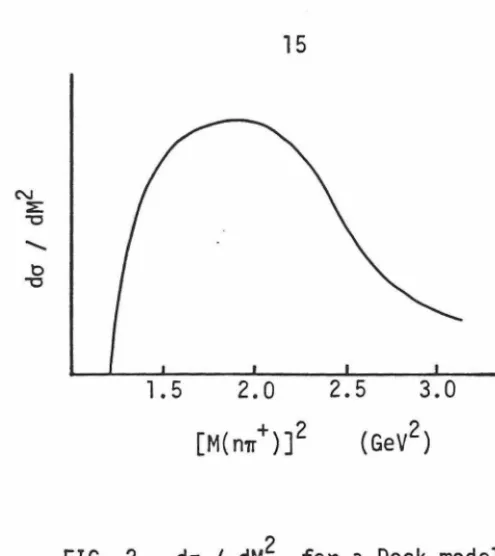
resonance fonnation in the CD system. We illustrate this in Figure 2
using do/dM2 for a particular Deck model fitted to data of the reaction
+
15
2.5 3.0
(GeV2)
FIG. 2. do/ dM2 for a Deck model.
I.4
Experimentally the do/dM for the diffractive dissociation of any
incident hadron, n , K, or nucleon, exhibits a threshold enhancement
(A
1, Q, or U*). Deck models tend, however, to overestimate its width.
The Deck mechanism also predicts the distribution in the variable
t(BB') [Oh and Walker 1969]. In a fit of the cross section to the form
exp[-b(M)t(BB')]
the expected result is a b(M) which decreases dramatically with
increasing M in the regime just above threshold.
From the t-channel viewpoint (preceding section) the Deck
mechanism is just a special case in which the Pomeron exchange mediates
the BD elastic scattering. By adding details of the dynamics at the
16 1.4
is not an intrinsic part of Pomeron phenomenology,
5. Some Published Data at Very High Energy
We do not undertake in this sec ti on a general review of the ·
experimental work on diffractive dissociation. Several such reviews are
available [Derrick 1975, Miettinen 1975, Leith 1974, Gramenitskii and
Novak 1974, and works they reference]. We merely want to point to four
recent published experiments which demonstrate dissociation of the
nucleon into exclusive channels at 20 GeV/c to 1000 GeV/c equivalent
beam momentum. All four experiments used electronic detection methods.
The first group [O'Brien et al. 1974] studied the reactions
n C -+ p 1r C
n Cu -+ p 1r Cu .
( 5. l}
(5.2)
The spectrum of their neutron beam peaked at 25 GeV/c and was 8 GeV/c
wide (FWHM). We reproduce some of their results in Figure 3. The
most noteworthy feature of this data is that none of the well established
N* resonances appear as obvious peaks.
The second experiment [Edelstein et al. 1977] obtained data for
the reactions
+
-pZ+p7r 'IT Z (5.3)
500
~
400
..
..,..
0 0300
~ .._
..
..
c:..
>200
w
JOO
l
°tos
-
---...
1470
i
...
...
1.2
L4
...
Carbon 0. 0<11'1
<O. 04 IGeVlcl 2 P1pn-1 > 20 Ge Vic
168S
l
Accept once ... ... ...
___
_
l6 LS C•V M(p1r-) for carbon• u c:
50
~ a.
..
u u ~25 Coherl'nt production cross section versus !ti (pir-)
240 2(11)
>
160
., Cl 0 ~
120
"' c ., ,. w
80 40 0
LZ l4 M(pir-) for copper Target 1.078 <M(pir-)< l.S GcV 1.4 < M(p,,-)< 1.6 GeV 1.5<M(p,,-)<1.8 GeV
c Cu
1.00 t 0.27 mb 0.37 t 0.13 mb 0.23 t 0.07 mb 2.27 t 0.47 mb 0.73 t 0.19 mb 0.36 t 0.16 mb FIG. 3. Figures and table from O'Brien et al. [1974].
Copper 0. 00
< lt'I < 0. 02 IGeV/cJ2 Ptpn-I > 20 GeVlt GtV
15 001~
r
·oo
12001
9 00]I
:. 6 00~
~
~ 50l
3 0 0 ~,__ ~ ~~~~ ~~ ~~~~~o 1 . 35 I 5 0 1 . 65 I 8 0 I 95 2 10 Mau ( p,.,• .• -)f G tV) Unc o rrected p1T+1T· mass spectrum for p +C -p1T+1T· +Cat 22.5 GeV with -t' < 0.04 (Gev/cl 2• Geo-metrical acceptance o f the spectrometer vs mass ls su-perimposed. FIG. 4. Figure from Edelstein et al. [1977]. ~ 35 0 '-' 2J11
0 . 1, -14 0 . 6 Go v 'N 0 0
6
7
3
1
'"'"''
' ~ c
210
..
>..
·::
1
~
I:
~
0 ~
..
uE
c
,
0
z
~ u u
..
1 .2 1 .4 1 .6 1. 8 2-0 2-2 2" 2 . 6 . 28 3 . 0 M ( p .... " -l (GtV I + -Experimental distribution in #(pw w ) for 0.1 S -t ~ 0.6 GeV 2 • The smooth curve is the acceptance.
_, 00
FIG. 5. Figure fro m Webb et al. [1976].
1200
I
(a>
900 6001
(
4\__
300 -~ -1.-2 1.4 1.6 1.8 900 I (b) _,,.rf[
5~
600 I 300 I 1.2 1.4 1.6 1.8 900I
(c)/ii\~
600! 300
I
r
1.2 1.4 1.6 1.8 (GeVl MASS p-rr-Mass spectra of prr-pairs In hydrogen, Inte-grated over a 50-300 GeV le neutron momentum band, displayed as a function oft . (a), (b), and (c) corre-spond to It I bands of 0.02-0.08, 0.08-0 . 20, and 0.20-1.00 Ge V 2, respectively.a
:0 ::1..
60
~ z 0 ~
40
u w (/) (/)
20
(/) 0 a: u
o
1.35<M<l.45
•
1.25<M<
1.35
-+-r+~
·+~100 200 300 NEUTRON MOMENTUM (GeV/c) Energy dependence of the cross section for two low-mass intervals. Data are shown Integrated over O .02 <It I< 1.0 Ge V 2 • The absolute normalization Is uncertain by about :i 20%
.
b
FIG . 6. Figures from Biel et al. [1976].
20 I.5
momentum was 22.5 GeV/c. In Figure 4 we show their p TI + -TI mass spectrum for the carbon data. Peaks are evident at about 1.4 GeV and
1.68 GeV. Whereas the lower peak could as well be a kinematic enhancement
(see the preceding section), the upper peak is more suggestive of a
resonance.
The reaction
n p ~ p TI p (5.4)
was the subject of the third experiment [Biel et al. 1976]. The neutrons
delivered by a neutral beam at Fennilab had momenta in the range 50-300
GeV/c. In Figure 6 we reproduce the pn- mass spectrum and the cross section as a function of neutron momentum. The mass spectrum suggests
some resonance production in the vicinity of 1.65 GeV. Figure 6b
shows that the energy dependence of the cross section is indeed as
expected for a diffractive process.
Our final example is an experiment conducted at the CERN-ISR
[Webb et al. 1975] to study the reaction
(5.5)
The momenta of the colliding beams were both 22 GeV/c which is equivalent
to a beam momentum of 1000 GeV/c for a fixed target experiment. The
mass spectrum obtained appears in Figure 5 • This spectrum suggests
21 I.5
experiment on nuclei (see Figure 4 ). The relative dearth of events
at the low mass end is most likely an artifact of the t selection, The
Fermilab data (Figure 6 ) shows how sensitive the mass spectrum can be
to the t cut. Much of the reaction (5.5) cross section corresponds to
!ti < 0.1 which is the lower limit of the ISR data. To estimate this
cross section including the unobserved small !ti region, Webb et al.
extrapolated their observed t distributions to t
=
0. Their resultis 0.33 ± 0.1 mb at Plab
=
1000 GeV/c and 0.34 ± 0.1 mb atPlab
=
1500 GeV/c. The absence of strong energy dependence characterizesthe process as diffractive.
Taken together these four experiments show that, at high energy,
nucleons dissociate into exclusive channels with cross sections of the
order of 200 µb and that the cross sections are roughly independent of
energy. Three of them suggest that a small part of the cross section
is attributable to resonance production.
6. Intent of the Present Experiment
Prior to the proposal of this experiment, missing mass
measure-ments [Belletini et al. 1965, Anderson et al. 1966, Foley et al. 1967]
had provided large sample mass distributions and differential cross
sections for nucleon diffractive dissociation. Peaks in the mass spectra
suggested resonance production but could reveal nothing about their decay.
More information was necessary to confront several questions. l) How
much of diffractive dissociation was ascribable to resonance production
22 I.6
produce? 3) Did their production angular distributions have forward
dips? 4) What was the status of the Gribov-Morrison and the helicity
conservation rules? Attacks on these questions required studies of the
angular distributions and correlations of the dissociation products.
For this kind of work the superior 4TI detection efficiency of a
bubble chamber is a considerable advantage, but the individual exposures
then available were not large enough. The objective of the present
experiment was a manyfold increase in the number of photographs of
proton diffractive dissociation.
We pursued this objective by means of a synergistic combination
of spark chamber and bubble chamber techniques. In the traditional mode
of operation bubble chambers produced a picture of every beam pulse
regardless of what sort of events occurred. This mode was not an
economical way to obtain a large sample of a particular channel which
was but a small fraction of the total cross section. The dissociation
channels p + p TI 0 , p + n TI + , and p + p TI + -TI represent about 5%
of a total cross section of 26 mb for TI- p interactions at 14 GeV.
We partially remedied the slectivity problem of the bubble chamber by
augmenting it downstream with a wire spark chamber spectrometer. The
spectrometer discriminated proton diffractive dissociation events both
from elastic scatters and, by its limited acceptance, from much of the
rest of the inelastic cross section. The bubble chamber camera produced
a picture only on pulses for which the spectrometer indicated the
23 I.6 By these means we collected film containing about 45 events/µb for the part of the cross section that we wished to investigate. What we achieved was about one half of our original goal, Chapters II and III document our methods, and in Chapter IV we present some analyses of the
- - +
TI TI TI p final state.
Before ·proceeding we issue one caveat. From the point of view of the absorption mechanism (Section I.l) our beam momentum is uncomfortably low. The inequality (l ,13) has the form f(M*)/P << 1. Below
we graph f(M*) and compare it with 14 GeV/c, the highest beam momentum available to the experiment. That the graphs cross at a comparatively low value of M* is certainly unfavorable. This situation is not directly relevant to our own analyses because in Chapter IV we do not explicitly treat our final state as a consequence of absorption.
20
-
15 Our beam>
cu ..._momentum<.!)
--
10*
~-
-
50
1.0 1.5 2.0 25
24
II. EXPERIMENTAL APPARATUS
l. Overview
The major components of the apparatus were the 4011
hydrogen
bubble chamber at the Stanford Linear Accelerator Center (SLAG), a large
aperture magnetic spectrometer installed downstream of the bubble
chamber, a beam line to deliver n- mesons from the primary target, and
a Xerox Sigma 2 computer. Briefly these components functioned together
as follows. Prior to delivery of a beam pulse the bubble chamber began
its expansion, and the cycle followed its normal course regardless of
the scattering of any beam particles. The computer controlled only the
bubble chamber camera. On most pulses the film remained unexposed. If
an appropriate interaction did occur, some scintillation counters
detected the forward scattered particle and triggered the wire spark
chambers of the spectrometer. The spark chamber electronics digitized
the spark positions and transferred this infonnation to the computer.
During the time required for bubbles to develop in the chamber, the
computer analyzed the spark data to ascertain the momentum of the
forward scattered track. If this momentum was within a preselected
range, the computer signaled the bubble chamber camera to expose the
film. Whenever the computer received spark digitizations it recorded
them on magnetic tape.
In the rest of this chapter we describe the apparatus and the
25 II. 2
2. The Secondary Beam Line
The SLAC accelerator delivered an intense beam of 19 GeV
electrons to a 30 cm beryllium wire target. The function of the beam
line was to fonn from the secondary emission of the target a low
intensity 14 GeV TI- beam and transport it to the bubble chamber. In
Figure 7 we show a schematic of the secondary beam line. It
collected particles emerging at 17 mrad from the primary beam direction
and had an aperture of about 50 µsr. The beam line had two points
which were foci in both the horizontal and vertical planes. At the
first focus the beam passed through 1.1 radiation lengths of lead to
degrade the momentum of the electron component. Final momentum
defi-nition occurred at a one meter iron slit at the second focus. The last
leg of the beam line gave the beam a ribbon like confonnation at the
bubble chamber. The quadrupoles made the beam parallel in the vertical
plane and focussed at the bubble chamber in the horizontal plane. The
optical axis of the bubble chamber camera was horizontal, so the camera
viewed the broad dimension of the beam. The dipole magnets in the last
leg steered the beam to the correct position and angle for passage
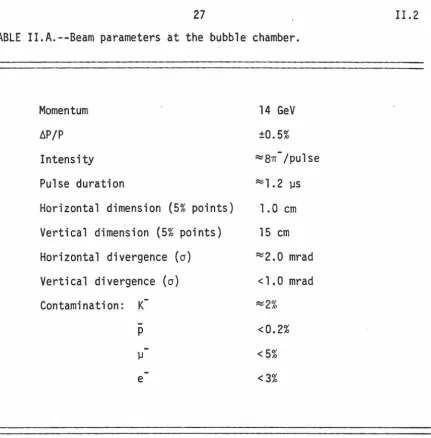
through the bubble chamber and spectrometer. In Table II.A we give
the characteristics of the beam at the bubble chamber. The infonnation
on contamination from K-,
p,
andµ- comes from Boyarski et al.[1968]. The infonnation on e contamination comes from our own
measurement with a shower counter. The method ultimately used to
l m Fe slit Legend: C, collimator 0, dipole magnet F, focus Q, quadrupole magnet TC, primary target 30 cm Be wire
I20
cm TC31 • ~~
e beam, 19 GeV FIG. 7. Elevation view of the secondary beam line. The function of this beam line was to form a 14 GeV/c n-beam and transport it to the bubble chamber. All major bends were in the -vertical plane. The field strengths in the horizontal trim magnets 00.5, 02.1, and 03.l were nominally zero.27
TABLE II.A.--Beam parameters at the bubble chamber.
Momentum
t:.P/P
Intensity
Pulse duration
Horizontal dimension (5% points)
Vertical dimension (5% points)
Horizontal divergence (o)
Vertical divergence (o)
Contamination:
K
-p
µ
e
3. The Bubble Chamber
14 GeV ±0.5%
~87T-/pulse
~1. 2 µs
1. 0 cm
15 cm
~2.0 mrad
< l. 0 mrad
~2%
<0.2%
<5%
<3%
II.2
The chamber was a cylinder of diameter 110 cm and depth 45 cm
in a magnetic field of 27 kG. Its axis was horizontal and transverse
to the beam direction. The camera provided three views of the chamber
from a position 200 cm along the chamber axis from the beam. The lens
centers were at the vertices of a 70 cm equilateral triangle, and
28 II.3
The chamber had two features, not colllTlon to most other bubble
chambers, which particularly suited it to this experiment. One was its
beam exit windows, and the other was its capability for rapid cycling.
In addition to the usual thin windows on the entrance side, this
chamber had 20 cm diameter thin windows on the exit side.t Material
intervening between the hydrogen and the spectrometer has two adverse
effects. It scatters beam particles into the sensitive region of the
spectrometer causing unwanted triggers, and it degrades the spectrometer
angle measurement of tracks scattered in the hydrogen. The interaction
rate in the windows was equivalent to the rate in 18 cm of liquid
hydrogen, and multiple scattering in the exit windows corresponded to
multiple scattering in 94 cm of hydrogen. The thin windows were a
prerequisite to the successful ooeration of the spectrometer.
The SLAC accelerator normally generates 360 pulses of electrons
each second, so it can supply beam to a bubble chamber as rapidly as
the chamber can pulse. The repetition rate of the chamber is therefore
the limiting factor in the data rate. At the outset of data taking
the 40" chamber operated at two expansions/sec, and at the conclusion
a rate of five expansions/sec was achievable. The overall result was
that the experiment logged 7xl06 expansions in ten weeks of data
accumulation (including down time), an average of one expansion/sec.
29 II. 3
The bubble chamber, while well suited to the accelerator and
to this experiment, also imposed the chief constraint on the trigger
apparatus. The chamber begins its expansion about 10 msec prior to
arrival of the beam particles. By beam time the liquid hydrogen is
close to the minimum in the pressure curve. Growth of bubbles then
requires about 3 msec. At the end of this interval high intensity
lamps flash to expose the film. The chamber returns to its equilibrium
state in 20 msec and then idles pending the arrival of the next beam
pulse. The triggerable part of this process is the flash of the high
intensi'ty lamps. The time available to the trigger mechanism to reach
a decision is the 3 msec bubble growth time.
4. The Spectrometer
A novel aspect of this experiment was the operation of a
spectrometer in conjunction with the bubble chamber. By measuring the
momentum of fast forward secondaries, the spectrometer together with the
Sigma 2 computer contributed in two ways, both of them indispensable
to the overall success of the experiment. First, it triggered the
bubble chamber flash tubes when it detected a forward track with
momentum in the desired range. Second, the spectrometer measurement
of momentum was far more precise than the corresponding bubble chamber
measurement. The increased precision is most important for reactions
containing a.single neutral particle in the final state. It reduces
ambiguity in the identification of these events to a tolerable
B3 J
BUBBLE CHAMBER
I
BEAM
}o
cm
t-r-;ni
-t---x
BC
MAGNET COILS
z (.\ " " " vY:: z xx YZl,2 I UVl,2
Ll
t
40
048
MAGNET
YZ3,4
I
YZ5,6
11
3
YZ9,10
l
--
--
----~---~j---)-
--
-~~=~-
-
--~-~-~rad
BCCAMERA
i
1 Rlt
t
1
··-t
1 2 4 f YZ7 ,8 .._ __ __.__ __ _..._STATIONS----FIG. 8. Plan view of the spectrometer. YZl-YZlO and UVl,2 are wire spark chambers. 83, Rl, Ll, R3, and L3 are scintillation detectors..i::-31 II.4
We describe the spectrometer with the assistance of Figure 8.
It consisted of a dipole magnet, wire spark chambers to measure
particle trajectories upstream and downstream of the magnet, and
scintillation counters for triggering. We give the relevant parameters
of the magnet in Table II.B.
TABLE II.B.--Parameters of the spectrometer magnet.
Horizontal aperture (z) 102 cm
Vertical aperture (y) 38 cm
Field strength 28 kG-m
Sextupole coefficient l.lxlo- 5 cm- 2
Bend angle of 14 GeV particles 62 mrad
Rl, Ll, R3, and L3 are labels of plastic scintillation counters.
The scintillator dimensions, horizontal (z) first, were 20 cm x 24 cm
at station 1 and 46 cm x 43 cm at station 3. Unscattered beam
particles passed through a 2.5 cm horizontal separation between Rl and
Ll and a 5.6 cm separation between R3 and L3. A coincidence of one of
Rl and Ll with one of R3 and L3 indicated that a scattered particle
had passed through the spectrometer magnet.
This coincidence produced a trigger for the twelve wire spark
32 II.4
at four locations designated station 1 through station 4. At station 1
adjacent to the yoke of the bubble chamber magnet were both a YZ pair
and the UV pair. Station 4 required two YZ pairs, one on each side of
the beam. Pairing the chambers ensured a high efficiency for the
detection of at least one spark at each station. The efficiency of
individual chambers ranged from 90% to 99%. All chambers were of the
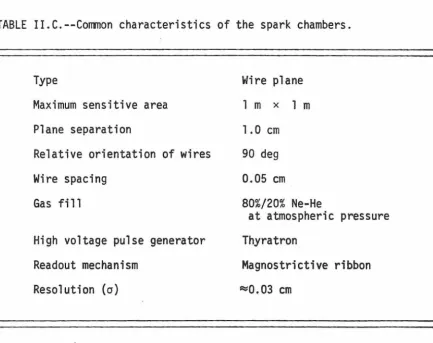
same physical size and the same basic design. We give their corrmon
characteristics in Table II.C.
TABLE II.C.--Co11TOon characteristics of the spark chambers.
Type
Maximum sensitive area
Plane separation
Relative orientation of wires
Wire spacing
Gas fill
High voltage pulse generator
Readout mechanism
Resolution (a)
Wire plane
l m x l m
1.0 cm
90 deg
0.05 cm
80%/20% Ne-He
at atmospheric pressure
Thyratron
Magnostrictive ribbon
~0.03 cm
To minimize the eccurrence of extraneous sparks in the chambers we
33 II.4
chamber and the spectrometer magnet. We simply severed the connection
of chamber wires with their bus bar. By the same technique we deadened
vertical bands through which the beam traversed the YZ chambers at
stations 1, 2, and 3. At station 4 the beam traversed a gap between
chamber pairs YZ7,8 and YZ9,10. To deaden the beam-illuminated area
of the UV chambers we inserted slabs of polyurethane foam between the
wire planes.
The physically relevant parameters of a forward scattered
track are its momentum and the scattering angle. For fixed values of
only these parameters some trajectories successfully negotiate the
spectrometer while others miss an aperture or traverse the dead region
at one of the stations. The resulting detection probability depends
heavily both on the momentum and the scattering angle, and we must
account for it in the analysis of the data. We discuss this issue in
detail in Section IV.5.
The most important measurement which the spectrometer supplied
was the bend angle in the magnet. The resolution (cr) for this
measure-ment was 0.25 mrad. The contributions from position error of the spark
chambers and from multiple scattering in the chambers and intervening
material were nearly equal. The relation of momentum to bend angle is
p
14 GeV
=
62 mrade
From this follows the relation for the error of the momentum.
34 II.4
6P
=
p2 6814 GeV 62 mrad
(4.2)
=
P2 x 2.9 x l0-4 Gev- 1 6P is ~60 MeV at 14 GeV and ~30 MeV at 10 GeV. 5. Triggering and the Role of the Online ComputerThe logic equation for the spark chamber trigger signal was
SCTRIG
=
GATE•(Rl + Ll)•(R3 + L3) (5.1)The factor GATE was true for the duration of every beam pulse. The
SCTRIG signal was fanned out to the high voltage pulse circuits at
each chamber. Because of cable delays and the rise time of the HV
pulsers, sparks developed roughly 0.4 µsec after the triggering particle
traversed the spectrometer. The memory time of the chambers easily
acco1T111odated this delay. Because of the delay, however, and because the
beam 11
spill11
was so short, a second track was sometimes observable in
the spark chambers.
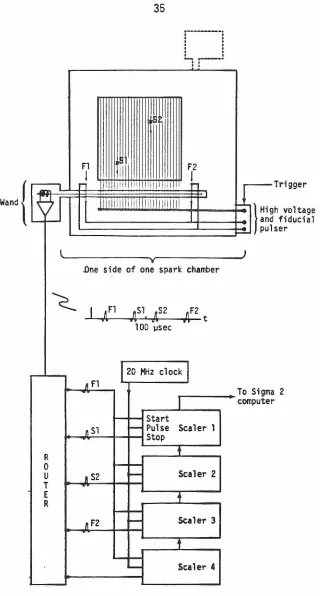
Figure 9 shows schematically the electronics used to
digitize spark coordinates. We use the term "wand" to refer to a
magnetostrictive ribbon, its mechanical support, the pickup coil, and
integral preamp. Near the ends of each wand at precisely known
loca-tions on the chambers were fiducial wires. Synchronously with the
I
-9
-~
l
<_
R 0
u T
E
R
35
J~
Fl
1111
I
,... lii!ll!I i:1 .I 1 .!il!li I
lll!illii!iiii i!!lll!lilllll
v
·
-
-··
.
t.
I.
t.
It I
I I
t I
-.. t
---
I-
·
t I
F2
I
-I
.One side of one spark chamber
I {l
"' ;.s1. 100 J.5µsec 2 '"
l
2
tA Fl
I
20 MHz clockI
~-I
Start
n Sl
-
Pulse Scaler 1 Stop'
ft S2
-
Scaler 2t
II F2
-
Scaler 3t
-
Scaler 4~
and~. pul
J
Trigger
h voltage fiducial ser
To Sigm compute
a 2
r
II. 5
FIG. 9. Schematic of the spark digitizing electronics. Fl and F2 are
36 11.5
initiated acoustic pulses in the magnetostrictive ribbon. Because the
acoustic pulse propagates along the ribbon with uniform velocity, the
position of the source of a pulse corresponds to a time of arrival at
the pickup coil. The first fiducial pulse from a wand started four
20 MHz 12 bit scalers associated with that wand. Succeeding pulses
stopped the scalers one by one. The last one to stop digitized the
time of arrival of the second fiducial except on occasion when a
chamber produced more than three sparks. The computer maintained a
running average of the digitizations obtained for the fiducial, and
this average established the effective propagation velocity in the
magnetostrictive ribbon.
We developed computer codes for the online Sigma 2 computer to
perform three primary tasks. One was to fetch the spark coordinates
from the spark chamber electronics and to record these on magnetic
tape. A second was to do some minimal analysis of the data to ensure
that the spectrometer was functioning satisfactorily. The third task,
and the most noteworthy, was to select pulses on which to trigger the
bubble chamber flash tubes. The design of this algorithm required
great care so as to satisfy the 3 msec time constraint.t
The trigger algorithm deals with the reaction
(5.2)
37 II.5
The system X includes one nucleon and an arbitrary number of mesons.
The primary objective is to generate a trigger when X includes at
least one pion. The cross section for elastic scattering is about a
factor of three larger than the cross section for the dissociation·
reactions which we seek to study. An algorithm must identify elastics
with efficiency greater than 93% in order that contamination of the
triggers be less than 20%.
We use the notation Mp' Mx for the masses of the proton and
X, and we use Pb and Pf for the magnitude in the lab frame of the
momenta of the beam particle, nb , and the secondary particle measured
in the spectrometer, nf • Neither of these momenta is ever less
than 6.5 GeV. For this discussion we can safely approximate the energies
of the pions by their momenta. Conservation of 4-momentum in the
reaction yields an expression for M; •
with t the square of the 4-momentum transfer from nb to nf An
adequate approximation for t is
¢y and ¢z are the vertical and horizontal projections of the
scattering angle.t
tProjecting an angle in this way is also an approximation which is satisfactory for our scattering angles of ~ 60 mrad.
38
We determine Pf from its bend angle in the spectrometer
according to the relation
11.5
{5.5)
The right hand side is the integral of the y component of the magnetic
field over the trajectory through the spectrometer magnet. We can
approximate this integral by the sum of the dipole term and a sextupole
term.
{5.6)
P
0 is the design momentum of the beam, and e0 is the bend angle of
an on-axis pion with this momentum. The quantities dz and dy are
the horizontal and vertical displacements of the trajectory from the
x axis of the magnet. The coefficient b is positive with magnitude
about l.lxl0- 5 cm-2 for the magnet. In analogy with the angle ef we
may define the angle eb which is the bend angle that the spectrometer
would measure for a beam track.
{5.7)
39 II.5 the average, eb , by using a small dipole magnet upstream of the bubble
chamber to steer the beam, at reduced intensity, into the active area
of the spark chambers.
We now combine relations (5.3)-(5.7) to obtain
- d2) p p ( 2 + 2)
y - b f ¢y ¢z
{5.8)
In a loose approximation which ignores the dimensions of the beam and
the bubble chamber we can write
(5.9)
xM is the distance from the bubble chamber to the spectrometer magnet.
Using relations
(5.9)
in a rearrangement of equation(5.8)
we have(5.10)
wherein
Cy
=
2 MpbxM - Pb 2=
-4 GeV (5.11)c
t.
=
2Mpbx~
+ Pb=
24 GeV . (5.12)40 II.5
the z coordinates of the sparks. This information is sufficient to
compute only the first and second terms on the right hand side of
equation (5.10). The second term may be as large as 1.0 Gev2, and
neglecting it in the trigger·program would have resulted in too much
contamination from elastic scatters. Because of the dimensions of the
magnet aperture, the maximum value of ¢y is about one half the
maximum of ¢z . On this account and because ICyl << ICzl , the third
term in equation (5.10) is
~0.08
GeV2 • Since the threshold inM~
-M~
for single pion production is 0.28 GeV2 , neglect of thethird term in the trigger creates no difficulties.
In Appendix A we describe in detail the steps taken by the
trigger program to identify tracks corresponding to inelastic events.
In Figure 10 we show a histogram of the time required for the trigger
program to reach a decision. For a small fraction of the spark chamber
triggers,the trigger program required more than 3 msec to conclude.
In these cases if the program called for a picture, the picture was
lost. In Table II.D we give statistics of the data acquisition and
L{")
C\1
0
a::; w
0..
a::; w
CD
:E
:::::>
z
1000
500
41
TIME TO TRIGGER DECISION
5720 ENTRIES
~3%
o lateOL-~-'-~---1~.J___._~__L~~-L-~_J_~~t=:::::l 0
r
Beam Data in
l
computer
2
TIME IN MSEC
3
f XBL 774-8563
Light flash time
FIG: 10. Distribution of the time required for the trigger program to reach its decision.
TABLE II.D.--Statistics of data collection. Number As a fraction of acquired Beam pulses SC triggers BC pictures BC events Beam pulses 5.5xl0 6 Spark chamber triggers 2.5xl0 6 0.45 BC picture triggers 3.2x10 5 0.058 0.13 Pictures lost because 1. Ox10 4 of late trigger 0.002 0.004 0.03
~ N
BC triggers on events l. lx10 5 in fiducial volume 0.020 0.044 0.34 BC triggers on 2.8xl0 4 elastic scatters 0.0051 0.011 0.088 0.25 BC triggers on 4.9xl0 4 inelastic two prongs 0.0089 0.020 0.15 0.45 BC triggers on 3. 5xl0 4 four prongs 0.0064 0.014 0.11 0.32 BC triggers on
-+ 1. 7xl0 4 0.0031 0.0068 0.053 0.15 np-+nnnp43
II I. PROCESS ING
1. Overview
We describe in this _chapter the metamorphosis of the data from
its original state to a form convenient for study of its physics, For
75% of the film all processing took place at Lawrence Berkeley
Labora-tory. For the remaining 25% Caltech carried out the scanning and
measuring on systems quite different from the LBL apparatus. In this
report we will describe only the LBL processing, and we will use only
LBL processed data in the analysis of the next chapter.
In Figure 11 we show schematically the major processes and
trace the flow of information from one to another. The figure is only
illustrative since large segments of the film received treatment which
varied in some respect from what is shown. For example some rolls did
not undergo filtering, and the measurement of other rolls was
exclu-sively via COB\1EB. In the last section of the chapter we discuss one
of the tests that we made to verify correct operation of the processes
from measurement through fitting.
2. Processing of the Spark Chamber Data
Our raw spark chamber data for an event consisted of groups of
spark digitizations associated with each coordinate of each chamber.
A computer code which we built and named TORTIS reorganized the
digi-tizations into "track banks." The collection of sparks forming a track
bank defined a trajectory which a charged particle could have followed
44
0
Bubble chamber film recorded on magnetic tape Spectrometer data
Scanning
Filtering (SCMATCH)
FSD measurement
COBWEB measurement
Track finding
- - - 1 (TORTIS)
Geometrical
reconstruction 1 - - - - .
(TVGP)
Hybridization (HYBRID)
Kinematic fitting {SQUAW)
I I
r---1----~,
I
Event selectionI
1 and analysis for I
I
individual channelsI
L _ ...!
III.2
45
track banks for each event, and it permitted each digitization to
appear in an arbitrary number of banks. The TORTIS algorithm went
roughly as follows. (y and z are defined in Figure 8.)
III.2
1) Merge the sparks of adjacent chambers into station banks
and remove redundant sparks.
2) Find all sets of four z coordinates, one from each
station, for which the lines defined by the station 1,2 pair and the
station 3,4 pair intersect at the midplane of the spectrometer magnet.
A separation of the lines at the midplane of less than 0.3 cm satisfies
this condition.
3) Analogously find sets of four y coordinates, one from
each station, but additionally require that the angle between the lines
be less than 2.5 mrad. The tolerance on this angle accormnodates the
bend in the vertical plane caused by the fringe field of the
spectro-meter magnet.
4) Pair each set of y coordinates with each set of z
coordinates. When the UV chambers at station l contain digitizations
consistent with the y,z position, fonn a track bank. In the case that
steps 2 and 3 result in just one z coordinate set and one y set,
fonn the track bank regardless of the UV chamber output.
The tolerances used in TORTIS were liberal enough that the
algorithms did not add significantly to the inefficiency of the spark
chambers themselves. Considering only those beam pulses which generated
a BC camera trigger, the TORTIS efficiency was at least 95%. The
precise value is unimportant because it does not enter in the method
46
created by TORTIS were available to the filter and hybridization
processes which we describe in succeeding sections.
3. Scanning and Filtering
III.2
Bona fide events occurring within the fiducial volume of the
bubble chamber (70 cm in length) account for only 35% of the BC camera
triggers. The balance are ascribable to events occurring in hydrogen
outside the fiducial volume (58 cm, much of which was invisible), to
events occurring in the beam entrance and exit windows (equivalent to
18 cm of H2), and to decays of beam particles in the last several meters of beam preceding the station 1 spark chambers. A typical roll
of film of 1000 frame~ containing ~50 bona fide events, contains in
addition ::::::350 events within the fiducial volume which are not trigger
associated and do not match a track in the spectrometer. Measurement
of these interlopers is unproductive, so we devised a scanning process
which substantially reduced this burden.
Our scanners worked at scan tables equipped wih an image plane
digitizing arm electronically interfaced to a magnetic tape drive. When
they located an event, they digitized one fiducial and the vertex of
the event in one view only. By the touch of a button the scanner
recorded the roll and frame numbers, the event type, and the
digitiza-tions. We used this procedure to locate all events except those with
kinks or V's resulting from the production and decay of strange particles.
The scan output and the TORTIS output were the input to a
47 III.3
code projected each of the spectrometer tracks back to the x
coordi-nate of the event's vertex. When the y coordicoordi-nate of the vertex was
within 1.8 cm of one of the projections, the code flagged the event for
measurement. We adopted the generous 1.8 cm tolerance rather than take
pains to optimize this process. The output per 1000 frames contained
all trigger associated events and ~go interlopers. The 25% extra measurement burden was acceptable.
4. Measuring
We utilized two independent systems for measuring the events.
One was a flying spot digitizer, FSD (known in some quarters as a
Hough-Powel l device, HPD) under the control of an IBM 7094 computer [White et
al. 1968]. Its mode of operation was fully and exclusively automatic;
it had no provision for operator assistance in the measurement process.
We will give no further details of this system.
The second system, called COBWEB [Albrecht et al. 1968],
con-sisted of several film plane digitizing engines. known as Frankensteins,
interfaced to an IBM 7044 computer. The control electronics of the
Frankensteins made them "semiautomatic." The reticle of the device is
an orientable slit. So long as the operator maintains the axis of
the slit within 6° of the tangent to a track, the electronics will
drive the stage so that the track passes precisely through the center
of the reticle. The machine can automatically digitize at intervals
along the track while the stage is in motion. Completely manual control
48 III.4
regions of confusion or obstruction of a track. The computer as well
as the operator can control stage position and frame advance, and the
computer intervenes where possible to speed the measurement process.
The FSD system was the first to process each roll. It produced
measurements for about 45% of the events on the measurement list. We
then directed the COBWEB system to measure those events (55%) on which
the FSD system failed. The output of either system was a magnetic tape
record containing up to twenty pairs of film plane digitizations for
each view of each track.
5. Geometrical Reconstruction
The input to the process which we call reconstruction is the
output of the measuring systems just described. Its function is to
produce a five parameter description of each track and the 5x5 error
matrix for the parameters, Specifically, in the coordinate system of
Figure 8 , the parameters are the polar and azimuthal angles and
the curvature at the beginning of the track, and the polar and azimuthal
angles at the end of the track. The computer code which we utilized for
reconstruction was TVGP (Three View Geometry Program) [Solmitz et al.
1966]. This code has seen prior use in many experiments and with
several different bubble chambers and measurement systems. Its
archi-tecture facilitates adaptation to a particular bubble chamber, and we
had only to ~evelop the necessary modifications for the SLAC 40"
chamber.
49 III.5
mass as well as momentum because of energy loss by ionization, dE/dx.
TVGP obligingly allows for a number of different mass interpretations
of each track. For negative tracks we obtained only a w-
interpreta-tion, and for positive tracks we obtained the TI+ and proton
interpre-tations. We omitted K~ and K+ interpretations and other more
esoteric possibilities in favor of savings in computer charges.
6. Hybridizatton
We built a computer code, HYBRID, which amalga
![Figure 4. FIG. al. et [1977].](https://thumb-us.123doks.com/thumbv2/123dok_us/1126827.1141542/23.787.90.457.54.685/figure-fig-al-et.webp)